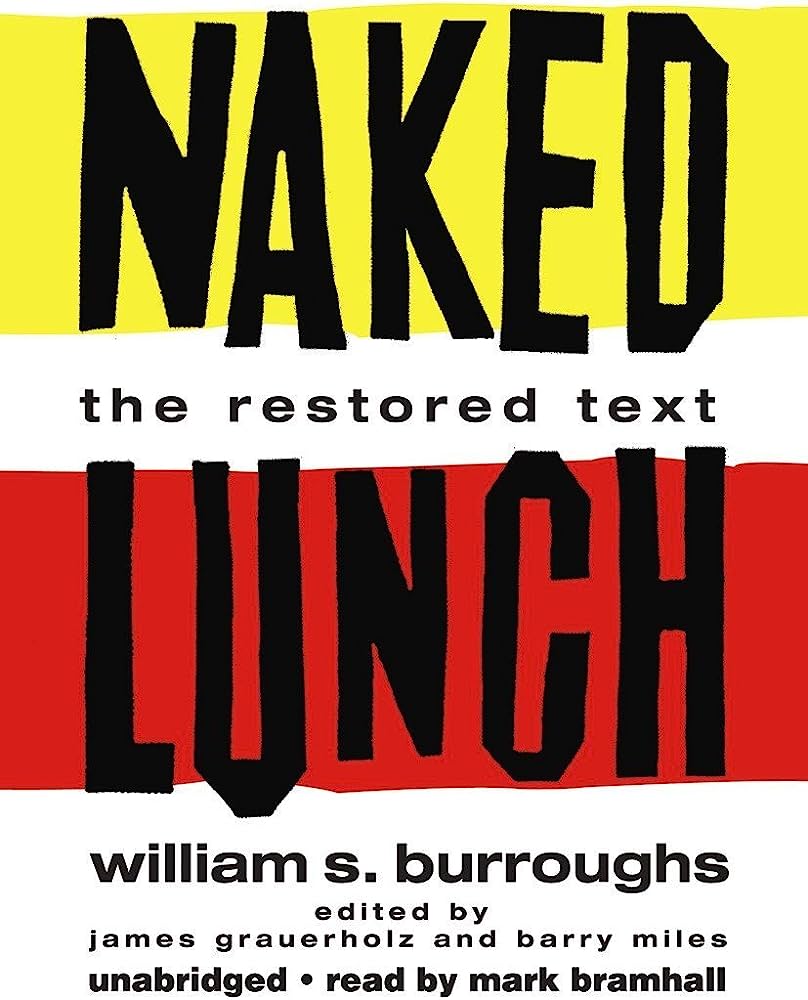
A review of Naked Lunch, by William S. Burroughs.
Planned writing is kind of weird. In terms of workflow, any writer out there will tell you that the way to do things, the way to beat writer’s block, get kickstarted, etc. is to just write. I don’t disagree, of course, it’s just that the robot which runs our existence, Mr. The Economy, and its various amalgamated, algorithmic henchmen tend to prefer a few more control measures around the content. They want you to write the specific things that fulfill demand. In my fiction writing (pre-editing, anyway), I usually have most of the freedom I need to take the conventional approach. On the other hand, my reading list, the review content I synthesize thereof, and the sOcIaL mEdIa PrEsEnCe it feeds, well, those all need planning. Cadence matters to y’all (or so say my webpage stats), so it must matter to me.
Anyway, the next book I had put on my list was Naked Lunch. I am not “ready” to write this review; the book is still worming its way through my brain; the extent to which I “get it” is not much farther than a certainty that there is something to get (skeptical readers: I promise you there is). It honestly feels something like the congealing protoplasm of one of Burroughs’ junk highs–gobbets of meaning sloughed off of reality, free-floating despite their truant obligation to be connected. Burroughs himself helpfully reaches up and jigsaws some of the slime via postscripts and afterwords: this book is about the twisted economy of opiate addiction. This book is about countercultural homosexuality. This book is about capital punishment and the violence of invasive government. Beyond that, based on secondhand accounts and editors notes, it seems like even the author was somewhat confused about what Naked Lunch really was. It makes one feel better at least.
The book comes out swinging hard:
“I can feel the heat closing in, feel them out there, making their moves, setting up their devil doll stool pigeons, crooning over my spoon and dropper I throw away at Washington Square Station, vault a turnstile and two flights down the iron stairs, catch an uptown A train…Young, good looking, crew cut, Ivy League, advertising exec type fruit holds the door back for me. I am evidently his idea of a character. You know the type: comes on with the bartenders and cab drivers, talking about right hooks and the Dodgers, calls the counterman at Nedick’s by his first name. A real asshole. And right on time this narcotics dick in a white trench coat (imagine tailing someone in a white trench coat. Trying to pass as a fag I guess) hit the platform. I can hear the way he would say it holding my outfit in his left hand, right hand on his piece: ‘I think you dropped something, fella.’”
Yeah, so maybe you’re quick, but for most I expect the language hits like cold water. The Beat slang, the pace, the not-really-stream-of-consciousness–more stream of words–simultaneously inscrutable and frantically modern (despite being written when my grandparents were kids). I had to read it like three times. You get used to it. You have to, there’s a whole lot of book, and it’s all written at least as incoherently as that.
The book is nominally written in vignettes that can be read in any order. I’m not totally sure if that’s true, but the chronology is by no means definite. At the beginning, you can sort of settle into the makings of a narrative frame: You’re following Bill Lee, junky, dealer, all-around ne’er-do-well, as he flees west across the U.S., through Chicago, down into Mexico. Context is hazy, descriptions of places and people are weirdly transient, allusions to titled-but-nameless figures such as “The Vigilante” or “The Rube” abound, and you start getting the picture of a heavy–but amusingly unhinged–noir.
But the descriptions get more and more detached from reality. You encounter an anecdote of Bradley the Buyer, a cop who never actually does drugs but picks up a contact habit from the act of buying them in stings. One thing apparently leads to another, and he turns into an ectoplasmic monster and assimilates his commanding officer. Among other dubious accolades, Naked Lunch makes better use of the onomatopoeia “schlup” than any other in literature. Anyway, shortly thereafter, the continuity breaks with the introduction of the highly disturbing Dr. Benway, and the ensuing 50% of the book’s material can best be described as phantasmagoria.
What does that mean? Well. It means it’s a great melting pot of senseless violence and animal sexuality; monstrously disinterested cruelty; every racial, misogynist, and homophobic slur imaginable–and others besides, along with a collection of derogatives that would certainly be more offensive if anyone used them these days–and for whatever reason, more semen than would be appropriate in erotica of a similar length. “Um, was it worth it?” Fuck if I know, though I can’t really say I enjoyed reading it. I took two things from it, though: First, in its picture of “the Interzone”, it reflected some essence of the carnival nightmare of existence between cultural identities, something which Burroughs, a cultural public enemy in America who spent his life flitting between his home country, Mexico, Europe, and Morocco, must have understood deeply and darkly.
Second, well, a digression first: Burroughs states explicitly in an afterword that the more violent and allegedly pornographic sections of the book were intended as an indictment of capital punishment, a description that strikes me as…strategically incomplete. The role of the state in dehumanizing, immiserating, and, yes, killing its populace is certainly spotlit in these and other sections of Naked Lunch, but the vitriol of the phantasmagoria seems to me to be about much more than government. It feels almost like emesis, vomiting out a hideous concentration of cynicism, frustration, and fear which Burroughs might very reasonably have swallowed involuntarily in his fifteen-year journey as a junky and gay man in ‘40s/’50s America. But he doesn’t seem to be much for naked self-pity. Hence the form.
The book resolves to coherence again at about the 70% mark, where the madness of the Interzone gets grounded around a more meaningful description of its power players (A.J., Hassan, Fats “Terminal”, and the other Agents) and its political parties (Factualists, Liquefactionists, Divisionists, and Senders). The former comprise the closest thing the book has to traditional characters–real personalities with (admittedly hard to decipher) wants, collaborating and competing toward their various and nefarious ends. The parties, meanwhile, are some of the book’s more interesting allegories, representing, apparently, something closer to worldly philosophy than strict politics.
Literally, three of the four rely on the Interzone’s surreal physics in order for their outlooks to make any sense. The Liquefactionists believe that ultimately, all of the protoplasm that forms each person’s essence will fuse into one. For them, it’s true, zero-sum schlup or be schlupped. The Divisionists are kind of like the opposite. They are obsessed with replicating themselves, though their endgame–where one mass of replicants has outcompeted the others, and everyone is just a copy of the same person–is much the same. Ditto for the Senders, a telepathic hive-mind in thrall to “the Sender” who collapses cyclically from the strain of sending all of themself to the receivers, leaving a void for a new Sender to fill. The Factualists seem primarily concerned with antagonizing all of the other factions, leaving some ambiguity as to whether their “factuality” is actually pragmatism or simply contrarianism.
Crudely, one can map the Liquefactionists to a “conqueror/capitalist” mindset, one that perceives the world as a rat race to be dominated at an individual level. The Senders are the religious, spiritually, and philosophically-inclined, who believe in the power of ideas, heedless to the inconvenient truth that in any given exchange, there is only one person talking at a time. The Divisionists, meanwhile, are the culture warriors who perceive the good of civilization to be a numbers game (a decent parallel to the Birchers from Burroughs’ time, the precursor to the modern U.S. right-wing propaganda machine). And the Factualists, with whom one must assume Burroughs identified himself, are the existentialists who, despite having none of the answers, are quite certain they disagree with all of the above.
Naked Lunch eventually ends in a dreamlike swirl of its dark images, leaving virtually all of its conflicts unsatisfactorily resolved. But it was never a book about resolution. It’s a book about going under, about the heavy, excruciating climb out of the water thereafter and the uncertainty of falling in again–or your ability to make it out again when you do. I won’t say it’s a must-read. A family member recently described a similarly unhinged book I recommended to her as “things you shouldn’t know”. This is a lot like that and much more disturbing besides. But it does feel true to a certain inebriated stream of experience. I believe Burroughs, and I think I’m better for having heard his thoughts. With some curiosity and an appetite for painful language, perhaps you might be as well.
 Salt-Powered Investments, LLC