An extended version of a short piece I posted here three years ago.
You have been walking this road for some time now. It is an unremarkable road, unpaved, trodden uniformly by an infinity of unrecognizable footsteps. All around you is mist, itself unremarkable for its familiarity–you’ve been living in it for longer than you’ve been walking the road, after all. It is everywhere in this place: blanketing the fields, suffusing the woods, wrapping the scattered towns between in its damp embrace. You suppose you can still remember that there was a time without the mist, but the specifics elude you. All you remember is this:
You were a soldier once. You and your companions. You no longer know who you fought, what you fought for, or where, but by the time you stopped you had nightmares. Bad ones. The kind that woke you not screaming but frozen, paralyzed by the notion that whatever you had been running from in your sleep had crossed into the waking world. It was there with you, standing over you, behind and to your left, just out of your peripheral vision, breathing heavy, deafening. You could feel the rancid condensation of that breath on your forehead as that nameless creature reached down and caressed your hair with dirty fingers and whispered:
“Why would you do that?”
Whether you could answer the query is moot–you can’t anymore. You never told anyone about the nightmares, save your companions, and you all agreed it wasn’t the sort of story anyone would want to hear. The war stories, though? The ones that preceded the nightmares? Those you traded away gladly for the means to sleep soundly again.
That was the thing. This place in the mists operated by different rules. The people here had different wants, a different economy. When it came time to pay for your meal, your provisions or board, they did not ask for coin. They asked for a story. And when you told it to them, it was gone. It was no longer yours.
Not all of your stories were horrible. The good memories you traded for fine food, company, and wine. The solemn ones you traded for fresh clothes or flint. The everyday occurrences, the uninteresting daily nothings weren’t worth much, but in a pinch you found they bought you attention, an ear to listen as you vented your increasingly formless rage.
You learned ways to make your stories last. You could tell only a single side of a complex tale, embellish banalities, omit details that you could cling to for a while longer. Sometimes it worked. Most often they would see through you, not that they minded. You were still offering a story of sorts, and it was still payment. A falsehood was just worth less than a truth, and what you bartered for was measured accordingly.
As time passed, as you walked the road, you grew poorer and poorer, and you remembered less and less. Sometimes you were able to trade your labor for someone else’s story. Sometimes your travels and choices and happenstance allowed you to forge your own anew, but too often you found yourself giving away more than you got, and now…well, now you have been walking the road for some time. You don’t remember the last time you saw anything but the dirt and the mist and the imprints of travelers before you. Of course, that could be for a number of reasons.
But now, whenever now is, however long it’s been since a suitable referent, the road has given way on one side to an irregularity. A stop. An inn. It is hard to say whether you need the rest or the provisions no doubt therein. You are tired, but you no longer remember a time when you weren’t. And your hunger has grown hour over hour, day over day. Bread no longer sates it, but still you eat, because ignoring it is impossible.
You do not know if you need to stop, but you do not know when you last stopped, when you may stop again. You enter the inn.
You find the tavern room crowded with shifting, murmuring bodies, mostly shadows in the mist, which seeps in even here. But at least it is warm, and the damp pall of the road has begun to lift. You approach the barkeep and ask for food and drink. You cannot see his face through the haze, but you recognize his eyeless stare nonetheless. He is waiting for payment. Your companions look to you–it is your turn, it seems.
“Amidst a long journey,” you say, “I came upon a child in the foothills. There was once a village there, but it had been scorched in the war. The child was the only survivor, huddled in the burnt out remnants of a cabin, clutching a small stuffed animal. Because I was alone, and there was no one to judge me for my pity, I gave the child my horse, a pack of rations, and a water skin and gave them directions to the nearest settlement. Because of my guilt, I asked nothing in return.”
A moment passes, and the haze warps as the barkeep silently judges your lie. He takes a cup from beneath the bar and reaches to fill it with filthy grog.
But your ambivalence interests me. I will forgive you this one.
Abruptly, the barkeep looks up. He reaches instead for the wine cask. For you and your companions, he sets forth wine and bowls of thick broth. You know this far exceeds your payment, but the barkeep’s pointed finger preempts your query. Behind you, at the corner table, you see a lone traveler hunched over a book. He is clad in black, a ragged hood pulled over his eyes, leaving only his filthy jaw visible. You see him–you see me, no need to bury the lede. You carry your food and drink to the table.
“What did you take from the child in return?” I ask you, showing teeth but not quite smiling. You don’t answer, of course, so I shrug. You see that though I hold a pen, the open pages of my book are white.
“Fine,” I say. “Will you tell me, then, whether you imagine it possible to escape a hell you choose for yourself?”
It is one of your companions who responds:
“Well…” they say haltingly, “why did I choose hell?”
I laugh quietly, though you may, if you choose, imagine that the walls shake at the sound.
“You think I know? Fair enough, I suppose. But then what follows? If I know, what good could the answer possibly do you?”
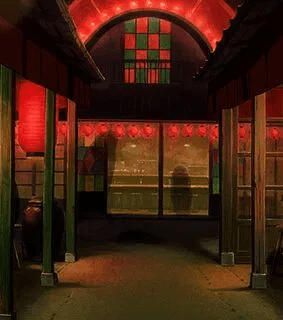
Top Image: From Spirited Away
 Salt-Powered Investments, LLC
2 thoughts on “The Maze in the Mists, Remixed”