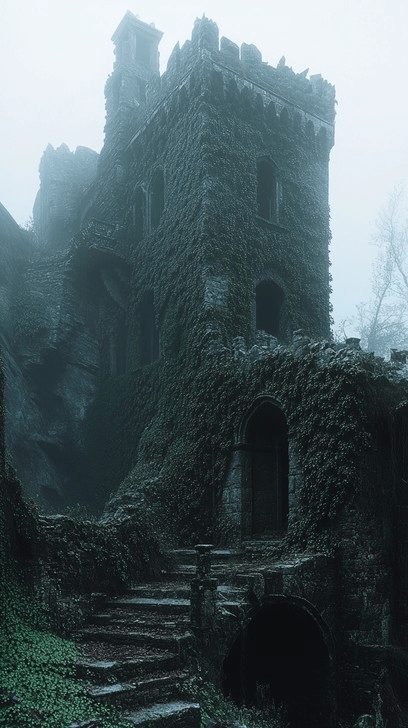
A continuation from the Maze in the Mists.
It is yet ambiguous whether your course is chosen or not, but you proceed. I leave you and your companions to finish your broth and wine, and you waste little time. The lure of opportunity feels akin to the hanging sword. It drives you out into the mists again and, for the first time in a long time, off the road. It is not clear to you whether the frenzy smothers your fear or if they are one feeling, the stag’s panicked flight and its hunger overlaid upon a single annulus, an undivided will to survive.
The first step into the mist immerses you in chill breath. The second is like being swallowed, and from there, your path is painstaking, carefully chosen from my map between the rocks, shrubs, untrodden muck, and, eventually, trees, themselves a concept which you had all but forgotten. The continuity of the road before had offered you a predictable notion of your location, not with respect to the places the road connects but simply that you were on the road. My map offers you no such assurances, for it does not truly identify the path–merely the unimportant landmarks that suggest it. The mist offers scarcely more than ten feet of visibility in any direction, and the way it wavers is unsettlingly regular. Like lungs. Corridors of shapeless, breathing bodies, opening esophageal as you venture forward. I do not mislead you, though, and you execute admirably.
After hours or days, you and your companions arrive at a set of ruined gates, dilapidated and sunk into the forest floor, giving the impression of a cave, comprised uncannily of uneven masonry and shielded by great doors of rotting wood. You stand before it in a sort of prescient horror, though you cannot say what about the fortress so moves you. One of your companions, though, undaunted, jaunts to the doors and heaves one up and open. The irreverence shocks you, even more so as you spot the shape of his smirk through the gloam, but you have to relent: He is right. You have found your quarry. Now you must find your prize.
You approach the doors, pushing against the deep foreboding you feel in spite of your companion’s nonchalance, resisting the urge to pause again as you notice something truly strange: At the darkened boundary of the fortress gates, the mist ends. There is no reason that should be impossible, of course, but you do not recall a time or place that the mist ever did end. It shrouded the road, every rest stop, every inn, stable, tavern, or village, indoors or out. The mist was the whole world, and here, somehow, the world ends. There is no reason that should matter, you tell yourself, no reason it should stop you. Encouraging. And so, as the door slams shut behind you–you are unsure whether your companion closed it or if the presence of this place is reacting to you–you find yourself out of the mists and in a pitch black tunnel of hard stone.
The scrape of flint against steel behind you makes you shiver, even as you draw comfort from the distant familiarity of the sound. You turn, witnessing the orange bloom as another companion presses a torch into your hand. It occurs to you that you have grown used to being unable to clearly discern your companions’ faces, and this one’s–obscured by a cloth mask and heavy goggles in spite of the darkness–nearly takes you by surprise. You know them, of course. This one has been loathe to abandon their supplies and effects despite their limited use in the mists, but you must admit that now seems fortunate. That reluctance now means you can see.
All of you can see, in fact, waiting there in the umbra, taking stock of the stone hallway, hesitating, momentarily dazed–all except for your insolent companion who previously opened the door, though he has always been…unique. With a grating chuckle, he takes the lead, refusing the torch your companion offers him.
An old place–but it should have plenty of secrets, I’d told you. It is as if the questions seep from between the stones: How old? What was this place? How did it come to ruin? Why is the mist gone? Need I continue to iterate the obvious? The lethargy of your mental cogs allows you to vacillate, and eventually you will have to realize that is on purpose.
Walk.
The hallway continues onward for an improbable distance without any doors, branches, or turns–save for a rightward bend where it is clear the stonework has become warped, as if some landslide managed to torque the entire structure.
After five minutes and change, your companion in the lead saunters past a damp, wooden doorframe that smells like a forest after rain, and you cautiously follow onto a landing with a half-broken balcony overlooking a flat, open room with a bar tucked into one corner. Both the landing and the room below are scattered with planks of wood and shattered furniture, all similarly fragrant, some even with visible fungal growth. And while you are struck with bewilderment as to why this darkened fortress would have a tavern in any state of repair, your concerns are preempted by the bodies strewn about the place.
They look withered. Perhaps mummified. But despite the disorder of the scene, the bodies’ postures do not reflect any obviously violent end. One lies alone on the floor. Others are slumped over the bar or against the walls. One sits, head down at the only unbroken table and chair combination remaining. In all, there are five. The same as your number.
You freeze, but your companions hurry down the stairs from the landing for–you have little doubt–a variety of reasons, ranging from moral concern (though these corpses ought be long dead) to alarm at this sign of danger (though any violent threat ought be long gone) to bald-face greed, a drive which rises within you as well, even as recognition of it stings with guilt.
You are not sure what gives you pause, though it is not as if you feel any need to preempt your companions’ instinctual investigations. Perhaps it is the sense that the scene before you is uncanny (it is) or that you feel you are being observed (you are, though that is hardly hidden–this is all in the second person, after all). Whatever the reason, your inaction does allow you a strange observation: The construction of this room is different from the hallway which led you to it.
Everything you had seen of the fortress up to now had been stone. This “tavern” appeared to be a kind of mud brick, and the subtleties of the architecture–in which you of course have no particular expertise–nonetheless evoke a removal of great physical and cultural distance.
Whatever the reason for this sudden change in decor, you find yourself with little time to contemplate it, as your masked companion below lets out a muffled yelp of surprise. You rush down the stairs to find that the desiccated figure slouched at the lone table–which you had thought a corpse–had lurched from his seat and grabbed your companion by the shoulders.
“Why did we do it?” the figure’s guttural rasp fills the space, distorted by coughed dust from mummified lungs but somehow both perfectly audible and completely comprehensible. “WHY?!”
Your companion, dependably present as the rest of you stand paralyzed, wondering at how you all are allowed to respond, places their hands on the figure’s arms and calmly responds:
“What did you do? Who are you?”
The figure breathes, his grip loosening on your companion.
“What…I…” he begins. “I was…we were called Taamir Ra…”
And that, of course, is when you begin to remember.
 Salt-Powered Investments, LLC