Notes on the LaSein Account, Parts 1 and 2

At the top of the page is a smudged symbol that may indicate a date.

I have received word of a costly skirmish in the northern reaches between one of our peacekeeping floats and an enemy raiding party.  Diarchian, according to the scouts. The presence of the troublemakers in the area is of course no anomaly, but the outcome was apparently dire: They sunk the entire float.  Barring the amassment of a far more significant force than we anticipated–a possibility the scouts’ report attempts to discredit–this is highly irregular.

The captain of the vessel was one Euphonia LaSein, and it seems she escaped with her life.  The scouts found her maimed and delirious. Her recovery will likely take some time, but I am eager to hear her report as soon as possible.

A second symbol marks the top of the next page.

I have decided that I will compile these notes separately from my regular reports to the Shareholders.  Captain LaSein’s account unsettled me, and I fear spreading it might induce a panic in the barge-districts we ought pointedly to avoid.

I had an opportunity to visit the LaSein estate on the northern plaza two days hence, and I found the captain there in a sorry state.  She was confined to an infirmary chair, wheeled by her butler, as during the battle for her float, her leg had been crushed beyond any hope of healing.  The scouts amputated it in the field. This war is a sordid business, and I shall be well glad to be rid of it when Spar is finally crushed. Still, though, the captain spoke very little of her physical state beyond those spare facts explaining her disposition.  Her worries seemed to lie elsewhere.

She confided in me a disturbing theory.  That her forces were defeated in the first place she was able to explain: The Diarchian raiding party attacked in the midst of a mutiny by the float’s slaves.  However, that they were ready and waiting for the opportunity, indeed that they were even aware of the mutiny merits further examination. Captain LaSein posited that a portion of the slave crew–a group of ten or so that the float had captured while following a lead in the Windwood–had been deliberately planted by Spar.  The slaves, in her opinion, had an unusual level of military training and cooperation, and the timing of their revolt alongside the raiding party’s assault could not have been a coincidence.

It is clear she fears the Diarchy may attempt a similar tactic closer to the Federation’s primary holdings, perhaps even within Thago itself.  While I do not wish that such exaggerated fears should spread among the populace, I do think her story merits cautious concern: I intend to immediately undertake an evaluation of my subordinates’ loyalties, in case some sort of infiltration has already begun.

Of course, I attempted to relay the same measured concern in my feedback to the captain, but it seemed she found my reaction insufficient.  After a time, she lapsed into an angry silence, and her butler, an elderly gentleman in conspicuously plain clothes, asked me politely to take my leave.

Getting Back

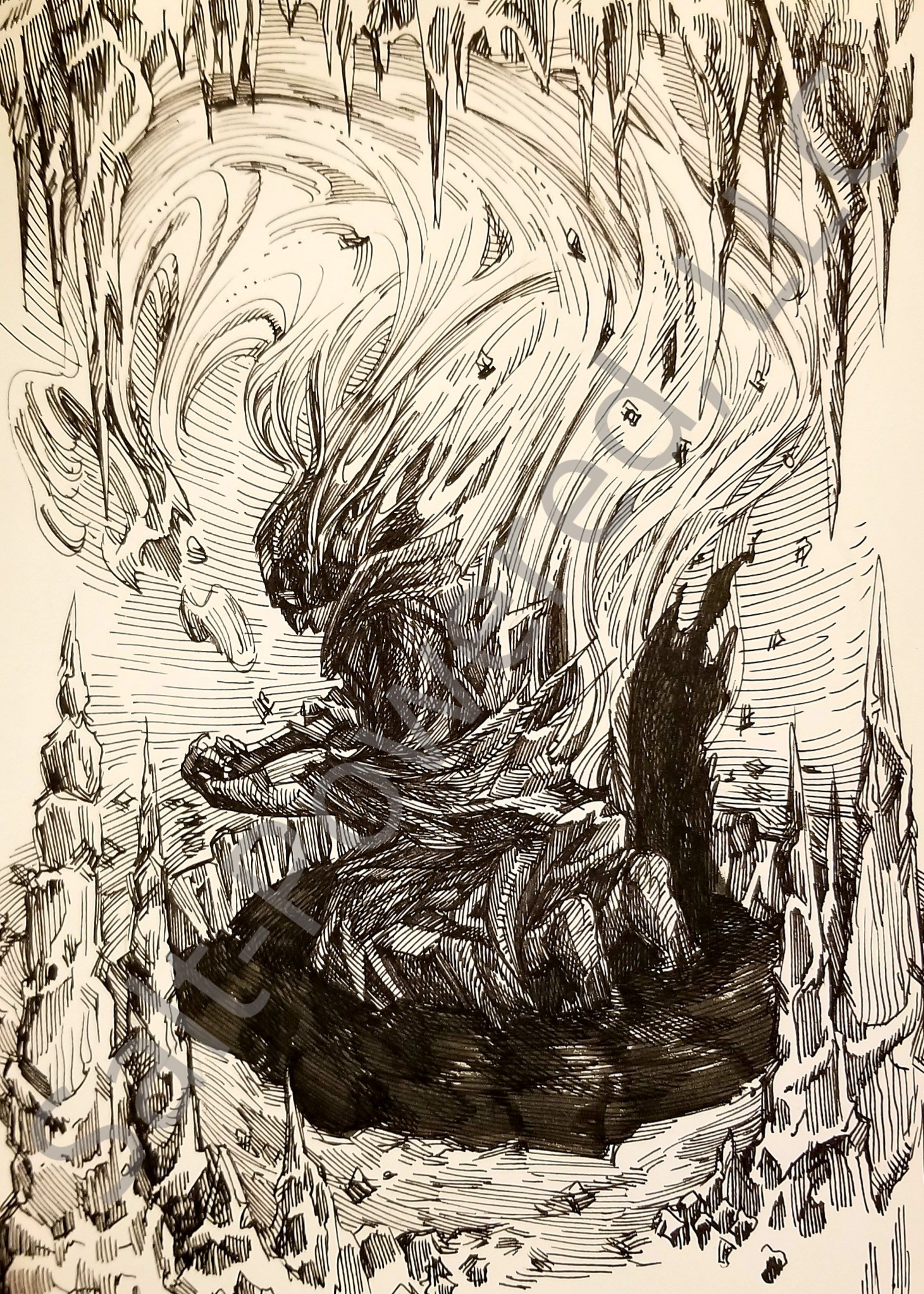
Apologies for the prolonged silence. I’ve been sick as well as traveling a lot recently (still not quite done), and writing has been even slower than usual. That said, I still have a little content for you while I’m wrapping up the main fare. See the final draft of Names above. I posted Rae’s original concept test some time ago here, and I think it’s absolutely wild to see how far it’s come.

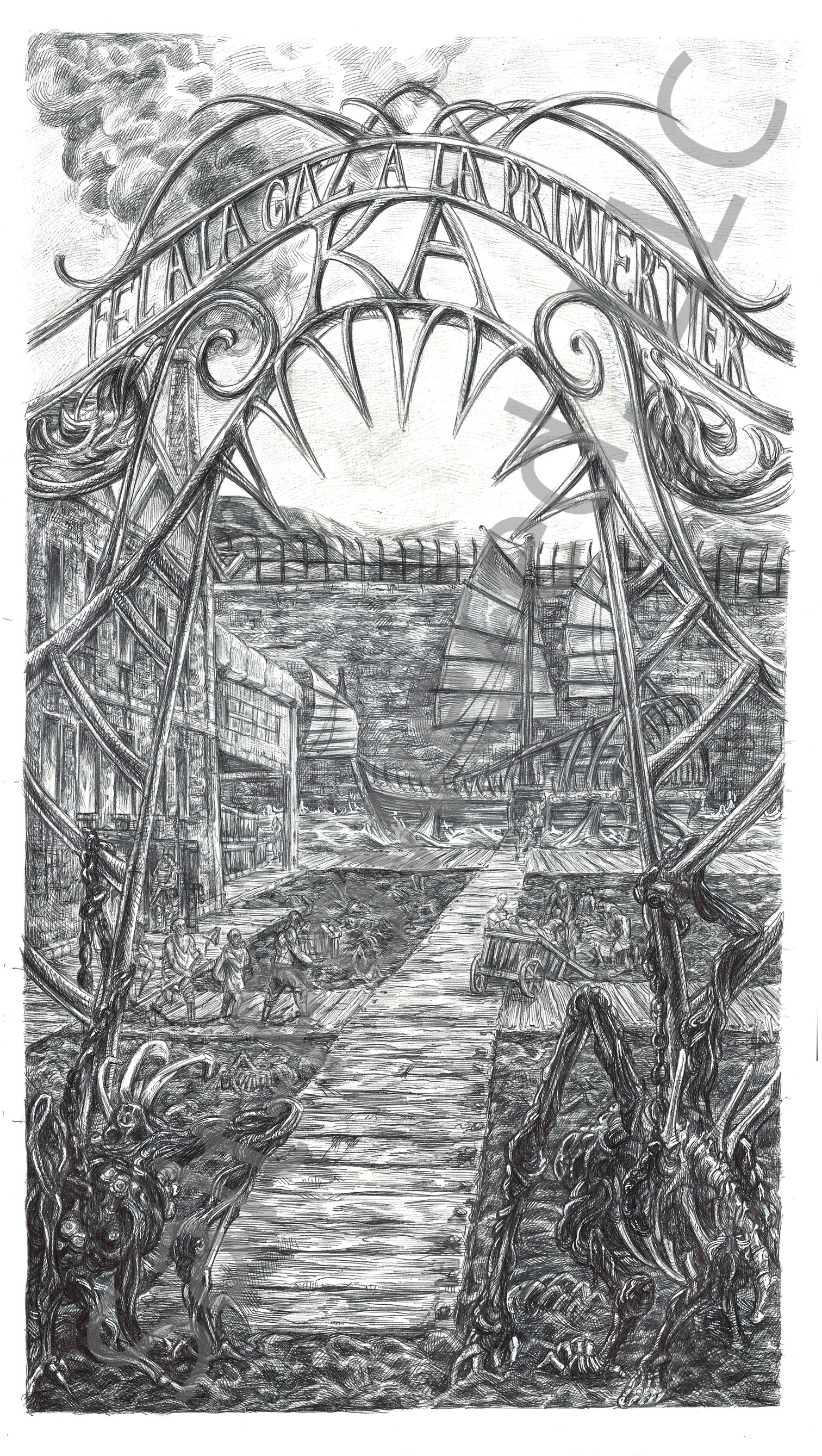
Part of the perspective change was to put that extra emphasis on the piece’s namesake (pun unavoidable), but in fleshing it out, we were also able to lay some groundwork in determining what Ka used the camps for, and with that came conceptions of the roaches, of labor systems, of facilities built at harbors atop muddy banks that slowly shipped the dead and rotting offal the Bloodfish’s forces gathered back to his citadel.

Top image: Names, by Rae Johnson, commissioned for War Torn/Rale

Something About Tortoises

“What happened to that Sevenfold Gyre post you said was in progress?”

Totally still in progress, but words are hard, and it’s been really slow going. Not really writers block, since a little has been getting done every day, but it is not a fast process. The character sketch posts were meant to be a delaying tactic, but they are not proving to be quite enough.

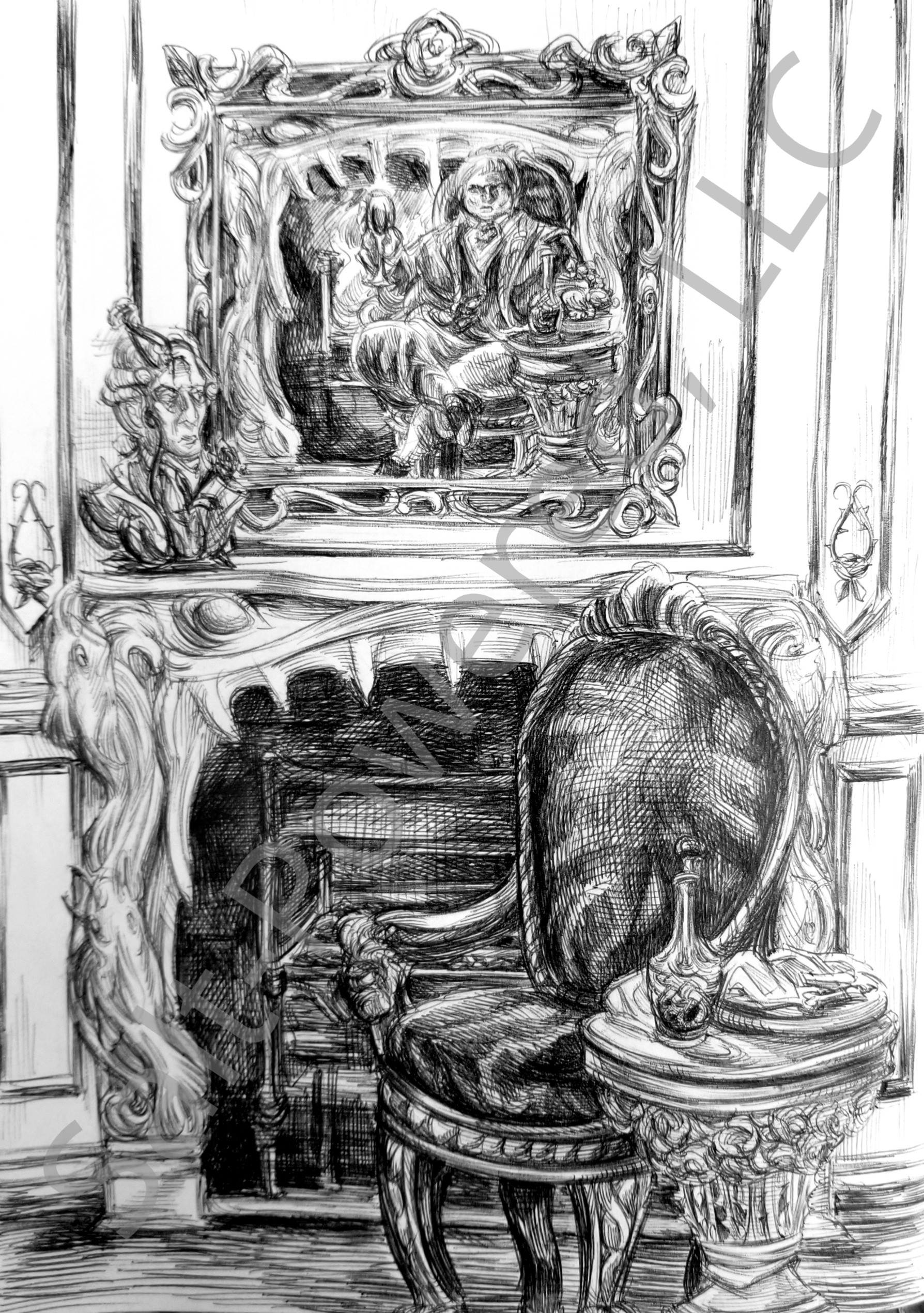
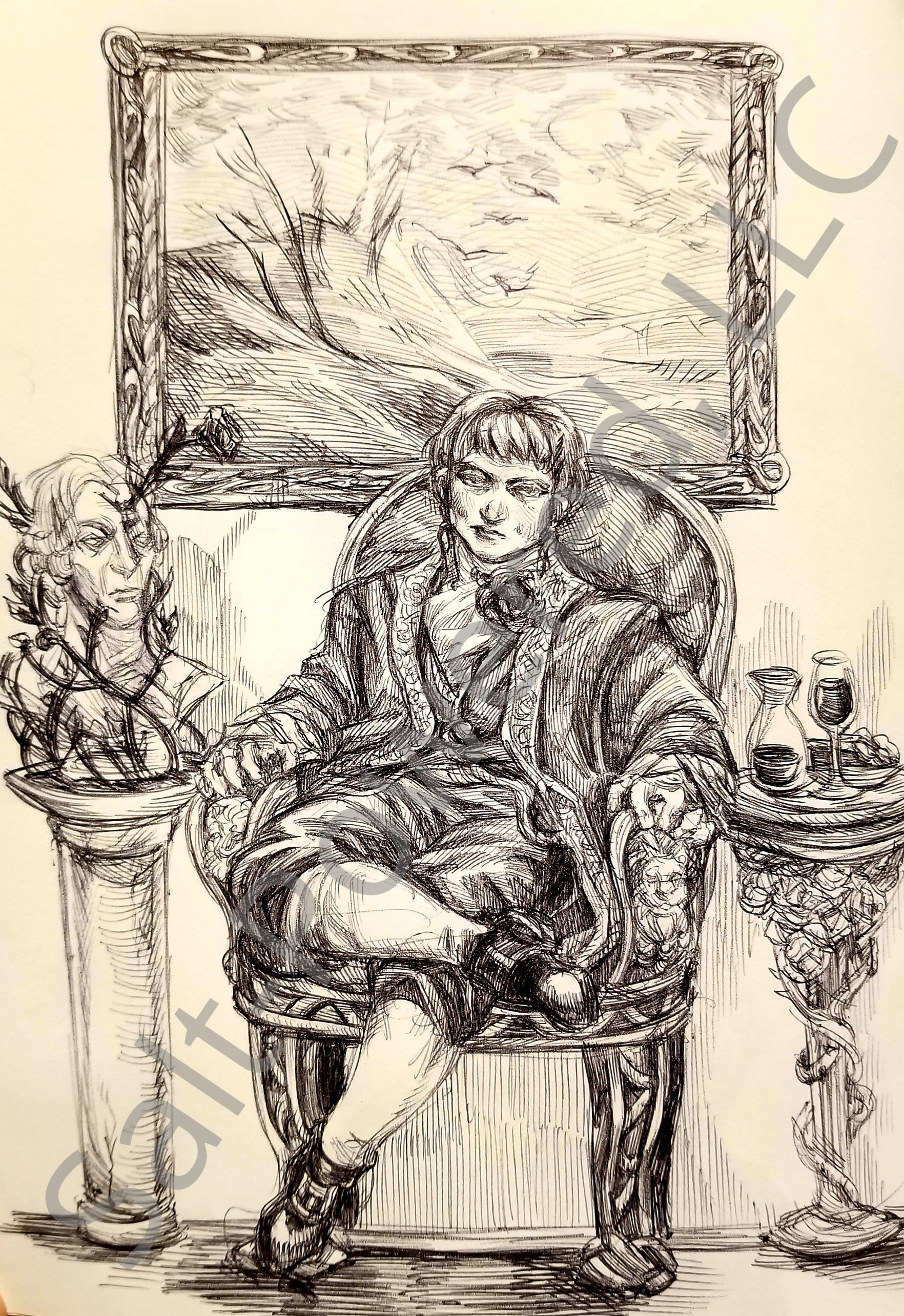
Oh well, here’s another: Les Marquains magically bound within a painting inside his house. At a point some time after the death of Ka, he disappeared leaving behind a house bereft of all the magical curiosities it had held since his grandfather’s glory days. None could say what became of him and his treasures until he resurfaced, forty years later, not a day older than when he had last been seen.

Top Image: Concept of Les Marquains in hiding, by Rae Johnson, commissioned for War Torn/Rale

Character Sketches 3 (and the Barabadoon)

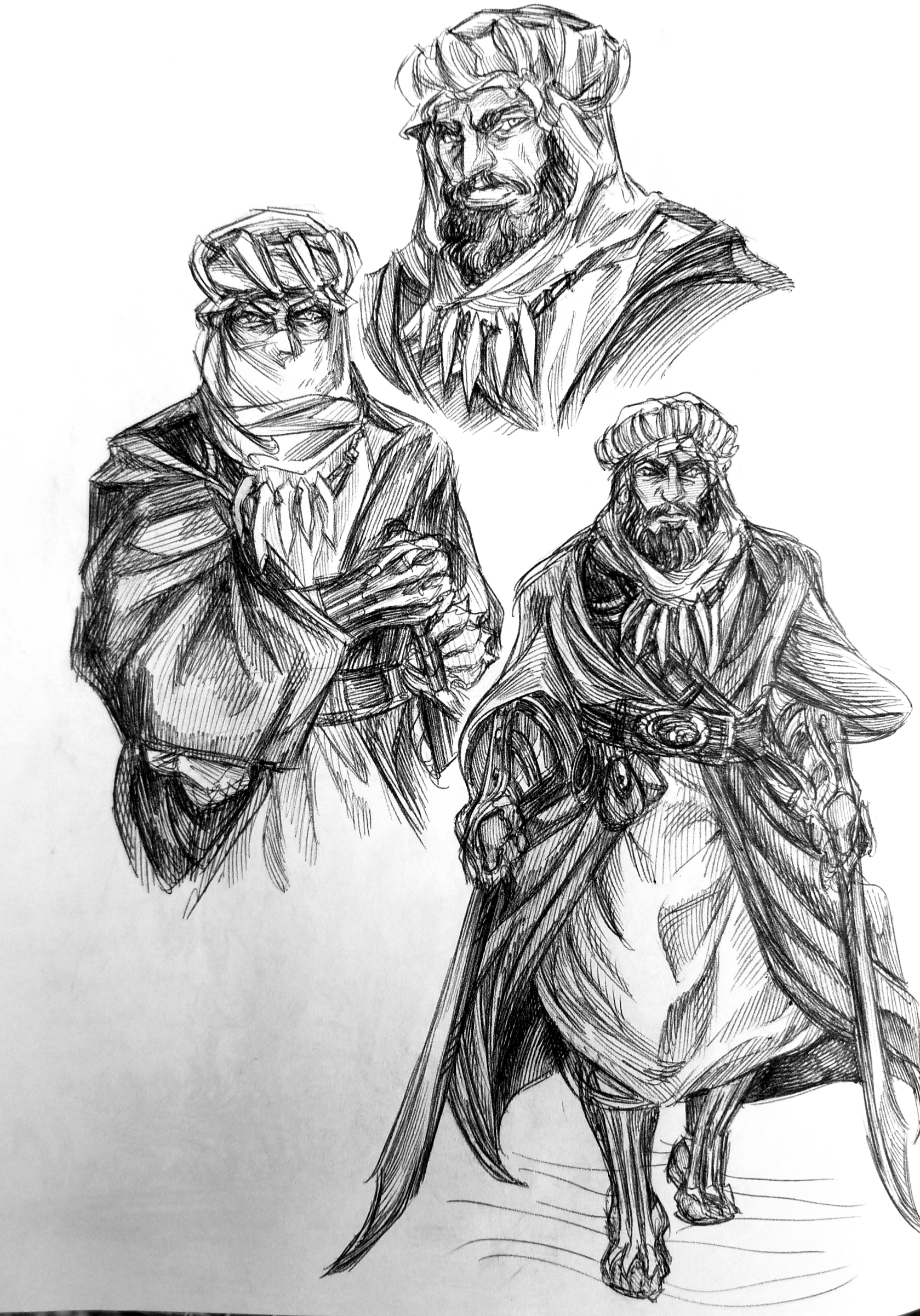
I’ve written a sparse little about the Saraa Sa’een on this blog so far. The name was originally used by the peoples of the Endless Dunes to describe dangerous exiles, criminals, or singular enemies of a society, but in the time following the Dereliction, it came to refer to a particular monster, an animate sandstorm that would arrive in a village, murder and torment its inhabitants for days, and then leave as suddenly as it came. Though the creature’s origins were uncertain, the danger it posed was clear, and an order (perhaps a cult) formed among the peoples of the Dunes to hunt the beast and protect against its onslaughts. This cult, named for a beast of myth (perhaps one of the Old Gods, perhaps a baseless legend), was known as the Barabadoon.

The Barabadoon was, at any given time, led by three gifted mages: The Nose, the Whiskers, and the Tooth. Of these, the Tooth was the fighting force behind their cooperation as well as the face of their order, and at the time the Saraa Sa’een was finally defeated, the title was held by this man:

Alikazan, Tooth of the Barabadoon.

Images: Concept sketches of Alikazan, Tooth of the Barabadoon, by Rae Johnson, commissioned for War Torn/Rale.

Character Sketches 1

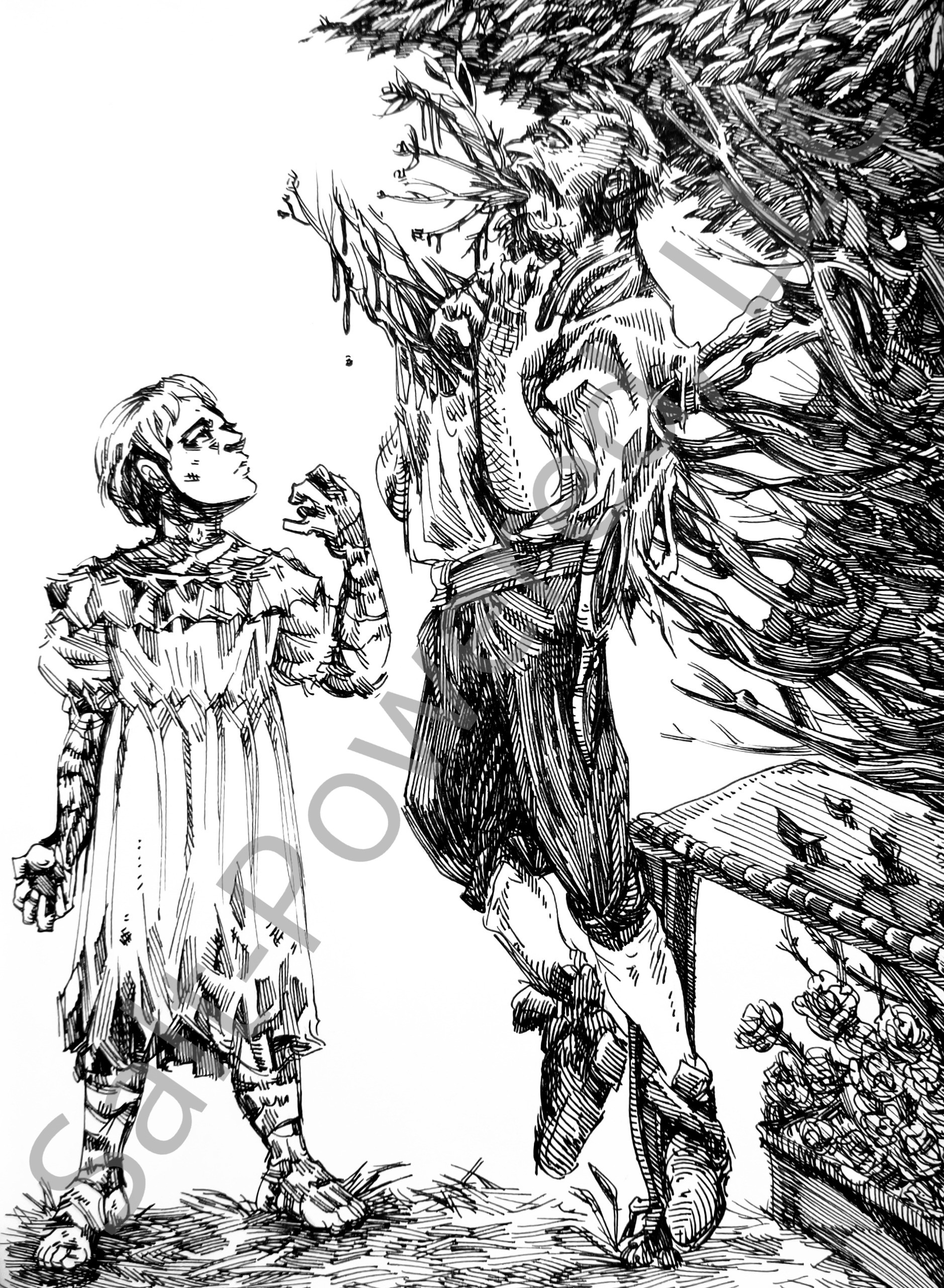
As a side-effort to our main pipeline of artwork, we asked Rae for their interpretations of a number of characters in our timeline. Here is Le Markhan (or Les Marquains, in the Riverlands tongue), from She-Lord of Ka! He’s looking a little svelter than he ought (he was not a thin man), but it’s a work in progress. I’m a huge fan of the imagery Rae brought to these pieces. Enjoy!

Stuck In a Ditch

Image result for car stuck in mud

Not fiction, not particularly polished. Hopefully you find it amusing, though.

I’ve had to explain to a lot of people lately that I spent the night in a ditch last week.  Sometimes, this is because the person I am speaking to wanted something from me the day that I was stuck in a ditch and now will not receive it for some time.  More often, it’s just a wacky story, fun to tell/hear. My wife thought so anyway, hence its presence.

Most everyone has a stockpile of travel horror stories.  I travel a lot, for work and otherwise, and I have a healthy supply of them.  The standard is usually a flight delay, maybe a night in the airport. It’s more interesting when a single day of travel turns into a shitty, multi-day road trip or an attempt to overnight Desert Bus yourself from Vegas to San Fran so you can report for work at 9 AM.  Then there’s the life-threatening stuff, and I offer my sympathies to anyone for whom that category has been less kind; it’s easily the worst.  My night in a ditch was not life-threatening. Rather, it was kind of surreal. Wholly unpleasant, but at least thought-provoking.

As my American readers may be aware, certain areas of the country became intimately reacquainted with tornado season last week, and while I was in the air, one such tornado relocated a portion of my destination airport’s architecture to its runway.  My flight diverted temporarily to nearby city, and as I sat on the plane listening to the delay tick later and later, I thought fuck it, I’m getting a rental car. So I did. I called my travel agent, got my reservation switched to my current airport, and within twenty minutes, I was on the road.  It was late, I was tired, but I’d dealt with so much worse. Things were going smoothly as far as I was concerned.

But you see, tornadoes tend to come with rain.  This one came with a shit ton, and I discovered as I was driving that the highway connecting the two cities had closed due to flooding.  Not a showstopper–my GPS just sent me to backroads. But then backroads became gravel roads, gravel roads became dirt roads, and one particular dirt road, having seen just a little too much rain, collapsed, running muddy into a nearby cornfield.  Upon reaching this road, my car–very slowly; I want to be clear that this was not reckless driving on my part–slid right into the cornfield as well and would not move further (or back).

At first I screamed, not out of alarm, not out of any particularly strong emotion at all, but it was late, and I was tired, and screaming just seemed to be the thing to do.  Then I screamed silently, my thoughts catching up to my circumstances, whirling about the multifold conclusion that man, am I a fucking idiot. I could have just waited on the plane.  I could have just not taken the gravel road (there was a paved alternative that would have taken all of ten minutes longer). I could have read the writing on the wall when I started seeing patches of water through the gravel.  But no. I didn’t. I fucked up, and now I’m stuck in a ditch. I took a breath, part seething, part too exhausted to seethe. The personal consequences of my mistakes were at that point pretty far from my mind. I wasn’t really going to sleep that night, I’d accepted it, but there were professional consequences–I had customers I was going to see in the morning–that needed mitigation.

I got out of the car, wading out in the field of ankle-deep mud to look for cell signal, and as my eyes adjusted from the searing glare of my headlights to the clear, starry, post-storm, night sky, I was overcome by a profound sense of peace, and the distinct thought entered my mind: Could I be dead?  Did this go way more poorly than I remember? It’s dead quiet, pitch dark, there’s no one around for miles. I don’t claim any special insight as to the nature of the afterlife, but if Saint Peter trudged up to me out of that darkness, I wouldn’t have batted an eye. And then another car crested the hill I’d come down and skidded into the mud, and the feeling vanished.

It wasn’t the last.  Ultimately, four cars got stuck in that particular ditch, the last close enough to freedom that we were able to push it out, but still, that left three groups: Myself, a tired-but-optimistic couple, and five expatriate college students who didn’t speak much English.  They all had the same story: traveling from the city I came from to the city I was going to, got routed to the wrong backroads by GPS (technology is so interesting). We called a tow truck company who let us know they were on their way, only to call back five minutes later to inform us that nevermind, they can’t help, good luck, go fuck yourself.  We called the sheriff’s office, and they told us, nicer but equally unhelpful, that no one was going to be able to make it out that night and we were better off camping out and calling a tow truck again in the morning.

I slept fitfully, as one generally does in a vehicle, disturbed, if only existentially, by the apparent sound of distant sirens whined by the legion of mosquitoes that had made it inside my car.  The crack of dawn rolled around. We called a tow truck again, they said they would be there in an hour. They were not. Running a quadrangle of communication between the tow truck, the sheriff’s office, and my travel agent, we were able to piece together that the tow truck had encountered a U-haul at our location (confusingly completely out of our sight) that was also stuck.  Meanwhile, I informed my customers that I was not going to be able to meet them that day. Still, we were in the midst of an important project, shit needed to get done, so while we were waiting for the tow truck, I found myself once again standing in ankle-deep mud in my metropolitan, hipster-business-casual attire in the middle of a field ten miles from anywhere, dialed into a conference call, reporting on whether we were going to meet deadlines for the projects I was managing (we weren’t).

Again, everything seemed to zoom out; again, it was like an afterlife, albeit a really different one, eschewing the peaceful, silent dark for a narrative hell resembling a bootleg copy of The Hangover.  It was hilarious, in a sense, out of place.  I was so ridiculously wrong for that field that I couldn’t help but laugh.  It wasn’t gallows humor. I wasn’t really in any danger.  Worst case, I could just walk the ten miles to town and make the car the rental agency’s problem, but my travel agent wanted me to stay put.  The tow truck was coming, they said. The U-haul was just taking awhile.

I don’t know if that was true or not.  That tense is deliberate: I didn’t know then, of course, but I still don’t, because four and half hours after the tow truck guy originally said he would arrive, a dude–not the tow truck guy–showed up in a bulldozer with a big blue winch stapled to the front and dragged us all out.  I paid him, checked into a motel in the nearest town, and tried to work there for the rest of the day (though flooding and a certain degree of poetic justice conspired to foil those attempts, knocking out phones, cell service, and internet in the entire region for the subsequent five hours).

Reactions to the ordeal, both from my customer and my company, were confusingly sympathetic.  Lots of “awful” and “what you went through”, as if I really had been in some kind of danger. It wasn’t fun, sure, I ruined a pair of shoes, I wouldn’t do it again, but not one person called me a dumbass, and I found that really weird.  I’ll allow myself latitude for the weather, the stress, the flooding, but I really didn’t see this all as something that happened to me.  It was a journey, an interesting, unpleasant one, but journeys require forward movement, and I moved forward and got myself stuck in a ditch, inconveniencing a number of people in the process.  Did I really do enough to avoid that possibility? Do I really deserve that sympathy?

I’m going with no, but your mileage may vary.

Top image is from here. I do not own it.
The Sevenfold Gyre, Interlude 4

This is the interlude preceding Part 5 of the Sevenfold Gyre. That part is in progress and will be posted soon. This interlude is shorter than its predecessors, but things are coming together, and the pace will speed up from here.

It has been two years since the walls of Mudhull burst, releasing their torrents of undead upon the Riverlands.  It has been nineteen months since the region fell to the Bloodfish, its last defenders retreating, with every citizen they could persuade, to the Bloodwood, the Dunes, the northern hills, whichever domain brought them relief from the Sadist’s inexorable advance.  It has been a hard, hellish war, but its life has thus far been short. For the man that calls himself Matze Matsua, though, it has been much longer. He has seen this all before, seen its beginnings and ends again and again. As before, he remembers the beginning–the first beginning.  He always will. But since then, he has discovered just how long life is.

This time, the war is going well.  The coalition, the forces of Harmony, fled the roaches for a time, but upon their first counterattack, far from the Sadist’s main force, they discovered the weakness, the hollowness of the Bloodfish’s stunted war machine.  Its monsters are swift, strong, inhumanly vicious. They know not fear nor pain, but, as Harmony discovered, falling upon the most far-flung of Ka’s outposts, this is because the creatures know almost nothing at all.

Harmony has now learned a great deal about their enemy, that the roaches are no more loyal to their keepers than to their enemies, that Ka’s soldiers keep them chained as threats to their sparse prisoners but never free them, that only Ka and the One-Eyed Sadist are able to command them.  And, of course: the monsters are fueled by magic, imbued with a lifespan of months instead of years, and each wretched one is made–unborn, undead–by Ka himself in Bloodhull. In this knowledge, Harmony has found its target. They will destroy the Bloodfish’s death camps, his grim depots for his armies’ harvests.  In so doing, they will rob him of his bones, his eyes, his teeth, the materials the camps channel back to Bloodhull. Without them, the roaches’ numbers will dwindle. Ka, influence shrinking, will grow desperate, stupid, and then, then the tide of discord–as it always does–will ebb.

Yardwork

Just some general updates:

  • The Archives and Ongoing Series pages have been cleaned up substantially.
  • The next chapter of the Sevenfold Gyre is in progress. I will be working on it as I travel this week, and I intend to post the interlude in advance of the finished piece.
  • I’ve added two patron-only posts (possible prologue and epilogue for Rale) to the Patreon. Check it out if you are so inclined.

Things Worth Trying

A review of Catherine.

I find it’s much easier to write when I have someone to be mad at.  To that end, take a look at this.  If I were in the mood to be kind, I would describe that as an informational review, and including it saves me a certain amount of effort in describing the thing I intend to explore a little more critically.  In case my dichotomy doesn’t read: There will be spoilers. If you are the type of person that cares, go play the game first. All good? Let’s begin.

I.

Catherine is a game about cheating, or, more particularly, it’s a game about how well-established social morals around cheating interact with “modern” ideals of how romantic relationships look.  The scare quotes are because the game’s (c. 2011) interpretation of modernity probably solidified around the late 90s and is at least a little different from what things are like today (accord variance for local culture as you will), but understanding that difference helps resolve at least a little of the cognitive dissonance you get when socially average (read: complete loser) protagonist Vincent wakes up massively hungover next to naked, beautiful, and not at all hungover Catherine after a night at the bar and immediately internalizes it as his fault.  Frankly, there’s a good argument that it is, but there is conspicuously little examination of what, by even more modern standards, is essentially date rape.

I’ll be clear: I’m not saying that I wanted that examination–God knows I get enough of it from modern media–but its absence is a good marker for where this game is coming from.  More broadly, there is a lot we can glean from what Catherine takes for granted.  In context, Vincent is characterized as a fairly together person who is going through a weird time in his life, but anyone looking at this by Western standards is immediately calling bullshit.  Vincent is a raging alcoholic in a clearly dysfunctional relationship, and that his behavior is normalized is telling, but before you get angry at that, slow down, have a drink yourself.

It’s easy to get pissy at the message this sends to society (“relationships are oppressive, excessive alcohol and poor communication skills are acceptable”) or at the people who get pissy thereof, but the story is still (depending on your ending) one of a fuckboi slowly learning to be less of a fuckboi, so the vector is still in the right direction in my mind.  Instead, let’s talk about fairy tales and how the general public has a hot-garbage understanding of the underpinnings of writing.

II.

Has anyone else run into that asshole who, you know, actually says the words “show, don’t tell”?  Honestly, it’s good advice in high school, but thereafter it’s generally not a kind conclusion.  As with all advice, “show, don’t tell” has an implied context, and a fair amount of fiction falls outside that context.  Case in point: folklore. In myth, legend, fairy tales, it’s extremely important to the format that you don’t show what actually happened.  The story you’re telling is actually the story of someone else being told what happened, and putting aside that you literally can’t show things in that framework, even so much as trying would disrupt the tension between the storyteller and the audience, which is important regardless of how hypothetical each of those entities is.  Same thing with the historicity in Dark Souls, and more generally, same thing with any story where you’re calling attention to a source.

Catherine, of course, doesn’t have a problem with showing or telling, but instead of reading its hyper-media-coded characters and “fumbled gender stereotypes” as hokey, politically incorrect attempts at description, consider reading them as deliberate oversimplifications, the types of things a storyteller would include in a tall tale to drive home a central point or exploration.  Actually, that suggestion may be a little soft–that’s exactly what they are, or did you just ignore the introduction where the game told you that everything you were about to see was a TV show?

This is, of course, one of the reasons why the outrage over the game’s treatment of transsexuality is ridiculous.  You’re looking at a well-intentioned and inclusive piece (provided you don’t view Vincent, et al’s transphobia as aspirational–you shouldn’t), wrapped in 90s/00s language that simply doesn’t have the same words and concepts as the modern []-Studies crowd.  The criticism then translates as a critique on fashionability, which seems kinda petty.

Aside, though uncomfortably political: The game’s nightmare–the one that only affects men, including the game’s trans-woman–is ultimately revealed to be generated by a demon whose stated aim is to torment men who are not contributing to human reproduction.  Given that it is a targeted weapon controlled by a specific entity rather than an axiomatic validation of gender, I would ask the folk who are upset to contemplate exactly how woke they think Satan is (1). “Sounds stupid?” Yes.

III.

“I get that you disagree with these people, but what about the game?”

I’m glad that it exists.  I’m reading it as a serious attempt at literary exploration of a complicated but atypically well-defined social perception.  The very first review I read for the game back in 2011 described it as “mature”, and I think that’s on point. There are a lot of cheesy places that a game about horror and sex can go, but I think that a puzzle loop harnessing the metaphor of elevating oneself amidst horrific emotional storms and antagonism feels very true.  

It’s not perfect, of course.  It’s really not perfect.  I’ll defend the game’s extremely blunt characterizations as deliberate choices, designed for a purpose, but that doesn’t mean they all worked.  Vincent, in particular, was rough. His shortcomings were fine as a baseline, but then they became a one-trick pony for advancing the plot, and I started feeling like I was going through the worst parts of Romeo and Juliet all over again–the problems stopped looking insurmountable because they were, in fact, very easy to solve, and Vincent’s sheer incompetence was the only thing standing in the way, which is even worse because this is a game, and games are supposed to harness your agency rather than strip you of it.

Still, when the game did invite player choice, it made good use of it, albeit in the really opaque, Persona-style sense, and the use of survey questions about romance as a means to guide the events and endings of the game was pretty interesting.

Ultimately, did Catherine push the boundaries of games as art?  Eh, not really, but my view is that the medium is still young enough that we can afford to give out cigars, because the game really visibly tried.  It picked an interesting topic and explored it in a fairly novel way with decent attention to detail and literary device.  If it were written a little more carefully, if it made just a little better use of its medium (specifically not fumbling it at the moments where giving the player control is most important), it might have been an artistic achievement.  Instead it was just a solid game, but the effort did not go unnoticed.

Footnotes:

(1): Perhaps, cynically or otherwise, you feel closer to Satan than whatever’s on your particular Light Side.  In that case, replace “Satan” with “Hitler”, which is only less interesting of a thought experiment because you know a priori he was a bigot.

Top Image: Banner for Catherine Classic (the version I happened to play) on Steam.