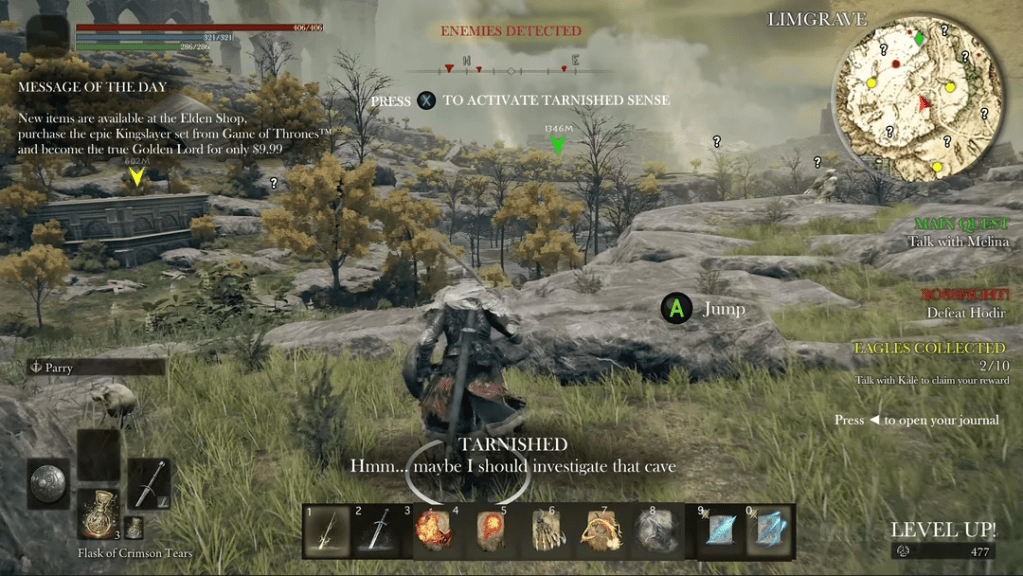
I’m not dead as it turns out. To be clear, the below is written in-character. This is practice for a weird piece I’m working on that may or may not ever see the light of day.
In Dark Souls 3, Sir Vilhelm, loyal knight and right hand of Lady Elfriede of Londor, finally having had enough of your shit, declares to you:
“I’ve seen your kind, time and time again. Every fleeing man must be caught. Every secret must be unearthed. Such is the conceit of the self-proclaimed seeker of truth. But in the end, you lack the stomach for the agony you’ll bring upon yourself.”
Hardcore, truly, especially as he proceeds to embody that agony by lighting his sword on fire and introducing it to your (lack of) stomach. It’s very tempting to take it as a pat on the back: This is Dark Souls! This bastard thinks you can’t take it, and true–his sword is scary (though hardly as scary as his liegelady’s eyeless stare and akimbo scythes)–but press on! Through persistence, you will prevail! But try taking it at face value first, and you can’t help but stumble. To start, want to tell me who he’s talking to?
These words, directed at the Unkindled (the player character), make deceptively little sense. Technically, the Unkindled has the choice to fuck off entirely, but beyond that, he is simply proceeding linearly to the castle’s backdoor. And insofar as he doesn’t fuck off, he is here for two things, neither of which is the truth. First, same as anywhere else on the journey to the Kiln of the First Flame, he’s here to take souls (=power) from the inhabitants of the painted world, the fragile order of Elfriede’s frozen, rotting kingdom be damned. Second, he has a task from Slave Knight Gael: someone must show his lady flame. Assuming the Unkindled cares about that, he’s going to show (=give) some lady somewhere in this awful place some fire, said fragile order be thrice-damned.
Neither of these even remotely resembles truth-seeking unless you accept, pretty much wholesale, the Nietzschean allegory of the Fire as Truth, meaning the souls you’re harvesting are fragments of Truth and that Vilhelm knows that if you have your way, you’re about to slurp the Truth right out of his armor and wear what’s left as a cape (he has a cool cape). So okay, that makes sense, but why “self-proclaimed”?
Again, the Unkindled isn’t proclaiming anything to anyone. He’s showing up, mostly taking things, sometimes giving them. It’s certainly a nuisance if you’re trying to maintain a status quo (or a slow degradation into rot, same difference), but there’s no proclamation, no fanfare–for those in his warpath, these interactions are coincidental. Consider the circumstances of the Unkindled’s confrontations with the other Lords of Cinder: The Watchers are killing each other, Aldrich is munching on Gwyndolin, Yhorm is just chilling deep underground where no one in their right mind would bother to bother him. To them, the Unkindled showing up is completely unexplained–they don’t even know who this guy is. To you, the narrative, what it all means, is constructed after the fact by the Fire Maden, by Ludleth and Yuria and the Painter Girl, by others. Sort of like the Peloponnesian War. Or Jesus Christ.
On the topic of both, Edward Teach M.D. throws out a particularly hot theological take in Sadly, Porn:
“Your God must be omnipotent so he won’t be omniscient, open your Bibles to the Gospel of the Television Christian, Mark 13:6, and let’s see what today’s reader wants out of a translation:
‘Many will come in my name, saying ‘I am he!’ and many will be lead astray’
You can read it again and again, it’s obviously a clear warning about being fooled by imposters and false Christs, which, curiously, there are no examples of anywhere in the New Testament or indeed in the history of Christianity. Huh. So much for omniscience.
A couple of things about this sentence. First, in the original Greek(s) there are no punctuation marks. Second, the word ‘he’, the predicate nominative of ‘I am’, is not there; the translator, whom they executed for being a translator and then plagiarized his work, just added it, along with all the thees, thys, hasts, and forsakens that effectively inform us that Jesus was a Stewart, all this being especially ironic as King James knew Greek even better than the translators, and probably Mark. Third, I guess to balance the ledger, the translator then omits the Greek word that comes after ‘saying’, and that word is ‘what’. So the actual line, translated using no psychoanalysis or literary deconstruction or collapsing the wave function–simply copying down the words–is:
‘many will come in my name saying what I am and many will be led astray’”
I will both echo and paraphrase Teach’s following sentiment: Your worldview is built on writhing mist and shadow, best acclimate. I know, quotes within quotes, metaphors within metaphors, it’s easy to get lost. You can pretend you’re Theseus, if only to pretend you’re not Orpheus, but either way you’re stuck in a maze. Better pay attention if you want out.
Anyway, to balance his heterodoxy against the millennia of interpretation disagreeing with it, Teach provides a buttress:
“...the most contextually appropriate reading here is the literal one: that people will claim Jesus is something else. Do you know why? Because that is what the Gospel of Mark is. That’s what happens over and over in the Gospel of Mark, no one else claims to be Christ, and almost no one doubts he is Christ; but everyone, Pharisees, Romans, disciples, Tusken raiders, everyone wants him to be something else.”
Take inventory of the pieces: You have Jesus, an actor, you have the clear desire(s) to (re)interpret his action, all repressed, distorted into the desire to imitate, to impersonate him. Recall that by Fire as Truth, Gwyn, Lord of Cinder, is an allegory for…Jesus. This would make the Unkindled, following in Gwyn’s footsteps, attempting–according to the Fire Maiden, et al–to link the Fire, a copycat.
That would imply, then, that many are deceived, not by the meaning of the Unkindled’s quest for Truth, but by the notion that the Unkindled is seeking Truth, is attempting to link the Fire at all. Do not misunderstand: He may in fact link the Fire, but the notion that his action is compelled by this question, that you know what this force wants is the distortion which hides what you’ve repressed.
Except the repressed always returns. When Sir Vilhelm rebukes the Unkindled, he is of course not speaking to the Unkindled, not even literally. He is only speaking to you. But it isn’t a commendation. The Unkindled seeks Truth for its power. You seek truth to defend against your powerlessness, and you will self-proclaim your quest to anyone who can’t get out of listening as long as it makes you think they think you aren’t doing what you’re really doing, which is nothing. Seeking truth, after all, means you aren’t finding it.
Sir Vilhelm sees you, just like I see you, but unlike me, he is easy to misinterpret, and in case he isn’t, he’s omniscient, which means he isn’t omnipotent, so you can always kill him to shut him up. But if you want out of here, don’t misinterpret him, don’t you dare think that “the agony you’ll bring upon yourself” means “Dark Souls is hard”, spare me your incompetent lies. Dark Souls is a work of entertainment, and anyway, anyone unsuited to its “agony” would never have reached Sir Vilhelm in the first place. Your agony is the never ending hunger, the seeking of truth you will never find because it will never satisfy, at the expense of anything and everything that might. “Lack[ing] the stomach” is intentional, you see. It keeps us hungry down here in the dark.
A story told by fallen leaves in the style of a young Nietzsche
***
Note: To be clearer to those less familiar with the context, this is a discussion of various literary themes (or just personal points of interest) in Elden Ring. It’s meaty for a series of essay-fragments, but disconnected and certainly not a complete treatment of any of these topics, much less the game as a whole. The style might be something I return to–temporally, though, I had just been reading a collection of Nietzsche’s earlier aphoristic work (alongside, as I mention, Borges), and it seemed a decent way to expound upon the contents of my brain at the time.
Cross the fog to the Lands Between. In the tradition of Bloodborne (and in contrast to Dark Souls) Elden Ring is rather forthcoming with the metaphysical nature of its action. The Lands Between are ruled by a goddess who has banished the very concept of death, power is conferred by “runes” (including the Elden Ring itself) and “grace”, individuals physically accomplish insane, abstract tasks like “holding the constellations in place” or “literally being two people” (including the fecundity implied by a less abstract multiplicity)–no need for the subtlety of a bird ride that transcends substrates of reality, but that’s okay. I mean it genuinely. It is often okay to say what one means, especially with the cat so far out of the bag.
Familiar Miyazaki-isms return: The fog from without the Lands Between again symbolizes the shifting becoming of materiality giving way to the divine being of grace (the Christian through-line) and runes (the Norse through-line, perhaps to be taken as Viking geometry, linking the metaphysical language to the old Platonic stand-in).
Perhaps it’s the Borges I have on my brain at the moment, but it’s all rather evocative of a labyrinth. Lands of resolved solidity delineating (forming pathways amidst) the fog (or vice-versa–the negative of a labyrinth is also a labyrinth)–I sure don’t have any idea what it was meant to house (or I lack the energy to enunciate it–you guess which), but labyrinths are awesome and, definitionally, provide both a goal and at least one path to tread in one’s delving.
***
Long lost grace. Grace, the guidance of gold, a network of glittering signposts and rest stops left by the Greater Will (the Outer God from which the Golden Order and the Two Fingers arise; and against whom both Marika and Ranni rebel), a golden glow in the eyes of the blessed–beyond its utility as supportive game mechanics, it sounds kind of like “purpose” and even more like “commandment”.
For the player character it’s a rough constant, but it’s worth considering the others for whom it comes and goes. Back before the Shattering, Godfrey, First Elden Lord, was divested of grace and “hounded from the Lands Between”, as far as I can tell not for any indiscretion, but because he fulfilled his commandment. He was done conquering the Lands Between in the name of Marika and the Erdtree, so as is only just, she banished her champion and the father of (some of) her children and remarried…herself. Divinity certainly is a strange thing. No one would appreciate me extrapolating this logic to IRL religion, but it’s worth ruminating on this characterization of “divine love” and the rules it plays by.
Anyway, when Godfrey is banished, loses the guidance of gold, he becomes Tarnished. Because From Software spends approximately a bazillion dollars (or at least hours) on English translation, we should be careful with their words–and we should be very suspicious when it looks like they aren’t. To which end, pure gold doesn’t tarnish–silver/other stuff does. The implication, then, of calling the Erdtree’s discarded guardians “Tarnished” is subtle but important: The golden grace which they formerly held was not a transmutation of the soul but an alloying. They, at base, are not gold but silver.
Sound familiar?
“I said; ‘but all the same hear the rest of the story. While all of you in the city are brothers, we will say in our tale, yet the gods, in fashioning those of you who are fitted to hold rule, mingled gold in their generation, for which reason they are the most precious–but in the [guardians, Samzdat’s words] silver, and iron and brass in the farmers and other craftsmen.’”
-Plato, Republic
TL;DR/#AllGreek2U, the rulers are gold, the soldiers are silver, everyone else is economically replaceable, and in the Lands Between, we sometimes stuff warriors into cabinets (or jars) until (or, more realistically: so that) they get corroded and gross. It’s worth considering as well that (Plato’s) Socrates presented the city based on the noble lie not as an ideal city (as he might have claimed for plausible deniability) but as a hellscape, a festering city, an absurd monument to the tendency of human complexities toward strife.
You can blame the genre or the philosophy, but either way the result is what you’d expect: Strife arrives, the gold-souled rulers are proven untrustworthy (or at least unworthy), so the conduits of grace on the ground begin unearthing their guardians. In other words, they not only followed Adeimantus’ bad example–they followed his bad example badly.
This is to say nothing of Miquella, child of Marika alone, who championed “unalloyed gold” as a countermeasure to the influence of the Outer Gods. Because philosopher kings are clearly the solution.
***
Game of rings. “Sonic or Gandalf?” Depends on how fast you are.
An obviously relevant point of discussion is that the development of Elden Ring’s pre-Shattering mythos was a collaboration between Miyazaki and the much vaunted (though perhaps tarnished in his own right) George R.R. Martin. Less obvious is exactly why this is relevant. We do know that the collaboration was not longitudinal: Martin’s involvement was at the beginning, in creating a “D&D sourcebook” for a setting that Miyazaki would then twist. What’s not clear is where the line is drawn–the degradation of the Lands Between was not by a single event, be it the Shattering (the war), the shattering (of the Elden Ring by Radagon), the Night of the Black Knives (which likely catalyzed both), or the banishment of Godfrey (which exposed–or even created–the cracks in the order that led to all the rest). Miyazaki has commented that some of the characters ended up unrecognizable from Martin’s original submission, but that raises more questions than it answers (like the degree to which that difference is editing versus the in-story corruption of the Shattering). All I can say now is that I would give not-zero appendages to see Martin’s original document.
In the same vein, I’ve long wondered about the particulars of Miyazaki’s collaborative strategy. The structure of this arrangement is particularly clear (in spite of the aforementioned ambiguities), in the sense that such arrangements must exist in most, if not all, collaborative works of long-form literature, and we, as onlookers, rarely get this degree of insight. Meanwhile, during the development of Elden Ring, Miyazaki was also directing Sekiro, on which he has stated he took a backseat on most of the object-level writing. Yet: Sekiro remains a beautifully-written work with the same hallmarks of style and attention to detail. I realize this observation is nothing especially profound, but I’m still curious about the nuts and bolts: Is Miyazaki himself especially good at directing his own style? Are From Software’s processes particularly conducive to that style? Do they simply maintain a staff of talented and faithful imitators? I have no idea, but I would love to understand how I could scale my own work in the same way.
***
Yass, King, I seen’t it! There’s something cowardly to me about getting too low-level in one’s critique/analysis, but there’s one piece of Elden Ring for which I’ll flirt with the lower bound of my standards.
Miyazaki has said before that his favorite boss in Demon’s Souls is the Old Monk, the proprietor of a tower in a swamp who was driven mad by a relic he acquired: a long, flowing, vibrant yellow robe. His reasons for liking this boss are likely multiple. There’s a lot to like, from the super creepy aesthetic (it’s instilled in me a lasting affinity for piles of discarded chairs), to the fact that the fight is not against the monk himself but an invading enemy player “possessed” by the robe (a mechanic which reprised its role in Dark Souls 3), to, of course, the literary reference. Hidetaka Miyazaki, too, has seen the Yellow Sign.
That The King in Yellow is so close to Miyazaki’s heart (or at least his portfolio) makes his use of the color yellow in Elden Ring nearly unignorable. To be fair, even not taking that into consideration, the precision (and deliberate obfuscation) of it is diabolical–or did we think that the representation of no fewer than four distinct (and bitterly-opposed) factions by nearly-identical yellow particle effects was merely sloppy art direction?
For accounting: The Golden Order, the “good guys” in the quest for a restored balance via the Elden Ring are, insofar as they are in any way a united front, represented by projections of pale yellow light and a predictably golden aura. Those Who Live in Death, worshippers of Godwyn the Golden (the first demigod to die) who would see the rune of death reintegrated with the Elden Ring, are characterized by a golden aura intermingled with black smoke, as if to connote some corruption of Godwyn’s original purpose. Similarly, the Omen, the curse of horns and filth that cuts its victims off from the Greater Will (see Margit/Morgott, Mohg, and the Dung Eater) is the same gold, interspersed with brown. And of course, the Frenzied Flame, ender of life and bringer of madness, is also yellow, this time more saffron–though it is scarcely distinguishable from the Golden Order’s particle effect when it is in an NPC’s eyes.
Far be it from me to offhandedly summarize the “point” of The King in Yellow without citation, but I think a respectable try looks like:
“A sort of madness, transient or not, of devotion to something larger than ourselves, even–especially–at the expense of the reality we would otherwise affirm, is endemic to the human condition.”
Shabriri and the Frenzied Flame thus stand at one end of the spectrum, wearing the same color but demonstrating, perhaps, just how deep the yellow/gold rabbit hole goes, while the remaining Erdtree derivatives reticently acknowledge that all that glitters, well, maybe it has something in common.
Less artistically but 100% also the point: The narcissism of small differences is often much more bitter than any rivalry with an alien Other.
***
We’ve made some improvements to the chapel since 2015. Furthering the “thematic connection to Bloodborne angle”, the two games’ use of runic alphabets is worth interrogating, and Elden Ring in particular gives a useful starting point for the aspiring Lorax linguist: the tree. The Lands Between admittedly incorporate several linguistic traditions (Latinate, e.g. Raya Lucaria, Dectus; descriptive English, e.g. Volcano Manor, Redmane Castle; and of course Germanic, e.g. Leyndell, Fortissax, Placidusax), but since most of them are allocated to the names of specific people and places (which is about how you would expect culture to work), the question of the Erdtree (a more fundamental concept) stands out. It’s definitely a tree, that part makes sense, but per the name, it’s also an “Erd”, so what’s that?
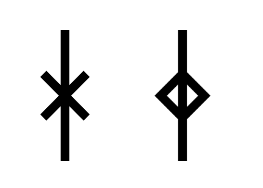
My own leap of logic lands me on “œd”, short for œdal, the Elder Futhark rune for “heritage” or “estate”, a fitting symbol for the Golden Lineage (used also by the Nazis, a connection which I will not explore here). It also seems to be the nominative basis for Bloodborne’s Great One, Oedon (not to mention the Norse god Odin). Except, one problem–the œdal rune looks like this:
And the Oedon rune looks like this:
Actually, no, not a problem, just a connection. You see, the seal of Queen Marika is this:
…which bears reference to Odin’s infamous vigil, hanging from a tree, and closely resembles the Anglo-Saxon rune “ear”, meaning “earth”:
…implying a “heritage of the earth” (Biblically, “inheriting the earth”) or the less grand “earthly heritage”, or both. There are fruitful implications to either.
Note: While I did mention before that these explorations are largely incomplete, it’s worth mentioning the trail of breadcrumbs leading to the “elgaz” rune as well:
The literal meaning of this rune is “elk”, which is a less useful similarity to Marika and the Erdtree, but given its visual similarity to “ear”, it might indicate some connection to the moose/elk-themed Ancestors present in various locations throughout Elden Ring, whose culture is believed to predate the Erdtree.
If we’re going to grill the Erdtree, we ought to do the same with its disfavored progeny. Thankfully, the Haligtree is easy–”Halig” fairly clearly derives from the Anglo-Saxon “hægl” rune
(or “haglaz” in Elder Futhark–aside, I am continuing to reference Elder Futhark mainly because Wikipedia’s entry for it is way better, but evidence points to the Anglo-Saxon runic alphabet being the most appropriate reference for Elden Ring’s runes), meaning “hail” or “precipitation”. Aesthetically, hail is appropriate–the Haligtree is located in the snow-covered northern mountains–but at a deeper level, the significance of the Haligtree is much better understood as precipitation, that which falls from the storm or, less meteorologically, from the heritage of the Erdtree. Miquella is an Empyrean, one of the three potential successors to Marika (Miquella, Malenia, and Ranni, for reference), and he intended the Haligtree to be a new symbol of a new order in the Lands Between. That it should be named for precipitation–or consequence–is entirely reasonable.
Lastly, just as we are shown the modified “ear” as the symbol of Marika, we are shown another rune as the seal of Radagon:
This is a superimposition of the epigraphical and manuscript variants of the Anglo-Saxon rune “gēr”:
“Gēr” signifies “year” or “harvest”, connoted as “year/season of plenty”, which in Radagon’s case might be taken ironically. In his role as champion of the Golden Order, he was “harvested” from his place at Raya Lucaria, ultimately leaving Liurnia in disarray (if not outright ruin), and the metaphor only gets darker in the sense of “harvest” as it applies to fertility.
Radagon and Marika had two children, Miquella and Malenia, both of whom wound up cursed, presumably by the particular degradation of the divine gene pool that occurs when one’s parents are not merely related but are, in fact, the same person. And if the problem of the harvest is a problem of one’s descendants, of succession, then it’s worth noting that the Shattering was literally a war of succession, preceded, of course, by the literal shattering of the Elden Ring–by Radagon.
***
A golden parasite for the golden lineage. Also returning in the Lands Between is one of Sekiro’s most potent symbols: the centipede. The one-armed wolf had a pretty good time with this one–literally, it is a creature that infests the corpses of the divine carp that swim in the Dragon-blessed waters of the Fountainhead Palace. It lines the corpses with its eggs, and as the flesh breaks down, the eggs bleed into the overall water supply, into the runoff that flows to Ashina. Then, when the mortals below drink the water, they find themselves “blessed” with an unpleasant and hollow brand of immortality.
The immortality, of course, is the result of the giant centipedes whose eggs they swallowed, now growing through and infesting their still-living body, though the “why” is definitely where the literality starts to blur. Is it because they are parasites to the divine? Is it coincident, in that the centipedes are themselves divine (which would allow them to devour the carp in the first place)? Sekiro isn’t especially clear on the biomechanics, but it all but bludgeons you with the notion that the immortality granted by the waters of the Fountainhead is only a crude imitation of that granted by the Dragon’s Heritage. A note, obvious within the Ashina province but worth clarifying for the Europhilic audience of Souls/Elden Ring: This is an Asian dragon we’re talking about here, no wings, serpentine, aquatic, celestial (a combination of adjectives worth dragging back to Bloodborne, by-the-by).
It should not be surprising that all of the supernatural creatures present in Sekiro (the carp, the centipedes, the giant snakes of the valley) all bear some morphological resemblance to the Dragon, to the divinity they emulate, but the implied ladder there also calls to mind a fable of a Buddhist monk and a centipede, where the centipede is expounded upon as a lesser creature which may yet regain its honor through rebirth.
Do you see it? Where the paradigm switches around? In traditional Buddhist teaching, the centipede is on the same continuum as man–in Sekiro, the ladder to divinity is snakeybois top-to-bottom, and that divinity (be it the literal gestation of centipedes in your gut or the more metaphorical “feeding” of the Heritage via Dragonrot) is a parasite to mankind. Yeah, religion. Someone call Bong Joon-ho and see if he can work that into the sequel or something.
Right, this is about Elden Ring, but all that is necessary context. So when Elden Ring’s Rune of Death is the Mark of the Centipede and golden centipedes begin to appear in places frequented by Those Who Live in Death, that is the lens we need to use to understand what it all ought to imply.
From the basics, the centipede, originally, is death, a threshold upon which the things that are become the things that were and then fade into the everything from which they were born. It is fitting that the true Cursemark of Death, broken into half-wheels during the Night of the Black Knives, is not one, but two centipedes in a circle. An ouroboros. Fitting for a conception of death meant to coexist with the rest of the Golden Order, but Marika dIdN’t LiKe ThAt PaRt. She cut it out of the Elden Ring, gave it to Maliketh, and what she got was a different death–not integrated cohesively with her Order but jammed askew into its cogs, birthing Those Who Live in Death. For all points and purposes, they’re undead, much the same as the Senpou monks who drank of the Fountainhead in Sekiro, but that is a slim overlap with Sekiro’s otherwise extremely well-developed mythology for the symbol.
With the exception of Rykard, Elden Ring’s pantheon is nowhere near so serpentine as Sekiro’s, but consider the position of the centipede in particular. Our myriapodal friend may be at the bottom of the spiritual totem pole (a turn of phrase made literal in Elden Ring: Godwyn, an unwilling recipient of the Half-Wheel Mark of the Centipede rests amidst the roots of the Erdtree), but the bottom of that hierarchy has more in common with the top than wherever mortal man hangs out (ie, not in the hierarchy at all). The theme of parasitism is not as eminent as in Sekiro, but the game is clear that adherents to the Golden Order are not stoked about the centipede stuff at all, reiterating that even the most reverent dogmatists tend to find some expression of the divine they would rather revile. And, of course, the parasite’s absence leaves an echo: Follow the Erdtree’s totem pole up to the very top to find the Greater Will, overwhelmingly interested in keeping the course of history in the Lands Between confined to its Golden parameters. For a being so immense, so abstract and multifarious, it is difficult to even formulate the question, but in the end, what can mankind be to such a creature? The answer: a pet, a pest–or a host.