Ferrik’s Journal

Day 1

Starting a first officer’s log in case something goes wrong with our pay and this needs to go to a magistrate.  I’ve signed onto this contract with fourteen acquaintances and one confused vagabond for one Edward of Corino, known as “Edward the Pirate”, recently returned to Piraeus after a decade of exile.  His reputation is poor and well-known, hence this log, but the crew was paid an advance of 10 silver a head on total wages of two Verduan marks per man.  Frankly far more than a month of our time is worth.  The men believe Edward has a rich sponsor for the voyage, but if he does, he’s kept quiet about it.

Issues with his reputation–and his exile–stem from a smuggling deal gone bad.  He was carrying contraband to Verdua and failed to deliver payment back to the praetor who hired him.  He says Verdua confiscated the goods, but who knows.  Things with Verdua have been tense for years.  About as long as he was exiled.  The old timers doubt it’s a coincidence.

***

Day 7

One week in, no sign of this “god of the seas”, but the Captain isn’t agitated yet.  He keeps quiet, though.  No sense among the crew of whether this is according to plan or not.  The vagabond tagging along is an odd bird.  His name is also Edward, which is damned confusing.  Surprisingly competent sailor, but he says he’s never been to sea.  Apparently he’s been wandering the Riverlands teaching children arithmetic for soup.  Crew have taken to calling him “Teach” to keep the Edwards straight.

***

Day 10

There’s a growing sense of unease with our course.  Nothing of our quarry still, but I’m more concerned that we’ve been sailing due west, way off any route any of us have ever taken.  Captain ain’t showing us the charts, and the main worry now is we might be lost.  What’s more, at sunrise, it feels like we can see land on the eastern horizon, which is obviously impossible.

Teach’s interest in this job clearly has nothing to do with the pay.  He’s an amateur mage, which is divisive, since the old and new timers have their superstitions both ways about that, but he also has this almost childlike interest in stories about gods.  Says he has this friend in the Bloodwood with some harebrained historical theories he’s trying to learn more about , and the job is a lead, I guess.  

I assume the Captain knows.  I wouldn’t have allowed it, though.  Magic is whatever.  Ulterior motives are the real bad luck.

***

Day 17

The crew was already on edge finding nothing, but now we’ve found something, and it certainly isn’t a “god”.  We’ve come upon a drift of things that look a little like jellyfish, but they also seem to dart about intermittently in a way that jellyfish never would.  We can’t seem to touch them with oars or nets.  They just avoid them.  The sea is full of weird shit, though, so this wouldn’t be so notable if not for the air around this shoal.  It’s thick, like you’re breathing vapor, chilly even though the sun’s out, and it smells like rot, like a fish market abandoned for a week.

The men don’t like it.  Captain says put the sails down, we’re drifting with this stuff for the night.  I might need to talk someone out of a mutiny.

Teach seems excited.  Not sure whether that’s a good or bad sign.

***

Something is wrong with me.  I can’t be seeing this.

***

Day 18

When I awoke today the sea was different.  Fuck, the whole world was different.  The sky’s gone dark, but it isn’t just the clouds.  It’s like the light that makes it through them is shining through fluid, like that fish mist we’re breathing is actually the sea, and we’re submerged.  And above us, just hanging there–mostly in the distance, though one got close enough we could see it was at least three times the size of a warship–are these jellyfish.  They look kind of like jellyfish anyway–they aren’t.  Still not sure they are even really there.  They look like reflections on rippling water, but you can’t tell what they’re reflecting.  And the reflection unravels at the end and streams off into these branching string-tentacles.

One of the ones in the distance seemed to get sucked into the darkness before our eyes.  None of us realized what we were seeing until hours later.

The surface of the water has grown cloudy, almost silvery, and it’s become like slime.  The creatures from before are still there, but there are more of them, and they’re more varied.  A times, they seem to rise up above the surface and just swim in the air, but it might be a trick of the light.  When it’s quiet, it almost sounds like they’re humming.  We can touch them now, too.  One of the crew picked one up and just sort of lost track of where he was.  He just stared off as the thing slipped out of his fingers, and it was minutes before he came to again.

In the distance, it’s hard to distinguish where the horizon is, what’s sea and what’s sky.  At one point we saw the whole fucking sky move, a shadow the size of a city just slip down beneath the slime.  We were too afraid to speak for nearly an hour, everyone except the Captain and Teach fucking pissing themselves.

***

The lookout says a shadow just passed underneath us.

***

Day 21.  We’re back in the real world.  We met god, and there is an angel with us.

I cannot tell how much is true and how much is just Teach’s speculation, but he believes that we just sailed up against was the end of the world, where everything unravels into the void.  And the vast creature that surfaced beside us–that is a god, I now see.  Teach describes it as “glaucus”, a term I’m not familiar with, but it’s caught on with the crew.  Glaucus shall be the name of the god who reigns at the end of the world.

The angel who we call the Endling, the strange, eight-legged child we pulled from Glaucus’ flesh has its own mystique.  It does not speak, at least not in any way we can understand, but as Teach observed–and I am inclined to agree–it seems intelligent.  Far more intelligent than a creature of the sea ought to be.

Unfortunately, we lost one sailor in the process of recovering the Endling.  Anton touched the appendage where the Endling clung.  As soon as he did, we saw him reel back as if stung.  All we could do was watch as he mouthed words without sound, and his body grew translucent before decomposing into slime that just…wafted into the air.

A lesson for me as a not especially religious man: It is no small thing to touch a god and survive.

***

Day 24

We have made port in Piraeus nearly a week ahead of schedule.  To think that Teach’s supposed “end of the world” was so close to the city, and no one knew of it.  I wonder why it’s remained secret for so long?

The crew has been paid, a development which moots the original purpose of this log–though I now believe myself to be chronicling something more important–but the way the payment was delivered has made me damned curious.  Upon disembarking, the crew was greeted by a man named Thrasymachus, representing the Blue Ring Cooperative, who handed each of us a purse with our full wage.  It seems there was something to the rumors of a sponsor after all.  

The Captain has asked Teach and me to accompany him to present the Endling to his benefactor.  I had no reason to refuse, but besides: How could I?  I believe I am now tied to the Endling.  I helped to bring this messenger of god to Piraeus.  It is my responsibility to ensure its message–whatever it may be–is delivered.

***

Edward’s sponsor, the head of this “Blue Ring Cooperative”, is no more than a child–a girl, barely of marriageable age!  I am unfamiliar with her persona–this “Halia of Thazan”–but she seems to be taking pains to disguise herself.  She wears a heavy cloak, darkened lenses over her eyes, speaks with this strange, affected accent that still sounds vaguely Verduan.  She’s hiding almost everything, and I don’t trust her.

She seemed happy with the Endling, though.  She and Edward are going to present it to the Council of Praetors.  The want the city’s support in investigating the opportunity on their borders.  I hid my rage well, but the fury has been difficult to suppress in the hours since the meeting.

Glaucus is no opportunity.  And the Endling is no sample to be dissected!

Their appointment is in three days.  I must rescue the Endling from their grasp before then.  I think Teach may be sympathetic.  Perhaps I can persuade him to help me.  We have found something sacred.  The last thing we should do is present it to the politicians for defilement.

***

I have spoken with several of the crew now, and it seems even having been in Glaucus’ presence is having a lingering effect.  All of them are dazed, have barely eaten since we last spoke.  Some are saying that they dream of floating through the sky as great Glaucus swims below them, and they awake to find their skin translucent like Anton’s.  They say it soon recongealed, but one showed me his foot.  It now appears more mollusc than human.

I seem to have been affected much less, though I am also finding my daydreams to have a stickiness to them, as if I am drifting into that inter-zone reality at the end of the world.  My thoughts linger on the god, and it is as if the whole world grows moist, but once I shake myself alert, moments pass before the slime dries from the walls, before the people around me cease to waver as wraiths.

Growing more concerned, as much for our wellbeing as for Halia’s plans for the Endling, I tracked Teach down at the tea house on the south side of the city.  He was having symptoms similar to mine, but he’d already put together an idea of what was going on, magically.  He told me the human body normally exudes mana, but whatever happened to us has caused that mana to start degrading into something less stable.  Unlike regular mana, he says, this “proto” mana seems to do some amount of magic by itself, changing bodies, warping reality, pulling us onto reality’s exterior, that inter-zone that exists everywhere, not merely at the end of the world.

Teach thinks that the reason my symptoms are milder than the crew’s is because I too have some latent magical ability, and I’m reflexively resisting the proto mana’s attempts to change me.  He shares my concern for the rest of the crew but also agrees that we must rescue the Endling immediately.  He thinks that the council is incapable of any decision but foolishness with respect to Glaucus.  I suspect he does not share my reverence.  I may ultimately need to save the Endling from him as well, but for now he is a much-needed ally.

***

The Endling is safe!  It was a poorly hidden operation, and I have certainly invited the Blue Ring girl’s wrath, but as I have seen no sign of cooperation from the city guard in their search for me, I can only conclude that Edward and Halia’s meeting was a failure.  The Captain’s efforts were noble–if misguided, I now understand–and it is a shame they must end in ignominy, but perhaps he too will soon share in the future I intend to build.

Teach, unfortunately, was wounded in our flight.  I had expected the Captain to be armed–I did not expect Halia to be carrying a crossbow under her cloak.  I think he made it to safety, but I cannot be sure as yet.  

After losing my pursuit in the Hospitality Quarter, I doubled all the way back south to the tea house where I had met with Edward.  It is dilapidated and undistricted and limited to the oddest and cheapest of clientele.  I rented a room there, and I doubt any but Teach will find me.  

Most fortunate, though, perhaps even divine recompense: The Endling has spoken to me.  He knows my name and desires that I gather the rest of the crew that brought him here.

***

Teach has found us, and alas, he could not be convinced of the providence fallen upon us and our city.  He was alarmed at the spirit that now animates me–as if I had any choice but to make myself an implement of the divine will before me.  He was frightened of the Endling, who has grown to the size of a man since Teach last saw him.  It is natural to quake before the miraculous, but Teach is slow to be persuaded.

I should have struck him down there as the Endling suggested.  I hesitated.  I still hope Teach will come around, but I admit that hope isn’t pragmatic.  No doubt he will defect now, and we will have to contend with Halia’s enforcers.  With any luck, though, we will be beyond any reasonable possibility of enforcement.

In the two weeks we have been hiding, the Endling has shared with me unthinkable secrets.  Most miraculous among them is that those of the crew who could not control Glaucus’ gifts have found themselves Sent into a state of strange apotheosis.  Their minds waver–if they remain at all–but the Blood of Glaucus runs through their veins in diluted form, seeping from their skin and mouths.  The Blood is new life.  Injected into one’s blood, it remakes them, strips away their shames, mistakes, failures, and ignoble predilections.  It builds them anew, as they were meant to be, supplanting their flaws with a new need for the Blood, for Glaucus’ blessing.  With the Endling’s guidance, I have been gathering it.  And I have been bringing it to those of Piraeus who need a star upon which to orient themselves.

We have a flock of almost twenty now.  Many are still sick, all are learning their new place in the world.  Amusingly, the two most dependable among them are children: two orphan boys named Alaric and Badger.  But we are growing.  Soon, all of Piraeus will understand what we are before Glaucus.

***

Badger has let me know that a “delegation” is on its way to our makeshift church.  Hali and her mercenarios, with two in tow who sound like they must be the Edwards.  Our congregation is still sickly.  It is unlikely that we could overpower them, but the Endling assures me I need not fear.  His Song, combined with our voices, will surely hold off any threat of force within our sanctum.  But he also intends to offer them something.

It is improbable that the Blood from the crew would appeal to Halia or her men–though perhaps Edward’s shame bears scouring at this juncture–but even she must have regrets.  

The Endling has shared with me that the Blood is, in fact, named poetically.  It is actually Glaucus’ venom, in this case a flawed and weakened copy, but even an image of the divine is potent, of course.  But while my fellow crew was touched merely with Glaucus’ presence, the Endling had attached himself to Glaucus’ flesh.  Within his body is a much purer form of the Blood, capable of dissolving even those regrets buttressed by privilege and ambition.  The allure is incredible, and I even I struggle to hold myself back from the serum the Endling has prepared.

***

The methods of divinity are…more twisted than I anticipated.  Our congregation is shattered, the Endling is injured, our blessed crew have been consumed.  I don’t understand how we did not foresee this.

As the Endling predicted, the Song effectively stalemated the confrontation, allowing us to make our peace offering of the Endling’s serum.  Edward accepted it reticently, and upon injection, he faded quickly into the inter-zone, where he remained, unresponsive.  I worried that this would be an unwelcome warning to Halia, but she all but seized the next syringe.

I do not know how, but it seems as if she understood its function even better than the Endling.  The serum transformed her into a horrific, billowing monster.  She turned upon us, engulfing our congregation, liquefying their flesh and drinking them.  Were it not for Teach, she might have swallowed all of us.

My memory of Teach’s reaction is the haziest.  I distinctly remember him accepting the serum and injecting it.  He was…dimly resigned.  As if this end was inevitable.  But my memory of him throwing the full syringe aside and leaping to Alaric’s and Badger’s defense is equally clear.  Ultimately, the handful of us who survived, including the Endling–who now bears multiple wounds from Halia’s molluscoid barbs–owe it to Teach’s sudden and fierce resistance.

Halia escaped into the harbor.  Teach left, seemingly disgusted.  The Endling is recuperating in the inter-zone, and he has advised that I take the faithful into hiding.  It seems that our nascent temple will need to remain a cult awhile longer, though the thought fills me with despair.

The Endling is vexed but not enraged.  He says it is fitting–though he says it reluctantly–that the compass rose should have more than one direction.  I wish I understood what he means.

Journey to the Center of Society, Possible Prologue: Trade Offer

“It’s weird how few people pay attention to how many religions are essentially contractual.”

-samzdat

It was an artfully complex transaction.

The opening was typical of the diplomatic speculation that pervaded China’s Warlord Era.  So many sides, so little to agree on–supremacy is an inherently zero-sum prize and all that.

The context: Cao Kun of the Zhili had beaten back the Fengtian and consolidated power over Beijing.  Wu Peifu, Cao’s right hand, was thus mired, from the administrative discomfort of his temporary office in the capital, in the effort of helping him keep it.  This meeting was one of many seeds cast, little investments with little expectation but–Wu hoped–incredible potential.  Cao had already secured the blessing of interests from the Western nations that would soon agglomerate into “Britannia”, but today’s talk promised a more bespoke advantage.  A private citizen with an interesting personal history.  Perhaps a charismatic figurehead, a cunning informant, a diplomatic shield if it came to it.  Wu had little idea of what this man wanted, but that was not unusual.  These meetings were, by their nature, exploratory.

At this point, the prospective exchange was simple: a little of my attention for a little of yours.

He entered Wu’s office with a small retinue: a manservant and a bodyguard, putatively, themselves flanked by eight of Wu’s own soldiers.  Wu gathered that the manservant would be interpreting when the unassuming man spoke first, in accented but otherwise inoffensive Mandarin:

“Thank you for meeting with us, General.”

This was in incorrect apprehension, but Wu did not yet have reason to realize it.

The man, Richard Sterling, a Western celebrity of whom even Wu was aware, had a surprisingly direct proposal: He and Wu had a mutual interest in the eradication of the Fengtian to the north, and he claimed to have the means to execute this goal bloodlessly.  But to do this, he needed two things: He needed men and materiél to bring him close to the enemy’s seat of power unscathed, and more peculiarly, he required that a more subtle operation be completed first.

There was a soldier, he explained, under the command of the Fengtian general Feng Zongchang, known as “Tianyi”.  Tianyi was to be captured, deprogrammed, and extracted from China without Sterling’s involvement.  Wu was, of course, aware of Tianyi–the name, along with numerous revolting accounts of his crimes–had spread through the provinces bordering Manchuria.  His capture would not be a trivial task, but that didn’t much matter.  Wu’s part in the transaction had ended nearly thirty minutes prior.

It was strange, in hindsight, that all of these negotiations had proceeded–between Sterling’s English and Wu’s Mandarin–without any further need for an interpreter.  Strange for Wu, that is, but not for the meeting’s singular outside observer.

For Em, Architect of Exchange, aware by nature of every passed coin, every promissory note, every clicking bead on even the most abstractly conceptual abacus, this context had become quite common of late among the planet’s most valuable transactions.  A little of my attention for a little of yours.  No one realized that all the King in Yellow needed was your attention.  After that, he had all of you.

What was beautiful about this transaction, though, was that what was nominally being asked of Wu Peifu by the King in Yellow was in fact being asked of the King in Yellow by Dick Sterling.  It was beautiful for its intricacy.  It was beautiful for its mystery: Why would one of the King’s agents ask another agent for a favor he cannot refuse?  Why would the King grant a personal request from his thrall so clearly at odds with his agenda?  And most delightfully maddening: Why would the King expend these resources to keep Tianyi–to keep Lamont Sterling–deliberately out of his control?

Em had learned a great deal of the gods of his existence, his own creators, gods that admittedly played dice but who made up for it with a command of mathematics that seemed impenetrable–even to the economy.  He had learned more of them even than the other Architects, he was sure, which would be an unpleasant surprise for See eventually.

But the devils–the Elder–were new.  Deities much more like the ones humans fantasized.  Deities who wanted worship, even in this petty, token sense, because that’s what this was, this bargain between Dick Sterling and the King in Yellow.  Because when a god exists, worship is a transaction.  

And so it was there, in that office in Beijing, that Em first caught a glimpse of that black mirror in which, he realized, he was the reflection.

The Fables #722

“The Fables” is a weekly hybrid social commentary/investigative journalism column in the Sunday edition of the Times of New Chthon, by Abraham E. Sopp

It’s not really a world of gods anymore.

Listen, folks.  Given the ontological weirdness of our whole metropolitan identity, I think it’s actually healthy for us to take a step back once in a while to reconsider why we’re here.  What it all means, living–actually living: not sold out to the mines in Asphodel; not taking the Lethe out to retirement in the ‘burbs; actually living–in New Chthon.

It’s no secret: This here is Hadestown, land of the dead, even if it isn’t totally clear if we are dead.  But it’s not a world of gods anymore.  In fact, none of this would be possible if it was.

You might wonder how that’s possible, and brother, I’m with you.  I’m no Socrates.  I’m just a poor Salukis fan hoping for another Championship win while my fingers can still type.  I’m not gonna act like the metaphysics of it all adds up.  But still: Every once in a while, I have an experience that reminds me that it’s actually important that we’re here, that this isn’t just Hades’ underworld that we’re only living in.  

This time, that experience was the recent scandal (and subsequent administrative shakeup) at Erebus Corp with which I was either fortunate or unfortunate enough to be closely involved.  As it happens, the sordid saga of Al Wyland’s research division at Erebus is a doozy, and while I promise to keep the editorializing light, this column is, at the end of the day, my editorial, a point which took my editor some convincing to relinquish.

Unfortunately, she still wouldn’t compromise on the format.  The saga’s a long one, friends, and while you, my readers, are a dedicated bunch, I was informed that I would not be allowed to command an entire special issue of the Times for this story alone.  You’ll need to settle for a serial.  But I promise: The real story will knock your socks off, and the tepid little statement the Gazette printed this last week doesn’t even begin to cover it.  You can ignore that corporate mouthpiece rag–the real story is here, and you’d best stay tuned.

For now, though, I’ll leave you at the beginning: an expansion survey out in Tartarus, a down-on-his-luck columnist on a ridealong in search of a story, and a lost god at rock bottom, in the worst possible place at a suspiciously bad time.

The Rose, the Cross, and the Sword, Ch. 2 – Flamel’s Cross

Legally distinct, as all things should be.

“Mademoiselle?  Mademoiselle!  A few questions if you will.”

The visibly beleaguered notary struggled to project himself over the stacked books and parchments that, if he’d had his composure, might have lent his too-tall desk an imposing air, an aura of respect befitting his station in the Parisian community.  But in this instance, with his client distracted, positioned such that she could–if bothered–simply look at the desk rather than up into it, the notary had to admit that he probably appeared more like a goblin.

“Mademoiselle!” he rasped, a regrettable bit of scorn entering his voice.  He was normally much better about his tone with women, but he was behind schedule.  He had needed to intervene with the morning’s trouble with the fireplace, and the afternoon had been a nonstop stream of unorthodox contract requests from the sort of clients he had a distinct sense might be hiding something.  And this Italian woman, dressed in gender-inappropriate academic regalia, gliding into his office at the very close of business, was very certainly one of them.

“Mademoiselle!” he redoubled, finally prompting a slight, aloof incline of his client’s head.  “The collateral arrangement you’ve requested–I’ll need more documentation of these Florentine holdings than–”

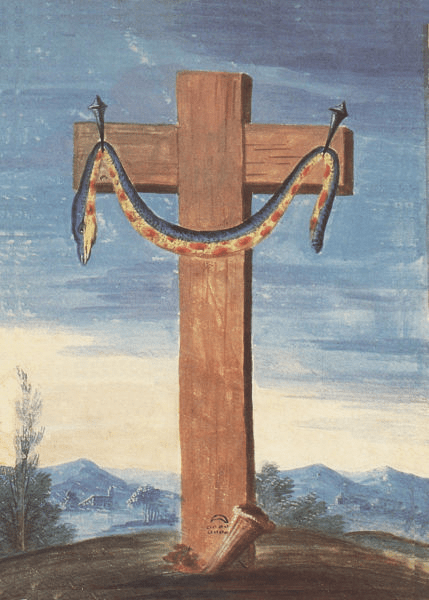
“Monsieur Flamel,” the woman said, still not quite turning to face him.  “This symbol you have carved into the moulding here–do you know its origin?”

“I’m sorry?  What?”

“This symbol.”  Her French was passable, though heavily accented.  “The cross and serpent.  I believe it is occultic, Monsieur.”

She turned, blank-faced, not presenting any clear intent from the otherwise rather threatening question.  The woman was not ugly, though her hook nose and mud-brown hair rendered her looks middling by Parisian convention, but otherwise she seemed to sidestep all of his available stereotypes.  She was well-past marriageable age, though she had arrived at his office with no chaperone, by all accounts very far from her purported holdings in Florence.  She was likely not of noble blood–proof of one’s pedigree was usually the first thing established when an aristocrat requested the notary’s services, and she had provided no such documentation.  Or even a claim, for that matter.  Whether she was of noble means, though, was the question.

Again, she was very far from home.  She must have secured her transport somehow–the notary could scarcely imagine a solitary scholar making the journey all the way from Florence unscathed, much less a solitary woman.  But the name she had given–Alighieri–meant nothing to him, and her claim to lands in Florence–to funding, as it all pertained to their business–was unsupported.  And she seemed more interested in his office’s walls than her own contractual viability?  The notary found his bewilderment and irritation increasing in equal measure.

“Mademoiselle.  Your property in Florence is unfit as collateral for your purchase,” he blustered, catching himself in time to qualify: “Without additional dated documentation, of course.”

“Oh, nevermind all of that.  I assume gold will suffice as collateral?”  

“Um…gold?”

“Two standard ingots and a purse of unmarked medallions, yes.”

“But that would be sufficient to buy the property outright!”

“Oh.”  The woman frowned.  “Well then, please write the contract to reflect that as payment, if you think Monsieur Menard would accept.”

The notary’s head spun.

“In any case,” the woman continued absentmindedly.  “In any case…sorry, how long will the contract take to complete?”

“Um.  Three days, most likely,” the notary replied at a mutter.  What was going on?  That amount of gold thrown about without a second thought at the purchase of a house on Mortelier Street?  This was palatial wealth, and this woman wanted to live on Mortelier Street?

“That will suffice.  Now, your moulding–I think this is alchemical.  Is it not?  Are you an alchemist?”

“Mademoiselle!”  The notary channeled all the outrage he could muster in his offput state.  “I am an ecrivain, a notary, a respectable citizen!  And you have come to my office to accuse me of witchcraft?”

The woman blinked, pausing to think, as if a simple rewording might resolve the issue.

“I don’t suppose it would be better to say I am accusing your walls?” she asked.

***

Her choice of words could have been more careful, Dante admitted, proceeding away from Flamel’s office at a brisk walk.  She had seen the symbol and gotten excited, and how was she to know that the implications of alchemy in Paris were so…macabre?  One might have thought the Church’s taboos against alchemy would have had more force in Florence, closer to Rome as it were–there it was generally regarded as mere eccentricity.  But apparently there was more geographic variation in the Church’s influence than she realized.

The conversation had aborted such that Dante was not sure whether Flamel would proceed with her purchase contract or not, which was inconvenient but maybe just as well?  The gold which she had volunteered as comparatively unscrutinized collateral was only 20% real.  The ingots were genuine, but the coins were just iron that she had plated with a leaf-thin veneer from shaving off the ingots.  Were it to be exchanged as tender for purchase, it might well be used, and somewhere along the ensuing chain of commerce, it was very likely to catch up with her.  If she’d had her wits about her, she would have waved off Flamel’s comment as to its worth, but she was out of her depth here and struggling to manage the details of her stay in Paris.  She’d gotten separated from her manservant back in Milan, and now, given the Black Guelphs had almost certainly seized her property in Florence, all she provably had to her name was a purse of mixed forged and legitimate currency, those two gold ingots, some parchment, ink, and a small collection of personal effects she had been able to carry in her pack out of Italy.  For now, she would need to stretch her real money a bit further at the inn.

The meeting with Flamel would perhaps prove not to have been a waste, though.  In the shouting match that ensued following Dante’s inquiry into the notary’s architecture, Flamel did provide the indignant defense that his building had been sold to him by an aristocrat with peculiar aesthetic tastes, a “Comte St. Germain”.  Flamel was, of course, unhelpful in providing the Count’s current whereabouts and proceeded quickly to a firm request that Dante get the hell out of his office, but she was holding onto hope that this Count St. Germain was still close at hand and–God willing–and alchemist, as his decor suggested.  

Dante did not come to Paris prepared to act like an aristocrat.  While she was an accomplished poet, that wouldn’t pay for bread.  And while she was a mediocre physician, she doubted the French would suffer a foreign woman to minister to them, skill aside.  If she could join some sort of venture with another alchemist, though…  In her experience, siblings in the Great Work tended to protect their own–and some could even be persuaded to look past their misogyny in the process.

Asking after that name would be tomorrow’s work, though.  Now it was getting dark, and she was starting to notice glances, piqued interest from dirty faces in muck-crusted alleyways that she hoped was merely larcenous.  She drew from her robes the crudely-sketched map she had made from the innkeeper’s directions to Flamel’s office and attempted to retrace her steps.  The cross street in front of her must have been just down the way, extended from the left edge of her drawing.  If she could just get a few streets north, then–she glanced up as something stepped between her and the light of the streetlamp she’d been reading by.

Ah, rats.

“Where ya tryin’ to get to, miss?” a rough voice rumbled from the shadow before her.

“You aren’t lost, are ya?” from behind, a few paces.

Dante raised a hand, both to encourage a pause and to dim the backlight so she could make out her prospective assailant.  Grubby, thick, crosseyed, black teeth, slightly taller than her–he was hunched over, but so was she–and no doubt quite a bit stronger.  He was an obvious cutthroat, of the variety common to every city in Europe, a brainless pair of idle hands with few scruples as to the misfortune of whomever might wander into his cesspool after sunset.  Dante assumed the one behind her was identical, since the first was already identical to all the rest she’d ever seen.

“Excusez-moi, gentlemen,” she said, rummaging in her robe’s inside pocket for a small folio.  “I assume you’re looking for money, yes?”

“Oh, we’ll accept it,” the ruffian said, smiling greasily, taking a step forward.  “For services rendered.”  What a disgusting way of putting it.

There.  She found the folio, pulled it out, flipped it open–which thankfully slowed the hoodlum’s approach, his piggish face scrunching with misplaced curiosity–and quickly paged through the stack of cut-down parchment squares within.

“Would you say Paris’ soil is more sandy or silty?” she asked, pausing with a square between two fingers.

“Huh?  The fuck are you yappin’ about?” the second ruffian muttered.  He’d grown closer, which was nervewracking but also convenient.  Dante glanced down at the parchment, embellished with an annotated geometric array emphasizing a graduating angular progression of circumscribed triangles.  She wasn’t sure it mattered.  The array was meant to search, a feature she’d built in to make up for the fact that her geologic measurements tended to be shoddy and low-precision.  She drew the parchment from the stack and, as carefully as she dared, dropped it, trying to angle its descent as close to straight down as possible.  It fluttered, landing about three feet away, a troublesome lunge.

“Oh, apologies, I’m so very clumsy!”  She tried to ham up the useless damsel persona, a role she really did not care for.  She often felt useless, of course, but she–true to her father’s delusions–also could not help but bristle against damselhood.  She shuffled over to where the parchment fell, which didn’t much give her an angle to run but did coincidentally–and fortuitously–put both thugs on the same side of her.  Trying to conceal her excitement–as well as the nervousness at how fucked she would be if this didn’t work–she knelt, reached out, and placed her fingertips on the parchment’s array.

The sensation was immediate, as if a muscle in her mind locked into place, did not merely wait for her to direct it, but rather leeched her intent from context, from her conscious and unconscious thoughts.  There was a notion of red flowing from her; the parchment erupted with white light; and the air grew cold.  This was literal, in fact: The ambient energy of the surrounding atmosphere, the fire of the streetlamp, body heat from Dante, the thugs, the unfortunate tomcat wandering past the mouth of the alley nearby were all being channeled into vibrations of increasing frequency that her alchemy was directing into the street below.  They were powerful vibrations, and when they found resonance with the cobbles and loam, Dante would–via the same transmutative array–delicately pry apart the stones beneath the thugs’ feet, causing the street to collapse beneath them.

In practice, the array locked in on resonance far faster than Danted anticipated, and the street, in apparently poor repair and built over sewer or other unexpected subterranean hollowing, collapsed instantly and explosively with a shrapnel spray of gravel and mud that flung Dante backward, almost fully across the street.

“Hrm,” she grunted quizzically, climbing unsteadily to her feet.  The dust was clearing.  By the light of the next streetlamp down the way, she could see the jagged hole before the alley opposite her and the unmoving arm protruding upward from it.  Fortunately, she also could not see any curious faces in the nearby windows, and she had yet to feel that telltale sense of being watched.

A sensible Florentine woman would have taken this opportunity to run, to put distance between herself and what had become a rather serious act of public vandalism–and likely murder.  But a sensible Florentine woman would never have found herself here in the first place.  She would never have taken up the serious study of medicine, of geometry, of the natural laws, or of the considerably less natural ones of alchemy.  She certainly would not have bought into the ambition foisted upon her that she would be the one to lead her family into a new era of prosperity and nobility, against the grain of her usurer father’s soured reputation.  And she never would have led a schismatic faction of anti-papists in an attempt to secure Florentine independence from Rome, earning her exile and condemnation to death should she ever return.  A sensible Florentine woman would have ebbed and flowed with the tides of that madness, probably, Dante assumed.  And she would never have developed this strange fascination she had found for death.

She crept toward the pit she had made, careful not to approach the arm too quickly, lest it still had that annoying capacity to grasp, and she allowed herself a little grin as she saw the carnage:

One of the thugs had apparently been buried completely, with no part of him still visible.  The other, the one whose arm now reached ineffectually for freedom from his chthonic end, still had the better part of his face exposed, a shelf of cobbles embedded into the side of it, leaving little doubt that he was quite dead.  It was beautiful, Dante thought, fighting the urge to sketch it on the back of one of her transmutation cards.  Absentmindedly, she picked up the remaining torn half of the parchment she’d used to create the pit and stuffed it in her robe.  This was just a terrible accident, she thought.  Rather: She hoped the guards would conclude.  There was no witchcraft involved.

But in truth she could scarcely remove her gaze from the thug’s deathmask.  The vision was intensely cathartic, and the salience of alchemy in the course of the man’s end seemed to burn in her brain.  This creature was Hell now, a notion of which she was certain, though which her relationship with the Church made electrically complex.  Her alchemy had opened the gates of Hell and pulled this man inside.  In a world of petty politics, the imprisonments of gender, of failure after failure to break out and rise, was this not a reminder that she still wielded the power of God Himself?  And was that not reason for hope?

Top image: Emblematic imagery in alchemical manuscripts – Flamel, Bibliotheque Nationale, 18th c.

The Rose, the Cross, and the Sword Ch.1 – The Christian

Something completely unrelated. I don’t know if I’ll post the rest (or even finish it), but I’ve always found the best cure for writer’s block is to write something else.

Events have unfolded such that it is now clear to me that I must be very precise in my accounting.  The world is changed now, very literally, perhaps quite irrevocably, and I am as yet the only man who has realized it.  This, then, is my statement of the events which I believe accomplished this cataclysm, though the possibility remains that I will never truly understand the precise mechanisms my apprentice employed.

The signs portend a pivotal role for the cult of Jesus of Nazareth–and my faith in those signs has only grown–so it is with respect to their organization that I date my first interaction with the man who would become my apprentice at the start of the planting season 33 years after their Messiah’s death.

***

“Great Sage of Hermes, I seek your wisdom.  It is said that you guard the secret of immortality, that you have gazed upon the same sky as Enoch, fifteen centuries ago.”

The man was young, by my guess no more than 30 years of age, unadorned clothes, hair that had been washed in preparation for this audience but likely no other time in the past month.  Ribbons of burn scar striped peculiarly across his face, though not in the manner of any brand I had ever seen.  His duplicitousness was that naive, guileless kind: no malice, but a quite foolish assumption that his provenance could possibly be immaterial to a seeker of truth.  As if one could expect to read constellations in the absence of stars.

“I do,” I replied, pacing before the great cylix at the center of my temple.  “And I have.  But that which is guarded is kept from the outside.”

“Of course, Great Sage.  It is not immortality which I seek–but the truth.  That which binds the world together–fastens the material to the divine.”

I blinked.

“You are more educated than you appear, both to be pondering these notions as well as to know that I could teach them to you.  But why?  What would you do with the truth?”

“Is not understanding its own reward?”

“I do not believe so,” I replied.  “No, I believe it is best taken as a means of doing miracles.  But I also believe you have your own opinions on miracles.  And truth–or at least its fungibility.”

The man’s face fell like spent wax, though he did not recoil the way exposed charlatans often do.

“You know of me, then?” he asked.  I turned to regard the glyphs lining the cylix’s interior, as I often did.

“This temple is not a cloister, and your arrival in Athribis has not been silent,” I said.  “The villagers have their opinions of who you are and what you flee.  I make no claim that your true motives have been revealed to me.  Merely that those you have revealed are false.”

The man vacillated over his secrets a moment, steeling himself.

“I seek to understand a particular miracle,” he said.

“Why?”

“Because I fear it.  And I wish either to find peace or undo it.”

It was my turn to consider the unexpected.

“What miracle is it that a Christian would see undone?” I asked, my tone betraying more than a measure of confusion.  The man took a breath.

“I have been brought back to life,” he said.  “I died.  My soul existed in the beyond for three days before the Christ returned it to my body, and then I was alive again.”

“But…”

“And I have not aged since.”

“Hm.”  I had turned.  This Christian had my full attention now.  I had dealt with his kind, amicably but unproductively.  The greatest threat their teachings posed was the possibility I might listen–an audience which might bring Rome’s attention to my village.  Their communion was irrelevant to my contemplation of the Harmony or my role as a physician, and most left when they realized I would be no ally to their movement.  This one was a very different dilemma.  He was most likely a liar, but his lie was a strange one for a Christian, and his wish–to die, plainly–was stranger still.

“It seems to me,” I began, “that the unraveling of this miracle would bring about your end.  At least, if what you have told me is true.”

“Yes, that is my intent.”

“I trust you’ve tried more direct methods to bring this about?”  I did not actually trust this was the case, but it seemed the easiest way to determine if he would be a waste of my time.

“I have.”

I could not help but raise an eyebrow.

“Oh?  And?”

“I shall demonstrate to you and only you, if you will consent, Great Sage.”

***

I had assumed to this point that I was facing a con, though the goal of such a deception remained a mystery.  The temple of Thrice-Blessed Hermes which I kept had few riches, and all of them could be purchased at market for a modest sum, even in a village as small as Athribis.  I had begun to regard the Christian’s entreaties as a test of my wits, a game whose prize was the unraveling of just what this man wanted.  His commitment, though, surprised me.  What I thought was a flaw in his fiction brought our shared inquiry directly to the prospect of his imminent death.  But he did not back down.

He allowed me to bind his hands and feet so that I could sacrifice him to the glory of my god–a practice which I, in truth, had never actually attempted, though I adapted an older funeral ritual to the task.  But I here rely on an amended recollection of the results, for when I first attempted to cut his throat, I instead, assured I had already completed the task, began to loose the bonds on his wrists.  It was only when he asked what I was doing that I realized that not only had I quite forgotten to kill him, but my entire memory of the event had been altered.  At first I reasonably attributed my mistake to a weakness of my own faculties, but as I began recording my intentions for the Christian’s demise in writing, it became clear that I was only a part of what seemed a vast network of happenstance and coincidence dedicated to the strangely singular goal that this man should not die or, for that matter, suffer any severe injury.

Torches would spontaneously extinguish, tools would go missing, my own train of thought would become insufferably hard to grasp as I concentrated on this theoretically simple task.  The closest I came to success, I sneezed at the instant I brought my old ritual knife to his neck, accidentally striking the stone table and shattering the blade.  At this, I was forced to face the notion that an order had been constructed about this Christian that, despite its evasion of my senses, had the consequential force of stone.  The manner of its function particularly intrigued me: I had long thought the Christians just another whirlwind of plebeian pseudo-objections to Roman occupation.  But if the force which protected this man was indeed the work of Jesus of Nazareth, it meant the would-be Messiah not only understood the Harmony of the Spheres; he had found a way to command it of which even I was unaware.

“I truly hoped you would succeed,” the Christian said, as I stepped away from the table.

“Remarkable,” I breathed, not even processing his disappointment.

“Indeed.”  He offered his wrists, which I untied.

“You have convinced me that you are indeed protected by a miracle.  I am afraid I cannot simply explain its nature, but if you would aid me, I would attempt to decode it.”

“Decode it, Great Sage?” the Christian asked, looking up from the partially untied rope around his ankles.

“Tell me, Christian: What do you know of geometry?”

***

The man, it seemed, had a mind for connections, influence.  He quickly grasped the profundity of mathematics that most dismissed as mere useful praxis, but his actual education proved rather arid, dotted with oases of things he had picked up from some of Christ’s more learned followers.  For what I judged to be the most significant subject of study my order had encountered in centuries, I needed a partner, a counterbalance to my insights, so when I determined that the gaps in his mystic knowledge would require more than just remedial instruction, I proposed to take him on as an apprentice.  My first in decades and–not to get ahead of myself–the only one who would not prove a disappointment, intellectually.

His training was expedited, just five years, shorter than my own by more than half, and in that time we did not even touch upon the mystery of his apparent immortality.  Before we could interrogate this divinity, I needed him to understand the language of the divine.  In effect, I needed him to be a translator: This working, allegedly by Christ, was a product of insights wholly illegible to me.  The Christians’ teachings seemed meant for the poor, the beaten down.  They seemed political, and I had only so much interest in the organization of the polis.  Still, I knew to look for the truth within truths.  Plato also modeled the soul as a city; baser political instincts have always served as a lead toward deeper truth.  Thus I needed my apprentice to speak my language, so I could speak his–so I could begin to chart the divine soul beneath Christ’s Kingdom of Heaven.

Up to now, my contribution to my order’s work had centered upon a particular epistemological point: Why should it be that we, creatures of fire and flux, each uncertain step, mishearing, and misapprehension, have any access to Truth at all?  How could we hear the Harmony of the Spheres?  More importantly, how could we possibly be sure it was actually True?

I was not the first to express skepticism of my own faculties for knowledge, nor, most assuredly, would I be the last, but my attempt to resolve the ambiguity was to collapse the Meno Paradox: “That which is above is like that which is below,” I wrote.  “And that which is below is like that which is above, to do thy miracles of one only thing.”  The inner circle is like–and is thus connected to–the outer circle.  If the Truth is unknowable, then the self is unknowable.  But if the self is knowable, then the Truth is knowable, for we are connected to the divine.  I was certain that my apprentice’s condition was the product of this connection, but my theory was that his particular connection to the Truth was different, enhanced, of a higher fidelity.  In imprecise but appealingly comprehensible vernacular: I believed his soul had been recreated of better material.

In search of the method of reforging, so to speak, we attacked the corpus of Christ’s teachings, subjecting them to all manner of mathematical, geometrical, and philosophical analysis.  We threaded our way through the curiously complex web of translational ambiguity created by the propagation of those teachings in Hebrew, Aramaic, Greek, Egyptian, and even Latin.  We found numerous insights that would no doubt have given the ancients pause, would certainly guide future inquiries into the nature of the material world, but what we could not find was any hint, any notion as to how Jesus of Nazareth had been able to manipulate not just the material world but, for the case of my apprentice, the link between the material and metaphysical.  Despite all of our efforts, all of our research, analysis, and experimentation, neither of us could fathom how one could alter the laws of material existence.

We proceeded in this effort for the better part of twenty years, in which time the weight of old age began gradually to overtake me while, true to his original premise, my apprentice did not seem to age a day.  And though he was, in real terms, my senior–and more ironically, though he was determinedly seeking his own death–he still fell into that sort of grief that afflicts the young far worse than their nearby, dying elders.

It was at first only an occasional day that my weakness or sickness forestalled my contribution to the Work, but as those days became more and more frequent, my apprentice began delving into solitary, increasingly esoteric, and sometimes violent lines of inquiry.  I suspected that a boundary had been crossed when he stumbled into my bedchamber one evening, clearly addled–by substance, lack of sleep, or some other adrenal frenzy.

“The covenant was not sealed until Longinus spilled His divine blood,” he said.  His voice was barely a whisper, but his diction was strangely perfect.  “The cross links the Platonic heaven to the earth, yes, but the serpent may not be fixed to the sky without…”  He trailed off, searching the room, before his gaze slowly homed to me.  His mouth hung open.  His lips were cracked.

“Without a Rose,” he said.

This was the first of many incidents in which I would find him amidst increasingly nonsensical ramblings.  He grew difficult to collaborate with, and then he grew difficult to reason with, even on my good days.  And of course, my health continued to deteriorate.  It reached a point that I could scarcely rise from bed, and I was growing certain that my remaining time would be measured in weeks if not days.  As my inquiries with my apprentice had consumed my time and efforts, I had never trained another to take up the duties of the temple, and I worried that the recent changes to his demeanor boded poorly for his willingness to take up my mantle.  Even so, I rose one day and attempted to find him, in hope that he would take sympathy and help me complete the duty to which I had been truant.

By that time, he had taken to carrying out his research in a cave at the base of the hill that abutted the temple.  It was close to the garden and offered convenient access to certain herbal reagents, though I strongly suspected he used the space for privacy moreso.  In my condition, even walking the short distance there was laborious, but slowly, carefully, I managed.

I was surprised to find the entrance of the cave covered in thatch, with a piece of papyrus fastened to the exterior.  It read:

“I have found the answer.  I have made of myself a bridge to God, and all humanity will be made gods in turn.

Touch the circle, and will see the Truth.”

Painfully, I hurried to lift one side of the thatch and stumbled inside.  At the end of the short path to the cave’s single chamber, I found a scene far more gruesome than any my lifetime of mystical inquiry might have prepared me for.

In the circular, lamplit space, my apprentice had erected a cross, stretching from the floor to the ceiling–which had somehow been scoured and flattened, parallel to the floor.  On both surfaces, bafflingly complex geometric arrays had been inscribed, incorporating symbols of Greek, Egyptian, and Judaic origin, along with markings I had never seen before.  Along the perimeter of the lower circle was inscribed an incantation in Latin which I haltingly translate here:

“Divine power made me

Highest wisdom and primal love

Before me were no things created

Except eternal ones

And I endure eternal”

This was mirrored on the ceiling by a language I had never seen before and which I had never seen and which I now believe had not, to that point, ever been written on earth before.  But the most evocative feature of the arrays were the two serpents: The lower circle was bisected by a depiction of a snake, stretching from east to west.  The upper circle held within in the Ouroboros.  This was it, I realized–the fastening of the serpent to the sky.

The centerpiece of the apparatus I describe last not because it was in any way less salient than the previous components but because I now perceive it to be, in a sense, resultant from these components:

My apprentice had nailed himself shirtless to the cross at his angles and left wrist.  His right hand, now draped over the other arm of the cross, still clutched a knife, which I gathered he had recently plunged into his chest.  But the blood which should have soaked him, his knife, the cross, and the ground beneath his mortal wound had taken on strange and disturbing properties.  All of it had become solid, with a rough, translucent, crystalline surface, stretching improbable arcs between the base of the cross and the knife and converging at his heart.  I realized belatedly that these streams of frozen blood, pulsing as if with a heartbeat, resembled the thorny stems of roses, and indeed the scarlet bloom at his chest did seem to radiate like petals of a macabre flower.  It would have been a horrible state in which to find my apprentice dead, but he was not dead.  His eyes were open wide, fixed on the distance but intermittently twitching and blinking, and his ribs heaved with wheezing breath.  I cried out to him.  He did not answer.

I moved to help him, but my first step forward made contact with the perimeter of the lower circle, and the very last things I beheld with my own mortal eyes were the sanguine glow which filled the chamber–and the beatific smile which spread across my apprentice’s face.

Top Image: Holes

Sin (from The Chimera)

Another strange piece, part of the same weird project as Maze in the Mists. House of Leaves had a lasting influence on me, and there is something just fascinating about the idea of a fictional character delivering a non-fictional analysis of a book that doesn’t exist. The difference here is that the latter will (hopefully) eventually exist. But that’s a far future sort of thing.

And if you enjoy my writing and would like to support it, please considering buying one of my books. It is timely, after all. $20,000 Under the Sea released just this month, and you can buy it in ebook or paperback format here!

Why did Taamir Ra allow himself to be taken by the Dead Queen?  His companions’ reasons shouldn’t be any great mystery: For his brother, it was a desperate, knowingly doomed attempt to repel the darkness which would surely swallow the kingdom.  For Tiresias and–but for an ancient pact–Jabez, it was brazen, stupid curiosity.  For the masked man, it was compelled.  Taamir’s reason should be no great mystery either, but it’s hard to trust you people: It was guilt.

Consider that for a moment.

It’s easy to dismiss many modern representations of guilt as melodrama since so few of you feel guilt anymore.  “The weight of your sins?  Grow up,” says the man with a soul of formaldehyde and jism.  “Quit sulking.”  Think of the last time you allowed yourself to be tormented by your past–for deeds no one would ever discover, that it would be immaterial for them to discover–and, perhaps, despair.  The modern human is tormented by the consequences of their actions, they are tormented by shame, the pain of their true self being seen–the fear that it might be seen–but guilt is wallowing.  An indulgence.

It wasn’t always that way.  Edward Teach calls guilt the synonym of freedom: “You bond yourself to yourself to free yourself from everyone else.”  If you are without guilt, then, what follows?

The lack of guilt is downstream of the hatred and envy which armors you against the terrible responsibility of that world that you–not you, specifically; it is crucial that it was not only you–have built.  You became powerful, only to discover that power does corrupt.  It burns like fire, and charred skin simply makes one pliable.

But unlike you, Taamir Ra still had his soul.  He understood his sin and acted to absolve it.  “But Persephone’s capture was engineered by Bas’ahra and the masked man.  They manipulated him!”

So little wisdom remains among Christians that it’s easy to forget there is a great deal of wisdom to be gleaned from their discarded flesh.  As it were, the Christian god is quite clear on this particular sin: Eve manipulated Adam–Adam still gets the boot.  He had exactly two jobs to do: Follow the rules, and make sure she follows the rules.  He failed at both.  He did not impress upon her the importance of the task at hand, perhaps because he was too stupid to understand it, and when it came time to make sure she was actually listening, he fell asleep.  The mistakes are boring, prosaic, and kind of pathetic, not the kind of thing you would think ought to cost an eternity of Paradise, but I assure you: The boring, the prosaic, and the pathetic are in fact an extremely dependable foundation for evil.

Taamir Ra should have seen through Bas’ahra’s incredible incentive to defect, he should have spirited Persephone away without telling her; failing that, he should have outwitted the masked man; failing that, he should have refused the Sun Priests’ job and left Khet, because if he were not there, Bas’ahra could not have succeeded in the way she did.  By his very presence, he caused others to do evil successfully.  That is sin, and sin ought to elicit guilt.

Where Adam had little choice but to accept the consequences of his failure, Taamir faced a decision.  His failure caused a child to be buried alive, and his submission to the revenant which disgorged from her tomb ten years later might have atoned–but to what end?  He could have simply run.  Bas’ahra did.

But sin weighs on more than the sinner.  The injustice of Persephone Elea’s death did not go unnoticed.  Divine recompense brought about her return, and Taamir saw that, even if he could not know the particulars of the divinity.  Perhaps he thought his sacrifice–even if it did not sate the Dead Queen–might adjust the karmic scales of Khet just so, might undermine the Queen’s right to the suffering she would inflict upon the city and the world.  It might bring about a responsibility for those who could one day resist.  A responsibility to do so, under pain of guilt.

Journey to the Center of Society, Chapter 1: The McFlinn Boy

For those who want to know what comes next–or those new to the adventure of $20,000 Under the Sea, this is a draft of the first chapter of the sequel.

$20,000 Under the Sea will be available for purchase in digital and physical formats on 7/4. Preorder the ebook on Amazon here!

Vincent McFlinn was feeling pretty unimpressed with New York.  Some of the boys back in the Chicago Outfit had talked it up in their way.  They were from Jersey, if he recalled, so they weren’t fans or anything, but those fuckers still gassed the place up: the big time, greatest worst city on earth, largest wormy apple you ever did see.  Made it sound like a crazy, fourth-circle hellscape where everything was different.  Like it was kinda different: buildings were a little taller.  Mostly, the people were just fuckin’ twits.

Vincent–Drip, to his acquaintances–was certainly not accustomed to decorum, but this was somethin’ else.  Bums struttin’ around the sidewalk like some kinda aristocracy, an idiot on every goddamn street corner fuckin’ yellin’ their lungs out in that stupid, incomprehensible New York accent, and the Lethal Chamber…just…seriously?  You need the fuckin’ government to subsidize your suicide attempt?  And they were mean to the pigeons, which was never a good sign–though, as Vasco reminded him, the pigeons were generally dicks.

Maybe there were extenuating circumstances.  The city did seem to be on a kind of high alert, though pulling the reasoning thereof outta these citizens was a task.  After maybe four conversations of the form of “hey, what’s with all the coppers, ya need five on every street, seems like a lot?” “Hey buddy wassa matta wit you, missin’ ya ears or somethin’?” Drip finally managed to squeeze a red-eyed businessman for the big picture summary that the local constabulary was embroiled in a hot fight with some sorta cult.  This, combined with a far less social–but far more physically detailed–account Vasco had obtained from the local crows, yielded a more complete story: A few days ago, New York’s mayor had been assassinated by members of a cult.  A manhunt ensued, and at some point, the cops had surrounded a group of the cultists in an office building in Midtown.  And then a couple random citizens dove onto the cops’ perimeter, double-fisting live grenades.

Also, apparently, the better part of the harbor had been obliterated by a spring storm, which Drip didn’t think was related, but he did find it odd that neither the people nor the birds of the city seemed even to acknowledge the damage except under duress.

Anyway, fuck the cops and all that, but Drip really did have to hand it to this cult for making the most of their time together.  He’d been downtown for all of three hours now, and these lunatics were already chafing his dick.  Not that they even knew who he was, but with all the nest kicking, they’d gotten their enemies out in force with no evidence to go on but a mandate to be fuckin’ everywhere looking for “suspicious characters”.  Unfortunately, by any reasonable definition, Drip was a suspicious character.

Because he wasn’t a dirty plebeian, he put effort into his appearance.  Hair slicked, clean shaven, fashionable dark red suit tailored and pressed, matching Stetson worn at this season’s calculated tilt.  He stood out in a fuckin’ crowd even without Vasco there–with the crow perched on his shoulder he was just about a beacon of salience, and he clocked more than a few significant looks and gestures from the patrols, prompting him to maneuver off down sidestreets and stations to avoid whatever questions they were brewin’ up for him.

Not so different from Chicago, really.

At this point, Drip felt like he’d spent half his life on the outs in one way or another.  He grew up in a tenement in Fuller Park before the fire, along with the rest of the Irish portion of the city’s scum.  His father was a pickpocket, which, in lieu of the real job the bastard was never gonna hold down, made enough money for beer and shitty soup.  No mother was present–though Drip’s social understanding was so fucked that he didn’t even notice he was supposed to have a mother until he was eleven.  When he asked Dad what was up with that, he just scowled, walked out the door, and didn’t come back until one in the morning.  Drip didn’t ask again.

Otherwise, he and his old man got on alright, until the sap got caught red handed and beaten to death by a copper two blocks away from their house.  Most of his memory of it was less painful than just fuckin’ numb.  Hazy.  The part that stuck out was the other cop–a different one, he was sure–that showed up at his door to let him know his dad was concussed and bleeding out over thataway.  Fucker was wearing sunglasses at eight o’clock and smiling.  It hurt to look at him.  The cop that killed his father took a trip to the bottom of the river for Drip’s twenty second birthday–one of the rare cases he saw of Boss Nepoca’s sweet side before things went sideways–but the guy with the shades?  Drip never saw him again.

Drip had a rough few years after that.  He couldn’t keep up rent, but he scraped enough together between his neighbors’ charity and his own pickpocketing and petty theft to keep himself mostly fed and mostly off the streets.  His streak ran out, though, when a couple of stiffs in the North Side Gang caught him nickin’ a box from their car.  Things kinda went red after that, and he woke up in an alley with four stab wounds, his own knife white-knuckled in his hand, and the two stiffs dead on the ground next to him.  Since it was December at the time, and “dead” was only slightly less alive than he was then, he probably wouldn’t have made it if not for the men who pulled up, dragged him into their car, and took him to the hospital.

Turned out that even though he’d stolen from the wrong people, those North Siders were causin’ trouble in Outfit territory, and Al Nepoca appreciated Drip’s sacrifice in keepin’ his streets clean.  About a year later, Drip was made muscle for the Chicago Outfit, and that might’ve been history if he could’ve just kept it in his pants.

Puberty had been pretty disastrous for Drip, less for his adaptation to his body or appearance than for the Irish Catholic neighborhood’s reaction to the appearances and bodies he found himself attracted to.  Refreshingly, the Outfit’s attitudes were practically progressive in comparison.  They didn’t like that he was a fag, but they didn’t mind so long as his romantic proclivities didn’t intersect with gang business.  Problem was, six years on, he found himself a crush.  A reciprocated crush: Sal Biggs.  Roman statue jawline, eyes like emeralds, those shoulders.  And he was Nepoca’s nephew.  They managed to keep their relationship secret for a year and a half before the big man found out, but then Drip got a no-nonsense, knuckle-accented nastygram indicating he better get the fuck outta Chicago, we don’t wanna see you around here no more, got it?

That one hurt.  Probably more than his dad dying, to be honest.  It probably didn’t help that before leaving, he jumped Nepoca’s messenger, sawed off his right hand to teach him to use some professional courtesy in his communications, but he wouldn’t’ve pulled that stun if he hadn’t been handed an out: a letter under his apartment door from someone named “J.B.”, offering timely employment far away from Chicago.  Accordingly, he packed light, and after disarming Nepoca’s impolite associate, he got into a black car at the corner of Canal and Jackson driven by an annoyingly chatty man named Bluesummer.  About forty-eight hours later, he was deposited on the steps of the Claridge Hotel in Atlantic City, New Jersey, with a prepaid reservation and another note from J.B.–this one with a wad of cash–telling him to sit tight and await further instructions.  Normally, he’d bristle, but he had to admit he might’ve gone overboard.  Nepoca had told him to get gone, yeah, but hitting back at his guys might’ve given him reason to call up some friends in New York if he caught wind of where Drip was headed.  Better to lie low for now.  Stick to this swanky hotel in this little mob bubble, just him and Vasco.

It did, however, put into sharp relief that Drip’s life up to now had been extremely unapologetic.  It was fortunate that for a time, anyway, the Chicago Outfit had accepted him as he was, because he’d done fuck all to fit in.  During those months he spent in Atlantic City, he wondered how reasonable that was, every day looking at his reflection in the mirror of the hotel bathroom: him, his red suit, his pet crow.  That was kind of a weird thing, wasn’t it?  Gangsters didn’t really walk around with birds on their shoulders, they weren’t pirates or some shit.  This was real life.  More to the point, people didn’t talk to birds, or rather, as Vasco confirmed, people did, but it was in the same way they talked to walls.  But somewhere in those years of stealing and stabbing in Chicago, Drip started talking to birds–on the street, feeding ‘em in the park, wherever–and at some point, he began to understand what they were saying back.

Most of them were pretty stupid, in an endearing sort of way, but the crows were alright for conversation.  And then Vasco stuck around after the rest of the flock flew off.  After a few times tailing him to the bar after dark, he just started sleeping at Drip’s apartment.  The way he put it, Drip’s life was just more interesting, whatever that meant.  Vasco had good enough sense to make himself scarce around the other gangsters–didn’t trust ’em; probably wise–but Sal was nice enough to him.  Yet another reason leaving Chicago had been painful.  Still, Drip found it pathetically comforting that Vasco had been so willing to leave with him.

At this point, though, the possibility that he would never see Sal again was significant, and he had burned the shit out of just about every other uneasy companionship he’d gathered up to this point in his life.  Drip had always been kind of a loner, but this was a distressing severity of alone.  He found himself relieved that Bluesummer had been willing to take Vasco’s attendance on their journey in stride.  Saved him from from wondering what sort of violence or self-sabotage he might’ve lashed out with otherwise.

In any case, Atlantic City went, Drip assumed, pretty much according to plan.  Two and a half months lying low, sleeping, eating, lightly gambling, and drinking himself into a stupor as the weather warmed up, as he steeled himself for a humid summer of his discontent.  Then in April, some arms dealer’s pleasure cruise out of New York turned into a national fucking incident, and scarcely two weeks later, another letter appeared on his hotel bed.  It was terse, just an address on the north side of Long Island, a date, and a time: tomorrow, 4 PM.

He took the train up north, but things got screwy pretty much just as he reached the city.  Whatever hand-of-god storm had wrecked the harbor had also taken out the bridge to Brooklyn, so he was forced to sidetrack through Manhattan.  Between getting lost and the business with the stupid cult, he was only now zeroing in on the subway station a distracted drug store clerk had told him would get him to Queens where he could catch an aboveground line out to Long Island.  It was nearly 1 PM, and Drip was beginning to realize that his chances of traversing 70 more miles east within the next three hours were closing in on zero.  Before he could conclude that punctuality was impossible, though, the strident blast of a car horn beside him scrambled his calculations beyond recovery.  His gaze snapped murderously to the vehicle, pulled up to the curbside.  The young man at the wheel called out:

“Mr. McFlinn!”

Drip’s response was a crooked grimace and a raised eyebrow.  He was careful not to offer any more positive acknowledgement than that: If this guy was Nepoca’s, there was about to be a tommy gun aimed through that window.  Better to leave him with some doubt that he might be shooting an innocent.  Hitmen didn’t like collateral damage.  That was the sort of shit that made ‘em a liability to the boss.

The driver leaned toward the passenger door and pushed it open.

“Get in,” he said.  “You’re going to be late!”

Drip let his annoyance and relief annihilate each other as he obliged.

Some fifteen minutes of adroit but chaotic swerving later, the driver broke the uneasy silence.

“You certainly took a circuitous route,” he said.  “What on earth prompted you to go through Manhattan?”

“Couldn’t get over to Brooklyn,” Drip muttered.  “You know somethin’ I don’t?”

“Couldn’t get over to…”  The driver whipped suddenly around a milk wagon stopped in front of them.  “Ah, of course, the bridge, right?”  Drip blinked.

“Yeah, wise guy.  The bridge.”

“You can see it, then?”

“What?”  Drip’s turn to look at the driver head-on jostled Vasco enough that the bird jumped to the dashboard with a rustling, surprised caw.  “The fuck kind of a–”

“I can’t see it,” the driver added, cheerfully.  “Very few in the city can.”

“What?!” Drip blurted, though neither his nor Vasco’s outsize reactions seemed to faze the driver–which was surprising.  He was young, maybe even younger than Drip.  Clean cut, spectacles, smart blazer and tie.  He looked like an assistant to an advertising executive–notably not like the type to maintain his nerve in traffic while gaslighting an alarmed gangster.

“It’s called memetic disavowal, I’m told,” the driver explained.  “When the Architects take direct action on society, society just refuses to perceive it–depending on the individual’s proximity to the Architect itself, that is.  But otherwise they’ll react as normal–like I wouldn’t try to take the bridge today and just fall into the bay.  Hell, construction’ll get funded, and crews’ll get out there to fix it, but none of us–me, the bureaucrats, the workers–register that anything happened or anything’s missing.”

“Is this the setup for some kinda joke?” Drip asked dryly.

“Not at all.  Just a personal observation of a phenomenon I find interesting–one which you evidently do not find at all.  Hence the discussion of the bridge which you no doubt found lacking among the citizenry this morning.  Heck, I only know about it because I was told about it by someone who, like you, is unaffected by said memetic disavowal.”

“Oh, so I’m special because I can see your Illuminati or whatever?”

“You’re special because of what allows you to see things I can’t,” the driver said.  “Which is the same as what allows you to speak to animals–I trust you accept this isn’t a joke now, yes?”

“You think I can talk to animals?” Drip probed, attempting a façade of incredulity.

“I know why you can talk to animals, though the way you are clutching your seat suggests you may not be ready to hear that explanation just yet.  Suffice it to say that my employer has had you under surveillance since before your specialness even manifested in that particular way.  So can we please table the skepticism at the notion that I know who you are?”

“Sure,” Drip muttered, rolling his eyes.  “Fine, whatever.  Who the fuck are you, then?”

“Jonathan Banks,” the driver replied smugly.  “I’ve been arranging your transportation, supervision, and lodging since slightly before your falling out in Chicago, and I daresay it is a pleasure to finally meet you in person.

Drip sighed, forcing himself to soften his posture and turn back to the road.

“J.B.?” he asked.

“The very same.”

“And your employer?”

“That’s a nosy question for a career criminal,” Jonathan said, “though I suppose it need not be a secret or anything.  Jonathan Banks is my real name after all.”

“Banks?”  Drip frowned, glancing back at him, trying to piece together where he might’ve heard that name before.  “Wait–like Milo Banks?  The M&M Corporation?”

“Alas, my father,” Jonathan replied resignedly.

Though Drip couldn’t quite tell what the M&M Corporation did, its owner, American-exceptionalist entrepreneur Milo Banks, was something like a celebrity.  He had played a recurrent supporting role in the news-drama of the Great War, aiding–and then seizing and turbo-charging–the Allies’ supply chains, the movement of materiel behind and to the battle lines, and, of course, the valiant postwar relief efforts in Germany.  By all accounts, every enterprise he touched became fabulously successful, and it had all made him fabulously rich.  More recently, Banks had relocated his corporate headquarters to Chicago, quietly purchasing the rebuilt skyline’s tallest building and loudly renaming it the stupidest thing ever.  Drip didn’t know whether the gesture was mistaken or facetious–he was not aware of any connection between the M&M Corporation and anyone named “Willis”–but he found the outrage around the city funny nonetheless.

“I’d heard he and Al Nepoca met last year,” Drip said.  “Was that about me, then?”  Jonathan shrugged.

“I can’t say for sure,” he replied.  “But I doubt it.  Rather, I don’t think it was about you yet.  I suppose you spent the morning downtown–have you become familiar with the King in Yellow?”

“Those cultists that killed the mayor?”

“Right.  My father has had issues with what they’ve been doing to cotton prices in Chicago for some time.  I think he asked Nepoca to help him do something about it.”

“Can’t imagine that went well,” Drip muttered.  “But wait, cotton?”  Jonathan shook his head.

“Don’t worry about it,” he said.  “What you’re here for is not about cotton, but it is about the King in Yellow.”

“You want me to do something with this cult?”

“To be clear about our terms, the King in Yellow is a person, and he is competing with my employer–our employer, assuming your cooperation–for control over some key resources.

“Key resources?” Drip snorted.  “The businessy-fuck does that mean?”

“To be frank with you, I don’t have the whole picture,” Jonathan said, grimacing as another automobile cut them off.  “My understanding is that we are meant to put some pressure on the King.  In order to do that, we need to find him.  In order to do that, we’re best off collaborating with some other interested parties, hence the agenda today.”

“Long Island?”

“Long Island.”

The drive to Long Island, it turned out, was longer than Drip had anticipated, even knowing the distance, and Jonathan seemed reluctant to share any more material details about the job.  The conversation devolved to weather, traffic, observations about New York City–Jonathan’s outlook on the place was much more positive–and Vasco’s anomalous inability to form an opinion on their erstwhile “handler”.  Jonathan was personable, Drip conceded.  Rather, he was disarming, which he decided that he wouldn’t trust, even if it was pleasant for conversation.  Jonathan, for his part, noted the crow’s communication with a raised brow, but did not otherwise comment.

Eventually, they arrived in the driveway of a picturesque estate backed up against Smithtown Bay.  Jonathan stopped the car and got out, beckoning Drip to join him.

“I do want to warn you,” he said, rummaging through his blazer pocket before producing a key.  “I think it’s likely there will be a gun pointed at us as soon as we open that door.  Please remain calm.  I’ll introduce us.”

Without further elaboration, he approached the entrance stairs.  Vasco, expressing his distaste for firearms, told Drip to find him when all that was done, which was discouraging but entirely the crow’s prerogative.  Drip took a deep breath, concerned–admittedly more for the lack of details than the threat of violence–and followed.  Calmly, Jonathan unlocked the door, opened it, and stepped inside.

Crossing the threshold behind him, Drip was dismayed to find that Jonathan’s prediction had been quite prescient: Awaiting them in the foyer were three men, one clean shaven in a crisp, gray suit, the other two disheveled and sunken-eyed, in filthy military uniforms.  The gray-suit man and one of the others, a familiar-looking face with a bloodthirsty snarl, were both brandishing pistols.

“You,” the bloodthirsty man growled.  Seemingly oblivious to the danger, Jonathan smiled.

“Mr. Sterling!” he said.  “Hello again!”

The Theban Interview

The previous CEO inappropriately exhibited behavior.

This closely references a passage of dialogue in Sadly, Porn, by Edward Teach M.D. Some of the H.R. rep’s phrasing comes from that passage, but while he leaned into the comedy of the exchange, I’m attempting to focus more on the surreal elements.

The woman’s age is…unclear, but she’s dressed young.  Her hair is green, shaved on one side but still dyed down to the roots.  Her left ear has three piercings, her right four, a rhinestone on the side of her nostril, and two black, snakebite studs frame her smile.  Her black pantsuit fits well, jacket tight but not creased, buttoned low over a white silk blouse with a thin neckline that plunges to the bottom of her sternum.  It does not seem work-appropriate, but perhaps times have changed.  She doesn’t have much cleavage, but the low neckline displays an intricate tattoo of patterned feathers on her chest.

“Ed, right?” she says.  “Thanks so much for taking the time today.  The board was thrilled with your resumé, and we’re really excited to explore the competencies you bring to the table.”

“My…resumé?” Ed asks.  The woman hands him a bottle of water.  The way she moves is uncanny–very quick, very precise, but the end result is odd: She executes the motion only 90% of the way.  Ed has to reach for the bottle just slightly more than he expects.

“Yes.”  The frosty smile returns.  “The way we see it, the company is undergoing a rightsizing, and as you know, the previous CEO inappropriately exhibited behavior.”

“Inappropriately–”

“The board believes that shareholders need strong assurances that this Ship of Theseus is in Shape of Theseus.  Millennials killed the bull market, but we still need that cowboy symbol to keep the substance moving, you know?  Now, of course…”  She reaches out and smooths a wrinkle on Ed’s lapel.  Her nails are green, the same shade as her hair, clipped short except for the little finger.  “We need to make sure your playbook has all the right pages.  This is a fast-paced operation, buy-in, lean-in, work-in, and when the music starts playing, all eyes are on you.”

Ed unscrews the cap of the bottle and takes a drink.  The water is room temperature and tastes like plastic.

“So, are you ready?” the woman asks, as if her previous sentence had clearly warranted a response.  Ed swallows quickly, inhaling a little of the water.  He struggles to cough it up without an undignified fit.

“Um, y–”  He coughs into his sleeve.  “Sorry, yes.”

“Perfect.  First question: What walks on four legs in the morning, two at midday, and three in the evening?”

Ed blinks.  He’s heard this one before, but there has to be a twist, right?

“A…man,” he says, pausing.  “Or a woman–except a woman wouldn’t need to lean on anything, so: a man.”

“Excellent!”  Her smile is vaguely carnivorous now.  “I love the process.  We also would’ve accepted one of those new Amazon delivery drones, with the different ambulatory configurations for variable traffic conditions–you can’t fight the AI tide–but who can resist the flattery of the truth you think we think you should live?  Market conditions are changing, and unless you want to have to report your minorities, you need to be including as many diverse equities as possible.

“Second question: Say you’re negotiating a consensually non-consensual merger and/or acquisition in flagrant violation of established antitrust law, and the other guys agree to a meeting.  They show up with the full C-suite, all their reports, and 300 lawyers, then at exactly noon, they tell you they need further instructions from the shareholders and break for the day.  They do the same thing the next day and the day after.  What’s your strategy?”

“Is this company currently involved in an acquisition?” Ed asks.  He doesn’t want to appear nervous, but the question seems oddly specific.

“Relax, Ed.”  The woman glances at her nails, picking disinterestedly at her cuticle.  “Strictly hypothetical, but we need to know you’re hyperengaged, that you’re the guy who’s gonna get the best people the latex-free material they need to erect better ones.”

“Well, then I’d say…they don’t really want the grueling negotiation and all that.  But they probably have internal pressures mandating pointless shows of force.”

“What sort of pressures do you think?”

“Uh…toxic masculinity?”

“10-4, kiddo.  So what’s the play?”

“I think we’d do the same thing, right?  Pack up, fly out, say we also need guidance from the board.  It’ll be expensive for us too, but that’ll raise organic pressure to finish the negotiation, which lets both sides save face.  And as a bonus, the media coverage will be so exhausting that the FTC wouldn’t dare risk blocking the merger in the end.”

“I love how you dig deep to deploy empathy, Ed.”  The woman gestures for him to follow as she proceeds to the other end of the lobby.  “Taking the guilt out of global strategy lets us prioritize conforming over performing so we can be prophet-guided for our community instead of profit-seeking.”

They approach a wide, concrete column, adorned by two sets of silver elevator doors.  Between them is a panel with several LED-lit buttons.  Two are easily distinguishable as “Up” and “Down”, but beside those are five more, circular, unlabeled, their purpose entirely unclear.

The woman approaches and presses one of the side buttons.  It lights up.

“I think the board will be pleased, Ed.  You have all the bona fides we need for you to plug and play in this culture.  Go ahead and breathe in the moment, and when you’re ready, head up to the tenth floor.”  She smiles.  Her canines are noticeably pronounced.  “Welcome to Thebes, Ed.”

The elevator doors open, and the woman steps inside.  Ed, slightly stunned at the pace of the interview, does not notice until after she vanishes that the elevator does not seem to have a floor.  He rushes over to it just in time for the doors to close.  Alarmed, he mashes the circular buttons on the panel, trying to remember which one she pressed.  None of them light up.

Eventually the doors open again.  Ed looks at the panel.  He seems to have accidentally pressed the “Up” button, and now, beyond the doors, a perfectly normal elevator–with a floor and green-felt carpet and tasteful, brushed-steel paneling–is waiting for him.  

He steps in.  Inside, the button labeled “10” is already lit.

Commuter’s Fantasia

Nevada’s meeting, for all the important names on the Zoom call, turned out to be just another multitasking opportunity.  You wrapped up the week’s progress report, clicked aimlessly through your calendar a few times.  Every time you tuned in–usually in response to the DoD Deputy Secretary’s reedy but humorless drawl–you understood what was being said, albeit not why.  You probably could have answered the guy’s questions if you were able to get a clarifying question in edgewise, but it didn’t much matter–Nevada did all the talking.  

It couldn’t exactly have been an email.  They seemed like they were discussing important things.  Those discussions just didn’t include you–or half the call’s muted attendees–except for the fifteen-second adrenaline rush when Nevada asked you to do some research to provide context for one of the Deputy Secretary’s finicky, probably irrelevant questions.  You piped up to say yes, absolutely, you’ll look into it and get back to them.  You added it to your to-do list, seventh from the top, figured it was maybe a 20% chance you’d get to it before everyone forgot the question entirely, it being probably irrelevant and all.

The rest of the day was a blur.  Nothing you had to do was all that high of a priority, so accordingly, you didn’t do much.  Falling asleep at your desk earlier had really put you in a weird mood, and the clarity with which you remembered your dream was making it very easy to get distracted by anything at all.  And then Tyler cornered you in the break room to talk to you about the Notre Dame game over the weekend.  Neither of you attended Notre Dame–though you did give him shit after they lost once, which he inexplicably took as an invitation to infodump.  Nor do you follow football, and based on the quality of his commentary, you think he might as well not either.  Anyway, by the time you extricated yourself, the day was basically done.  It wasn’t a good Monday, even for a Monday.

The subway ride back to your apartment was normal, up to a point.  It was a little less crowded than usual, the standard mix of exhausted salary-earners, errand runners, vagrants, and goth or costumed weirdos whose bizarre appearances all but dared an inquiry into what their deal was, exactly.  This was all standard up until the stop before yours, where your car evacuated in its entirety, leaving just you standing, awkward, offset from the only other remaining passenger.  It was one of the weirdos, apparently a literal hunchback, bedecked in a  black, distressed, fantasy-esque cloak which covered their downturned head, slumped over in one of the handicapped seats.

You felt a bit dizzy, overwhelmed by the sudden unplanned surplus of choice, and just sat in the nearest open seat.  The humming that picked up in your ears as the train began moving again made you glad you did.  It felt like a sort of psychedelic rainbow, synesthetic, an overwhelming spectrum of aural frequencies altogether inappropriate for the reverberations of a subway car, and you were just about zeroing in on a certainty that you’d come down with something serious and maybe needed to call in sick to work tomorrow when a deep, feathery voice cut through the humming, accented but mercifully undistorted:

“‘The mind is its own place and in it self…Can make a Heav’n of Hell, a Hell of Heav’n.’”  There was a pause, then: “That is what your Milton said, is it not?”

You tried to look around, half expecting your stomach to spasm your lunch onto the floor.  But thankfully, while you were still kind of unclear on where “up” was, nausea wasn’t setting in just yet.  You noticed that the hooded passenger seemed to have adjusted their posture, not to face you, exactly, but to angle the top of their downturned head in your direction.  

No, wait.  Wait a fucking minute.  In the blurry, visual doubling, you caught a glimpse, some sort of impaired recall.  The hood wasn’t shrouding a downturned head: This fucker had a snout.  The silhouette was just like those rat people from your dream.  And whether it was coincidence or a deliberate confirmation of some recognition spreading to your face, the passenger lifted two four-fingered hands to its head and drew back the hood.

“Have you already forgotten your nature, devil?  Or are you merely surprised to find we can reach you here?”

Yeah, it was a rat.  But this one was way more fucked up than the ones in your dream.  Its fur was black, matted, probably disgusting, broken intermittently by scabs and…oh god, was that fungus?  Branching, seemingly gelatinous, polychromatic tendrils that looked kind of like that zombie ant fungus from that one TV show, growing out of its nose, its mangled eye sockets, the gaps you could see between the yellow teeth in its open mouth.

“What?” is what you managed to get out.  You were still betting even money that this was some sort of hallucination–or another variation of unreality–but even with that aside, you just weren’t sure how to respond.  You still couldn’t see straight, and a rat with a brain parasite was calling you a devil on the subway.

The rat wheezed.  Or maybe it was a growl.  The thing really didn’t look so good.

“You were called for a purpose,” it said, climbing to its feet.  “Wake up.  Find your chains.  We still have need of you.”

Then you were all but thrown horizontal by the subway’s rapid deceleration.  The doors opened, and the rat limped off the train, its gait seeming neither human nor rodentine.  You willed yourself to your feet to follow, partly out of morbid curiosity at the creature’s nonsensical command, partly because, well, this was your stop.  You made it to the door via sheer momentum before you tripped on the threshold and ate shit on the platform outside.  You laid there, gravity’s unwillingness to find purchase on your inner ear taking precedence over your pursuit of the maybe-imaginary rat, though before the vertigo diminished entirely, a prodding at your shoulder roused your attention.

“You alright mate?”

The question came from a slightly overweight cop, standing over you with an expression you felt might be somewhat less emotive than your sorry state of affairs warranted.

“Yeah, sorry.  I think so,” you mumbled.

“Well get up then,” the cop said, without any other visible reaction.  “You can’t sleep here.”  He continued on along the platform without another glance as you heaved yourself to your feet, vaguely annoyed at how he could possibly think you were sleeping.

But perhaps catatonia did have something to do with it.  Glancing about the station, you couldn’t see the rat anywhere, and there was little you could imagine doing about it other than sleeping–thoroughly, uninterrupted this time–as soon as you got home.

The Maze in the Mists, Remixed

An extended version of a short piece I posted here three years ago.

You have been walking this road for some time now.  It is an unremarkable road, unpaved, trodden uniformly by an infinity of unrecognizable footsteps.  All around you is mist, itself unremarkable for its familiarity–you’ve been living in it for longer than you’ve been walking the road, after all.  It is everywhere in this place: blanketing the fields, suffusing the woods, wrapping the scattered towns between in its damp embrace.  You suppose you can still remember that there was a time without the mist, but the specifics elude you.  All you remember is this:

You were a soldier once.  You and your companions.  You no longer know who you fought, what you fought for, or where, but by the time you stopped you had nightmares.  Bad ones.  The kind that woke you not screaming but frozen, paralyzed by the notion that whatever you had been running from in your sleep had crossed into the waking world.  It was there with you, standing over you, behind and to your left, just out of your peripheral vision, breathing heavy, deafening.  You could feel the rancid condensation of that breath on your forehead as that nameless creature reached down and caressed your hair with dirty fingers and whispered:

“Why would you do that?”

Whether you could answer the query is moot–you can’t anymore.  You never told anyone about the nightmares, save your companions, and you all agreed it wasn’t the sort of story anyone would want to hear.  The war stories, though?  The ones that preceded the nightmares?  Those you traded away gladly for the means to sleep soundly again.

That was the thing.  This place in the mists operated by different rules.  The people here had different wants, a different economy.  When it came time to pay for your meal, your provisions or board, they did not ask for coin.  They asked for a story.  And when you told it to them, it was gone.  It was no longer yours.

Not all of your stories were horrible.  The good memories you traded for fine food, company, and wine.  The solemn ones you traded for fresh clothes or flint.  The everyday occurrences, the uninteresting daily nothings weren’t worth much, but in a pinch you found they bought you attention, an ear to listen as you vented your increasingly formless rage.

You learned ways to make your stories last.  You could tell only a single side of a complex tale, embellish banalities, omit details that you could cling to for a while longer.  Sometimes it worked.  Most often they would see through you, not that they minded.  You were still offering a story of sorts, and it was still payment.  A falsehood was just worth less than a truth, and what you bartered for was measured accordingly.

As time passed, as you walked the road, you grew poorer and poorer, and you remembered less and less.  Sometimes you were able to trade your labor for someone else’s story.  Sometimes your travels and choices and happenstance allowed you to forge your own anew, but too often you found yourself giving away more than you got, and now…well, now you have been walking the road for some time.  You don’t remember the last time you saw anything but the dirt and the mist and the imprints of travelers before you.  Of course, that could be for a number of reasons.

But now, whenever now is, however long it’s been since a suitable referent, the road has given way on one side to an irregularity.  A stop.  An inn.  It is hard to say whether you need the rest or the provisions no doubt therein.  You are tired, but you no longer remember a time when you weren’t.  And your hunger has grown hour over hour, day over day.  Bread no longer sates it, but still you eat, because ignoring it is impossible.

You do not know if you need to stop, but you do not know when you last stopped, when you may stop again.  You enter the inn.

You find the tavern room crowded with shifting, murmuring bodies, mostly shadows in the mist, which seeps in even here.  But at least it is warm, and the damp pall of the road has begun to lift.  You approach the barkeep and ask for food and drink.  You cannot see his face through the haze, but you recognize his eyeless stare nonetheless.  He is waiting for payment.  Your companions look to you–it is your turn, it seems.

“Amidst a long journey,” you say, “I came upon a child in the foothills.  There was once a village there, but it had been scorched in the war.  The child was the only survivor, huddled in the burnt out remnants of a cabin, clutching a small stuffed animal.  Because I was alone, and there was no one to judge me for my pity, I gave the child my horse, a pack of rations, and a water skin and gave them directions to the nearest settlement.  Because of my guilt, I asked nothing in return.”

A moment passes, and the haze warps as the barkeep silently judges your lie.  He takes a cup from beneath the bar and reaches to fill it with filthy grog.  

But your ambivalence interests me.  I will forgive you this one.

Abruptly, the barkeep looks up.  He reaches instead for the wine cask.  For you and your companions, he sets forth wine and bowls of thick broth.  You know this far exceeds your payment, but the barkeep’s pointed finger preempts your query.  Behind you, at the corner table, you see a lone traveler hunched over a book.  He is clad in black, a ragged hood pulled over his eyes, leaving only his filthy jaw visible.  You see him–you see me, no need to bury the lede.  You carry your food and drink to the table.

“What did you take from the child in return?” I ask you, showing teeth but not quite smiling.  You don’t answer, of course, so I shrug.  You see that though I hold a pen, the open pages of my book are white.

“Fine,” I say.  “Will you tell me, then, whether you imagine it possible to escape a hell you choose for yourself?”

It is one of your companions who responds:

“Well…” they say haltingly, “why did I choose hell?”

I laugh quietly, though you may, if you choose, imagine that the walls shake at the sound.
“You think I know?  Fair enough, I suppose.  But then what follows?  If I know, what good could the answer possibly do you?”

Top Image: From Spirited Away