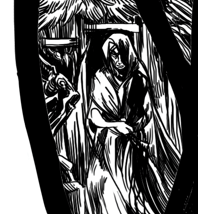
One Wing, One Eye, Chapter 4: Unwelcome Participants

“What the fuck is this?” Marko snapped, lifting his hood as he scuttled into Brill’s backroom infirmary.  He started as the Homunculus turned to face him.

“It may be more efficient,” the Homunculus said to Brill in its unnaturally even, unnervingly human tone, “if you were to gather all of the appropriate audience prior to further discussion.  It will save time on repeated explanations.”

Brill shook their head, beckoning Marko closer and stepping past him to draw the curtain that divided the infirmary from the rest of their shop.

“Now was that sarcasm?” they asked.  The Homunculus looked back to them, moving only its head and neck.  While seated, the construct remained almost perfectly still, save for the limited gestures it used to facilitate its stilted communication.

“Monk’s great at sarcasm,” Naples added.  “Gave us some real zingers on the way here.”

“Fucking wh–”

“Your name is ‘Monk’, then?” Brill asked, cutting off Marko’s outburst.

“I was designated the title ‘Homunculus’,” the construct replied.  “You may call me whatever you find serviceable.  This one has elected the moniker ‘Monk’.”

“Quick-witted as ever, Mr. Naples.”

“Isn’t this the guy you threw out of here two weeks ago?” Marko interjected.

“I did, yes,” Brill sighed.  “But when he arrived with my erstwhile charges, themselves safe from what al’Ver concurs as a harrowing journey to the Reach, I thought it perhaps worth our time to entertain some discussion as to how this discovery relates to the Crossroads.  As to why I sent for you, Marko, I trust you can see what is in plain sight?”

“Quit with the fuckin’ riddles and get to the fuckin’…” Marko trailed off as he scanned the room, his eyes focusing on the parting of Monk’s cloak.  “Motherfucker.  That’s the Keystone, ain’t it?”

“Indeed,” Monk confirmed.

“Ah…” Marko exhaled, somehow giving the impression of smiling and scowling at the same time.  “I don’t suppose you also brought Ehsam back with you, Naple man?”

“It’s, um, it’s Naples, thank you.  And no.  Ty Ehsam is–”

“Skulking about somewhere but not dumb enough to show his face, got it.”

Naples frowned momentarily before he realized the expression only served to confirm Marko’s cold read.

“Calm, Mr. Naples,” Brill said, noting the shape curled on the bed in the back of the infirmary, stirring.  “We are not in a position to turn Mr. Ehsam over to the Blaze at present, as much as we all would like to be rid of that threat.  And I imagine Commander Atra might try to sabotage such an exchange, from what Bleeding Wolf has told us of her goals.”

“So…?” Naples prodded.

“So it’s still best he’s in hiding,” Marko said.  “Us knowin’ about him’s the least of your concerns.  That still don’t answer my first question–” he gestured at Monk, “–the fuck are you?”

“Please explain again…Monk,” Brill added.  “The only person left who ought to hear is Bleeding Wolf, and I cannot say when he will be joining us.”

As Monk recounted its purpose–its scenario, the Alchemist’s plan to avert some prophesied end of the world–Brill idly wondered how credulous they ought to be at it all.  Though popular legend made Excelsis out to be a sort of magical genius–and Monk’s presence in their shop was perhaps even proof of that–they one thing they had never heard of magic having any success with was prophecy.  The histories they had read were dotted with accounts of charlatans who attempted to parlay spurious–though difficult to disprove–half-predictions into political influence.  But these histories all culminated in situations where those regimes with supposed access to magical foresight found ruin by pointedly unforeseen circumstances.

The Bloodfish’s rise completely obliterated the Highlord’s unsuspecting hegemony.  All the Sun Priests of Khet could not, apparently, predict the ascendancy of the Dead Queen.  And even the vaunted prophecy said to have fueled the reign of the Iron Queen of Spar–the sourceless and vaguely-worded “magic will destroy the world”–seemed, in the scope of history, to be little more than post-hoc justification for the Right-Hand Diarch’s consolidation of power.

And putting the conceptual issues with prophecy aside , the particulars of this one invited skepticism.  The Night Sky?  The Old Gods?  They weren’t real.  Sure, there was historical evidence of their worship, but people might worship any old thing.  The forces of Harmony believed Matze Matsua was an incarnation of some godlike spirit, but he died like any other man when he was gored by a roach.  Before the War, the followers of Le Marquains reportedly worshipped bulimia.  Hell, Bleeding Wolf still counted himself part of a cult that worshipped the color green!

The shape on the bed had sat upright, and Brill caught Devlin’s face, shaded by the boy’s tattered hood, staring, lidded with exhaustion but nonetheless fascinated by the construct’s locutions.

“And thus it is of paramount importance that the site of the Night Sky’s awakening be located expediently,” Monk concluded.  “It was Captain al’Ver’s belief that we might investigate that question here.  And Brill recommended we consult you, as you have expertise in creations such as myself.”

Brill nodded in agreement.

“What do you make of it, Marko?” they asked.  Marko shrugged, grimacing.

“What do I make of it?  I don’t sell abominations anymore,” he spat.  “Though…I’ve a few clients who–”

“Abomination?!” Naples exclaimed.

“Technical term,” Marko replied, distractedly calculating what Brill could only assume was a sales offer on their guest.  “Any artifact that seems to be alive.  Messy fuckin’ business, but–”

“Regardless, Monk is not for sale!”

“Indeed, Marko,” Brill interjected.  “My query for you was not regarding commerce.”

“Well then what the fuck was it regarding?  I don’t know shit about the Keystone–and I woulda bet you no one’s interest in it was more’n speculative in the first place.  And if you want my opinion on the end of the world story, it’s horseshit.  If the tinker toy here ain’t a commercial opportunity, I can’t fuckin’ fathom why you want my opinion.”

Brill glanced at Monk, but if the construct was alarmed or offended at Marko’s outburst, it did not show it.

“I was hoping, my friend, that you might consider this development from a different angle.”

“Talk straight or I’m leavin’,” Marko growled.  Brill sighed.

“Self-preservation, Marko,” they said.

“Eh?”

“The Blaze’s momentum toward us is being used to justify meddling in your business that you don’t much appreciate, yes?”

Marko held their gaze for a moment before nodding slowly.

“An’ you think that whatever prophetic interaction this thing has prepped can be used as leverage.”

“I have no idea whether such a thing is feasible, of course,” Brill added.  “But if it is, I would consider you best equipped to determine it.  Ideally before Atra does.”

Brill glanced again at Devlin, still staring from afar, half his face concealed by his hood.  The boy seemed different since his return, they realized.  He was still quite ill, of course, but beneath his labored breathing and evident weakness, a sort of grim determination had overcome his catatonia.  Brill could not imagine Devlin held any stake in the intrigue to which he was listening so intently.  They could only wonder where all that determination was aimed.

“So…who is this ‘Atra’, anyway?” Naples asked.  Before anyone could answer, the creak of Brill’s shop door wheezed from beyond the infirmary curtain, along with the sound of voices.  Brill motioned to Naples, who readily intuited the alarm in the gesture.  He quietly escorted Monk to the corner of the infirmary and draped the construct in a bulky canvas sheet.

“Now you must promise to rest, my dear,” came Lan al’Ver’s voice from the next room, followed by the trudge of approaching footsteps.  “Your journey has been arduous, and it is no weakness to admit it!”

“It seems there was no cause for concern after all, Captain…” Atra’s voice was fainter, trailing off as the door creaked shut again.  Then Orphelia drew the infirmary curtain aside, only to freeze as she beheld the veritable crowd within.

“Mr. Marko…” she said.  It was an almost-gasp, as if she lacked the energy to be properly surprised.  Brill noted with some concern that the aura of mischief she’d had in her brief visit to the shop a few hours ago had given way to a demeanor that seemed practically haunted.

Marko looked from her to Brill.

“Gonna go,” he muttered uncomfortably.  

He slipped past Orphelia and made his way out as Brill approached the girl, wary that she seemed somewhat far from alright.  Like Devlin, she seemed different as well.  Older, they decided.  By several years.  They could have sworn that she was a child when they took her in a few weeks ago, but now she seemed nearly old enough to be married.  That could not have been a lapse in attention, they thought.  There had to be something more…complex affecting the girl.

“What’s wrong, Orphelia?” they asked, setting aside their suspicions for now.  She shook her head, looking up at them vacuously.

“Nothing…” she said.  “You aren’t smiling.  And that’s…good.  Probably.”

***

This wasn’t good, Atra thought, reentering the jail.  She stood over the desk, shuffling parchment absentmindedly.  The girl.  Something was not right about the girl.  She could not tell what, and that by itself was perhaps cause for alarm.

Orphelia was indeed a mage, that was certain.  Bleeding Wolf had said as much–though he had deliberately omitted detail–but it was more than that.  Not a concrete observation, not a characteristic Atra could see, but a feeling: like a paranoid delusion that something was just over her shoulder, just out of sight, but only when she was near Orphelia.  That feeling was magic she had never seen before, and she had seen quite a bit.  

Never mind the shock of it, though.  She had researched the deep lore of the Riverlands extensively, and though the complication Orphelia presented was outside her expertise, it was unlikely to be outside her knowledge entirely.

A different angle, then: The girl had been traveling with al’Ver, “retrieved” from the Chateau de Marquains, as he had relayed to Bleeding Wolf.  This meant the girl had made a journey south…a week’s journey to the Reach, a week’s journey back with al’Ver.  The captain had been gone about two weeks, yes.  But so had the girl, according to a conversation Cirque had overheard from Brill.  Had he…chased her down to the Reach?  That was impossible.  No one could elude al’Ver on a river for a whole week.  His “experience” as a boatman aside, the magical forces involved in that proposition made the certainty of him catching her almost categorical.

Which meant he wasn’t chasing her.  He knew she would be at the Reach.  And if he meant to retrieve a teenage girl from the Chateau de Marquains of all places , she had to imagine his hurry would supersede his preference for conventional travel.

Which meant she wasn’t there in the intervening week.  She was merely going to be there at the end of it.

She had left the stream.

And the Chateau de Marquains…the Saraa Sa’een.  Fucking shit.

It was all Atra could do to keep from punching through a corner of the jailer’s desk.  It wasn’t a certainty, no, but if the girl was a locus of the Gyre, it would dwarf every other cause for concern she and Cirque had yet found.  Marko’s scrying attempts, Brill’s political feints, even al’Ver–an incarnate primal storm, albeit one she was pretty sure she could sidestep–all of these were minor distractions compared to the prospect of being warped into the circular story, the Smiling Lie and the Promised Vengeance.  Al’Ver could be convinced to stay out of things.  The Gyre, though, existed almost exclusively to meddle.

Her ears perked up at the telltale sound of skittering in the jail hallway.  Odd.  Cirque was early tonight.  She looked over her shoulder to see him stalk into the room, frustration more apparent than usual on his face.

“Weird stuff going on at the apothecary,” he said.  His tone was quiet but still cuttingly clear.  “Al’Ver came back with a talking construct that’s trying to find the ‘place where the Night Sky will awaken’.  Marko’s trying to use it to keep the mayor away from his toys, and it gets worse.”

“We might be in the Gyre right now,” Atra replied grimly.  Cirque stared at her, his frustration visibly giving way to worry as he slouched back against the wall.

“No shit.”  He paused.  “You sure?  You see the old man or something?”

“No.  Not yet.  But I’m fairly certain there’s a locus in this town.”

“So we might not be in it yet?”

“Right,” she said.  “But I’m not sure we have the luxury of keeping to the background right now.  An’ I hate to run.”  Cirque snarled at nothing in particular.

“Worthless town,” he muttered.  “Rotten scheme.  Can the Gyre be counteracted magically?”

“Hard to say.  Only information we’ve got is that’s ensnared many a powerful mage.  Catherine of Greypass was said to be one of the greatest Blood Knights of Kol.  Jin Gaenyan was supposedly formidable enough to have the Barabadoon on ‘is tail even before he became a monster.  An’ Feathermen records suggest even the bloody Masked Alpha got pulled in before the War.  But there’s ambiguity.”

“Ambiguity?”

“Did they get pulled in?  Or did they enter of their own accord?”

Cirque scowled.

“That’s a greedy fucking question.”

“‘Tis.  But we may never get a chance like this again.  The whole damn horizon’s dyin’, an’ a barren waste just won’t burn.  No fire for me, no feast for ye.”

“I hate this argument.”

“Come now.  Isn’t it exciting there’s a player in this game that might best us?”

“Two,” Cirque spat.  Atra raised an eyebrow.

“Pardon?”

“Two players.  The boy al’Ver brought to town–”

“Not the girl?”

No, not the girl.  The fucking boy.  He reeks of feathers.”

“…feathers?”

“Feathers, you arrogant musclehead.  Like the Feathermen and the Sadist.  Like Ka’s palace.  Like her.”
Dreamfish

Another flash-story in the same setting as The Praetor “From Thazan”.

You’ve never seen a dreamfish.  You think you can say whether they exist or not?  Shut your idiot mouth.  You can barely feel the mana you’re huffin’ on a good day–doubt you’ll even comprehend what the dreamfish are swimmin’ in.  Yeah. You gotta comprehend before you can see it–it’s backwards that way.

What?  Ain’t satisfied?  Tough shit.  I didn’t tell you that to convince you it was true.  I told you because it is true, and I hoped you’d hear it and then go the fuck away.  This is a sizeable establishment.  Go find some other corner to infest. 

But. 

You’re still here.  You’ll have to pardon me–it’s difficult to tell the difference between curiosity and envy these days, and no, I will not elaborate.  But you haven’t fucked off yet, and I’m thinkin’ you may have a mind to act on this, so fine.  I’ll share more.  Ain’t like it’s gonna hurt me.

So you ever met a Sunsinger?  Like one of those sleazy storyteller types with the “gather round! Gather round!” who’ll sit against the wall like that’un there and slur out some half-baked folklore while picking your pocket for ale?  Or maybe you just know the generic variety?  Whatever–bardic tradition is dying like everything else.  Even the generics are liable to break out the creation story, though.  You know: Night Sky dreams the world and three animals–three Old Gods–wheedle their way into its stewardship.  But then there are other stories–sometimes with the same gods, sometimes new ones.  Like the one where the Night Sky breaks the Fox’s nose.  Were they fighting–as the Diarchians told it–over the campfire he built or over the scarab he mentored in the Khettite myth?  Particularly: Were there Old Gods besides the three?

Short answer’s yes.

Longer answer, well, you get that the Blood God was just a mage, right?  A fucking strong one, yeah, you don’t just jump from drip-drinking mana to leveling cities, but he wasn’t the first one to brush up against the metaphysical.  What?  Does it seem so unbelievable that animals can learn magic?  That the world’s first super-mage was a fucking fox?  Keep your shoes on.  It gets weirder still.

History’s hard, and I’ll spare you the details, but it’s likely the Old God pantheon was way bigger than the old Kolai orthodoxy taught.  All the spirits and “gods” you heard about in the stories, the Scarab, the Moon Lily, the Wendigo: They were all probably rolling with capital G’s.

You…don’t get it?  Fucking godshell, kid.  If you take nothing else from this conversation, you ought to learn to read.

Anyway, obvious assumption: The world’s finite.  Where’d that come from?  Shut the fuck up and pay attention.  The world’s a dream, right, and a dream has a beginning, an end, and boundaries: limits in psychic time and space.  The substance of the world is mana, death, not an especially great outlook, but that ain’t my point.  My point is: What happens at the end of the world?  Is there mana and then, just, nothing?  Don’t give me that “no one’s ever seen the end of the world” crap.  It’s a fucking embarrassment.

Kid, we’re in Piraeus.  If you wanna see the edge of the world, go outside and just look west.  It’d be one thing if no one who sailed over that horizon ever returned, but I challenge you to name one person who ever tried.  You can’t, right?  You think maybe someone has to have had this idea before because it’s so damn obvious, but I’ll let you in on a little secret: Lots of people have sailed west before.  You don’t remember them because they aren’t in the dream anymore.  Oh, they’re dead too–that ain’t ambiguous, but we’re getting to it.

So engrave this in your memory: I’ve gone there.  It don’t look like much, not to your eyes, just open water and clear-ish sky, but if you’re attuned to it, the mana out there is strange.  It’s not nothing, but there’s a gradient, a blurry, gradual frontier where the death loses its structure.  It stops making things, stops enforcing causal relationships.  And it’s hard to perceive, even if you can channel mana, because more than likely it’s taking all the focus you’ve got to keep your mind from unraveling.  Buf if you somehow get that down, all you gotta do to see them is look up.

They’re everywhere out there.  Dreamfish.  These swirling loci of that proto-mana, maybe just eddies in the entropy that laps at the border of the Night Sky’s mind–but they’re stable enough to persist for awhile.  And make no mistake, they’re fucking dangerous.  They’ve got these tentacles dragging from ‘em, and if they touch you, they’ll spiralize your soul, take your essence and slurp it like chowder in a whirlwind.  The fuck is that metaphor?  It’s messy and ugly, just like the process.  Should watch it sometime.

So that’s why you can’t see ‘em.  But that ain’t why you’re asking, is it?  This ain’t about me and my crazy talk.  You’re bothering me because you heard about dreamfish out there, and you heard about dreamfish out there because of Legion.  The Cult’s schism has blown this whole business public, and now crazy Edward’s crazy stories aren’t so crazy anymore.  Fuck you all, it was easier when you thought I was crazy, because now you think I’m important, but you still aren’t going to listen.  You think that the problem is that Legion’ll swarm the Hospitality Quarter again or some other nonsense, because you can’t bear another look into the infinity mirror of the society you chose.  You can’t stand knowing that you’re all the same.

No, the problem is the Cult.  The problem is Glaucus.  The problem is the Old God we found out here at the edge of the world eating dreamfish–the Old God who we couldn’t just leave alone.  The problem is that half this city is high on a kraken’s dandruff and can’t give up the notion that their psychoplasmic degradation must mean something.  You can take it or leave it, but the truth is it ain’t worth shit.  You’ve been offered the Terminal Man’s product by now, yeah?  My advice is you fucking decline.  Only thing down that way is suffering and an eventual cessation of existence.

Oh, what is that sneer?  A tepid fucking thing, like you wanna fight with an “or flight” in parentheses.  Had a taste, have you?  Carry the fuck on, then.  I know where you’ll end up eventually.  It is inevitable.

The Praetor “From Thazan”

A short story I speedwrote as part of a setting document for an upcoming project.This is set in the world of Rale (like Three and Two and Two) but several centuries earlier.Again, a reminder that Promises for a Worse Tomorrow and Three and Two and Two are both heavily discounted on all formats and platforms until the end of January.If you haven’t picked one of them up yet, now is a perfect time!

No one in Piraeus remembered when exactly Halia Eleria–called “the Thazanian” by her detractors–arrived.  It wasn’t so simple as her becoming an irreplaceable fixture of the city, though she seemed on her way to accomplish that.  Rather, just as no one could pinpoint the timeframe of her arrival, everyone was dead sure it wasn’t that long ago.  Everyone could remember a time when she hadn’t been there, though Piraeus’ most introspective folk certainly found it odd that they couldn’t remember any specific event that occurred during that time.

Still, it was damned obvious she wasn’t from around here.

The “Thazanian” thing reportedly came from her own mouth.  Eavesdroppers to a conversation between her and Praetor Cleonar at the Calibratory Festival two years ago–or was it three?–reported a discussion of her childhood in Saltstill.  Thazan, the Khettites used to call it, back when Saltstill was a Khettite city, though Halia didn’t much look like a Khettite, Grayskin or otherwise.  Meanwhile, in a speech to the council last year, she cited her experience managing a famine in her home village to the East, in old Kolai territory.

Ultimately, the most convincing account of Halia’s ancestry arrived by way of a rhetorical question from old Edward the Pirate during one of his drunken rants at the tavern in the Fisherman’s Quarter:

“Does it fucking matter where she’s from?  You have a place in mind that’ll make her trustworthy?”

This argument didn’t satisfy anyone, exactly, but few could argue with him.  Indeed, no one trusted Halia, though the reasons why this should be the case were varied and nebulous.

Her politics hardly raised eyebrows.  By every account, her ministry over the city’s aquaculture and trade, to which she had been appointed over her own objection by Praetor Pierron, had saved thousands of lives last summer during the siege by the forces of the Revián’s self-proclaimed Highlord.  There was a superstitious handful that blamed her for the ensuing plague of ectoplasm that now ravaged the Hospitality Quarter, but these accusers held that the plague was divine punishment for the cowardice the city had shown in refusing to mount a counteroffensive against the Highlord.  Anyone keeping score could point out that Halia had abstained from the Council vote which had sealed the gates that summer–how could she be blamed for a decision she had not supported?

Unseemly though it was, the most pervasive criticism against Halia was for her appearance.  None could accuse her of neglecting formality, but her ubiquitous wardrobe, the impeccable silken tunic, hose, and long gloves, the heavy cloak she wore over them–they were all too pressed, too clean, too white.  And they covered everything from the neck down.  Not even her eyes were visible, as she was in the habit of wearing spectacles with dark-tinted glass, even indoors.  It was uncanny, many thought, and her still, perfect poise gave few if any reminders that what lay beneath all her finery was especially human.

Indeed, there was a vocal minority that claimed she was actually not human.  Some said she was a mermaid, hiding her disfigured fish-body beneath all that silk.  Others speculated that she was some sort of crocodilian face-stealer, that her anatomy was human enough, but her too-still posture and too-sharp teeth betrayed what lurked beneath her pilfered skin.

Few listened to Edward’s observation that what she had “stolen” was capital in nature: Over the course of the wars with the Highlord, more and more of the city’s industries seemed to be pulled under the financial auspices of Halia’s affiliates.  The fishery had become a funnel to a single intermediary buyer, the navy had contracted its supply lines to Halia’s merchant captains, every single stall in the Market Quarter was now owned and rented out by trade companies who could, if placed under the appropriate duress, provide documentation linking their provenance to a certain alleged Thazanian.

The rumors and accusations against Halia never stuck, of course.  Her control was never obvious.  She was no crocodilian.  She never seized what she wanted to hold, never bit what she wanted to consume.  She merely drew close, helpfully reached out, and slowly, nigh-unnoticeably, drank it.

One Wing, One Eye, Chapter 3: A Restless Homecoming

But this has not yet become a story about the knife.
Three and Two and Two

“Godshell, I–I don’t even know what to say, Dog Boy.  This is beyond the pale.”

“I don’t either, Gene,” Bleeding Wolf muttered, ducking in through the door to the jail.  “It’s why I came here.  To figure the details.  Sort my thoughts.”

“That ain’t what I mean!” Gene retorted, loudly enough to catch Michel’s attention from behind the warden’s desk.

“Evening gentlemen,” he called.  “What brings you, uh, here tonight?”

“Town business,” Bleeding Wolf replied.

“The shell it is, Dog Boy!” Gene interjected.  “There shouldn’t be nothin’ to figure!”

“What sort of business?” Michel asked, frowning.  “Incidentally, Anita and I did want to thank both of you for helping out as much as you have these last few days.  It’s taken a load off both of our backs.”

“Don’t mention it.”  Bleeding Wolf didn’t much care for effusive thanks, but he was happy to help.  “This place is home for me, even if I’m given to spend time away.  Anyway, Gene, if there’s nothing to figure, then who would you fork over to the whitefrocks?”

“No one!  That ain’t our right!”

“That’s neither an option nor your call,” Bleeding Wolf growled.

“Uh, what’s all this then?” Michel asked, taking a nervous step back as the argument reerupted.  Bleeding Wolf raked his claws through the stubble on his face.

“I’m sure word was gonna reach you soon enough,” he said.  “Meetin’ with Holme went…meh.  Sculptor wants a sacrifice in exchange for the Holmite lives lost.”

“But…didn’t they attack you?”

“Yep.  John wants to keep ‘em happy, though.”

“They don’t get to demand our blood if it was their fault!” Gene objected.

“I mean, right,” Michel agreed.  “They shouldn’t…well…”

“Well, what, son?” Gene spat.  Bleeding Wolf put a hand on the old man’s shoulder as Michel frowned, nervous.

“There is the Masson boy,” he said.  “He’s still here.”  Bleeding Wolf raised an eyebrow as Gene’s face fell.

“Masson?” Bleeding Wolf asked.  “What’d he do?”

“Vince Masson,” Michel clarified.  “Young man set fire to his house a few years ago.  His family was inside, and the fire spread too.  Took out a whole district.  Ten or so died, dozens more were hurt.  Kid was sentenced to hang.”

“But he’s still here?” Bleeding Wolf asked.  Michel shrugged.

“Mayor Bergen commuted all death sentences when he was elected.  There was a vocal portion of the town that thought we were going too far, killing a sixteen-year-old.  So Mayor Bergen changed the sentence to jail and mandatory labor.”

“For how long?”

“Rest of his life, which…”  Michel glanced back toward the hallway which housed the jail cells.  “Which isn’t great logistically.  This place wasn’t made to have permanent tenants.  We’ve had to hire temporary jail guards, put him fully in the care of the caravants he’s working for–not totally humane, those contracts.  They treat him like an animal, and he’s come back a few times with serious injuries that Brill has had to treat.  I’ve wondered a few times if it would’ve been kinder to just follow through in the first place.”

“An’ now it’s convenient to flip-flop, John’s doin’ it,” Gene muttered.  It was a fair point.  Though that didn’t mean it was the wrong answer in this instance.

“Politics, indeed,” Bleeding Wolf growled.  He agreed with Michel, for what it was worth.  It sounded like the kid did a bad thing, probably for bad reasons.  If the town wanted to kill him, they were well within their rights, but this “leniency”, the process, the spectacle of it–bigger pieces of shit marched through the Crossroads every day, and the seriousness with which the mayor pretended at justice here felt like a mockery.  It almost did feel kinder to hand the condemned man over to Holme.  Except Bleeding Wolf knew what the Holmites did with their sacrifices, and he suspected Mayor Bergen did not.

“A town meetin’ in the gaol?” came the twisting syllables of Atra’s accent from the doorway.  “I must’ve missed quite the development today.  Michel, here to relieve ye.”

Bleeding Wolf turned to regard the woman sweeping into the room.  He knew that at this point, Commander Atra enjoyed quite a bit of the Crossroads’ respect, and he could see why.  By all outward appearances, she was a reassuring protector.  Even-tempered, muscled, battle scarred, yet still clearly in her prime.  Bleeding Wolf trusted her about as little as it was possible to trust an ally–and less than many enemies.  When they met, he had caught a glimpse of the magical power she was somehow keeping hidden.  He was certain that she had not accumulated that much death from even-tempered protecting, but what she had told him of her goals–forthrightly, honestly, that she wished to meet the Blaze in battle–made no fucking sense.  And he had a feeling that she was dragging the Crossroads into the fire more than she was shielding it.

“Thank you, Commander,” Michel said with a respectful salute.  “Have a good evening, gentlemen–I’m sure that you and the mayor will come to a reasonable solution.”  Bleeding Wolf waved him a halfhearted goodbye and faced Atra.

“What ‘reasonable solution’ are ye debatin’ then?” she asked.

“You want me to believe you don’t already know?” he growled back.  Her calm smile somehow made him feel both remorse for the sudden aggression and even more anger for the accusation’s little visible effect.

“I’m runnin’ a militia here, Bleeding Wolf, not a spy network.”

“And yet.”

Atra shrugged, walking past them to the warden’s desk.  She lifted a piece of parchment with a convincing veneer of assiduousness.

“Mr. Jens spent his 24 hours here,” she muttered.  “Best be lettin’ him out tonight.”  She looked up.  “Yer deliberation’ on whom to send to Holme, then?”

“You have been spyin’!” Gene snapped, almost shouting.  “And we ain’t sendin’ nobody!”

“Well, Bleeding Wolf’s right, and there’s no point hidin’ it: I do keep informed.  But ye’ll forgive me for takin’ a turn at disbelief, seein’ as the decision of whom to send isn’t yers to make.”

Gene’s face slowly reddened as he grasped the meaning of Atra’s roundabout phrase.

“It isn’t mine, either,” she added, lifting a keyring from a hook behind the desk.  “So there’s little warrant for the blame yer bringin’ to me, Gene.”

And yet.  Bleeding Wolf didn’t need to say it again–the thought hung in the air obviously enough without additional vocalization.  He couldn’t tell if his intuition was being clouded by what he had discovered of Atra’s prowess–by how incredibly intimidated he realized he was–but he couldn’t shake the notion that the particulars of the arrangement with Holme were material to her interests.  It was obvious that she would want an arrangement with the Sculptor’s military, of course, but what made no sense–and yet seemed inexplicably evident–was that an offering of one of the Crossroads’ own to those horrifying statues was exactly how she wanted it to go down.

If she was concerned by Bleeding Wolf’s anxious calculus, though, Atra did not show it.  She simply returned his pensive glare with a pleasant smile and left the room, proceeding down the jail hallway, keyring jingling as she walked.

“I’m startin’ to get damned tired of everyone tellin’ me my opinion don’t matter,” Gene muttered quietly.  Bleeding Wolf listened as the metallic jingle receded to the far end of the hallway.

“It’s a distraction to think of it as an insult, Gene,” he replied in a similarly low voice, though he doubted there was anything they could do to prevent Atra from eavesdropping at this range–even Bleeding Wolf’s magic was capable of augmenting his hearing enough to catch isolated whispers fifty feet away.  “If you look at the big picture right now, you’ll notice that no one’s opinion matters that much.  I don’t know if you realize how much political fuckery it takes to engineer a situation that everyone disagrees with but no one can gainsay.”

Gene raised an eyebrow, evidently rattled, though he didn’t have time to respond.

“Gentlemen!” a voice boomed as the jail door slammed violently open.  “I have need to interject upon your arrangement with Holme!”  Bleeding Wolf whirled, annoyed at what was becoming a stream of interruptions, as Lan al’Ver glided through the doorway, brandishing his umbrella like a showman.

“Where the hell have you been?” Bleeding Wolf spat.

“The Chateau de Marquains, Mr. Wolf, retrieving our dear Orphelia and more–”

What?!

“Pay attention!  You are to travel to Holme, and we shall join your caravan.”  Bleeding Wolf blinked.

“To…Holme?” he asked, winded.

“Indeed,” al’Ver continued dismissively.  “To secure the iron you promised the Doctor’s ward.  Have you forgotten your own priorities in this crisis?”

“Crisis?  How do you…?” Bleeding Wolf sputtered.  He shook himself, rapidly reacclimating to al’Ver’s infuriating gift for putting him off balance.  “We aren’t going to Holme!”  Al’Ver rolled his eyes.

“Of course you are,” he said.  “There is no one here you trust to take charge of that exchange.  You will be going there, and as momentous events await beyond that bend, I will be accompanying you.”  There was a moment of silence.

“Did you say Orphelia was at the Chateau de Marquains?” Gene finally asked.

“Now yer to go straight home.  No stops at the tavern–ye worried yer family bad with this last stunt, so don’t ye go worryin’ them more.”  Atra’s voice preceded her entrance from the hallway, escorting a gaunt, disheveled man whom Bleeding Wolf did not recognize but assumed was the “Mr. Jens” mentioned earlier.  “Ah,” she said, looking to the three of them.  “Captain al’Ver, welcome back.”

Al’Ver was silent for about a second longer than the greeting warranted.  Bleeding Wolf glanced back at him and noted that–for perhaps the first time in his memory–Lan al’Ver seemed surprised.

“Atra, my lady,” al’Ver said belatedly, though with recovered composure.  “It is a pleasure to see you again.”

“You’ve met?” Gene grunted.

“Had the good fortune of meetin’ the Captain on the way here,” she replied with a smirk.  “As I understand many do.”

“Indeed,” al’Ver corroborated disinterestedly.  “But once again, you have me at a peculiar disadvantage: I did not expect to find you here, and so I am unsure what to make of it. –”

“The mayor here issued a call for fightin’ folk to train a militia while ye were on yer latest voyage, Captain…”

Bleeding Wolf stared at Atra as she explained the situation, Bergen’s nominal concerns, progress in the Blaze’s advance in the weeks al’Ver had been gone, all of it logical and intuitive.  Al’Ver nodded politely, adding his stupid, self-important quips and affirmations as he would, but Bleeding Wolf had heard it: the jolt at the end of his expression of confusion, as Atra offered her explanation just slightly too quickly.  It was impeccably smooth, but she had interrupted him.  Why?

“If you don’t mind,” Bleeding Wolf said, reentering the conversation amidst a somewhat off-topic discussion of Holmite idiosyncrasies, “I would like to hear the end of al’Ver’s question.”  He looked at Atra.  “The one you cut off.”

“Oh, I’m sorry, Captain!  Did I interrupt ye?”

“It is Captain al’Ver, Mr. Wolf,” al’Ver rebuked.  “And there is no need to be rude.  The commander’s explanation was perfectly sufficient.

Bleeding Wolf scowled but did not reply.  He was going to have to pry less directly if al’Ver was going to be a pill about it.

“In any case,” al’Ver continued, “this has been a serendipitous reunion, surely, but my work lies elsewhere.  We have our objective, Mr. Wolf!  Now I must determine where Orphelia has gotten to.”

“Oh no,” Gene mumbled.

“Orphelia?” Atra asked.  “I recall mention of the name from Brill when I arrived.  Is the girl prone to trouble, perhaps?”

***

Orphelia had not intended any trouble to come from her visit to the tavern.  She really only wanted some mulled wine by the fire–and to spend the two pieces of silver she had pickpocketed from Mr. Naples before he realized it was gone.  But now that she was there, it was getting difficult to resist.

Part of it was boredom, yes.  She knew it was.  The last several days on the water had not been mentally stimulating, in spite of the cool cave Captain al’Ver had found with Ty and the weird metal man who had joined them.  And she was starting to appreciate that her reactions to boredom were perhaps more of a burden than she really wanted to inflict on herself or others.  Listening to Mr. Ruffles that day she had left the Crossroads had put her and Devlin in danger–far more danger than she had even realized until Ty and Naples’ explained what the Chateau de Marquains was–and she wasn’t eager to do that again.  But she was still bored.

The other part was that the happenings at the tavern tonight were making her really curious.

It wasn’t an especially busy night.  Multiple large caravans had apparently just departed, and the room was spotted with empty tables.  But one patron, a tall, bulky, middle-aged man in ill-fitting clothes, had gotten sloppy drunk and was proclaiming loudly to anyone who would listen that during the War, he had become known as the “Taker of Skulls” for his combat prowess–or his roach body part collection, or just a habit of decapitating any corpse he came upon as an offering to the Blood God.  It wasn’t really clear to Orphelia, but as far as she could tell, it also wasn’t clear to him.  The man seemed confused, and his fit of bravado likely would have guttered quickly had Orphelia not sat down beside him and–to the barkeep’s chagrin–began requesting elaborations on his various boasts.

“I killed a hundred men at Bloodhull!” he roared at one point.

“Oh, so you were fighting for the bad guys?” Orphelia asked.

“What?!  Of course not!  I fought for Harmony!  Matze Matsua was right next to me, he was!”

“Then why’d you kill all those people?  Weren’t the bad guys mostly roaches and those tongue things?”

“Well…”

Orphelia didn’t know whether she was asking after real historical details or simply playing along with this weirdo’s delusions of grandeur–the stories her father had told her about the War of the Roaches always did seem rather fanciful.  But either way, it didn’t seem like this guy would know.  He didn’t look old enough to have actually seen the war, and he seemed too stupid to be a mage like Dog Boy.

Or like her, she supposed.

She was still processing what had happened at the Chateau de Marquains, Mr. Ruffles’ task, what he had said about her abilities.  Could she still call him Mr. Ruffles?  She wanted to, but there was a part of him now that she couldn’t force back into the stuffed animal her father had given her.  The spectral man who had guided her to the Saraa Sa’een.  Romesse of Khet.  Rom, he had called himself.

Captain al’Ver didn’t seem to trust him, but it didn’t seem like Rom had lied: She was able to do magic.  Mr. Ruffles didn’t talk to her the entire trip back, didn’t give her any instructions, but she had tried to do the things he had helped her do before, pushing away Naples’, Ty’s, and the metal Homunculus’ notice while she skulked around the raft, stealing things which she usually gave back.  It worked.  Sort of.  For a while.

It didn’t work on Captain al’Ver at all–he seemed to have an eye on her whenever she was near, whether she was attempting to “channel mana” or not.  And then, after a time or two, Naples caught her trying to lift his notebook.

“When you do that,” he said, gently taking the book from her hands, “people around you can sense the mana that you’re pushing at them.  The reason it works most of the time is because they aren’t paying that much attention–not unless they know someone’s close.  Or trying to steal their stuff.

“But once they’re actively looking for you, it takes a lot more effort to keep them from finding you.  Heck, that’s why Master Faisal taught us to look for shadow-walkers before teaching us to shadow-walk ourselves.”

It turned out that both Naples and Ty knew how to do some of the things Rom had guided her through.  It was a rare school of magic which, Naples explained, originated with a “separatist sect”–or something like that–from the city of Khet.

“Where is Khet, Mr. Naples?” she asked.

“Oh, nowhere anymore.  It used to be way north, in the desert past the Gravestone mountains, but it was destroyed centuries ago by the Blood God.”

“The who?”  Naples laughed at this.

“Do you actually want to learn some history, Orphelia?”

She did not, though she did think that the “Blood God” sounded like a cool name.  Now, though, as the “Taker of Skulls” kept going on about how the powers of the Blood God strengthened him or whatever, she slightly regretted not asking about it when the opportunity was there.

“I even got some proof I was there,” the strange man grunted eventually.  “Ya see, I was in the vanguard at the assault on Roachheart after Bloodhull fell too.  Was the first one in the room where Ka done killed ‘imself.  Stodgy bastards wouldn’t let me take his head, but I did get this!”

The “Taker of Skulls” drew a small knife from a sheath at his belt and embedded it into the bar with a loud THUNK.

“The very knife he cut ‘is throat with!” he proclaimed.

Orphelia wasn’t sure what she was supposed to be impressed with.  The knife was visibly rusting, and the blade appeared to be loosely joined to the handle with twine.  The barkeep was even more unimpressed.

“Alright, I think you’ve had plenty,” she said, glaring at the new notch in her bar.  “Time to go!”

The “Taker of Skulls” slammed his fist against the bar and roared something back, but Orphelia was only dimly aware of it.  She realized with equal parts fascination and concern that despite the knife’s innocuous appearance, she couldn’t take her eyes from it.  And the sounds around her had faded.  It was as if the substantial din of the tavern–of the argument ongoing right beside her–had become background, replaced not by different noise, but by intrusive thought:

Take it, her instinct told her.

Take it.  Take it.

Take it.

TAKE IT.

The part of her that was concerned was now, of course, alarmed, but she had no other reason not to take the knife.  So she did.

The silence and stillness fell so immediately that she felt she had been struck.  But nothing had touched her.  She pried the knife from the bar, considered it, noting that it was indeed a shoddy, unremarkable piece of work.  But then she noticed that the tavern around her had not merely stilled.  It had changed.

The barkeep was staring at her.  No.  No, everyone, the whole tavern was starting at her, but for some reason, as she glanced, panicked, back and forth, she couldn’t seem to focus on their eyes.  All of their faces were…the same.  And every single one of them was smiling, teeth bared.  At the back tables, some of them began to laugh, quiet peals of high-pitched cackling echoing across the room’s high ceiling.  And then a whisper, chime-like, consonants clicking, inches from her ear:

“Awake from your dream, child?”

She sat bolt-upright, suppressing a shiver, and whirled.  No one was there.  Rather, the tavern was there, its warmth and noise suddenly returned, and not a single person was looking at her.  No one was smiling.  At least no one was smiling like that.

Next to her, the barstool where the “Take of Skulls” had been sitting was empty.  The barkeep looked up from the cask of ale she had just finished tapping.

“You alright, sweetheart?” she asked.  “Need more wine?”

Orphelia shook her head, dazed.  Then she looked down at her hands.  She was still holding the knife, and, despite its dubious construction, it felt light and comfortable in her palm.  She glanced at the notch in the bar where the man had plunged the knife moments before.

“Excuse me, ma’am,” she said to the barkeep, gesturing to the empty stool.  “Do you know where the man who was sitting here went?”  The barkeep frowned.

“You sure you’re okay, hun?  That seat’s been empty all night.”

Orphelia stared at her, feeling a pit in her stomach.  She nodded slowly, tucked the knife into a pocket inside her dress, and slid down from her stool.  Saying nothing to the barkeep, she placed Naples’ two pieces of silver on the bar and made her way to the door as quickly as she could without sprinting.

The air was cool and wet outside.  Calming.  Traffic was light, but the street was far from empty, which was good: What happened in the tavern had left her unsettled, somehow, by both crowds and solitude.  She took a deep, nervous breath.

What was that?  Did it have to do with that weird Skull guy?  With the knife?  And where did he go?  And why did she keep the knife?  Ooh.  She had no answer she could frame in words, but even the thought of discarding the knife struck her with overpowering dread.  The voice…the knife, for some reason it was all settling, familiar, in her mind.  She didn’t like that.  She knew it wasn’t familiar.  She knew she had never seen it before.

“Orphelia, my dear!”

The voice calling from the busy end of the street was familiar too.  But it was the right kind of familiar.

“Captain al’Ver…?” she muttered, turning, dazed, toward its source.

“Orphelia, what’s the matter?” Captain al’Ver asked, drawing closer.  Behind him, she saw old Gene and Dog Boy approaching as well, along with a tall woman she had never seen before.

Orphelia didn’t reply.  She just shook her head, the air in her lungs feeling fuzzy amidst the comedown from the panic.  Gene exchanged a glance with Bleeding Wolf, who ducked quickly through the tavern door, only to reemerge a few seconds later with a shrug.

“Seems normal in there,” he said.  “What’s gotcha spooked, girl?”  Once again, Orphelia had no words.  What could she say?  How would she even begin to describe it?  Captain al’Ver frowned, looking down at her empty hands.

“Where is your stuffed bear, Orphelia?” he asked quietly.

“Left him at Brill’s,” she replied.  The world’s resolution was coming back.  She could breathe normally again.

Still, she thought, better not tell Captain al’Ver about the knife.  Better to save it for a surprise.

Oh no.

That thought had not been hers, but try as she could to contradict it, she could not.

The Dreamer’s Rhyme

A rhyme that will likely appear in some form in $20,000 Under the Sea, revealed to me, perhaps ironically, in a dream nearly a decade ago. This is the version that has bubbled up after some 10 revisions. There is a particular, if obscure, lyrical inspiration, though I’m not sure how apparent it is at this point.

On darkest side of darkest Dream
The Dreamer softly sings
He wraps himself in gilded thought
And robes and eyes and wings

One man has seen the Yellow Sign
The other never will
In synthesis they reckon with
The world He means to kill

So watcher if you like the glass
That shatters in the sky
Show me what you’ll trade for it
This hour before you die

Give me the fire in your heart
And the shards of Dream shall be
Smoothed for you, made glassy eyes
Through which, at last, you’ll see