Notes on the LaSein Account, Part 5

The same altered-knife symbol as the previous entry, appended with two tally marks.

The events immediately following my previous entry are rapidly decaying to something of a blur in my memory, but I will endeavor to recount them as accurately as possible.  Upon realizing my oversight (which, in retrospect, could hardly have been blamed on me despite my feelings of foolishness), I rushed to assemble a unit of guardsmen, and, having done so, I proceeded to the LaSein estate in order to apprehend the old man I now understand to be Arman LaSein.

My greeting there was not so warm this time, though not for any hostility on the part of the estate.  Perhaps it was our lack of appointment or the armed demeanor of the guards, but beyond distant acquiescence from the servants, we were not greeted at all.  Rather, on our own, we found Arman LaSein in a far-flung parlor, playing some sonata on an old grand piano. He informed us, without interruption to his melody, that the Captain was unwell and would not be able to entertain that day.

I of course replied with the truth: We were not there for the Captain.  As he nodded, still playing his music, I directed the guards to arrest him, but they would not.  The sergeant just shook his head at me and departed. His subordinates followed, leaving me dumbfounded in the parlor when, at last, LaSein stopped playing.  Unnerved but undeterred, I asked him a number of questions there, but still I cannot help but feel that his answers have not substantially enhanced my understanding of the situation.

I asked him what he had done to the guards–he said he showed them the truth.  I asked why he was here in the city–he replied it was to persuade his daughter to cease her patriotism.  I asked him what any of that meant, and he just sneered, asking me in return why I thought he was bothering to answer my questions at all.  Without waiting for my response, he began to play again, a cyclical series of variations, alternating between dissonance and harmony. After a few moments, he elaborated:

He stated that he had devoted his life to the study of a particular pattern, and he had returned to Thago to answer the question of whether that pattern might be able to be broken if its components were simply made aware of their preordination.  I remained bewildered as he bade me farewell, but then he issued a pointed suggestion: “Why don’t you write it down?”

That is what I am doing now, though I must confess I feel no wiser and all the more discomfited by Captain LaSein’s impending fate.

Notes on the LaSein Account, Part 4

Another date symbol, altered only slightly from the previous one.

It seems Captain LaSein has additional secrets the Shareholders would prefer buried.  I met with Prince Cotnoir today to raise my concerns regarding the timing and publicity of her trial.  He was not receptive, but as he understands my concerns to be related to his own safety, he did share with me the reason for his beliefs.

This is, according to the Prince, the third time that Euphonia LaSein has emerged with her life from a massacre, each one very costly to the Federation.  The second was, of course, the incident with Ignigoet, but the first predated it by nearly twenty years, well before my time, indeed before any of the present Shareholders had reached their current positions.  LaSein was only a child, but it was then that her father, Arman LaSein, was put on trial for unlawful magical experimentation.

The crime is familiar to me: I have known Riverwalkers to occasionally develop an unhealthy interest in the occult, and I have personally presided over investigations into those uncommon cases of mages acquiring an interest in the dissection and other subjection of human specimens in their research.  The penalty for such actions is of course death, and this was precisely that prescribed for Arman. According to the records, he was executed in the third week of the harvest, nearly forty years ago. I was aware of this conclusion, aware as well that Captain LaSein’s military career was no doubt stunted by her inauspicious parentage.  I did not hold it against her. What I did not realize was the extent to which the former Shareholders had been able to obscure the true narrative of Arman LaSein’s execution.

The Prince was in the audience on the day of the old mage’s hanging, had been brought there by his own father, and all seemed to go according to plan until the moment the block was kicked from under LaSein’s feet.  As he dangled there, the Prince told me, Arman LaSein did not kick, did not thrash, indeed, did not die. He simply stared with “eyes like coal” upon the crowd, and as he did, the hangman, the guards and magistrates, all in attendance who facilitated the execution fell to their knees and died with rope-marks about their necks.  Amid the screams, the Prince did not see what became of LaSein, but when the commotion finally settled, the old man was gone.

It is his opinion that a pattern has emerged, and the danger posed by Euphonia LaSein’s continued citizenship in Thago is greater than any possible threat she may profess regarding the defeat of her float.

I do not know if I agree with him–I feel that Captain LaSein’s account still merits preventative action–but it does not appear the point is negotiable.  Even so, I am far, far more concerned by the fruits of my visit to the records office following my appointment with the Prince. I sought to glean background on his story in a report on the precise crimes of Arman LaSein, but my eye was taken by sketch of the man appended to the main document.  I have seen this man before, in the LaSein estate, barely a week ago. I mistook him for the butler.

Notes on the LaSein Account, Part 3

A third date symbol, resembling a small blade.

Charges were brought against Euphonia LaSein today by Prince Cotnoir on behalf of the Shareholders.  I understand their reasoning. News of defeat means the riverways aren’t safe. It scares investors, or it would if it were a sign we were not handily winning our war.  Thus, the reason for the destruction of Captain LaSein’s float must have been isolated incompetence on the part of her crew, and as her crew is entirely absent–almost entirely confirmed dead, by her account–the scapegoat must be Captain LaSein herself.

I do understand, and I understand as well that the Federation’s fortunes may have a bearing on the outcome of this war beyond the Shareholders’ personal profits, but the particulars are most inconvenient.  From a strategic perspective, the LaSein account may indicate an actual threat from the Diarchy of Spar that we ought to mitigate. If Captain LaSein’s credibility is crushed here, I will lose most of my ground for argument on that point.  Unfortunately, I fear that is exactly what will happen.

My research subsequent to my meeting with the captain has yielded a disturbing connection.  The current commander of the Diarchian pseudo-military in the Revián is a man who goes by the name Selenus Ignigoet, and though it is not widely spoken of, he served in a security company in Thago some decades ago under the command of the very same Euphonia LaSein.  Evidently he betrayed his unit, leaving LaSein as the only survivor, stole a cargo skiff, and bolted north. Though it is clear from the record that LaSein was in no way involved in this mutiny, it remains a point of curiosity that Ignigoet did not kill her as well. I did not have to search hard for this information–I have little doubt it will be raised in her trial.

Also, though Captain LaSein did not raise this connection as a factor for her concern in her most recent report, I suspect it is very much relevant.

Notes on the LaSein Account, Parts 1 and 2

At the top of the page is a smudged symbol that may indicate a date.

I have received word of a costly skirmish in the northern reaches between one of our peacekeeping floats and an enemy raiding party.  Diarchian, according to the scouts. The presence of the troublemakers in the area is of course no anomaly, but the outcome was apparently dire: They sunk the entire float.  Barring the amassment of a far more significant force than we anticipated–a possibility the scouts’ report attempts to discredit–this is highly irregular.

The captain of the vessel was one Euphonia LaSein, and it seems she escaped with her life.  The scouts found her maimed and delirious. Her recovery will likely take some time, but I am eager to hear her report as soon as possible.

A second symbol marks the top of the next page.

I have decided that I will compile these notes separately from my regular reports to the Shareholders.  Captain LaSein’s account unsettled me, and I fear spreading it might induce a panic in the barge-districts we ought pointedly to avoid.

I had an opportunity to visit the LaSein estate on the northern plaza two days hence, and I found the captain there in a sorry state.  She was confined to an infirmary chair, wheeled by her butler, as during the battle for her float, her leg had been crushed beyond any hope of healing.  The scouts amputated it in the field. This war is a sordid business, and I shall be well glad to be rid of it when Spar is finally crushed. Still, though, the captain spoke very little of her physical state beyond those spare facts explaining her disposition.  Her worries seemed to lie elsewhere.

She confided in me a disturbing theory.  That her forces were defeated in the first place she was able to explain: The Diarchian raiding party attacked in the midst of a mutiny by the float’s slaves.  However, that they were ready and waiting for the opportunity, indeed that they were even aware of the mutiny merits further examination. Captain LaSein posited that a portion of the slave crew–a group of ten or so that the float had captured while following a lead in the Windwood–had been deliberately planted by Spar.  The slaves, in her opinion, had an unusual level of military training and cooperation, and the timing of their revolt alongside the raiding party’s assault could not have been a coincidence.

It is clear she fears the Diarchy may attempt a similar tactic closer to the Federation’s primary holdings, perhaps even within Thago itself.  While I do not wish that such exaggerated fears should spread among the populace, I do think her story merits cautious concern: I intend to immediately undertake an evaluation of my subordinates’ loyalties, in case some sort of infiltration has already begun.

Of course, I attempted to relay the same measured concern in my feedback to the captain, but it seemed she found my reaction insufficient.  After a time, she lapsed into an angry silence, and her butler, an elderly gentleman in conspicuously plain clothes, asked me politely to take my leave.

Getting Back

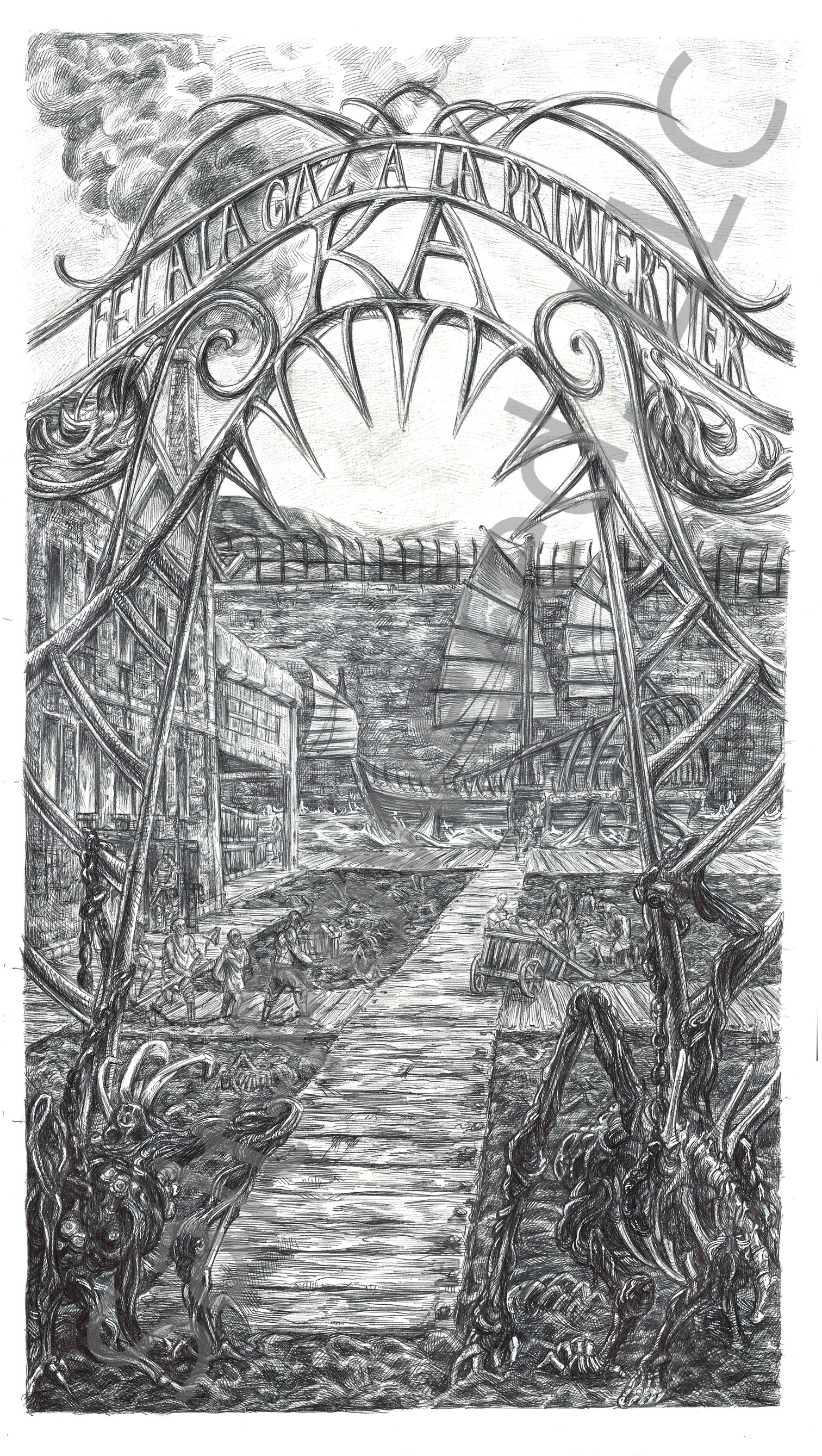
Apologies for the prolonged silence. I’ve been sick as well as traveling a lot recently (still not quite done), and writing has been even slower than usual. That said, I still have a little content for you while I’m wrapping up the main fare. See the final draft of Names above. I posted Rae’s original concept test some time ago here, and I think it’s absolutely wild to see how far it’s come.

Part of the perspective change was to put that extra emphasis on the piece’s namesake (pun unavoidable), but in fleshing it out, we were also able to lay some groundwork in determining what Ka used the camps for, and with that came conceptions of the roaches, of labor systems, of facilities built at harbors atop muddy banks that slowly shipped the dead and rotting offal the Bloodfish’s forces gathered back to his citadel.

Top image: Names, by Rae Johnson, commissioned for War Torn/Rale

Something About Tortoises

“What happened to that Sevenfold Gyre post you said was in progress?”

Totally still in progress, but words are hard, and it’s been really slow going. Not really writers block, since a little has been getting done every day, but it is not a fast process. The character sketch posts were meant to be a delaying tactic, but they are not proving to be quite enough.

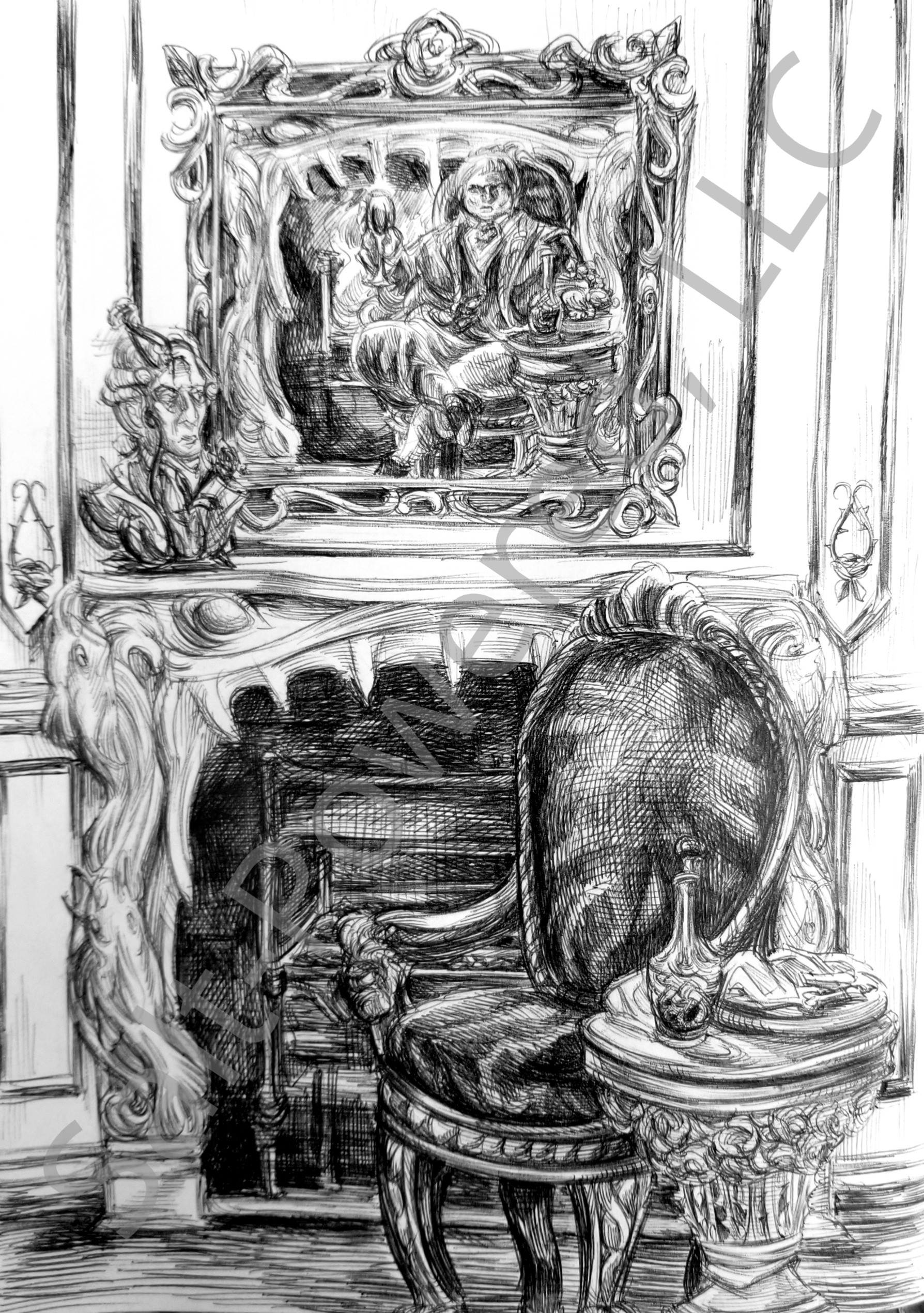
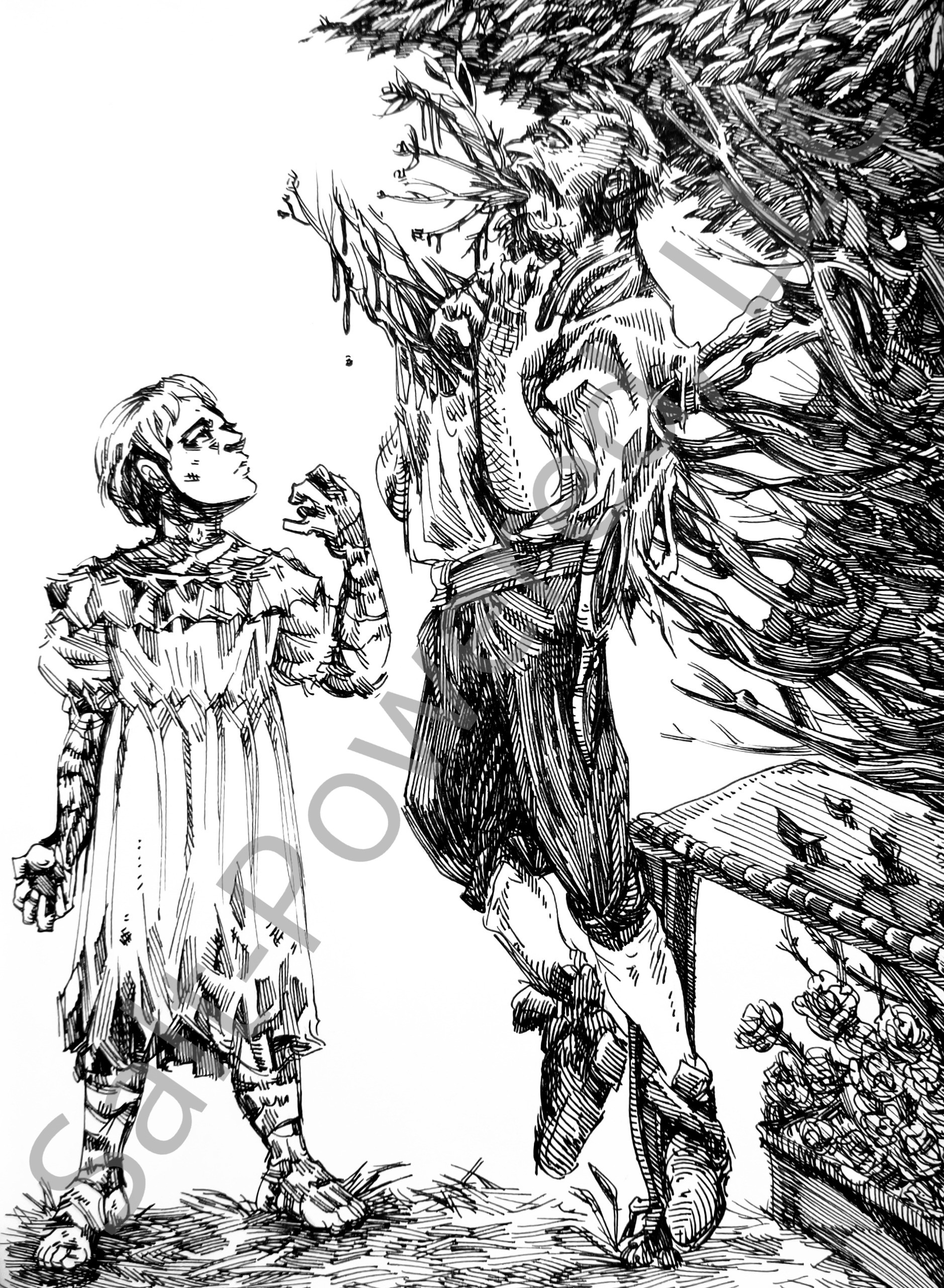
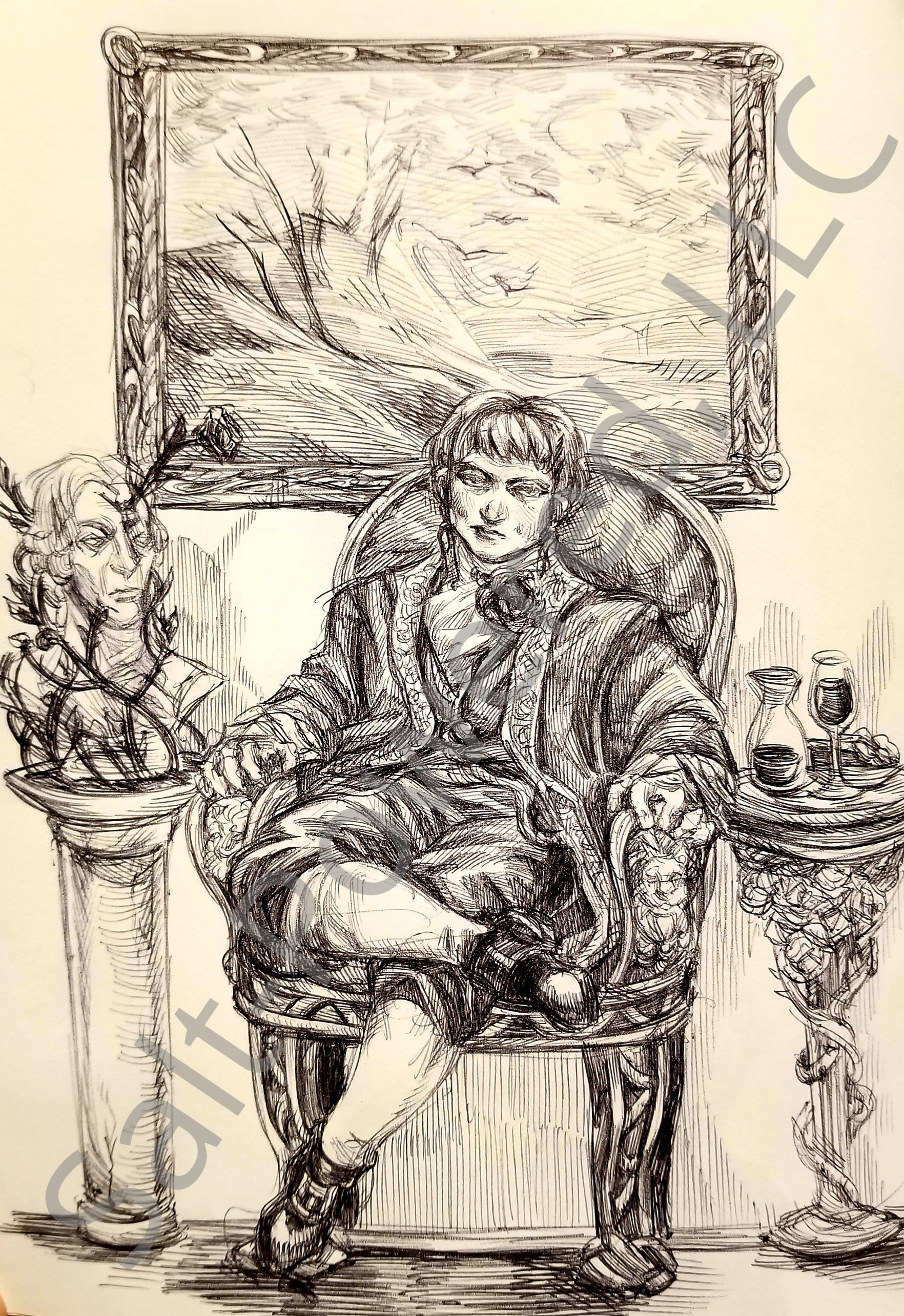
Oh well, here’s another: Les Marquains magically bound within a painting inside his house. At a point some time after the death of Ka, he disappeared leaving behind a house bereft of all the magical curiosities it had held since his grandfather’s glory days. None could say what became of him and his treasures until he resurfaced, forty years later, not a day older than when he had last been seen.

Top Image: Concept of Les Marquains in hiding, by Rae Johnson, commissioned for War Torn/Rale

Character Sketches 3 (and the Barabadoon)

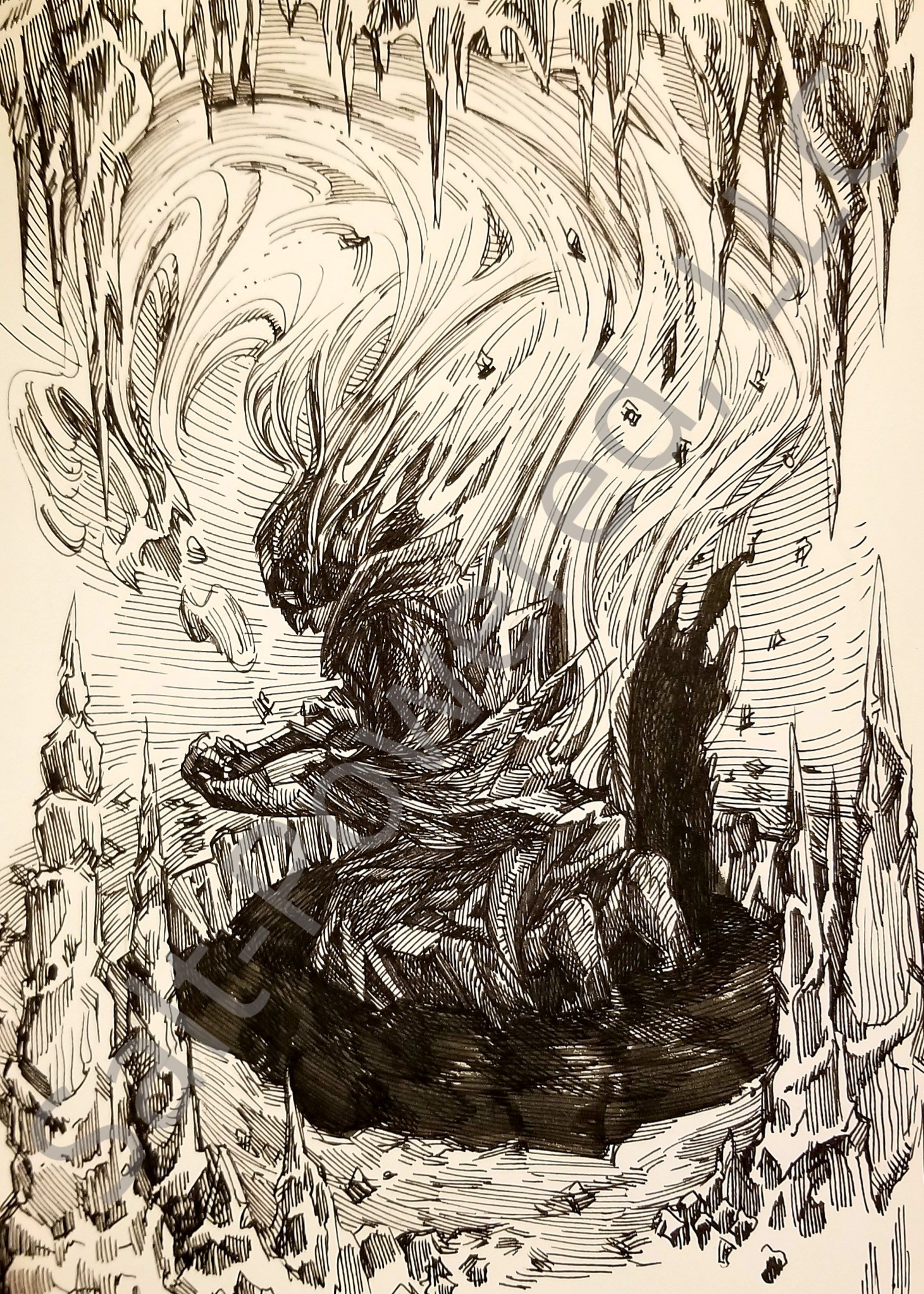
I’ve written a sparse little about the Saraa Sa’een on this blog so far. The name was originally used by the peoples of the Endless Dunes to describe dangerous exiles, criminals, or singular enemies of a society, but in the time following the Dereliction, it came to refer to a particular monster, an animate sandstorm that would arrive in a village, murder and torment its inhabitants for days, and then leave as suddenly as it came. Though the creature’s origins were uncertain, the danger it posed was clear, and an order (perhaps a cult) formed among the peoples of the Dunes to hunt the beast and protect against its onslaughts. This cult, named for a beast of myth (perhaps one of the Old Gods, perhaps a baseless legend), was known as the Barabadoon.

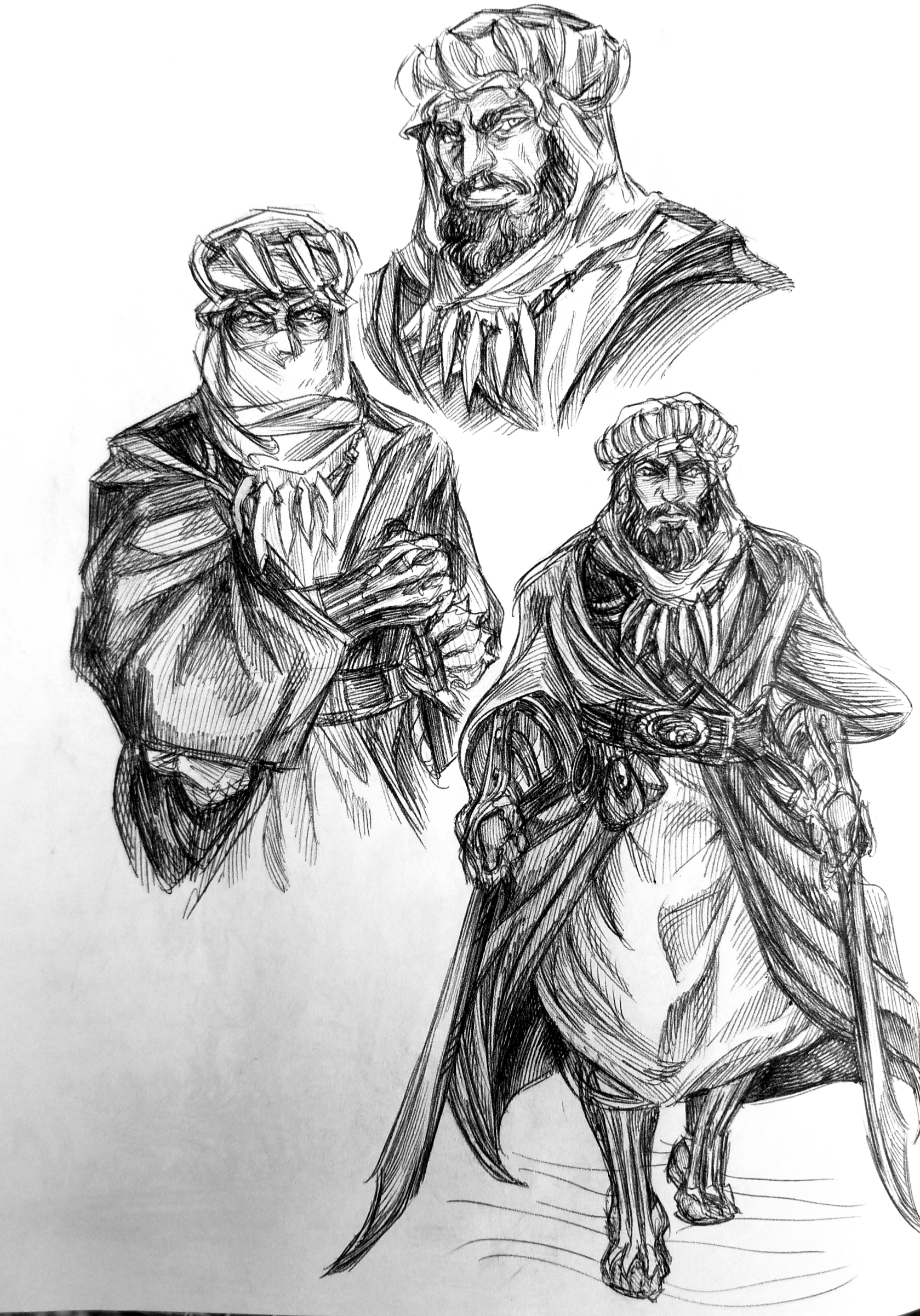
The Barabadoon was, at any given time, led by three gifted mages: The Nose, the Whiskers, and the Tooth. Of these, the Tooth was the fighting force behind their cooperation as well as the face of their order, and at the time the Saraa Sa’een was finally defeated, the title was held by this man:

Alikazan, Tooth of the Barabadoon.

Images: Concept sketches of Alikazan, Tooth of the Barabadoon, by Rae Johnson, commissioned for War Torn/Rale.

Character Sketches 1

As a side-effort to our main pipeline of artwork, we asked Rae for their interpretations of a number of characters in our timeline. Here is Le Markhan (or Les Marquains, in the Riverlands tongue), from She-Lord of Ka! He’s looking a little svelter than he ought (he was not a thin man), but it’s a work in progress. I’m a huge fan of the imagery Rae brought to these pieces. Enjoy!

Stuck In a Ditch

Image result for car stuck in mud

Not fiction, not particularly polished. Hopefully you find it amusing, though.

I’ve had to explain to a lot of people lately that I spent the night in a ditch last week.  Sometimes, this is because the person I am speaking to wanted something from me the day that I was stuck in a ditch and now will not receive it for some time.  More often, it’s just a wacky story, fun to tell/hear. My wife thought so anyway, hence its presence.

Most everyone has a stockpile of travel horror stories.  I travel a lot, for work and otherwise, and I have a healthy supply of them.  The standard is usually a flight delay, maybe a night in the airport. It’s more interesting when a single day of travel turns into a shitty, multi-day road trip or an attempt to overnight Desert Bus yourself from Vegas to San Fran so you can report for work at 9 AM.  Then there’s the life-threatening stuff, and I offer my sympathies to anyone for whom that category has been less kind; it’s easily the worst.  My night in a ditch was not life-threatening. Rather, it was kind of surreal. Wholly unpleasant, but at least thought-provoking.

As my American readers may be aware, certain areas of the country became intimately reacquainted with tornado season last week, and while I was in the air, one such tornado relocated a portion of my destination airport’s architecture to its runway.  My flight diverted temporarily to nearby city, and as I sat on the plane listening to the delay tick later and later, I thought fuck it, I’m getting a rental car. So I did. I called my travel agent, got my reservation switched to my current airport, and within twenty minutes, I was on the road.  It was late, I was tired, but I’d dealt with so much worse. Things were going smoothly as far as I was concerned.

But you see, tornadoes tend to come with rain.  This one came with a shit ton, and I discovered as I was driving that the highway connecting the two cities had closed due to flooding.  Not a showstopper–my GPS just sent me to backroads. But then backroads became gravel roads, gravel roads became dirt roads, and one particular dirt road, having seen just a little too much rain, collapsed, running muddy into a nearby cornfield.  Upon reaching this road, my car–very slowly; I want to be clear that this was not reckless driving on my part–slid right into the cornfield as well and would not move further (or back).

At first I screamed, not out of alarm, not out of any particularly strong emotion at all, but it was late, and I was tired, and screaming just seemed to be the thing to do.  Then I screamed silently, my thoughts catching up to my circumstances, whirling about the multifold conclusion that man, am I a fucking idiot. I could have just waited on the plane.  I could have just not taken the gravel road (there was a paved alternative that would have taken all of ten minutes longer). I could have read the writing on the wall when I started seeing patches of water through the gravel.  But no. I didn’t. I fucked up, and now I’m stuck in a ditch. I took a breath, part seething, part too exhausted to seethe. The personal consequences of my mistakes were at that point pretty far from my mind. I wasn’t really going to sleep that night, I’d accepted it, but there were professional consequences–I had customers I was going to see in the morning–that needed mitigation.

I got out of the car, wading out in the field of ankle-deep mud to look for cell signal, and as my eyes adjusted from the searing glare of my headlights to the clear, starry, post-storm, night sky, I was overcome by a profound sense of peace, and the distinct thought entered my mind: Could I be dead?  Did this go way more poorly than I remember? It’s dead quiet, pitch dark, there’s no one around for miles. I don’t claim any special insight as to the nature of the afterlife, but if Saint Peter trudged up to me out of that darkness, I wouldn’t have batted an eye. And then another car crested the hill I’d come down and skidded into the mud, and the feeling vanished.

It wasn’t the last.  Ultimately, four cars got stuck in that particular ditch, the last close enough to freedom that we were able to push it out, but still, that left three groups: Myself, a tired-but-optimistic couple, and five expatriate college students who didn’t speak much English.  They all had the same story: traveling from the city I came from to the city I was going to, got routed to the wrong backroads by GPS (technology is so interesting). We called a tow truck company who let us know they were on their way, only to call back five minutes later to inform us that nevermind, they can’t help, good luck, go fuck yourself.  We called the sheriff’s office, and they told us, nicer but equally unhelpful, that no one was going to be able to make it out that night and we were better off camping out and calling a tow truck again in the morning.

I slept fitfully, as one generally does in a vehicle, disturbed, if only existentially, by the apparent sound of distant sirens whined by the legion of mosquitoes that had made it inside my car.  The crack of dawn rolled around. We called a tow truck again, they said they would be there in an hour. They were not. Running a quadrangle of communication between the tow truck, the sheriff’s office, and my travel agent, we were able to piece together that the tow truck had encountered a U-haul at our location (confusingly completely out of our sight) that was also stuck.  Meanwhile, I informed my customers that I was not going to be able to meet them that day. Still, we were in the midst of an important project, shit needed to get done, so while we were waiting for the tow truck, I found myself once again standing in ankle-deep mud in my metropolitan, hipster-business-casual attire in the middle of a field ten miles from anywhere, dialed into a conference call, reporting on whether we were going to meet deadlines for the projects I was managing (we weren’t).

Again, everything seemed to zoom out; again, it was like an afterlife, albeit a really different one, eschewing the peaceful, silent dark for a narrative hell resembling a bootleg copy of The Hangover.  It was hilarious, in a sense, out of place.  I was so ridiculously wrong for that field that I couldn’t help but laugh.  It wasn’t gallows humor. I wasn’t really in any danger.  Worst case, I could just walk the ten miles to town and make the car the rental agency’s problem, but my travel agent wanted me to stay put.  The tow truck was coming, they said. The U-haul was just taking awhile.

I don’t know if that was true or not.  That tense is deliberate: I didn’t know then, of course, but I still don’t, because four and half hours after the tow truck guy originally said he would arrive, a dude–not the tow truck guy–showed up in a bulldozer with a big blue winch stapled to the front and dragged us all out.  I paid him, checked into a motel in the nearest town, and tried to work there for the rest of the day (though flooding and a certain degree of poetic justice conspired to foil those attempts, knocking out phones, cell service, and internet in the entire region for the subsequent five hours).

Reactions to the ordeal, both from my customer and my company, were confusingly sympathetic.  Lots of “awful” and “what you went through”, as if I really had been in some kind of danger. It wasn’t fun, sure, I ruined a pair of shoes, I wouldn’t do it again, but not one person called me a dumbass, and I found that really weird.  I’ll allow myself latitude for the weather, the stress, the flooding, but I really didn’t see this all as something that happened to me.  It was a journey, an interesting, unpleasant one, but journeys require forward movement, and I moved forward and got myself stuck in a ditch, inconveniencing a number of people in the process.  Did I really do enough to avoid that possibility? Do I really deserve that sympathy?

I’m going with no, but your mileage may vary.

Top image is from here. I do not own it.