Protected: The Crossroads, Chapter 11: Security Considerations
Constellations
Getting back out of my house once more.
“You might try then, as I did, to find a sky so full of stars it will blind you again. Only no sky can blind you now. Even with all that iridescent magic up there, your eye will no longer linger on the light, it will no longer trace constellations.”
-Mark Z. Danielewski, House of Leaves
The problem is that you think a constellation is a picture. You see in the Night Sky’s plumage an unknowable design–but merely a design, to be studied for meaning, for intent. But would you study it for its use?
A pair of points makes a line, and each line is a connection, yes, but also a barrier, a demarcation separating one side from another, a within from a without. And in the Night Sky, millions of lines, millions of walls become a vast, shining labyrinth, home and prison to Existence’s greatest shame and most inexorable inevitability.
When the Night Sky first dreamed the world into being, he had yet to look upon it. As he did, the multiplicity of his subconscious vision greeted him: the earth, the forests and fields and seas, the creatures, the first gods and their Magics, and yes, of course, mankind. But beneath it all, a second greeting, singular, arose from the darkness. It was Hunger. It was Lack. It was Cold. It was Freedom. It was Song and Promise and Desire, All That Was Not, All That Should Have Been, All That Might Yet Be. The humans gave it many names–the Minotaur, the Wendigo, the Voice that whispered and sang in the night–for it hunted and devoured them with a cold and unfathomable tenderness.
To spare the rest of his dream, the Night Sky sealed the darkness in the space between the stars. Its whispers would not be silenced, and its hunger–the hunger of all creation–would not be sated, but for a time, none could heed its call. They would look skyward and be saved, struck senseless by the vast array of beauty and light.
The Maze in the Mists
Slight change of pace. This is the introduction for a new setting I’m working on for the Rale universe. Credit to Kelsyn for the original concept.
You have been walking this road for some time now. It is an unremarkable road, unpaved, trodden uniformly by an infinity of unrecognizable footsteps. All around you is mist, itself unremarkable for its familiarity–you’ve been living in it for longer than you’ve been walking the road, after all. It is everywhere in this place: blanketing the fields, suffusing the woods, wrapping the scattered towns between in its damp embrace. You suppose you can still remember that there was a time without the mist, but the specifics elude you. All you remember is this:
You were a soldier once. You and your companions. You no longer know who you fought, what you fought for, or where, but by the time you stopped you had nightmares. Bad ones. The kind that woke you not screaming but frozen, paralyzed by the notion that whatever you had been running from in your sleep had crossed into the waking world. It was there with you, standing over you, behind and to your left, just out of your peripheral vision, breathing heavy, deafening. You could feel the rancid condensation of that breath on your forehead as that nameless creature reached down and caressed your hair with dirty fingers and whispered:
“Why would you do that?”
Whether you could answer the query is moot–you can’t anymore. You never told anyone about the nightmares, save your companions, and you all agreed it wasn’t the sort of story anyone would want to hear. The war stories, though? The ones that preceded the nightmares? Those you traded away gladly for the means to sleep soundly again.
That was the thing. This place in the mists operated by different rules. The people here had different wants, a different economy. When it came time to pay for your meal, your provisions or board, they did not ask for coin. They asked for a story. And when you told it to them, it was gone. It was no longer yours.
Not all of your stories were horrible. The good memories you traded for fine food, company, and wine. The solemn ones you traded for fresh clothes or flint. The everyday occurrences, the uninteresting daily nothings weren’t worth much, but in a pinch you found they bought you attention, an ear to listen as you vented your increasingly formless rage.
You learned ways to make your stories last. You could tell only a single side of a complex tale, embellish banalities, omit details that you could cling to for a while longer. Sometimes it worked. Most often they would see through you, not that they minded. You were still offering a story of sorts, and it was still payment. A falsehood was just worth less than a truth, and what you bartered for was measured accordingly.
As time passed, as you walked the road, you grew poorer and poorer, and you remembered less and less. Sometimes you were able to trade your labor for someone else’s story. Sometimes your travels and choices and happenstance allowed you to forge your own anew, but too often you found yourself giving away more than you got, and now…well, now you have been walking the road for some time. You don’t remember the last time you saw anything but the dirt and the mist and the imprints of travelers before you. But, of course, that could be for a number of reasons.
Protected: The Crossroads, Chapter 10: Nom de Guerre
Protected: The Crossroads, Chapter 9: Confluence
Protected: The Crossroads, Chapter 8: Devlin
Protected: Alternative Alternative History
Protected: The Crossroads, Chapter 7: A Visitor
Coming Back: Remaining Alive in Dimly-Lit Rooms
***
“The title…it doesn’t make a lot of sense…”
“What do you mean? It’s Nietzsche. The kids’ll love it!”
***
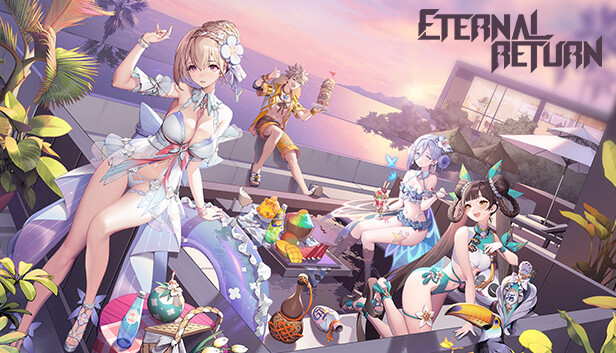
Taking a brief break here from Crossroads (brief=while writing this), since game design and culture are on my mind. To blow off steam lately, some friends and I have been playing Eternal Return: Black Survival, which, design-wise, is a fascinating and bizarre evolution, and it’s filled my head with many thoughts. They are not terribly organized so do please pardon the rambling, and for those of you who don’t care for video games, don’t worry: This is about much at least a little more than the mouthfeel of my digital pastimes.
***
The “what” comes first: Eternal Return is a Battle Royale (e.g. Fortnite) formatted as an isometric MOBA (Multiplayer Online Battle Arena, e.g. DotA, League of Legends). The latter term refers to a team-based game where players fight each other in an arena populated by tactically relevant (and usually at least slightly hostile) environmental features, growing and specializing their characters as the action escalates. The game ends, generally, when one team achieves some goal with respect to the environment, unrelated, really, to the fighting with the other players (except insofar as they can’t stop you while they’re dead).
A Battle Royale is less complicated: A large number of players/teams get dropped onto a large map, and the last one standing wins. To escalate the action (and to make safety a meaningful and fun tradeoff), weapons, armor, and other useful things are scattered around the map to give the strategically-minded survivors an edge in the showdowns that become inevitable as the map shrinks.
Amusingly (from an industry perspective), the two now-mega-genres have similar origin stories. Some sloppy history: By most accounts, the first MOBA (in the sense they exist today) was a StarCraft mod called Aeon of Strife. This inspired the Warcraft mod Defense of the Ancients (DotA), which became DotA: Allstars, which schismed out of Blizzard’s umbrella of control into League of Legends and DotA 2. Similarly, Battle Royale started with the ARMA 2 mod DayZ, which passed design talent along to PlayerUnknown’s Battlegrounds (PUBG), which prompted Epic Games to whipturn development on Fortnite in order to compete with it.
Generally, the creative direction of the games industry can be modeled as a linear combination of the interests of its best game designers and those of guys in suits who like the word “monetize”, and it is very easy to see the explosion of genres like these as dominated by the latter. I’ll admit: It’s damned hard not to notice that within five months of the Auto Chess mod for DotA 2, both Valve and Riot had released their own proprietary versions, with Blizzard’s arriving only six months after that. But the spectacle of the fat cat feeding frenzy distracts from the fact that these mod-to-blockbuster stories captured the artists’ attention too, with pseudo-legendary designers like Tim Schafer describing DayZ as the future of narrative in games (nosic).
***
For those of you whose eyes glazed over at all of that, this is where things return to the normal subject matter of this blog. The lingo may get a little blurry, but the key to Schafer’s argument is this: Battle Royale games don’t have a story in any conventional sense. There is little setting, no cutscenes or writing, no characters but you and the other players, no narrative but the one you make for yourself.
Frankly, I feel vindicated. Back when I was in school, I dropped this same argument in one of my writing classes. The MFA student opposite me, unimpressed, inquired: “Isn’t that just everything in life, though?” It was very Robert Frost of her, but last I checked, no one is arguing that free verse isn’t poetry anymore. The boundaries where art begins and ends are not important. They were never important. What’s important is that art can be crafted from agency. It can be framed and sculpted, and like just about everything else within our powers, it can be improved upon.
The baseline for multiplayer games is essentially what you see with mainstream sports. You have a simple task with a simple goal, and the game is doing it better than the other guys until one of you wins. Maneuver the sportsball through the hoopgoal. Go fast. Hit hard and shoot accurately. That these imperatives apply equally well to football/soccer, Street Fighter, Mario Kart, and Halo shouldn’t be controversial, but make no mistake: There’s a narrative there. It’s just a very short narrative, leaving comparatively few opportunities for interesting variation. I’m not knocking the excitement of the neck-and-neck rival showdown, won at the last second by a half-court buzzer beater, but I will point out that when they make movies about sports, it is always about the context, an athlete or team’s struggle and growth over months or years–their rise to greatness–and not the one awesome match they fought out in the preseason when stakes were low.
This then begs the question: How do we take that framework of engagement and structure it in such a way that a single game tells a story worth hearing? The MOBA and the Battle Royale are two answers to that question.
The standard narrative of a MOBA match is this: The beginning, instead of a team v. team slugfest, opens with smaller scale matchups (generally 1v1 or 2v2) in “lanes”, with each side competing to most efficiently extract resources from the “minions” the enemy base sends down each lane. You can fight your opponent directly here, and you might even succeed if you outmaneuver them severely, but you’re weak. The minions aren’t strong, but they are a significant defensive advantage should your opponent catch you in the middle of them. And, of course, attacking your opponent beneath the defensive structures at the end of their lane is certain death, so barring extreme outcomes, it is advantageous for both of you to sit there and farm, competing to grow faster, prodding and skirmishing to prevent each other from feeling too comfortable.
Soon you grow stronger. Within the first third of the game, you’ll have unlocked all of your abilities and have improved your stats. With some smart planning, you can now work around or through your opponents environmental defenses and score a player kill (for much higher rewards) or simply leave your lane to coordinate with your teammates (and overwhelm another lane), all with the goal of securing more resources, growing stronger, and conquering objectives to aid in the final assault on your opponents’ inner stronghold.
Nuts-and-bolts-wise, this is basically a whole bunch of subgames glued together, though organically and analogous enough to common concepts (e.g. war) to not feel like an abomination. The variation in skillsets the game demands is wild, with different tactical mindsets needed for “laning”, “jungling”, “sieging”, “teamfighting”, and skirmishing around objectives. There is, of course, some overlap with the basics of controlling your character, but even that is subject to do’s and don’ts that don’t travel well between concepts.
Seems like a cost, but the holistic result is profound. In 20-40 minutes, you’ve now gone through the better part of the Hero’s Journey, from humble beginnings (level 1 laning) to confluence with your companions (meeting up as the laning phase ends), proving yourself as a Dragon Slayer (literally an objective in League of Legends), and ultimate, hard-fought victory over the enemy. The goal was to establish a complex narrative in a multiplayer game, and, uh, mission accomplished.
Ish. There are cons, many of them logistical. For example, these are team games, and the precisely-combined nature of their subgames means they don’t have IRL sports’ luxury of freeform adjustment to deviant behavior. So if Timmy gets disgruntled and walks off the virtual field by way of an unplugged router, that ruins the game for everyone. There are no substitutes, there’s no rearranging the teams to account for the new imbalance (both for technical reasons and for the fact that doing so would invalidate all of the narrative built up to that point). All the players can really do is remain halfheartedly engaged as the game grinds on for another fifteen minutes to its predictable, cheapened conclusion.
This is, of course, inextricably entangled with the other big MOBA downside: These games are long. In the abstract, 25-45 minutes might not seem like a long time, but it’s time when you cannot be interrupted, when a moment of inattention could have deleterious consequences for the following half-hour. If that doesn’t sound at least mildly stressful, you probably ought to check in with your significant other more often than you do. All this to say, the MOBA is a significant development for narrative in (multiplayer) games, but it’s not the only one in town. Meanwhile, the Battle Royale tackles things differently, avoiding these issues and falling upon different ones.
The narrative of a Battle Royale, specifically, is less about growth and more about movement. It’s less a journey of empowerment, a campaign to win the war, and more a daring trek through the desert or a harrowing escape from prison. Growth is, of course, there, but it’s incidental, an excuse for the movement, a reason to scatter everyone across a giant map instead of just dumping them all into the usual FPS deathtrap and having them shoot it out. The resulting, absolutely enormous sandbox serves to frame the goal nicely: This isn’t a daunting foe that’ll require skill and coordination to bring low–it’s a huge and hostile gauntlet, and you want to get to the end by any means necessary. Of note, the former is a team goal, the latter, a solitary one. Obvious point: Most Battle Royales allow you to play solo at no disadvantage, and even when you do play with a team, you will often lose your friends on the way to the end, leaving you to soldier on alone.
None of this is to diminish the narrative value of the journey–it’s just a different type of journey, one where you have the choice to fight or flee, making it to the end through bloodthirst, boofing every chad who shows his face in headshot range, or instead playing the clever scavenger, forgoing combat with the guy who is just gonna get killed by the next player he meets anyway, biding your time, picking the circumstances of your final showdown.
This addresses the MOBA’s weaknesses pretty well. Players are numerous and eliminated rapidly, allaying any risk that someone might unilaterally kick the experience off its rails. And it’s fairly short, with the map shrinking down to its highly constrained showdown point in twenty minutes (or less, depending on the specific game).
Predictably, this introduces its own problems. The first is that you aren’t going to win a lot. Games of Fortnite have 100 players. Apex Legends does 60. Assuming you are all evenly matched (you aren’t), this means you are likely to win fewer than one in 60 games, which maybe doesn’t sound so bad, but I will emphasize that the real parameters of that calculation definitely skew the output toward “fewer”. This wouldn’t be nearly as much of a problem if placing anything but first meant something, but it’s not clear that it does. It is, in fact, trivially easy to not be the first one dead in a Battle Royale, because not being the first one dead only means you avoided the first clash over loot (and, of course, that you didn’t get any). It’s not even particularly difficult to hide out and keep a low profile to the end, but doing so slams you right into the second big problem: 1v1 games are hard.
This is simultaneously big-dumb-obvious in theory and still shocking in practice, but virtually any mano-a-mano contest worth contesting is going to feature a high skill ceiling, and while multiplayer games tend to obfuscate it behind the chaos of a hundred shooting scavengers, team coordination, and (for asymmetrical games) matchup differentials, the final moments of a Battle Royale lead fairly reliably to a contest of skill between a small number of players on mostly even ground. Then you factor in the likelihood that you are the most skillful player in the 100, and, uh, it seems like you’re pretty boned. Again, victory isn’t everything, but when your narrative is worth so little when it doesn’t end in victory, it starts to look less worthwhile to keep pulling the lever on the slot machine.
Cutting off the salt stream, where does that leave us? Our leading narrative structures have encountered four key pitfalls:
- Vulnerability to unilateral disruption
- Burdensome commitment of time and energy
- Minimal likelihood of victory (or, more importantly, having a worthwhile narrative at the end)
- Exposure to the vicissitudes of symmetrical balance
Is it possible, then, to design a structure that addresses all four?
***
As with all questions of aesthetics, any answer is going to be a matter of interpretation, but I would argue Eternal Return is at least a respectable attempt. Refresher/dissection of my previous description: It’s a Battle Royale with the interface/control scheme of a MOBA (isometric, QWER abilities that you rank up, equipment slots you fill up to improve your stats). By this logic, its resolution of #1-#3 is actually pretty boring. By simply being a Battle Royale, it becomes resilient to #1 and #2, and taking the edge off #3 is simpler than I’ve made it sound: Just reduce the number of players (Eternal Return has 18)! Duh. Where the MOBA elements really shine (and where this analysis gets its crunch) is in how they address #4.
It’s worth mentioning here that while certain game structures confer a sort of immunity to certain pitfalls (e.g. Battle Royale and unilateral disruption), MOBAs have no such immunity to #4. It would certainly be possible to design a perfectly symmetrical MOBA with on-rails development to guarantee “perfect balance”–it would just be stupid, and no one would play it. The salient observation here is not that MOBA designs inherently overcome the risk of directly exposing players to their own lack of skill but rather that they have tools to mitigate that risk to a greater or lesser degree.
The one to focus on is growth (matchmaking improvements with fewer players/teams as well as Eternal Return’s asymmetry–that each of its characters plays differently, with varying capabilities at different stages of the game–are relevant too, but they are less novel here).
Most MOBAs structure character growth along two axes: “Experience”, a slow trickle of small stat improvements and ability access/augmentations awarded for productive activity (ie, killing stuff, in most MOBAs) and “resources”, often as a currency used to purchase items which provide larger, spikier stat boosts in a much more variable stream (the two are invariably correlated, but while the experience dispensed to all characters tends toward a tight bell curve, it is common to see a subset of players get “fed”, acquiring a great deal more currency than other players in the same match at the same time). Eternal Return adopts this system, eschewing the Battle Royale standard of awarding random embiggening to those who stumble upon loot boxes. This serves to both smooth and complicate the growth curve, reducing the power differential between the character who opened one more box and the one who showed up just behind him. More importantly, it makes growth a focus, something to pay attention to, as doing it well or poorly can influence or even overwhelm in-the-moment mechanical contests down the road.
Another way to argue for the same design element is that it emphasizes multiple skillsets, deprioritizing absolute dominance in any one of them. As with the earlier metaphor of military campaigns, you can excel either as a general, planning your map movement to most efficiently secure resources and control strategic positions and opportune times; or as a tactician, winning even unfavorable battles through superior execution and a dearth of mistakes. Conventional Battle Royales heavily favor the latter; Eternal Return puts both on much more even footing.
***
The result is a game with lots of cool narrative moments, not dissimilar to either genre it draws from, but notable for the way it fuses them and, more importantly, the way it minimizes the costs of each.
Back to hedge-world, that doesn’t mean it’s going to be everyone’s cup of tea. If you dig neither MOBAs nor Battle Royales, you may be underwhelmed here, not even for dislikeability but for a lack of things you care for. You might be put off by the anime aesthetics or the half-hearted translations, or you might just hate isometric, click-to-move control schemes.
But even beyond the obvious target demographic of [not the above], I’ll throw a cautious recommendation to that narrow, eclectic group who has no idea what the fuck I’m talking about but remains curious about this notion of narrative in agency. Check it out. It’s the future, man. The future is now, of course, but it’s gonna keep coming back, if this budget localization is to be believed.
 Salt-Powered Investments, LLC