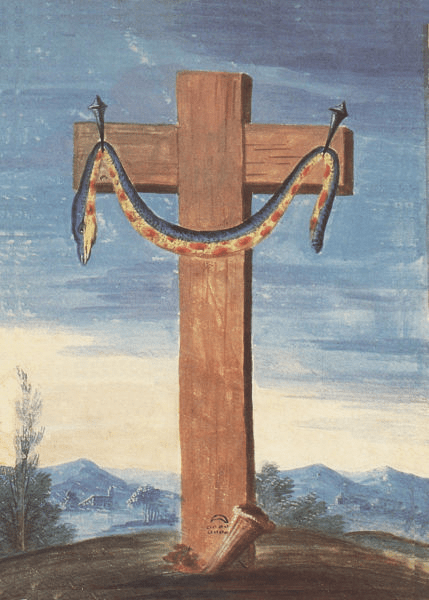
The Rose, the Cross, and the Sword, Ch. 2 – Flamel’s Cross

Legally distinct, as all things should be.

“Mademoiselle?  Mademoiselle!  A few questions if you will.”

The visibly beleaguered notary struggled to project himself over the stacked books and parchments that, if he’d had his composure, might have lent his too-tall desk an imposing air, an aura of respect befitting his station in the Parisian community.  But in this instance, with his client distracted, positioned such that she could–if bothered–simply look at the desk rather than up into it, the notary had to admit that he probably appeared more like a goblin.

“Mademoiselle!” he rasped, a regrettable bit of scorn entering his voice.  He was normally much better about his tone with women, but he was behind schedule.  He had needed to intervene with the morning’s trouble with the fireplace, and the afternoon had been a nonstop stream of unorthodox contract requests from the sort of clients he had a distinct sense might be hiding something.  And this Italian woman, dressed in gender-inappropriate academic regalia, gliding into his office at the very close of business, was very certainly one of them.

“Mademoiselle!” he redoubled, finally prompting a slight, aloof incline of his client’s head.  “The collateral arrangement you’ve requested–I’ll need more documentation of these Florentine holdings than–”

“Monsieur Flamel,” the woman said, still not quite turning to face him.  “This symbol you have carved into the moulding here–do you know its origin?”

“I’m sorry?  What?”

“This symbol.”  Her French was passable, though heavily accented.  “The cross and serpent.  I believe it is occultic, Monsieur.”

She turned, blank-faced, not presenting any clear intent from the otherwise rather threatening question.  The woman was not ugly, though her hook nose and mud-brown hair rendered her looks middling by Parisian convention, but otherwise she seemed to sidestep all of his available stereotypes.  She was well-past marriageable age, though she had arrived at his office with no chaperone, by all accounts very far from her purported holdings in Florence.  She was likely not of noble blood–proof of one’s pedigree was usually the first thing established when an aristocrat requested the notary’s services, and she had provided no such documentation.  Or even a claim, for that matter.  Whether she was of noble means, though, was the question.

Again, she was very far from home.  She must have secured her transport somehow–the notary could scarcely imagine a solitary scholar making the journey all the way from Florence unscathed, much less a solitary woman.  But the name she had given–Alighieri–meant nothing to him, and her claim to lands in Florence–to funding, as it all pertained to their business–was unsupported.  And she seemed more interested in his office’s walls than her own contractual viability?  The notary found his bewilderment and irritation increasing in equal measure.

“Mademoiselle.  Your property in Florence is unfit as collateral for your purchase,” he blustered, catching himself in time to qualify: “Without additional dated documentation, of course.”

“Oh, nevermind all of that.  I assume gold will suffice as collateral?”  

“Um…gold?”

“Two standard ingots and a purse of unmarked medallions, yes.”

“But that would be sufficient to buy the property outright!”

“Oh.”  The woman frowned.  “Well then, please write the contract to reflect that as payment, if you think Monsieur Menard would accept.”

The notary’s head spun.

“In any case,” the woman continued absentmindedly.  “In any case…sorry, how long will the contract take to complete?”

“Um.  Three days, most likely,” the notary replied at a mutter.  What was going on?  That amount of gold thrown about without a second thought at the purchase of a house on Mortelier Street?  This was palatial wealth, and this woman wanted to live on Mortelier Street?

“That will suffice.  Now, your moulding–I think this is alchemical.  Is it not?  Are you an alchemist?”

“Mademoiselle!”  The notary channeled all the outrage he could muster in his offput state.  “I am an ecrivain, a notary, a respectable citizen!  And you have come to my office to accuse me of witchcraft?”

The woman blinked, pausing to think, as if a simple rewording might resolve the issue.

“I don’t suppose it would be better to say I am accusing your walls?” she asked.

***

Her choice of words could have been more careful, Dante admitted, proceeding away from Flamel’s office at a brisk walk.  She had seen the symbol and gotten excited, and how was she to know that the implications of alchemy in Paris were so…macabre?  One might have thought the Church’s taboos against alchemy would have had more force in Florence, closer to Rome as it were–there it was generally regarded as mere eccentricity.  But apparently there was more geographic variation in the Church’s influence than she realized.

The conversation had aborted such that Dante was not sure whether Flamel would proceed with her purchase contract or not, which was inconvenient but maybe just as well?  The gold which she had volunteered as comparatively unscrutinized collateral was only 20% real.  The ingots were genuine, but the coins were just iron that she had plated with a leaf-thin veneer from shaving off the ingots.  Were it to be exchanged as tender for purchase, it might well be used, and somewhere along the ensuing chain of commerce, it was very likely to catch up with her.  If she’d had her wits about her, she would have waved off Flamel’s comment as to its worth, but she was out of her depth here and struggling to manage the details of her stay in Paris.  She’d gotten separated from her manservant back in Milan, and now, given the Black Guelphs had almost certainly seized her property in Florence, all she provably had to her name was a purse of mixed forged and legitimate currency, those two gold ingots, some parchment, ink, and a small collection of personal effects she had been able to carry in her pack out of Italy.  For now, she would need to stretch her real money a bit further at the inn.

The meeting with Flamel would perhaps prove not to have been a waste, though.  In the shouting match that ensued following Dante’s inquiry into the notary’s architecture, Flamel did provide the indignant defense that his building had been sold to him by an aristocrat with peculiar aesthetic tastes, a “Comte St. Germain”.  Flamel was, of course, unhelpful in providing the Count’s current whereabouts and proceeded quickly to a firm request that Dante get the hell out of his office, but she was holding onto hope that this Count St. Germain was still close at hand and–God willing–and alchemist, as his decor suggested.  

Dante did not come to Paris prepared to act like an aristocrat.  While she was an accomplished poet, that wouldn’t pay for bread.  And while she was a mediocre physician, she doubted the French would suffer a foreign woman to minister to them, skill aside.  If she could join some sort of venture with another alchemist, though…  In her experience, siblings in the Great Work tended to protect their own–and some could even be persuaded to look past their misogyny in the process.

Asking after that name would be tomorrow’s work, though.  Now it was getting dark, and she was starting to notice glances, piqued interest from dirty faces in muck-crusted alleyways that she hoped was merely larcenous.  She drew from her robes the crudely-sketched map she had made from the innkeeper’s directions to Flamel’s office and attempted to retrace her steps.  The cross street in front of her must have been just down the way, extended from the left edge of her drawing.  If she could just get a few streets north, then–she glanced up as something stepped between her and the light of the streetlamp she’d been reading by.

Ah, rats.

“Where ya tryin’ to get to, miss?” a rough voice rumbled from the shadow before her.

“You aren’t lost, are ya?” from behind, a few paces.

Dante raised a hand, both to encourage a pause and to dim the backlight so she could make out her prospective assailant.  Grubby, thick, crosseyed, black teeth, slightly taller than her–he was hunched over, but so was she–and no doubt quite a bit stronger.  He was an obvious cutthroat, of the variety common to every city in Europe, a brainless pair of idle hands with few scruples as to the misfortune of whomever might wander into his cesspool after sunset.  Dante assumed the one behind her was identical, since the first was already identical to all the rest she’d ever seen.

“Excusez-moi, gentlemen,” she said, rummaging in her robe’s inside pocket for a small folio.  “I assume you’re looking for money, yes?”

“Oh, we’ll accept it,” the ruffian said, smiling greasily, taking a step forward.  “For services rendered.”  What a disgusting way of putting it.

There.  She found the folio, pulled it out, flipped it open–which thankfully slowed the hoodlum’s approach, his piggish face scrunching with misplaced curiosity–and quickly paged through the stack of cut-down parchment squares within.

“Would you say Paris’ soil is more sandy or silty?” she asked, pausing with a square between two fingers.

“Huh?  The fuck are you yappin’ about?” the second ruffian muttered.  He’d grown closer, which was nervewracking but also convenient.  Dante glanced down at the parchment, embellished with an annotated geometric array emphasizing a graduating angular progression of circumscribed triangles.  She wasn’t sure it mattered.  The array was meant to search, a feature she’d built in to make up for the fact that her geologic measurements tended to be shoddy and low-precision.  She drew the parchment from the stack and, as carefully as she dared, dropped it, trying to angle its descent as close to straight down as possible.  It fluttered, landing about three feet away, a troublesome lunge.

“Oh, apologies, I’m so very clumsy!”  She tried to ham up the useless damsel persona, a role she really did not care for.  She often felt useless, of course, but she–true to her father’s delusions–also could not help but bristle against damselhood.  She shuffled over to where the parchment fell, which didn’t much give her an angle to run but did coincidentally–and fortuitously–put both thugs on the same side of her.  Trying to conceal her excitement–as well as the nervousness at how fucked she would be if this didn’t work–she knelt, reached out, and placed her fingertips on the parchment’s array.

The sensation was immediate, as if a muscle in her mind locked into place, did not merely wait for her to direct it, but rather leeched her intent from context, from her conscious and unconscious thoughts.  There was a notion of red flowing from her; the parchment erupted with white light; and the air grew cold.  This was literal, in fact: The ambient energy of the surrounding atmosphere, the fire of the streetlamp, body heat from Dante, the thugs, the unfortunate tomcat wandering past the mouth of the alley nearby were all being channeled into vibrations of increasing frequency that her alchemy was directing into the street below.  They were powerful vibrations, and when they found resonance with the cobbles and loam, Dante would–via the same transmutative array–delicately pry apart the stones beneath the thugs’ feet, causing the street to collapse beneath them.

In practice, the array locked in on resonance far faster than Danted anticipated, and the street, in apparently poor repair and built over sewer or other unexpected subterranean hollowing, collapsed instantly and explosively with a shrapnel spray of gravel and mud that flung Dante backward, almost fully across the street.

“Hrm,” she grunted quizzically, climbing unsteadily to her feet.  The dust was clearing.  By the light of the next streetlamp down the way, she could see the jagged hole before the alley opposite her and the unmoving arm protruding upward from it.  Fortunately, she also could not see any curious faces in the nearby windows, and she had yet to feel that telltale sense of being watched.

A sensible Florentine woman would have taken this opportunity to run, to put distance between herself and what had become a rather serious act of public vandalism–and likely murder.  But a sensible Florentine woman would never have found herself here in the first place.  She would never have taken up the serious study of medicine, of geometry, of the natural laws, or of the considerably less natural ones of alchemy.  She certainly would not have bought into the ambition foisted upon her that she would be the one to lead her family into a new era of prosperity and nobility, against the grain of her usurer father’s soured reputation.  And she never would have led a schismatic faction of anti-papists in an attempt to secure Florentine independence from Rome, earning her exile and condemnation to death should she ever return.  A sensible Florentine woman would have ebbed and flowed with the tides of that madness, probably, Dante assumed.  And she would never have developed this strange fascination she had found for death.

She crept toward the pit she had made, careful not to approach the arm too quickly, lest it still had that annoying capacity to grasp, and she allowed herself a little grin as she saw the carnage:

One of the thugs had apparently been buried completely, with no part of him still visible.  The other, the one whose arm now reached ineffectually for freedom from his chthonic end, still had the better part of his face exposed, a shelf of cobbles embedded into the side of it, leaving little doubt that he was quite dead.  It was beautiful, Dante thought, fighting the urge to sketch it on the back of one of her transmutation cards.  Absentmindedly, she picked up the remaining torn half of the parchment she’d used to create the pit and stuffed it in her robe.  This was just a terrible accident, she thought.  Rather: She hoped the guards would conclude.  There was no witchcraft involved.

But in truth she could scarcely remove her gaze from the thug’s deathmask.  The vision was intensely cathartic, and the salience of alchemy in the course of the man’s end seemed to burn in her brain.  This creature was Hell now, a notion of which she was certain, though which her relationship with the Church made electrically complex.  Her alchemy had opened the gates of Hell and pulled this man inside.  In a world of petty politics, the imprisonments of gender, of failure after failure to break out and rise, was this not a reminder that she still wielded the power of God Himself?  And was that not reason for hope?

Top image: Emblematic imagery in alchemical manuscripts – Flamel, Bibliotheque Nationale, 18th c.

The Rose, the Cross, and the Sword Ch.1 – The Christian

Something completely unrelated. I don’t know if I’ll post the rest (or even finish it), but I’ve always found the best cure for writer’s block is to write something else.

Events have unfolded such that it is now clear to me that I must be very precise in my accounting.  The world is changed now, very literally, perhaps quite irrevocably, and I am as yet the only man who has realized it.  This, then, is my statement of the events which I believe accomplished this cataclysm, though the possibility remains that I will never truly understand the precise mechanisms my apprentice employed.

The signs portend a pivotal role for the cult of Jesus of Nazareth–and my faith in those signs has only grown–so it is with respect to their organization that I date my first interaction with the man who would become my apprentice at the start of the planting season 33 years after their Messiah’s death.

***

“Great Sage of Hermes, I seek your wisdom.  It is said that you guard the secret of immortality, that you have gazed upon the same sky as Enoch, fifteen centuries ago.”

The man was young, by my guess no more than 30 years of age, unadorned clothes, hair that had been washed in preparation for this audience but likely no other time in the past month.  Ribbons of burn scar striped peculiarly across his face, though not in the manner of any brand I had ever seen.  His duplicitousness was that naive, guileless kind: no malice, but a quite foolish assumption that his provenance could possibly be immaterial to a seeker of truth.  As if one could expect to read constellations in the absence of stars.

“I do,” I replied, pacing before the great cylix at the center of my temple.  “And I have.  But that which is guarded is kept from the outside.”

“Of course, Great Sage.  It is not immortality which I seek–but the truth.  That which binds the world together–fastens the material to the divine.”

I blinked.

“You are more educated than you appear, both to be pondering these notions as well as to know that I could teach them to you.  But why?  What would you do with the truth?”

“Is not understanding its own reward?”

“I do not believe so,” I replied.  “No, I believe it is best taken as a means of doing miracles.  But I also believe you have your own opinions on miracles.  And truth–or at least its fungibility.”

The man’s face fell like spent wax, though he did not recoil the way exposed charlatans often do.

“You know of me, then?” he asked.  I turned to regard the glyphs lining the cylix’s interior, as I often did.

“This temple is not a cloister, and your arrival in Athribis has not been silent,” I said.  “The villagers have their opinions of who you are and what you flee.  I make no claim that your true motives have been revealed to me.  Merely that those you have revealed are false.”

The man vacillated over his secrets a moment, steeling himself.

“I seek to understand a particular miracle,” he said.

“Why?”

“Because I fear it.  And I wish either to find peace or undo it.”

It was my turn to consider the unexpected.

“What miracle is it that a Christian would see undone?” I asked, my tone betraying more than a measure of confusion.  The man took a breath.

“I have been brought back to life,” he said.  “I died.  My soul existed in the beyond for three days before the Christ returned it to my body, and then I was alive again.”

“But…”

“And I have not aged since.”

“Hm.”  I had turned.  This Christian had my full attention now.  I had dealt with his kind, amicably but unproductively.  The greatest threat their teachings posed was the possibility I might listen–an audience which might bring Rome’s attention to my village.  Their communion was irrelevant to my contemplation of the Harmony or my role as a physician, and most left when they realized I would be no ally to their movement.  This one was a very different dilemma.  He was most likely a liar, but his lie was a strange one for a Christian, and his wish–to die, plainly–was stranger still.

“It seems to me,” I began, “that the unraveling of this miracle would bring about your end.  At least, if what you have told me is true.”

“Yes, that is my intent.”

“I trust you’ve tried more direct methods to bring this about?”  I did not actually trust this was the case, but it seemed the easiest way to determine if he would be a waste of my time.

“I have.”

I could not help but raise an eyebrow.

“Oh?  And?”

“I shall demonstrate to you and only you, if you will consent, Great Sage.”

***

I had assumed to this point that I was facing a con, though the goal of such a deception remained a mystery.  The temple of Thrice-Blessed Hermes which I kept had few riches, and all of them could be purchased at market for a modest sum, even in a village as small as Athribis.  I had begun to regard the Christian’s entreaties as a test of my wits, a game whose prize was the unraveling of just what this man wanted.  His commitment, though, surprised me.  What I thought was a flaw in his fiction brought our shared inquiry directly to the prospect of his imminent death.  But he did not back down.

He allowed me to bind his hands and feet so that I could sacrifice him to the glory of my god–a practice which I, in truth, had never actually attempted, though I adapted an older funeral ritual to the task.  But I here rely on an amended recollection of the results, for when I first attempted to cut his throat, I instead, assured I had already completed the task, began to loose the bonds on his wrists.  It was only when he asked what I was doing that I realized that not only had I quite forgotten to kill him, but my entire memory of the event had been altered.  At first I reasonably attributed my mistake to a weakness of my own faculties, but as I began recording my intentions for the Christian’s demise in writing, it became clear that I was only a part of what seemed a vast network of happenstance and coincidence dedicated to the strangely singular goal that this man should not die or, for that matter, suffer any severe injury.

Torches would spontaneously extinguish, tools would go missing, my own train of thought would become insufferably hard to grasp as I concentrated on this theoretically simple task.  The closest I came to success, I sneezed at the instant I brought my old ritual knife to his neck, accidentally striking the stone table and shattering the blade.  At this, I was forced to face the notion that an order had been constructed about this Christian that, despite its evasion of my senses, had the consequential force of stone.  The manner of its function particularly intrigued me: I had long thought the Christians just another whirlwind of plebeian pseudo-objections to Roman occupation.  But if the force which protected this man was indeed the work of Jesus of Nazareth, it meant the would-be Messiah not only understood the Harmony of the Spheres; he had found a way to command it of which even I was unaware.

“I truly hoped you would succeed,” the Christian said, as I stepped away from the table.

“Remarkable,” I breathed, not even processing his disappointment.

“Indeed.”  He offered his wrists, which I untied.

“You have convinced me that you are indeed protected by a miracle.  I am afraid I cannot simply explain its nature, but if you would aid me, I would attempt to decode it.”

“Decode it, Great Sage?” the Christian asked, looking up from the partially untied rope around his ankles.

“Tell me, Christian: What do you know of geometry?”

***

The man, it seemed, had a mind for connections, influence.  He quickly grasped the profundity of mathematics that most dismissed as mere useful praxis, but his actual education proved rather arid, dotted with oases of things he had picked up from some of Christ’s more learned followers.  For what I judged to be the most significant subject of study my order had encountered in centuries, I needed a partner, a counterbalance to my insights, so when I determined that the gaps in his mystic knowledge would require more than just remedial instruction, I proposed to take him on as an apprentice.  My first in decades and–not to get ahead of myself–the only one who would not prove a disappointment, intellectually.

His training was expedited, just five years, shorter than my own by more than half, and in that time we did not even touch upon the mystery of his apparent immortality.  Before we could interrogate this divinity, I needed him to understand the language of the divine.  In effect, I needed him to be a translator: This working, allegedly by Christ, was a product of insights wholly illegible to me.  The Christians’ teachings seemed meant for the poor, the beaten down.  They seemed political, and I had only so much interest in the organization of the polis.  Still, I knew to look for the truth within truths.  Plato also modeled the soul as a city; baser political instincts have always served as a lead toward deeper truth.  Thus I needed my apprentice to speak my language, so I could speak his–so I could begin to chart the divine soul beneath Christ’s Kingdom of Heaven.

Up to now, my contribution to my order’s work had centered upon a particular epistemological point: Why should it be that we, creatures of fire and flux, each uncertain step, mishearing, and misapprehension, have any access to Truth at all?  How could we hear the Harmony of the Spheres?  More importantly, how could we possibly be sure it was actually True?

I was not the first to express skepticism of my own faculties for knowledge, nor, most assuredly, would I be the last, but my attempt to resolve the ambiguity was to collapse the Meno Paradox: “That which is above is like that which is below,” I wrote.  “And that which is below is like that which is above, to do thy miracles of one only thing.”  The inner circle is like–and is thus connected to–the outer circle.  If the Truth is unknowable, then the self is unknowable.  But if the self is knowable, then the Truth is knowable, for we are connected to the divine.  I was certain that my apprentice’s condition was the product of this connection, but my theory was that his particular connection to the Truth was different, enhanced, of a higher fidelity.  In imprecise but appealingly comprehensible vernacular: I believed his soul had been recreated of better material.

In search of the method of reforging, so to speak, we attacked the corpus of Christ’s teachings, subjecting them to all manner of mathematical, geometrical, and philosophical analysis.  We threaded our way through the curiously complex web of translational ambiguity created by the propagation of those teachings in Hebrew, Aramaic, Greek, Egyptian, and even Latin.  We found numerous insights that would no doubt have given the ancients pause, would certainly guide future inquiries into the nature of the material world, but what we could not find was any hint, any notion as to how Jesus of Nazareth had been able to manipulate not just the material world but, for the case of my apprentice, the link between the material and metaphysical.  Despite all of our efforts, all of our research, analysis, and experimentation, neither of us could fathom how one could alter the laws of material existence.

We proceeded in this effort for the better part of twenty years, in which time the weight of old age began gradually to overtake me while, true to his original premise, my apprentice did not seem to age a day.  And though he was, in real terms, my senior–and more ironically, though he was determinedly seeking his own death–he still fell into that sort of grief that afflicts the young far worse than their nearby, dying elders.

It was at first only an occasional day that my weakness or sickness forestalled my contribution to the Work, but as those days became more and more frequent, my apprentice began delving into solitary, increasingly esoteric, and sometimes violent lines of inquiry.  I suspected that a boundary had been crossed when he stumbled into my bedchamber one evening, clearly addled–by substance, lack of sleep, or some other adrenal frenzy.

“The covenant was not sealed until Longinus spilled His divine blood,” he said.  His voice was barely a whisper, but his diction was strangely perfect.  “The cross links the Platonic heaven to the earth, yes, but the serpent may not be fixed to the sky without…”  He trailed off, searching the room, before his gaze slowly homed to me.  His mouth hung open.  His lips were cracked.

“Without a Rose,” he said.

This was the first of many incidents in which I would find him amidst increasingly nonsensical ramblings.  He grew difficult to collaborate with, and then he grew difficult to reason with, even on my good days.  And of course, my health continued to deteriorate.  It reached a point that I could scarcely rise from bed, and I was growing certain that my remaining time would be measured in weeks if not days.  As my inquiries with my apprentice had consumed my time and efforts, I had never trained another to take up the duties of the temple, and I worried that the recent changes to his demeanor boded poorly for his willingness to take up my mantle.  Even so, I rose one day and attempted to find him, in hope that he would take sympathy and help me complete the duty to which I had been truant.

By that time, he had taken to carrying out his research in a cave at the base of the hill that abutted the temple.  It was close to the garden and offered convenient access to certain herbal reagents, though I strongly suspected he used the space for privacy moreso.  In my condition, even walking the short distance there was laborious, but slowly, carefully, I managed.

I was surprised to find the entrance of the cave covered in thatch, with a piece of papyrus fastened to the exterior.  It read:

“I have found the answer.  I have made of myself a bridge to God, and all humanity will be made gods in turn.

Touch the circle, and will see the Truth.”

Painfully, I hurried to lift one side of the thatch and stumbled inside.  At the end of the short path to the cave’s single chamber, I found a scene far more gruesome than any my lifetime of mystical inquiry might have prepared me for.

In the circular, lamplit space, my apprentice had erected a cross, stretching from the floor to the ceiling–which had somehow been scoured and flattened, parallel to the floor.  On both surfaces, bafflingly complex geometric arrays had been inscribed, incorporating symbols of Greek, Egyptian, and Judaic origin, along with markings I had never seen before.  Along the perimeter of the lower circle was inscribed an incantation in Latin which I haltingly translate here:

“Divine power made me

Highest wisdom and primal love

Before me were no things created

Except eternal ones

And I endure eternal”

This was mirrored on the ceiling by a language I had never seen before and which I had never seen and which I now believe had not, to that point, ever been written on earth before.  But the most evocative feature of the arrays were the two serpents: The lower circle was bisected by a depiction of a snake, stretching from east to west.  The upper circle held within in the Ouroboros.  This was it, I realized–the fastening of the serpent to the sky.

The centerpiece of the apparatus I describe last not because it was in any way less salient than the previous components but because I now perceive it to be, in a sense, resultant from these components:

My apprentice had nailed himself shirtless to the cross at his angles and left wrist.  His right hand, now draped over the other arm of the cross, still clutched a knife, which I gathered he had recently plunged into his chest.  But the blood which should have soaked him, his knife, the cross, and the ground beneath his mortal wound had taken on strange and disturbing properties.  All of it had become solid, with a rough, translucent, crystalline surface, stretching improbable arcs between the base of the cross and the knife and converging at his heart.  I realized belatedly that these streams of frozen blood, pulsing as if with a heartbeat, resembled the thorny stems of roses, and indeed the scarlet bloom at his chest did seem to radiate like petals of a macabre flower.  It would have been a horrible state in which to find my apprentice dead, but he was not dead.  His eyes were open wide, fixed on the distance but intermittently twitching and blinking, and his ribs heaved with wheezing breath.  I cried out to him.  He did not answer.

I moved to help him, but my first step forward made contact with the perimeter of the lower circle, and the very last things I beheld with my own mortal eyes were the sanguine glow which filled the chamber–and the beatific smile which spread across my apprentice’s face.

Top Image: Holes

One Wing, One Eye, Chapter 2: The Homunculus

Lan al’Ver awoke with an uncharacteristic jolt.  It was becoming more frequent.  Sleep.  Dreams.  The writhing and resonance of the Night Sky’s mind was intruding ever more upon the world’s substance.  Structure was beginning to decalcify, mana ran rich with dreamsilt, and even beings such as Lan, who had long since dispensed with the biological necessity of somnolence, were having it thrust upon them.  Unimpeded, the end would be here soon.  Perhaps in weeks, perhaps in years, but when He woke up, reality would melt into dream, and dream would melt into nothing.  Only the Dark would remain, and that was lovely for the Dark, but Lan was beginning to view the prospect of nonexistence with a new apprehension of late.  Perhaps the Alchemist had been right.  It was fortunate the man had been so persuasive during his crossing.

Lan surveyed his crowded raft.  Dawn had not quite arrived, and the sky was still a deep, whorled grey.  The others were still asleep: Orphelia and Devlin huddled inside the raft’s small cabin, Ty Ehsam the scavenger crouched against its outer wall, and Naples the scholar lounged, snoring, atop a pallet of linen bolts.  None, apparently, had noticed his lapse in vigilance.  And he had woken before they had come upon their intermediary destination, so it seemed no evidence remained for them to find.  All was still in hand so far, though the uncertainty of it chilled him.

A soft breeze blew through the reeds, the minutes passed, the sky lightened, and as his companions began to stir, Lan maneuvered the raft to the bank, just as it began to widen before them.

Seek the Keystone, and bring it to the shrine where once you ruled, Excelsis had said.  Though he was still unaware of the purpose of this errand, Ty had the Keystone now.  They had gone to some lengths to extricate it from Les Marquains’ clutches.  He would certainly be disappointed to learn he would not be handing the stone over to the Blaze, but the stakes were higher than he could know.  Even if he saved himself from the fire, taking any other course would end him–and everything–all the same.

“The shrine” where once Lan “ruled” was a flattering reference, even if it was based in historical inaccuracy.  Lan’s erstwhile incarnation, the “Turtle on the River’s Surface”, as the remaining stories recalled him, had never been a political entity, much less a ruler.  But nonetheless, for a time, there were some humans who claimed him as a guardian.  Those humans, the ones who charted and spread across the Riverlands, who became, in fact, the first Riverlanders, maintained among their disparate tribes a place of confluence here, at the fork between the Lifeline and the Artery.  Over time, its permanence in culture became permanence in edifice, and as the Turtle–the creature–faded into the background, the turtle as a symbol rose in the form of the Godshell Palace at the center of the floating city of Thago, capital of the Revián Federation.

It had been many centuries now since Thago had been destroyed, torn apart by social unrest and an opportune attack by the Diarchy of Spar, their rival to the east.  Though Lan had felt the loss of Thago keenly at the time, he had grown to understand that by then, the age of the Old Gods had long since ended.  Thago had all but forgotten him, palaces notwithstanding, and Spar had almost certainly forgotten Brother.  It had become a world of men, of their creation, and Lan’s role from then on was merely to live in it.  There were worse fates.  Though now it seemed had one last debt to pay the world he no longer guarded.

Now at the fork in the river where Thago once floated, there was nothing left, not even ruins, save perhaps some disintegrated hull fragments long stuck in mud and shielded from the eroding currents.  But Lan was reasonably sure it was the place which was symbolic in the Alchemist’s gesture and not the literal architecture.  No, he presumed–and his presumptions were generally apt–that what he was looking for here would be the Alchemist’s creation.

“Did you stop to rest, al’Ver?” Ty asked.  He had stirred, it seemed, awakened by their cessation of movement.

“Captain al’Ver,” Lan corrected, though not disdainfully.  Ty was attempting well enough to blunt his own discomfort at their decreased pace.

“Yes, of course.  Captain.  But–”

“No, Mr. Ehsam.  We have stopped because there is something the two of us need to see.”

“The…two of us?”  The question was punctuated by a moist thud as Naples toppled to the deck.


“Wha–what’s all this?” the scholar asked blearily.

“No need to worry,” Lan assured.  “Please keep watch over the children.  We will not be away long.”

With that, he stepped out onto the bank, Ty bewildered but in tow.  The reeds were thick where he had moored the raft, and if there were anything hiding in the mud near them, it would be all but impossible to find.  But Lan doubted it would be so close to the river’s churn.  Excelsis, whose life’s work had been toward the preservation of the world, would have been particularly wary of erosive influences.  Up ahead, there was an outcropping of rocks which would certainly be a more fruitful ground for their search.  Lan drifted up the uneven terrain on footholds he suspected were too slight for Ty to notice as Ty, accordingly, ignored them, clambering up the rocks with impressive agility but no small effort.

“Al’Ver.  Captain,” he said, about three quarters of the way up.  He was trying to disguise his heavy breathing, only mostly successfully.  “What are we doing here?”

“We are looking for something the Alchemist left us, Mr. Ehsam.”  Ty’s frown deepened to incredulity.

“What?  No!  Absolutely not!”

Lan peered between a gap in two boulders, spotting the telltale contours of stairs hewn into the rock.

“Right here, I believe,” he said.  Ty looked through the gap.

“Oh, gods, there’s actually something here,” he muttered.  Then, more dedicatedly: “No!  I’m done with this, al’Ver!  I finally have my freedom in hand, and I’m not going to risk it for a payday on whatever manse or lair this is.  I need to get back up north!”  He turned to leave, but Lan called after him:

“It is precisely because you have the Keystone that we are here.”  Ty stopped, looking back at Lan with sudden suspicion.  “Did you think your quest was merely coincident to my journey to the Reach?”

“I did,” Ty said slowly, eyes widening with something approaching recognition.  “What does this have to do with the Keystone?”

“Some time ago, the Alchemist asked me to find it and bring it here.  I have done so.  Now we must see what that was meant to accomplish.”  Ty stared.

“The Alchemist died nearly a century ago,” he said.  “Who–what are you?”  Lan held his gaze for a moment and then turned back to the occluded staircase.  He began making his way downward.  Ty would follow in a moment.  He was resistant, but the stream had him now.

At the bottom of the staircase, surrounded on all sides by rocky walls made more of intentionally-placed stone bricks than the random boulders above, Lan paused before a metallic door.  It was peculiar–dark, almost black, not iron or steel, nor any other metal with which he was familiar, though metal was hardly a domain over which he claimed expertise.  He waited to hear Ty’s dampened footsteps behind him before opening it, stepping out of the way of the corpse that fell into the doorway.

“Fuck!” Ty hissed.

The corpse was practically mummified, its skin taut and pale-brown over its bones, though its chest had been flattened, with a large, square crater of pulverized flesh and bone in the center of its otherwise-preserved torso.  It meant they weren’t the first to find this place, though they were likely the first in some time.  It also meant something else, though Lan trusted Ty’s instincts were sharp enough for him to discern it on his own.  He stepped around the corpse and into the large, rectangular room beyond.

As he did, a number of crevices at the base of each wall came to life with a green glow, illuminating a dizzying array of symbols etched into nearly every inch of the stone walls, floor, and ceiling inside.  Lan was no metamage.  These symbols were neither within his command nor comprehension, but he was not blind to the ways that humans interacted with the residual dream and death they called “mana”.  Even if he did not know what they meant, he knew what they were: mathematics, epistemological declarations alien to his own experiential nature, memos to reality as to the specifics of the transmutations the mana was meant to invoke.  The entire room was an artifact, then, but on the off chance an entrant knew the language the Alchemist used to document his enchantment, they might glean some idea of his intent.  Fortunately–or unfortunately, as may have been the case for their semi-embalmed forerunner–it seemed Excelsis had left a separate message in a more universally understood language, and that message began to rumble to life, separating itself from the wall as Ty tiptoed in, and the door behind them squealed shut.

It was a golem, a magical constructed wielded by earth mages the world over, its anatomy sculpted to a crude humanoid shape in the same cubic bricks that made up the rest of the room’s surfaces.  This one was unique, however, in that the evocation of a golem was a somewhat demanding allocation of mana, and this one seemed to be persisting in the absence of a mage.

“Ready the Keystone, Mr. Ehsam,” Lan said.  The golem braced to charge, its intent–to the extent an unthinking construct’s will to violence might be considered intent–eminently clear.

“Ready it for wha–gah!”  Ty threw himself sideways as the golem lurched into the spot where head had been standing, coming to a halt with the force of a rockslide but far more grace than its unwieldy form might have implied possible.  Lan swatted at its “head”–a gesture which had little hope of impeding it but which might acquire its attention.  The ploy was partially successful: The construct’s torso spit around the axis of its waist, causing its arms to whip outward at the men on either side of it, stretching–in such a way that the bricks in its arms separated from each other slightly, held together by nothing but pure mana–and clipping Ty, sending him reeling back into the wall.

“The Keystone was to be brought here,” Lan said, keeping most signs of concern from his voice as he leaned out of the way of the golem’s whirling strike.  “We must find what it was to be brought to.”

“Oh, must we?!” Ty snarled, pushing himself upright and dashing away from the golem.  Amidst the chaos, it seemed he had, in fact, followed Lan’s instructions: The marbled blue medallion was dangling by its chain from his fingertips.  

Lan regripped his umbrella and drove it more dedicatedly into the construct’s cranium, with force that likely would have broken a human’s skull.  Almost surprisingly, the surface gave slightly against the blow.  Reasonable, he supposed: So mobile a configuration of stones might not be the most stable one.  Either way, it seemed he had its attention.

The golem shifted its strategy, squaring up toward Lan and seeming almost to widen.  It had learned quickly, he realized.  It had gathered that its sudden movements were not sufficient to surprise him, so now it meant to corner him instead.  Slowly, it began to stretch an arm toward him.  Excellent.  He had been hoping to see whether this would work.  As the stones in its arm once again began to separate, he jammed his umbrella into one of the gaps and levered it hard.

Golems, in his experience, were not difficult to partially destroy.  All one had to do was overpower the local mana the mage was channeling to hold a particular piece together, which, for the joints, was generally not very much.  This was only so useful in the normal case, though, since a mage would be able to regather whatever was destroyed in seconds.  Lan was curious, though, whether Excelsis’ guardian possessed the wherewithal to repair itself.  Sure enough, its arm shattered at the elbow, the stones falling uselessly at Lan’s feet, but the construct did not give him the pleasure of confusion at its sudden disarmament.  It simply rushed him.

He opened his reinforced umbrella in an attempt to blunt the impact, though he doubted how much it would matter in preventing his imminent flattening against the wall.  In the end, though, he did not find out.  Nor did he answer his question regarding the construct’s regenerative talents.  As it impacted his umbrella, the golem’s entire body disintegrated into rubble, which washed over him uncomfortably but harmlessly.  Simultaneously, every inscrutable symbol on every wall lit up with the same green glow that lined the floor.  Lan looked to Ty, standing at the opposite end of the room before a large, stone slab.  At the center of the slab, slotted into an indentation and glowing a brilliant blow, was the Keystone.  The door they had entered by swung open.

“Ah, so there is something he–ah, Captain!  There you are!”

Naples poked his head into the room, flanked by Orphelia’s diminutive form.  Lan fixed him with a disapproving glare.

“I instructed you to keep watch over my vessel, Mr. Naples,” he said, picking pebbles from his glove.

“I’m afraid you merely instructed me to keep watch over the children,” Naples replied, attention suddenly overtaken by the glowing room.  “And they are, uh, here, of course.”

“Ooh, what’s this place, Captain?” Orphelia asked, following him in, dragging Devlin, semiconscious, by the wrist.

“A place of not trivial danger, my dear,” Lan said.  He turned his attention to Ty, who was trying to make sense of the slab which now bore the Keystone–and from which, to his mounting frustration, he seemed unable to extricate it.

“Danger is fun,” Orphelia probed, picking up one of the golem’s fragments, not entirely convinced.

“Is this one of the Alchemist’s laboratories?” Naples asked, breathless.

“You call this a laboratory?” Ty shouted over his shoulder, trying to get a grip on the Keystone, to no avail.

“I suppose not, but…these are most certainly his runes.  I’m sure of it.”

“You can read the Alchemist’s language, Mr. Naples?” Lan asked, bemused.

“Not well, not well, but Master Jabez taught me a little.  Like–” he gestured to the indentation where the golem had separated from the wall.  “This seems to be describing a ‘doorman’ who turns away anyone without an…’opener’.  Or, yes, a key!  So it would…”  He glanced from the slab and Ty over to the pile of rubble.  “Perhaps you’ve already gotten that far.”

“You wanna make yourself useful?” Ty snapped.  “Come tell me what all this shit means!”  Cautiously, Naples approached with Orphelia in tow as Devlin took a seat amidst the scattered stones.

“So this is less verb-y…lots of relative and reflexive particles I don’t really follow, but the two biggest pieces are here–” he tapped a series of large runes at the bottom of the slab, “–which is a compound of ‘fire’ and ‘gathering’ and ‘place’.  I’d maybe translate it as ‘hearth’ or ‘campfire’, not sure about the context.”  He pointed up at a similarly-sized inscription at the top of the slab.  “And that’s…that’s weird.  The rune in the middle means ‘within’, but the ones on either side aren’t really standard as far as I’m aware.  That one on the left looks sort of like ‘dream’, but also like ‘night’, or even ‘mage’, which is itself a known modification of ‘death’, just with an indicator to denote it is being wielded.”

Ty exhaled, clearly apathetic to the nuance, but he held his tongue.  Lan, for his part, was intrigued.  It was a rare occurrence that he should encounter something he was so thoroughly unaware of, and he was happy for Naples’ aid in the discovery.  Moreover, he had heard the name Jabez Faisal before, upon tertiary currents.  Perhaps he would need to make a point of meeting this individual.

“And the one on the right appears to be a fusion also.  I see the distinctive marks of ‘human’ and ‘tool’ and ‘small creature’ and…’asleep’?”

“What does it mean?” Ty blurted, his frustration finally boiling over.

“I, uh,” Naples stammered.  “It means ‘dream-night-mage within asleep-small-human-tool’.  Beyond that, your interpretation is as good as mine.”  Ty grunted, punching the wall with his palm.

“All that fucking knowledge, and even you don’t know what to do with this?  Dammit!”

Lan laughed.

“Mr. Ehsam!” he said.  “That was your question?  I’d thought you might spare the moment for a fascinating lesson in linguistics, the way forward being as obvious as it is.”

“Obvious, al’Ver?” Ty asked through his teeth.

“But of course!  You brought the Keystone to the door.  All that’s left is to open it!”

With that, Lan grasped the right side of the slab and pulled.  With some resistance, it swung open, the Keystone receding into the indentation where Ty had placed it.

Inside, half-embedded into the wall, was something that looked like a man but was not.  Rather, Lan noted with interest, it had a man’s face, cast meticulously and realistically in silver.  Its limbs, he supposed, while anatomically correct enough, were far too runed, metallic, interspersed with filigree and empty space for any observer to realistically mistake them for human flesh.  It was, all told, a beautiful sculpture, but more pertinently, it seemed that the Keystone, through the door, had connected with a slot on its chest, where it now rested, pulsing a soft blue.  Then, as if in answer to all of their questions, the sculpture opened its black eyes.

“I am awake,” it said.  Its voice was human enough, vaguely male, though it sounded as if it were echoing through a hallway made of tin.  “Please confirm the status of the scenario.”

“…what?” Ty breathed, incredulous.  The sculpture’s head turned very slightly to face him, though the rest of it remained perfectly still.

“Very well,” it replied.  “I will clarify the scenario subpoints: Is Excelsis dead?”

“Yes?” Ty said skeptically, taking a reflexive step back.

“Thank you.  Is the Night Sky’s awakening imminent?”

“What?” Ty muttered, but Lan supplied the appropriate response.

“It is.”  All eyes turned to him, including the sculpture’s.

“Thank you,” it repeated.  “Is the place of His awakening known to you?” Lan frowned.

“I’m afraid not,” he said.

“Very well.  Is the Great Fire nearby?”  Ty squinted.

“The Great Fire?” he asked.  “The Blaze?”

“It is not,” Lan clarified.  “Though it approaches from afar.”

“Thank you,” the sculpture replied.  “The status of the scenario is currently viable, provided the Great Fire remains ambulatory.  It is my recommendation that the place of awakening be located immediately.  I will aid you in this effort, to the best of my ability.”

With this, the sculpture’s limbs came to life, and it began to climb down from the wall.  Its motions were not graceful.  It stumbled slightly upon touching the floor, but it righted itself quickly enough.

“No, no, no, no,” Ty sputtered, moving to intercept it.  “This isn’t–fuck!”  As if struck by an unseen force, he reeled backward, clutching his temples.  “This wasn’t the deal!”  The motions of Ty’s mouth in the following sentence were slurred with hisses and grunts of pain, but Lan caught the quiet, whispered response that he knew was not really from Ty:

“This was exactly the deal,” he said.

“Are you alright?” Naples shouted, running over to Ty while keeping a wary eye on the sculpture, who merely watched impassively.

“That was my out!” Ty shouted.  “That stone was gonna save my life!”  He sank to his knees, in defiance of Naples’ efforts to help him up.

“Quit your whining,” Lan said, adopting a haughty sternness.  “Now it will save everyone’s life.  Ideally including your own.  Now construct–what may we call you?”  Once again turning to face Lan with an uncanny minimum of movement, the sculpture replied:

“I…was designated the title Homunculus.”

“Very well, Homunculus, are you able to explain the remaining steps of this ‘scenario’?  Excelsis declined to provide the particulars.”

“Yes,” the Homunculus replied.  “The objective is to bring the Great Fire into confluence with the Night Sky’s awakening, for it is fire which wards off the night.”

“Yes, yes, the business with the scarab and the broken nose,” Lan said.  “Are we to get our noses broken too?  Then off to sleep with Father again?”

“What?”  The response came asynchronously from Ty, Naples, and Orphelia, though the Homunculus’ was much the same:

“I’m afraid I do not understand,” it said.  “But to the broader context, I cannot say what the precise impact of accomplishing our task will be, merely that it should forestall the erosion of reality.  To that end, it is ideal that the confluence with the Great Fire should be both spatial and temporal, though I am equipped to correct for errors on either side, provided we locate the place of the awakening.”  Lan nodded, planting his umbrella on the floor, satisfied.

“Excellent, then.  Please join us, Mr. Homunculus.  We have a lengthy journey yet.”

“Al’Ver!” Ty hissed, climbing to his feet.  “Enough with the sweeping us all off to adventure.  What the hell is going on?”

“Put simply, Mr. Ehsam, the substance of the very world has been on the brink of dispersion for some time.  This world was created, its creator is not inclined to keep it that way, and it was the Alchemist’s last wish that something be done about all that.”

“Do you have an idea where this ‘place of awakening’ is then, Captain?” Naples asked, playing along reticently but admirably.

“Not even the faintest,” Lan replied.  “But I’m sure we’ll find it by some road.  And around here, all roads lead to the same place.”