Blame

There is a story I’m planning to pair with this piece, but for reasons I will not discuss just yet, I likely won’t post it here. Instead, I wanted just to show it to you all:

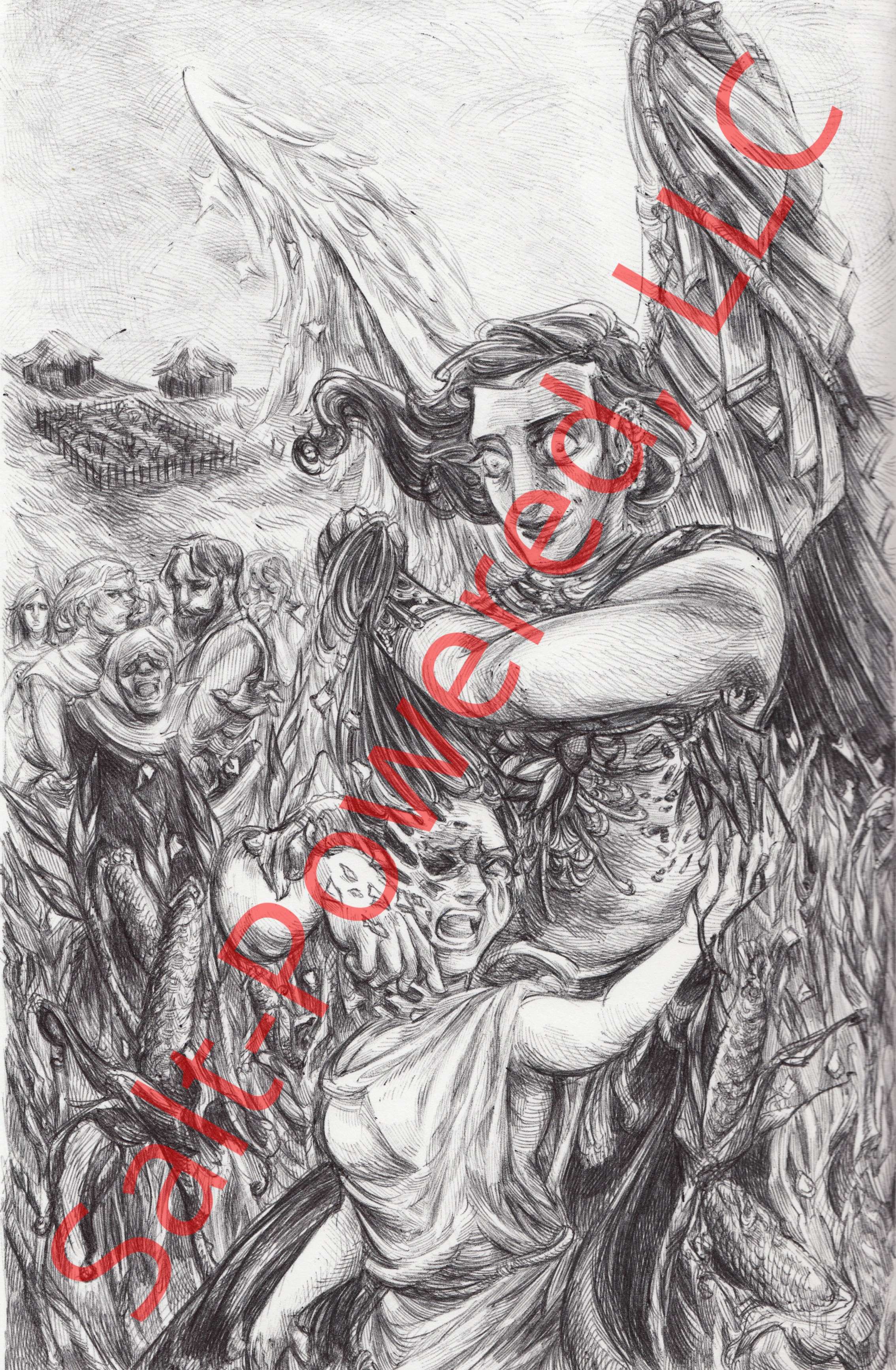
Rae did a fantastic job with this one, and while the scene is in some ways powerful enough to stand on its own, it also drips context.

I’ve mentioned Spar previously, if briefly, here. The head-brandishing individual is one of its Diarchs–the Right-Hand Queen, specifically. This one, known to history as the Iron Queen (or to her contemporaries as…less savory names), ascended to the throne at a very young age alongside an older, more experienced Left-Hand King who sought to make her politically irrelevant. He arranged that she be sent to the front lines of war for over a decade while he consolidated power at home, but instead of quietly allowing her generals to direct the campaigns (or dying), she became a brutal warrior and an accomplished battlefield tactician, leading her to countless victories and a homecoming in Spar as a hero of the people. Nonetheless, the political elite, the Left-Hand King included, found her vulgar and imperious and feared she would upset the balance of power in the city.

A turning point came when she and the King attended a private demonstration at the academy. A traveling scholar had found a child, prodigious in a strange reality-bending magic practiced in the north, very different from the elemental magics espoused by the Diarchian scholars. Of the twenty or so that went into the room, only the Queen left alive, holding the head of the child in her bloodied gauntlet. She took it to the speaker for the Diarchian senate and presented it to him, with reference to the prophecy all had heard and few had taken to heart: This is what magic has done to our kingdom, I will defend us against it, and you will stand in my way no longer. But even as she holds the child’s head in her right hand, we can see something in her left: the crown of the Left-Hand King. No one knows what happened in that room, no one knows whether the child’s magic truly caused this tragedy, but it hardly matters now that there is no one left to oppose the Queen’s rule.

Top Image: Blame, by Rae Johnson, commissioned for War Torn/Rale

Fighting Death

Some of you may have noticed the minimalist titles for the art I’ve been posting for War Torn/Rale.  It’s not accidental, and it’s not a deliberate attempt at edge, rather, it’s a philosophical premise that we’ve built into our pipeline, better appreciated with some backstory:

I’ve mentioned before that War Torn is a “dying” world, and I hope my fiction has made its bleakness clear, but I’ve also been pretty vague about what exactly that means.  It “starts” (there is time before, but consider this the history’s inciting event) with a prophecy. The exact content of the prophecy varies with each retelling, and no one’s really sure who said it first, but the thrust is this: “The use of magic will destroy the world.”  Understandably, this prompts some questions. How will it do this? When? And, most popular: Is it tru, tho? And, of course, the answers don’t come clear, concise, etched into stone–they come in cacophanies, as followers and dissidents argue with words and steel over what words mean and what is true.

That’s not quite true.  At first, the prophecy garners little attention from anyone until it gets picked up by the tyrant of a city-state called Spar to cement the legitimacy of her rule during a political crisis, and from there, it becomes the basis for a system of extermination for all those gifted with impure magic.  Long story short: A blood mage slips through the cracks of this system, murders the entire establishment, and declares himself the Blood God, beginning an era of free magic. Things proceed slowly but steadily downward from there.

The timeline goes on for several thousand years past that point, until the world is a desert, and the last vestiges of humanity are fighting to the bitter, pyrrhic end over the last known source of drinkable water.  Even then, it’s not clear: Was the prophecy true? Was it causal? At a literal level, it’s not something we intend to answer, but Leland and I were set on a metaphor that should hang heavy–much like the prophecy itself on the world’s history–in both the mechanics of our system and the characterization of magic in the canon.  Perhaps you’ve noticed in the allusions from stories like The Chimera: Magic is death.

I.

Digression: I don’t think most realize the variability of what “magic” means in different fantasy worlds.  Obviously, it is underpinned by different sources of power–the gods, nature, crystals (wtf, Square Enix), the strength of one’s body, etc.–but there are practical differences as well, and if you dig into the philosophy (or at least apparent philosophy–many times this isn’t textual), those differences are pretty profound.

Consider two of the largest archetypes: magic as a scholarship (as practiced by DnD’s wizards) and magic as religion, a means of channeling the power of some elevated entity (as practiced by DnD’s clerics and warlocks).  There are others, but it’s defensible to say that almost all magical systems are a linear combination of these two ideas, and praxis, in all cases, is an argument. The difference is just whom you’re arguing with. For religion, that’s a duh, but for the hermetic, scholarly variety, the argument with Truth is a little harder to visualize.  Still, I’m not coming up with this from nothing–this line of thought is extremely old, dating back to Pythagoras, and it formed the underpinnings of alchemy as it was understood in the Middle Ages as well as the epistemological tradition that enabled modern science (1).

As it concerns War Torn, magic in our world is decidedly of the “hermetic” tradition.  There are no proper deities in our world, rather the “True Gods” were presumably human (or animal) at some point, as I describe here, and they don’t have much in the way of codified rites allowing one to channel their power.  Rather, magic is fueled by mana, ambient environmental energy that a properly trained individual can sense and draw into himself.

I put quotes around “hermetic” because this is actually fairly paradigm-neutral.  It’s just energy that you can harness (essentially) with yoga-style breathing exercises, but it only appears that way because no one really knows what it is.  Throughout history, various schools of thought uncover ways that mana may be gathered more effectively. The fire mages of the Diarchian Goetia learn that mana can be harvested from burning flames, the beast mages of the Bloodwood gather it by devouring living prey, and the Walking Winters of the Dereliction leach it directly from their hypothermic victims.  Behaviorally, there is a sort of argument with Truth happening here, and the method of argumentation seems to be: being a dick. Think about it. You’re burning down a forest, you’re eating someone, you’re sucking the life from their body. Magic can be used for good, but you can use so much more of it if you’re open to murder.

II.

As I said before, I don’t intend to make the scholarship any clearer than that.  Ostensibly, magic is not really death, but there’s a hell of a tragedy going on in the commons.  Magic is power, the acquisition of power kills, but how else are we to fight death?  This is roughly where the backstory collides with the prompt. Think back to the art titles: Hope, Embrace, Control, Names, a collection of vague ideals, certainly, but there’s a pattern: These are ways that humans fight death.

I mentioned in my intro for Flailing that the history of War Torn/Rale is not one of humanity at its worst, and I really do mean that.  Humanity is obviously capable of a tremendous amount of good (and even more obviously, the opposite), but what’s profound isn’t the capability–it’s the need.  Fighting death isn’t just a human behavior, it’s perhaps the most fundamental human behavior of them all, and if you don’t believe me, consider the way we relate to animals: It’s pretty easy to grok a spider’s (or any animal’s) fights and flights, struggles for survival that we experience in our own lives (however indirectly in the modern world), but how well do you relate to allowing your mate to devour you?  You’ll note that adulations of the male spider’s noble sacrifice are vanishingly rare (2).  Embracing death is unsettling, as a society it revolts us, though the fact that the individual has no such immunity is an important basis for the Dark Souls series.

My point muddles, I’ll clarify: In so many places, in so much literature, you’ll find indictments and benedictions of human nature.  We are inherently good, bad, tabula rasa, but that’s wrong.  We are all of the above, and we are only one or the other insofar as it serves a need, and that need is to be, if not in true life, then in memory, its simulacrum.  Look back to The Dragon’s Thesis.  The Dragon’s goal matches the setup perfectly, but look closer: so does Mefit’s.  That is the nature of redemption by memory.  Even if you die, you’re not dead to everyone else.

III.

This (the essay you’re reading, but also the theme as it appears throughout the world of War Torn/Rale) is meant artistically, as an exploration and affirmation.  It does not criticize, and it desires no particular change. Still, some may be tempted to view the singular drive of a fight against death as something selfish. It isn’t.  To that end, I’ll leave you on the same note we began. See the opening image. What, do you think, is its title?

Footnotes:

(1): For a good example of how this translates to fantasy, see Full Metal Alchemist, particularly the original.  Its brand of magic tracks very well with the mathematical tradition of alchemy as it actually existed.  By its title, you can probably tell that it wanted to be associated with alchemy, but recognize that the scholarly wizard angle in DnD et al is the same logical foundation.

(2): It can be justified with some mental gymnastics–we do, in fact, make sacrifices for those we love, but there’s a brief moment of revulsion when you think of it, right?

Top Image: Children, by Quinn Milton, commissioned for War Torn/Rale
The Way the World Has Died

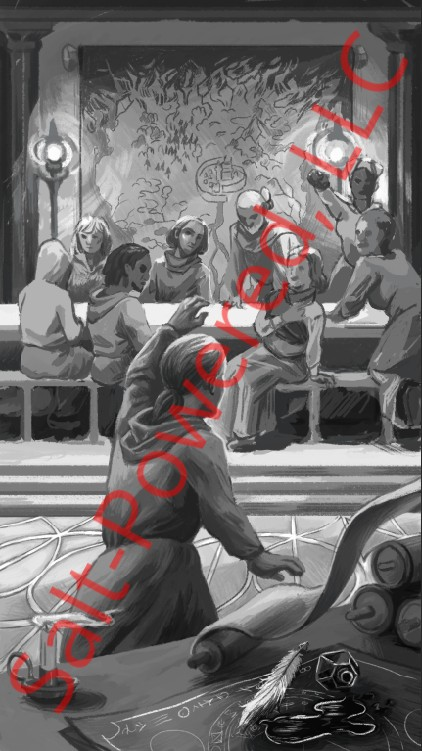
Working on a couple of larger pieces right now, but posting is going to be dead for the next few days due to travel. The following was originally written as an introduction to the War Torn/Rale rulebook. That is unlikely to be its final use, but I want to share it here as good perspective on that world, looking to the beginning from the end. Overall the history on which Mefit is commenting is not really a story of humanity at its worst, but it is nonetheless deeply pessimistic. Death here is inexorable, and if humanity at its highly variable average cannot stop it, then hope certainly is difficult to hold.

To whomever reads this: I pray dearly that your hope is not lost.  My own fled me long ago, but perhaps you may yet find a use for these pages.  You see, I paid for them, with the years of my life, my blood, my sweat, even the integrity of my mind; everything I’ve ever built, indeed everything I’ve ever been, I’ve scrawled onto this parchment and bound in this leather in hope that it might serve as a lens through which one might see the way to save us.

I see no such way.  I have found no such map to salvation in what you hold in your hands.  I have found only a grim chronicle of the way the world has died. And how is that?  Even now I cannot be sure whether it was our arrogance or our cowardice; our strength or our weakness, but I know one thing without a doubt: We are to blame.  It was man and woman, just like you or I–indeed you and I–who tore the essence of life from our kin and used it to grind to dust every last thing that was good.  Some of us were as dark gods; others simple murderers, rapists, and thieves; still others called themselves heroes.  Some called themselves nothing at all. Not one of them–not one of us–was innocent.

Now the ground we stand on is torn asunder, and there is no lot left us but to fall.  Grow wings if you can. Else, read on and abandon hope.

-Mefit Il-Hazeen

Note: Mefit Il-Hazeen–though perhaps he did not use that name then–is also the narrator of The Dragon’s Thesis. You’re welcome to sort out the chronology yourselves.

Top Image: Mefit Il-Hazeen, concept sketches by Rae Johnson

Flailing

Art by Rae Johnson, original story by Leland Masek, editing by me. In between some of the larger posts, I wanted to give a look into the creative process we use for War Torn/Rale. The story was the concept we used to flesh out the idea of this character’s–Judiah’s–death scene, a pivotal moment in the history of our world. Your context is certainly limited, but that’s the intent–what do you glean from these images and words?

Forty hands with forty daggers will find the hole in Judiah’s unbreakable flesh.

And that is what happened.

Judiah, False God of Wind and Time. Was stabbed in the armpit by a random, thrashing, dying girl. With a blade from her grandmother, meant for crops, a tiny, cutting blade. As he held her down and lowered the Arm of Justice to her skin, turning first her hair, then her scalp, to ash, as if caressing her with love. Her random flailings hit flesh like stone over and over, the sound of steel chipping at rock ringing out, nauseating, infamous in Judiah’s wake of destruction. Until a strike landed wet and hot in her hand.

And Judiah’s eyes opened wide. And he blinked. And the Arm of Justice drifted inward, obliterating the poor child’s face as he fell, dying.

The blade had found a gap in his uncanny invincibility, a gap that had not existed the year before, a gap that grows from magic wearing thin. But Judiah had never known his tools well enough to become careful. And like that, his powers of Wind and Time, which had made him God-like for twenty years, simply and utterly failed him.

Top Image: Flailing, by Rae Johnson, commissioned for War Torn/Rale
The Chimera

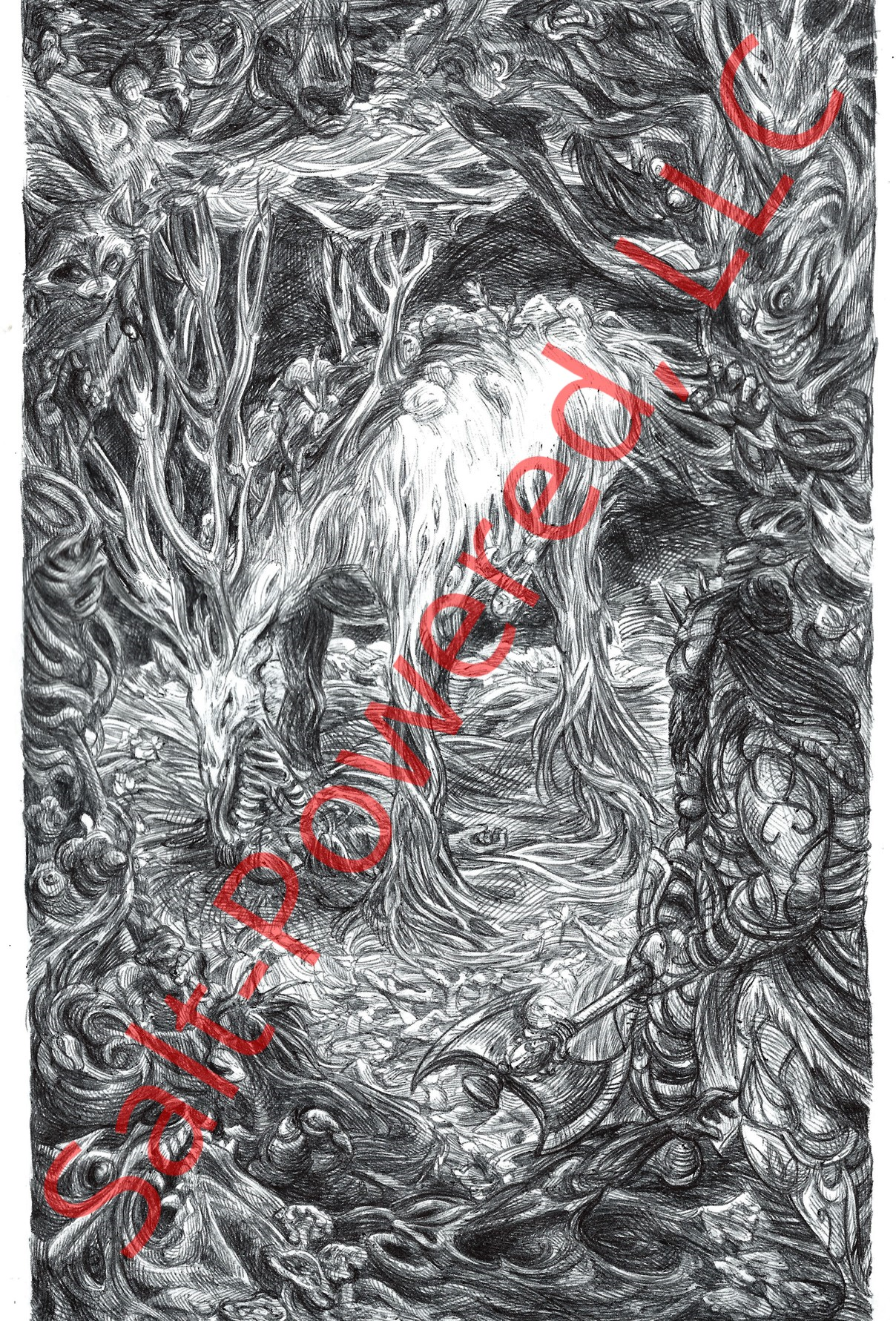
Very rough, written for use in a War Torn/Rale playtest one-shot (hence the weird, second-person framing).  Posting primarily as an excuse to show off Rae’s art.

You feel time drain from your perspective.  Where you are is not here, when you are is not now.  The trees around grow tall and vast, larger than you have ever seen, and the underbrush grows in kind.  From the canopy, birds take flight, and squirrels scamper between the boughs. Amidst it all, you see a stag emerge from the greenery.  The creature is tall and proud and weathered by its years in the forest–it knows that even as it is surrounded by life, death is never far.

Even now, it is pursued by a group of men.  They carry bows and spears and fire, and eve though the creature flees from them at great speed, they are relentless.  Soon, it is tired, and the men reach it. Their blades and arrows pierce its hide, and their flames scorch its face, and though it tries once more to flee, its legs fail it, and it crashes, heavy, to the ground.

The men approach but do not reach it, for suddenly, a wolf leaps from between the branches and bites a man’s throat.  Blood flows, and the man’s companions stab the beast, but even in death, it does not forsake its quarry.

The stag, seeing life abandon its would-be salvation, cries out in horror.  The sound is feral, animal, real, but you recognize the creature’s voice all the same from the echoes you heard beneath the earth in your own world, outside this strange rift in reality.  Abandoned by life, it instead calls out to death, to draw the macabre scene into its warm embrace.

For the first time in the creature’s long memory, death heeds its call.  The branches around them, imbued with that deathly force, grow and pierce the men, enshrouding the dead wolf in monument of briar and blood.  At once, the stag realizes: To help the world escape death, it must become as death. It must draw the whole world into its embrace.

The stag, galvanized by fear and grief, sets about its task.  It devours the wolf, swallowing its tail, its flank, its shoulders.  As the stag engulfs the dead beast’s maw, a spark of life, of hunger, awakens inside it, and the beasts, now twinned, begin to eat as one the men, the briar, the earth, and the trees, until the chimera and the forest are one.

Years pass, and the earth shifts, and a Hunter arrives at the forest’s edge.  He understands, as the chimera does, the balance of life and death. And just as the chimera has, he has swallowed the strength of the dead, stocked it beneath his skin.  For years, the two hunt each other, attempting, as they had before, to pull one more soul into their embrace, but they are tenacious and tireless, and neither does prevail.

The Hunter grows tired of the hunt, but he cannot walk away.  He bands with a strange bird and a king among beasts, and the three end the chimera’s advance in a cavern below two burning trees, ensuring, despite the creature’s cries, that the world never will be saved from death.

Top Image: Embrace, by Rae Johnson, commissioned for War Torn/Rale

Project: War Torn/Rale

My tastes in tabletop roleplaying have always been a little unconventional.  Part of that is probably the way I learned the genre. About thirteen years ago, a group of my friends gathered in a basement and learned that you could essentially build your own video game from the ground up by writing your character down on a sheet of paper and rolling dice.  Apologies to the folks who found that description caustic–the New Times are no doubt very different from the Old. My unconventional take, though, was that I didn’t actually play Dungeons and Dragons for another six years.  For me, it was homebrews for nearly all of my young-adult life.

Enter War Torn.  A little over a decade ago, Bill Masek designed a roleplaying system (the most rules-heavy I’d played up to then), and, as I was good friends with his brother, I was roped into a playtest group.  It was more unconventional than I think I realized at the time. It did away with much of the tables-upon-tables minutiae of DnD and its ilk and instead tied character progression to a single axis: your abilities, which, in DnD parlance, behaved like feats.  In Bill’s game, there was technically a system for the creation of magical items, but in our experience the difference between a new character and a battle-hardened veteran was simply the number of abilities he had accumulated.

As the years went by, I lost touch with Bill, folks in the playtest group went off to college, and I experimented with a number of other systems (including DnD and White Wolf’s Exalted), but I never stopped building on War Torn.  I built a mod that I affectionately dubbed War Torn, 3rd Edition (after the two distinct versions I had playtested for Bill–in reality, Bill had made his own 3rd edition separately), aimed at increasing accessibility at the expense of the tenuously tame balance of power that existed in the original, but I never pushed it out beyond a close circle of friends.  Eventually, though, Leland, Bill’s brother, approached me with ideas on how to truly build on the ideas Bill had set down, and our current collaboration was born.

In the War Torn that exists today (sometimes referred to as Rale), little remains in terms of the specifics of Bill’s original design, save for the feat-like ability system, the names of the stats, and the theme of a dying, dark-fantasy world.  While I may use this blog at times to discuss some of the nuts and bolts of the game’s design, that dying world is what I intend to write about the most. We have developed a storyboard of several thousand years of history, which we intend to furnish with fiction and illustration, both of which I will be posting here.  As with much of my material, the fiction does fit into a much larger whole, so if you find anything inaccessible, feel free to pose any questions you may have in the comments.

Top Image: Hope, by Hector Rasgado, commissioned for War Torn/Rale