One Wing, One Eye, Chapter 5: Here’s the Plan

Realized it’s been 10 months since the last chapter of this story. Man, time really does fly, fun or no.

There was something that needed to be done.  Devlin felt it, powerfully, desperately.  Except for rescuing Orphelia, he was certain it was the most important task he had ever faced.  And yet, somehow, despite the burning sense of urgency practically holding his eyes open as he rolled fitfully on his bunk in Brill’s infirmary, he had no idea what it was he had to do.

At least he could see now.

Since the Chateau de Marquains, the birds had returned in force.  They were on and around him, rustling, flapping their dirty wings as he choked on the miasma that wafted off them.  They would perch on his bare skin, place their beaks against his eyes and utter a hollow, rattling croak.  It felt like encouragement.  It felt like a threat.  He wasn’t sure to what end.  Their presence still stifled, anxiety like heavy mist.  But unlike before, he could see.  The feathers from their wingbeats fell beside him rather than clouding his vision.  And unlike before, he could move.  Rather than harry and hinder him, it was as if the birds attempted to lift him when he walked.  He felt like he was floating, sometimes, each step not weightless but ineffably light.

He was still worried about Orphelia.  Always worried about Orphelia.  She came home concerned.  Not concerned.  Distressed.  Not home.  Brill’s infirmary–what was home, anymore?  What could home ever be?  None of that was important.  It would all be okay if he could just complete this last task.

Devlin clutched his temples as he felt a wave of pinpricks in a line down the side of his skull.  Slowly, the pain receded. […]  For a moment, the birds were quiet.

Orphelia was safe, though, right?  It wasn’t like Les Marquains could chase her all the way here.  It seemed absurd that he would even want to.

No, Devlin thought, strangely assured of the notion: Les Marquains had no reason to pursue Orphelia.  And the False God would have to be distracted: As they fled, the Saraa Sa’een had burst through the magically-reinforced walls of his chateau.  Was Les Marquains even still alive?  It was a useless question.  It had nothing to do with Orphelia, with determining what it was that found her here.  Whatever it was that scared her.  The birds quietly muttered their approval.  They knew he was right.  They would help him protect Orphelia.  But he would need to get up.  He would need to go out and see what lurked in the Crossroads’ alleys.  No, it was okay, he realized.  The thing that kept him awake, the thing he needed to do: This would be the first step.

The birds fluttered up around him, lifting him from the cot, holding him steady as he crept to the curtain, across the apothecary shop floor.  He lifted the deadbolt and slipped out the front door.

The birds hadn’t yet seen much of this Crossroads, Devlin thought, confined as he had been previously to Brill’s infirmary–and the alley across the street before that.  This little patch of squandered potential sprung up in the ruins of Ulrich’s Bend, itself barely an outpost of the arrogant, long-ruined Kol.  So close to what had once been the Blackwood–now open marsh at the outskirts of the Windwood.  Though one had to admit the Bloodwood was a better name for it.  A name befitting a substrate for the loathsome fungus of human tenacity, never bothered to pull its way upward, yet nigh unstoppable in its stubborn push forward.

Somewhere, secondarily, Devlin wondered how he knew these things, why he made these judgments.  He didn’t remember learning any of it, but it had been some time since he had felt awake.

The streets were empty now, of course.  The inn where Orphelia had been had locked its doors, all of the Crossroads’ late-night wanderers had settled for the night, at the inn, their homes, the posts at the thoroughfare intersections–in the case of the militia volunteers playing the role of night watchmen–and, for those vagrants too poor or too cheap for more sensible lodging, squirreled away in secluded alleys about the town, much as Devlin and Orphelia had been when they first came here.

But despite the quietude, the birds saw things, now that they were awake, now that they were helping.  They fluttered about Captain al’Ver’s boat-wagon, tied outside Brill’s shop.  They dared not land upon it.  It was not theirs.  But this place, this Crossroads, was no one’s.  Between their domains.  It was not her right to meddle here–which was why the birds merely watched–but it was not his either.  Captain al’Ver gave up long ago.  They all did.  Why this sudden regret?

A wave of dissonance washed over Devlin, and the pinpricks in his temples flared again.  Orphelia.  Captain al’Ver was watching Orphelia.  Because of his mistake.  His own poison gift.  The birds croaked menacingly, and somehow Devlin understood the implication: It was upon that observation that he became watched.  And because he understood that connection, he was not afraid when he turned and saw the watcher, seated in the shadows beside the door of the inn.  Beneath a wide-brimmed hat, eyes glinted orange in the light of the brazier down the street.

The old man rested a hand on the stock of a crossbow laid across his lap.  He sat, but he was not inert, the weathered lines on his face showing no trace of fatigue.  The scowl, the stare, the mechanical poise of his fingers–he saw through Devlin, and he judged.  Devlin did not know what to say, but the birds spoke through him:

“I was betrayed first.  What right do you have to intervene in my retribution?”

The corner of the old man’s mouth creased, and his knuckles whitened around the crossbow, but Devlin did not wait for his assent.  He turned and walked away, toward the north end of town.  The nature of Orphelia’s predicament was growing clearer, but there were other winds blowing about this place.  The merchant of bespoke blights–this Marko–he would shortly have designs upon the Homunculus abomination.  How could he not?  But the birds could not guess what those designs would be, so maybe Devlin could find out?

The story the silver man–the abomination, the Homunculus– had told in the infirmary was not alarming to Devlin.  It sounded foreboding, ominous.  The awakening of the Night Sky sounded like a Very Important Change.  Scary, in a far off sort of way–but also exciting?  Hopeful?  Like a promise of eventual relief.  It was a strange way to feel about what Captain al’Ver said would be the end of the world, but Devlin had been in this haze, so tired for so long.  He wanted it to end.  He wanted it all to be what it had been before.  But ending…the sickness, the transience, the sleeping through raspy coughs on boats, in alleys, on infirmary cots–ending that was the first step, right?

The birds’ startled croaks wrenched his thoughts away from that confusion, drawing his gaze upwards.  Devlin’s eye caught Ty Ehsam, perched on the roof of Gene’s smithy.

Rogue, the birds croaked.  Wayward child.  Did the crawling worm not grasp the opportunity before them?

For just a moment, Devlin wondered how it was that the birds’ tittering placed these thoughts into his mind.  As if they were his.

But he had a task he had to complete.  Time was of the essence.  He continued on toward Marko’s.

***

Ty shivered as Devlin looked up suddenly, directly at him, one eye obscured by his ragged hood, the other clearly–almost ethereally–illuminated, piercing, frozen grey in the faint torchlight.  It was by no means alarming that Devlin noticed him, of course.  They had come to town together.  To the extent that the boy had been paying attention, he would have known that Ty was keeping to the rooftops in this general area of town.  Still, the interaction had been uncanny.

“Well, I would say we’ve been clocked.”

The whisper came from Ty’s mouth, but the words were certainly not his, prompted instead by scarcely detectable pulses of mana running through the threads sewn into his head and neck.

“What do you mean?” Ty asked under his breath.  “The boy knew we were here.”

“The boy?” the Dragon replied in Ty’s voice.  “You gods forsaken idiot, you think that what just saw us–and I mean us–was a boy?”

Ty did not respond.  The Dragon’s abuse was more or less a constant when the False God spoke to him, and he saw little point in engaging with it.  He followed Devlin as the boy–or whatever the Dragon thought he was–continued up the street, stumbling and meandering in much the same way he had ever since leaving the Chateau de Marquains.

“I can forgive a simpleton like you for not sensing the mana.  It’s a subtle flavor, and his sister is much, much louder with her magical pollution.  But have you really not noticed the way he hides his hand from al’Ver?”

Ty had not.  He considered it for a moment.

“Is he hiding his ring?” he asked.

“A lovely guess.  It is better to be stupid than stupid and blind, I suppose.  What can you tell me about this ring?”  Ty shrugged.

“Cheap,” he said.  “Looks like dirty iron.  Grooves cut into the flat on one side.  Are those supposed to mean something?”

“It shocks me that you’re even intelligible, let alone literate,” the Dragon sneered.  “Grooves?  Mean ‘something’?  That is a bird’s footprint, you dunce.”

“You say that as if it’s a crest I should know.”

“Only because it is.  That is the crest of the Strange Bird.”

Ty glanced again at the street.  Devlin had disappeared into the shadows, and all was once again silent and empty.

“Never heard of them,” he said, leaning back against Gene’s chimney.  “Another new False God?”

“My disgust can scarcely be vocalized,” came the Dragon’s surprisingly calm reply.  “They’re almost childlike, your priors.  Raised in a world of bad replicas, you are unable to recognize the real thing.  Even when you run right into two of them.  But I suppose the Feathermen disbanded decades before you were born, and why would you have learned their master’s sobriquet?  It was buried on purpose, precisely so that fools like you would forget it.”

“Well, sorry for the foolishness, but I don’t follow,” Ty whispered.  “The ring is magic, I assume?  And it’s linked to this Strange Bird–so what?”

“So she saw us.  And you’re just going to let him dance off to his business in the dead of night?  Get up and follow him, you idiot!”

Ty sighed, carefully creeping to the edge of Gene’s roof.  He leaped over the small alley between the smithy and the potter’s workshop next door, proceeding to make his way after Devlin as stealthily as he could.

“She saw us?” he asked between measured exhalations.  “Who is she, exactly?”

“The Strange Bird,” the Dragon replied.  “The One-Eyed Crow, the Lark in the Burning Tree, et cetera.  And the kid’s been traveling with you all this time: She’s seen everything there is to see about you.  I am more vexed that she saw me.”

Ty frowned, annoyed as much by the Dragon’s vagaries as the thinning of available rooftop routes.  He carefully lowered himself to the street beside a vegetable garden wedged randomly amidst the tradesman’s corridor and took to the street, beginning to push out a field of mana, a subtle, vacuous delusion, the technique Naples called “shadow walking”.

“So what does it mean?” he muttered, quickening his pace as Devlin swayed toward the square up ahead.

“I shan’t waste any more pearls on you,” came the flat reply.  “Find a codex if you’re curious.  Suffice it to say that we should underestimate neither the number of parties interested in our Homunculus, nor their level of interest.  Now keep following the damn boy.  The more I can learn about her angle, the better.”

Ty’s motivation to carry out the Dragon’s reconnaissance was waning, but he really did not like the notion the False God seemed to be reading from the boy’s behavior.  A fourteen-year-old boy being controlled by a mage–let alone one that could intimidate a mass-murderer like the Dragon?  It was just…grim.  Both Devlin and his sister had had a truly rough go of it, and though Ty had his frustrations with Orphelia’s relentless troublemaking, he couldn’t help but pity them.  And he was left to wonder whether the boy’s ring was a problem he might be able to address.  The Dragon didn’t seem to think there was any such opportunity, but Ty was also fairly certain the Dragon didn’t give a damn about the boy’s welfare.

For a moment, Devlin disappeared from view, rounding the corner onto the north square.  Ty lingered there, peering out at the surprisingly well-lit space.  To his surprise, Devlin had stopped scarcely fifteen feet beyond the turn, staring straight ahead.  The benches, fountain, and walkways at the center of the square fell well within the torchlight, but Ty couldn’t make out anything there that might have given Devlin pause.  He noticed it only because Devlin’s attention prompted him to keep looking, but there, under an awning at the opposite end of the square, Ty caught movement.  Smoke.  No–vapor.

The shadows behind the trail of steam stood and approached the boy.

“Devlin?” Bleeding Wolf rumbled, stepping into the light, pensively balancing a steaming wooden cup between his fingers.  “What are you doing out at this hour?”

“Uhm…”

Ty could not understand Devlin’s response, barely a murmur as the boy swayed, hands balled up inside his sleeves.  Apparently, Bleeding Wolf didn’t catch it either.  The concern on the beastman’s face deepened.

“Let’s get you back to Brill’s.  Maybe they’ll have somethin’ for the sleepwalkin’.”

Ty ducked quickly back around the corner, into an alley where he used a barrel as a makeshift step ladder back to the rooftops.  He waited there for the next few minutes as Bleeding Wolf ushered Devlin past, back to bed, seemingly oblivious to the eldritch presence Ty had seen behind the boy’s eyes only moments ago.

“Did you see it?” the Dragon whispered once the two were out of sight.  “He hid the ring from the beastman as well.  Al’Ver is obvious, but why would she consider your ‘Bleeding Wolf’ a threat?”  Ty paused.

“A threat to what?” he asked.

“Finally.  A pertinent question.  Alas, the boy retreated, so I don’t imagine we can be sure.  Still, he was approaching…Marko’s office, was he not?”

***

“Here’s the plan,” Marko announced to his empty theater, no-nonsense, motivational-like, the type of confidence that ought to inject some energy into his thinking.  Except he didn’t have the plan.  He sighed, grumbling a half-hearted string of curses.

The pieces, then.  Atra wanted to fight the Blaze, for whatever shell-forsaken reason.  The Blaze wanted the Keystone.  Unclear if he wanted the construct.  He would if he weren’t an idiot, but…  And the construct, this “Monk”, wants to…bring the Blaze to the site of the Night Sky’s awakening?  What?

Marko glanced out at the torchlit shadows beyond the stage where he stood.  He fiddled with his crossbow, concerned that he might not be alone but self aware enough to know that he was always thus concerned, that there was no signal whatsoever in his worry.  He jumped down from the stage, landing hard, his knees just no flexing with the impact the way they used to, and he checked his wards and traps:

The unobtrusive strip of strange metal at the doorway–the same metal as one of the seven rings he wore–which dissuaded anyone from entering without his approval, still in place and undamaged, unlike the rest of his doorframe; the elongated stone brazier at the edge of the stage–a creation of Holme’s Sculptor–which burned without fuel and grew much brighter in the presence of violent intent, still alight with its normal, orange hue; the windows, all completely ordinarily shuttered but affixed with small parchment tags fastening the shutters to the sill such that they would tear if a window were opened–and which would instantly reduce the temperature in the vicinity dangerously below freezing upon tearing; and, of course, the trap door beneath the rug on the stage, locked both conventionally and with a magical device operated by his pendant which would, by default, redirect any harm done to the device, the door, or the room beneath it back at whoever was attempting to smash their way in.  Everything was still in place, in working order, and crucially, only Marko knew how it all worked.

Back in the old days, it was once every couple years a scav would try him.  Now no one had bothered him in a decade, excepting the Ben Gan Shui’s centipedal envoy smashing through his door the other week.  But he tried not to let that affect his paranoia.  This was a dangerous fuckin’ line of work, and being on the backlines of the scav trade really wasn’t any safer.  His little stronghold wasn’t impregnable, though even the envoy probably wouldn’t have made it past the lock–and none of this shit seemed to work on Lan al’Ver, but it was still better protected than the vast majority of scav marks.

Marko heaved himself back onto the stage, his checks, his thrice-daily ritual completed.  The pieces again: 

If Monk wanted to get someplace else and bring the Blaze there, that gave Atra her stupid battlefield, right?  So she could get herself killed, the Blaze would get his Keystone, and the threat to the Crossroads would be gone.  With the threat–and Atra–gone, the militia would go, and Marko could find some means to wrench his mercantile autonomy back from the mayor.

What about that loose end, then?  Mayor Bergen probably wouldn’t care about Monk’s prophecy, and who knew how much he cared about Atra’s death wish?  He would probably want to ship Monk and Ehsam up north.  Marko had to admit the simplicity was appealing, but Atra would certainly meddle.  In the end, he neither trusted her, nor was he willing to put his neck on the line to give the mayor an unmitigated win–the mayor was his enemy too, after all.

“Here’s the plan,” he said again.  “We got the research angle, see if I can dig up any scraps of wisdom I might’ve picked up from the Alchemist’s fanboys over the last few decades.  Need to figure out where Monk needs to go.  Hell, maybe the clockwork piece of shit will help me.

“Then the action.  Gotta–”  He stopped cold as the stone brazier flared up.

It was for just an instant that the flames sputtered higher, just a quick flash of light that brushed the dark corners of the stage before dying back to dim candlelight.  Could’ve been a fluke.  Something outside, whatever malice woke it up either phantom or just gone now.  Or maybe Atra’s little spy tripped one of his wires.

“Don’t fuckin’ worry,” Marko muttered.  “You’ll be in on it.  Now fuck off.”

It was the truth, sort of.  If everything worked out, Atra would get what she wanted, far away from here, at maximal cost to the Bergen boy’s stupid militia.  But she couldn’t know in advance.  He needed her to react hastily, to be taken by surprise.  He needed to be driving this cart.

But whether or not his invective had been received, there was, of course, no response.

Journey to the Center of Society, Possible Prologue: Trade Offer

“It’s weird how few people pay attention to how many religions are essentially contractual.”

-samzdat

It was an artfully complex transaction.

The opening was typical of the diplomatic speculation that pervaded China’s Warlord Era.  So many sides, so little to agree on–supremacy is an inherently zero-sum prize and all that.

The context: Cao Kun of the Zhili had beaten back the Fengtian and consolidated power over Beijing.  Wu Peifu, Cao’s right hand, was thus mired, from the administrative discomfort of his temporary office in the capital, in the effort of helping him keep it.  This meeting was one of many seeds cast, little investments with little expectation but–Wu hoped–incredible potential.  Cao had already secured the blessing of interests from the Western nations that would soon agglomerate into “Britannia”, but today’s talk promised a more bespoke advantage.  A private citizen with an interesting personal history.  Perhaps a charismatic figurehead, a cunning informant, a diplomatic shield if it came to it.  Wu had little idea of what this man wanted, but that was not unusual.  These meetings were, by their nature, exploratory.

At this point, the prospective exchange was simple: a little of my attention for a little of yours.

He entered Wu’s office with a small retinue: a manservant and a bodyguard, putatively, themselves flanked by eight of Wu’s own soldiers.  Wu gathered that the manservant would be interpreting when the unassuming man spoke first, in accented but otherwise inoffensive Mandarin:

“Thank you for meeting with us, General.”

This was in incorrect apprehension, but Wu did not yet have reason to realize it.

The man, Richard Sterling, a Western celebrity of whom even Wu was aware, had a surprisingly direct proposal: He and Wu had a mutual interest in the eradication of the Fengtian to the north, and he claimed to have the means to execute this goal bloodlessly.  But to do this, he needed two things: He needed men and materiél to bring him close to the enemy’s seat of power unscathed, and more peculiarly, he required that a more subtle operation be completed first.

There was a soldier, he explained, under the command of the Fengtian general Feng Zongchang, known as “Tianyi”.  Tianyi was to be captured, deprogrammed, and extracted from China without Sterling’s involvement.  Wu was, of course, aware of Tianyi–the name, along with numerous revolting accounts of his crimes–had spread through the provinces bordering Manchuria.  His capture would not be a trivial task, but that didn’t much matter.  Wu’s part in the transaction had ended nearly thirty minutes prior.

It was strange, in hindsight, that all of these negotiations had proceeded–between Sterling’s English and Wu’s Mandarin–without any further need for an interpreter.  Strange for Wu, that is, but not for the meeting’s singular outside observer.

For Em, Architect of Exchange, aware by nature of every passed coin, every promissory note, every clicking bead on even the most abstractly conceptual abacus, this context had become quite common of late among the planet’s most valuable transactions.  A little of my attention for a little of yours.  No one realized that all the King in Yellow needed was your attention.  After that, he had all of you.

What was beautiful about this transaction, though, was that what was nominally being asked of Wu Peifu by the King in Yellow was in fact being asked of the King in Yellow by Dick Sterling.  It was beautiful for its intricacy.  It was beautiful for its mystery: Why would one of the King’s agents ask another agent for a favor he cannot refuse?  Why would the King grant a personal request from his thrall so clearly at odds with his agenda?  And most delightfully maddening: Why would the King expend these resources to keep Tianyi–to keep Lamont Sterling–deliberately out of his control?

Em had learned a great deal of the gods of his existence, his own creators, gods that admittedly played dice but who made up for it with a command of mathematics that seemed impenetrable–even to the economy.  He had learned more of them even than the other Architects, he was sure, which would be an unpleasant surprise for See eventually.

But the devils–the Elder–were new.  Deities much more like the ones humans fantasized.  Deities who wanted worship, even in this petty, token sense, because that’s what this was, this bargain between Dick Sterling and the King in Yellow.  Because when a god exists, worship is a transaction.  

And so it was there, in that office in Beijing, that Em first caught a glimpse of that black mirror in which, he realized, he was the reflection.

Sin (from The Chimera)

Another strange piece, part of the same weird project as Maze in the Mists. House of Leaves had a lasting influence on me, and there is something just fascinating about the idea of a fictional character delivering a non-fictional analysis of a book that doesn’t exist. The difference here is that the latter will (hopefully) eventually exist. But that’s a far future sort of thing.

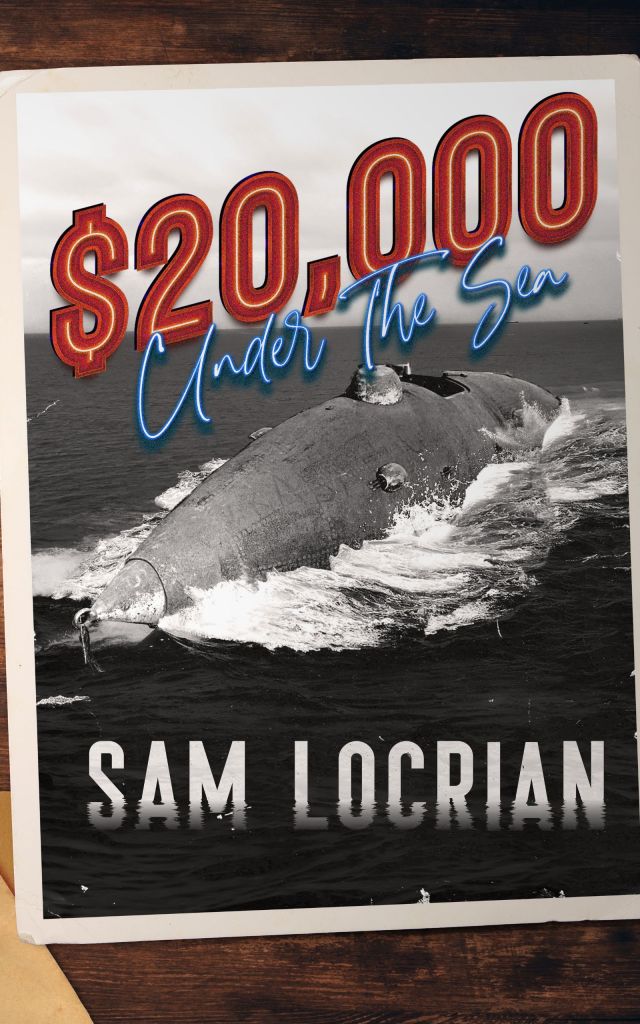
And if you enjoy my writing and would like to support it, please considering buying one of my books. It is timely, after all. $20,000 Under the Sea released just this month, and you can buy it in ebook or paperback format here!

Why did Taamir Ra allow himself to be taken by the Dead Queen?  His companions’ reasons shouldn’t be any great mystery: For his brother, it was a desperate, knowingly doomed attempt to repel the darkness which would surely swallow the kingdom.  For Tiresias and–but for an ancient pact–Jabez, it was brazen, stupid curiosity.  For the masked man, it was compelled.  Taamir’s reason should be no great mystery either, but it’s hard to trust you people: It was guilt.

Consider that for a moment.

It’s easy to dismiss many modern representations of guilt as melodrama since so few of you feel guilt anymore.  “The weight of your sins?  Grow up,” says the man with a soul of formaldehyde and jism.  “Quit sulking.”  Think of the last time you allowed yourself to be tormented by your past–for deeds no one would ever discover, that it would be immaterial for them to discover–and, perhaps, despair.  The modern human is tormented by the consequences of their actions, they are tormented by shame, the pain of their true self being seen–the fear that it might be seen–but guilt is wallowing.  An indulgence.

It wasn’t always that way.  Edward Teach calls guilt the synonym of freedom: “You bond yourself to yourself to free yourself from everyone else.”  If you are without guilt, then, what follows?

The lack of guilt is downstream of the hatred and envy which armors you against the terrible responsibility of that world that you–not you, specifically; it is crucial that it was not only you–have built.  You became powerful, only to discover that power does corrupt.  It burns like fire, and charred skin simply makes one pliable.

But unlike you, Taamir Ra still had his soul.  He understood his sin and acted to absolve it.  “But Persephone’s capture was engineered by Bas’ahra and the masked man.  They manipulated him!”

So little wisdom remains among Christians that it’s easy to forget there is a great deal of wisdom to be gleaned from their discarded flesh.  As it were, the Christian god is quite clear on this particular sin: Eve manipulated Adam–Adam still gets the boot.  He had exactly two jobs to do: Follow the rules, and make sure she follows the rules.  He failed at both.  He did not impress upon her the importance of the task at hand, perhaps because he was too stupid to understand it, and when it came time to make sure she was actually listening, he fell asleep.  The mistakes are boring, prosaic, and kind of pathetic, not the kind of thing you would think ought to cost an eternity of Paradise, but I assure you: The boring, the prosaic, and the pathetic are in fact an extremely dependable foundation for evil.

Taamir Ra should have seen through Bas’ahra’s incredible incentive to defect, he should have spirited Persephone away without telling her; failing that, he should have outwitted the masked man; failing that, he should have refused the Sun Priests’ job and left Khet, because if he were not there, Bas’ahra could not have succeeded in the way she did.  By his very presence, he caused others to do evil successfully.  That is sin, and sin ought to elicit guilt.

Where Adam had little choice but to accept the consequences of his failure, Taamir faced a decision.  His failure caused a child to be buried alive, and his submission to the revenant which disgorged from her tomb ten years later might have atoned–but to what end?  He could have simply run.  Bas’ahra did.

But sin weighs on more than the sinner.  The injustice of Persephone Elea’s death did not go unnoticed.  Divine recompense brought about her return, and Taamir saw that, even if he could not know the particulars of the divinity.  Perhaps he thought his sacrifice–even if it did not sate the Dead Queen–might adjust the karmic scales of Khet just so, might undermine the Queen’s right to the suffering she would inflict upon the city and the world.  It might bring about a responsibility for those who could one day resist.  A responsibility to do so, under pain of guilt.

Journey to the Center of Society, Chapter 1: The McFlinn Boy

For those who want to know what comes next–or those new to the adventure of $20,000 Under the Sea, this is a draft of the first chapter of the sequel.

$20,000 Under the Sea will be available for purchase in digital and physical formats on 7/4. Preorder the ebook on Amazon here!

Vincent McFlinn was feeling pretty unimpressed with New York.  Some of the boys back in the Chicago Outfit had talked it up in their way.  They were from Jersey, if he recalled, so they weren’t fans or anything, but those fuckers still gassed the place up: the big time, greatest worst city on earth, largest wormy apple you ever did see.  Made it sound like a crazy, fourth-circle hellscape where everything was different.  Like it was kinda different: buildings were a little taller.  Mostly, the people were just fuckin’ twits.

Vincent–Drip, to his acquaintances–was certainly not accustomed to decorum, but this was somethin’ else.  Bums struttin’ around the sidewalk like some kinda aristocracy, an idiot on every goddamn street corner fuckin’ yellin’ their lungs out in that stupid, incomprehensible New York accent, and the Lethal Chamber…just…seriously?  You need the fuckin’ government to subsidize your suicide attempt?  And they were mean to the pigeons, which was never a good sign–though, as Vasco reminded him, the pigeons were generally dicks.

Maybe there were extenuating circumstances.  The city did seem to be on a kind of high alert, though pulling the reasoning thereof outta these citizens was a task.  After maybe four conversations of the form of “hey, what’s with all the coppers, ya need five on every street, seems like a lot?” “Hey buddy wassa matta wit you, missin’ ya ears or somethin’?” Drip finally managed to squeeze a red-eyed businessman for the big picture summary that the local constabulary was embroiled in a hot fight with some sorta cult.  This, combined with a far less social–but far more physically detailed–account Vasco had obtained from the local crows, yielded a more complete story: A few days ago, New York’s mayor had been assassinated by members of a cult.  A manhunt ensued, and at some point, the cops had surrounded a group of the cultists in an office building in Midtown.  And then a couple random citizens dove onto the cops’ perimeter, double-fisting live grenades.

Also, apparently, the better part of the harbor had been obliterated by a spring storm, which Drip didn’t think was related, but he did find it odd that neither the people nor the birds of the city seemed even to acknowledge the damage except under duress.

Anyway, fuck the cops and all that, but Drip really did have to hand it to this cult for making the most of their time together.  He’d been downtown for all of three hours now, and these lunatics were already chafing his dick.  Not that they even knew who he was, but with all the nest kicking, they’d gotten their enemies out in force with no evidence to go on but a mandate to be fuckin’ everywhere looking for “suspicious characters”.  Unfortunately, by any reasonable definition, Drip was a suspicious character.

Because he wasn’t a dirty plebeian, he put effort into his appearance.  Hair slicked, clean shaven, fashionable dark red suit tailored and pressed, matching Stetson worn at this season’s calculated tilt.  He stood out in a fuckin’ crowd even without Vasco there–with the crow perched on his shoulder he was just about a beacon of salience, and he clocked more than a few significant looks and gestures from the patrols, prompting him to maneuver off down sidestreets and stations to avoid whatever questions they were brewin’ up for him.

Not so different from Chicago, really.

At this point, Drip felt like he’d spent half his life on the outs in one way or another.  He grew up in a tenement in Fuller Park before the fire, along with the rest of the Irish portion of the city’s scum.  His father was a pickpocket, which, in lieu of the real job the bastard was never gonna hold down, made enough money for beer and shitty soup.  No mother was present–though Drip’s social understanding was so fucked that he didn’t even notice he was supposed to have a mother until he was eleven.  When he asked Dad what was up with that, he just scowled, walked out the door, and didn’t come back until one in the morning.  Drip didn’t ask again.

Otherwise, he and his old man got on alright, until the sap got caught red handed and beaten to death by a copper two blocks away from their house.  Most of his memory of it was less painful than just fuckin’ numb.  Hazy.  The part that stuck out was the other cop–a different one, he was sure–that showed up at his door to let him know his dad was concussed and bleeding out over thataway.  Fucker was wearing sunglasses at eight o’clock and smiling.  It hurt to look at him.  The cop that killed his father took a trip to the bottom of the river for Drip’s twenty second birthday–one of the rare cases he saw of Boss Nepoca’s sweet side before things went sideways–but the guy with the shades?  Drip never saw him again.

Drip had a rough few years after that.  He couldn’t keep up rent, but he scraped enough together between his neighbors’ charity and his own pickpocketing and petty theft to keep himself mostly fed and mostly off the streets.  His streak ran out, though, when a couple of stiffs in the North Side Gang caught him nickin’ a box from their car.  Things kinda went red after that, and he woke up in an alley with four stab wounds, his own knife white-knuckled in his hand, and the two stiffs dead on the ground next to him.  Since it was December at the time, and “dead” was only slightly less alive than he was then, he probably wouldn’t have made it if not for the men who pulled up, dragged him into their car, and took him to the hospital.

Turned out that even though he’d stolen from the wrong people, those North Siders were causin’ trouble in Outfit territory, and Al Nepoca appreciated Drip’s sacrifice in keepin’ his streets clean.  About a year later, Drip was made muscle for the Chicago Outfit, and that might’ve been history if he could’ve just kept it in his pants.

Puberty had been pretty disastrous for Drip, less for his adaptation to his body or appearance than for the Irish Catholic neighborhood’s reaction to the appearances and bodies he found himself attracted to.  Refreshingly, the Outfit’s attitudes were practically progressive in comparison.  They didn’t like that he was a fag, but they didn’t mind so long as his romantic proclivities didn’t intersect with gang business.  Problem was, six years on, he found himself a crush.  A reciprocated crush: Sal Biggs.  Roman statue jawline, eyes like emeralds, those shoulders.  And he was Nepoca’s nephew.  They managed to keep their relationship secret for a year and a half before the big man found out, but then Drip got a no-nonsense, knuckle-accented nastygram indicating he better get the fuck outta Chicago, we don’t wanna see you around here no more, got it?

That one hurt.  Probably more than his dad dying, to be honest.  It probably didn’t help that before leaving, he jumped Nepoca’s messenger, sawed off his right hand to teach him to use some professional courtesy in his communications, but he wouldn’t’ve pulled that stun if he hadn’t been handed an out: a letter under his apartment door from someone named “J.B.”, offering timely employment far away from Chicago.  Accordingly, he packed light, and after disarming Nepoca’s impolite associate, he got into a black car at the corner of Canal and Jackson driven by an annoyingly chatty man named Bluesummer.  About forty-eight hours later, he was deposited on the steps of the Claridge Hotel in Atlantic City, New Jersey, with a prepaid reservation and another note from J.B.–this one with a wad of cash–telling him to sit tight and await further instructions.  Normally, he’d bristle, but he had to admit he might’ve gone overboard.  Nepoca had told him to get gone, yeah, but hitting back at his guys might’ve given him reason to call up some friends in New York if he caught wind of where Drip was headed.  Better to lie low for now.  Stick to this swanky hotel in this little mob bubble, just him and Vasco.

It did, however, put into sharp relief that Drip’s life up to now had been extremely unapologetic.  It was fortunate that for a time, anyway, the Chicago Outfit had accepted him as he was, because he’d done fuck all to fit in.  During those months he spent in Atlantic City, he wondered how reasonable that was, every day looking at his reflection in the mirror of the hotel bathroom: him, his red suit, his pet crow.  That was kind of a weird thing, wasn’t it?  Gangsters didn’t really walk around with birds on their shoulders, they weren’t pirates or some shit.  This was real life.  More to the point, people didn’t talk to birds, or rather, as Vasco confirmed, people did, but it was in the same way they talked to walls.  But somewhere in those years of stealing and stabbing in Chicago, Drip started talking to birds–on the street, feeding ‘em in the park, wherever–and at some point, he began to understand what they were saying back.

Most of them were pretty stupid, in an endearing sort of way, but the crows were alright for conversation.  And then Vasco stuck around after the rest of the flock flew off.  After a few times tailing him to the bar after dark, he just started sleeping at Drip’s apartment.  The way he put it, Drip’s life was just more interesting, whatever that meant.  Vasco had good enough sense to make himself scarce around the other gangsters–didn’t trust ’em; probably wise–but Sal was nice enough to him.  Yet another reason leaving Chicago had been painful.  Still, Drip found it pathetically comforting that Vasco had been so willing to leave with him.

At this point, though, the possibility that he would never see Sal again was significant, and he had burned the shit out of just about every other uneasy companionship he’d gathered up to this point in his life.  Drip had always been kind of a loner, but this was a distressing severity of alone.  He found himself relieved that Bluesummer had been willing to take Vasco’s attendance on their journey in stride.  Saved him from from wondering what sort of violence or self-sabotage he might’ve lashed out with otherwise.

In any case, Atlantic City went, Drip assumed, pretty much according to plan.  Two and a half months lying low, sleeping, eating, lightly gambling, and drinking himself into a stupor as the weather warmed up, as he steeled himself for a humid summer of his discontent.  Then in April, some arms dealer’s pleasure cruise out of New York turned into a national fucking incident, and scarcely two weeks later, another letter appeared on his hotel bed.  It was terse, just an address on the north side of Long Island, a date, and a time: tomorrow, 4 PM.

He took the train up north, but things got screwy pretty much just as he reached the city.  Whatever hand-of-god storm had wrecked the harbor had also taken out the bridge to Brooklyn, so he was forced to sidetrack through Manhattan.  Between getting lost and the business with the stupid cult, he was only now zeroing in on the subway station a distracted drug store clerk had told him would get him to Queens where he could catch an aboveground line out to Long Island.  It was nearly 1 PM, and Drip was beginning to realize that his chances of traversing 70 more miles east within the next three hours were closing in on zero.  Before he could conclude that punctuality was impossible, though, the strident blast of a car horn beside him scrambled his calculations beyond recovery.  His gaze snapped murderously to the vehicle, pulled up to the curbside.  The young man at the wheel called out:

“Mr. McFlinn!”

Drip’s response was a crooked grimace and a raised eyebrow.  He was careful not to offer any more positive acknowledgement than that: If this guy was Nepoca’s, there was about to be a tommy gun aimed through that window.  Better to leave him with some doubt that he might be shooting an innocent.  Hitmen didn’t like collateral damage.  That was the sort of shit that made ‘em a liability to the boss.

The driver leaned toward the passenger door and pushed it open.

“Get in,” he said.  “You’re going to be late!”

Drip let his annoyance and relief annihilate each other as he obliged.

Some fifteen minutes of adroit but chaotic swerving later, the driver broke the uneasy silence.

“You certainly took a circuitous route,” he said.  “What on earth prompted you to go through Manhattan?”

“Couldn’t get over to Brooklyn,” Drip muttered.  “You know somethin’ I don’t?”

“Couldn’t get over to…”  The driver whipped suddenly around a milk wagon stopped in front of them.  “Ah, of course, the bridge, right?”  Drip blinked.

“Yeah, wise guy.  The bridge.”

“You can see it, then?”

“What?”  Drip’s turn to look at the driver head-on jostled Vasco enough that the bird jumped to the dashboard with a rustling, surprised caw.  “The fuck kind of a–”

“I can’t see it,” the driver added, cheerfully.  “Very few in the city can.”

“What?!” Drip blurted, though neither his nor Vasco’s outsize reactions seemed to faze the driver–which was surprising.  He was young, maybe even younger than Drip.  Clean cut, spectacles, smart blazer and tie.  He looked like an assistant to an advertising executive–notably not like the type to maintain his nerve in traffic while gaslighting an alarmed gangster.

“It’s called memetic disavowal, I’m told,” the driver explained.  “When the Architects take direct action on society, society just refuses to perceive it–depending on the individual’s proximity to the Architect itself, that is.  But otherwise they’ll react as normal–like I wouldn’t try to take the bridge today and just fall into the bay.  Hell, construction’ll get funded, and crews’ll get out there to fix it, but none of us–me, the bureaucrats, the workers–register that anything happened or anything’s missing.”

“Is this the setup for some kinda joke?” Drip asked dryly.

“Not at all.  Just a personal observation of a phenomenon I find interesting–one which you evidently do not find at all.  Hence the discussion of the bridge which you no doubt found lacking among the citizenry this morning.  Heck, I only know about it because I was told about it by someone who, like you, is unaffected by said memetic disavowal.”

“Oh, so I’m special because I can see your Illuminati or whatever?”

“You’re special because of what allows you to see things I can’t,” the driver said.  “Which is the same as what allows you to speak to animals–I trust you accept this isn’t a joke now, yes?”

“You think I can talk to animals?” Drip probed, attempting a façade of incredulity.

“I know why you can talk to animals, though the way you are clutching your seat suggests you may not be ready to hear that explanation just yet.  Suffice it to say that my employer has had you under surveillance since before your specialness even manifested in that particular way.  So can we please table the skepticism at the notion that I know who you are?”

“Sure,” Drip muttered, rolling his eyes.  “Fine, whatever.  Who the fuck are you, then?”

“Jonathan Banks,” the driver replied smugly.  “I’ve been arranging your transportation, supervision, and lodging since slightly before your falling out in Chicago, and I daresay it is a pleasure to finally meet you in person.

Drip sighed, forcing himself to soften his posture and turn back to the road.

“J.B.?” he asked.

“The very same.”

“And your employer?”

“That’s a nosy question for a career criminal,” Jonathan said, “though I suppose it need not be a secret or anything.  Jonathan Banks is my real name after all.”

“Banks?”  Drip frowned, glancing back at him, trying to piece together where he might’ve heard that name before.  “Wait–like Milo Banks?  The M&M Corporation?”

“Alas, my father,” Jonathan replied resignedly.

Though Drip couldn’t quite tell what the M&M Corporation did, its owner, American-exceptionalist entrepreneur Milo Banks, was something like a celebrity.  He had played a recurrent supporting role in the news-drama of the Great War, aiding–and then seizing and turbo-charging–the Allies’ supply chains, the movement of materiel behind and to the battle lines, and, of course, the valiant postwar relief efforts in Germany.  By all accounts, every enterprise he touched became fabulously successful, and it had all made him fabulously rich.  More recently, Banks had relocated his corporate headquarters to Chicago, quietly purchasing the rebuilt skyline’s tallest building and loudly renaming it the stupidest thing ever.  Drip didn’t know whether the gesture was mistaken or facetious–he was not aware of any connection between the M&M Corporation and anyone named “Willis”–but he found the outrage around the city funny nonetheless.

“I’d heard he and Al Nepoca met last year,” Drip said.  “Was that about me, then?”  Jonathan shrugged.

“I can’t say for sure,” he replied.  “But I doubt it.  Rather, I don’t think it was about you yet.  I suppose you spent the morning downtown–have you become familiar with the King in Yellow?”

“Those cultists that killed the mayor?”

“Right.  My father has had issues with what they’ve been doing to cotton prices in Chicago for some time.  I think he asked Nepoca to help him do something about it.”

“Can’t imagine that went well,” Drip muttered.  “But wait, cotton?”  Jonathan shook his head.

“Don’t worry about it,” he said.  “What you’re here for is not about cotton, but it is about the King in Yellow.”

“You want me to do something with this cult?”

“To be clear about our terms, the King in Yellow is a person, and he is competing with my employer–our employer, assuming your cooperation–for control over some key resources.

“Key resources?” Drip snorted.  “The businessy-fuck does that mean?”

“To be frank with you, I don’t have the whole picture,” Jonathan said, grimacing as another automobile cut them off.  “My understanding is that we are meant to put some pressure on the King.  In order to do that, we need to find him.  In order to do that, we’re best off collaborating with some other interested parties, hence the agenda today.”

“Long Island?”

“Long Island.”

The drive to Long Island, it turned out, was longer than Drip had anticipated, even knowing the distance, and Jonathan seemed reluctant to share any more material details about the job.  The conversation devolved to weather, traffic, observations about New York City–Jonathan’s outlook on the place was much more positive–and Vasco’s anomalous inability to form an opinion on their erstwhile “handler”.  Jonathan was personable, Drip conceded.  Rather, he was disarming, which he decided that he wouldn’t trust, even if it was pleasant for conversation.  Jonathan, for his part, noted the crow’s communication with a raised brow, but did not otherwise comment.

Eventually, they arrived in the driveway of a picturesque estate backed up against Smithtown Bay.  Jonathan stopped the car and got out, beckoning Drip to join him.

“I do want to warn you,” he said, rummaging through his blazer pocket before producing a key.  “I think it’s likely there will be a gun pointed at us as soon as we open that door.  Please remain calm.  I’ll introduce us.”

Without further elaboration, he approached the entrance stairs.  Vasco, expressing his distaste for firearms, told Drip to find him when all that was done, which was discouraging but entirely the crow’s prerogative.  Drip took a deep breath, concerned–admittedly more for the lack of details than the threat of violence–and followed.  Calmly, Jonathan unlocked the door, opened it, and stepped inside.

Crossing the threshold behind him, Drip was dismayed to find that Jonathan’s prediction had been quite prescient: Awaiting them in the foyer were three men, one clean shaven in a crisp, gray suit, the other two disheveled and sunken-eyed, in filthy military uniforms.  The gray-suit man and one of the others, a familiar-looking face with a bloodthirsty snarl, were both brandishing pistols.

“You,” the bloodthirsty man growled.  Seemingly oblivious to the danger, Jonathan smiled.

“Mr. Sterling!” he said.  “Hello again!”

Commuter’s Fantasia

Nevada’s meeting, for all the important names on the Zoom call, turned out to be just another multitasking opportunity.  You wrapped up the week’s progress report, clicked aimlessly through your calendar a few times.  Every time you tuned in–usually in response to the DoD Deputy Secretary’s reedy but humorless drawl–you understood what was being said, albeit not why.  You probably could have answered the guy’s questions if you were able to get a clarifying question in edgewise, but it didn’t much matter–Nevada did all the talking.  

It couldn’t exactly have been an email.  They seemed like they were discussing important things.  Those discussions just didn’t include you–or half the call’s muted attendees–except for the fifteen-second adrenaline rush when Nevada asked you to do some research to provide context for one of the Deputy Secretary’s finicky, probably irrelevant questions.  You piped up to say yes, absolutely, you’ll look into it and get back to them.  You added it to your to-do list, seventh from the top, figured it was maybe a 20% chance you’d get to it before everyone forgot the question entirely, it being probably irrelevant and all.

The rest of the day was a blur.  Nothing you had to do was all that high of a priority, so accordingly, you didn’t do much.  Falling asleep at your desk earlier had really put you in a weird mood, and the clarity with which you remembered your dream was making it very easy to get distracted by anything at all.  And then Tyler cornered you in the break room to talk to you about the Notre Dame game over the weekend.  Neither of you attended Notre Dame–though you did give him shit after they lost once, which he inexplicably took as an invitation to infodump.  Nor do you follow football, and based on the quality of his commentary, you think he might as well not either.  Anyway, by the time you extricated yourself, the day was basically done.  It wasn’t a good Monday, even for a Monday.

The subway ride back to your apartment was normal, up to a point.  It was a little less crowded than usual, the standard mix of exhausted salary-earners, errand runners, vagrants, and goth or costumed weirdos whose bizarre appearances all but dared an inquiry into what their deal was, exactly.  This was all standard up until the stop before yours, where your car evacuated in its entirety, leaving just you standing, awkward, offset from the only other remaining passenger.  It was one of the weirdos, apparently a literal hunchback, bedecked in a  black, distressed, fantasy-esque cloak which covered their downturned head, slumped over in one of the handicapped seats.

You felt a bit dizzy, overwhelmed by the sudden unplanned surplus of choice, and just sat in the nearest open seat.  The humming that picked up in your ears as the train began moving again made you glad you did.  It felt like a sort of psychedelic rainbow, synesthetic, an overwhelming spectrum of aural frequencies altogether inappropriate for the reverberations of a subway car, and you were just about zeroing in on a certainty that you’d come down with something serious and maybe needed to call in sick to work tomorrow when a deep, feathery voice cut through the humming, accented but mercifully undistorted:

“‘The mind is its own place and in it self…Can make a Heav’n of Hell, a Hell of Heav’n.’”  There was a pause, then: “That is what your Milton said, is it not?”

You tried to look around, half expecting your stomach to spasm your lunch onto the floor.  But thankfully, while you were still kind of unclear on where “up” was, nausea wasn’t setting in just yet.  You noticed that the hooded passenger seemed to have adjusted their posture, not to face you, exactly, but to angle the top of their downturned head in your direction.  

No, wait.  Wait a fucking minute.  In the blurry, visual doubling, you caught a glimpse, some sort of impaired recall.  The hood wasn’t shrouding a downturned head: This fucker had a snout.  The silhouette was just like those rat people from your dream.  And whether it was coincidence or a deliberate confirmation of some recognition spreading to your face, the passenger lifted two four-fingered hands to its head and drew back the hood.

“Have you already forgotten your nature, devil?  Or are you merely surprised to find we can reach you here?”

Yeah, it was a rat.  But this one was way more fucked up than the ones in your dream.  Its fur was black, matted, probably disgusting, broken intermittently by scabs and…oh god, was that fungus?  Branching, seemingly gelatinous, polychromatic tendrils that looked kind of like that zombie ant fungus from that one TV show, growing out of its nose, its mangled eye sockets, the gaps you could see between the yellow teeth in its open mouth.

“What?” is what you managed to get out.  You were still betting even money that this was some sort of hallucination–or another variation of unreality–but even with that aside, you just weren’t sure how to respond.  You still couldn’t see straight, and a rat with a brain parasite was calling you a devil on the subway.

The rat wheezed.  Or maybe it was a growl.  The thing really didn’t look so good.

“You were called for a purpose,” it said, climbing to its feet.  “Wake up.  Find your chains.  We still have need of you.”

Then you were all but thrown horizontal by the subway’s rapid deceleration.  The doors opened, and the rat limped off the train, its gait seeming neither human nor rodentine.  You willed yourself to your feet to follow, partly out of morbid curiosity at the creature’s nonsensical command, partly because, well, this was your stop.  You made it to the door via sheer momentum before you tripped on the threshold and ate shit on the platform outside.  You laid there, gravity’s unwillingness to find purchase on your inner ear taking precedence over your pursuit of the maybe-imaginary rat, though before the vertigo diminished entirely, a prodding at your shoulder roused your attention.

“You alright mate?”

The question came from a slightly overweight cop, standing over you with an expression you felt might be somewhat less emotive than your sorry state of affairs warranted.

“Yeah, sorry.  I think so,” you mumbled.

“Well get up then,” the cop said, without any other visible reaction.  “You can’t sleep here.”  He continued on along the platform without another glance as you heaved yourself to your feet, vaguely annoyed at how he could possibly think you were sleeping.

But perhaps catatonia did have something to do with it.  Glancing about the station, you couldn’t see the rat anywhere, and there was little you could imagine doing about it other than sleeping–thoroughly, uninterrupted this time–as soon as you got home.

The Maze in the Mists, Remixed

An extended version of a short piece I posted here three years ago.

You have been walking this road for some time now.  It is an unremarkable road, unpaved, trodden uniformly by an infinity of unrecognizable footsteps.  All around you is mist, itself unremarkable for its familiarity–you’ve been living in it for longer than you’ve been walking the road, after all.  It is everywhere in this place: blanketing the fields, suffusing the woods, wrapping the scattered towns between in its damp embrace.  You suppose you can still remember that there was a time without the mist, but the specifics elude you.  All you remember is this:

You were a soldier once.  You and your companions.  You no longer know who you fought, what you fought for, or where, but by the time you stopped you had nightmares.  Bad ones.  The kind that woke you not screaming but frozen, paralyzed by the notion that whatever you had been running from in your sleep had crossed into the waking world.  It was there with you, standing over you, behind and to your left, just out of your peripheral vision, breathing heavy, deafening.  You could feel the rancid condensation of that breath on your forehead as that nameless creature reached down and caressed your hair with dirty fingers and whispered:

“Why would you do that?”

Whether you could answer the query is moot–you can’t anymore.  You never told anyone about the nightmares, save your companions, and you all agreed it wasn’t the sort of story anyone would want to hear.  The war stories, though?  The ones that preceded the nightmares?  Those you traded away gladly for the means to sleep soundly again.

That was the thing.  This place in the mists operated by different rules.  The people here had different wants, a different economy.  When it came time to pay for your meal, your provisions or board, they did not ask for coin.  They asked for a story.  And when you told it to them, it was gone.  It was no longer yours.

Not all of your stories were horrible.  The good memories you traded for fine food, company, and wine.  The solemn ones you traded for fresh clothes or flint.  The everyday occurrences, the uninteresting daily nothings weren’t worth much, but in a pinch you found they bought you attention, an ear to listen as you vented your increasingly formless rage.

You learned ways to make your stories last.  You could tell only a single side of a complex tale, embellish banalities, omit details that you could cling to for a while longer.  Sometimes it worked.  Most often they would see through you, not that they minded.  You were still offering a story of sorts, and it was still payment.  A falsehood was just worth less than a truth, and what you bartered for was measured accordingly.

As time passed, as you walked the road, you grew poorer and poorer, and you remembered less and less.  Sometimes you were able to trade your labor for someone else’s story.  Sometimes your travels and choices and happenstance allowed you to forge your own anew, but too often you found yourself giving away more than you got, and now…well, now you have been walking the road for some time.  You don’t remember the last time you saw anything but the dirt and the mist and the imprints of travelers before you.  Of course, that could be for a number of reasons.

But now, whenever now is, however long it’s been since a suitable referent, the road has given way on one side to an irregularity.  A stop.  An inn.  It is hard to say whether you need the rest or the provisions no doubt therein.  You are tired, but you no longer remember a time when you weren’t.  And your hunger has grown hour over hour, day over day.  Bread no longer sates it, but still you eat, because ignoring it is impossible.

You do not know if you need to stop, but you do not know when you last stopped, when you may stop again.  You enter the inn.

You find the tavern room crowded with shifting, murmuring bodies, mostly shadows in the mist, which seeps in even here.  But at least it is warm, and the damp pall of the road has begun to lift.  You approach the barkeep and ask for food and drink.  You cannot see his face through the haze, but you recognize his eyeless stare nonetheless.  He is waiting for payment.  Your companions look to you–it is your turn, it seems.

“Amidst a long journey,” you say, “I came upon a child in the foothills.  There was once a village there, but it had been scorched in the war.  The child was the only survivor, huddled in the burnt out remnants of a cabin, clutching a small stuffed animal.  Because I was alone, and there was no one to judge me for my pity, I gave the child my horse, a pack of rations, and a water skin and gave them directions to the nearest settlement.  Because of my guilt, I asked nothing in return.”

A moment passes, and the haze warps as the barkeep silently judges your lie.  He takes a cup from beneath the bar and reaches to fill it with filthy grog.  

But your ambivalence interests me.  I will forgive you this one.

Abruptly, the barkeep looks up.  He reaches instead for the wine cask.  For you and your companions, he sets forth wine and bowls of thick broth.  You know this far exceeds your payment, but the barkeep’s pointed finger preempts your query.  Behind you, at the corner table, you see a lone traveler hunched over a book.  He is clad in black, a ragged hood pulled over his eyes, leaving only his filthy jaw visible.  You see him–you see me, no need to bury the lede.  You carry your food and drink to the table.

“What did you take from the child in return?” I ask you, showing teeth but not quite smiling.  You don’t answer, of course, so I shrug.  You see that though I hold a pen, the open pages of my book are white.

“Fine,” I say.  “Will you tell me, then, whether you imagine it possible to escape a hell you choose for yourself?”

It is one of your companions who responds:

“Well…” they say haltingly, “why did I choose hell?”

I laugh quietly, though you may, if you choose, imagine that the walls shake at the sound.
“You think I know?  Fair enough, I suppose.  But then what follows?  If I know, what good could the answer possibly do you?”

Top Image: From Spirited Away

Shitpost (feat. Sir Vilhelm)

I’m not dead as it turns out. To be clear, the below is written in-character. This is practice for a weird piece I’m working on that may or may not ever see the light of day.

In Dark Souls 3, Sir Vilhelm, loyal knight and right hand of Lady Elfriede of Londor, finally having had enough of your shit, declares to you:

“I’ve seen your kind, time and time again.  Every fleeing man must be caught.  Every secret must be unearthed.  Such is the conceit of the self-proclaimed seeker of truth.  But in the end, you lack the stomach for the agony you’ll bring upon yourself.”

Hardcore, truly, especially as he proceeds to embody that agony by lighting his sword on fire and introducing it to your (lack of) stomach.  It’s very tempting to take it as a pat on the back: This is Dark Souls!  This bastard thinks you can’t take it, and true–his sword is scary (though hardly as scary as his liegelady’s eyeless stare and akimbo scythes)–but press on!  Through persistence, you will prevail!  But try taking it at face value first, and you can’t help but stumble.  To start, want to tell me who he’s talking to?

These words, directed at the Unkindled (the player character), make deceptively little sense.  Technically, the Unkindled has the choice to fuck off entirely, but beyond that, he is simply proceeding linearly to the castle’s backdoor.  And insofar as he doesn’t fuck off, he is here for two things, neither of which is the truth.  First, same as anywhere else on the journey to the Kiln of the First Flame, he’s here to take souls (=power) from the inhabitants of the painted world, the fragile order of Elfriede’s frozen, rotting kingdom be damned.  Second, he has a task from Slave Knight Gael: someone must show his lady flame.  Assuming the Unkindled cares about that, he’s going to show (=give) some lady somewhere in this awful place some fire, said fragile order be thrice-damned.

Neither of these even remotely resembles truth-seeking unless you accept, pretty much wholesale, the Nietzschean allegory of the Fire as Truth, meaning the souls you’re harvesting are fragments of Truth and that Vilhelm knows that if you have your way, you’re about to slurp the Truth right out of his armor and wear what’s left as a cape (he has a cool cape).  So okay, that makes sense, but why “self-proclaimed”?

Again, the Unkindled isn’t proclaiming anything to anyone.  He’s showing up, mostly taking things, sometimes giving them.  It’s certainly a nuisance if you’re trying to maintain a status quo (or a slow degradation into rot, same difference), but there’s no proclamation, no fanfare–for those in his warpath, these interactions are coincidental.  Consider the circumstances of the Unkindled’s confrontations with the other Lords of Cinder: The Watchers are killing each other, Aldrich is munching on Gwyndolin, Yhorm is just chilling deep underground where no one in their right mind would bother to bother him.  To them, the Unkindled showing up is completely unexplained–they don’t even know who this guy is.  To you, the narrative, what it all means, is constructed after the fact by the Fire Maden, by Ludleth and Yuria and the Painter Girl, by others.  Sort of like the Peloponnesian War.  Or Jesus Christ.

On the topic of both, Edward Teach M.D. throws out a particularly hot theological take in Sadly, Porn:

“Your God must be omnipotent so he won’t be omniscient, open your Bibles to the Gospel of the Television Christian, Mark 13:6, and let’s see what today’s reader wants out of a translation:

‘Many will come in my name, saying ‘I am he!’ and many will be lead astray’

You can read it again and again, it’s obviously a clear warning about being fooled by imposters and false Christs, which, curiously, there are no examples of anywhere in the New Testament or indeed in the history of Christianity.  Huh.  So much for omniscience.

A couple of things about this sentence.  First, in the original Greek(s) there are no punctuation marks.  Second, the word ‘he’, the predicate nominative of ‘I am’, is not there; the translator, whom they executed for being a translator and then plagiarized his work, just added it, along with all the thees, thys, hasts, and forsakens that effectively inform us that Jesus was a Stewart, all this being especially ironic as King James knew Greek even better than the translators, and probably Mark.  Third, I guess to balance the ledger, the translator then omits the Greek word that comes after ‘saying’, and that word is ‘what’.  So the actual line, translated using no psychoanalysis or literary deconstruction or collapsing the wave function–simply copying down the words–is:

‘many will come in my name saying what I am and many will be led astray’”

I will both echo and paraphrase Teach’s following sentiment: Your worldview is built on writhing mist and shadow, best acclimate.  I know, quotes within quotes, metaphors within metaphors, it’s easy to get lost.  You can pretend you’re Theseus, if only to pretend you’re not Orpheus, but either way you’re stuck in a maze.  Better pay attention if you want out.

Anyway, to balance his heterodoxy against the millennia of interpretation disagreeing with it, Teach provides a buttress:

“...the most contextually appropriate reading here is the literal one: that people will claim Jesus is something else.  Do you know why?  Because that is what the Gospel of Mark is.  That’s what happens over and over in the Gospel of Mark, no one else claims to be Christ, and almost no one doubts he is Christ; but everyone, Pharisees, Romans, disciples, Tusken raiders, everyone wants him to be something else.”

Take inventory of the pieces: You have Jesus, an actor, you have the clear desire(s) to (re)interpret his action, all repressed, distorted into the desire to imitate, to impersonate him.  Recall that by Fire as Truth, Gwyn, Lord of Cinder, is an allegory for…Jesus.  This would make the Unkindled, following in Gwyn’s footsteps, attempting–according to the Fire Maiden, et al–to link the Fire, a copycat.

That would imply, then, that many are deceived, not by the meaning of the Unkindled’s quest for Truth, but by the notion that the Unkindled is seeking Truth, is attempting to link the Fire at all.  Do not misunderstand: He may in fact link the Fire, but the notion that his action is compelled by this question, that you know what this force wants is the distortion which hides what you’ve repressed.

Except the repressed always returns.  When Sir Vilhelm rebukes the Unkindled, he is of course not speaking to the Unkindled, not even literally.  He is only speaking to you.  But it isn’t a commendation.  The Unkindled seeks Truth for its power.  You seek truth to defend against your powerlessness, and you will self-proclaim your quest to anyone who can’t get out of listening as long as it makes you think they think you aren’t doing what you’re really doing, which is nothing.  Seeking truth, after all, means you aren’t finding it.  

Sir Vilhelm sees you, just like I see you, but unlike me, he is easy to misinterpret, and in case he isn’t, he’s omniscient, which means he isn’t omnipotent, so you can always kill him to shut him up.  But if you want out of here, don’t misinterpret him, don’t you dare think that “the agony you’ll bring upon yourself” means “Dark Souls is hard”, spare me your incompetent lies.  Dark Souls is a work of entertainment, and anyway, anyone unsuited to its “agony” would never have reached Sir Vilhelm in the first place.  Your agony is the never ending hunger, the seeking of truth you will never find because it will never satisfy, at the expense of anything and everything that might.  “Lack[ing] the stomach” is intentional, you see.  It keeps us hungry down here in the dark.

Top Image: Screenshot from Dark Souls 3

Edward’s Account of the Dereliction

Historical fiction is great and all, but have you tried fictional history?

You say her name is Anna?  This may be a lark, but…is this Anna Vael we’re talking about?

Godshell.  Then she’s really still alive.  And you don’t have a clue who she is, do you?  Fine, then, I’ll tell you while she listens–yes, I know she’s listening.  Anyone would know that if they just knew who she was.

Anna Vael’s limited fame–or infamy, depending on the side you might have been on in a conflict that ended over a century ago–has to do with the events of the Blood God’s Dereliction, which I think you’ll agree is a poorly-recorded story these days.  Piraeus keeps uncommonly good records, so around here, we at least know that the Dereliction did happen, but it’s worth noting that in the stretch between here and Ulrich’s Bend, most consider the Blood God a myth at this point.  Something to tell the kids.  The type of thing you don’t need to bring economics into–the Blood God disappeared, and his empire crumbled, that’s it.

Of course, in the real world, it doesn’t work like that.  The Blood God disappeared, yeah, but he spent most of his time disappeared for the decades before that anyway.  For the last thirty, forty years of his reign, he made a low-single-digit number of public appearances, all of them spectacular, filled with mass murder.  Putting down rebellions, mostly.  When you add in accounts from much earlier in the Kolai Dominion–recovered from the Blood Knight stronghold here in the city, actually; Peren Stratus made sure the archives were extracted before he burned the place–you get a picture of a Blood God who was interested, to a point, in a particular sort of rule, but very disinterested in personally ruling.  So very early on, he handed the job off to the Magni Kolai.

The Magni were like his high priests, selected meritocratically, but the merits they were selected for–devotion to the Blood God and his philosophies, and absurd, raw, magical talent–mostly didn’t translate to skill in governance.  You probably had one or two that figured out what needed to be done, and they channeled a whole lot of hostile work environment onto the Migni Kolai, their handpicked subordinates who went on to become the Dominion’s central bureaucracy.

This kept the ship sailing for a century or so, but as the Blood God grew less and less engaged, the Magni were left with way less pressure to get any of it done right, which meant that more and more of the Migni positions got filled lazily.  On average, that meant you had folks in there mildly unsuited to keeping an empire running.  As it got worse, it meant that more and more positions in the bureaucracy were filled–as a matter of course–by bribery and nepotism.  Remember: Kol’s anti-corruption measures didn’t have moral norms.  They were, collectively, “if you break it, I’ll turn all of your veins inside out”.  As the guy saying that stopped paying attention, the backroom deals stopped having consequences.  Then it took awhile, but eventually the cracks in the system caught up with them.

When, for example, the city of Cantabyz suffered a plague that decimated their iron output for the better part of a year, a skilled provincial governor might have channeled central resources toward aid to mitigate the economic disruption.  They might have adjusted taxation, pushing that burden into future, less plague-ridden years.  But should the governor not have reacted at all, the city, already impoverished by circumstance, would have been liable to snap when the Dominion’s unadjusted taxes dragged what was left of it into the ground.  So they would rebel–and they did rebel, as it happened.  The Blood God dragged himself out of his temple, put down the rebellion, then went back to bed or whatever.  Except he put down the rebellion by killing everyone involved–along with a really-not-trivial number of bystanders–which meant that the economic impact radiated out to the rest of the Dominion.

Long story short, this all happened a couple of times, in this outlying province or that one, before the economic implications finally crashed into Kol proper, in the form of a famine.  And this time, when the torches and pitchforks crossed that unimaginably foolhardly threshold of marching on the Blood God’s temple and throwing the doors wide…they lucked out.  The bastard was gone.  To this day, no one knows what happened to him, but that’s not the point.  The point is that this was where the games began.  It’s where Anna Vael comes in, in fact.

To clarify, when I say the torches and pitchforks lucked out, I mean their cause–and, again, the bystanders–lucked out.  Those specific idiots all died very quickly, because the Magni were plenty capable of putting down a disorganized riot by themselves.  Still, I don’t want that initial stall to detract from how big a paradigm shift this was.  The Blood God was, not mincing words, a god.  He killed the Dead Queen of Khet.  There literally is no entity–not even a collective entity–that I am confident could stand against him.  That’s a more nuanced qualification than I would like to make, but the point is: Overthrowing him was straight-up impossible.  Overthrowing the Magni Kolai, on the other hand, was merely difficult.

At this point, I’ll add that the number of sources on the record declines precipitously.  There were lots of corroborating sources for the rebellion at Cantabyz, the famine, the storming of the temple, but from then on, the only account that’s survived to today is by our friend, the Abbot Ezekiel Polyon, who, as you are well aware, may or may not currently have command of a stable nervous system.  That said, he did keep regular journals up to a point, and those have since been copied extensively.

In any case, Polygon describes Anna Vael as one of the central players of the Dereliction.  Prior to the riot that reached the Blood God’s temple, she was an underworld fixer of sorts, some mix of information dealer, mercenary, and assassin, earning her bread on whatever skulduggery the Migni let happen within their walls.  Pretty sharp–she’d have to be for the ensuing events to be true–and apparently notable for her appearance.  Her body was, he says, infested with flies–to the point where he was not sure whether she was carrying the insects with her or if, somehow, she was the flies, and the body was merely a vessel.  

In any case, in the leadup to the big riot, the Migni must’ve seen the writing on the wall.  They realized that if the Blood God got involved, it might not have been on their terms, so they raised a militia to keep the peace and recalled a selection of the Blood Knights–Polyon included–to lead it.

Solid short term plan, yeah?  The problem is that militias are rickety things, lots of competing priorities and loyalties, cracks that will get exploited sooner or later if they don’t get cleaned up into a formally-administrated army.  And despite the militia’s best efforts, the riot did break through to the temple, and the revelation therein meant that keeping the operation running wasn’t discretionary anymore.  

The Kolai tried to recall more Blood Knights, but news traveled faster than their missives.  A number of Kol’s outlying provinces rebelled outright–Piraeus included, and the question of loyalist reinforcements became one of if, not when.  And in the meantime, they were left with this large force of conscripts and mercenaries, poorly paid and extremely sensitive to payment, trying to hold back a tide of suddenly-emboldened insurgent movements with whom they probably shared more in common than their Kolai overlords.

Vael was among those conscripts, and she made herself very useful very quickly by gathering intelligence on the rebel cells, which she provided to the militia, obviously–but also to Polyon and the Migni, who were at this point growing suspicious of the militia’s intermediary leadership.  The commander who bubbled to the top of that mess, a former mercenary named Adrian Martell, was charismatic, clearly ambitious, and beholden to the Kolai solely on the basis of coin.  His loyalties were in sharp doubt, but based on Vael’s surveillance, he was making no imminent moves to consolidate power.  And with micro-rebellions breaking out all across the territory map–vandalism, attacks on tax collectors, mass theft of the Migni’s stockpiled food–replacing him would have been costly indeed.

The balancing act continued for months, as message after message rolled in, sending word of the slaughter of the Blood Knights in Piraeus and elsewhere, all confirming that, ultimately, no reinforcements would be coming.  The Migni’s resources began to run thin.  And then, gradually, they began taking casualties.

Assassination attempts.  Poorly equipped, poorly thought out, by Polyon’s description.  Usually they would fail, but occasionally they would get lucky.  And all of them were fanatics, apparently brainwashed to the edge of sanity, all repeating the same mantra as they were imprisoned, interrogated, tortured to death, what have you:

“Forty hands with forty daggers will find the oppressor’s heart.”

Pretty cold, right?  Wish I’d thought of it.  Well, the Migni started dropping, either from these creepy assassins or just outright desertion.  Then, the Magni started infighting.  There were just nine or ten of them at this point, all wildly-dangerous humanoid death engines, but in their jockeying for power, one of them was killed, one severely injured before Polyon finally found an out for the Dominion.  Vael delivered him a report one day detailing evidence from scores of witnesses that all of the insurgent movements in the city were being coordinated by a “Gutterway Oracle”, who she identified as Karl Hamlin, another militia conscript who had been selling tax collector schedules for favors and coin to anyone who would listen.  And Hamlin, she said, was lying low at that moment at an inn on the outskirts of Kol’s pastoral territories.

Polyon interlaced his account of what followed with so much self-flagellation that it’s frankly hard to parse, but my translation is this: He took this intel to the Magni and gathered a task force comprised of most of the remaining Blood Knights in the city to go hunt down Hamlin.  And as soon as he left Kol, Adrian Martell commanded his troops to slaughter the Magni.

The truth, it turned out, was that Karl Hamlin was nothing but a skilled distraction.  He may, in fact, have been delivering the messages the rebels were coordinating around, but Anna Vael was writing them.  She was collaborating with Martell to ensure the militia always kept a brisk pace just two steps behind.  She was the one who brainwashed the Migni’s assassins, who coordinated the forty hands and forty daggers which bled out the Kolai bureaucracy, primarily to develop and test a method by which the militia might actually kill the Magni.  Her answer was simple enough to be upsetting: snake venom.  It stops blood from coagulating.  Coat arrows and blades with the shit, and now you can make wounds a blood mage can’t easily close.

To Polyon’s credit, he smelled shit way sooner than he should’ve.  He aborted his mission just a few hours after his departure, but he still returned too late.  By his account, he made it to Kol’s central plaza just in time to witness the last Magnia, surrounded by dismembered militiamen, fall dead at Anna Vael’s feet.

“The Apiarist”, Excerpt 7: Peren Stratus

“Ezekiel Polyon.  I’ve been looking forward to meeting you.  Don’t know if you’ve heard–you have a reputation among the sailors now.”

“The…sailors?”

“The navy.  Ever since we broke the Saltstill Cabal’s blockade two weeks ago.  While we were fending off their reinforcements, somehow the fucking city guard repelled their primary invasion force at the Fisher’s docks and didn’t give a fucking inch.  We got outmaneuvered plain and simple, but we didn’t pay for it, all owing to a Kolai reject who charged a ten-man advance unit with nothing but a spear and a bucket of pitch, killed them all, then set fire to a galleon.  Among what I’m sure are many acts of heroism, of course.”

“Rumors are prone to exaggeration, Lord Stratus.”

“Perhaps, but I personally witnessed some of the carnage you left.  Impressive.  Ironic as well, given the actual Kolai were no damn help at all.”

“You honor me.  I can’t help but assume, though, that Piraeus’ most promising young admiral should have a more pressing cause for this meeting.”

“Most promising, Lord Polyon?  You honor me, though far less deservedly.”

“I am no lord.”

“Oh?  Am I mistaken, then, in my understanding that you are the son of Maria Athene, herself a cousin of Councillor Ekreon Athene?”

“I am not accustomed to masquerading as nobility here.  I am merely the son of an apiarist.”

“An unruly branch, to be sure, but you still possess the right to petition the council.”

“Provided I never avail myself of it.”

“…”

“…”

“Very well, Lord Polyon, I will get to the point.  You have heard the directive by now that the guards and navy both are to root out the remnant smuggling operations the Cabal still has in the city?  And I expect your commander has received additional intelligence regarding regular shipments arriving each week on the southern Fisher’s dock that then disappear into the city tunnels?”

“I have received both of these directives, yes.”

“Would it interest you to know that this second piece of intelligence was delivered by a known agent of Lord Teleos?  It would, wouldn’t it?”

“My interest in such a detail would be a dangerous thing to express, Lord Stratus.  Though if what you say were to be true, it would introduce a battery of additional questions.”

“Then let’s speak plainly.  My aims here are dangerous to express too.  Treasonous, some might say, but I think you’ll be receptive.”

“Receptive…to what?”

“I want to overthrow the council.  Teleos, Athene, Alcyon, all of them.”

“…”

“Come now, Lord Polyon.  I find it hard to believe you wouldn’t be interested.  Or do you not think me–”

“I’m listening, Lord Stratus.  Tell me more about this conversation with Teleos’ agent.”

“The Apiarist”, Excerpt 6: A Thousand Cuts

My training took the better part of six years, in which time I enthusiastically apprehended the skills I would need as a soldier, as a mage, and as a de facto cleric of the Blood God.  I was good.  Far better than my recruiting class, better, even, than many of the Knights in full standing.  But it had turned out that despite these products of my hard work, my most interesting quality to chapterhouse leadership was actually my pedigree.  I was, of course, Piraean, but more uniquely, I was of the noble class–albeit its bourgeois fringe.  

As it was, the fight against the Atheists was angling more and more uphill with each passing year.  The Knights had little difficulty eliminating the radical elements who made themselves visible, but they were having a much more perilous time navigating the invisible gauntlet of small resistances the Atheists placed in their way.  Delayed responses from the Piraean Council, effectively tying the Knights’ hands in civil matters; the ubiquitous threat of petty theft and vandalism that compromised the movement of Blood Knight assets throughout the city; and the occasional assassination of Knights on patrol–retributed fiercely, but not fiercely enough to outweigh the attrition–all combined to ensure that the Knights’ existence in Piraeus remained decidedly hostile.  And where new Atheist aggressors seemed to spring up almost passively, owing to the unrest sowed by the noble families, new Knights…took six years to train.

It was, as the Knight Captain told me in a private meeting two weeks before my knighting ceremony, unsustainable.  Indeed, though I was not a Knight yet myself, I had felt the effects of the Atheists’ resistance keenly.  I had long since lost count of the meals I had skipped due to supply shortages, and just the previous month, Cassandra of Coralta–the Knight who had intervened on my father’s behalf at the city gates over a decade ago–had been killed when a group of Atheist riverwalkers pushed her from a pier in the harbor and held the water around her head until she asphyxiated.  She had been a mentor to me since I enlisted, and the rage that filled me when I heard the news has, to this day, only been equaled once.

It was for this reason especially that I was receptive to the assignment the Captain had for me in that meeting.  We could no longer ignore the Atheists’ inner workings, he said.  In all likelihood, they had an agent, an informant in the chapterhouse, and there was little we could do about it.  We simply could not afford to purge every Piraean from our ranks, and there was little else to go on.  The only sensible course of action was to manufacture a spy of our own.  I had the right characteristics, he said, and there was no one whose loyalty he trusted more.  It was a light blow to my pride that I would not have my knighthood recognized for some time–perhaps for years–but he knighted me there in his office.  Then, following a public and ignominious display of my expulsion from the chapterhouse for “disloyalty and heresy”, I was left on the streets of Piraeus to begin my mission.

Were the Atheists a centralized organization, I have little doubt that my chances of infiltration so soon after my exit from the chapterhouse would have been zero, pageantry or no.  But I knew they were not, and I knew the city guard had reason enough not to be suspicious of a new recruit.

If any faction had suffered worse attrition than the Knights in the Atheists’ protracted rebellion, it was Piraeus’ armed forces.  Since it was of the utmost importance that the Atheists did not establish anything resembling a fighting force, the guards and the navy had permanent places on the Knights’ list of usual suspects for any Atheist activity needing investigation.  Needless to say, damage to their ranks–both collateral and targeted–was substantial, and they were in constant need of new recruits to keep their numbers stable.  I had the martial skills they required, and they certainly did not have the luxury of investigating the unstated suspicions of the Piraean nobility.  They accepted my application without question, and within a few months, my history of allegiance to Piraeus’ “illegal occupiers” had been buried if not forgotten entirely.