Discussion of worldbuilding principles, referencing Nioh, Elden Ring, and Ender Lilies. A lazy review of Nioh 3 included.
I recently dipped my toe into Nioh 3, and I’m sad to report that perhaps the nicest thing I have to say about it is that it is better than the previous two games in the series. The writing and narrative might fairly be described as the My Immortal of Shogunate-era historical fanfic (“Fanfic of what? You can’t write fanfic of history!” The faux-fantasy Sengoku/Shogunate genre is so saturated it may as well be fanfic of all of them), the goddamned loot piñatas ensure you spend at least half your playtime managing your inventory instead of playing the game (having done my time in the ARPG casinos, I think I can say that randomized equipment stats don’t belong in any game, though Nioh is still one of the worst implementations out there), and the dialogue is cringe: poorly written, poorly localized, and overacted with an incomprehensible array of British Isles accents (NB: these characters are definitely Japanese).
The point of contention is obviously the combat, which one reviewer describes as “the best combat of any soulslike, past or present, end of story”. To be clear, this is false, and the take is dumb and hypey. Still, I’ll admit the combat is good. At the end of the end of the day, this is an action RPG, and action RPGs do benefit from toolkits of flashy toys. But after a point it starts to feel like a roadside family restaurant:
This place has everything! Burgers, breakfast, pasta, steak, sushi (huh?), parries, i-frames, magic on an ammo system, two sets of magic on a mana system, summon spells, fighting game combos, stance breaking, enemy stamina management (with bonus BAD zones!), and invincible devil trigger transformations! After a couple of visits you get wise. You realize that most of this shit is best left unordered, must have been dropped onto the menu by a chef with low standards after a weekend fixation–or by a tone-deaf manager hoping to project the appearance of repertoire. Most of it isn’t all that good. It probably shouldn’t be there. But just like there’s a market of hooligans who think that the latest Call of Duty is the bleeding edge of FPS, there is apparently a conclave of plebeians who want their Dark Souls to be more like God of War or Diablo (or both, I guess). Oh well. There’s no accounting for taste.
What I really want to discuss, though, is the map. I think Nioh 3 took the wrong lesson from Elden Ring. But unlike the rest of my feedback (I think Nioh’s aesthetics are bad, but you don’t have to listen to me yucking your yum), I think there is actually a lesson to be learned here.
After Elden Ring’s release, there was much discourse on the contrast between its UI and the “Ubisoft model”. The latter might reasonably be called the previous paradigm of open world game design, and though it goes way beyond Ubisoft, it was a Ubisoft dev that jumped on Twitter and called Elden Ring’s UI “bad”. The memeing was accordingly relentless:
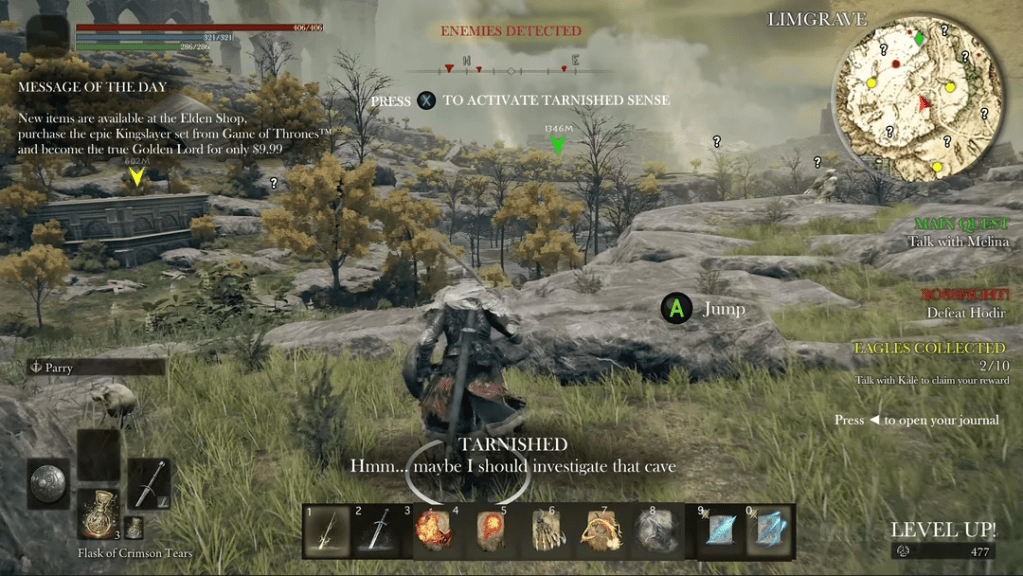
The larger story unfolded from there. Since the mid-00’s, the argument goes, “readability” in games has come to be interpreted as “making sure the reviewer who gets assigned your game finishes it with no distractions and never, ever gets lost”. This began as clear notations of an open world game’s “main path”, but over time, more and more studios began to take the MMO strategy (marking quests on the map) to its logical extreme, leading to a sort of implied guarantee in the UI in general–and the map in particular: If there is something to do in a location, it will be marked on your map. This will help you not waste time.
Elden Ring’s insight, thus, was that people don’t actually like being force fed information on how they should be playing the game, and also they like exploring! If everything they could find on the map is already marked, then they aren’t exploring–they’re navigating, which is much less fun.
Well, seems like Nioh 3 has proved this only half-right. Putting aside that its map segmentation system is kind of a miss (exploring and doing stuff in region X, Y, or Z gives you stats and stuff; this is good in that it partially supplants worrying about the horrible loot system, but it’s bad in that it’s essentially still a sign that says GO HERE FOR REWARDS), it did make an attempt to move closer to not bombarding the player with information.
Ah, but it turns out there was another, worse thing the Ubisoft model was doing the whole time! Calling it copypasting would be inaccurate–what it actually is is drawing a boundary around a particularly minute play pattern (say, killing a group of enemies in a location), calling that pattern a “system”, then littering the map with low-effort quests that trivially use that system. Shoot the ferret balloons! Chase the spherical cats! Kill the 10 enemies in the “base”! Kill the 10 enemies in staggered waves in the “crucible”! I’m not saying Elden Ring didn’t have these play patterns, but it didn’t act like you were supposed to care. In that game, if you kill a group of enemies, you get one of your refillable potions back. Nice job not dying to that, kid. Keep looking, maybe you’ll find something interesting around here. What it definitely doesn’t do is track each of these stupid encounters you have and present you a checklist so that you can make sure to find and complete every single one.
But for Nioh 3, that’s the name of the game. You go to the place, you kill the guys, you get a fucking loot piñata. Unlike the Ubisoft model, I guess you don’t then open your map and find the next one, since the map is hidden until you complete enough checklist items. I guess that’s better? But it’s not much better, because while you get some of the fun of exploring, you’re still just trying to find all of the items on your scavenger hunt in each region, and none of the items are actually interesting.
The only “quests” Nioh gives you that don’t feel lazy are the field bosses (which start to feel lazy again when you encounter them as regular enemies, not in the late game, but literally the next zone over) and the “ghosts with unfinished business”, which aren’t lazy in the templating (it’s nice to have some unique experiences in the soup of what is otherwise the same shit over and over) but are lazy in the execution. “Find out what happened here!” Was…everyone killed by yokai? Again? Damn, that’s crazy.
So consider some advice in the affirmative. If you are a game designer looking to fill out a map players may actually want to explore, consider having a map full of stories. I don’t mean cutscenes or quests, I definitely don’t mean “lore tidbits” (to writers/designers: reading chunks of your unrelated prose is almost never the reward you want it to be–in order for that stuff to be interesting, it has to actually answer a question), and I’m not even particularly referring to the Dark Souls-esque fragmentary lore-in-item-descriptions. I get that those have grown divisive, I know that some don’t want to deal with the sleuthing and reading in order to have an idea of what’s going on. To be clear, what I’m saying has nothing to do with that argument–the merits and flaws of conventional exposition are orthogonal to the worldbuilding I’m getting at–but also: If you’re having trouble with context clues, Nioh 3 isn’t gonna make sense to you anyway, not because it relies on them overly so much as it doesn’t really make a lot of sense in the first place, and that isn’t gonna be kind to someone playing with less than a full deck.
Rather, what I’m referring to is stuff like Elden Ring’s first accessible cave dungeon, so early you’re liable to wander in before even meeting Melina. It’s a little cave off the path, full of wolves, and in the boss room is a beastman of Farum Azula. Farum Azula is notably an endgame area, but from a less gameist point of view, it is a shattered, floating tomb city suspended at the edge of a vortex in the middle of the sea. What is the beastman doing here, far from home, with no clear method of transit between there and here? You’ll never know. The game doesn’t tell you, doesn’t even really hint at it. But the situation is highly salient, there is a notably out of place enemy here, definite lore implications (even if what is implied is unclear), and I’d bet even money there exists at least a draft of this beastman’s story somewhere on a From Software hard drive.
That is the “system” you should be establishing across your map. Every place of interest should have a story that explains how it got to be how it is. If that story boring, change details until it isn’t, then change the place in-game to match.
And then throw the story away. Don’t show the player any more than a dangling fragment, feel free to not even show that. There are, of course, players who will gravitate to the fuzzy edges, interested in the mystery, but this isn’t only for them. Even the most lore-disinterested player is going to notice when your world turns into a checklist, because while checklists are helpful, it’s no fun to play them. The purpose of writing a story for all the unique pieces of your world is to create a world with actually unique pieces. Players can engage with the underlying implications if they want, but whether or not it all feels same-y comes upstream of that engagement, and, unfortunately, Nioh 3, is a great example of how to do it wrong.
Of course, the problem for Nioh 3 specifically is more foundational than just that they didn’t do the writing homework. Where Elden Ring and other games have robust vocabulary of enemy types as symbols for lore and factions, all interrelated and furtively gesturing, Nioh’s set pieces are way too neatly quadrifurcated into material (people, soldiers, historical Japan) and spiritual (kodama, yokai, guardian spirits, Buddhist…stuff) elements, each in turn divided clearly into the good guys and bad guys. Since the setup is that the bad humans have summoned the bad demons everywhere to kill everyone, constructing a factional anomaly is close to impossible. And since the yokai appear to have the agenda sophistication of the Hulk, their presence anywhere in particular says nothing. It’s almost amazing how a game with this level of enemy variety manages to make them all feel narratively identical. If this point is confusing, consider a comparison point other than Elden Ring. Look at Ender Lilies, admittedly a game that is almost as Dark Souls as Dark Souls in its narrative setup–but if you want to see how you can do more with less, it’s your girl.
Ender Lilies is a game where every single enemy is a deranged zombie thrashing at everything around. All of them were made this way by the same eldritch force, so with no agendas or intents, you’d think it would be just as homogenized as Nioh. And yet, every single area prompts different questions that the game conveys (outside of lore tidbits) through enemy visuals, the architecture, the surrounding state of disrepair. “Something happened here” is obvious, but it slowly becomes clear that “something” was much more delightfully twisted than “the bad stuff showed up and killed everyone”. The problem with Nioh 3, thus, isn’t just that they opted for the dumbest possible backstory but also that they obliterated any of the language they might have used to convey that it was anything more.
I point all of this out not simply to rag on Team Ninja. For their missteps here, I do feel they’ve exposed a lesson they and others can learn. And to be clear, you don’t need to be on an open world game design team to make use of it. Consider it if you’re a fiction writer, a tabletop GM, any other narrative architect. Similar to Mark Rosewater’s venerable themed party planning advice (Rule 1: Have a theme), building an interesting world matters. Whether you built it from interesting bones will be noticeable, regardless of whether your audience ever has access to the backstory, history, and planning that went into those bones.
Top image: Nioh 3 splash, from Team Ninja
 Salt-Powered Investments, LLC