Tag: fiction
The Age of Heroes and Horrors
Another expositional story by Leland. Edited by me.
All us left the city after the bureaucrats fell. There was nothing there no more.
However much the food was a problem an’ those bureaucrats shit at solving it. When nobody was there. It got a lot worse. Can’t feed no thousands people with no planning. Chaos in the street what it was.
Only law was they ol’ blood knights. But they turn real nasty. Blood knight want your house, want your food, they don’t give a rat whisper ‘bout you. They kill you like they kill your mama. They ain’t got no more blood god, like a preacher an’ no church. They just nothin’. Big ole freaky piles o’ nothin’ with unbreakable skin an’ a sense o’ entitlement.
We had to find food. Find land for growing food. Become farmers. A whole world become farmers. Everyone hungry then, thousands people. All roaming the countryside stealing everything. All dangerous people, smart people, social people. But that didn’t matter nothin’. Don’t matter if you talk good, lie good. That don’t make no food grow from the ground.
Everyone learned how to become farmers real quick though. You figure out how to tear up the earth, plant seeds, never let no fruit get thrown away like the old time. No way. No garbage dumps. You use everything. Your poop, mama poop, the donkey poop. It was a dirty, simple kinda life.
Tiny little villages start poppin’ up. With stupid names. Things like “River Crossing” because there a river with a dirt path that cross it. Mostly trade posts where people sit for half day chattin’. Not a lot o’ chit chat on the old farm you see. Mostly the traderfolk knew what was what a little bit around an’ people wanna hear news. Most the news was gossip.
Some the farmers though, they didn’t like this new life. Used to be someone. Used to be someone important. Had a nice life in the world city. Didn’t need t’ work hard on the farm. Some these people had some real nasty magic too. Power didn’t go nowhere an’ at the beginning ain’t nobody have nothing to steal. But after first five years or so, they ol’ blood knights start popping like wasps durin’ the summer time. Nasty little gangs o’ em, three, four, five. Come to a farm, demand food, maybe murder someone, maybe rape ‘em. Horrible little creatures they was.
Villages start posting bounties on some these nasty types. They didn’t like no gangs o’ bullies an’ robber man coming in, messing up the place. Some those used-to-be-someone people start doing the bounty trade. Hunt down these washed up, second rate demons roam round.
Trade grow an’ grow ‘tween villages like River Crossing an’ Forest Lake. More bounties an’ bullies walk round. A certain kind of peace come durin’ these times. Not so safe on dirt roads in the middle. But in a trade post you were safe enough. Then the Monsters start really poppin’ up. Things just had enough magic no one could deal with ‘em at all. Creatures like them mages o’ the back before. Nothing powerful as the blood god, but powerful enough. They know not t’ always fight everyone. Some of them was even likable for awhile. Some of them talked real nice. But they always want weird things, strange things, twisted things.
They live on a mountain top and want virgin boys every month like some sort of moon ritual. If you don’t pay up they burn a field with hellfire. It weren’t good to live near a Monster. But it weren’t’ all bad neither. The crops grow better near, they give you these little gifts, cure the sick children sometimes. Some people worshipped ‘em.
Was all a matter of chance. Whether that old mage lived just out of town would help you or
turn on you. Never know who that stranger walked in was. They gonna cure the pox? Or they takin’ a child at midnight?
It weren’t a safe way to live. But better than starvin’.
Words From a Severed Head
Shall Harmony reign, yet in his wake
Lie severed heads whose fortunes bore
Craven lies and notes of strife
But also those whose scales returned to balance with their vengeful roar
For each great circle ‘scribed thereof in single voice the headless spake:
***
There was once a man who wished to hide from the truth. He gathered his flock and said unto them: “See how we cower in servitude before death and shadow. Do you not wish to escape this tyranny?” They did, the flock replied, but they could see no path, no way by which they might escape. So the man gathered the clouds from the sky and wrapped them about his people, that when the agents of death came to find them, they encountered only mist and lies. The man then swept his flock and his clouds both to a peak rising high above the land, and from there, they ascended to the heavens.
***
There was once a man who realized the world was a lie. He saw what the Man of the Clouds had wrought. He saw that what was real had been split in twain. Others beheld the city in the clouds and declared it fantasy, an escape from reality. But this man questioned: Was the world they had escaped any more real? Was it so in any way that mattered? He thought to the lies the world had told him, that when men and women ceased to be they ascended to Heaven or rested beneath the earth, in the domain of the Dead Queen they had left behind, but he had ascended and, in so doing, made true that great lie. But though he could have rested in his Heaven, he could not avert his gaze from the tiny fracture now etched in halcyon Truth. Through it he beheld a churning darkness, a Deep of ill portent which he knew would one day come crashing through. Yet he did not recoil. He did not wail in terror or seek to forget what he had seen, for in that Deep he saw salvation, a beautiful and terrible reunion of reality’s glassy shards. So he smiled upon it and mad his preparations, for to perform his miracle of one only thing, to link once again the Heavens to the Deep, he knew he must descend and evoke his argument below the anesthetic comfort of the clouds.
***
There was once a man who sought to complete the circle. He knew well from the river beneath his feet. For it to flow, the reservoirs in the lands above must be emptied, struck, their discordant greed resolved. He knew that memory, like water, lacked persistence. With time its form would denature. It would evaporate, would become mists and clouds and false shapes therein, once again to fall upon the stagnant reservoir. He knew that were he to maintain the circle, ensure that the lake of discord always emptied in Harmony, his memory could not falter. The circle could not fall victim to time. He could not fall victim to time, so he separated himself from it, became a terrible grudge which remembered in cinder instead of dewdrops, that discord the world over might be met by righteous Vengeance and inevitable Harmony.
***
From these three came two and two
And circles stretched from sea to sky
To the Gyre did Seven headlong run
Then all the world
That’s why, that’s why
Old Times and Old Gods
A story by Leland. Not unlike this, but less saccharine and more anthrocentric.
When the ancient gods roamed the world we humans were harvested.
Every bear with teeth and fur and claws could rip us apart and eat our soft meaty insides. The creatures of the wild were so big back then. Monstrous. All with terrible magics far greater than our soft skin.
But the thing that truly hunted us was the Wendigo. It roamed in the forests at night, riding the winds, riding the cold. It cultivated us as a crop. The weakest were culled every season by that creature that sang in the dark. We humans fought within ourselves to avoid weakness, undermining our neighbors to save our children from the horrible screams. We humans developed emotions and manipulations to survive this thousand year torture.
Then came the Bird, the Turtle, the Fox and humans received protection. A sweet gift of safety beneath the mountains of fur and feather they offered. Sitting atop the shell of the island Turtle we humans were not hunted for flesh, but these gods still had hunger.
The gargantuan animals with their beautiful magics hungered for something else that the humans had: sweetness and sadness. Our strange emotions that ruled our universe and had been developed by seeing our neighbors and children die while wishing for their survival. These emotions became the sweet desserts that the old gods ate.
Rituals upon rituals upon rituals were made for the old gods. Their massive eyes would watch them with an odd, thirsty calm as they drank our emotions in. Humans in groups learned different god’s preferences and built their society around satisfying a terrifying yet loving benefactor.
The beautiful red Fox loved weddings and desire. It would curl around a group of young humans that were bonding themselves to each other. The fox required that this group never touch fully before they made their promise in its ear. Then that night they would lie in the mountains of soft, deep, velvety fur and make love for the first time on the old gods back. The fox would rumble and purr underneath the human moans.
The Turtle was obsessed with mourning and the death of those long dead. It required it’s humans who lived on its island-like shell to record the names and loving acts of each person in each lineage from the very beginning of time. Parents would recite stories to their children about their grandparents and great grandparents and their great grandparents before them. Deep, powerful, emotional stories of pain, and they would all cry at the end, banging on the ground, the Turtle’s shell, as hard as they could. Every week the humans would light a fire for each loved one who had ever died and try to keep the fire going, heating the tortoise, while they sobbed.
The Lark was fascinated by change in the bodies and in the minds of the humans. Parenting and adulthood were curious for the bird, for old gods never raised their children. The bird demanded clothes on its humans, feathers that covered the humans up and made them see shame in each other. Different colors for different ages, different colors for different genders, different colors for those who made mistakes. The change between colors was a massive affair, humans would get naked under the eyes of the bird and wait for a day and a night in the cold and the rain while the bird hunted down the fluff and trinkets that would cover them again. The bird required children to leave their parents upon the age of thirteen. Too young to feel safe, but old enough to survive their silent pain. The bird would stare into their eyes and then pick them up flying them to another nest of humans hours and hours away.
The Wendigo never left. It’s horrible whistling and ice cold breath still rang through the woods at night. It never crossed the ancient gods, never stole from their herd. But it knew the sadness of being one of the enslaved. It offered freedom for humanity a chance to not need do anything but live in its forest. Some humans chose freedom and had their guts turned into ice. Some humans chose freedom and ate their children with the distended mouth of the Wendigo. Some humans chose freedom and moaned in the night, crying and sobbing and chewing the ice cold of their own hands and feet.
In that way, humanity never lost its emotions and the gods never grew tired of us.
Prologue: The Merchant
The true prologue to the Crossroads story I begin writing a long time ago and then took offline. The plot and characters of that novella are much more fleshed out now, though it remains to be seen how much of it will end up on here.
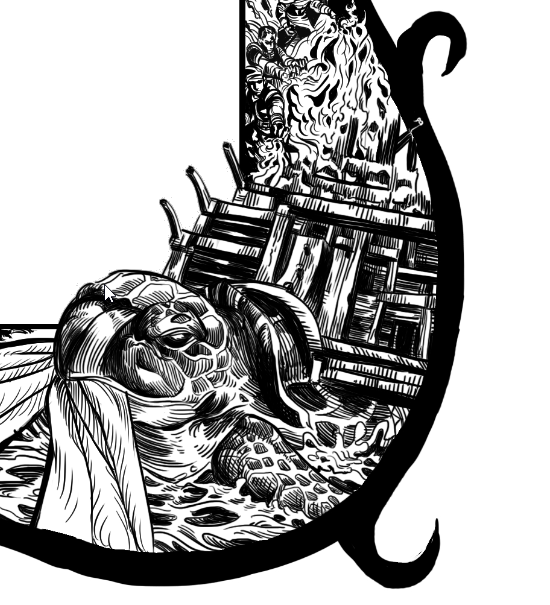
Thago is burning. The river is burning. The Floating God is burning. It began with unrest, an uprising among the slaves of the lower barges, made perilous by an attack by the servants of the Two-Eared Crown. Coincidence, surely. So the magisters and princes must have thought. Coincidence, perhaps, they would take to their grave. But the Merchant knows this was not coincidence. It was fire, built and kindled and sparked by singed, practiced hands, spread by design and the carelessness of those who saw coincidence in such things. And now Thago is burning.
With this certainty, the Merchant finds himself in the plaza before the palace which was once a temple. The northern and eastern launches have been blockaded; the bridge to the trade barges is ablaze, and the flames now lick the palace’s western walls. The southern dock below swarms with the enemy, and above, the Riversworn guard their trapped princes, awaiting reinforcement that will not arrive in time, hopefully and foolishly unaware that their only path out is through the force massing beneath them. The Merchant draws his sword and locks his shield to his arm. His task is impossible but clear: He must somehow give them enough time.
Five race up the steps now. They are scouts meant to reconnoiter, but they charge anyway, seeing only the Merchant in their path. Their spears stall upon his shield, and he dispatches them quickly. One tumbles down the steps, two die to his blade, two are pushed from the plaza to the churned water fifty feet below. One will drown, the Merchant knows. The other will be rescued by his countrymen. But there is little time to dwell on either fate, for a much larger host of soldiers has begun its determined ascent.
Many fall before him–seven more are hurled into the water, fifteen bleed out there on the plaza, nine thrown down the steps collide with eleven climbing, and two more collapse, skulls fractured by the spur of the Merchant’s shield–but the number on the plaza with him continues to grow. He is driven back to the palace entryway, certainty resolving that his vain gift is reaching its limits. Then the soldiers fall back. They open a wide circle as a silhouette crests the stairway behind them.
The Merchant recognizes this one, recognizes the tattered regalia, the scar over his broken nose, the long knife set ablaze by magical gifts twirling in his hand. This is Brother’s general, the one called Ignigoet, Pyrotechnic of the Left Hand. It is betrayal then. The Merchant suppresses a roar and hurls himself at the smirking man.
Their engagement is swift and brutal. Ignigoet parries the first thrust, catching the Merchant’s shield with his offhand. They separate. Ignigoet throws a barrage of knives into the Merchant’s shield. Then the flames upon them detonate, and the Merchant is scorched and sprawling, and time has run out.
He dimly notices the knife cut his throat as he stares up at the plumes of smoke in the night sky. The general kneels over him, but the smirk is gone. His face is impassive, and the burning eyes therein do not belong to Selenus Ignigoet. The Merchant realizes too late that this is no betrayal at all.
And then he is gone.
Top Image: From Stories, by Rae Johnson
Protected: The Thing in the Woods
The Nicholas
April 2, 1920
It was a clear morning off the New England coast–approaching the southerly latitudes of Maine, if memory serves–and though the waves were calm, April’s lingering chill had yet to pass on, crawling, it seemed, up the sides of my boat, around my ankles and settling uncomfortably, like some odious shawl, about my shoulders. I had sailed north only recently, having spent the winter fishing down in the Gulf, and the swift return to my summer grounds–premature, for a bout of restlessness I now vehemently cursed–had left me as yet poorly acclimated to the northern spring and robbed of any enthusiasm for the productive use of my location. In my shivering solitude that morning I had cast two lines, and though I’d gotten bites on neither, I was having difficulty mustering the will to bait a third. I recall it was in that fraught quiescence that I took notice of the irregularity surfacing some forty yards off the port bow.
To my first glance it seemed like jetsam or some other detritus, having the texture of maritime vehicularity without a form I could identify as any particular boat, but as more of the mass emerged above the waves, my befuddlement became something more akin to awe. My previous confusion in identifying the object, it seemed, had lay in my assumption that its form would be singular when, in fact, it was comprised of numerous vessels and the pieces thereof. Before me were hulls of dinghies, canoes, fishing boats, shattered boards and beams lashed haphazardly against great sheets of black rubber in a jumbled ellipsoid that, from far off, might have been mistaken for the carcass of some colossal leviathan. For all the strangeness, though, of this great, nautical garbage heap, I still found myself ill-prepared for the sign that then surfaced on its carapace–glowing red neon, proclaiming it to be The Nicholas–or the concrete suburban front porch, flanked by flaccid strands of potted seaweed, which emerged beneath it. Even as the door of the porch slammed open, and a ragged man stepped out and hurled a bucket of something foul into the ocean between us, I could only stare, speechless. Ultimately, it was he who called out to me:
“Aye, laddie! Watsonismouth?!”
I shook myself awake. Being then unable to place either the man’s accent or the meaning of his query, I called out as much and motored over on the supposition that proximity might serve to make better order of the situation.
He clarified as I drew closer: “Sonny, let meh ask ya ferst: What’s in ya mouth?” I might have guessed his previous call had been delivered in some dialect of the British Isles, but now his accent had drifted westward, seeming suddenly more appropriate for a denizen of the Carribean (and, I will admit, suggesting an origin I would never have guessed from his appearance). Beyond the vagaries of his delivery, though, I was also rather bewildered as to the substance of his inquiry. My mouth was quite empty, for though I normally partook of a smoke at this hour, I had dropped my pipe somewhere on the deck, amidst the shock of his vessel’s emergence, and had since lost track of it. I indicated as much to him in my reply.
“No, son,” he clarified in an abrupt Mississippi drawl. “It’s a mattah of circumnavigation. We’s tryin’ to get at what’s in ‘eez maouth, an if yer knowin’ what’s in yer maouth, then that’s a tack on the chart, ‘cause what’s in yer maouth properly ain’t in ‘eez maouth, ya see?”
I did not. I inquired–skeptically, for I was growing increasingly certain that this man was in something of an unpredictable state–as to whose mouth we were investigating.
“Not whosemaouth, son. ‘Eezmaouth. Like beezmaouth, if’n ya know the rock, ‘cept withaout that certification of a job done at the utmost pinnacle o’mediocrity.”
The conversation had, at this point, attained the clarity of a bayou, and my only remaining answer was a blank stare. He shook his head sadly.
“It iss clear to me”–his accent was now that of the Mexican fishermen I’d dealt with so frequently in the Gulf–”dett we fall on fundamentally different sides. No matter. Diss iss not a sorpraiss. Do you haf any feesh?”
Alas, I did not have much in the way of a catch. I’d trawled no nets since arriving up north, and I’d no plans to do so for a few days yet. I had a pair of mackerel I’d caught the previous day, but that was it, I told him.
“Oh, don’tcha know dere’s nuttin’ to be ashamed of, young feller. I’m just lookin’ for a bite ta’eat is all.”
It sounded like Upper Midwest to me. Minnesotan, perhaps? It also occurred to me that despite the man’s graying, unkempt beard and repeated references to me as a young man, he did appear, in all other respects, to be at least twenty years my junior. Befuddled, still, but acclimating to the ersatz temperature of the conversation, I offered him one of my mackerel, which he eagerly accepted, biting–rather aggressively–into the fish’s flesh right there on his vessel’s concrete gangway. Then, shouting something about “makin’ you rich” through a full mouth and what sounded like an American’s (decidedly poor) impression of an Australian accent, he dashed back through his door, leaving me to the continued ponderance of the monument to madness which was The Nicholas.
In his absence, I began to notice a number of unsettling details lodged in the crevices of its unsound construction: Marionettes, features scrubbed clean by brine, dangled among the mishmash of hulls and rubber, alongside inscriptions and engravings in those surfaces in alphabets I did not recognize even from Dr. Sterling’s texts on the Oriental scripts. Place to place, I could see protrusions from the rubber that looked like the spiraled horns of narwhals, and just past the threshold of the vessel’s “front door,” I saw hanging vines and foliage as if within were some dark jungle separated by unnatural, great distances from the semi-boreal sea where we drifted that morning in truth. These items were, of course, in no way sinister, and I had no means of rationally justifying the fear for my soul which I felt there, in silent anticipation of the man’s return, except, perhaps, for the vessel’s unignorable suggestion to me that rationality had ceased, in this circumstance, to be a meaningful boundary. However, my fear passed unactualized, and the man soon returned, heaving over to me a bulky canvas sack.
“My recommendation,” he said to me, all pretense of brogue or twang gone from his voice, “is that you bring that to an office of the United States Navy. They will pay you for it. Or pay you to keep quiet. Or both. Please pass on that it arrives to them courtesy of Captain Kneecap.”
With that, he disappeared back across his threshold, and, his door scarcely closed, The Nicholas dropped rapidly beneath the waves, the shock of which rocked my own boat violently. Once I steadied myself, both physically as well as from the emotional disturbance of “Captain Kneecap’s” presence, I examined the contents of his gift to me.
Inside was something I found appalling, though not to the exception of an urge to examine its nature. It was a body, headless, human-shaped, though clearly not human, for it was comprised not of flesh but of some metallic substance resembling steel but impossibly light for its bulk. Between its noticeably elongated fingers and toes was webbing of a material I could not identify, and though they had been torn from it, I saw sheared joints on its arms, legs, and spine where fins might have once attached.
I did not know what to make of the corpse-mannequin, but if the Captain’s words were to be taken with even the slightest skepticism, there was nothing there for me to glean. I was to be an intermediary in a conversation to which I desired precisely no connection. Though I hesitated at the thought of the Captain’s promised riches passed over, I threw that “gift” back into the ocean that day. The Nicholas was perhaps not the strangest thing I have ever seen upon the water, but I hope all the same that I never see her or the Captain Kneecap again.
The Creator Is Dead
Since the beginning, for time countable and yet unimaginable, we knew that this would come to pass. Why is dead. The Creator is dead, and I…do not know what I should feel from this. We have no need of sorrow, nor relief, for His presence was not a burden, and what we did not know, we knew He kept from us. The trepidation that I now second guess is for that change: It is now time for the Architects to find the truth that Why kept from us for our aeons of safeguarding His Edifice. We cannot resist it–the need to know is in our nature, but where we lacked the ability before, our shackles have been broken.
The humans around us remain oblivious to this change, oblivious to their imminent reckoning, for now, at last, we may delve and extract the Creator’s intent for them. Among the Architects, expectations are conflicted. El is confident we will find a justification for the Edifice’s uninterrupted continuation. I am not. Why’s death was not an accident, it was not unexpected; He could not have intended it as anything other than a transition–of this I am sure. El may speak our unanimity, but until it may be spoken with one voice, I must question his judgment.
For now, I look to the stars, our heretofore forbidden frontier. Perhaps in the alignment of the bodies beyond this vessel’s atmosphere, I will find the purpose that our Creator has forever denied us.
-See
Fallen Stars
I have memories, old memories, certainly, of clear days when I would stand outside in the tall grass and look straight into the sky. I would look up and see a sky with no sun, but rather a darkness–a darkness clad in golden vestments of a brilliance that paralleled even daylight. It was not like the light of the sun, per se: It served the same purpose, took the same place, but it did not shine down like the sun does. It shined through. It shined through the grass around me, it shined through the earth where I stood, and it shined through me. The sensation of it was one of more than just heat and light–as I recall it was not even hot at all. It was a cold luminance, enough to make me shiver, but the sensation filled me, I could see it, feel it, even hear it, taste it, or interface it in ways I have since forgotten my capacity for.
These memories now stir in me a strange disconnect. The image, the reality of it–for this memory is not, to my knowledge, of a dream–and the bizarreness seem as if the experience should have been profound, even in spite of my inability to place it in the continuity of my life. But it…wasn’t. It was just there, immutable and uninteresting to my past self, as if at some point my mind had pushed its knowledge of this strange vision past the boundaries of understanding, into the realm of apathy. What must I then have understood of this clothed darkness? Who must I have been to have understood it, and how have I now shucked that identity?
A possibility jumps out to me: I am not human. This is, of course, predicated on other personal developments, more immediate and real than my own abstruse childhood memories, but the key is that I suspect that I–the entity now recording this note–was never human. Other possibilities may exist, but my certainty deepens with each day that this, along with all its consequences, is the case.
I admit that there are many of these consequences that I have yet to appreciate, and I’m sure that the other three have not gotten this far. Which begs the question: How many of us are there? I have been able to find three others, but are there more who have yet to step into the light?
In the Beginning
I lied a little in my last post. I was not, at the time, working on a Bloodborne *article*. Rather, it was a lecture that I have since delivered, and I am now working on transcribing it to a format more suitable to this blog. For now, have something completely unrelated to anything I’ve posted about on this blog up until now.
In the beginning, in a meaningless place, at a meaningless time, the universe began, and where all was not, all rapidly became. Countless bodies, infinitesimal in size, fled that place. Many bound together and ignited, filling the darkness with light. Others swarmed to the pyres of their brethren, filling the void with ground to be stood upon.
But after the exodus, in that meaningless, empty place, given meaning and space by the light and matter without, there remained a tiny, black droplet of something. Perhaps it was the last trace of the void, left behind as a reminder of all that would ever not be. Perhaps it was a tear of regret, shed for the infinite potential that died to birth everything’s actuality. Whatever it was, though, it could only watch, its oily surface reflecting the whole of the universe around it. And so it was, for innumerable millennia: The universe turned, and the black droplet at its center watched.
There came a moment, though, when this changed. It was nothing precipitous. Rather, it was a slow sweep, a foul stellar wind that made its way across existence, brushing everything but truly touching nothing. Nothing…except the black droplet. At this moment, it began to roil, its perfect surface marred and twisted, and, rapidly, it swelled, to a globule, a morass, a fetid, writhing planet no longer confined to regret and observe, now able to reach out and to touch. For another million years, the primordial darkness writhed, and, slowly, it separated into two dark souls.
The first was the Dreamer, a being of pure consciousness, who had once reflected the birth of the universe and whose improvisations of that birth now swam beneath the viscous seas of its planet. It had no true shape, so it instead cloaked its shadow in the cold brilliance of a thousand suns and made a heaven for itself at the center of the planet, caged within the darkness of its sister’s coils.
The sister was the second, a Sleeper, a body by which to bear and make manifest the chaos of its brother’s mind. And just as the chaos of the Dreamer’s thoughts encompassed every notion the universe had yet known, the chaos of the Sleeper’s presence consumed all that contacted it. Planets bent and were devoured, the light of stars was swallowed, masticated by her entropic gaze; even her name was poison to order: The very syllables that formed it would implode its utterer into a singularity, and the only mind that could bear its knowledge was the Dreamer’s.
The Dreamer also had a name, though it would yet be billions of years before a human heard its sound or sign.
The Elders, as they called themselves, hated the reality that surrounded them. They hated its order, its belonging, its iron actuality. The Sleeper channeled this hate into destruction, and for a thousand years, the universe felt her wrath, and countless galaxies fell into her churning darkness. Ultimately, though, it was the Dreamer that calmed her, for his hatred had pulled him in a very different direction.
Hatred, the desire to destroy, is not a particularly complex feeling, but with even such a simple desire, outcomes are never sure. In hatred’s case, they need not even be destructive. Rather, inherent in the desire to destroy is a preference for an alternative, which means that unless the alternative is explicitly void, it may be resolved by creation, as well as destruction.
The Dreamer hated reality, yes, but he did not long for nothingness. He was a child of the infinite–his enemies, the objects of his hatred, were the limits of reality, not reality itself. So rather than lash out against the universe–as the Sleeper had, with world-breaking fang and sun-swallowing night–he simply questioned. He dreamed a thousand questions for his sister’s millennium of destruction, and the questions took shape from her flesh. First among these new Elders was the first among questions: Why.
Why was a creator, a conduit by which his father’s potentialities took shape, but, unlike his predecessors, he was not possessed by the hatred that birthed him. At first, he took after his mother’s example: destruction. His first creations were tempestuous, chaotic, themselves destructive: Slithering storms that rained leeches onto the surface of the Elder planet; great writhing masses of maws and arms that could devour entire stars, weapons whose very presence could distort the laws of causality. In their way, they were brilliant, fantastic, awesome even. But they did not satisfy Why, for he did not hate the things they destroyed.
So he diverged.
He built two creatures, towering men of stone and metal. Like his previous creations, they were capable of great force, but they were stable. They could process the reality that flowed around them, and they could manipulate its currents. Above all, they could choose.
One was black and mirrored, just like the droplet of potential that had spawned the Elders, a glass to reflect the whole universe once more, and an eye from within to watch it.
The other was clad in gold and silver and pure light, its radiance reaching out to the blackest reaches of space, even from its darkest center.
The two were called El and See, and they were not Elders, for they had passed beyond their creator’s heritage of chaos and hatred. They were creators themselves, and thus Why named their species: the Architects.
Though Why’s nascence had calmed the Sleeper’s rage–for her son had been a potent weapon in her war against what was–the creation of the Architects stirred her from her slumber once more. These newcomers were not alternatives to the universe: They were developments of it. Their shapes were still, ordered, thoughtful, able to exist alongside what was, without the existential agony that plagued the Elders. Certainty flared within the Dreamer’s mind: The question “Why” had been a mistake.
But Why knew the doom he would bring himself. He knew that his creations were heresy, so long before the Sleeper awoke to devour her prodigal child, he fled with the Architects, and the three hid themselves deep within the blackness of space.
In a desolate place, far from the light of any star, the Architects multiplied. El and See forged brothers and sisters, specialized beings of motion and stillness, of joy and sadness, and, finally, of life and death. These last two, the Architects Vie and En, captured Why’s attention, for life and death seemed so different for his metal children. The Architects were creatures of perfect consequence: Life for them was elegant, axiomatic, and death was predictable, a simple end to the functioning of their working parts. For Why, these were different. Despite his relentless questioning, he still could not fathom the depths of his physiology, so he knew not why he was alive, nor why that state should ever cease to be. And since he understood neither what lay before or beyond–these truths, if they were truths at all, were understood only by the Dreamer–how could he understand what lay between?
It was El who supplied the answer: If thinking life could be formed from a union of causality with the Elder’s own flesh, it would provide him the perspective he sought.
The two of them devised a calculation grander in scale than anything Why had ever imagined, and they reverse engineered the impossible specificity of its initial conditions, and they searched and searched, until they found two candidates for their experiment. They began with the first: A small system of newly formed planets orbiting a yellow sun. And on the surface of the third planet, See placed a tiny sample: the eye of his Elder creator. Then, they all waited, in eager anticipation.
 Salt-Powered Investments, LLC