She-Lord of Ka

Content warning: Rape

The boy was raised to be clean.  His father was heir to the largest domain in the Riverlands, bastion of the Pure, and in his grandfather’s house, all chose: They would be made clean, or they would be expelled.  Grandfather taught him to vomit all but the barest taste of his food from his guts, taught him to scrub the grease from his skin until it bled. He was taught that his body was sacred, that it must not be contaminated with the grime and gluttony of lesser folk.  When he failed–and he failed often–Grandfather broke his bones and seared his back with hot iron.

The boy was raised to be resilient.  When he was ten, his mother and father departed to lead the Bloodfish’s armies in the war.  Grandfather would not hear a word otherwise. Lord Ka had brought the ways of the Pure out of a great, lost darkness, mustering the strength to force upon the wretched the cleanliness they were too weak to maintain in themselves, and Lo Markhan, the hero of the Riverlands–Grandfather–would help him realize that revolution at any cost.  The boy was alone, bereft of any shield from the marquis’ ferric discipline. He learned to hide his pain, bind his wounds invisibly, make himself seem a model of Purity, for to be expelled was to join the roaches and Lo Markhan’s other creations of mud and bile.

The boy was raised to be strong.  Grandfather had studied the fey-magics of the Feathermen in the Bloodwood, and his house was filled with death-infused creations.  Some of these were for the boy, like the dish he was made to vomit in, the gown he was given for dress, the bandages wrapped around his seared skin.  They lapped at his suffering, hungry, as if one day, finally sated, they would wake, but of course they never did. Instead that suffering flowed into the house, accumulating in foreboding presences that loomed when Grandfather was away.

Other objects, the boy was never to touch.  There were shackles in the cellar that slowly gnawed the flesh of whomever they held, spools of thread, gifts from the Dragon of the West, that wormed into any skin unfortunate enough to be nearby.  These were meant for Grandfather’s guests-of-low-regard–prisoners, perhaps, or idle, sadistic diversions–but there were still other oddities whose cruelty was not quite so direct. The boy’s favorite was a painting in the sitting room near where he slept.  It was an arid, hilly landscape, unremarkable as a work of art, but fascinating in the way its pigments and smudges danced and drifted across the surface. Birds flew in the painted sky, dust blew, and branches swayed. It confused him, even as it filled him with wonder: How could this expression of beauty be at home amidst Grandfather’s other trinkets?  The boy understood these creations to be fueled by suffering, maiming, the pursuit of Purity, but that darkness did not seem to be there in the painting.

It was a visiting emissary of the Dune Men, a tall, intense man with yellow eyes, intrigued by the child’s interest, who finally revealed the answer: The painting was a prison.  Years ago, Lo Markhan had assisted in the subdual of the Saraa Sa’een, a terrible, wandering monster responsible for centuries of destruction. This painting was possibly his greatest creation, a cage of color and fiction that would keep the demon bound forever.  That was it, the boy realized. This beauty was still of death, but death was not confined to the ugly austerity Grandfather so revered. His bewilderment was gone, but wonder remained.

As he grew into his teenage years, the boy was allowed to travel beyond the house’s boundaries, down to the villages of Grandfather’s domain.  There, the customs of the Pure were merely one of many superstitions, and the darkness that watched him always seemed to abate. He walked among the villagers, queer but unobtrusive in his gown, absent the regalia and symbols of Ka or his manor.  Among them, he found companionship, a sense of commonality in survival–even flourishing–in a world the boy felt so acutely to be immersed in death. On his days of escape from Grandfather’s house, he joined them in their goings-on, he learned their sayings, he ate their food, he even fell in love.  

One day, he and a peasant boy caught a rabbit in the woods.  The cooked it over a fire and shared it. Overcome by an affection the boy had never known under his grandfather’s roof, he kissed his companion, and the peasant boy kissed back.  The two made love into the evening until the responsibilities of reality set back in, and, flush and delighted, they parted ways. But that delight soon soured–the boy had not been attentive to the time.  He would arrive home after dark, and Grandfather would certainly notice. Suddenly welling with dread and acutely aware of the rabbit fat still flecking his lips, he made his way back to the manor. He needed to find his dish.  He needed to vomit.

But when he arrived, Grandfather was waiting.  He tore the boy’s gown from his body, struck him with knuckles like horn, raped him until he bled, and again, and again.

“Is this how you like it?” he asked, his breath hot against the boy’s ear.

The boy did not eat for days.  He did not walk for weeks, and even then, he needed a cane.  He did not return to the villages for some time, and he never saw the peasant boy again.

But he wasn’t broken.  He simply understood: He was raised to be strong.  He began to grasp at the death he felt writhing in his broken body, in the house, in Grandfather’s demented trinkets.  He found he could speak to it, and it would make things change.  Perhaps it was his startling memory of first love in the forest, perhaps it was simple coincidence, but he found it easiest with plants.  He could make them grow, flower, entangle constrict. He practiced first with the vines growing on the manor walls, snatching insects from the air, crushing them, savoring the odor of their pain.  Then he embedded those vines in the lungs of a manor worker malingering in the shade on a hot day. He watched the man claw at his throat, eyes wide, gasping as the leaves emerged from his mouth. In that moment, he understood his grandfather’s cruelty, and he understood his strength.

He was raised to be resilient.  As the war grew more fierce, Grandfather’s attentions became ever more drawn to it.  The boy began to look for a particular opportunity, a pretext for removing the marquis from his sorcerous bastion and separating him from his lieutenants.  For a single day, he slipped away, finding the commander of the Bloodfish’s enemies in a remote village. He made the man a proposal: Attack the domain of the Dragon.  Lo Markhan would marshal his forces to defend his ally, and the boy would ensure the marquis would never arrive to the battlefield.

The commander did as the boy proposed, and when Lo Markhan departed to join his troops, the boy met him in the forest at the edge of his domain and entangled him in thorny branches.  He planted a briar in his grandfather’s throat, and it grew rapidly, bursting through the skin of his face and chest. In his final moments, Grandfather could not speak, but he did not need to.  The boy knew he was meeting the old man’s expectations.

He was raised to be clean.  When the soldiers returned to the manor months later, they found a new marquis there, decadent, flamboyant, everything his grandfather had not been, save for cruel.  The new marquis had found a diversion in the torture of his subjects, and he had begun to tax the villages of his domain for meat and wine and able-bodied men to satisfy him.  Some of the soldiers rebelled against Le Markhan, the sickening She-Lord of Ka, but they were defeated, tortured and executed in the village squares by the marquis’ thorns. Those that survived left without a backward glance, but to Le Markhan, it did not matter.  He did not much care for Ka or his war.

He ruled there for many more years, leeching the despicable world and its despicable people for all they were worth.  He, himself, was despicable–he knew that. But he had been taught that cruelty somewhere.

The Way the World Has Died

Working on a couple of larger pieces right now, but posting is going to be dead for the next few days due to travel. The following was originally written as an introduction to the War Torn/Rale rulebook. That is unlikely to be its final use, but I want to share it here as good perspective on that world, looking to the beginning from the end. Overall the history on which Mefit is commenting is not really a story of humanity at its worst, but it is nonetheless deeply pessimistic. Death here is inexorable, and if humanity at its highly variable average cannot stop it, then hope certainly is difficult to hold.

To whomever reads this: I pray dearly that your hope is not lost.  My own fled me long ago, but perhaps you may yet find a use for these pages.  You see, I paid for them, with the years of my life, my blood, my sweat, even the integrity of my mind; everything I’ve ever built, indeed everything I’ve ever been, I’ve scrawled onto this parchment and bound in this leather in hope that it might serve as a lens through which one might see the way to save us.

I see no such way.  I have found no such map to salvation in what you hold in your hands.  I have found only a grim chronicle of the way the world has died. And how is that?  Even now I cannot be sure whether it was our arrogance or our cowardice; our strength or our weakness, but I know one thing without a doubt: We are to blame.  It was man and woman, just like you or I–indeed you and I–who tore the essence of life from our kin and used it to grind to dust every last thing that was good.  Some of us were as dark gods; others simple murderers, rapists, and thieves; still others called themselves heroes.  Some called themselves nothing at all. Not one of them–not one of us–was innocent.

Now the ground we stand on is torn asunder, and there is no lot left us but to fall.  Grow wings if you can. Else, read on and abandon hope.

-Mefit Il-Hazeen

Note: Mefit Il-Hazeen–though perhaps he did not use that name then–is also the narrator of The Dragon’s Thesis. You’re welcome to sort out the chronology yourselves.

Top Image: Mefit Il-Hazeen, concept sketches by Rae Johnson

Death of an Old Wolf

His first words were: “I wonder about choices.”  I’ll confess it made little sense to me at the time, but it’s how he began.  I remember it vividly.

He said: “I wonder about choices.”

It was near the end of the campaign.  The trees had fallen, victory was within our grasp, and for the first time, Mother had seen fit to allow me to accompany her expedition.  I knew she expected the beasts to surrender–it was a reasonable expectation. We outnumbered them ten-to-one, and their groves and hidey-holes had been taken from them.  But the old wolf didn’t want to discuss surrender. He wanted to discuss choices.

He turned to face our battalion.

“You are the one they call Kr’lash, yeah?” he asked.  Mother nodded. He rolled his shoulders and smiled a manic, harrowed smile.  “You’ve made choices. Do you think about them too?”

We had found the wolf in a strange place.  Days earlier, we had raided the fort he’d taken as a headquarters, only to find it empty of beasts, of supplies, even of traps.  The scouts found tracks in every direction, like the beasts had just scattered. Most led off into the desert, but one set had run deep into the fallen wood, to a cave at the base of the mountain.  They found him there, alone, and, by his request, went to fetch Mother for a “talk.”

The term “cave,” however, failed to truly capture this place.  Though the tunnel we’d taken to get there was dark and narrow and all the things you would expect of a cave, the chamber where the wolf awaited us was something else entirely.  It was a cavern, vast, uncannily silent, lit in part by beams of sun slicing in through cracks in the ceiling, but truly strange was what the cavern contained.  

Just behind the wolf were two great trees, branching like black lightning into the darkness, in bizarre defiance of the cavern’s lack of light, but where leaves might haver hung from their branches, instead tongues of flame crackled, strung from the boughs like tears of a willow.  And though I could feel the heat from the blaze where I stood beside Mother, I saw that the branches did not smolder or crack.

In the dim behind the trees, nestled into the rear wall of the cavern, was a great stone building, its crumbled statues and pillars just barely visible through the shadows.  I did not grasp it then, but when I think to that day, I now wonder whether I did not see a body, stained with blood, sprawled across the stairs of that structure.

“I do, Bleeding Wolf,” Mother said.  “Though I cannot say I regret those I’ve made recently.”  The wolf regarded her coldly, one hand clenched in a fist.  The other, I noticed, was twirling a small knife between its fingers.  I use these words deliberately: It was as if the gesture was occuring, serene, entirely outside the wolf’s sphere of attention.

“You cut down a forest,” he growled, bewildered, seething.

“You gave us no choice,” Mother replied, her voice every bit as cold.  “My people would die in the desert, and they would die with you and your cannibals lurking between the trees.”

“Cannibals…” the wolf remarked to the air as she spoke.

“Yes.  You are.”

“Of course.”  There was a hint of a smile on his scarred face.  “It’s just that you’ve judged us human enough to recognize our meals as our own.  Unusual. Flattering.”

Mother seemed taken aback, but only slightly, and only for a moment.  She reformed her composure but did not respond. The wolf took notice, shuddering as he chuckled.

“Still, do you see how it circles?” he asked.  “I’ve been looking at the big picture. I’ve seen what you people do to places like this, what we’ve done to places like this for millennia, and I tried to stand in the way.  I tried to make it so that one of us, at least, would live to see tomorrow.  It was the only choice. You might say,” he looked over his shoulder at one of the blazing trees before turning back with an unsettling gleam in his eyes.  “You might say I had no choice at all.”

“I’m left here wondering,” he continued,” whether anything we’ve done has ever mattered.  Were we always going to die?”

“Perhaps you always were,” Mother said.  “You and all those who traded life for power.”

“Wonderful try, K’rlash, but your history is dogshit.  Everyone keeping score knows about the prophecy, but no one remembers what anyone tried to do about it.”  He gestured at the surreal vista behind him. “Do you even know what this place is?” Mother smiled, rising to his taunt.

“I’d chance a guess this is their temple,” she replied.  “The ‘long lost’ temple of the beastmen that called themselves the Lords of the Sky.  I’m surprised you found it, but I don’t know that it matters.” The wolf stared at her, seeming almost offended.

“Incredible,” he muttered.  “Did you learn all your history by interrogating prisoners of war?”

“Is this banter a condition of your surrender?” Mother asked, this time stonefaced.  The wolf cackled.

“Absolutely not!  But to understand the conditions of my surrender, you’re going to need some education.  This, for one, is the temple of the god that started all of this. The one who looked our fate in the eye and said ‘I choose death.’  The Lords of the Sky have just been squatting.  

“Moreover,” he continued, “only the outcasts of the Lords of the Sky took up the ways of my people, of beasts.  The main contingent kept a very different culture. They dwelled here until recently, guarding their own sordid history.”

As he said this, his knife stopped twirling, fingers snapping tight around the handle.  It took me more than a decade to understand this gesture, and this delay has become one of my greatest regrets.

“Both of these facts are known,” the wolf said, “if you ask the right people, look in the right places.”  He paused, then added: “Take the right care. I don’t suppose your mages have noticed the power in this place?”

I was not, at the time, accustomed to opening my body to magic–my mother and her advisors had taught me that doing so would hasten the death of the world we sought to prevent–but at the wolf’s words, I reached out and felt what he meant: This place was awash with magic and soaked in death, but words struggle to capture the feeling.  I knew with a certainty and clarity I’d never before felt that blood had been spilled in this place, in dizzying quantity, over centuries long past but reeking of death as if the slaughter had stopped only yesterday. Mana oozed from the dirt, from the stone, even from the air, heavy with the collective last breath of tens of thousands.

“He brought us here because he’s stronger,” I whispered to Mother, jumping to my own conclusions.  “He doesn’t intend to surrender.”

“Apparently,” she replied, raising a hand.  At this, the archers trained their bows on the wolf.  “Make sure that you and Cain are ready.” As I made eye contact with our pyromancer, the wolf seemed to take note of our conference.

“There is a number three, you know.”  His voice goaded. “My own little secret.  Would you like to hear it?” Mother decided she did not.

She signalled the archers, and in the same moment, the wolf sprinted to one of the burning trees.  It was nearly fifty feet away, but he covered the ground in a second. By the time the first arrow left its string, he was plunging his knife into the tree’s bark.  His priority seemed bizarre, but we realized its purpose quickly enough: As he stabbed the tree, its flames flared and then suddenly vanished, and then we were left in darkness with the most powerful mage in the forest.

The first thing that broke through the pitch was Cain’s torrent of flame, narrowly missing the wolf as he charged our front line, still in transition after the archer’s initial volley.  The spearmen made it to the front, but they were unable to set their weapons before he crashed through their line, sending bodies flying, limbless and lacerated by the maws lining his hands and arms.

The wolf’s form had changed.  Though it still resembled a human in shape and number of limbs, its features had twisted into nauseating mockeries of both human and beast.  Its body was now covered in grey fur that bristled, raised, needlelike, against the bursts of fire and dim sunlight above, and everywhere, along its arms, legs, all sides of the appendage that was previously its head, were mouths, gasping, tearing, gnashing thousands of horrid fangs.  The only part of it untouched by the amorphic nightmare of jaws and teeth was its torso, where the scars that had lined the creature’s skin as a man had begun to run with blood, and in so doing, had begun to glow red with magical power in the darkness.

I reached out, grasping at the mana it radiated, pulling the strength of the earth around me to collapse the dirt beneath it, but I pulled too much, and instead of dragging the creature into the mud, I shattered the ground beneath all of our feet.  The wolf stumbled, to be sure, but the majority of our soldiers were sent sprawling, and the earthen shrapnel from my explosion proved far more ruinous for them than for the creature.

After only a moment, it stood, jagged rock protruding–and falling, woundless–from its flesh, seeming no more in pain than before the blast, and looked to Cain, who had been knocked unconscious by a stone to his temple.  In that instant, Mother charged from the shadows, her black armor only barely visible in the darkness, and plunged her sword into the wolf’s chest. As the blade punched through, grinding audibly against bone, the beast’s glowing scars ignited.  I realized, suddenly, that she had prepared for this–her sword was wreathed in mana, and, attuned as I was then to the flows of death around me, I recognized the pattern in its enchantment, and I realized then that Mother was not above imitation of those we had vilified.  

For its part, Mother’s magic was devastatingly effective.  Through the flare of the wolf’s scars, its own blood shot from its torso in a salvo of glistening, crimson spikes, wrapping about its arms and legs and solidifying, pressing, suddenly crystalline and sharp against its flesh.  Even so, bloody and nearly crucified, the wolf was not done. With a sudden, tinny crack, it wrenched its right arm free of its gruesome restraints and grabbed Mother by the neck, fingers curling around the bottom of her helm.  I willed my legs to move, desperately trying to close my distance to the beast as I saw its claws slowly elongate, puncturing the sides of her head. Within an instant, her body went limp.

Enraged, flailing, I sent a pulled a spike of rock from the ground, impaling the wolf through his abdomen.  It lurched, and its claws receded. Mother tumbled to the ground. I rushed to her, but for some reason, I couldn’t pull my eyes from the wolf.

“You fool,” it mumbled to me.  “You don’t see it. You think you’re out of time, it’s do or die, you have nothing to lose…”  The lupine features of its face seemed to melt before my eyes, ragged fur receded, teeth pulled back as its jaw flattened, until it was no longer a wolf.

“There’s always time,” the man said, blood burbling from his open mouth.  “And things can always…get…worse…” He trailed off, as the cavern began to shudder, and with no more warning, the floor beneath us collapsed.

About a third of us survived, able to climb to safety near the entrance of the cavern.  Following the collapse, the fire never returned. The trees had disappeared, and the only thing that remained was a vast pit, descending into the darkness farther than any of us could see.  I sent a party down to search the rubble at the bottom for Mother’s body, but only one soldier was able to climb back out alive. He never found the body. All he was able to deliver was a small knife.

The Chimera

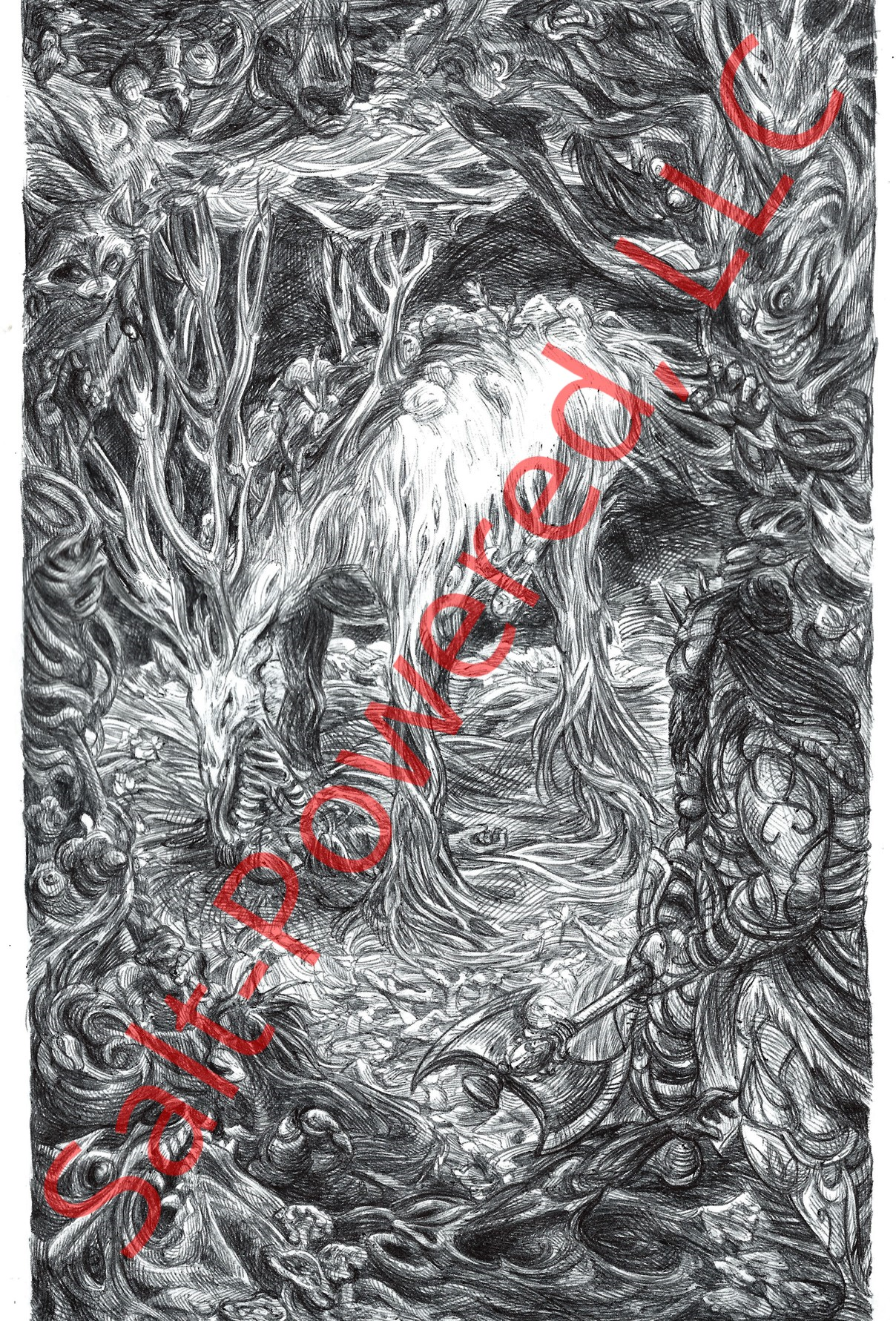
Very rough, written for use in a War Torn/Rale playtest one-shot (hence the weird, second-person framing).  Posting primarily as an excuse to show off Rae’s art.

You feel time drain from your perspective.  Where you are is not here, when you are is not now.  The trees around grow tall and vast, larger than you have ever seen, and the underbrush grows in kind.  From the canopy, birds take flight, and squirrels scamper between the boughs. Amidst it all, you see a stag emerge from the greenery.  The creature is tall and proud and weathered by its years in the forest–it knows that even as it is surrounded by life, death is never far.

Even now, it is pursued by a group of men.  They carry bows and spears and fire, and eve though the creature flees from them at great speed, they are relentless.  Soon, it is tired, and the men reach it. Their blades and arrows pierce its hide, and their flames scorch its face, and though it tries once more to flee, its legs fail it, and it crashes, heavy, to the ground.

The men approach but do not reach it, for suddenly, a wolf leaps from between the branches and bites a man’s throat.  Blood flows, and the man’s companions stab the beast, but even in death, it does not forsake its quarry.

The stag, seeing life abandon its would-be salvation, cries out in horror.  The sound is feral, animal, real, but you recognize the creature’s voice all the same from the echoes you heard beneath the earth in your own world, outside this strange rift in reality.  Abandoned by life, it instead calls out to death, to draw the macabre scene into its warm embrace.

For the first time in the creature’s long memory, death heeds its call.  The branches around them, imbued with that deathly force, grow and pierce the men, enshrouding the dead wolf in monument of briar and blood.  At once, the stag realizes: To help the world escape death, it must become as death. It must draw the whole world into its embrace.

The stag, galvanized by fear and grief, sets about its task.  It devours the wolf, swallowing its tail, its flank, its shoulders.  As the stag engulfs the dead beast’s maw, a spark of life, of hunger, awakens inside it, and the beasts, now twinned, begin to eat as one the men, the briar, the earth, and the trees, until the chimera and the forest are one.

Years pass, and the earth shifts, and a Hunter arrives at the forest’s edge.  He understands, as the chimera does, the balance of life and death. And just as the chimera has, he has swallowed the strength of the dead, stocked it beneath his skin.  For years, the two hunt each other, attempting, as they had before, to pull one more soul into their embrace, but they are tenacious and tireless, and neither does prevail.

The Hunter grows tired of the hunt, but he cannot walk away.  He bands with a strange bird and a king among beasts, and the three end the chimera’s advance in a cavern below two burning trees, ensuring, despite the creature’s cries, that the world never will be saved from death.

Top Image: Embrace, by Rae Johnson, commissioned for War Torn/Rale