Tag: fiction
Protected: Whom Emperors Have Served, Chapter 17: The Literal Grasp of Death
The Dreamer’s Rhyme
A rhyme that will likely appear in some form in $20,000 Under the Sea, revealed to me, perhaps ironically, in a dream nearly a decade ago. This is the version that has bubbled up after some 10 revisions. There is a particular, if obscure, lyrical inspiration, though I’m not sure how apparent it is at this point.
On darkest side of darkest Dream
The Dreamer softly sings
He wraps himself in gilded thought
And robes and eyes and wings
One man has seen the Yellow Sign
The other never will
In synthesis they reckon with
The world He means to kill
So watcher if you like the glass
That shatters in the sky
Show me what you’ll trade for it
This hour before you die
Give me the fire in your heart
And the shards of Dream shall be
Smoothed for you, made glassy eyes
Through which, at last, you’ll see
Protected: Whom Emperors Have Served, Chapter 16: No Regrets at All
Protected: Whom Emperors Have Served, Chapter 15: Best Laid Plans and Heavy Machinery
Protected: Whom Emperors Have Served, Chapter 14: Hot Shoe, Burning Down the Avenue
Protected: Whom Emperors Have Served, Chapter 13: Distasteful Reintroductions
Can’t You Read the Sign?
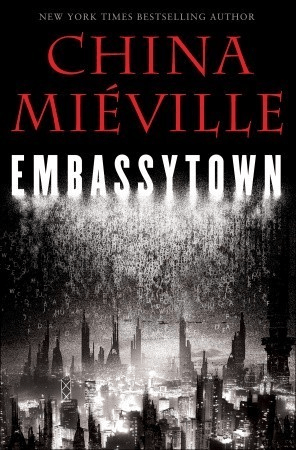
A review of Embassytown, by China Mieville.
Circumstances being what they are (ie, needing to focus on finishing one more manuscript while I have the freedom to do so), it is likely that the following will not do China Mieville’s Embassytown justice. Perhaps that’s because the book is a lot, perhaps it’s because it’s just a lot that I’m personally interested in. It’s become depressingly clear to me over my adult life that the average person just cannot be persuaded to care about epistemology. That’s fine; it’s a headache, but just as others may enjoy headaches in the form of booze or boxing, the nuances of knowing things is a headache that speaks to me. And boy oh boy does Embassytown speak that Language.
Cheap pun notwithstanding, this book is silty. It’s classic Mieville, which is to say it’s not especially forthcoming with what it’s about, despite seeming to follow a cogent narrative arc. I’m not sure why this is so common in his work, since it seems to be a different sin (or at least a different purpose) depending on the story you’re reading. In Perdido Street Station, it’s an issue the setting gobbling up pages in exploration of details and implications extraneous to–and thus obfuscating–the plot. Meanwhile, in Kraken, it’s just an excessive amount of intentional misdirection (seriously: That book builds to a climax around the theft of an idol worshipped by a squid cult, only to reveal that the god-squid was merely incidental to the antagonist’s quest to become a god of ink, which is then thwarted by the protagonist’s realization that he has become a god of glass containers, only then to reveal that the apocalypse he was seeking to avert has nothing to do with that antagonist’s scheme and everything to do with the ideological impact of Darwin’s theory of evolution, completely unrelated to squid, ink, or bottles).
Embassytown is somewhere in between. The setting is, of course, very whacky, and a lot of space is given to implications and interactions of its aspects, but after the third (or so) major paradigm shift that changes how everything operates, one can’t help but feel a little jerked around. To that end, I think it’s fair to say that as a story, the pacing is kinda flawed. It’s still gripping, in ways, for reasons, but what makes the book great is what it is beyond a plot.
For starters, like most of the sci-fi genre, Embassytown is about its premise just as much as the series of events that occurs within it. That premise is that there is a planet on the edge of known, navigable space that is home to a sentient species (the Ariekei; the planet is Arieke) that can communicate only via the weirdest language. They have two speaking mouths, and each word or term is constructed of two words, spoken simultaneously by those two mouths. No, that isn’t the weird part. The weird part is that they are incapable of registering anything not spoken in this language, according to particular constraints (cumulatively, Language) as communication at all. A person speaking to them in a foreign tongue; body language; writing–they are aware that there is a thing moving or making sounds in their vicinity, but they will not, cannot understand it or even grasp the notion that there might be thought or intent behind it. Even weirder, when two people repeat the phonemes of their Language back to them, down to the precise pronunciation and simultaneity, the result is the same: They don’t react. It isn’t communication to them. Only through a slow, historical stumble (which the book briefly summarizes) do the linguists making contact figure out that the two halves of Language must essentially be spoken simultaneously by a single mind in order to be comprehensible.
This discovery prompts a series of attempts at workarounds. Mechanical aids (to provide the second speaking mouth) don’t work, ditto synthesized sounds in general. The closest of the first drafts is identical twins, which mostly doesn’t work either, but per Miracle Max, mostly failure is slightly success. Humans devise psychological tests to evaluate empathic synchronicity, gather the sets of twins who score the highest, and then further augment that synchronicity with cybernetic implants. This works okay, and they are able to establish basic lines of communication with the Ariekei. By the time of the book’s events, though, this is all rickety, ancient history, and the embassy (of the interplanetary empire that originally made contact) has moved onto using precisely-engineered clones. These are the Ambassadors.
A brief digression: Some portion of the book gets into the significance of Arieke to interplanetary politics, which is amusing anticlimax. The planet is, in fact, very valuable, but for reasons that have nothing to do with natural resources, the oddities of Language, or the super weird, biorigged technology in which the Ariekei specialize. So going in, the score is that the interests of the empire and its embassy only slightly intersect. Contact with the empire is of a fraught sort of salience, but it’s infrequent. Embassytown (the place, not the book) is out in the boonies, and the way in which its citizens have gone (or proceed to go) native is part of the point.
Anyway, the Ambassadors communicate reliably, but the way the Ariekei work is still a bit opaque. For the Ambassadors, speaking Language requires a lot of engineering, but in the end, Language for them is just language, a semiotic construct. For the Ariekei, it’s not. For them, Language is Truth. They can’t lie, for instance, but it is more than a preventative for deception. They cannot describe anything they know to be contrary to reality, they cannot speculate as to anything that has not happened (they have a future tense, but it can only be used in situations of extremely high certainty), they can’t use conditional hypotheticals or metaphors, cannot even conceive of them. In order to access new concepts, they have a practice called “performing simile”, in which an individual, frequently a foreigner from Embassytown, performs some task of abstract significance under ritualistic observation. These individuals, including Avice, Embassytown’s protagonist-narrator (her simile, roughly translated: “the girl who was hurt in the dark and ate what was given to her”) effectively comprise the Ariekei’s limited window into that which is not.
Needless to say, this is all very bizarre, but the embassy is not especially interested in understanding the boundaries of these limitations. They don’t want to rock the boat–the status quo is awesome for them. They effectively rule their provincial kingdom, coexisting peacefully with the Ariekei via their genetically-engineered, diplomatic metis. For one, elucidating the fundamentals of their diplomacy undermines their interests: The empire understanding what they do makes them replaceable. But also, they would honestly rather the Ariekei not discover anything wild and crazy in their linguistic differences, lest the embassy become a victim of a cultural revolution that turns political. Of course, this is exactly what happens.
Actually, that isn’t precise. It’s what almost happens. And then it’s what happens so hard that nothing will ever be the same again.
The book’s first conflict is fairly organic. Per the above, despite their best efforts, the embassy has introduced a new, invasive oddity into Ariekei culture: The Ambassadors can lie. It turns out the Ariekei have noticed and find it very interesting. For many, it’s entertainment, something between a magic show and a freak show, but a group–of what Avice speculates are sort of Ariekei intellectuals–pick up the idea with more curiosity and attempt to learn how to lie themselves. They can do it, sort of. With great difficulty, by omitting words from sentences, by tricking themselves into failing to finish thoughts, they are capable of vocalizing things which they know to be false.
But they don’t stop there. The intellectual clique, led by an Ariekes named Surl/Tesh-echer (each side of the slash said simultaneously) appears to be fixating on a group of human similes as a means to speak falsehood without having to trick oneself. Ultimately, Surl/Tesh-echer is able to say, in front of a crowd:
“Before the humans came we did not speak so much of certain things. Before the humans came we did not speak so much. Before the humans came we did not speak.”
And then, in very short order, Surl/Tesh-echer is assassinated in a conspiracy between the embassy and the Ariekei “rulers”. Everyone agreed, apparently, that it (Ariekei use impersonal pronouns, or the Ambassadors do for them anyway) was onto something, and none of them wanted to find out what, for reasons ranging from brutal realpolitik to religious fanaticism. The book presents this arc, effectively the first, post-prologue, interspersed with the events leading up to the true crisis years later, and from a storytelling perspective, it is Embassytown at its (and Mieville at his) best. It’s an elegant introduction to a highly complicated world and a heartbreaking belated coming-of-age for Avice, who had somewhat intimate personal connections to both sides of the assassination conspiracy. This isn’t to say that the two thirds of the book that follow are a letdown–the beginning merely stands very well on its own. What happens after, though, is where the already philosophically heavy situation gets spicy.
So: Several “years” later (time spans that large are measured in the book in kilohours, because space), the empire sends an Ambassador to Embassytown. This is, on its face, already strange. Ambassadors don’t come from the empire–they are grown in a vat in Embassytown (an ethically spiky topic on which the book touches but does not dwell). Moreover, the particulars of the empire’s Ambassador are highly atypical. Again, modern Ambassadors are sets of doppels, perfect clones, cybernetically linked and physically re-synchronized (so that minute differences in their physical experiences do not accumulate) on a daily basis. The empire’s new Ambassador, EzRa (this is the ambassadorial naming convention, e.g. BrenDan, JoaQuin, MagDa, JasMin) on the other hand, is just two completely different guys with a supposedly off-the-charts score on the paired empathy test that predicts ability to speak Language.
But can they speak Language? Ha. Haha. Yes, but really badly. This is not “badly” as in “their grammar is terrible” or “they are hard to understand”. Rather, when they speak, it enraptures the Ariekei into a trance. It takes a minute for anyone to figure out what’s going on because, surprise, this isn’t what the empire intended at all. They knew their new Ambassador was scientifically fucky (there is, of course, more going on technologically than two guys who just really get each other), but they were genuinely just hoping to create a pipeline for Language speakers they could control. Within a few days, the embassy is able to put enough pieces together to relate EzRa’s oratory to a little known phenomenon they had encountered in their own failed Ambassadors (of which they apparently have an asylum-full in the basement). Turns out that when a pair of humans speaks Language in a way that is just slightly off, the effect on the Ariekei is not distortionary but narcotic. In a small way, the Ariekei can become addicted to the infinitesimal incongruities in a miscalibrated Ambassador’s voice. Except what’s going on with EzRa is not small. The high of their voice is potent enough to spread demand like wildfire: Upon their first public pronouncement, the Ariekei subsequently flood the embassy, overcome by fervid desire to hear EzRa’s voice based on nothing but word of mouth. And once they hear it, the addiction does not seem to have a cure. If an Ariekes goes too long without hearing EzRa say something else (and it has to be something new–repeated pronouncements induce tolerance rapidly), they just shut down.
Oh, but it gets worse.
Virtually all Ariekei infrastructure is biorigged, organic, chemically and physiologically interconnected, which means it isn’t just the Ariekei individuals who are addicted. It’s every Ariekei machine, vehicle, and building on the planet as well. Embassytown is still mostly human architecture, so it isn’t entirely a biological construct, but it isn’t unaffected. The most visible clock to emerge from this development is that the addiction afflicts the aeoli used to convert Arieke’s toxic atmosphere into human-breathable air, which means that unless the situation is stabilized, everyone is gonna die.
It gets even worse than that. And then, it gets even worse than that. In summary, everyone loses their shit; Ez murders Ra; the embassy, in whose leadership Avice is taking on an increasingly active role, figures out how to “replace” Ra in order to keep the Ariekei going and creates EzCal, who is way too into his role as the “god-drug” and begins solidifying power structures around himself; the Ariekei begin to deafen themselves in order to cure their addiction (which, for a species for whom spoken language is thought and unspoken language isn’t language at all, is way worse than it sounds); the deafened Ariekei begin massing an unstoppable horde, hell-bent on the extermination of the humans and addicted alike; and Avice goes renegade and discovers a way to teach the Ariekei to use referential language, which cures the addiction and stops the forthcoming genocide. I want to be clear that my description does not do this last step justice. It is extremely awesome, and I would almost recommend reading the book just for that portion of it.
Needless to say, this is all extremely analyzable. The low-hanging fruit, the piece that I imagine a socially-involved but not especially careful reader might notice with immediate umbridge, is the commentary on colonialism. Embassytown as a colonial story runs counter to the anti-imperialist narrative in vogue right now, and without getting too political, I do want to clarify that that narrative has a lot of good sense behind it: Historical colonialism was rife with utter atrocity, and it is hard to defend the intent behind it as any more noble. This is why my above weakman would not be wrong to be immediately suspicious of Embassytown’s characterization of its colony as native-friendly. Anyone even passingly familiar with the concept of bias should immediately recognize that first-person good intentions are very easy to presuppose and wildly difficult to ethically execute on. But counterpoint: This is fiction, not a geopolitical instruction manual. Mieville is at liberty to define whatever setup he wants, without any obligation to make that setup replicable in real life, and the setup he defines is one where the colonists have little power over the natives, and their empire has little interest in establishing any direct political control. Part of this should be understood as a change in economic theory between now (and especially Mieville’s stellar far-future) and the 15th century, largely independent of the parallel shift in geopolitical ethics (it is worth noting that despite Mieville’s impressive authorial catalog, he also has a fair amount of training in law and economics). A little-appreciated observation is that mercantilism as a driving motivation for early colonialism was catastrophically destructive for the places getting colonized, and Embassytown is operating on very different sensibilities. Specifically, the empire in the book is operating with the specific interest of being friends with whatever human settlement ends up on Arieke in the long run. They don’t really care about conventional exploitation (though they do want reliable and semi-exclusive diplomatic influence), they certainly don’t want to be financially responsible for the settlement’s survival. And the resources? Meh. Biorigging is neat but probably not a game changer. No, the value for the empire is deep space exploration, and Arieke is the farthest outpost available. They just want to be on better terms with that outpost than anyone else. Mieville himself is a Marxist, but if that isn’t a picture of capitalism, I don’t know what is. The empire thinks the liability of owning the capital is too much, but they would love to lease, and the natives are free to share in the value.
Now of course not all of the downsides of colonialism arise from the colonizers being evil fuckers. Addictive substances introduced with varying levels of intention have resulted in events that might fairly be described as “genocide” on multiple continents, and I don’t think Embassytown glosses this. But what I think may ruffle feathers is that in this story, a colonist “saves” the natives by “elevating” their conception of the world.
Yeah, I don’t love that either. Still, I think there’s a perforated line where you can tear the book’s themes to save it. Set aside the particulars of Language for a moment–they’ll be relevant on the other side of the tear, but on this side let’s simply examine the colonial commentary alone. A generalization from this narrative that is obviously true is that cultural exchange has a significant potential for harm. In history, this is most visible in the transmission of European vices and poor hygiene, but it is a much stronger claim to say it stops there than that it doesn’t. I think the sci-fi style question that Embassytown very reasonably asks is whether it is possible to acknowledge certain directional harms of that cultural exchange and provide mutually agreed-upon aid to mitigate those harms. A key feature of this story is that even though factions align in opposition to each other, they are still all in agreement that this addiction thing is apocalyptically bad, and the only solution that will resolve it is one the Ariekei themselves choose. I think that this, as a prescriptive cap to the interpretation, is not in itself an offensive assertion.
Now on the other side of things, consider the Language. For a number of reasons, despite the unfortunate conjunction of the Ariekei’s shift in linguistic culture with the aforementioned colonial story, I think the particulars of Language and its evolution place it in a separate allegory. Calling it a philosophical allegory would be eliding the point: It is an allegory of philosophy itself. Think about it. Capital L Language is a very strange concept, even by sci-fi standards, and if this were a run-of-the-mill white savior story, that strangeness would be wholly unnecessary. If you want to make the natives wrong, there are easier ways to do it, but Mieville didn’t make the natives wrong–it’s the exact opposite! Language is both thought and Truth. It obviates epistemology. Human language is referential because our experience is unreliable. We need reference points to reassure ourselves and others that we know anything at all, but the Ariekei don’t have that misunderstanding. Their map is literally their territory. They still have a Westword-style “those words don’t sound like anything to me” when an Ambassador says something that fails to compute, but for the most part, this is a species entirely unconstrained by one of the most fundamental handicaps of the human experience. It’s no wonder, then, that Avice’s xenolinguist husband, Scile, reacts with almost militant horror when he discovers the emergent cultural phenomenon of Ariekei attempting to lie. Here is an experiential wonder of the universe, unlike anything ever discovered before, and human influence is already destroying it.
So think like an economist in this case. Do the cost-benefit analysis. List out the pros and cons, quantify them if possible; it’s easy to not question why we do what we do when there isn’t any alternative, but here one is. And while an anthropologist may very reasonably retreat from this exercise for fear of the bias-wolves lurking in the hills, we shouldn’t be deterred. In real life, that bias might literally kill people, which is why we sometimes write books to explore these sorts of problems instead of field-testing our solutions.
Since Scile’s stance is the first to disrupt the flow, we’ll look at that first. Why might the disruption of Language be bad? Obviously, change is not always good. Ariekei culture–which, it’s worth reiterating, is not especially well-understood–is deeply rooted in Language, so any linguistic revolution will almost necessarily mean cultural upheaval. Even if the Ariekei are “better” on the other side (hard to evaluate and extremely far from certain), some of them are going to get hurt along the way. Assuming you care about them, your prior should be toward caution. Moreover, even though the total benefits of the Ariekei’s linguistic status quo may not be legible, we can see some aspects that are clearly prosocial. Social trust and coordination are crazy valuable and hard to establish, and being unable to lie automatically overcomes the hardest hurdles for both, to say nothing of the reduced social friction from the much higher fidelity by which the Ariekei are able to articulate concepts. Tertiarily (from the philosophy of this argument–though Scile, et al may value it more highly), there is the aesthetic value of this truly unique linguistic (and, to a certain extent, metaphysical) phenomenon existing in a place where you can reach out and touch it. The alternative has potential to destroy it, and that is not a negligible cost. Even if you accept that the giant panda is dubiously fit for survival, you’d still kind of rather it wasn’t extinct.
On the other side, pinning your language to your thoughts, to what is literally, verifiably there, is limiting in ways you might not expect. Consider that the Ariekei are a technologically advanced civilization (they have made technological advancements that an interstellar empire has not), but they’ve never been to space. They have no interest in space–how could they? It being unknown to them means it is not, and it being not, means it can neither be spoken nor thought of. Needless to say, this has downsides in much more mundane ways too, hence the Ariekei’s reliance on living similes.
But this is all fairly surface. It’s what the book lays out for you, alongside the embassy’s political motivations, leading up to the assassination of Surl/Tesh-echer. The question one ought to be asking oneself: The megacrisis, the EzRa-induced addiction–is that explainable by the philosophical nature of Language (without a need for some additional MacGuffin)?
I think it is, mostly, sort of. It requires us to fill in a number of gaps as to what it means to speak Language badly. Mieville provides a hint, though: In the creation of EzCal following the death of Ra, the protagonists operate on the assumption that a key ingredient in the “god-drug” is that the second voice in the second voice in the speaking pair hates the first. For normal language, this would be irrelevant, entirely outside the model, but for Language, where both voices are meant to come from a single mind, it makes each word a negation of itself, infusing it with a whole bunch of meaning not implied by the actual phonemes. The scale of the crisis is MacGuffin, of course. The reason EzRa’s voice is so much more narcotic than previous observations of the phenomenon is that Ez is, himself, an engineered hyper-empath for whom being hated by his cybernetically-linked second voice is a uniquely-affecting experience, which comes through in his Language. But consider what this implies about the Ariekei experience.
It is obvious that scientific discovery depends in some measure on epistemology, but those roots spread wide underground. To paraphrase Lou Keep, Kant claimed that his work was meant to save the sciences, but what was really at stake was everything else. Interpretation of experience relies on validity of experience, which means that epistemology has fairly serious implications for aesthetics as well. The Ariekei don’t really have epistemology, but they have plenty of science. Provided your biology allows it, you can just go places to expand your mind. Skipping over a lot of details of this argument (this isn’t really the venue for philosophical groundwork), the Ariekei’s empiricism is awesome, but their predictive math is not. And if all of your experience is high-fidelity empiricism, all of your aesthetic values are going to center around anomalies.
The retreat, then, from Language’s perfect alignment with reality, to semiotics, to reference, is really about values. It’s about freedom to define what is good, independent from the balance of Science (the good is minimizing anomalies) and Suffering (the good is minimizing pain) which the Ariekei were strung between before. It’s the ability to access philosophy, tools to make the incommensurate commensurate.
Of course, Mieville doesn’t overextend thai to a stance on such thinking being better. Some Ariekei are unable to unlearn Language, some choose not to, and the society of cured is able to engineer workarounds to keep the addicted alive. Nor is it a perfect exploration of the topic (to say nothing of my own no doubt stunted understanding of it), but even so, there’s a lot there. A lot of things to think about, biases to unlearn, new looks to be had at this series of images we call life, and, of course, new words to describe it all.
One Wing, One Eye, Chapter 2: The Homunculus
Lan al’Ver awoke with an uncharacteristic jolt. It was becoming more frequent. Sleep. Dreams. The writhing and resonance of the Night Sky’s mind was intruding ever more upon the world’s substance. Structure was beginning to decalcify, mana ran rich with dreamsilt, and even beings such as Lan, who had long since dispensed with the biological necessity of somnolence, were having it thrust upon them. Unimpeded, the end would be here soon. Perhaps in weeks, perhaps in years, but when He woke up, reality would melt into dream, and dream would melt into nothing. Only the Dark would remain, and that was lovely for the Dark, but Lan was beginning to view the prospect of nonexistence with a new apprehension of late. Perhaps the Alchemist had been right. It was fortunate the man had been so persuasive during his crossing.
Lan surveyed his crowded raft. Dawn had not quite arrived, and the sky was still a deep, whorled grey. The others were still asleep: Orphelia and Devlin huddled inside the raft’s small cabin, Ty Ehsam the scavenger crouched against its outer wall, and Naples the scholar lounged, snoring, atop a pallet of linen bolts. None, apparently, had noticed his lapse in vigilance. And he had woken before they had come upon their intermediary destination, so it seemed no evidence remained for them to find. All was still in hand so far, though the uncertainty of it chilled him.
A soft breeze blew through the reeds, the minutes passed, the sky lightened, and as his companions began to stir, Lan maneuvered the raft to the bank, just as it began to widen before them.
Seek the Keystone, and bring it to the shrine where once you ruled, Excelsis had said. Though he was still unaware of the purpose of this errand, Ty had the Keystone now. They had gone to some lengths to extricate it from Les Marquains’ clutches. He would certainly be disappointed to learn he would not be handing the stone over to the Blaze, but the stakes were higher than he could know. Even if he saved himself from the fire, taking any other course would end him–and everything–all the same.
“The shrine” where once Lan “ruled” was a flattering reference, even if it was based in historical inaccuracy. Lan’s erstwhile incarnation, the “Turtle on the River’s Surface”, as the remaining stories recalled him, had never been a political entity, much less a ruler. But nonetheless, for a time, there were some humans who claimed him as a guardian. Those humans, the ones who charted and spread across the Riverlands, who became, in fact, the first Riverlanders, maintained among their disparate tribes a place of confluence here, at the fork between the Lifeline and the Artery. Over time, its permanence in culture became permanence in edifice, and as the Turtle–the creature–faded into the background, the turtle as a symbol rose in the form of the Godshell Palace at the center of the floating city of Thago, capital of the Revián Federation.
It had been many centuries now since Thago had been destroyed, torn apart by social unrest and an opportune attack by the Diarchy of Spar, their rival to the east. Though Lan had felt the loss of Thago keenly at the time, he had grown to understand that by then, the age of the Old Gods had long since ended. Thago had all but forgotten him, palaces notwithstanding, and Spar had almost certainly forgotten Brother. It had become a world of men, of their creation, and Lan’s role from then on was merely to live in it. There were worse fates. Though now it seemed had one last debt to pay the world he no longer guarded.
Now at the fork in the river where Thago once floated, there was nothing left, not even ruins, save perhaps some disintegrated hull fragments long stuck in mud and shielded from the eroding currents. But Lan was reasonably sure it was the place which was symbolic in the Alchemist’s gesture and not the literal architecture. No, he presumed–and his presumptions were generally apt–that what he was looking for here would be the Alchemist’s creation.
“Did you stop to rest, al’Ver?” Ty asked. He had stirred, it seemed, awakened by their cessation of movement.
“Captain al’Ver,” Lan corrected, though not disdainfully. Ty was attempting well enough to blunt his own discomfort at their decreased pace.
“Yes, of course. Captain. But–”
“No, Mr. Ehsam. We have stopped because there is something the two of us need to see.”
“The…two of us?” The question was punctuated by a moist thud as Naples toppled to the deck.
“Wha–what’s all this?” the scholar asked blearily.
“No need to worry,” Lan assured. “Please keep watch over the children. We will not be away long.”
With that, he stepped out onto the bank, Ty bewildered but in tow. The reeds were thick where he had moored the raft, and if there were anything hiding in the mud near them, it would be all but impossible to find. But Lan doubted it would be so close to the river’s churn. Excelsis, whose life’s work had been toward the preservation of the world, would have been particularly wary of erosive influences. Up ahead, there was an outcropping of rocks which would certainly be a more fruitful ground for their search. Lan drifted up the uneven terrain on footholds he suspected were too slight for Ty to notice as Ty, accordingly, ignored them, clambering up the rocks with impressive agility but no small effort.
“Al’Ver. Captain,” he said, about three quarters of the way up. He was trying to disguise his heavy breathing, only mostly successfully. “What are we doing here?”
“We are looking for something the Alchemist left us, Mr. Ehsam.” Ty’s frown deepened to incredulity.
“What? No! Absolutely not!”
Lan peered between a gap in two boulders, spotting the telltale contours of stairs hewn into the rock.
“Right here, I believe,” he said. Ty looked through the gap.
“Oh, gods, there’s actually something here,” he muttered. Then, more dedicatedly: “No! I’m done with this, al’Ver! I finally have my freedom in hand, and I’m not going to risk it for a payday on whatever manse or lair this is. I need to get back up north!” He turned to leave, but Lan called after him:
“It is precisely because you have the Keystone that we are here.” Ty stopped, looking back at Lan with sudden suspicion. “Did you think your quest was merely coincident to my journey to the Reach?”
“I did,” Ty said slowly, eyes widening with something approaching recognition. “What does this have to do with the Keystone?”
“Some time ago, the Alchemist asked me to find it and bring it here. I have done so. Now we must see what that was meant to accomplish.” Ty stared.
“The Alchemist died nearly a century ago,” he said. “Who–what are you?” Lan held his gaze for a moment and then turned back to the occluded staircase. He began making his way downward. Ty would follow in a moment. He was resistant, but the stream had him now.
At the bottom of the staircase, surrounded on all sides by rocky walls made more of intentionally-placed stone bricks than the random boulders above, Lan paused before a metallic door. It was peculiar–dark, almost black, not iron or steel, nor any other metal with which he was familiar, though metal was hardly a domain over which he claimed expertise. He waited to hear Ty’s dampened footsteps behind him before opening it, stepping out of the way of the corpse that fell into the doorway.
“Fuck!” Ty hissed.
The corpse was practically mummified, its skin taut and pale-brown over its bones, though its chest had been flattened, with a large, square crater of pulverized flesh and bone in the center of its otherwise-preserved torso. It meant they weren’t the first to find this place, though they were likely the first in some time. It also meant something else, though Lan trusted Ty’s instincts were sharp enough for him to discern it on his own. He stepped around the corpse and into the large, rectangular room beyond.
As he did, a number of crevices at the base of each wall came to life with a green glow, illuminating a dizzying array of symbols etched into nearly every inch of the stone walls, floor, and ceiling inside. Lan was no metamage. These symbols were neither within his command nor comprehension, but he was not blind to the ways that humans interacted with the residual dream and death they called “mana”. Even if he did not know what they meant, he knew what they were: mathematics, epistemological declarations alien to his own experiential nature, memos to reality as to the specifics of the transmutations the mana was meant to invoke. The entire room was an artifact, then, but on the off chance an entrant knew the language the Alchemist used to document his enchantment, they might glean some idea of his intent. Fortunately–or unfortunately, as may have been the case for their semi-embalmed forerunner–it seemed Excelsis had left a separate message in a more universally understood language, and that message began to rumble to life, separating itself from the wall as Ty tiptoed in, and the door behind them squealed shut.
It was a golem, a magical constructed wielded by earth mages the world over, its anatomy sculpted to a crude humanoid shape in the same cubic bricks that made up the rest of the room’s surfaces. This one was unique, however, in that the evocation of a golem was a somewhat demanding allocation of mana, and this one seemed to be persisting in the absence of a mage.
“Ready the Keystone, Mr. Ehsam,” Lan said. The golem braced to charge, its intent–to the extent an unthinking construct’s will to violence might be considered intent–eminently clear.
“Ready it for wha–gah!” Ty threw himself sideways as the golem lurched into the spot where head had been standing, coming to a halt with the force of a rockslide but far more grace than its unwieldy form might have implied possible. Lan swatted at its “head”–a gesture which had little hope of impeding it but which might acquire its attention. The ploy was partially successful: The construct’s torso spit around the axis of its waist, causing its arms to whip outward at the men on either side of it, stretching–in such a way that the bricks in its arms separated from each other slightly, held together by nothing but pure mana–and clipping Ty, sending him reeling back into the wall.
“The Keystone was to be brought here,” Lan said, keeping most signs of concern from his voice as he leaned out of the way of the golem’s whirling strike. “We must find what it was to be brought to.”
“Oh, must we?!” Ty snarled, pushing himself upright and dashing away from the golem. Amidst the chaos, it seemed he had, in fact, followed Lan’s instructions: The marbled blue medallion was dangling by its chain from his fingertips.
Lan regripped his umbrella and drove it more dedicatedly into the construct’s cranium, with force that likely would have broken a human’s skull. Almost surprisingly, the surface gave slightly against the blow. Reasonable, he supposed: So mobile a configuration of stones might not be the most stable one. Either way, it seemed he had its attention.
The golem shifted its strategy, squaring up toward Lan and seeming almost to widen. It had learned quickly, he realized. It had gathered that its sudden movements were not sufficient to surprise him, so now it meant to corner him instead. Slowly, it began to stretch an arm toward him. Excellent. He had been hoping to see whether this would work. As the stones in its arm once again began to separate, he jammed his umbrella into one of the gaps and levered it hard.
Golems, in his experience, were not difficult to partially destroy. All one had to do was overpower the local mana the mage was channeling to hold a particular piece together, which, for the joints, was generally not very much. This was only so useful in the normal case, though, since a mage would be able to regather whatever was destroyed in seconds. Lan was curious, though, whether Excelsis’ guardian possessed the wherewithal to repair itself. Sure enough, its arm shattered at the elbow, the stones falling uselessly at Lan’s feet, but the construct did not give him the pleasure of confusion at its sudden disarmament. It simply rushed him.
He opened his reinforced umbrella in an attempt to blunt the impact, though he doubted how much it would matter in preventing his imminent flattening against the wall. In the end, though, he did not find out. Nor did he answer his question regarding the construct’s regenerative talents. As it impacted his umbrella, the golem’s entire body disintegrated into rubble, which washed over him uncomfortably but harmlessly. Simultaneously, every inscrutable symbol on every wall lit up with the same green glow that lined the floor. Lan looked to Ty, standing at the opposite end of the room before a large, stone slab. At the center of the slab, slotted into an indentation and glowing a brilliant blow, was the Keystone. The door they had entered by swung open.
“Ah, so there is something he–ah, Captain! There you are!”
Naples poked his head into the room, flanked by Orphelia’s diminutive form. Lan fixed him with a disapproving glare.
“I instructed you to keep watch over my vessel, Mr. Naples,” he said, picking pebbles from his glove.
“I’m afraid you merely instructed me to keep watch over the children,” Naples replied, attention suddenly overtaken by the glowing room. “And they are, uh, here, of course.”
“Ooh, what’s this place, Captain?” Orphelia asked, following him in, dragging Devlin, semiconscious, by the wrist.
“A place of not trivial danger, my dear,” Lan said. He turned his attention to Ty, who was trying to make sense of the slab which now bore the Keystone–and from which, to his mounting frustration, he seemed unable to extricate it.
“Danger is fun,” Orphelia probed, picking up one of the golem’s fragments, not entirely convinced.
“Is this one of the Alchemist’s laboratories?” Naples asked, breathless.
“You call this a laboratory?” Ty shouted over his shoulder, trying to get a grip on the Keystone, to no avail.
“I suppose not, but…these are most certainly his runes. I’m sure of it.”
“You can read the Alchemist’s language, Mr. Naples?” Lan asked, bemused.
“Not well, not well, but Master Jabez taught me a little. Like–” he gestured to the indentation where the golem had separated from the wall. “This seems to be describing a ‘doorman’ who turns away anyone without an…’opener’. Or, yes, a key! So it would…” He glanced from the slab and Ty over to the pile of rubble. “Perhaps you’ve already gotten that far.”
“You wanna make yourself useful?” Ty snapped. “Come tell me what all this shit means!” Cautiously, Naples approached with Orphelia in tow as Devlin took a seat amidst the scattered stones.
“So this is less verb-y…lots of relative and reflexive particles I don’t really follow, but the two biggest pieces are here–” he tapped a series of large runes at the bottom of the slab, “–which is a compound of ‘fire’ and ‘gathering’ and ‘place’. I’d maybe translate it as ‘hearth’ or ‘campfire’, not sure about the context.” He pointed up at a similarly-sized inscription at the top of the slab. “And that’s…that’s weird. The rune in the middle means ‘within’, but the ones on either side aren’t really standard as far as I’m aware. That one on the left looks sort of like ‘dream’, but also like ‘night’, or even ‘mage’, which is itself a known modification of ‘death’, just with an indicator to denote it is being wielded.”
Ty exhaled, clearly apathetic to the nuance, but he held his tongue. Lan, for his part, was intrigued. It was a rare occurrence that he should encounter something he was so thoroughly unaware of, and he was happy for Naples’ aid in the discovery. Moreover, he had heard the name Jabez Faisal before, upon tertiary currents. Perhaps he would need to make a point of meeting this individual.
“And the one on the right appears to be a fusion also. I see the distinctive marks of ‘human’ and ‘tool’ and ‘small creature’ and…’asleep’?”
“What does it mean?” Ty blurted, his frustration finally boiling over.
“I, uh,” Naples stammered. “It means ‘dream-night-mage within asleep-small-human-tool’. Beyond that, your interpretation is as good as mine.” Ty grunted, punching the wall with his palm.
“All that fucking knowledge, and even you don’t know what to do with this? Dammit!”
Lan laughed.
“Mr. Ehsam!” he said. “That was your question? I’d thought you might spare the moment for a fascinating lesson in linguistics, the way forward being as obvious as it is.”
“Obvious, al’Ver?” Ty asked through his teeth.
“But of course! You brought the Keystone to the door. All that’s left is to open it!”
With that, Lan grasped the right side of the slab and pulled. With some resistance, it swung open, the Keystone receding into the indentation where Ty had placed it.
Inside, half-embedded into the wall, was something that looked like a man but was not. Rather, Lan noted with interest, it had a man’s face, cast meticulously and realistically in silver. Its limbs, he supposed, while anatomically correct enough, were far too runed, metallic, interspersed with filigree and empty space for any observer to realistically mistake them for human flesh. It was, all told, a beautiful sculpture, but more pertinently, it seemed that the Keystone, through the door, had connected with a slot on its chest, where it now rested, pulsing a soft blue. Then, as if in answer to all of their questions, the sculpture opened its black eyes.
“I am awake,” it said. Its voice was human enough, vaguely male, though it sounded as if it were echoing through a hallway made of tin. “Please confirm the status of the scenario.”
“…what?” Ty breathed, incredulous. The sculpture’s head turned very slightly to face him, though the rest of it remained perfectly still.
“Very well,” it replied. “I will clarify the scenario subpoints: Is Excelsis dead?”
“Yes?” Ty said skeptically, taking a reflexive step back.
“Thank you. Is the Night Sky’s awakening imminent?”
“What?” Ty muttered, but Lan supplied the appropriate response.
“It is.” All eyes turned to him, including the sculpture’s.
“Thank you,” it repeated. “Is the place of His awakening known to you?” Lan frowned.
“I’m afraid not,” he said.
“Very well. Is the Great Fire nearby?” Ty squinted.
“The Great Fire?” he asked. “The Blaze?”
“It is not,” Lan clarified. “Though it approaches from afar.”
“Thank you,” the sculpture replied. “The status of the scenario is currently viable, provided the Great Fire remains ambulatory. It is my recommendation that the place of awakening be located immediately. I will aid you in this effort, to the best of my ability.”
With this, the sculpture’s limbs came to life, and it began to climb down from the wall. Its motions were not graceful. It stumbled slightly upon touching the floor, but it righted itself quickly enough.
“No, no, no, no,” Ty sputtered, moving to intercept it. “This isn’t–fuck!” As if struck by an unseen force, he reeled backward, clutching his temples. “This wasn’t the deal!” The motions of Ty’s mouth in the following sentence were slurred with hisses and grunts of pain, but Lan caught the quiet, whispered response that he knew was not really from Ty:
“This was exactly the deal,” he said.
“Are you alright?” Naples shouted, running over to Ty while keeping a wary eye on the sculpture, who merely watched impassively.
“That was my out!” Ty shouted. “That stone was gonna save my life!” He sank to his knees, in defiance of Naples’ efforts to help him up.
“Quit your whining,” Lan said, adopting a haughty sternness. “Now it will save everyone’s life. Ideally including your own. Now construct–what may we call you?” Once again turning to face Lan with an uncanny minimum of movement, the sculpture replied:
“I…was designated the title Homunculus.”
“Very well, Homunculus, are you able to explain the remaining steps of this ‘scenario’? Excelsis declined to provide the particulars.”
“Yes,” the Homunculus replied. “The objective is to bring the Great Fire into confluence with the Night Sky’s awakening, for it is fire which wards off the night.”
“Yes, yes, the business with the scarab and the broken nose,” Lan said. “Are we to get our noses broken too? Then off to sleep with Father again?”
“What?” The response came asynchronously from Ty, Naples, and Orphelia, though the Homunculus’ was much the same:
“I’m afraid I do not understand,” it said. “But to the broader context, I cannot say what the precise impact of accomplishing our task will be, merely that it should forestall the erosion of reality. To that end, it is ideal that the confluence with the Great Fire should be both spatial and temporal, though I am equipped to correct for errors on either side, provided we locate the place of the awakening.” Lan nodded, planting his umbrella on the floor, satisfied.
“Excellent, then. Please join us, Mr. Homunculus. We have a lengthy journey yet.”
“Al’Ver!” Ty hissed, climbing to his feet. “Enough with the sweeping us all off to adventure. What the hell is going on?”
“Put simply, Mr. Ehsam, the substance of the very world has been on the brink of dispersion for some time. This world was created, its creator is not inclined to keep it that way, and it was the Alchemist’s last wish that something be done about all that.”
“Do you have an idea where this ‘place of awakening’ is then, Captain?” Naples asked, playing along reticently but admirably.
“Not even the faintest,” Lan replied. “But I’m sure we’ll find it by some road. And around here, all roads lead to the same place.”
 Salt-Powered Investments, LLC