Tag: fiction
Protected: The Crossroads, Chapter 6: The Hunter of Beasts
Trickery
Still a lot of things being worked on, but the pace has been slow these last two weeks. Hoping to get much more done on the Crossroads story by next weekend. In the meantime, here is something Leland wrote for a collection of “world-building” stories we’re working on. It’s a subtly different depiction of the Fox, as if in a tale to be told to Diarchian children. The Fox was the original patron deity of Spar, and one of its founding myths concerned the Old God’s interactions with two orphans: a right-handed boy and a left-handed girl, who became the mythological models for the Diarchs (the Left-Hand King and the Right-Hand Queen).
Once upon a time, a long long time ago, older than your grandmother, and maybe even older than me there was a brother and a sister who loved each other and had only each other in the big wide world. A pair of orphans, whose mother and father were godless and dead, leaving them with just a small family home.
The sister, who was right handed, was a very clever girl who could build amazing traps for hunting. The brother, who was left handed and clever too, knew everything about the forest, what was edible, what was poison, what would happily eat him instead. Brother and Sister lived together, each depending on the other for days and weeks and months and years.
One day a fox with a long pointy nose, a great fluffy tail, and crooked smile from ear to ear came by the cheery little home of the orphaned boy and girl. This fox with a crooked grin was an Old god and he had a sense of humor. The fox god had many humans he took care of and in return they gave him little gifts. He had a funny idea: What if he came to this little house and acted like he needed a human’s help? He was a little tired and a little hungry. He thought to himself: After I climb inside and take a quick nap, l shall eat whoever lives here!
The fox shrank down, chuckling to himself the entire time and knocked on the door. The sister who was right-handed opened the door and looked at this tiny fox sitting on their doorstep. The fox said, “Oh little girl! Can you help me? I am all alone in these woods and I would very much like to come in from the rain just to warm up!”
The Right-handed Sister looked at the fox and said, “I suppose there’s nothing wrong with heating up from the rain,” and took the fox inside. The fox went towards the fire, snuggled up into a tight little ball and fell fast asleep. He was, after all, very fond of napping.
The Brother came through the door with a small basket of mushrooms and paused as he saw the fox. “Sister,” he said “There’s a god sleeping on our rug! What’s more–he’s not a very nice one.”
The Sister thought to herself and said, “I have a plan! Could you pick some mushrooms that would make an elephant fall asleep?” The brother nodded his head quietly and left.
The Right-handed Sister started to make a delicious rabbit stew. She knew that foxes loved rabbit more than anything else in this entire world. She put in potatoes and carrots and celery and salt. Pepper and paprika and even Garlic pods. By the time she was done the stew’s smell hung in the room and felt like a meal all on its own.
The fox woke up and snuffled the air. “What smells so delicious?” he asked the girl.
“Why it’s my favorite soup!” the girl said to the fox. “And it’s almost ready, it just needs something before it’s done.”
The fox said, “I’m so hungry I think it’s time I eat you!”
The girl said, “Well you could…but if you get me a radish this soup will be twice as good.”
The fox paused. “Twice as good?” he thought. Now as we know foxes are a little greedy, and he did know where radishes were. He thought, “I’ll get this radish, and eat her and the soup soon after!”
Off the fox went as the brother came back, with mushrooms in his hand. The sister took the mushrooms and put them in the soup and said, “Brother, can you get a rope?” The brother nodded and left, and the fox came back, a big juicy radish held in his watering mouth.
“Perfect!” the girl said “It is almost ready, it just needs something else.”
The fox said, “Something else? It smells amazing! I’ll eat it and you right now!”
The girl said, “Well you could…but if you get me some seaweed it will be twice as good.”
“…Seaweed?” said the fox whose tummy was rumbling.He’d never had seaweed before. “Fine!” he said and ran out the door.
At that very moment, the brother came back with fresh rope. “Hide behind the pot!” said the sister to her brother. And the fox came back, wet, salty and miserable.
He said, “Here’s your seaweed!”
And the little girl said, “Perfect almost done! The very last thing…”
“No way!” Said the fox. “No more radishes, no more seaweed! I want to eat!”
And the little girl said, “I was just going to ask you to try it and see if there’s enough salt.”
“Oh,” said the fox, “I suppose that makes sense.” The fox tried the soup. He said, “This is good!” and he started slurping and smacking and licking his snout. He ate the whole pot and started to feel woozy… and fell fast asleep from the mushrooms in the soup!
The Brother jumped out from behind the pot,tied up the sleeping fox and threw him out the door. That wasn’t the last time they saw the fox mind you, but they weren’t the meal for one day more!
Three Gifts Given of Dissatisfaction

A brief interlude from Crossroads (because I caught myself working on material out of order). Note the references below to the Sevenfold Gyre and to the One-Eyed Crow (and, obviously, the previous Three Gifts story).
***
From these three came two and two
And circles stretched from sea to sky
To the Gyre did Seven headlong run
Then all the world
That’s why, that’s why
-Words From a Severed Head
***
The Fox’s Second Gift
Long ago I gave you hearth
A place of return from which you roamed
A fire within to banish night
To soothe your aches, to make you home
I rested then for I had thought
My labors had achieved their end
Of steeling you to cold and rot
Your fire I would not need to tend
But now we meet here in the Dark
In fearful quiet ‘neath the earth
Your inner fire early guttered
Broken body lost its worth
The light of day betrayed your years
Promised you many, gave you few
For you I’ll burn, entombed below
This shall be my gift to you
***
The Lark’s Second Gift
Long ago I gave you sticks
Upon your ground I taught my tricks
I brought you craft which you might ply
I bid you: Join me in the sky
Why now have you misplaced your wings?
Forgot that art which made you free
To toil among the beasts and bring
Those who bleed right back to me
I fixed their marks of red and black
As wisdom you refused to learn
I wonder if it’s fear you lack
To drive you on, to make you burn
‘Tis fear that brings you here tonight
Poxed and stricken, marked by blue
Fear of wrongs you would not right
This shall be my gift to you
***
The Turtle’s Second Gift
Forever ago I gave you time
A river running ‘round this bend
Would frame your life with reason, rhyme
Would crown your story with an end
When at last you came to cross
Your souls would from your bodies leap
Your ghosts I’d carry to the shore of loss
Your flesh would drift on to the Deep
I will admit I’ve grown fatigued
As I look upon your evil eye
Your request–it has me so intrigued
You’d go upstream instead of die
Three Gifts were given under Night
And from those three came two and two
You’ve sought your torment, earned three more
This last shall be my gift to you
Protected: The Crossroads, Chapter 5: Ty’s Quandary
Tarot
I have mentioned it before in the most fleeting sense, but one of the long-standing goals of the Rale project has been to produce a Tarot-inspired (though structurally not really) deck of cards depicting images from the world as exemplars of the ways that humans fight death.
Many of the images themselves have been ready for some time, but they have been waiting on frames. They need frames, of course, because the frame is what indicates the card’s suit. Like so:
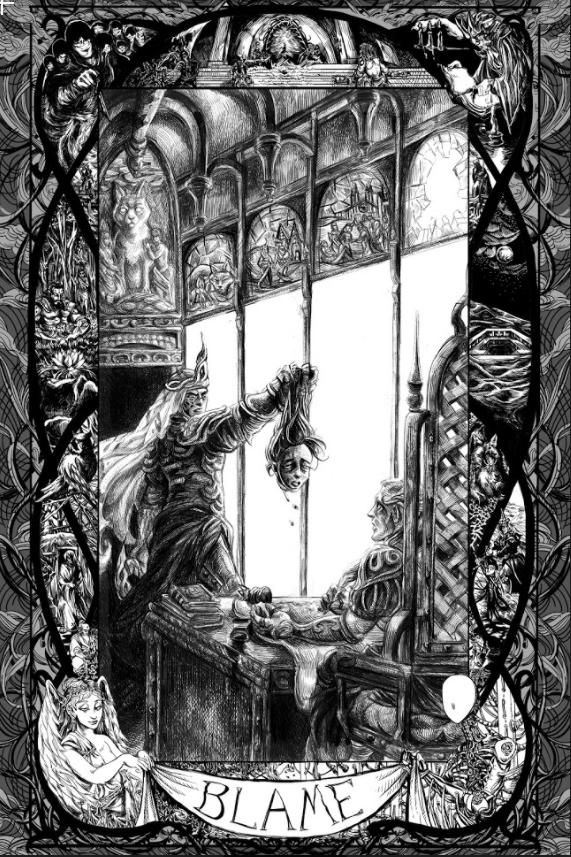
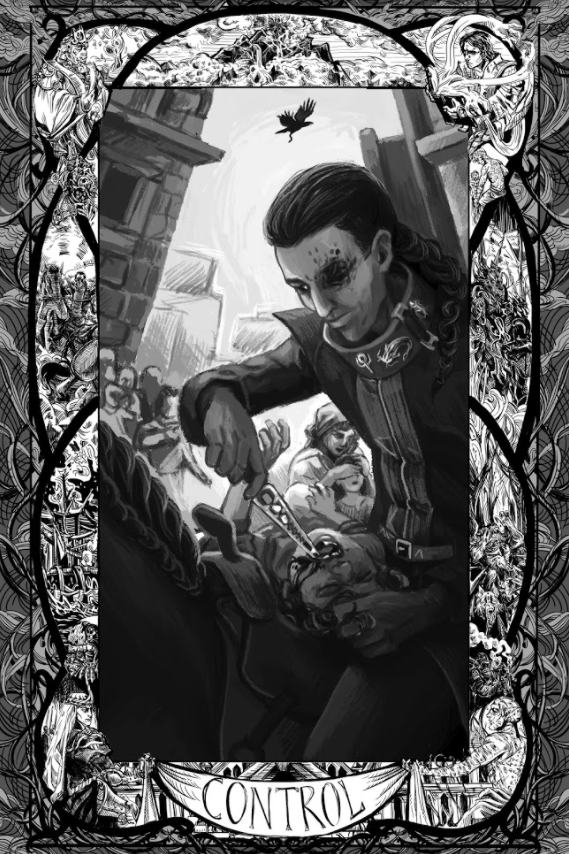
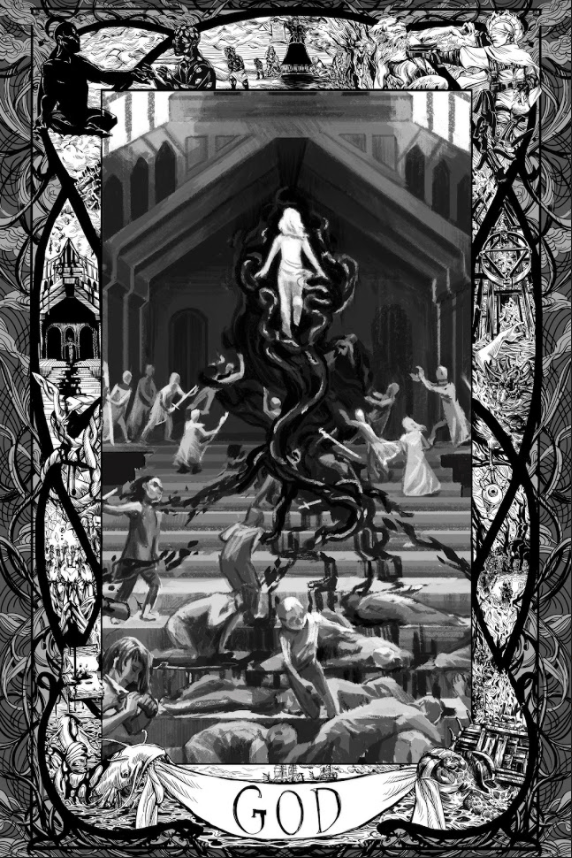
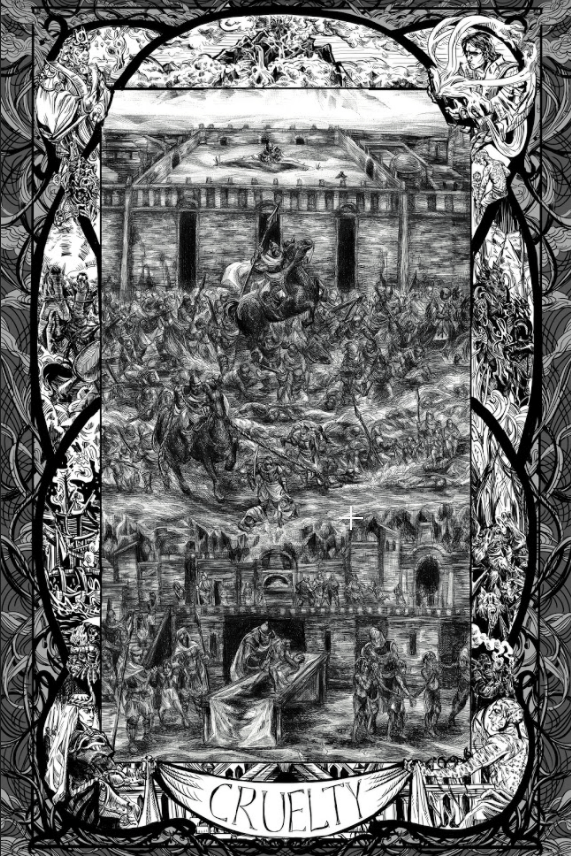
Cruelty and Control are here presented in the “Viscera” suit. Blame is in the “Gifts” suit, and God is in “Stories”. Not pictured here are “Embraces” and “Avoidance”, as they are still in progress, but these came together so beautifully that I had to share.
Way down the road, a deck is in the works, but if you like any of these, they are now for sale on the store!
Images include work by Quinn Milton and Rae Johnson. The “Tarot” suit frames in particular are by Rae.
Protected: The Crossroads, Chapter 4: Marko
A Strange and Particular Prayer
Oh great Mind who should reign
Over matter and potential
Who was first to See and first to Judge and first to Hate
Upon your resonant hall I return with contrition
And an offering of trade
 Salt-Powered Investments, LLC