Journey to the Center of Society, Possible Prologue: Trade Offer

“It’s weird how few people pay attention to how many religions are essentially contractual.”

-samzdat

It was an artfully complex transaction.

The opening was typical of the diplomatic speculation that pervaded China’s Warlord Era.  So many sides, so little to agree on–supremacy is an inherently zero-sum prize and all that.

The context: Cao Kun of the Zhili had beaten back the Fengtian and consolidated power over Beijing.  Wu Peifu, Cao’s right hand, was thus mired, from the administrative discomfort of his temporary office in the capital, in the effort of helping him keep it.  This meeting was one of many seeds cast, little investments with little expectation but–Wu hoped–incredible potential.  Cao had already secured the blessing of interests from the Western nations that would soon agglomerate into “Britannia”, but today’s talk promised a more bespoke advantage.  A private citizen with an interesting personal history.  Perhaps a charismatic figurehead, a cunning informant, a diplomatic shield if it came to it.  Wu had little idea of what this man wanted, but that was not unusual.  These meetings were, by their nature, exploratory.

At this point, the prospective exchange was simple: a little of my attention for a little of yours.

He entered Wu’s office with a small retinue: a manservant and a bodyguard, putatively, themselves flanked by eight of Wu’s own soldiers.  Wu gathered that the manservant would be interpreting when the unassuming man spoke first, in accented but otherwise inoffensive Mandarin:

“Thank you for meeting with us, General.”

This was in incorrect apprehension, but Wu did not yet have reason to realize it.

The man, Richard Sterling, a Western celebrity of whom even Wu was aware, had a surprisingly direct proposal: He and Wu had a mutual interest in the eradication of the Fengtian to the north, and he claimed to have the means to execute this goal bloodlessly.  But to do this, he needed two things: He needed men and materiél to bring him close to the enemy’s seat of power unscathed, and more peculiarly, he required that a more subtle operation be completed first.

There was a soldier, he explained, under the command of the Fengtian general Feng Zongchang, known as “Tianyi”.  Tianyi was to be captured, deprogrammed, and extracted from China without Sterling’s involvement.  Wu was, of course, aware of Tianyi–the name, along with numerous revolting accounts of his crimes–had spread through the provinces bordering Manchuria.  His capture would not be a trivial task, but that didn’t much matter.  Wu’s part in the transaction had ended nearly thirty minutes prior.

It was strange, in hindsight, that all of these negotiations had proceeded–between Sterling’s English and Wu’s Mandarin–without any further need for an interpreter.  Strange for Wu, that is, but not for the meeting’s singular outside observer.

For Em, Architect of Exchange, aware by nature of every passed coin, every promissory note, every clicking bead on even the most abstractly conceptual abacus, this context had become quite common of late among the planet’s most valuable transactions.  A little of my attention for a little of yours.  No one realized that all the King in Yellow needed was your attention.  After that, he had all of you.

What was beautiful about this transaction, though, was that what was nominally being asked of Wu Peifu by the King in Yellow was in fact being asked of the King in Yellow by Dick Sterling.  It was beautiful for its intricacy.  It was beautiful for its mystery: Why would one of the King’s agents ask another agent for a favor he cannot refuse?  Why would the King grant a personal request from his thrall so clearly at odds with his agenda?  And most delightfully maddening: Why would the King expend these resources to keep Tianyi–to keep Lamont Sterling–deliberately out of his control?

Em had learned a great deal of the gods of his existence, his own creators, gods that admittedly played dice but who made up for it with a command of mathematics that seemed impenetrable–even to the economy.  He had learned more of them even than the other Architects, he was sure, which would be an unpleasant surprise for See eventually.

But the devils–the Elder–were new.  Deities much more like the ones humans fantasized.  Deities who wanted worship, even in this petty, token sense, because that’s what this was, this bargain between Dick Sterling and the King in Yellow.  Because when a god exists, worship is a transaction.  

And so it was there, in that office in Beijing, that Em first caught a glimpse of that black mirror in which, he realized, he was the reflection.

Sin (from The Chimera)

Another strange piece, part of the same weird project as Maze in the Mists. House of Leaves had a lasting influence on me, and there is something just fascinating about the idea of a fictional character delivering a non-fictional analysis of a book that doesn’t exist. The difference here is that the latter will (hopefully) eventually exist. But that’s a far future sort of thing.

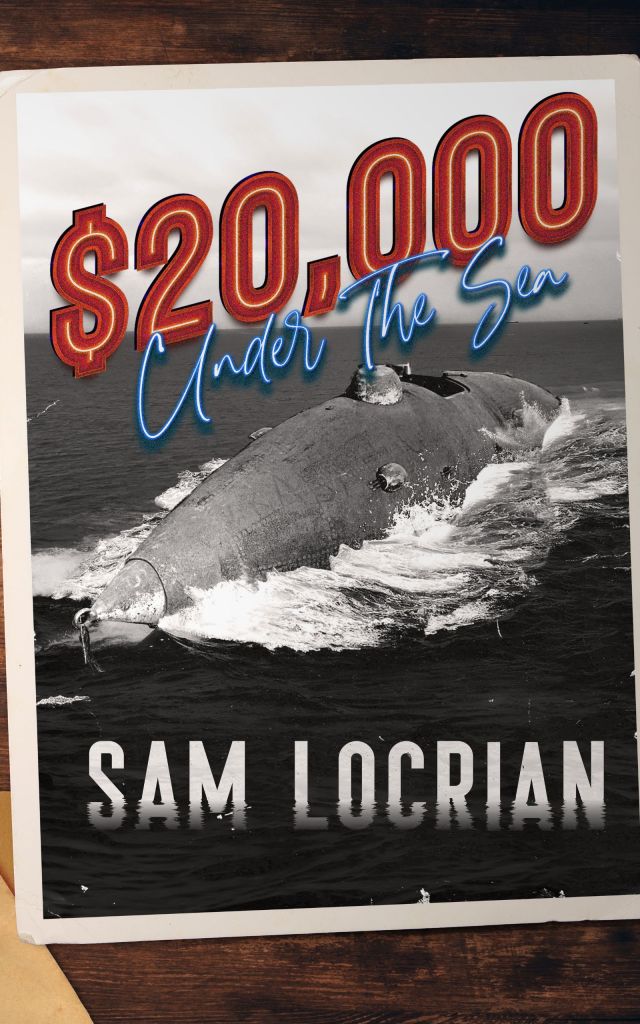
And if you enjoy my writing and would like to support it, please considering buying one of my books. It is timely, after all. $20,000 Under the Sea released just this month, and you can buy it in ebook or paperback format here!

Why did Taamir Ra allow himself to be taken by the Dead Queen?  His companions’ reasons shouldn’t be any great mystery: For his brother, it was a desperate, knowingly doomed attempt to repel the darkness which would surely swallow the kingdom.  For Tiresias and–but for an ancient pact–Jabez, it was brazen, stupid curiosity.  For the masked man, it was compelled.  Taamir’s reason should be no great mystery either, but it’s hard to trust you people: It was guilt.

Consider that for a moment.

It’s easy to dismiss many modern representations of guilt as melodrama since so few of you feel guilt anymore.  “The weight of your sins?  Grow up,” says the man with a soul of formaldehyde and jism.  “Quit sulking.”  Think of the last time you allowed yourself to be tormented by your past–for deeds no one would ever discover, that it would be immaterial for them to discover–and, perhaps, despair.  The modern human is tormented by the consequences of their actions, they are tormented by shame, the pain of their true self being seen–the fear that it might be seen–but guilt is wallowing.  An indulgence.

It wasn’t always that way.  Edward Teach calls guilt the synonym of freedom: “You bond yourself to yourself to free yourself from everyone else.”  If you are without guilt, then, what follows?

The lack of guilt is downstream of the hatred and envy which armors you against the terrible responsibility of that world that you–not you, specifically; it is crucial that it was not only you–have built.  You became powerful, only to discover that power does corrupt.  It burns like fire, and charred skin simply makes one pliable.

But unlike you, Taamir Ra still had his soul.  He understood his sin and acted to absolve it.  “But Persephone’s capture was engineered by Bas’ahra and the masked man.  They manipulated him!”

So little wisdom remains among Christians that it’s easy to forget there is a great deal of wisdom to be gleaned from their discarded flesh.  As it were, the Christian god is quite clear on this particular sin: Eve manipulated Adam–Adam still gets the boot.  He had exactly two jobs to do: Follow the rules, and make sure she follows the rules.  He failed at both.  He did not impress upon her the importance of the task at hand, perhaps because he was too stupid to understand it, and when it came time to make sure she was actually listening, he fell asleep.  The mistakes are boring, prosaic, and kind of pathetic, not the kind of thing you would think ought to cost an eternity of Paradise, but I assure you: The boring, the prosaic, and the pathetic are in fact an extremely dependable foundation for evil.

Taamir Ra should have seen through Bas’ahra’s incredible incentive to defect, he should have spirited Persephone away without telling her; failing that, he should have outwitted the masked man; failing that, he should have refused the Sun Priests’ job and left Khet, because if he were not there, Bas’ahra could not have succeeded in the way she did.  By his very presence, he caused others to do evil successfully.  That is sin, and sin ought to elicit guilt.

Where Adam had little choice but to accept the consequences of his failure, Taamir faced a decision.  His failure caused a child to be buried alive, and his submission to the revenant which disgorged from her tomb ten years later might have atoned–but to what end?  He could have simply run.  Bas’ahra did.

But sin weighs on more than the sinner.  The injustice of Persephone Elea’s death did not go unnoticed.  Divine recompense brought about her return, and Taamir saw that, even if he could not know the particulars of the divinity.  Perhaps he thought his sacrifice–even if it did not sate the Dead Queen–might adjust the karmic scales of Khet just so, might undermine the Queen’s right to the suffering she would inflict upon the city and the world.  It might bring about a responsibility for those who could one day resist.  A responsibility to do so, under pain of guilt.

Journey to the Center of Society, Chapter 1: The McFlinn Boy

For those who want to know what comes next–or those new to the adventure of $20,000 Under the Sea, this is a draft of the first chapter of the sequel.

$20,000 Under the Sea will be available for purchase in digital and physical formats on 7/4. Preorder the ebook on Amazon here!

Vincent McFlinn was feeling pretty unimpressed with New York.  Some of the boys back in the Chicago Outfit had talked it up in their way.  They were from Jersey, if he recalled, so they weren’t fans or anything, but those fuckers still gassed the place up: the big time, greatest worst city on earth, largest wormy apple you ever did see.  Made it sound like a crazy, fourth-circle hellscape where everything was different.  Like it was kinda different: buildings were a little taller.  Mostly, the people were just fuckin’ twits.

Vincent–Drip, to his acquaintances–was certainly not accustomed to decorum, but this was somethin’ else.  Bums struttin’ around the sidewalk like some kinda aristocracy, an idiot on every goddamn street corner fuckin’ yellin’ their lungs out in that stupid, incomprehensible New York accent, and the Lethal Chamber…just…seriously?  You need the fuckin’ government to subsidize your suicide attempt?  And they were mean to the pigeons, which was never a good sign–though, as Vasco reminded him, the pigeons were generally dicks.

Maybe there were extenuating circumstances.  The city did seem to be on a kind of high alert, though pulling the reasoning thereof outta these citizens was a task.  After maybe four conversations of the form of “hey, what’s with all the coppers, ya need five on every street, seems like a lot?” “Hey buddy wassa matta wit you, missin’ ya ears or somethin’?” Drip finally managed to squeeze a red-eyed businessman for the big picture summary that the local constabulary was embroiled in a hot fight with some sorta cult.  This, combined with a far less social–but far more physically detailed–account Vasco had obtained from the local crows, yielded a more complete story: A few days ago, New York’s mayor had been assassinated by members of a cult.  A manhunt ensued, and at some point, the cops had surrounded a group of the cultists in an office building in Midtown.  And then a couple random citizens dove onto the cops’ perimeter, double-fisting live grenades.

Also, apparently, the better part of the harbor had been obliterated by a spring storm, which Drip didn’t think was related, but he did find it odd that neither the people nor the birds of the city seemed even to acknowledge the damage except under duress.

Anyway, fuck the cops and all that, but Drip really did have to hand it to this cult for making the most of their time together.  He’d been downtown for all of three hours now, and these lunatics were already chafing his dick.  Not that they even knew who he was, but with all the nest kicking, they’d gotten their enemies out in force with no evidence to go on but a mandate to be fuckin’ everywhere looking for “suspicious characters”.  Unfortunately, by any reasonable definition, Drip was a suspicious character.

Because he wasn’t a dirty plebeian, he put effort into his appearance.  Hair slicked, clean shaven, fashionable dark red suit tailored and pressed, matching Stetson worn at this season’s calculated tilt.  He stood out in a fuckin’ crowd even without Vasco there–with the crow perched on his shoulder he was just about a beacon of salience, and he clocked more than a few significant looks and gestures from the patrols, prompting him to maneuver off down sidestreets and stations to avoid whatever questions they were brewin’ up for him.

Not so different from Chicago, really.

At this point, Drip felt like he’d spent half his life on the outs in one way or another.  He grew up in a tenement in Fuller Park before the fire, along with the rest of the Irish portion of the city’s scum.  His father was a pickpocket, which, in lieu of the real job the bastard was never gonna hold down, made enough money for beer and shitty soup.  No mother was present–though Drip’s social understanding was so fucked that he didn’t even notice he was supposed to have a mother until he was eleven.  When he asked Dad what was up with that, he just scowled, walked out the door, and didn’t come back until one in the morning.  Drip didn’t ask again.

Otherwise, he and his old man got on alright, until the sap got caught red handed and beaten to death by a copper two blocks away from their house.  Most of his memory of it was less painful than just fuckin’ numb.  Hazy.  The part that stuck out was the other cop–a different one, he was sure–that showed up at his door to let him know his dad was concussed and bleeding out over thataway.  Fucker was wearing sunglasses at eight o’clock and smiling.  It hurt to look at him.  The cop that killed his father took a trip to the bottom of the river for Drip’s twenty second birthday–one of the rare cases he saw of Boss Nepoca’s sweet side before things went sideways–but the guy with the shades?  Drip never saw him again.

Drip had a rough few years after that.  He couldn’t keep up rent, but he scraped enough together between his neighbors’ charity and his own pickpocketing and petty theft to keep himself mostly fed and mostly off the streets.  His streak ran out, though, when a couple of stiffs in the North Side Gang caught him nickin’ a box from their car.  Things kinda went red after that, and he woke up in an alley with four stab wounds, his own knife white-knuckled in his hand, and the two stiffs dead on the ground next to him.  Since it was December at the time, and “dead” was only slightly less alive than he was then, he probably wouldn’t have made it if not for the men who pulled up, dragged him into their car, and took him to the hospital.

Turned out that even though he’d stolen from the wrong people, those North Siders were causin’ trouble in Outfit territory, and Al Nepoca appreciated Drip’s sacrifice in keepin’ his streets clean.  About a year later, Drip was made muscle for the Chicago Outfit, and that might’ve been history if he could’ve just kept it in his pants.

Puberty had been pretty disastrous for Drip, less for his adaptation to his body or appearance than for the Irish Catholic neighborhood’s reaction to the appearances and bodies he found himself attracted to.  Refreshingly, the Outfit’s attitudes were practically progressive in comparison.  They didn’t like that he was a fag, but they didn’t mind so long as his romantic proclivities didn’t intersect with gang business.  Problem was, six years on, he found himself a crush.  A reciprocated crush: Sal Biggs.  Roman statue jawline, eyes like emeralds, those shoulders.  And he was Nepoca’s nephew.  They managed to keep their relationship secret for a year and a half before the big man found out, but then Drip got a no-nonsense, knuckle-accented nastygram indicating he better get the fuck outta Chicago, we don’t wanna see you around here no more, got it?

That one hurt.  Probably more than his dad dying, to be honest.  It probably didn’t help that before leaving, he jumped Nepoca’s messenger, sawed off his right hand to teach him to use some professional courtesy in his communications, but he wouldn’t’ve pulled that stun if he hadn’t been handed an out: a letter under his apartment door from someone named “J.B.”, offering timely employment far away from Chicago.  Accordingly, he packed light, and after disarming Nepoca’s impolite associate, he got into a black car at the corner of Canal and Jackson driven by an annoyingly chatty man named Bluesummer.  About forty-eight hours later, he was deposited on the steps of the Claridge Hotel in Atlantic City, New Jersey, with a prepaid reservation and another note from J.B.–this one with a wad of cash–telling him to sit tight and await further instructions.  Normally, he’d bristle, but he had to admit he might’ve gone overboard.  Nepoca had told him to get gone, yeah, but hitting back at his guys might’ve given him reason to call up some friends in New York if he caught wind of where Drip was headed.  Better to lie low for now.  Stick to this swanky hotel in this little mob bubble, just him and Vasco.

It did, however, put into sharp relief that Drip’s life up to now had been extremely unapologetic.  It was fortunate that for a time, anyway, the Chicago Outfit had accepted him as he was, because he’d done fuck all to fit in.  During those months he spent in Atlantic City, he wondered how reasonable that was, every day looking at his reflection in the mirror of the hotel bathroom: him, his red suit, his pet crow.  That was kind of a weird thing, wasn’t it?  Gangsters didn’t really walk around with birds on their shoulders, they weren’t pirates or some shit.  This was real life.  More to the point, people didn’t talk to birds, or rather, as Vasco confirmed, people did, but it was in the same way they talked to walls.  But somewhere in those years of stealing and stabbing in Chicago, Drip started talking to birds–on the street, feeding ‘em in the park, wherever–and at some point, he began to understand what they were saying back.

Most of them were pretty stupid, in an endearing sort of way, but the crows were alright for conversation.  And then Vasco stuck around after the rest of the flock flew off.  After a few times tailing him to the bar after dark, he just started sleeping at Drip’s apartment.  The way he put it, Drip’s life was just more interesting, whatever that meant.  Vasco had good enough sense to make himself scarce around the other gangsters–didn’t trust ’em; probably wise–but Sal was nice enough to him.  Yet another reason leaving Chicago had been painful.  Still, Drip found it pathetically comforting that Vasco had been so willing to leave with him.

At this point, though, the possibility that he would never see Sal again was significant, and he had burned the shit out of just about every other uneasy companionship he’d gathered up to this point in his life.  Drip had always been kind of a loner, but this was a distressing severity of alone.  He found himself relieved that Bluesummer had been willing to take Vasco’s attendance on their journey in stride.  Saved him from from wondering what sort of violence or self-sabotage he might’ve lashed out with otherwise.

In any case, Atlantic City went, Drip assumed, pretty much according to plan.  Two and a half months lying low, sleeping, eating, lightly gambling, and drinking himself into a stupor as the weather warmed up, as he steeled himself for a humid summer of his discontent.  Then in April, some arms dealer’s pleasure cruise out of New York turned into a national fucking incident, and scarcely two weeks later, another letter appeared on his hotel bed.  It was terse, just an address on the north side of Long Island, a date, and a time: tomorrow, 4 PM.

He took the train up north, but things got screwy pretty much just as he reached the city.  Whatever hand-of-god storm had wrecked the harbor had also taken out the bridge to Brooklyn, so he was forced to sidetrack through Manhattan.  Between getting lost and the business with the stupid cult, he was only now zeroing in on the subway station a distracted drug store clerk had told him would get him to Queens where he could catch an aboveground line out to Long Island.  It was nearly 1 PM, and Drip was beginning to realize that his chances of traversing 70 more miles east within the next three hours were closing in on zero.  Before he could conclude that punctuality was impossible, though, the strident blast of a car horn beside him scrambled his calculations beyond recovery.  His gaze snapped murderously to the vehicle, pulled up to the curbside.  The young man at the wheel called out:

“Mr. McFlinn!”

Drip’s response was a crooked grimace and a raised eyebrow.  He was careful not to offer any more positive acknowledgement than that: If this guy was Nepoca’s, there was about to be a tommy gun aimed through that window.  Better to leave him with some doubt that he might be shooting an innocent.  Hitmen didn’t like collateral damage.  That was the sort of shit that made ‘em a liability to the boss.

The driver leaned toward the passenger door and pushed it open.

“Get in,” he said.  “You’re going to be late!”

Drip let his annoyance and relief annihilate each other as he obliged.

Some fifteen minutes of adroit but chaotic swerving later, the driver broke the uneasy silence.

“You certainly took a circuitous route,” he said.  “What on earth prompted you to go through Manhattan?”

“Couldn’t get over to Brooklyn,” Drip muttered.  “You know somethin’ I don’t?”

“Couldn’t get over to…”  The driver whipped suddenly around a milk wagon stopped in front of them.  “Ah, of course, the bridge, right?”  Drip blinked.

“Yeah, wise guy.  The bridge.”

“You can see it, then?”

“What?”  Drip’s turn to look at the driver head-on jostled Vasco enough that the bird jumped to the dashboard with a rustling, surprised caw.  “The fuck kind of a–”

“I can’t see it,” the driver added, cheerfully.  “Very few in the city can.”

“What?!” Drip blurted, though neither his nor Vasco’s outsize reactions seemed to faze the driver–which was surprising.  He was young, maybe even younger than Drip.  Clean cut, spectacles, smart blazer and tie.  He looked like an assistant to an advertising executive–notably not like the type to maintain his nerve in traffic while gaslighting an alarmed gangster.

“It’s called memetic disavowal, I’m told,” the driver explained.  “When the Architects take direct action on society, society just refuses to perceive it–depending on the individual’s proximity to the Architect itself, that is.  But otherwise they’ll react as normal–like I wouldn’t try to take the bridge today and just fall into the bay.  Hell, construction’ll get funded, and crews’ll get out there to fix it, but none of us–me, the bureaucrats, the workers–register that anything happened or anything’s missing.”

“Is this the setup for some kinda joke?” Drip asked dryly.

“Not at all.  Just a personal observation of a phenomenon I find interesting–one which you evidently do not find at all.  Hence the discussion of the bridge which you no doubt found lacking among the citizenry this morning.  Heck, I only know about it because I was told about it by someone who, like you, is unaffected by said memetic disavowal.”

“Oh, so I’m special because I can see your Illuminati or whatever?”

“You’re special because of what allows you to see things I can’t,” the driver said.  “Which is the same as what allows you to speak to animals–I trust you accept this isn’t a joke now, yes?”

“You think I can talk to animals?” Drip probed, attempting a façade of incredulity.

“I know why you can talk to animals, though the way you are clutching your seat suggests you may not be ready to hear that explanation just yet.  Suffice it to say that my employer has had you under surveillance since before your specialness even manifested in that particular way.  So can we please table the skepticism at the notion that I know who you are?”

“Sure,” Drip muttered, rolling his eyes.  “Fine, whatever.  Who the fuck are you, then?”

“Jonathan Banks,” the driver replied smugly.  “I’ve been arranging your transportation, supervision, and lodging since slightly before your falling out in Chicago, and I daresay it is a pleasure to finally meet you in person.

Drip sighed, forcing himself to soften his posture and turn back to the road.

“J.B.?” he asked.

“The very same.”

“And your employer?”

“That’s a nosy question for a career criminal,” Jonathan said, “though I suppose it need not be a secret or anything.  Jonathan Banks is my real name after all.”

“Banks?”  Drip frowned, glancing back at him, trying to piece together where he might’ve heard that name before.  “Wait–like Milo Banks?  The M&M Corporation?”

“Alas, my father,” Jonathan replied resignedly.

Though Drip couldn’t quite tell what the M&M Corporation did, its owner, American-exceptionalist entrepreneur Milo Banks, was something like a celebrity.  He had played a recurrent supporting role in the news-drama of the Great War, aiding–and then seizing and turbo-charging–the Allies’ supply chains, the movement of materiel behind and to the battle lines, and, of course, the valiant postwar relief efforts in Germany.  By all accounts, every enterprise he touched became fabulously successful, and it had all made him fabulously rich.  More recently, Banks had relocated his corporate headquarters to Chicago, quietly purchasing the rebuilt skyline’s tallest building and loudly renaming it the stupidest thing ever.  Drip didn’t know whether the gesture was mistaken or facetious–he was not aware of any connection between the M&M Corporation and anyone named “Willis”–but he found the outrage around the city funny nonetheless.

“I’d heard he and Al Nepoca met last year,” Drip said.  “Was that about me, then?”  Jonathan shrugged.

“I can’t say for sure,” he replied.  “But I doubt it.  Rather, I don’t think it was about you yet.  I suppose you spent the morning downtown–have you become familiar with the King in Yellow?”

“Those cultists that killed the mayor?”

“Right.  My father has had issues with what they’ve been doing to cotton prices in Chicago for some time.  I think he asked Nepoca to help him do something about it.”

“Can’t imagine that went well,” Drip muttered.  “But wait, cotton?”  Jonathan shook his head.

“Don’t worry about it,” he said.  “What you’re here for is not about cotton, but it is about the King in Yellow.”

“You want me to do something with this cult?”

“To be clear about our terms, the King in Yellow is a person, and he is competing with my employer–our employer, assuming your cooperation–for control over some key resources.

“Key resources?” Drip snorted.  “The businessy-fuck does that mean?”

“To be frank with you, I don’t have the whole picture,” Jonathan said, grimacing as another automobile cut them off.  “My understanding is that we are meant to put some pressure on the King.  In order to do that, we need to find him.  In order to do that, we’re best off collaborating with some other interested parties, hence the agenda today.”

“Long Island?”

“Long Island.”

The drive to Long Island, it turned out, was longer than Drip had anticipated, even knowing the distance, and Jonathan seemed reluctant to share any more material details about the job.  The conversation devolved to weather, traffic, observations about New York City–Jonathan’s outlook on the place was much more positive–and Vasco’s anomalous inability to form an opinion on their erstwhile “handler”.  Jonathan was personable, Drip conceded.  Rather, he was disarming, which he decided that he wouldn’t trust, even if it was pleasant for conversation.  Jonathan, for his part, noted the crow’s communication with a raised brow, but did not otherwise comment.

Eventually, they arrived in the driveway of a picturesque estate backed up against Smithtown Bay.  Jonathan stopped the car and got out, beckoning Drip to join him.

“I do want to warn you,” he said, rummaging through his blazer pocket before producing a key.  “I think it’s likely there will be a gun pointed at us as soon as we open that door.  Please remain calm.  I’ll introduce us.”

Without further elaboration, he approached the entrance stairs.  Vasco, expressing his distaste for firearms, told Drip to find him when all that was done, which was discouraging but entirely the crow’s prerogative.  Drip took a deep breath, concerned–admittedly more for the lack of details than the threat of violence–and followed.  Calmly, Jonathan unlocked the door, opened it, and stepped inside.

Crossing the threshold behind him, Drip was dismayed to find that Jonathan’s prediction had been quite prescient: Awaiting them in the foyer were three men, one clean shaven in a crisp, gray suit, the other two disheveled and sunken-eyed, in filthy military uniforms.  The gray-suit man and one of the others, a familiar-looking face with a bloodthirsty snarl, were both brandishing pistols.

“You,” the bloodthirsty man growled.  Seemingly oblivious to the danger, Jonathan smiled.

“Mr. Sterling!” he said.  “Hello again!”

The Theban Interview

The previous CEO inappropriately exhibited behavior.

This closely references a passage of dialogue in Sadly, Porn, by Edward Teach M.D. Some of the H.R. rep’s phrasing comes from that passage, but while he leaned into the comedy of the exchange, I’m attempting to focus more on the surreal elements.

The woman’s age is…unclear, but she’s dressed young.  Her hair is green, shaved on one side but still dyed down to the roots.  Her left ear has three piercings, her right four, a rhinestone on the side of her nostril, and two black, snakebite studs frame her smile.  Her black pantsuit fits well, jacket tight but not creased, buttoned low over a white silk blouse with a thin neckline that plunges to the bottom of her sternum.  It does not seem work-appropriate, but perhaps times have changed.  She doesn’t have much cleavage, but the low neckline displays an intricate tattoo of patterned feathers on her chest.

“Ed, right?” she says.  “Thanks so much for taking the time today.  The board was thrilled with your resumé, and we’re really excited to explore the competencies you bring to the table.”

“My…resumé?” Ed asks.  The woman hands him a bottle of water.  The way she moves is uncanny–very quick, very precise, but the end result is odd: She executes the motion only 90% of the way.  Ed has to reach for the bottle just slightly more than he expects.

“Yes.”  The frosty smile returns.  “The way we see it, the company is undergoing a rightsizing, and as you know, the previous CEO inappropriately exhibited behavior.”

“Inappropriately–”

“The board believes that shareholders need strong assurances that this Ship of Theseus is in Shape of Theseus.  Millennials killed the bull market, but we still need that cowboy symbol to keep the substance moving, you know?  Now, of course…”  She reaches out and smooths a wrinkle on Ed’s lapel.  Her nails are green, the same shade as her hair, clipped short except for the little finger.  “We need to make sure your playbook has all the right pages.  This is a fast-paced operation, buy-in, lean-in, work-in, and when the music starts playing, all eyes are on you.”

Ed unscrews the cap of the bottle and takes a drink.  The water is room temperature and tastes like plastic.

“So, are you ready?” the woman asks, as if her previous sentence had clearly warranted a response.  Ed swallows quickly, inhaling a little of the water.  He struggles to cough it up without an undignified fit.

“Um, y–”  He coughs into his sleeve.  “Sorry, yes.”

“Perfect.  First question: What walks on four legs in the morning, two at midday, and three in the evening?”

Ed blinks.  He’s heard this one before, but there has to be a twist, right?

“A…man,” he says, pausing.  “Or a woman–except a woman wouldn’t need to lean on anything, so: a man.”

“Excellent!”  Her smile is vaguely carnivorous now.  “I love the process.  We also would’ve accepted one of those new Amazon delivery drones, with the different ambulatory configurations for variable traffic conditions–you can’t fight the AI tide–but who can resist the flattery of the truth you think we think you should live?  Market conditions are changing, and unless you want to have to report your minorities, you need to be including as many diverse equities as possible.

“Second question: Say you’re negotiating a consensually non-consensual merger and/or acquisition in flagrant violation of established antitrust law, and the other guys agree to a meeting.  They show up with the full C-suite, all their reports, and 300 lawyers, then at exactly noon, they tell you they need further instructions from the shareholders and break for the day.  They do the same thing the next day and the day after.  What’s your strategy?”

“Is this company currently involved in an acquisition?” Ed asks.  He doesn’t want to appear nervous, but the question seems oddly specific.

“Relax, Ed.”  The woman glances at her nails, picking disinterestedly at her cuticle.  “Strictly hypothetical, but we need to know you’re hyperengaged, that you’re the guy who’s gonna get the best people the latex-free material they need to erect better ones.”

“Well, then I’d say…they don’t really want the grueling negotiation and all that.  But they probably have internal pressures mandating pointless shows of force.”

“What sort of pressures do you think?”

“Uh…toxic masculinity?”

“10-4, kiddo.  So what’s the play?”

“I think we’d do the same thing, right?  Pack up, fly out, say we also need guidance from the board.  It’ll be expensive for us too, but that’ll raise organic pressure to finish the negotiation, which lets both sides save face.  And as a bonus, the media coverage will be so exhausting that the FTC wouldn’t dare risk blocking the merger in the end.”

“I love how you dig deep to deploy empathy, Ed.”  The woman gestures for him to follow as she proceeds to the other end of the lobby.  “Taking the guilt out of global strategy lets us prioritize conforming over performing so we can be prophet-guided for our community instead of profit-seeking.”

They approach a wide, concrete column, adorned by two sets of silver elevator doors.  Between them is a panel with several LED-lit buttons.  Two are easily distinguishable as “Up” and “Down”, but beside those are five more, circular, unlabeled, their purpose entirely unclear.

The woman approaches and presses one of the side buttons.  It lights up.

“I think the board will be pleased, Ed.  You have all the bona fides we need for you to plug and play in this culture.  Go ahead and breathe in the moment, and when you’re ready, head up to the tenth floor.”  She smiles.  Her canines are noticeably pronounced.  “Welcome to Thebes, Ed.”

The elevator doors open, and the woman steps inside.  Ed, slightly stunned at the pace of the interview, does not notice until after she vanishes that the elevator does not seem to have a floor.  He rushes over to it just in time for the doors to close.  Alarmed, he mashes the circular buttons on the panel, trying to remember which one she pressed.  None of them light up.

Eventually the doors open again.  Ed looks at the panel.  He seems to have accidentally pressed the “Up” button, and now, beyond the doors, a perfectly normal elevator–with a floor and green-felt carpet and tasteful, brushed-steel paneling–is waiting for him.  

He steps in.  Inside, the button labeled “10” is already lit.

Edward’s Account of the Dereliction

Historical fiction is great and all, but have you tried fictional history?

You say her name is Anna?  This may be a lark, but…is this Anna Vael we’re talking about?

Godshell.  Then she’s really still alive.  And you don’t have a clue who she is, do you?  Fine, then, I’ll tell you while she listens–yes, I know she’s listening.  Anyone would know that if they just knew who she was.

Anna Vael’s limited fame–or infamy, depending on the side you might have been on in a conflict that ended over a century ago–has to do with the events of the Blood God’s Dereliction, which I think you’ll agree is a poorly-recorded story these days.  Piraeus keeps uncommonly good records, so around here, we at least know that the Dereliction did happen, but it’s worth noting that in the stretch between here and Ulrich’s Bend, most consider the Blood God a myth at this point.  Something to tell the kids.  The type of thing you don’t need to bring economics into–the Blood God disappeared, and his empire crumbled, that’s it.

Of course, in the real world, it doesn’t work like that.  The Blood God disappeared, yeah, but he spent most of his time disappeared for the decades before that anyway.  For the last thirty, forty years of his reign, he made a low-single-digit number of public appearances, all of them spectacular, filled with mass murder.  Putting down rebellions, mostly.  When you add in accounts from much earlier in the Kolai Dominion–recovered from the Blood Knight stronghold here in the city, actually; Peren Stratus made sure the archives were extracted before he burned the place–you get a picture of a Blood God who was interested, to a point, in a particular sort of rule, but very disinterested in personally ruling.  So very early on, he handed the job off to the Magni Kolai.

The Magni were like his high priests, selected meritocratically, but the merits they were selected for–devotion to the Blood God and his philosophies, and absurd, raw, magical talent–mostly didn’t translate to skill in governance.  You probably had one or two that figured out what needed to be done, and they channeled a whole lot of hostile work environment onto the Migni Kolai, their handpicked subordinates who went on to become the Dominion’s central bureaucracy.

This kept the ship sailing for a century or so, but as the Blood God grew less and less engaged, the Magni were left with way less pressure to get any of it done right, which meant that more and more of the Migni positions got filled lazily.  On average, that meant you had folks in there mildly unsuited to keeping an empire running.  As it got worse, it meant that more and more positions in the bureaucracy were filled–as a matter of course–by bribery and nepotism.  Remember: Kol’s anti-corruption measures didn’t have moral norms.  They were, collectively, “if you break it, I’ll turn all of your veins inside out”.  As the guy saying that stopped paying attention, the backroom deals stopped having consequences.  Then it took awhile, but eventually the cracks in the system caught up with them.

When, for example, the city of Cantabyz suffered a plague that decimated their iron output for the better part of a year, a skilled provincial governor might have channeled central resources toward aid to mitigate the economic disruption.  They might have adjusted taxation, pushing that burden into future, less plague-ridden years.  But should the governor not have reacted at all, the city, already impoverished by circumstance, would have been liable to snap when the Dominion’s unadjusted taxes dragged what was left of it into the ground.  So they would rebel–and they did rebel, as it happened.  The Blood God dragged himself out of his temple, put down the rebellion, then went back to bed or whatever.  Except he put down the rebellion by killing everyone involved–along with a really-not-trivial number of bystanders–which meant that the economic impact radiated out to the rest of the Dominion.

Long story short, this all happened a couple of times, in this outlying province or that one, before the economic implications finally crashed into Kol proper, in the form of a famine.  And this time, when the torches and pitchforks crossed that unimaginably foolhardly threshold of marching on the Blood God’s temple and throwing the doors wide…they lucked out.  The bastard was gone.  To this day, no one knows what happened to him, but that’s not the point.  The point is that this was where the games began.  It’s where Anna Vael comes in, in fact.

To clarify, when I say the torches and pitchforks lucked out, I mean their cause–and, again, the bystanders–lucked out.  Those specific idiots all died very quickly, because the Magni were plenty capable of putting down a disorganized riot by themselves.  Still, I don’t want that initial stall to detract from how big a paradigm shift this was.  The Blood God was, not mincing words, a god.  He killed the Dead Queen of Khet.  There literally is no entity–not even a collective entity–that I am confident could stand against him.  That’s a more nuanced qualification than I would like to make, but the point is: Overthrowing him was straight-up impossible.  Overthrowing the Magni Kolai, on the other hand, was merely difficult.

At this point, I’ll add that the number of sources on the record declines precipitously.  There were lots of corroborating sources for the rebellion at Cantabyz, the famine, the storming of the temple, but from then on, the only account that’s survived to today is by our friend, the Abbot Ezekiel Polyon, who, as you are well aware, may or may not currently have command of a stable nervous system.  That said, he did keep regular journals up to a point, and those have since been copied extensively.

In any case, Polygon describes Anna Vael as one of the central players of the Dereliction.  Prior to the riot that reached the Blood God’s temple, she was an underworld fixer of sorts, some mix of information dealer, mercenary, and assassin, earning her bread on whatever skulduggery the Migni let happen within their walls.  Pretty sharp–she’d have to be for the ensuing events to be true–and apparently notable for her appearance.  Her body was, he says, infested with flies–to the point where he was not sure whether she was carrying the insects with her or if, somehow, she was the flies, and the body was merely a vessel.  

In any case, in the leadup to the big riot, the Migni must’ve seen the writing on the wall.  They realized that if the Blood God got involved, it might not have been on their terms, so they raised a militia to keep the peace and recalled a selection of the Blood Knights–Polyon included–to lead it.

Solid short term plan, yeah?  The problem is that militias are rickety things, lots of competing priorities and loyalties, cracks that will get exploited sooner or later if they don’t get cleaned up into a formally-administrated army.  And despite the militia’s best efforts, the riot did break through to the temple, and the revelation therein meant that keeping the operation running wasn’t discretionary anymore.  

The Kolai tried to recall more Blood Knights, but news traveled faster than their missives.  A number of Kol’s outlying provinces rebelled outright–Piraeus included, and the question of loyalist reinforcements became one of if, not when.  And in the meantime, they were left with this large force of conscripts and mercenaries, poorly paid and extremely sensitive to payment, trying to hold back a tide of suddenly-emboldened insurgent movements with whom they probably shared more in common than their Kolai overlords.

Vael was among those conscripts, and she made herself very useful very quickly by gathering intelligence on the rebel cells, which she provided to the militia, obviously–but also to Polyon and the Migni, who were at this point growing suspicious of the militia’s intermediary leadership.  The commander who bubbled to the top of that mess, a former mercenary named Adrian Martell, was charismatic, clearly ambitious, and beholden to the Kolai solely on the basis of coin.  His loyalties were in sharp doubt, but based on Vael’s surveillance, he was making no imminent moves to consolidate power.  And with micro-rebellions breaking out all across the territory map–vandalism, attacks on tax collectors, mass theft of the Migni’s stockpiled food–replacing him would have been costly indeed.

The balancing act continued for months, as message after message rolled in, sending word of the slaughter of the Blood Knights in Piraeus and elsewhere, all confirming that, ultimately, no reinforcements would be coming.  The Migni’s resources began to run thin.  And then, gradually, they began taking casualties.

Assassination attempts.  Poorly equipped, poorly thought out, by Polyon’s description.  Usually they would fail, but occasionally they would get lucky.  And all of them were fanatics, apparently brainwashed to the edge of sanity, all repeating the same mantra as they were imprisoned, interrogated, tortured to death, what have you:

“Forty hands with forty daggers will find the oppressor’s heart.”

Pretty cold, right?  Wish I’d thought of it.  Well, the Migni started dropping, either from these creepy assassins or just outright desertion.  Then, the Magni started infighting.  There were just nine or ten of them at this point, all wildly-dangerous humanoid death engines, but in their jockeying for power, one of them was killed, one severely injured before Polyon finally found an out for the Dominion.  Vael delivered him a report one day detailing evidence from scores of witnesses that all of the insurgent movements in the city were being coordinated by a “Gutterway Oracle”, who she identified as Karl Hamlin, another militia conscript who had been selling tax collector schedules for favors and coin to anyone who would listen.  And Hamlin, she said, was lying low at that moment at an inn on the outskirts of Kol’s pastoral territories.

Polyon interlaced his account of what followed with so much self-flagellation that it’s frankly hard to parse, but my translation is this: He took this intel to the Magni and gathered a task force comprised of most of the remaining Blood Knights in the city to go hunt down Hamlin.  And as soon as he left Kol, Adrian Martell commanded his troops to slaughter the Magni.

The truth, it turned out, was that Karl Hamlin was nothing but a skilled distraction.  He may, in fact, have been delivering the messages the rebels were coordinating around, but Anna Vael was writing them.  She was collaborating with Martell to ensure the militia always kept a brisk pace just two steps behind.  She was the one who brainwashed the Migni’s assassins, who coordinated the forty hands and forty daggers which bled out the Kolai bureaucracy, primarily to develop and test a method by which the militia might actually kill the Magni.  Her answer was simple enough to be upsetting: snake venom.  It stops blood from coagulating.  Coat arrows and blades with the shit, and now you can make wounds a blood mage can’t easily close.

To Polyon’s credit, he smelled shit way sooner than he should’ve.  He aborted his mission just a few hours after his departure, but he still returned too late.  By his account, he made it to Kol’s central plaza just in time to witness the last Magnia, surrounded by dismembered militiamen, fall dead at Anna Vael’s feet.

“The Apiarist”, Excerpt 7: Peren Stratus

“Ezekiel Polyon.  I’ve been looking forward to meeting you.  Don’t know if you’ve heard–you have a reputation among the sailors now.”

“The…sailors?”

“The navy.  Ever since we broke the Saltstill Cabal’s blockade two weeks ago.  While we were fending off their reinforcements, somehow the fucking city guard repelled their primary invasion force at the Fisher’s docks and didn’t give a fucking inch.  We got outmaneuvered plain and simple, but we didn’t pay for it, all owing to a Kolai reject who charged a ten-man advance unit with nothing but a spear and a bucket of pitch, killed them all, then set fire to a galleon.  Among what I’m sure are many acts of heroism, of course.”

“Rumors are prone to exaggeration, Lord Stratus.”

“Perhaps, but I personally witnessed some of the carnage you left.  Impressive.  Ironic as well, given the actual Kolai were no damn help at all.”

“You honor me.  I can’t help but assume, though, that Piraeus’ most promising young admiral should have a more pressing cause for this meeting.”

“Most promising, Lord Polyon?  You honor me, though far less deservedly.”

“I am no lord.”

“Oh?  Am I mistaken, then, in my understanding that you are the son of Maria Athene, herself a cousin of Councillor Ekreon Athene?”

“I am not accustomed to masquerading as nobility here.  I am merely the son of an apiarist.”

“An unruly branch, to be sure, but you still possess the right to petition the council.”

“Provided I never avail myself of it.”

“…”

“…”

“Very well, Lord Polyon, I will get to the point.  You have heard the directive by now that the guards and navy both are to root out the remnant smuggling operations the Cabal still has in the city?  And I expect your commander has received additional intelligence regarding regular shipments arriving each week on the southern Fisher’s dock that then disappear into the city tunnels?”

“I have received both of these directives, yes.”

“Would it interest you to know that this second piece of intelligence was delivered by a known agent of Lord Teleos?  It would, wouldn’t it?”

“My interest in such a detail would be a dangerous thing to express, Lord Stratus.  Though if what you say were to be true, it would introduce a battery of additional questions.”

“Then let’s speak plainly.  My aims here are dangerous to express too.  Treasonous, some might say, but I think you’ll be receptive.”

“Receptive…to what?”

“I want to overthrow the council.  Teleos, Athene, Alcyon, all of them.”

“…”

“Come now, Lord Polyon.  I find it hard to believe you wouldn’t be interested.  Or do you not think me–”

“I’m listening, Lord Stratus.  Tell me more about this conversation with Teleos’ agent.”

“The Apiarist”, Excerpt 6: A Thousand Cuts

My training took the better part of six years, in which time I enthusiastically apprehended the skills I would need as a soldier, as a mage, and as a de facto cleric of the Blood God.  I was good.  Far better than my recruiting class, better, even, than many of the Knights in full standing.  But it had turned out that despite these products of my hard work, my most interesting quality to chapterhouse leadership was actually my pedigree.  I was, of course, Piraean, but more uniquely, I was of the noble class–albeit its bourgeois fringe.  

As it was, the fight against the Atheists was angling more and more uphill with each passing year.  The Knights had little difficulty eliminating the radical elements who made themselves visible, but they were having a much more perilous time navigating the invisible gauntlet of small resistances the Atheists placed in their way.  Delayed responses from the Piraean Council, effectively tying the Knights’ hands in civil matters; the ubiquitous threat of petty theft and vandalism that compromised the movement of Blood Knight assets throughout the city; and the occasional assassination of Knights on patrol–retributed fiercely, but not fiercely enough to outweigh the attrition–all combined to ensure that the Knights’ existence in Piraeus remained decidedly hostile.  And where new Atheist aggressors seemed to spring up almost passively, owing to the unrest sowed by the noble families, new Knights…took six years to train.

It was, as the Knight Captain told me in a private meeting two weeks before my knighting ceremony, unsustainable.  Indeed, though I was not a Knight yet myself, I had felt the effects of the Atheists’ resistance keenly.  I had long since lost count of the meals I had skipped due to supply shortages, and just the previous month, Cassandra of Coralta–the Knight who had intervened on my father’s behalf at the city gates over a decade ago–had been killed when a group of Atheist riverwalkers pushed her from a pier in the harbor and held the water around her head until she asphyxiated.  She had been a mentor to me since I enlisted, and the rage that filled me when I heard the news has, to this day, only been equaled once.

It was for this reason especially that I was receptive to the assignment the Captain had for me in that meeting.  We could no longer ignore the Atheists’ inner workings, he said.  In all likelihood, they had an agent, an informant in the chapterhouse, and there was little we could do about it.  We simply could not afford to purge every Piraean from our ranks, and there was little else to go on.  The only sensible course of action was to manufacture a spy of our own.  I had the right characteristics, he said, and there was no one whose loyalty he trusted more.  It was a light blow to my pride that I would not have my knighthood recognized for some time–perhaps for years–but he knighted me there in his office.  Then, following a public and ignominious display of my expulsion from the chapterhouse for “disloyalty and heresy”, I was left on the streets of Piraeus to begin my mission.

Were the Atheists a centralized organization, I have little doubt that my chances of infiltration so soon after my exit from the chapterhouse would have been zero, pageantry or no.  But I knew they were not, and I knew the city guard had reason enough not to be suspicious of a new recruit.

If any faction had suffered worse attrition than the Knights in the Atheists’ protracted rebellion, it was Piraeus’ armed forces.  Since it was of the utmost importance that the Atheists did not establish anything resembling a fighting force, the guards and the navy had permanent places on the Knights’ list of usual suspects for any Atheist activity needing investigation.  Needless to say, damage to their ranks–both collateral and targeted–was substantial, and they were in constant need of new recruits to keep their numbers stable.  I had the martial skills they required, and they certainly did not have the luxury of investigating the unstated suspicions of the Piraean nobility.  They accepted my application without question, and within a few months, my history of allegiance to Piraeus’ “illegal occupiers” had been buried if not forgotten entirely.

“The Apiarist”, Excerpt 5: The Right Side of History

I enlisted with the Blood Knights in the eighty-second year of the Blood God’s reign, when I was twenty years old.  This was somewhat older than most recruits, but my path in life had been dominated by other factors, and I had yet to seize any particular control over it.

The previous year, my father was stricken with a consumptive infection of the lungs and–mercifully, perhaps–passed quickly.  It wasn’t precisely the attack in Piraeus that had brought about his end: His injuries healed mostly, leaving him with a limp and limited function in his right eye.  But it had, in hindsight, been the beginning of a downward slide.

He, of course, did not return to the city from then on, for the very reasonable desire not to become a martyr or scapegoat to either side in the thinly-veiled conflict now ongoing between the Knights and Piraeus’ self-determinative Atheist faction.  But I suspected it was also deeper than that, a phobic unwillingness to face even the place, much less the people, which had subjected him to that trauma.  The result was that he was confined to our home and grounds, occupied by not busy, increasingly present and irritable to Mother, the servants, and myself.  That he was moving so much less than he had been, that even his limited mobility in that limited space was painful for him–it all meant that even before the infection set in, he had become little more than a cruel, vaporous reminder of his former self.  I found it striking that when he died, not even Mother truly mourned.

The legacy he left, though, was complicated for everyone.  Despite his many enemies, Father was still regarded as one of the most talented artisans in the region.  Our family’s honey fetched an outright exotic price as far away as Kol, and even despite our lifestyle of rural borderline-nobility, the business had been shockingly frugal.  It turned out Father had left behind a fortune in silver, valuable goods, and stock certificates in a number of successful merchant companies, each of which had been paying dividends for years.  The future of the apiary was, of course, uncertain, but it quickly became clear that Mother and I were in no danger of starvation.  What was less clear was whether either of us had any desire to carry on Father’s work.

Eventually we settled on a course.  Our head servant, Giuseppe, the very same servant who had sought help for Father the night of the attack, would take charge of the apiary, and when Mother passed, he would be the one to inherit it.  I, meanwhile, had taken my father’s rejection to heart and fully accepted I would have no future in beekeeping, truly assumed I had no aptitude for it.  And my mind had belatedly wandered to the political unrest in Piraeus, and tectonics of power I now saw shifting around us.  So it was with not insignificant enthusiasm that I renounced my inheritance and made my way to the city, determined to stand on the right side of history.

Despite my ardent opposition, I have little doubt that if the political skirmish I arrived in had taken place even twenty years later, the Atheists would have won handily.  Though the Knights were formidable warriors, anti-Kolai sentiment ran deeply through Piraeus, and they were outnumbered–possibly a hundred to one.  Their advantage was that the Uprising of the 79th was fresh in the collective memory of the Kolai dominion: Only three years earlier, the city of Cantabyz, the source of the majority of the Dominion’s iron, had declared open rebellion against the Magni Kolai.  The Blood God’s arrival at their gates–his first public appearance in a decade–claimed over 10,000 lives.

In the wake of this event, Piraeus’ cooler heads overwhelmingly opted to lie low, leavin the Knights to contend only with the Atheist’s firebrands.  My allegiances were unconflicted.  I had no grievance against the Kolai’s taxes, and the only meddling I had seen from the Knights had been clearly on the side of justice.  It did not matter that when I arrived at the chapterhouse, the squire on duty in the hall urged me to consider that I would very likely not become a Knight without any magical talent I knew about.  And it did not matter that my enthusiasm was met by a bemused chuckle from the only Knight in the hall at the time.  I had existed too long in a state of terror at the unbelonging I had felt from my father, from the apiary, from the indolent, insular people of Piraeus.  I knew that the Blood Knights–even simple service to the Blood Knights–was something greater that I would be glad to be part of.  The Knight Captain’s speculative nod, when it came time to provide him my reason for enlisting, was tepid vindication.  But it was enough.

“The Apiarist”, Excerpt 4: The Blood Knights of Piraeus

My first contact with the Blood Knights was when I was eleven years old.  Against my father’s wishes, I was made to accompany him into the city on a delivery to the Hospitality Quarter, as the servant who normally helped him with those trips had fallen ill.  It was a fraught journey, but I was familiar enough with the work that I no longer roused his anger, so long as I stayed quiet.

Some years later, I would become acquainted with a common template of a man: the type who charmes, who is a socialite to all except those with whom he lives–to them he is a terror.  As that template is well understood by many, I wish to emphasize that my father was very certainly not this type of man.  He was not merely irritable and angry to his family–he was irritable and angry to everyone, and, as I discovered on this trip, these qualities had earned him enemies in Piraeus.

At the gates of the city, we were stopped by a guard who requested, smirking lasciviously, that my father produce his licensure.  Rather than showing documents, my father handed over a large parcel of his goods before continuing through the gates.  He did not offer me any explanation, and I did not ask, but I found the interaction decidedly tense.  And I was not the only one–I distinctly recall the skeptical glance of the woman in armor on the other side of the checkpoint.

As we were finishing our third delivery, that same woman approached us, carrying the parcel Father had given the guard.

“Piraeus has no licensure requirements for apiarists,” she said.  “I guess you knew that, but extortion is also prohibited.  If it happens again, you can let us know at the chapterhouse.”

Father accepted the parcel, eyes down and jaw set with an emotion that seemed perturbed but otherwise lacked definition.  When we passed back through the gates on our way home, the guard we had spoken with was no longer there, and the one who had taken his place fixed us with a look of such hatred that I could not bear to hold his gaze.

I was at the time too young, too sheltered to understand the political implications of what occurred that day, but as my role facilitating Father’s deliveries expanded, the situation grew clearer:

In those days, Piraeus was ruled by a council of elders who nominally commanded the loyalty of the city’s entrenched aristocracy.  It had been this way for as long as most citizens could remember, but where, a century ago, Piraeus had taken pride in being the last stronghold of Riverlander rule unswayed by the machinations of Spar, the city had finally surrendered rather than face ruin at the hands of the Blood God.  Even now, there were many Piraeans who resented this obeisance, who refused to recognize the Blood Knights’ authority to oversee and overrule the city’s various administrative functions.  That the Knights were largely hands-off and demonstrably less corrupt than their local counterparts–a notion for which the incident at the gate was, to me, irrefutable evidence–was beside the point.  Nor did it matter that the Blood Knights in Piraeus were a majority ethnically-Piraean: The Kolai were outsiders, and those that bent the knee were, behind certain doors, traitors.

Of course, when those criticisms emerged publicly, the repercussions were severe.  A month after that first incident, a group of guards, displeased with the Blood Knights intervening on his behalf, ambushed my father in the midst of his deliveries.  They destroyed his goods and beat him so severely that his servant had to fetch me and a separate wagon in order to bring him back home.  And though, to my knowledge, Father never reported the incident, the Knights seemingly discovered the incident on their own.  They massacred the city’s peacekeeping force, assuming their duties for the better part of a year, and the guards’ flayed and exsanguinated corpses were hung from the city walls for months after the altercation.

Father never set foot in Piraeus again.  I never learned whether he had a stance of his own on the Blood Knights’ rule.  He certainly did not seek their aid–I discovered from his ledgers that he had been paying bribes to the guards for over a decade.  But that was a stable arrangement: He was paying for his ill repute among the citizens.  It had nothing to do with the Blood Knights, and it was not by his will that his business became a battleground in their fight over who would control their hive.

“The Apiarist” Excerpt 3: A Lesson on Free Magic

“I do so hate these commencement speeches, but our mission can get so muddled in all the regimens and pageantry and Sacristi; especially out here, so far from Kol…”

It was customary, the Knight Captain had explained, that each new class of recruits receive its first training in Kol’s sacred art from the visiting Magnia that year.  It was a great honor, and exposure to the Magni was otherwise highly limited.  Command of the Blood Knights mixed only tepidly with the ranks of the Migni Kolai, the World City’s administrators and functionaries, and promotion to civilian office from the Blood Knight rank and file was vanishingly rare.  And it was almost unheard of that any of these should join the company of the Magni, the Blood God’s high priests.  Kol’s leaders, for the most part, were born rather than made.  So to be close to a Magnia, to have her attention, was not to be squandered.

Even at the time, though, I was under little illusion as to how practical the instruction would be.  The chapterhouse’s senior squires had already put us through remedial arms training, and I was well familiar with how foundational any introduction to a martial art would have to be.  And of course, we had little time: Magnia Livia was important, and we, plainly, were not.

This impression proved only partially correct.  I did not learn to call the Blood that day–that would be a process of slow growth over decades, as it was for nearly every recruit–but the pith she did dispense was more impactful than all the tutelage I would soon receive from lesser teachers.  She began with a demonstration:

“As I’m sure you all know,” she said, unsheathing a razor, “the armament our God wields is blood, and the strength by which he wields it is violence.”  She cut a deep line from her elbow to her wrist and turned her palm upward.  Solid, sharp tendrils of blood erupted from the wound.  She continued:

“Both violence and blood exist within all of us which is both blah blah blah and blegh blegh blegh…”

Rolling her eyes, she shook her arm, and the writhing tendrils collapsed in a wet cascade, which seeped back up into her arm as she turned to us.

“You will learn how to do that with a lot of practice, and you’ll learn the apologetics and justifications–probably with a bit less practice.  But all of that–the weapons and discipline–is what we use to maintain our strength.  None of it is, by itself, going to tell you what it’s for, and the lot of you are going to be damned miserable excuses for knights if you can’t grasp why the Blood God sent us out here in the first place!

“To that point,” she said, “consider a bit of heresy.”

Once again, she drew her razor from her elbow to her wrist, but this time, instead of a roiling scourge of blood, a blast of flame surged from the wound, engulfing her arm and prompting more than one of us to stagger backward at the sudden wave of heat.  And then, just as suddenly, the flame extinguished, and her flesh knit itself back together.

“The Blood God decreed Free Magic, so we mustn’t forget that the arts of the pyromancer, the Greyskin, the beastman–all are like to ours.  Free Magic means that never again shall a tyrant claim control over the potential that lies within us.  That is the legacy the Blood Knights are meant to protect.  We do not cultivate strength for its own sake, we don’t imitate our God out of vanity, and we certainly don’t become strong so we can bully the weak.  You are protectors, and it will serve you to learn a thing or two about what you aim to protect!”