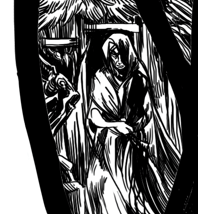
Edward’s Account of the Dereliction

Historical fiction is great and all, but have you tried fictional history?

You say her name is Anna?  This may be a lark, but…is this Anna Vael we’re talking about?

Godshell.  Then she’s really still alive.  And you don’t have a clue who she is, do you?  Fine, then, I’ll tell you while she listens–yes, I know she’s listening.  Anyone would know that if they just knew who she was.

Anna Vael’s limited fame–or infamy, depending on the side you might have been on in a conflict that ended over a century ago–has to do with the events of the Blood God’s Dereliction, which I think you’ll agree is a poorly-recorded story these days.  Piraeus keeps uncommonly good records, so around here, we at least know that the Dereliction did happen, but it’s worth noting that in the stretch between here and Ulrich’s Bend, most consider the Blood God a myth at this point.  Something to tell the kids.  The type of thing you don’t need to bring economics into–the Blood God disappeared, and his empire crumbled, that’s it.

Of course, in the real world, it doesn’t work like that.  The Blood God disappeared, yeah, but he spent most of his time disappeared for the decades before that anyway.  For the last thirty, forty years of his reign, he made a low-single-digit number of public appearances, all of them spectacular, filled with mass murder.  Putting down rebellions, mostly.  When you add in accounts from much earlier in the Kolai Dominion–recovered from the Blood Knight stronghold here in the city, actually; Peren Stratus made sure the archives were extracted before he burned the place–you get a picture of a Blood God who was interested, to a point, in a particular sort of rule, but very disinterested in personally ruling.  So very early on, he handed the job off to the Magni Kolai.

The Magni were like his high priests, selected meritocratically, but the merits they were selected for–devotion to the Blood God and his philosophies, and absurd, raw, magical talent–mostly didn’t translate to skill in governance.  You probably had one or two that figured out what needed to be done, and they channeled a whole lot of hostile work environment onto the Migni Kolai, their handpicked subordinates who went on to become the Dominion’s central bureaucracy.

This kept the ship sailing for a century or so, but as the Blood God grew less and less engaged, the Magni were left with way less pressure to get any of it done right, which meant that more and more of the Migni positions got filled lazily.  On average, that meant you had folks in there mildly unsuited to keeping an empire running.  As it got worse, it meant that more and more positions in the bureaucracy were filled–as a matter of course–by bribery and nepotism.  Remember: Kol’s anti-corruption measures didn’t have moral norms.  They were, collectively, “if you break it, I’ll turn all of your veins inside out”.  As the guy saying that stopped paying attention, the backroom deals stopped having consequences.  Then it took awhile, but eventually the cracks in the system caught up with them.

When, for example, the city of Cantabyz suffered a plague that decimated their iron output for the better part of a year, a skilled provincial governor might have channeled central resources toward aid to mitigate the economic disruption.  They might have adjusted taxation, pushing that burden into future, less plague-ridden years.  But should the governor not have reacted at all, the city, already impoverished by circumstance, would have been liable to snap when the Dominion’s unadjusted taxes dragged what was left of it into the ground.  So they would rebel–and they did rebel, as it happened.  The Blood God dragged himself out of his temple, put down the rebellion, then went back to bed or whatever.  Except he put down the rebellion by killing everyone involved–along with a really-not-trivial number of bystanders–which meant that the economic impact radiated out to the rest of the Dominion.

Long story short, this all happened a couple of times, in this outlying province or that one, before the economic implications finally crashed into Kol proper, in the form of a famine.  And this time, when the torches and pitchforks crossed that unimaginably foolhardly threshold of marching on the Blood God’s temple and throwing the doors wide…they lucked out.  The bastard was gone.  To this day, no one knows what happened to him, but that’s not the point.  The point is that this was where the games began.  It’s where Anna Vael comes in, in fact.

To clarify, when I say the torches and pitchforks lucked out, I mean their cause–and, again, the bystanders–lucked out.  Those specific idiots all died very quickly, because the Magni were plenty capable of putting down a disorganized riot by themselves.  Still, I don’t want that initial stall to detract from how big a paradigm shift this was.  The Blood God was, not mincing words, a god.  He killed the Dead Queen of Khet.  There literally is no entity–not even a collective entity–that I am confident could stand against him.  That’s a more nuanced qualification than I would like to make, but the point is: Overthrowing him was straight-up impossible.  Overthrowing the Magni Kolai, on the other hand, was merely difficult.

At this point, I’ll add that the number of sources on the record declines precipitously.  There were lots of corroborating sources for the rebellion at Cantabyz, the famine, the storming of the temple, but from then on, the only account that’s survived to today is by our friend, the Abbot Ezekiel Polyon, who, as you are well aware, may or may not currently have command of a stable nervous system.  That said, he did keep regular journals up to a point, and those have since been copied extensively.

In any case, Polygon describes Anna Vael as one of the central players of the Dereliction.  Prior to the riot that reached the Blood God’s temple, she was an underworld fixer of sorts, some mix of information dealer, mercenary, and assassin, earning her bread on whatever skulduggery the Migni let happen within their walls.  Pretty sharp–she’d have to be for the ensuing events to be true–and apparently notable for her appearance.  Her body was, he says, infested with flies–to the point where he was not sure whether she was carrying the insects with her or if, somehow, she was the flies, and the body was merely a vessel.  

In any case, in the leadup to the big riot, the Migni must’ve seen the writing on the wall.  They realized that if the Blood God got involved, it might not have been on their terms, so they raised a militia to keep the peace and recalled a selection of the Blood Knights–Polyon included–to lead it.

Solid short term plan, yeah?  The problem is that militias are rickety things, lots of competing priorities and loyalties, cracks that will get exploited sooner or later if they don’t get cleaned up into a formally-administrated army.  And despite the militia’s best efforts, the riot did break through to the temple, and the revelation therein meant that keeping the operation running wasn’t discretionary anymore.  

The Kolai tried to recall more Blood Knights, but news traveled faster than their missives.  A number of Kol’s outlying provinces rebelled outright–Piraeus included, and the question of loyalist reinforcements became one of if, not when.  And in the meantime, they were left with this large force of conscripts and mercenaries, poorly paid and extremely sensitive to payment, trying to hold back a tide of suddenly-emboldened insurgent movements with whom they probably shared more in common than their Kolai overlords.

Vael was among those conscripts, and she made herself very useful very quickly by gathering intelligence on the rebel cells, which she provided to the militia, obviously–but also to Polyon and the Migni, who were at this point growing suspicious of the militia’s intermediary leadership.  The commander who bubbled to the top of that mess, a former mercenary named Adrian Martell, was charismatic, clearly ambitious, and beholden to the Kolai solely on the basis of coin.  His loyalties were in sharp doubt, but based on Vael’s surveillance, he was making no imminent moves to consolidate power.  And with micro-rebellions breaking out all across the territory map–vandalism, attacks on tax collectors, mass theft of the Migni’s stockpiled food–replacing him would have been costly indeed.

The balancing act continued for months, as message after message rolled in, sending word of the slaughter of the Blood Knights in Piraeus and elsewhere, all confirming that, ultimately, no reinforcements would be coming.  The Migni’s resources began to run thin.  And then, gradually, they began taking casualties.

Assassination attempts.  Poorly equipped, poorly thought out, by Polyon’s description.  Usually they would fail, but occasionally they would get lucky.  And all of them were fanatics, apparently brainwashed to the edge of sanity, all repeating the same mantra as they were imprisoned, interrogated, tortured to death, what have you:

“Forty hands with forty daggers will find the oppressor’s heart.”

Pretty cold, right?  Wish I’d thought of it.  Well, the Migni started dropping, either from these creepy assassins or just outright desertion.  Then, the Magni started infighting.  There were just nine or ten of them at this point, all wildly-dangerous humanoid death engines, but in their jockeying for power, one of them was killed, one severely injured before Polyon finally found an out for the Dominion.  Vael delivered him a report one day detailing evidence from scores of witnesses that all of the insurgent movements in the city were being coordinated by a “Gutterway Oracle”, who she identified as Karl Hamlin, another militia conscript who had been selling tax collector schedules for favors and coin to anyone who would listen.  And Hamlin, she said, was lying low at that moment at an inn on the outskirts of Kol’s pastoral territories.

Polyon interlaced his account of what followed with so much self-flagellation that it’s frankly hard to parse, but my translation is this: He took this intel to the Magni and gathered a task force comprised of most of the remaining Blood Knights in the city to go hunt down Hamlin.  And as soon as he left Kol, Adrian Martell commanded his troops to slaughter the Magni.

The truth, it turned out, was that Karl Hamlin was nothing but a skilled distraction.  He may, in fact, have been delivering the messages the rebels were coordinating around, but Anna Vael was writing them.  She was collaborating with Martell to ensure the militia always kept a brisk pace just two steps behind.  She was the one who brainwashed the Migni’s assassins, who coordinated the forty hands and forty daggers which bled out the Kolai bureaucracy, primarily to develop and test a method by which the militia might actually kill the Magni.  Her answer was simple enough to be upsetting: snake venom.  It stops blood from coagulating.  Coat arrows and blades with the shit, and now you can make wounds a blood mage can’t easily close.

To Polyon’s credit, he smelled shit way sooner than he should’ve.  He aborted his mission just a few hours after his departure, but he still returned too late.  By his account, he made it to Kol’s central plaza just in time to witness the last Magnia, surrounded by dismembered militiamen, fall dead at Anna Vael’s feet.

“The Apiarist”, Excerpt 7: Peren Stratus

“Ezekiel Polyon.  I’ve been looking forward to meeting you.  Don’t know if you’ve heard–you have a reputation among the sailors now.”

“The…sailors?”

“The navy.  Ever since we broke the Saltstill Cabal’s blockade two weeks ago.  While we were fending off their reinforcements, somehow the fucking city guard repelled their primary invasion force at the Fisher’s docks and didn’t give a fucking inch.  We got outmaneuvered plain and simple, but we didn’t pay for it, all owing to a Kolai reject who charged a ten-man advance unit with nothing but a spear and a bucket of pitch, killed them all, then set fire to a galleon.  Among what I’m sure are many acts of heroism, of course.”

“Rumors are prone to exaggeration, Lord Stratus.”

“Perhaps, but I personally witnessed some of the carnage you left.  Impressive.  Ironic as well, given the actual Kolai were no damn help at all.”

“You honor me.  I can’t help but assume, though, that Piraeus’ most promising young admiral should have a more pressing cause for this meeting.”

“Most promising, Lord Polyon?  You honor me, though far less deservedly.”

“I am no lord.”

“Oh?  Am I mistaken, then, in my understanding that you are the son of Maria Athene, herself a cousin of Councillor Ekreon Athene?”

“I am not accustomed to masquerading as nobility here.  I am merely the son of an apiarist.”

“An unruly branch, to be sure, but you still possess the right to petition the council.”

“Provided I never avail myself of it.”

“…”

“…”

“Very well, Lord Polyon, I will get to the point.  You have heard the directive by now that the guards and navy both are to root out the remnant smuggling operations the Cabal still has in the city?  And I expect your commander has received additional intelligence regarding regular shipments arriving each week on the southern Fisher’s dock that then disappear into the city tunnels?”

“I have received both of these directives, yes.”

“Would it interest you to know that this second piece of intelligence was delivered by a known agent of Lord Teleos?  It would, wouldn’t it?”

“My interest in such a detail would be a dangerous thing to express, Lord Stratus.  Though if what you say were to be true, it would introduce a battery of additional questions.”

“Then let’s speak plainly.  My aims here are dangerous to express too.  Treasonous, some might say, but I think you’ll be receptive.”

“Receptive…to what?”

“I want to overthrow the council.  Teleos, Athene, Alcyon, all of them.”

“…”

“Come now, Lord Polyon.  I find it hard to believe you wouldn’t be interested.  Or do you not think me–”

“I’m listening, Lord Stratus.  Tell me more about this conversation with Teleos’ agent.”

“The Apiarist”, Excerpt 6: A Thousand Cuts

My training took the better part of six years, in which time I enthusiastically apprehended the skills I would need as a soldier, as a mage, and as a de facto cleric of the Blood God.  I was good.  Far better than my recruiting class, better, even, than many of the Knights in full standing.  But it had turned out that despite these products of my hard work, my most interesting quality to chapterhouse leadership was actually my pedigree.  I was, of course, Piraean, but more uniquely, I was of the noble class–albeit its bourgeois fringe.  

As it was, the fight against the Atheists was angling more and more uphill with each passing year.  The Knights had little difficulty eliminating the radical elements who made themselves visible, but they were having a much more perilous time navigating the invisible gauntlet of small resistances the Atheists placed in their way.  Delayed responses from the Piraean Council, effectively tying the Knights’ hands in civil matters; the ubiquitous threat of petty theft and vandalism that compromised the movement of Blood Knight assets throughout the city; and the occasional assassination of Knights on patrol–retributed fiercely, but not fiercely enough to outweigh the attrition–all combined to ensure that the Knights’ existence in Piraeus remained decidedly hostile.  And where new Atheist aggressors seemed to spring up almost passively, owing to the unrest sowed by the noble families, new Knights…took six years to train.

It was, as the Knight Captain told me in a private meeting two weeks before my knighting ceremony, unsustainable.  Indeed, though I was not a Knight yet myself, I had felt the effects of the Atheists’ resistance keenly.  I had long since lost count of the meals I had skipped due to supply shortages, and just the previous month, Cassandra of Coralta–the Knight who had intervened on my father’s behalf at the city gates over a decade ago–had been killed when a group of Atheist riverwalkers pushed her from a pier in the harbor and held the water around her head until she asphyxiated.  She had been a mentor to me since I enlisted, and the rage that filled me when I heard the news has, to this day, only been equaled once.

It was for this reason especially that I was receptive to the assignment the Captain had for me in that meeting.  We could no longer ignore the Atheists’ inner workings, he said.  In all likelihood, they had an agent, an informant in the chapterhouse, and there was little we could do about it.  We simply could not afford to purge every Piraean from our ranks, and there was little else to go on.  The only sensible course of action was to manufacture a spy of our own.  I had the right characteristics, he said, and there was no one whose loyalty he trusted more.  It was a light blow to my pride that I would not have my knighthood recognized for some time–perhaps for years–but he knighted me there in his office.  Then, following a public and ignominious display of my expulsion from the chapterhouse for “disloyalty and heresy”, I was left on the streets of Piraeus to begin my mission.

Were the Atheists a centralized organization, I have little doubt that my chances of infiltration so soon after my exit from the chapterhouse would have been zero, pageantry or no.  But I knew they were not, and I knew the city guard had reason enough not to be suspicious of a new recruit.

If any faction had suffered worse attrition than the Knights in the Atheists’ protracted rebellion, it was Piraeus’ armed forces.  Since it was of the utmost importance that the Atheists did not establish anything resembling a fighting force, the guards and the navy had permanent places on the Knights’ list of usual suspects for any Atheist activity needing investigation.  Needless to say, damage to their ranks–both collateral and targeted–was substantial, and they were in constant need of new recruits to keep their numbers stable.  I had the martial skills they required, and they certainly did not have the luxury of investigating the unstated suspicions of the Piraean nobility.  They accepted my application without question, and within a few months, my history of allegiance to Piraeus’ “illegal occupiers” had been buried if not forgotten entirely.

“The Apiarist”, Excerpt 5: The Right Side of History

I enlisted with the Blood Knights in the eighty-second year of the Blood God’s reign, when I was twenty years old.  This was somewhat older than most recruits, but my path in life had been dominated by other factors, and I had yet to seize any particular control over it.

The previous year, my father was stricken with a consumptive infection of the lungs and–mercifully, perhaps–passed quickly.  It wasn’t precisely the attack in Piraeus that had brought about his end: His injuries healed mostly, leaving him with a limp and limited function in his right eye.  But it had, in hindsight, been the beginning of a downward slide.

He, of course, did not return to the city from then on, for the very reasonable desire not to become a martyr or scapegoat to either side in the thinly-veiled conflict now ongoing between the Knights and Piraeus’ self-determinative Atheist faction.  But I suspected it was also deeper than that, a phobic unwillingness to face even the place, much less the people, which had subjected him to that trauma.  The result was that he was confined to our home and grounds, occupied by not busy, increasingly present and irritable to Mother, the servants, and myself.  That he was moving so much less than he had been, that even his limited mobility in that limited space was painful for him–it all meant that even before the infection set in, he had become little more than a cruel, vaporous reminder of his former self.  I found it striking that when he died, not even Mother truly mourned.

The legacy he left, though, was complicated for everyone.  Despite his many enemies, Father was still regarded as one of the most talented artisans in the region.  Our family’s honey fetched an outright exotic price as far away as Kol, and even despite our lifestyle of rural borderline-nobility, the business had been shockingly frugal.  It turned out Father had left behind a fortune in silver, valuable goods, and stock certificates in a number of successful merchant companies, each of which had been paying dividends for years.  The future of the apiary was, of course, uncertain, but it quickly became clear that Mother and I were in no danger of starvation.  What was less clear was whether either of us had any desire to carry on Father’s work.

Eventually we settled on a course.  Our head servant, Giuseppe, the very same servant who had sought help for Father the night of the attack, would take charge of the apiary, and when Mother passed, he would be the one to inherit it.  I, meanwhile, had taken my father’s rejection to heart and fully accepted I would have no future in beekeeping, truly assumed I had no aptitude for it.  And my mind had belatedly wandered to the political unrest in Piraeus, and tectonics of power I now saw shifting around us.  So it was with not insignificant enthusiasm that I renounced my inheritance and made my way to the city, determined to stand on the right side of history.

Despite my ardent opposition, I have little doubt that if the political skirmish I arrived in had taken place even twenty years later, the Atheists would have won handily.  Though the Knights were formidable warriors, anti-Kolai sentiment ran deeply through Piraeus, and they were outnumbered–possibly a hundred to one.  Their advantage was that the Uprising of the 79th was fresh in the collective memory of the Kolai dominion: Only three years earlier, the city of Cantabyz, the source of the majority of the Dominion’s iron, had declared open rebellion against the Magni Kolai.  The Blood God’s arrival at their gates–his first public appearance in a decade–claimed over 10,000 lives.

In the wake of this event, Piraeus’ cooler heads overwhelmingly opted to lie low, leavin the Knights to contend only with the Atheist’s firebrands.  My allegiances were unconflicted.  I had no grievance against the Kolai’s taxes, and the only meddling I had seen from the Knights had been clearly on the side of justice.  It did not matter that when I arrived at the chapterhouse, the squire on duty in the hall urged me to consider that I would very likely not become a Knight without any magical talent I knew about.  And it did not matter that my enthusiasm was met by a bemused chuckle from the only Knight in the hall at the time.  I had existed too long in a state of terror at the unbelonging I had felt from my father, from the apiary, from the indolent, insular people of Piraeus.  I knew that the Blood Knights–even simple service to the Blood Knights–was something greater that I would be glad to be part of.  The Knight Captain’s speculative nod, when it came time to provide him my reason for enlisting, was tepid vindication.  But it was enough.

“The Apiarist”, Excerpt 4: The Blood Knights of Piraeus

My first contact with the Blood Knights was when I was eleven years old.  Against my father’s wishes, I was made to accompany him into the city on a delivery to the Hospitality Quarter, as the servant who normally helped him with those trips had fallen ill.  It was a fraught journey, but I was familiar enough with the work that I no longer roused his anger, so long as I stayed quiet.

Some years later, I would become acquainted with a common template of a man: the type who charmes, who is a socialite to all except those with whom he lives–to them he is a terror.  As that template is well understood by many, I wish to emphasize that my father was very certainly not this type of man.  He was not merely irritable and angry to his family–he was irritable and angry to everyone, and, as I discovered on this trip, these qualities had earned him enemies in Piraeus.

At the gates of the city, we were stopped by a guard who requested, smirking lasciviously, that my father produce his licensure.  Rather than showing documents, my father handed over a large parcel of his goods before continuing through the gates.  He did not offer me any explanation, and I did not ask, but I found the interaction decidedly tense.  And I was not the only one–I distinctly recall the skeptical glance of the woman in armor on the other side of the checkpoint.

As we were finishing our third delivery, that same woman approached us, carrying the parcel Father had given the guard.

“Piraeus has no licensure requirements for apiarists,” she said.  “I guess you knew that, but extortion is also prohibited.  If it happens again, you can let us know at the chapterhouse.”

Father accepted the parcel, eyes down and jaw set with an emotion that seemed perturbed but otherwise lacked definition.  When we passed back through the gates on our way home, the guard we had spoken with was no longer there, and the one who had taken his place fixed us with a look of such hatred that I could not bear to hold his gaze.

I was at the time too young, too sheltered to understand the political implications of what occurred that day, but as my role facilitating Father’s deliveries expanded, the situation grew clearer:

In those days, Piraeus was ruled by a council of elders who nominally commanded the loyalty of the city’s entrenched aristocracy.  It had been this way for as long as most citizens could remember, but where, a century ago, Piraeus had taken pride in being the last stronghold of Riverlander rule unswayed by the machinations of Spar, the city had finally surrendered rather than face ruin at the hands of the Blood God.  Even now, there were many Piraeans who resented this obeisance, who refused to recognize the Blood Knights’ authority to oversee and overrule the city’s various administrative functions.  That the Knights were largely hands-off and demonstrably less corrupt than their local counterparts–a notion for which the incident at the gate was, to me, irrefutable evidence–was beside the point.  Nor did it matter that the Blood Knights in Piraeus were a majority ethnically-Piraean: The Kolai were outsiders, and those that bent the knee were, behind certain doors, traitors.

Of course, when those criticisms emerged publicly, the repercussions were severe.  A month after that first incident, a group of guards, displeased with the Blood Knights intervening on his behalf, ambushed my father in the midst of his deliveries.  They destroyed his goods and beat him so severely that his servant had to fetch me and a separate wagon in order to bring him back home.  And though, to my knowledge, Father never reported the incident, the Knights seemingly discovered the incident on their own.  They massacred the city’s peacekeeping force, assuming their duties for the better part of a year, and the guards’ flayed and exsanguinated corpses were hung from the city walls for months after the altercation.

Father never set foot in Piraeus again.  I never learned whether he had a stance of his own on the Blood Knights’ rule.  He certainly did not seek their aid–I discovered from his ledgers that he had been paying bribes to the guards for over a decade.  But that was a stable arrangement: He was paying for his ill repute among the citizens.  It had nothing to do with the Blood Knights, and it was not by his will that his business became a battleground in their fight over who would control their hive.

One Wing, One Eye, Chapter 4: Unwelcome Participants

“What the fuck is this?” Marko snapped, lifting his hood as he scuttled into Brill’s backroom infirmary.  He started as the Homunculus turned to face him.

“It may be more efficient,” the Homunculus said to Brill in its unnaturally even, unnervingly human tone, “if you were to gather all of the appropriate audience prior to further discussion.  It will save time on repeated explanations.”

Brill shook their head, beckoning Marko closer and stepping past him to draw the curtain that divided the infirmary from the rest of their shop.

“Now was that sarcasm?” they asked.  The Homunculus looked back to them, moving only its head and neck.  While seated, the construct remained almost perfectly still, save for the limited gestures it used to facilitate its stilted communication.

“Monk’s great at sarcasm,” Naples added.  “Gave us some real zingers on the way here.”

“Fucking wh–”

“Your name is ‘Monk’, then?” Brill asked, cutting off Marko’s outburst.

“I was designated the title ‘Homunculus’,” the construct replied.  “You may call me whatever you find serviceable.  This one has elected the moniker ‘Monk’.”

“Quick-witted as ever, Mr. Naples.”

“Isn’t this the guy you threw out of here two weeks ago?” Marko interjected.

“I did, yes,” Brill sighed.  “But when he arrived with my erstwhile charges, themselves safe from what al’Ver concurs as a harrowing journey to the Reach, I thought it perhaps worth our time to entertain some discussion as to how this discovery relates to the Crossroads.  As to why I sent for you, Marko, I trust you can see what is in plain sight?”

“Quit with the fuckin’ riddles and get to the fuckin’…” Marko trailed off as he scanned the room, his eyes focusing on the parting of Monk’s cloak.  “Motherfucker.  That’s the Keystone, ain’t it?”

“Indeed,” Monk confirmed.

“Ah…” Marko exhaled, somehow giving the impression of smiling and scowling at the same time.  “I don’t suppose you also brought Ehsam back with you, Naple man?”

“It’s, um, it’s Naples, thank you.  And no.  Ty Ehsam is–”

“Skulking about somewhere but not dumb enough to show his face, got it.”

Naples frowned momentarily before he realized the expression only served to confirm Marko’s cold read.

“Calm, Mr. Naples,” Brill said, noting the shape curled on the bed in the back of the infirmary, stirring.  “We are not in a position to turn Mr. Ehsam over to the Blaze at present, as much as we all would like to be rid of that threat.  And I imagine Commander Atra might try to sabotage such an exchange, from what Bleeding Wolf has told us of her goals.”

“So…?” Naples prodded.

“So it’s still best he’s in hiding,” Marko said.  “Us knowin’ about him’s the least of your concerns.  That still don’t answer my first question–” he gestured at Monk, “–the fuck are you?”

“Please explain again…Monk,” Brill added.  “The only person left who ought to hear is Bleeding Wolf, and I cannot say when he will be joining us.”

As Monk recounted its purpose–its scenario, the Alchemist’s plan to avert some prophesied end of the world–Brill idly wondered how credulous they ought to be at it all.  Though popular legend made Excelsis out to be a sort of magical genius–and Monk’s presence in their shop was perhaps even proof of that–they one thing they had never heard of magic having any success with was prophecy.  The histories they had read were dotted with accounts of charlatans who attempted to parlay spurious–though difficult to disprove–half-predictions into political influence.  But these histories all culminated in situations where those regimes with supposed access to magical foresight found ruin by pointedly unforeseen circumstances.

The Bloodfish’s rise completely obliterated the Highlord’s unsuspecting hegemony.  All the Sun Priests of Khet could not, apparently, predict the ascendancy of the Dead Queen.  And even the vaunted prophecy said to have fueled the reign of the Iron Queen of Spar–the sourceless and vaguely-worded “magic will destroy the world”–seemed, in the scope of history, to be little more than post-hoc justification for the Right-Hand Diarch’s consolidation of power.

And putting the conceptual issues with prophecy aside , the particulars of this one invited skepticism.  The Night Sky?  The Old Gods?  They weren’t real.  Sure, there was historical evidence of their worship, but people might worship any old thing.  The forces of Harmony believed Matze Matsua was an incarnation of some godlike spirit, but he died like any other man when he was gored by a roach.  Before the War, the followers of Le Marquains reportedly worshipped bulimia.  Hell, Bleeding Wolf still counted himself part of a cult that worshipped the color green!

The shape on the bed had sat upright, and Brill caught Devlin’s face, shaded by the boy’s tattered hood, staring, lidded with exhaustion but nonetheless fascinated by the construct’s locutions.

“And thus it is of paramount importance that the site of the Night Sky’s awakening be located expediently,” Monk concluded.  “It was Captain al’Ver’s belief that we might investigate that question here.  And Brill recommended we consult you, as you have expertise in creations such as myself.”

Brill nodded in agreement.

“What do you make of it, Marko?” they asked.  Marko shrugged, grimacing.

“What do I make of it?  I don’t sell abominations anymore,” he spat.  “Though…I’ve a few clients who–”

“Abomination?!” Naples exclaimed.

“Technical term,” Marko replied, distractedly calculating what Brill could only assume was a sales offer on their guest.  “Any artifact that seems to be alive.  Messy fuckin’ business, but–”

“Regardless, Monk is not for sale!”

“Indeed, Marko,” Brill interjected.  “My query for you was not regarding commerce.”

“Well then what the fuck was it regarding?  I don’t know shit about the Keystone–and I woulda bet you no one’s interest in it was more’n speculative in the first place.  And if you want my opinion on the end of the world story, it’s horseshit.  If the tinker toy here ain’t a commercial opportunity, I can’t fuckin’ fathom why you want my opinion.”

Brill glanced at Monk, but if the construct was alarmed or offended at Marko’s outburst, it did not show it.

“I was hoping, my friend, that you might consider this development from a different angle.”

“Talk straight or I’m leavin’,” Marko growled.  Brill sighed.

“Self-preservation, Marko,” they said.

“Eh?”

“The Blaze’s momentum toward us is being used to justify meddling in your business that you don’t much appreciate, yes?”

Marko held their gaze for a moment before nodding slowly.

“An’ you think that whatever prophetic interaction this thing has prepped can be used as leverage.”

“I have no idea whether such a thing is feasible, of course,” Brill added.  “But if it is, I would consider you best equipped to determine it.  Ideally before Atra does.”

Brill glanced again at Devlin, still staring from afar, half his face concealed by his hood.  The boy seemed different since his return, they realized.  He was still quite ill, of course, but beneath his labored breathing and evident weakness, a sort of grim determination had overcome his catatonia.  Brill could not imagine Devlin held any stake in the intrigue to which he was listening so intently.  They could only wonder where all that determination was aimed.

“So…who is this ‘Atra’, anyway?” Naples asked.  Before anyone could answer, the creak of Brill’s shop door wheezed from beyond the infirmary curtain, along with the sound of voices.  Brill motioned to Naples, who readily intuited the alarm in the gesture.  He quietly escorted Monk to the corner of the infirmary and draped the construct in a bulky canvas sheet.

“Now you must promise to rest, my dear,” came Lan al’Ver’s voice from the next room, followed by the trudge of approaching footsteps.  “Your journey has been arduous, and it is no weakness to admit it!”

“It seems there was no cause for concern after all, Captain…” Atra’s voice was fainter, trailing off as the door creaked shut again.  Then Orphelia drew the infirmary curtain aside, only to freeze as she beheld the veritable crowd within.

“Mr. Marko…” she said.  It was an almost-gasp, as if she lacked the energy to be properly surprised.  Brill noted with some concern that the aura of mischief she’d had in her brief visit to the shop a few hours ago had given way to a demeanor that seemed practically haunted.

Marko looked from her to Brill.

“Gonna go,” he muttered uncomfortably.  

He slipped past Orphelia and made his way out as Brill approached the girl, wary that she seemed somewhat far from alright.  Like Devlin, she seemed different as well.  Older, they decided.  By several years.  They could have sworn that she was a child when they took her in a few weeks ago, but now she seemed nearly old enough to be married.  That could not have been a lapse in attention, they thought.  There had to be something more…complex affecting the girl.

“What’s wrong, Orphelia?” they asked, setting aside their suspicions for now.  She shook her head, looking up at them vacuously.

“Nothing…” she said.  “You aren’t smiling.  And that’s…good.  Probably.”

***

This wasn’t good, Atra thought, reentering the jail.  She stood over the desk, shuffling parchment absentmindedly.  The girl.  Something was not right about the girl.  She could not tell what, and that by itself was perhaps cause for alarm.

Orphelia was indeed a mage, that was certain.  Bleeding Wolf had said as much–though he had deliberately omitted detail–but it was more than that.  Not a concrete observation, not a characteristic Atra could see, but a feeling: like a paranoid delusion that something was just over her shoulder, just out of sight, but only when she was near Orphelia.  That feeling was magic she had never seen before, and she had seen quite a bit.  

Never mind the shock of it, though.  She had researched the deep lore of the Riverlands extensively, and though the complication Orphelia presented was outside her expertise, it was unlikely to be outside her knowledge entirely.

A different angle, then: The girl had been traveling with al’Ver, “retrieved” from the Chateau de Marquains, as he had relayed to Bleeding Wolf.  This meant the girl had made a journey south…a week’s journey to the Reach, a week’s journey back with al’Ver.  The captain had been gone about two weeks, yes.  But so had the girl, according to a conversation Cirque had overheard from Brill.  Had he…chased her down to the Reach?  That was impossible.  No one could elude al’Ver on a river for a whole week.  His “experience” as a boatman aside, the magical forces involved in that proposition made the certainty of him catching her almost categorical.

Which meant he wasn’t chasing her.  He knew she would be at the Reach.  And if he meant to retrieve a teenage girl from the Chateau de Marquains of all places , she had to imagine his hurry would supersede his preference for conventional travel.

Which meant she wasn’t there in the intervening week.  She was merely going to be there at the end of it.

She had left the stream.

And the Chateau de Marquains…the Saraa Sa’een.  Fucking shit.

It was all Atra could do to keep from punching through a corner of the jailer’s desk.  It wasn’t a certainty, no, but if the girl was a locus of the Gyre, it would dwarf every other cause for concern she and Cirque had yet found.  Marko’s scrying attempts, Brill’s political feints, even al’Ver–an incarnate primal storm, albeit one she was pretty sure she could sidestep–all of these were minor distractions compared to the prospect of being warped into the circular story, the Smiling Lie and the Promised Vengeance.  Al’Ver could be convinced to stay out of things.  The Gyre, though, existed almost exclusively to meddle.

Her ears perked up at the telltale sound of skittering in the jail hallway.  Odd.  Cirque was early tonight.  She looked over her shoulder to see him stalk into the room, frustration more apparent than usual on his face.

“Weird stuff going on at the apothecary,” he said.  His tone was quiet but still cuttingly clear.  “Al’Ver came back with a talking construct that’s trying to find the ‘place where the Night Sky will awaken’.  Marko’s trying to use it to keep the mayor away from his toys, and it gets worse.”

“We might be in the Gyre right now,” Atra replied grimly.  Cirque stared at her, his frustration visibly giving way to worry as he slouched back against the wall.

“No shit.”  He paused.  “You sure?  You see the old man or something?”

“No.  Not yet.  But I’m fairly certain there’s a locus in this town.”

“So we might not be in it yet?”

“Right,” she said.  “But I’m not sure we have the luxury of keeping to the background right now.  An’ I hate to run.”  Cirque snarled at nothing in particular.

“Worthless town,” he muttered.  “Rotten scheme.  Can the Gyre be counteracted magically?”

“Hard to say.  Only information we’ve got is that’s ensnared many a powerful mage.  Catherine of Greypass was said to be one of the greatest Blood Knights of Kol.  Jin Gaenyan was supposedly formidable enough to have the Barabadoon on ‘is tail even before he became a monster.  An’ Feathermen records suggest even the bloody Masked Alpha got pulled in before the War.  But there’s ambiguity.”

“Ambiguity?”

“Did they get pulled in?  Or did they enter of their own accord?”

Cirque scowled.

“That’s a greedy fucking question.”

“‘Tis.  But we may never get a chance like this again.  The whole damn horizon’s dyin’, an’ a barren waste just won’t burn.  No fire for me, no feast for ye.”

“I hate this argument.”

“Come now.  Isn’t it exciting there’s a player in this game that might best us?”

“Two,” Cirque spat.  Atra raised an eyebrow.

“Pardon?”

“Two players.  The boy al’Ver brought to town–”

“Not the girl?”

No, not the girl.  The fucking boy.  He reeks of feathers.”

“…feathers?”

“Feathers, you arrogant musclehead.  Like the Feathermen and the Sadist.  Like Ka’s palace.  Like her.”

One Wing, One Eye, Chapter 1: Diplomacy in a Lawless Land

Crossroads is finally starting back up here! For those of you just joining, this is the first (unedited) chapter of the sequel to Three and Two and Two. Similar to the way the story has appeared on the blog up until now, this is neither formatted as it will be in the final version (e.g. prologues and interludes may be absent or presented out of order) nor is it necessarily even what this chapter will look like in the end. I’m excited to be continuing this journey with you all–if you would like to catch up on the story so far, check out Three and Two and Two here!

“We believe that you speak the truth,” the white-gowned man said.  “The Sculptor will surely see that no aggression was intended.”

Bleeding Wolf leaned back in his creaky wooden chair and met the speaker’s gaze across the table.  The man, Elder Stephen per the introductions, had a familiar sort of face–the type on which Bleeding Wolf could see glints of the arithmetic the man perceived in every relationship, every exchange.  The kind of face that belonged to shrewd merchants.  Or connivers.  

The meeting was nominally to discuss the breach of diplomacy that had occurred a little over a week ago, on a job Bleeding Wolf had undertaken upon making it to town.  His group had encountered a rival group of Holmite scavengers in the Bloodwood, and they had killed three of them.  Apparently, no survivors had made it back, and the mayor had anticipated that concessions would need to be made to unwind the tensions.  But despite Stephen’s assurance that the offense to the Crossroads’ largest trading partner had not been grave, Bleeding Wolf did not think the negotiation had yet begun.

“That is good to hear,” Mayor Bergen replied, acknowledging the opening salvo.  “We nonetheless regret that this bloodshed occurred, and we would like to send along an apology in the form of goods, perhaps including whatever you may require from our artifact dealer during this visit.”  Stephen smiled and shook his head.  Gracious, condescending, characteristically Holmite, Bleeding Wolf thought.  A counteroffer was coming.

“That will not be necessary.  We have already visited Marko.  His prices were very accommodating, given the circumstances.”

The two acolytes sitting beside Stephen nodded their affirmation of this detail.  They, Bleeding Wolf had decided, were definitely not connivers.  They were zealous idiots, eyes practically sparkling with their dearth of questions.

“The spirit of the apology is appreciated,” Stephen continued.  “But I would propose a more even exchange.  Rumors run upon the wind of danger approaching the Crossroads.  Holme, of course, would also be affected by the Blaze’s southern encroachment, even incidentally, but we also do not believe Holme’s involvement to be incidental.”

“Oh?” Bleeding Wolf interjected, breaking his silence.  “What do you mean?”

“The members of our flock whom you…encountered in the Bloodwood were contracted by an itinerant dealer, one Salaad of hazan.  Salaad’s remains were discovered a little under a week ago in one of our field communes, scorched.  Two dead dragonlings were found nearby.  It does not stretch the imagination to suggest that his death may be connected to the survivors you mentioned failing to return to us.  And–” Stephen gestured toward the mayor, “–it is known that attacks upon the dealers are growing more common of late.”

Bleeding Wolf grunted at this.  The logic was absurd: The Ben Gan Shui’s probing attack on Marko’s office certainly had nothing to do with the Blaze killing Salaad of Hazan.  Even the reasons behind the attacks probably had nothing in common.  But Stephen’s overture had little to do with logic.  It was rhetoric that appealed to the mayor’s priorities.  Stephen knew it, Bleeding Wolf knew it–hell, Bergen probably knew it, even as he was eating it up.  But it worked:

“That is certainly the case,” Bergen said.  “And we would welcome closer ties with Holme in the face of these new developments.”

“Excellent,” Stephen replied, smiling just a little too serenely before launching into the details of his proposal.  Bleeding Wolf stopped himself from rolling his eyes at the honey, the saccharine eloquence spritzed like perfume over the duplicity.  Fucking politics.

He glanced at the empty chair on his side of the table.  Funny, he thought, that the most distracting political gesture of the meeting was actually that empty chair.  It should have been occupied by Atra, the newly-appointed commander of the Crossroads’ militia, but she had a matter come up which, she claimed, urgently required her attention.  Bleeding Wolf was sure the excuse was bullshit.  For one, it seemed highly unlikely that any such matter could not have been overseen by Anita or Michel, the Crossroads’ long-standing peacekeepers.  But even beyond that, Bleeding Wolf harbored doubts that Atra even experienced the feeling of surprise.  This was a woman who calculated every decision, every step, and so far, it seemed her only slip had been the arc of mana she had exchanged with Bleeding Wolf when they shook hands a few days ago.  All he knew for certain was that she was a mage, one of the most terrifying he had ever encountered, but by the same token, he was sure that her missing this meeting meant that she had very purposefully wanted to miss it.  He wondered why, and he wished that Mayor Bergen–who certainly noticed but didn’t seem to care–would put a little more effort into wondering himself.

“…then we shall await your delegation in the coming weeks,” Stephen was saying as Bleeding Wolf tuned back in.  “There remains one symbolic request, though.  It is the Sculptor’s teaching that conflicts should be resolved through mutual sacrifice, of the kind which begat the dispute.  Given that our disagreement began in bloodshed, the Sculptor requests that agreeable blood be shed to close the cycle.”  Bleeding Wolf inhaled sharply.  Uh oh.

“Do you mean an agreement sealed by a drop of blood?” Bergen asked.  “Or something more substantial?”  Stephen shook his head with a theatrically solemn frown.

“My apologies.  The blood itself is metaphorical.  The Sculptor requests a life.”  Mayor Bergen drummed his fingers on the table, showing entirely too little shock at the request for Bleeding Wolf’s liking.

“Must the sacrifice be willing?” he asked after a moment.  “Or simply willingly provided by the Crossroads?”

“The latter will suffice.”

Bleeding Wolf shook his head.  Gene wasn’t going to like this.

***

Looking over his shoulder at the busy town square, Gene paused before Marko’s theater-office.  He wasn’t sure what he was looking for, he realized.  He wasn’t actually concerned that he had been followed, and it wasn’t as if he were doing anything forbidden.  Marko’s office just made him uncomfortable.  It had made him uncomfortable ever since the time Marko had almost shot him with a crossbow when he’d come by unannounced, and the furtive look behind, he supposed, was just an expression of that discomfort.  Grimacing, he swallowed it and rapped on the door.

“Appointments only!” came the muffled response.  Gene glanced about once more before half-shouting at the door:

“It’s Gene!”

There was a moment of silence before the door creaked open, revealing a wizened, androgynous figure in a brown habit.  It was Brill, the apothecary.

“Oh good, you’re here,” Gene began.  “I wanted to–”

“Not here, Gene.  Let’s discuss inside.”

Brill receded quickly into the shadows of the entryway as Gene raised a hand to object.

“It’s nothin’ secretive…” he said, though it was clear that Brill wasn’t listening–or at least didn’t care.  He sighed, following them in.

He noted with disappointment that he had to tilt the door on its hinges in order to close it.  His apprentice, Jeremy, had built it about a week ago to replace the one that had been destroyed during the Ben Gan Shui’s “visit”, but this was terrible craftsmanship.  Gene would need to send the boy to Frank and Erik, he decided.  He could teach smithing well enough, but his carpentry was beginning to slip.

Inside, standing over a table set up in the theater’s cleared-out audience floor, Gene found both Brill and Marko, the Crossroads’ prickly, paranoid artifact dealer.

“Speak of the fuckin’ devil,” Marko muttered, looking up.  Gene blinked.

“You were…speakin’ about me?”

“You had better see this, Gene,” Brill added, beckoning him to the table.  Shuffling over, Gene saw that they were considering a piece of parchment with a detailed sketch upon it.

The sketch depicted a scene at a long table where five men engaged in some sort of negotiation.  The man in the foreground was leaning back from the table, some degree of dismay flashing across his face.  He looked familiar, Gene realized.

“Is that…Dog Boy?”  And then he noticed the caption scrawled at the bottom of the page, where Bleeding Wolf’s sketched torso faded into the margins: Gene wasn’t going to like this.  He looked at Marko, alarm bubbling up in his chest.  “What in the shell is this?”

“The most artistic invasion of privacy you ever did see,” Marko replied with a sour grin.  “Really gotta give whichever mage that thought of it some credit.”

“It’s a scrying artifact, of a sort,” Brill explained.  “You ‘tell’ it someone you want to see, and it sketches their context in that moment.”

“Got it on the sly from an old contact in the Westwood,” Marko said.  “Needed a way to follow along with whatever Atra’s tryin’ to do.  But Brill’n I got curious as to what was goin’ on in Dog Boy’s meetin’ with the Holmites.”

“What does it mean that ‘Gene won’t like this’?”  Marko shrugged.

“You should ask Dog Boy.  But I reckon you ain’t gonna like it.”

“Guess I’ll have to,” Gene said, shaking his head resignedly.  “I came here for you, though, Brill.  Had folks wanderin’ by the shop wantin’ to know when you’d be back.”

“My apologies, Gene,” Brill replied, a twitch of frustration nonetheless crossing their face.  “Dull moments are seeming more and more a distant memory these days, and I’m trying to stay abreast of the…political situation.  Between Marko’s read and Bleeding Wolf’s warning, I am concerned about Atra.”  Gene nodded.

“You ain’t the only one.  John’s playin’ with fire.”

“He is.  I agree.  But his read on the landscape is sensible.  The Crossroads is growing less safe, and Mayor Bergen is right to respond.  Moreover, the town’s opinion of Atra so far is quite high.  Anita is quite enamored with her, and the relationship between the merchants and the militia has remained entirely amicable.  They do not interfere, and people feel safer when they’re around.”

“Sure it’s easy to seem decent when you ain’t doin’ nothin’,” Marko spat.

“Of course,” Brill agreed.  “But we must be careful, lest our attention to detail be mistaken for common xenophobia.”

“Hmph,” Marko grunted.  “Wanna let ‘im in on the latest?”  Brill looked back, pausing a moment before recognition set in.

“Yes, that’s right.  There are two updates: The first is that Atra has an accomplice in town.  We only have what this–” they gestured to the parchment, “–can tell us, but we understand that the accomplice looks like a child.”

“A kid?  Godshell.”

“They are probably not actually a child, but I will admit, I am out of my depth as far as magic may be concerned here.  The second update, well.  Marko, would you show Gene our picture of Atra right now?”

Marko nodded.  He placed his hand on the parchment and closed his eyes momentarily.  The scene of Bleeding Wolf and the Holmites faded, and new strokes of ink began to line the page.  But these did not seem to form any coherent picture, instead just massing in blots and nests of chickenscratch.

“Been getting this more often in the last day and a half,” he said.  “My money’s on her figurin’ out she’s bein’ watched.  Dunno how she’s counteractin’ it, but she’s figured out how to hide when she needs to.”

“And apparently, she wants to be hidden right now,” Brill added.

***

A few miles outside of town, Atra sat upon a boulder, contemplating the trickle of the river through the reed-crowded shallows stretching before her.  She knew the river, knew what it encoded, though it continued to surprise her how many lifelong Riverlanders regarded it as a solely physical phenomenon.  There was old magic in the river, magic that even she could barely parse.  But she was only listening for a specific piece.

No.  Not yet.  It was the loosest end so far: What was Lan al’Ver doing down south?

She felt a sudden intrusion of mana, troublingly familiar of late, as an enchantment began to weave itself in the aether around her.  Fortunately, she was prepared: The strands had eroded somewhat in their travel from the Crossroads, and she needed merely to nudge one out of place to disrupt the weave.  Instead of an oculus, the enchantment resolved to a tangled mass and began to dissipate.

“What the fuck was that?” Cirque asked, suddenly perched on the boulder beside her.  She side-eyed him, this ragged, piranha-eyed not-child with rats scurrying off him, into the swamp below.  It was enough to make her laugh: She could glean temporal portent from the river’s flow, she could parry a metamagical scrying attempt, mid-formation, but even she couldn’t keep track of Cirque.  He was a valuable ally, and she was glad that the relationship had little risk of inverting.

“Marko, most likely,” she replied.  “Been noticin’ oculi formin’ about me ‘round town.  Integrity falls off hard with distance, though, means it’s probably an artifact powerin’ it.”

“So town isn’t safe to talk anymore?  You might’ve warned me explicitly.”

“Yer a sharp one.  Ye caught on just fine.”  Cirque growled, a sound which might have come off as a pathetic mewl if not for the ominous chittering that reverberated through the boulder with it.

“We’re encountering an awful lot of resistance for what this town is,” he spat.  “Are you sure it will be worthwhile?”

“Ye tell me: Is the meetin’ with Holme done?”

“Yes.”

“And they took note of Salaad?”

“Are you second-guessing my work?”  Atra shook her head.

“Hardly.  I merely question the Holmites’ vigilance.  It seems ye got their attention, though.”

“At some cost,” Cirque muttered bitterly.  “You should try biting into a dragonling sometime.”

“An incandescent pleasure, I’m sure,” Atra said, considering the idea of napalm on her tongue with more curiosity than revulsion.  “They are amicable to reconciliation, then?”

“Yes.  On the condition that the Crossroads supply a sacrifice for one of the Sculptor’s insipid harvest rituals.”  Atra smirked.  It was almost too perfect: an alliance of rivals against the Blaze’s overwhelming threat of annihilation, with each harboring a tinge of toxic distrust for the other’s murder of their countrymen.  The makings of the tinderbox were there.  Now, it was simply a matter of preventing it from igniting too soon.  To which end, the political backlash from this would be Mayor Bergen’s to shoulder.  That, after all, was why she had not attended the meeting.

The mayor, she had to admit, was in an interesting position.  Laughably out of his depth, of course, but he wasn’t dumb.  He had seen her own ulterior motive plain as day.  But though he had the intellect and guts necessary for realpolitik in the lawless age of the scav trade, Atra doubted he had the skill, the wherewithal to deflect blame, or the instinct to predict when his allies would become his enemies.  More than likely, he would provide everything she needed from him, and then he would die.

The real problem was the folk who would never trust her.  Marko, to an extent, though he carried so little of the town’s favor that he might not matter.  But Gene and Brill–tradition was a potent defense against the brainfever she hoped to instill–and, of course, Bleeding Wolf.  She would need to be careful with those ones.

“I still think we should kill him,” Cirque said, as if reading her thoughts.  “The beastman.  He knows what you’re up to.”  Atra groaned.

“Not all of it.  Not yet,” she said.  “And like I told ye before, there are others watchin’.”

“Apparently,” Cirque replied, with a significant look at Marko’s withered enchantment.  “And I think it’s time we took some countermeasures.”

“Fine.  If it please ye.  But no assassinations yet–all the pieces are still too important.”

“What, then?”

“Keep an eye on Marko.  If he finds another toy to use against us, it’d be better we find out before and not after.  The apothecary too: That one holds more of the strings than they let on.”

“And–”

“Leave Bleeding Wolf to me.”