Another strange piece, part of the same weird project as Maze in the Mists. House of Leaves had a lasting influence on me, and there is something just fascinating about the idea of a fictional character delivering a non-fictional analysis of a book that doesn’t exist. The difference here is that the latter will (hopefully) eventually exist. But that’s a far future sort of thing.
And if you enjoy my writing and would like to support it, please considering buying one of my books.It is timely, after all. $20,000 Under the Sea released just this month, and you can buy it in ebook or paperback format here!
Why did Taamir Ra allow himself to be taken by the Dead Queen? His companions’ reasons shouldn’t be any great mystery: For his brother, it was a desperate, knowingly doomed attempt to repel the darkness which would surely swallow the kingdom. For Tiresias and–but for an ancient pact–Jabez, it was brazen, stupid curiosity. For the masked man, it was compelled. Taamir’s reason should be no great mystery either, but it’s hard to trust you people: It was guilt.
Consider that for a moment.
It’s easy to dismiss many modern representations of guilt as melodrama since so few of you feel guilt anymore. “The weight of your sins? Grow up,” says the man with a soul of formaldehyde and jism. “Quit sulking.” Think of the last time you allowed yourself to be tormented by your past–for deeds no one would ever discover, that it would be immaterial for them to discover–and, perhaps, despair. The modern human is tormented by the consequences of their actions, they are tormented by shame, the pain of their true self being seen–the fear that it might be seen–but guilt is wallowing. An indulgence.
It wasn’t always that way. Edward Teach calls guilt the synonym of freedom: “You bond yourself to yourself to free yourself from everyone else.” If you are without guilt, then, what follows?
The lack of guilt is downstream of the hatred and envy which armors you against the terrible responsibility of that world that you–not you, specifically; it is crucial that it was not only you–have built. You became powerful, only to discover that power does corrupt. It burns like fire, and charred skin simply makes one pliable.
But unlike you, Taamir Ra still had his soul. He understood his sin and acted to absolve it. “But Persephone’s capture was engineered by Bas’ahra and the masked man. They manipulated him!”
So little wisdom remains among Christians that it’s easy to forget there is a great deal of wisdom to be gleaned from their discarded flesh. As it were, the Christian god is quite clear on this particular sin: Eve manipulated Adam–Adam still gets the boot. He had exactly two jobs to do: Follow the rules, and make sure she follows the rules. He failed at both. He did not impress upon her the importance of the task at hand, perhaps because he was too stupid to understand it, and when it came time to make sure she was actually listening, he fell asleep. The mistakes are boring, prosaic, and kind of pathetic, not the kind of thing you would think ought to cost an eternity of Paradise, but I assure you: The boring, the prosaic, and the pathetic are in fact an extremely dependable foundation for evil.
Taamir Ra should have seen through Bas’ahra’s incredible incentive to defect, he should have spirited Persephone away without telling her; failing that, he should have outwitted the masked man; failing that, he should have refused the Sun Priests’ job and left Khet, because if he were not there, Bas’ahra could not have succeeded in the way she did. By his very presence, he caused others to do evil successfully. That is sin, and sin ought to elicit guilt.
Where Adam had little choice but to accept the consequences of his failure, Taamir faced a decision. His failure caused a child to be buried alive, and his submission to the revenant which disgorged from her tomb ten years later might have atoned–but to what end? He could have simply run. Bas’ahra did.
But sin weighs on more than the sinner. The injustice of Persephone Elea’s death did not go unnoticed. Divine recompense brought about her return, and Taamir saw that, even if he could not know the particulars of the divinity. Perhaps he thought his sacrifice–even if it did not sate the Dead Queen–might adjust the karmic scales of Khet just so, might undermine the Queen’s right to the suffering she would inflict upon the city and the world. It might bring about a responsibility for those who could one day resist. A responsibility to do so, under pain of guilt.
A review of Alice, by Gary Gautier. Obligatorily, the “low-class art” in the intro refers to my own genre work and not the book being reviewed.
It’s a strange paradox of the modern world’s educational edifices that aspiring artists only receive meaningful training in the production of low-class art in the context of great prestige, at the greatest expense. I mean, sure, you can take a few free credit hours of “modern film” your senior year of high school to help pay off the district’s gambit to persuade you not to spend your lunch break on the bike path across the street, getting blasted on some guy’s blend of low-quality cannabis, but that generally doesn’t train you on much. Meanwhile, if you would like to attend USC’s high-cachet rockstar school for approximately $1 bazillion per year, you are suddenly in a very competitive environment.
The economics are deceptively obvious: Cynically, teaching enduring classics shields criticism, absolves educators of the responsibility for excessive insight, etc. But the other side pushes hardest: Marvel is big business, and if you want to speak to the masses, the system will only spend the money teaching you how if it thinks you can succeed. Dollars are expected of you, so either put skin in the game or get to work.
All this to say, I did not attend rockstar school or its literary equivalent, so virtually all of my training in the written word has been on more highbrow material. I suspect this is common for genre authors like myself, where the glitz of speculative fiction was left as an exercise for the writer. Less common, perhaps (or not, I don’t know you), I really enjoyed that training, I have literary aspirations, of course I try to return to it often.
Today’s return is Alice, by Gary Gautier. Gary is a neighbor in the blogosphere (you can check him out here), and he was kind enough to consent to me posting this review. Unsurprisingly, I recommend the book–it’s a quick read, an enticing dream, a novel take on post-apocalypse. I make no claim to a “final” reading of it. I’m sure I missed a few things, but that’s part of the fun of analyzable literature: The point of the puzzle is that the solution is not trivial.
Before I get to the meat of it, I want to note that the below contains some spoilers. My isolated take is that preserving the surprise of Alice’s plot is somewhat beside the point, but if reading those sorts of revelations early bothers you, I encourage you to read the book and then come back.
Now: The premise of Alice is that Alice (the character) lives in an idyllic, egalitarian commune in the woods and is having some strange experiences. Like dreams but waking, less hallucination than astral dissociation, paired with the inexplicable experience of change. For example, in the very first paragraph, she perceives that the constellations in the sky have changed. Much is made of this, of course, and it remains ambiguous whether the change was material or perceptual. She mentions it to other characters, and they acknowledge something, but they seem mostly to be acknowledging Alice’s perception rather than a physical change in the world that is salient to them. These changes, alongside visions and conversations with individuals who are dubiously “there”, are bewildering and concerning to Alice, but it’s notable all the same how long she does nothing about it.
Okay, so the real draw here isn’t the plot. It’s the prose (which later validates the plot). It’s faespeak, highly simple, almost the literary equivalent of “plain English” legalese, but informal, hazy, and full of reference to commonly-understood memes. At the risk of comparing it to something it’s not really like, it reminds me a lot of Madeleine Is Sleeping, a very different book about dreamlike hazes. But it’s a book about dreamlike hazes. Whimsy is definitionally protean, and it takes the form of Kingdom Death: Monster just as well as that of A Midsummer Night’s Dream. Her somnolence is technical, surface level, and her flights of fancy are more worldly than fantastical, but practically speaking, Alice is asleep. Part of this is literal–it is revealed that the ladybugs flying throughout the commune are robotic, designed to acoustically pacify the people around them–but much of it is still literary. Alice is chock full of circumlocution of the fact that, while she is very reasonably confused at the unfolding of her ethereal meta-world, she is neither incompetent nor dumb. She is clearly capable of synthesizing from the information she has, and she has more information than she should due to her metaphysical connections. But she still lacks agency for much of the book. Materially, this is the same reason most people lack agency: She doesn’t know what she wants. But this manifests as an aimless seeking of answers only to be shunted from her path, gently but repeatedly, by random happenstance, by people who also do not really know what they want but seek control because it’s there to seek. Psychoanalytically, this looks a whole lot like resistance, a projection of Alice’s inability to act, onto the external structures that theoretically should bind her but really don’t.
This perspective, that of the individual within the world, nominally surrounded by power structures meant to corral populations, but in reality gated only by their ability to control/change themself, to want things, to act, feels to me to be where Alice is at its strongest. This may be projection–I may still be high on Sadly, Porn, but the core thought is not especially uncommon. From Alice:
“The pointlessness of all the rebellions in El Dorado–the deliberate pointlessness–that was the point. Changing the world is vanity. The revolution must be subjective, or at least physical in the body, not physical in the world. That’s why Alice felt her body changing. Subjective transformation first, and the change in the world will follow. You can only change the world from the inside out. Those who would start by changing the outside world are starting all wrong.”
Alternatively, at a somewhat lower reading level, from Netflix’s Nimona:
“Ballister: No matter what we do, we can’t change the way people see us.
[Pause]
Nimona: You changed the way you see me.”
To be clear, that isn’t a criticism. Life’s most important lessons are often deceptively ubiquitous, and literature’s role is to affirm insights–it virtually never makes an insight that’s actually new. And Alice affirms this notion–that human power over the world originates within the self–beautifully, piecing it into a framework of interconnectedness not unlike the oneness and being you might encounter in the midst of an acid trip. This is intentional, of course: Alice’s dream-insights arise from the…unique qualities of her genetics, but she finds herself connected to individuals who became connected in this way, literally, from drug use. Why this is such a common experience with psychedelics in the real world is an interesting topic. I won’t address it here, but the assertion that said interconnectedness is a real thing that the drugs simply give access to is, at the very least, reasonable within the bounds of literature. Still, it’s on the threshold of where I think Alice stumbles.
As an affirmation of those theses in psychology and social connection, Alice does a fantastic job for as long as Alice’s experience is foggy enough to ward off the insufferable mosquitoes of material reality, the annoying inquiries of “yeah, but does it actually work like that?” Having written a whole novel manuscript with a plot predicated on a quantum-mechanical basis for sentience (and extinction), believe me, I relate to the challenge of making up believable science, but Alice’s invocation of the economic history of the Hoarder Wars, the lab and the social control schemes of El Dorado, the Mitochondrial Eve–one has to wonder if the coherence of the argument might have been improved with less scientismic dei ex machina.
I’m not entirely hostile to it, and I will readily admit that there are a lot of cool meta-dynamics within those details, but writing realistic but fantastical hard sciences is, well, hard. The inner workings of chaotic systems are stupendously difficult to discern; paraphrasing Lou Keep, it’s unclear whether there is anyone alive who really understands how “the economy” works. So when Alice postulates a delta within a single lifetime, from 1970 upstate New York to a post-apocalyptic-war clean slate in which there are two towns and a total population of ~300 people (and almost no one has any memory of the war, and also no meaningful technology has been lost, and actually significant technological strides have been made, etc.), I 100% understand it’s not the point, but the material details are distracting. I don’t think it’s entirely the text’s responsibility to provide those details, but it provides just enough that the HOW?! in the back of my head is deafening.
My feelings are even more mixed (though, to be clear, for the better) on Alice’s use of genetics. The book employs the Mitochondrial Eve, the matrilineal common ancestor of all living humans, as a symbol for the ebbing of possibilities and the cyclical repetition of human history. Putting aside the perhaps unnecessary paradox of those two concepts being symbolized by the same entity, I found myself a little distracted by the fact that that’s neither how genetics work nor how they are used. Said differently, I found the actual subject of genetics to be a poor substrate for what it felt like the book was trying to get at.
But there’s still something cool here: A prevailing theme in Alice is ancestral connection, which is experientially, psychologically, a very key part of what it means to be human. And I get it, literature can be what we want it to be, and there seems to be a want for that ancestral connection to be more than experience and psychology–the want is for it to be real, for it to be true. So Gautier asks: Why can’t it be chemical, embedded in our actual, physical DNA?
The answer: cryptography. Since, to the extent that environmental factors get encoded into our DNA, they are encoded many-to-one, you can’t decode them backwards without a key. The book clearly gets this at some level–much space is devoted to keys that would unlock this: the aforementioned psychedelics, an “elixir” brewed up by a young witch from medieval Germany whom Alice speaks to in dream space, a literal skeleton key that Alice finds early on. The symbol of a key allowing one to access the encoded past is absolutely there.
But it’s messy. The encoding is literal; the key is metaphorical. The Mitochondrial Eve, a temporally moving target (the common ancestor of all living humans changes depending on which humans are currently living) is framed as fundamental root potentiality and an inevitable return to “true alpha”. The environmental information encoded in DNA–in reality, stuff like “drank a bunch of lead before adolescence” or “was, by sheer happenstance, good at throwing things and lived in an environment where that was relevant to survival”–is so far from what ancestral memory actually means to us that these sections just fall a little flat. Though, reiterating, these are impressions and not a final reading–I would absolutely welcome discussion on this take.
Belatedly, I think another side of it is that the prose, which fits the buzzed out tranquility of the commune’s life excellently, is not a great match for technical description. Consider Alice’s conversation with Faunus, the director of the lab at the rival town of El Dorado:
“‘Or maybe,’ continued Faunus, ‘the cyborg approach, using artificial intelligence and robotics. Artificial intelligence will give you control alright, but it always tends toward total control, total surveillance. All freedom is lost. But now we’re getting back to the idea of the fascists, aren’t we? But the fascists, as I said, were rooted out. And robotics? Sure, you can make someone faster, stronger. But human nature? No, the cyborg approach–artificial intelligence and robotics won’t do.”
I’ll admit that Pan the Venture Capitalist is a symbol I have not entirely unpacked. But beyond his Greco-Roman cred, Faunus very much resembles a caricature that applies equally well to podcasting VCs and drunk hipsters at house parties: This is a guy, surrounded by people who think he’s a genius, who has absolutely no idea what he’s talking about. All of his thoughts and perceptions are organized into neat, macro-philosophical boxes, labeled things like “Fascism” or “Artificial Intelligence” while he leaves the messy details/comprehension to his employees and/or no one. I got the impression that this was at least partially unintended, largely because the tone (again, informal, full of imprecise commonplaces and memes) is kind of how Alice describes everything. In context, I got the impression Faunus was supposed to sound ambiguously villainous, walking through the twists and turns of his plan for social control, but the language isn’t quite right. Social control can be described from a wonk perspective (see Pigouvian taxes) or, more horrifyingly, from ideology (see Goebbels), but getting it in milquetoast party-chat over tea rather conveys the impression that none of the underlying machine actually works. I mean, perhaps this was intended: In the end, the lab fails to achieve its (or, discernibly, any) goal and gets a couple people killed. It’s a very digestible moral with regards to the desert of top-down social engineering. My skepticism is merely with respect to the highly dubious intentions behind it–intentions which would have carried more weight had they been better thought out (or rather, expressed in the language of those doing the thinking).
Despite the criticisms, I don’t mean all the harping to be much more than a warning sticker in aggregate. On the whole, I found Alice very much worth reading. Despite the simplicity of the prose, it was literarily very crunchy, and though I wrapped it up some weeks ago, I’m still thinking through it. Moreover, I’ll certainly be checking out more of Gautier’s work in the future. There’s something inspiring in this horribly modern era about his belief in human potential. The faespeak, for all its limitations, makes for good dreams.
Some notes:
Those who read my work frequently probably already know this, but I want to be clear that my use of the term “meme” is academic here. I am referring to commonly-understood ideas and idea fragments, not to Advice Animals.
Because the book is titled Alice and involves journeys into dreams and/or the subconscious, I would be remiss to not at least mention the potential for references to Carroll. I have not read Through the Looking Glass, so I don’t feel confident asserting anything in particular, but an allegory between the social control schemes of New Arcadia versus El Dorado and the opposition of the Red and White Queens does seem at least possible.
Planned writing is kind of weird. In terms of workflow, any writer out there will tell you that the way to do things, the way to beat writer’s block, get kickstarted, etc. is to just write. I don’t disagree, of course, it’s just that the robot which runs our existence, Mr. The Economy, and its various amalgamated, algorithmic henchmen tend to prefer a few more control measures around the content. They want you to write the specific things that fulfill demand. In my fiction writing (pre-editing, anyway), I usually have most of the freedom I need to take the conventional approach. On the other hand, my reading list, the review content I synthesize thereof, and the sOcIaL mEdIa PrEsEnCe it feeds, well, those all need planning. Cadence matters to y’all (or so say my webpage stats), so it must matter to me.
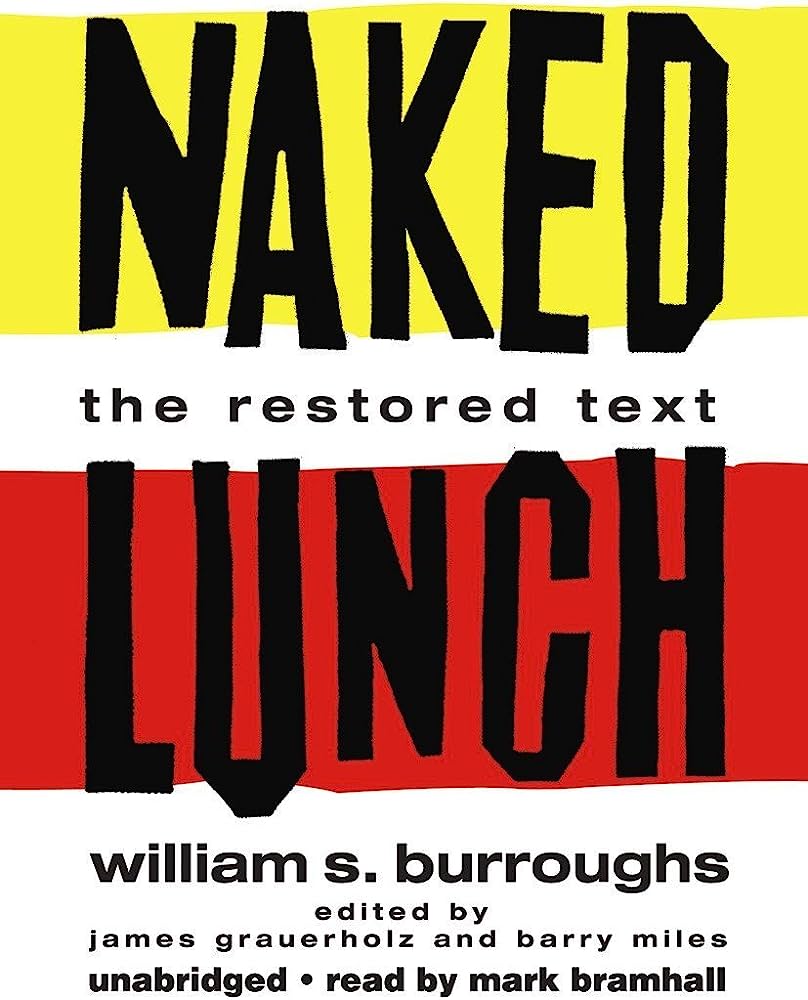
Anyway, the next book I had put on my list was Naked Lunch. I am not “ready” to write this review; the book is still worming its way through my brain; the extent to which I “get it” is not much farther than a certainty that there is something to get (skeptical readers: I promise you there is). It honestly feels something like the congealing protoplasm of one of Burroughs’ junk highs–gobbets of meaning sloughed off of reality, free-floating despite their truant obligation to be connected. Burroughs himself helpfully reaches up and jigsaws some of the slime via postscripts and afterwords: this book is about the twisted economy of opiate addiction. This book is about countercultural homosexuality. This book is about capital punishment and the violence of invasive government. Beyond that, based on secondhand accounts and editors notes, it seems like even the author was somewhat confused about what Naked Lunch really was. It makes one feel better at least.
The book comes out swinging hard:
“I can feel the heat closing in, feel them out there, making their moves, setting up their devil doll stool pigeons, crooning over my spoon and dropper I throw away at Washington Square Station, vault a turnstile and two flights down the iron stairs, catch an uptown A train…Young, good looking, crew cut, Ivy League, advertising exec type fruit holds the door back for me. I am evidently his idea of a character. You know the type: comes on with the bartenders and cab drivers, talking about right hooks and the Dodgers, calls the counterman at Nedick’s by his first name. A real asshole. And right on time this narcotics dick in a white trench coat (imagine tailing someone in a white trench coat. Trying to pass as a fag I guess) hit the platform. I can hear the way he would say it holding my outfit in his left hand, right hand on his piece: ‘I think you dropped something, fella.’”
Yeah, so maybe you’re quick, but for most I expect the language hits like cold water. The Beat slang, the pace, the not-really-stream-of-consciousness–more stream of words–simultaneously inscrutable and frantically modern (despite being written when my grandparents were kids). I had to read it like three times. You get used to it. You have to, there’s a whole lot of book, and it’s all written at least as incoherently as that.
The book is nominally written in vignettes that can be read in any order. I’m not totally sure if that’s true, but the chronology is by no means definite. At the beginning, you can sort of settle into the makings of a narrative frame: You’re following Bill Lee, junky, dealer, all-around ne’er-do-well, as he flees west across the U.S., through Chicago, down into Mexico. Context is hazy, descriptions of places and people are weirdly transient, allusions to titled-but-nameless figures such as “The Vigilante” or “The Rube” abound, and you start getting the picture of a heavy–but amusingly unhinged–noir.
But the descriptions get more and more detached from reality. You encounter an anecdote of Bradley the Buyer, a cop who never actually does drugs but picks up a contact habit from the act of buying them in stings. One thing apparently leads to another, and he turns into an ectoplasmic monster and assimilates his commanding officer. Among other dubious accolades, Naked Lunch makes better use of the onomatopoeia “schlup” than any other in literature. Anyway, shortly thereafter, the continuity breaks with the introduction of the highly disturbing Dr. Benway, and the ensuing 50% of the book’s material can best be described as phantasmagoria.
What does that mean? Well. It means it’s a great melting pot of senseless violence and animal sexuality; monstrously disinterested cruelty; every racial, misogynist, and homophobic slur imaginable–and others besides, along with a collection of derogatives that would certainly be more offensive if anyone used them these days–and for whatever reason, more semen than would be appropriate in erotica of a similar length. “Um, was it worth it?” Fuck if I know, though I can’t really say I enjoyed reading it. I took two things from it, though: First, in its picture of “the Interzone”, it reflected some essence of the carnival nightmare of existence between cultural identities, something which Burroughs, a cultural public enemy in America who spent his life flitting between his home country, Mexico, Europe, and Morocco, must have understood deeply and darkly.
Second, well, a digression first: Burroughs states explicitly in an afterword that the more violent and allegedly pornographic sections of the book were intended as an indictment of capital punishment, a description that strikes me as…strategically incomplete. The role of the state in dehumanizing, immiserating, and, yes, killing its populace is certainly spotlit in these and other sections of Naked Lunch, but the vitriol of the phantasmagoria seems to me to be about much more than government. It feels almost like emesis, vomiting out a hideous concentration of cynicism, frustration, and fear which Burroughs might very reasonably have swallowed involuntarily in his fifteen-year journey as a junky and gay man in ‘40s/’50s America. But he doesn’t seem to be much for naked self-pity. Hence the form.
The book resolves to coherence again at about the 70% mark, where the madness of the Interzone gets grounded around a more meaningful description of its power players (A.J., Hassan, Fats “Terminal”, and the other Agents) and its political parties (Factualists, Liquefactionists, Divisionists, and Senders). The former comprise the closest thing the book has to traditional characters–real personalities with (admittedly hard to decipher) wants, collaborating and competing toward their various and nefarious ends. The parties, meanwhile, are some of the book’s more interesting allegories, representing, apparently, something closer to worldly philosophy than strict politics.
Literally, three of the four rely on the Interzone’s surreal physics in order for their outlooks to make any sense. The Liquefactionists believe that ultimately, all of the protoplasm that forms each person’s essence will fuse into one. For them, it’s true, zero-sum schlup or be schlupped. The Divisionists are kind of like the opposite. They are obsessed with replicating themselves, though their endgame–where one mass of replicants has outcompeted the others, and everyone is just a copy of the same person–is much the same. Ditto for the Senders, a telepathic hive-mind in thrall to “the Sender” who collapses cyclically from the strain of sending all of themself to the receivers, leaving a void for a new Sender to fill. The Factualists seem primarily concerned with antagonizing all of the other factions, leaving some ambiguity as to whether their “factuality” is actually pragmatism or simply contrarianism.
Crudely, one can map the Liquefactionists to a “conqueror/capitalist” mindset, one that perceives the world as a rat race to be dominated at an individual level. The Senders are the religious, spiritually, and philosophically-inclined, who believe in the power of ideas, heedless to the inconvenient truth that in any given exchange, there is only one person talking at a time. The Divisionists, meanwhile, are the culture warriors who perceive the good of civilization to be a numbers game (a decent parallel to the Birchers from Burroughs’ time, the precursor to the modern U.S. right-wing propaganda machine). And the Factualists, with whom one must assume Burroughs identified himself, are the existentialists who, despite having none of the answers, are quite certain they disagree with all of the above.
Naked Lunch eventually ends in a dreamlike swirl of its dark images, leaving virtually all of its conflicts unsatisfactorily resolved. But it was never a book about resolution. It’s a book about going under, about the heavy, excruciating climb out of the water thereafter and the uncertainty of falling in again–or your ability to make it out again when you do. I won’t say it’s a must-read. A family member recently described a similarly unhinged book I recommended to her as “things you shouldn’t know”. This is a lot like that and much more disturbing besides. But it does feel true to a certain inebriated stream of experience. I believe Burroughs, and I think I’m better for having heard his thoughts. With some curiosity and an appetite for painful language, perhaps you might be as well.
A story told by fallen leaves in the style of a young Nietzsche
***
Note: To be clearer to those less familiar with the context, this is a discussion of various literary themes (or just personal points of interest) in Elden Ring. It’s meaty for a series of essay-fragments, but disconnected and certainly not a complete treatment of any of these topics, much less the game as a whole. The style might be something I return to–temporally, though, I had just been reading a collection of Nietzsche’s earlier aphoristic work (alongside, as I mention, Borges), and it seemed a decent way to expound upon the contents of my brain at the time.
Cross the fog to the Lands Between. In the tradition of Bloodborne (and in contrast to Dark Souls) Elden Ring is rather forthcoming with the metaphysical nature of its action. The Lands Between are ruled by a goddess who has banished the very concept of death, power is conferred by “runes” (including the Elden Ring itself) and “grace”, individuals physically accomplish insane, abstract tasks like “holding the constellations in place” or “literally being two people” (including the fecundity implied by a less abstract multiplicity)–no need for the subtlety of a bird ride that transcends substrates of reality, but that’s okay. I mean it genuinely. It is often okay to say what one means, especially with the cat so far out of the bag.
Familiar Miyazaki-isms return: The fog from without the Lands Between again symbolizes the shifting becoming of materiality giving way to the divine being of grace (the Christian through-line) and runes (the Norse through-line, perhaps to be taken as Viking geometry, linking the metaphysical language to the old Platonic stand-in).
Perhaps it’s the Borges I have on my brain at the moment, but it’s all rather evocative of a labyrinth. Lands of resolved solidity delineating (forming pathways amidst) the fog (or vice-versa–the negative of a labyrinth is also a labyrinth)–I sure don’t have any idea what it was meant to house (or I lack the energy to enunciate it–you guess which), but labyrinths are awesome and, definitionally, provide both a goal and at least one path to tread in one’s delving.
***
Long lost grace. Grace, the guidance of gold, a network of glittering signposts and rest stops left by the Greater Will (the Outer God from which the Golden Order and the Two Fingers arise; and against whom both Marika and Ranni rebel), a golden glow in the eyes of the blessed–beyond its utility as supportive game mechanics, it sounds kind of like “purpose” and even more like “commandment”.
For the player character it’s a rough constant, but it’s worth considering the others for whom it comes and goes. Back before the Shattering, Godfrey, First Elden Lord, was divested of grace and “hounded from the Lands Between”, as far as I can tell not for any indiscretion, but because he fulfilled his commandment. He was done conquering the Lands Between in the name of Marika and the Erdtree, so as is only just, she banished her champion and the father of (some of) her children and remarried…herself. Divinity certainly is a strange thing. No one would appreciate me extrapolating this logic to IRL religion, but it’s worth ruminating on this characterization of “divine love” and the rules it plays by.
Anyway, when Godfrey is banished, loses the guidance of gold, he becomes Tarnished. Because From Software spends approximately a bazillion dollars (or at least hours) on English translation, we should be careful with their words–and we should be very suspicious when it looks like they aren’t. To which end, pure gold doesn’t tarnish–silver/other stuff does. The implication, then, of calling the Erdtree’s discarded guardians “Tarnished” is subtle but important: The golden grace which they formerly held was not a transmutation of the soul but an alloying. They, at base, are not gold but silver.
Sound familiar?
“I said; ‘but all the same hear the rest of the story. While all of you in the city are brothers, we will say in our tale, yet the gods, in fashioning those of you who are fitted to hold rule, mingled gold in their generation, for which reason they are the most precious–but in the [guardians, Samzdat’s words] silver, and iron and brass in the farmers and other craftsmen.’”
-Plato, Republic
TL;DR/#AllGreek2U, the rulers are gold, the soldiers are silver, everyone else is economically replaceable, and in the Lands Between, we sometimes stuff warriors into cabinets (or jars) until (or, more realistically: so that) they get corroded and gross. It’s worth considering as well that (Plato’s) Socrates presented the city based on the noble lie not as an ideal city (as he might have claimed for plausible deniability) but as a hellscape, a festering city, an absurd monument to the tendency of human complexities toward strife.
You can blame the genre or the philosophy, but either way the result is what you’d expect: Strife arrives, the gold-souled rulers are proven untrustworthy (or at least unworthy), so the conduits of grace on the ground begin unearthing their guardians. In other words, they not only followed Adeimantus’ bad example–they followed his bad example badly.
This is to say nothing of Miquella, child of Marika alone, who championed “unalloyed gold” as a countermeasure to the influence of the Outer Gods. Because philosopher kings are clearly the solution.
***
Game of rings. “Sonic or Gandalf?” Depends on how fast you are.
An obviously relevant point of discussion is that the development of Elden Ring’s pre-Shattering mythos was a collaboration between Miyazaki and the much vaunted (though perhaps tarnished in his own right) George R.R. Martin. Less obvious is exactly why this is relevant. We do know that the collaboration was not longitudinal: Martin’s involvement was at the beginning, in creating a “D&D sourcebook” for a setting that Miyazaki would then twist. What’s not clear is where the line is drawn–the degradation of the Lands Between was not by a single event, be it the Shattering (the war), the shattering (of the Elden Ring by Radagon), the Night of the Black Knives (which likely catalyzed both), or the banishment of Godfrey (which exposed–or even created–the cracks in the order that led to all the rest). Miyazaki has commented that some of the characters ended up unrecognizable from Martin’s original submission, but that raises more questions than it answers (like the degree to which that difference is editing versus the in-story corruption of the Shattering). All I can say now is that I would give not-zero appendages to see Martin’s original document.
In the same vein, I’ve long wondered about the particulars of Miyazaki’s collaborative strategy. The structure of this arrangement is particularly clear (in spite of the aforementioned ambiguities), in the sense that such arrangements must exist in most, if not all, collaborative works of long-form literature, and we, as onlookers, rarely get this degree of insight. Meanwhile, during the development of Elden Ring, Miyazaki was also directing Sekiro, on which he has stated he took a backseat on most of the object-level writing. Yet: Sekiro remains a beautifully-written work with the same hallmarks of style and attention to detail. I realize this observation is nothing especially profound, but I’m still curious about the nuts and bolts: Is Miyazaki himself especially good at directing his own style? Are From Software’s processes particularly conducive to that style? Do they simply maintain a staff of talented and faithful imitators? I have no idea, but I would love to understand how I could scale my own work in the same way.
***
Yass, King, I seen’t it! There’s something cowardly to me about getting too low-level in one’s critique/analysis, but there’s one piece of Elden Ring for which I’ll flirt with the lower bound of my standards.
Miyazaki has said before that his favorite boss in Demon’s Souls is the Old Monk, the proprietor of a tower in a swamp who was driven mad by a relic he acquired: a long, flowing, vibrant yellow robe. His reasons for liking this boss are likely multiple. There’s a lot to like, from the super creepy aesthetic (it’s instilled in me a lasting affinity for piles of discarded chairs), to the fact that the fight is not against the monk himself but an invading enemy player “possessed” by the robe (a mechanic which reprised its role in Dark Souls 3), to, of course, the literary reference. Hidetaka Miyazaki, too, has seen the Yellow Sign.
That The King in Yellow is so close to Miyazaki’s heart (or at least his portfolio) makes his use of the color yellow in Elden Ring nearly unignorable. To be fair, even not taking that into consideration, the precision (and deliberate obfuscation) of it is diabolical–or did we think that the representation of no fewer than four distinct (and bitterly-opposed) factions by nearly-identical yellow particle effects was merely sloppy art direction?
For accounting: The Golden Order, the “good guys” in the quest for a restored balance via the Elden Ring are, insofar as they are in any way a united front, represented by projections of pale yellow light and a predictably golden aura. Those Who Live in Death, worshippers of Godwyn the Golden (the first demigod to die) who would see the rune of death reintegrated with the Elden Ring, are characterized by a golden aura intermingled with black smoke, as if to connote some corruption of Godwyn’s original purpose. Similarly, the Omen, the curse of horns and filth that cuts its victims off from the Greater Will (see Margit/Morgott, Mohg, and the Dung Eater) is the same gold, interspersed with brown. And of course, the Frenzied Flame, ender of life and bringer of madness, is also yellow, this time more saffron–though it is scarcely distinguishable from the Golden Order’s particle effect when it is in an NPC’s eyes.
Far be it from me to offhandedly summarize the “point” of The King in Yellow without citation, but I think a respectable try looks like:
“A sort of madness, transient or not, of devotion to something larger than ourselves, even–especially–at the expense of the reality we would otherwise affirm, is endemic to the human condition.”
Shabriri and the Frenzied Flame thus stand at one end of the spectrum, wearing the same color but demonstrating, perhaps, just how deep the yellow/gold rabbit hole goes, while the remaining Erdtree derivatives reticently acknowledge that all that glitters, well, maybe it has something in common.
Less artistically but 100% also the point: The narcissism of small differences is often much more bitter than any rivalry with an alien Other.
***
We’ve made some improvements to the chapel since 2015. Furthering the “thematic connection to Bloodborne angle”, the two games’ use of runic alphabets is worth interrogating, and Elden Ring in particular gives a useful starting point for the aspiring Lorax linguist: the tree. The Lands Between admittedly incorporate several linguistic traditions (Latinate, e.g. Raya Lucaria, Dectus; descriptive English, e.g. Volcano Manor, Redmane Castle; and of course Germanic, e.g. Leyndell, Fortissax, Placidusax), but since most of them are allocated to the names of specific people and places (which is about how you would expect culture to work), the question of the Erdtree (a more fundamental concept) stands out. It’s definitely a tree, that part makes sense, but per the name, it’s also an “Erd”, so what’s that?
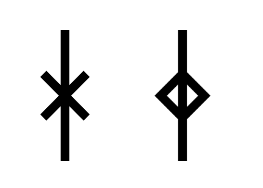
My own leap of logic lands me on “œd”, short for œdal, the Elder Futhark rune for “heritage” or “estate”, a fitting symbol for the Golden Lineage (used also by the Nazis, a connection which I will not explore here). It also seems to be the nominative basis for Bloodborne’s Great One, Oedon (not to mention the Norse god Odin). Except, one problem–the œdal rune looks like this:
And the Oedon rune looks like this:
Actually, no, not a problem, just a connection. You see, the seal of Queen Marika is this:
…which bears reference to Odin’s infamous vigil, hanging from a tree, and closely resembles the Anglo-Saxon rune “ear”, meaning “earth”:
…implying a “heritage of the earth” (Biblically, “inheriting the earth”) or the less grand “earthly heritage”, or both. There are fruitful implications to either.
Note: While I did mention before that these explorations are largely incomplete, it’s worth mentioning the trail of breadcrumbs leading to the “elgaz” rune as well:
The literal meaning of this rune is “elk”, which is a less useful similarity to Marika and the Erdtree, but given its visual similarity to “ear”, it might indicate some connection to the moose/elk-themed Ancestors present in various locations throughout Elden Ring, whose culture is believed to predate the Erdtree.
If we’re going to grill the Erdtree, we ought to do the same with its disfavored progeny. Thankfully, the Haligtree is easy–”Halig” fairly clearly derives from the Anglo-Saxon “hægl” rune
(or “haglaz” in Elder Futhark–aside, I am continuing to reference Elder Futhark mainly because Wikipedia’s entry for it is way better, but evidence points to the Anglo-Saxon runic alphabet being the most appropriate reference for Elden Ring’s runes), meaning “hail” or “precipitation”. Aesthetically, hail is appropriate–the Haligtree is located in the snow-covered northern mountains–but at a deeper level, the significance of the Haligtree is much better understood as precipitation, that which falls from the storm or, less meteorologically, from the heritage of the Erdtree. Miquella is an Empyrean, one of the three potential successors to Marika (Miquella, Malenia, and Ranni, for reference), and he intended the Haligtree to be a new symbol of a new order in the Lands Between. That it should be named for precipitation–or consequence–is entirely reasonable.
Lastly, just as we are shown the modified “ear” as the symbol of Marika, we are shown another rune as the seal of Radagon:
This is a superimposition of the epigraphical and manuscript variants of the Anglo-Saxon rune “gēr”:
“Gēr” signifies “year” or “harvest”, connoted as “year/season of plenty”, which in Radagon’s case might be taken ironically. In his role as champion of the Golden Order, he was “harvested” from his place at Raya Lucaria, ultimately leaving Liurnia in disarray (if not outright ruin), and the metaphor only gets darker in the sense of “harvest” as it applies to fertility.
Radagon and Marika had two children, Miquella and Malenia, both of whom wound up cursed, presumably by the particular degradation of the divine gene pool that occurs when one’s parents are not merely related but are, in fact, the same person. And if the problem of the harvest is a problem of one’s descendants, of succession, then it’s worth noting that the Shattering was literally a war of succession, preceded, of course, by the literal shattering of the Elden Ring–by Radagon.
***
A golden parasite for the golden lineage. Also returning in the Lands Between is one of Sekiro’s most potent symbols: the centipede. The one-armed wolf had a pretty good time with this one–literally, it is a creature that infests the corpses of the divine carp that swim in the Dragon-blessed waters of the Fountainhead Palace. It lines the corpses with its eggs, and as the flesh breaks down, the eggs bleed into the overall water supply, into the runoff that flows to Ashina. Then, when the mortals below drink the water, they find themselves “blessed” with an unpleasant and hollow brand of immortality.
The immortality, of course, is the result of the giant centipedes whose eggs they swallowed, now growing through and infesting their still-living body, though the “why” is definitely where the literality starts to blur. Is it because they are parasites to the divine? Is it coincident, in that the centipedes are themselves divine (which would allow them to devour the carp in the first place)? Sekiro isn’t especially clear on the biomechanics, but it all but bludgeons you with the notion that the immortality granted by the waters of the Fountainhead is only a crude imitation of that granted by the Dragon’s Heritage. A note, obvious within the Ashina province but worth clarifying for the Europhilic audience of Souls/Elden Ring: This is an Asian dragon we’re talking about here, no wings, serpentine, aquatic, celestial (a combination of adjectives worth dragging back to Bloodborne, by-the-by).
It should not be surprising that all of the supernatural creatures present in Sekiro (the carp, the centipedes, the giant snakes of the valley) all bear some morphological resemblance to the Dragon, to the divinity they emulate, but the implied ladder there also calls to mind a fable of a Buddhist monk and a centipede, where the centipede is expounded upon as a lesser creature which may yet regain its honor through rebirth.
Do you see it? Where the paradigm switches around? In traditional Buddhist teaching, the centipede is on the same continuum as man–in Sekiro, the ladder to divinity is snakeybois top-to-bottom, and that divinity (be it the literal gestation of centipedes in your gut or the more metaphorical “feeding” of the Heritage via Dragonrot) is a parasite to mankind. Yeah, religion. Someone call Bong Joon-ho and see if he can work that into the sequel or something.
Right, this is about Elden Ring, but all that is necessary context. So when Elden Ring’s Rune of Death is the Mark of the Centipede and golden centipedes begin to appear in places frequented by Those Who Live in Death, that is the lens we need to use to understand what it all ought to imply.
From the basics, the centipede, originally, is death, a threshold upon which the things that are become the things that were and then fade into the everything from which they were born. It is fitting that the true Cursemark of Death, broken into half-wheels during the Night of the Black Knives, is not one, but two centipedes in a circle. An ouroboros. Fitting for a conception of death meant to coexist with the rest of the Golden Order, but Marika dIdN’t LiKe ThAt PaRt. She cut it out of the Elden Ring, gave it to Maliketh, and what she got was a different death–not integrated cohesively with her Order but jammed askew into its cogs, birthing Those Who Live in Death. For all points and purposes, they’re undead, much the same as the Senpou monks who drank of the Fountainhead in Sekiro, but that is a slim overlap with Sekiro’s otherwise extremely well-developed mythology for the symbol.
With the exception of Rykard, Elden Ring’s pantheon is nowhere near so serpentine as Sekiro’s, but consider the position of the centipede in particular. Our myriapodal friend may be at the bottom of the spiritual totem pole (a turn of phrase made literal in Elden Ring: Godwyn, an unwilling recipient of the Half-Wheel Mark of the Centipede rests amidst the roots of the Erdtree), but the bottom of that hierarchy has more in common with the top than wherever mortal man hangs out (ie, not in the hierarchy at all). The theme of parasitism is not as eminent as in Sekiro, but the game is clear that adherents to the Golden Order are not stoked about the centipede stuff at all, reiterating that even the most reverent dogmatists tend to find some expression of the divine they would rather revile. And, of course, the parasite’s absence leaves an echo: Follow the Erdtree’s totem pole up to the very top to find the Greater Will, overwhelmingly interested in keeping the course of history in the Lands Between confined to its Golden parameters. For a being so immense, so abstract and multifarious, it is difficult to even formulate the question, but in the end, what can mankind be to such a creature? The answer: a pet, a pest–or a host.
In 1948, Vladimir Nabokov accepted a position at Cornell University, teaching Russian and European literature. That same year, he wrote this piece, ostensibly material for his students (though I can find no confirmation of that inference). Go ahead and read it if you haven’t–this will essentially be a review.
My own experience with this essay goes back to high school. I read it then for class, found it completely insufferable, moved on with my life, etc., but now I’m returning to the ideas and finding them mostly correct and very relevant to the “reading” I am doing now with Dark Souls and Sekiro. This is, of course, not psychically painless. Nabokov’s tone is still aneurysmally condescending, and his organizational structures are bizarre, but he’s also One of the Most Important Writers of the 20th Century, so his thoughts are worth a looksee. Take from the piece what you will, it may not be the same list as mine, but in case it’s at all helpful to you, my thoughts are these:
The authors of the classics are smarter than you.
Okay, this isn’t actually one of Nabokov’s points, but it’s a healthy attitude to have and all but prerequisite for digesting the rest of his exegesis. A more plain way of putting it would be to say that in reading a work, you should assume that there is something there of depth. Ironically, Nabokov himself distinguishes between writers of genius and minor authors, but to assume you can tell the difference is astonishingly arrogant. Perhaps Nabokov earned his arrogance. You didn’t–be kind to those you read.
Read, then evaluate.
This is especially important for works that you’ve heard about. Everyone knows Beloved is a scathing indictment of the evils of slavery (and it totally is), but to condense it to that, to go in with those expectations sells short the loving detail (sic) with which its characters are rendered and everything else it might say about what it is to be human.
By the same token, don’t judge a book’s contents by the one who recommended it to you regardless of whether your opinion of (e.g.) Karen is positive or negative. Sure, take a recommendation as an excuse to eat some tasty, tasty typesetting, but don’t let your knowledge of the recommender’s mind preempt your own capacity to interpret art for yourself.
Fiction is generally not historically accurate.
Uh, yes. I’m a little confused as to why Nabokov finds this observation uniquely important, but it is correct, and it has some useful implications regarding the role of art. I’ve alluded to it before, but politics and art have an annoying way of getting tangled up in each other. This isn’t all bad–politics shapes life, life shapes art, why shouldn’t art sometimes be political? Things start turning sideways, though, when one uses political art from the past to synthesize political arguments today; worse: when one uses historical fiction depicting politics that might never have existed to draw conclusions about the present. If the distinction is confusing, let me put it this way: Harry Potter has nothing actionable to say about politics in the 1930s, the 1990s, or the 2010s (I have seen arguments for all three on this lovely internet). I will not accept disagreement on this point.
Attune your reading to the work and not yourself.
Nabokov is much more vehement on this “lowly kind” of imagination, which is a little funny to me. I wouldn’t begrudge someone emotional involvement in their reading material, and I suspect he wouldn’t either, not truly. Rather, I’d guess his war, as with many of these points, is against preconception. If you identify with a character in a story, if you empathize with them, that creates expectations that the author didn’t put there, and expectations cause misinterpretations and distractions.
An example from my own work: If you identify with Les Marquains in this story (and you are not a dangerous sadist), you run the risk of taking the narrative at face value and assuming that his character arc has a distinct turning point. No doubt being raped traumatized him, but he was also abused physically and psychologically his entire life. A very salient question is whether, if his grandfather never learned about his homosexuality, he wouldn’t have gone full despot-de-Sade anyway. Was he on the cusp of acceptance by the common people, a hopeful vector away from his grandfather’s authoritarian rule, or was he just playacting at peasantry? Answer that how you like, but kindness means recognizing that there is a question.
***
The rest of the essay has some ballin’ quotes (“To call a story a true story is an insult to both art and truth,” fuck yeah), and deals largely with the craftsman on the other side of the printing press. It’s a beautiful, if not incredibly useful, description of an author’s own responsibility to his work, but that’s appropriate. Art is a remarkably difficult thing to describe, its manufacture more difficult still, and in writing his essay, I hope you realize he was making art himself. And I hope we can agree that art has minimal mandate toward utility.



 Salt-Powered Investments, LLC
