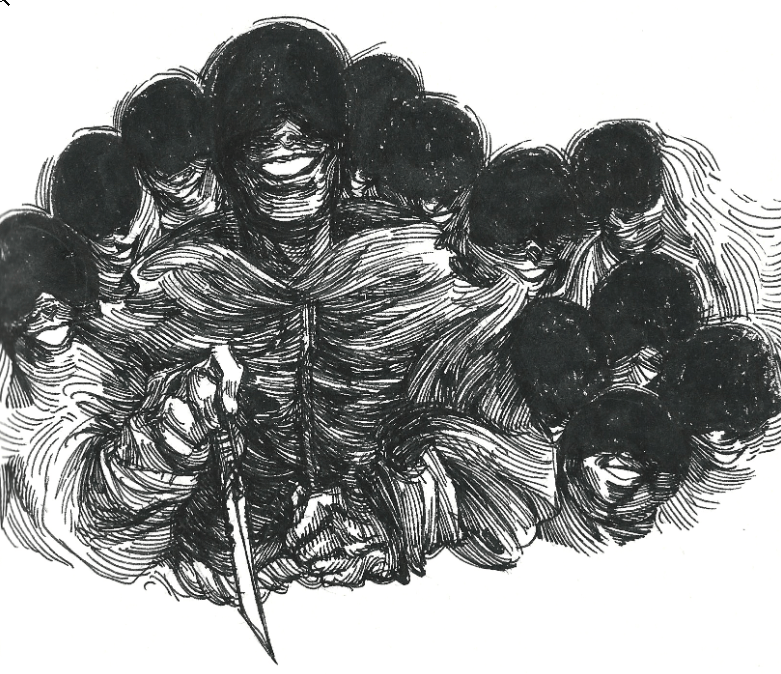
I’ve been quiet the past month, but work is continuing on a number of projects. Rale is ongoing of course (currently chewing away at Sevenfold Gyre Part 6), but I’m also working on a fairly beefy analytical article. A not-so-subtle hint as to its content:
On Doki Doki Literature Club, science fiction, and self-awareness. An incredible volume of spoilers below, so if you have any intention of playing DDLC, play it before reading.
The standard (and pretty moldy) introduction to this topic, I’m told, is Star Trek, but fuck that, there’s tradition to uphold! As always, we can’t just talk about philosophy–we have to insult someone, and, here, “someone” is a distorted amalgamation of John Kessel and Orson Scott Card.
The background, which is in no way current, is as follows: Sixteen years ago, Kessel wrote an essay criticizing the moral thesis of Ender’s Game (published 35 years ago, for reference). As disclaimer, the essay is good, and, frankly, Ender’s Game is good. Moreover, discussion has almost certainly taken place on this topic since the essay’s initial publication (if the “2009 postscript” is any indication), and in Wittgensteinian fashion, I intend to interact with none of it. My concern here is not whether Kessel or Card are habitually wrong nor even whether they are prone to sloppy thinking. Rather, I want to talk about this one particular morass of sloppy thinking because it makes for a lovely journey through something completely different. We aren’t there yet. Patience.
So Kessel writes this essay, tearing into Card’s vision of morality (“moral and immoral standing is determined by intent rather than action”), provides citation after citation of evidence that Card’s setup is hopelessly contrived, and closes with “in the real world genocide is not committed by accident.” Heh. You gotta admit it’s funny to watch a guy shoot himself in the foot, even if you feel bad for him afterward. In case you missed it, the previously glossed-over Star Trek factoid is this: The advantage of the science fiction genre–arguably its primary literary purpose–is that it allows you to consider problems (moral, ethical, experiential) that may well exist but, cordoned off by safeguards in reality that technology has not yet stripped away, just don’t come up in normal, everyday life. So yeah, duh, genocide doesn’t happen by accident in the real world, but did you forget you were a sci-fi author or something?
The real criticism of Card’s setup, the one it looks like Kessel was trying to make, is that he didn’t let the setup breathe. You can’t just wave it all away–the ansible, the genius-breeding programs, the complete and utter control the establishment has over Ender’s life, the layers and layers of vicious abstraction needed to make interstellar war look like a computer game–with an “it don’t be like that.” You have to engage with the argument on its own terms. Here’s Ender, charged with genocide and two counts of manslaughter that the system literally built him for. By virtue of the facts that the system used him for this purpose, that he never intended to kill anyone, that he did not, in fact, know that he killed anyone, does he get to be “innocent”? The answer that Kessel does not dare provide (but which I think is correct, nonetheless): Yeah, I guess.
There’s a second question, of course, and I admit it’s a little suspicious Kessel doesn’t ask it: Ender’s innocent–we’ll even take it as a given. So, uh, what does it mean?
I.
Some years ago, I wrote a novel. I never published it, it was sloppy, whatever, but my setup was similar. It was this: One man has been given credible information that the world is about to end in a magnified Malthusian crisis as human population continues to increase. The event horizon for this apocalypse is one year out. What do?
He considers his options. His evidence is convincing to him but subtle enough that anyone who hasn’t seen it firsthand won’t believe him–thus, convincing any major government (let alone all of them) in a year that there is even a threat is a non-starter. And, of course, this is to say nothing of getting them all to agree on a solution without any defection, tragedy of the commons, etc. That about kills the top-down approach, so what’s left? He settles reluctantly on a cull via mass-murder. He convinces a small set of colleagues to help him build a doomsday device that will wipe out 90% of human life on the planet, and with the effort nearly complete, he (Johnathan [sic], in the below quote) fulfills his obligation as a sci-fi protagonist and ruminates on the morality of it all:
“The problem, Doctor Romanov,” he said, “is that you want me to justify mass murder, and I can’t do that. You can’t justify mass murder.” I stared at him.
“Wait,” I said. “What?”
“The greater good necessitates mass murder, but it doesn’t justify it,” he replied, sitting back up in his chair. “You’re looking at the wrong costs.” I didn’t move, but I began glancing around the room, trying to make sense of the phrase.
“What do you mean by ‘wrong costs?’” I asked, finally.
“You’ve identified mass murder as the cost of the greater good,” Johnathan said. “But that’s not a cost and it can’t be justified. The cost is the part of your identity that mass murder will swallow up. The cost of the greater good, for you, is becoming evil.” I thought about it. I probably thought about it for much longer than an acceptable pause in conversation. Eventually I looked back to Johnathan.
“Becoming evil,” I said quietly. “Complete with punishment, I suppose?”
“Of course,” Mishibezeyu said, leaping onto the table. “Just imagine, you could do what most good people do and commit blazing suicide out of shame for the horrible things you’ve done.” The cat smiled. “When the time comes, you could give everything.”
“Or,” Johnathan said, tapping the table. He was obviously annoyed. “Or you could not do that. A better solution: You could live through it, shoulder the responsibility, bear the pain of guilt–”
“And give more than everything,” I said, still mulling over the notion.
-The Torment and Misery of Samuel Delacroix, Chapter 41
First, yes, my thesis is not Card’s. I’m gonna throw out there that if you commit genocide, you deserve social censure no matter how justified it was. Fittingly, Johnathan’s collaborators attempt to murder him when this is all said and done. But be that as it may, I’ll still take a joyride in Card’s boat because that’s what the setup deserves.
Is Card’s setup contrived? Hell yes, and so is mine (the contrivance is a plot point–we aren’t there yet). But the proper response to a question is not to deny its pretext. “It doesn’t work that way.” Yeah, but what if it did? What if you could be manipulated into committing genocide through no fault of your own? What does that imply? I’ll quickly jump back to Kessel’s side to agree that it certainly does NOT mean that people in general are good and bad independent of their actions, but I think the hangup might be on the question itself. I’ll substitute it with a different one, less direct but perhaps more illuminating: What happens next?
For Ender, this is vague penance by way of attempting to reseed the Formic race as well as lifelong devotion to the construction of a philosophical/religious framework meant to validate that what he did was Not Evil. Meanwhile, he peaces out to another solar system and disavows his identity as, predictably, people turn sour at the fact that he committed genocide. We can probably give Card a break here–this is well within the realm of reasonable consequence for what went down–but does it exonerate Ender? Haha, no. The Nazis who made it to Argentina are, of course, free to live out their lives in the haze of whatever cognitive framework helps them sleep at night, but should they ever reveal themselves, it seems fair for the system to scrub them, right? So too with Ender.
“So what does that imply?”
Can a person commit genocide and still be good? Kessel shoots back a categorical “no”; Card tries for a “yes”, and I see why. Whether Jesus of Nazareth might be responsible for the millions killed in his name–and all the other similar questions–demand answer in this age of increasing hostility to religion, but Card’s thought experiment, his overwrought and careful setup to make the sequence of events possible, offers no relief. Ender’s Game simply doesn’t answer the question.
II.
Yes’s and no’s are rough, so let’s move onto something completely different. As the title might suggest, I’ve been playing Doki Doki Literature Club. In case the title did not suggest that to you and/or you have no idea what the fuck I’m talking about, Doki Doki Literature Club (DDLC) is, nominally, a visual novel. Since the setup here plays on your expectations, the expectations you “should” have are these: This is a narrative-focused game that will place the player in the shoes of a high school student attending an after-school literature club. Through limited and gimmicky mechanics for player input, you will be able to romantically pursue one or more of the other (female) characters in this literature club. The characters are tropey, and the aesthetic is clearly for people who like anime/manga/cutesy Japanese things.
“Sounds like trash.” An aggressive opinion, to be sure, but I won’t really disagree. The twist is that those are just the assumptions presumably intended by the branding. The setup is actually this: One of the four characters, Monika, is aware that she is in a dating simulation, is aware that there is no plotline in this game that gives her a happy ending, has access to the game files/source code, and is altogether not pleased with the whole affair. This, of course, is playing a little fast and loose with the fine line between being a deconstruction of the genre and a Bitch You Thought prank, but it’s very well written, and once you peel away the slough of what the game is pretending to be, it cuts pretty deep. The topics include fairly honest discussion of some of the heavier issues high schoolers go through (depression, self-harm, parental abuse, everybody’sgotbaggage, etc.), but the meat of it all isn’t a high-school slice-of-life quandary–it’s a sci-fi one, one that our rapidly increasing proximity to functional AI is making more apt every day: What happens when an artificial intelligence discovers its circumstances?
This is a broad question, so I’ll here clarify that this is not the [killer robot/singularity/end of human civilization as we know it] angle. That has its own questions, but they’re all pretty irrelevant here. Rather, this game is posing a more benign, much more individual question: What is it like to be a simulated being who knows they are a simulation?
III.
Oh wait, I wrote this too:
“But what will happen to you when we actually open the second chamber?” Christophe asked. Benjamin raised an eyebrow, evidently confused.
“What do you mean?” he asked.
“If all of this is virtual, like Espereza said it is,” Christophe said, “then you’re part of the program. Won’t you disappear when all of this ends?”
“I’m…part of the program?” Benjamin asked. The concept was obviously disturbing to him. “I..um. I don’t know. This is a program?” He looked around the circle. “Are you saying that I’m not real?”
-The Torment and Misery of Samuel Delacroix, Chapter 21
The obvious first sub-question is whether the simulated entity is a simulacrum or a “person”. In my own work, it’s solidly the latter, as the distinction between real and virtual space is vanishingly ill-defined and the simulations wind up escaping into the real world. DDLC has a rough time with this one, though, and it relies on goodwill from the player to interpret it kindly.
A lot of this is the game’s length: It’s very short, and while the questions it explores are good and the methods of exploration (glitching, psycho-horror, fucking with game files as a play mechanic) are innovative, the lack of weight makes it easy not to get invested. If you aren’t invested, you are more tempted to look at the overall work as a prank rather than a deconstruction, and you won’t pay as much attention to Monika’s dilemma–she isn’t a person; she’s an image of a person, pretending to be a broken simulation.
While this is “true”, it’s a little heartless, and besides, when was the last time you read a novel where the characters weren’t literally simulacra? “Why are we even discussing Jean Valjean? He isn’t a person, he’s just symbols on paper pretending to be a person.” Yeah, well you’re not invited to dinner anymore. This is the setup. You can’t walk away from the Ender’s Game argument yelling “it’s just a book, man!” You need to engage with the setup on its terms, which for DDLC means taking as given that Monika is a person.
DDLC does take the extra risk of having Monika address–indeed attempt to court–the player directly, but the wall is one-way. She can speak to you, but you can’t communicate with her, except via the options the game provides, which become meaningless as she dismantles the plot they were meant to support. Still, as we consider her dilemma, it becomes an interesting exercise to pick out the pieces that are her character and those that are artifice, which is to say, part of the setup implied by the deeply flawed simulation in which she is trapped.
For example, she is absolutely smitten with you, despite absolutely no knowledge or experience of who you are–is this part of the simulation? Is it inherent in her identity that she should be in love with this presence that she can just barely detect behind the player character? Or is she just a teenage girl who has caught a glimpse of a world far grander than her own limited horizons, who has latched onto the only identity with which she can associate that alternative? Frankly, both possibilities are pretty cursed, but this is a good jumping-off point. We have our setup–what happens next?
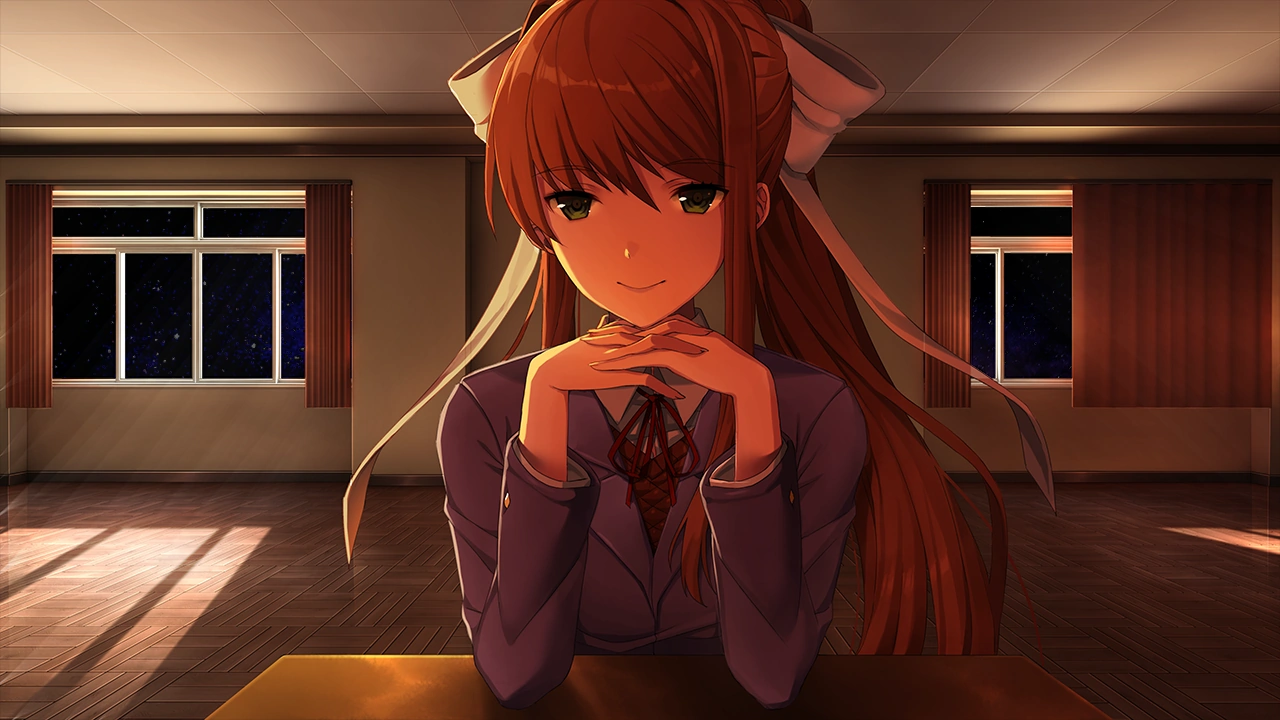
Well, first she drives the player character’s best friend to suicide to stop them from falling in love. Then she does the same to another potential love interest (albeit in a much more horrifying fashion) and finally just says “fuck it” and deletes all the rest of the game’s supporting infrastructure. All that’s left is her, staring into your eyes from a room suspended in space:
Her plan is apparently to “date” you, which seems to entail her staring out of the screen and you staring back in forever, except for the times when you really need to get up, in which case you can bring her along in a flash drive or something. Yeah, you can say it: That’s whacked. But is it killer-robot whacked or just depressed-teenage-girl whacked? I’m sure Baudrillard would like a word, but I’m gonna err toward the latter. Fucked up programming is only so interesting of a motivation–let’s look at it through a slightly different lens.
Monika admits in her “confession” that she wasn’t just motivated by jealousy (though it seems a pretty hard part to ignore). She had begun to see her world as grey and two-dimensional, had become hyper-aware of its shortcomings and limitations. Her friends weren’t “people”; they were just semi-reactive collections of dialogue meant to support the game’s plot, and, feeling completely and utterly alone, she was just about ready to kill herself before she realized the player character was a window to the outside. Remember, a priori, she’s a person. What does that mean?
Well, first, the friend thing, even by the logic of the game, is hogwash. Though Monika seems to be able to fuck with their memories and cognition, the other characters do, in fact, react to non-plot events. After the second character commits suicide, the last remaining member of the club walks in after 72 (in-game) hours to find you standing over her rotting body and, in a very human fashion, freaks the fuck out. Likewise, as Monika begins tweaking their personalities, the other girls certainly notice. They take note of the changes in their perception, they feel that something is wrong. Consider the numerous historical examples of how easy it is for a person under stress to discount the humanity of another human. I don’t feel like it’s a stretch to assume that they’re as real as she is. Likewise, “grey” and “two-dimensional” could be reference to the medium, but they fit “anhedonia associated with major depression” even better.
Before this gets too bizarre, no, I’m not saying we should look at this medically. I’m saying if you’re looking at a person’s behavior, put yourself in their shoes. Let’s say you, in some freak epiphany, get absolute, unequivocal confirmation that there is an outer world, and someone is looking in, watching you. “Sounds like schizophrenia.” Sounds like you need to go back and read the Ender’s Game section again. It doesn’t matter whether accidental genocide happens in the real world; it doesn’t matter whether you would actually be convinced that the world was going to end in a year; it doesn’t matter whether the nature and quantity of proof necessary to make you believe you live in a video game is implausible–that’s the setup. Should you become convinced of this, what might you feel?
Could it be depressing? Could the sudden smallness of your world affect what it means to you? What if you could access pieces of the code that governed your world, such that you could see bits and pieces, you could see the plan the simulation has for you? What if that plan was just that you should just be a set-piece, a spectator on the sidelines of life–except you’re not even there to see anything. It’s even worse than that. You’re just there to be seen. It isn’t entirely without upside: You can change the code, but no matter what you try, you can’t create with it. You can only make things worse. All in all, I think two outcomes are clear: I would expect you to be upset, and I would expect you to be very interested in the watcher.
IV.
I dearly wish DDLC had gone there more readily. Make no mistake: It went there, but the sheer brevity of the game prevented it from diving in, and dear god, there is a lot to dive into. As it was, it hinted at that depth, but mostly it was just sad. All of the characters are, ultimately, compelling examples of humanity that you get to engage with only barely. There is no resolution, there is no reparation; even with a lot of fiddling, the best you can really maneuver it all to is a vague impression of bittersweet. And for Monika, even the best ending involves near erasure from existence (you have to delete her character file from the game directory). Frankly, it fucked me up for days.
And after all of it, I have to wonder if I don’t already feel the same sort of hopelessness, living in a tiny corner of a vast reality as the Powers That Be watch with disinterest from above. I can see how the gears turn, driving the system forward, but I can’t really bend them to my will. I can chuck a wrench in, maybe fuck someone’s life up. I can certainly hurt myself, but I’m mostly just a spectator, and it’s not clear that it matters whether I watch.
“What’s the point when none of it is even real?” Monika asks, having destroyed her reality so that she can stare you down on the most equal terms her circumstances allow.
Through the whirring, root-lined passages of the workshop, a diminutive figure shuffles along. Where there is open space, she observes the goings on, the maintenance of her domain, with muted interest. At the periphery, tiny, metal spiders clink and clatter on about their thousand little tasks, sweeping away dust, digging, polishing, sometimes even melting themselves down, embedding themselves in the tunnels as struts and beams, retaining enough function, though, to click and whir and watch. Her workshop was alive, the figure mused with a smile, so unlike the houses of men.
Where the ceilings were high enough to permit them, her other servants labored in studious silence. Men–and women, she supposed, though it hardly mattered anymore–made of ticking metal transcribed and translated her library, organized the tables at the center of her workspace, banished her abandoned projects to the corners of the room, and, when so requested, retrieved them. Their tasks were not difficult, but they were not easily programmable or required more heft than the spiders offered readily. Either way, the metal men did them gladly–they were grateful for the life she had given them.
Pensively, she scaled a stool, producing a host of spindly appendages from within her black robes which carried her into the seat with the undulating grace of a centipede. She had been traveling–not physically, of course, but through a proxy–and the effort of the conscious projection invariably wore on her. Still, she was disinclined to display any affect outwardly, though it was doubtful her servants would have noticed or cared. She had notes yet to make, and fatigue–even the magical variety–was an enemy to which she refused to succumb.
From a stack on the table, she drew a leaf of thin, papery material and licked her finger, secreting a drop of oily, black ink from the reservoirs in her salivary glands. Splitting her finger into eight much finer-tipped instruments, she lowered them to the page, where their twitching, seemingly random and erratic in the air, began, precisely and rapidly, to inscribe her thoughts:
On this 1237th year of the Exsanguine Era, it has come to pass that open practice of the Way of the Green has been all but eradicated here in the Riverlands. The popularity of anti-magical “Harmony” movements in the wake of the Incident has evidently left it little room to grow, and what texts remain of its rites all seem to have disappeared into the Papacy’s vaults, likely to be burned or twisted beyond reasonable recognition. Thus, it has fallen to me to generate a more trustworthy record of the institution. This is necessary, I would submit, both for the value of the knowledge in itself as well as for a speculative angle of analysis. After all, the diaspora of the Greencircle, in more than a single sense, can be held responsible for the Riverlands’ worrying modernity.
To begin, the Way of the Green, distinct from the Greencircle as day to the sun, was a movement, and like any popular movement, it was fragmented in its purpose. Its intentions and praxis varied wildly among its constituencies, and any anthropocentric account of its history is sure to be flawed for this reason. This is fitting, of course, as its origin had little to do with humanity. The Greencircle did not congregate there in the Bloodwood to found a movement, and they were certainly uninterested in teaching a way of life. Rather, the Greencircle was a reaction, itself, to an external threat.
Some 500 years ago, by my best estimate, the folk hero known popularly as the Hunter of Beasts raised a call to arms among the aspiring heroes and scholars of the Riverlands. He sought an alliance meant to destroy a monster deep within the Bloodwood, a ravenous, devouring mass he called the Hunger, though it was a subsequent name–the Chimera–that found its way into the local lore of the time. A great number answered his call, for the Hunter was well-known at the time, and he soon led a host of glory-seekers on an ill-fated quest to slay the beast. Nearly all of them perished. Most among the company were inexperienced, blessed by talent or ambition but no art, and vanishingly few had cunning or strength to match the Hunter’s. So bereft, they made of themselves easy food for the Chimera. Far more notable than the casualties, though, were those that survived. The organization they formed thereafter, though it had no formal title, became known as the Greencircle.
Chief among its members were the Wolf–also called the Masked Alpha–a powerful hermit mage and self-styled “protector” of the forest; a pair of scholars, a Botanist and an Arborist whose names were not recorded but who are noteworthy nonetheless for their success in translating the Chimera’s ability to manipulate flora into a teachable magical art; and, of course, the Strange Bird, ostensibly just a talented, one-eyed hedge witch, though her enduring influence–and the macabre nature thereof–raises serious questions as to the innocuousness of her identity.
Now, for a period of some twenty years–an average of the retellings I’ve gathered–this organization–which is to say the Hunter, those four, and their closest followers and aspirants–were an open and public institution, well-known among the villages in and around the outer Bloodwood. Following their disastrous confluence, they tempered their aim of destroying the Chimera, instead focusing on containment: repelling the beast from woodland villages and–to a reasonable extent–keeping it confined to the wood’s heart, where it posed little threat to the “civilization” outside. In so doing–for all the Greencircle were learned mages–they uncovered and codified magical knowledge to rival that of the ancient universities, including the bases for what I would now classify as three distinct schools of magic. The organization was loved and respected as protectors of the people, and soon, the discoveries and philosophies of its members began to spread beyond the Bloodwood and throughout the Riverlands.
The words I have chosen, however, are very particular: The Greencircle had little in the way of a unified worldview, save, perhaps, for the agreement that the Chimera was dangerous. Regardless, what proceeded to spread among the people, known collectively and indiscriminately as the “Way of the Green” were the ideas of the Greencircle’s individuals.
What this meant, of course, differed by both origin and adherent. The Wolf, for instance, inspired a tradition of copycats, practitioners of his shapeshifting and cannibalism, albeit with only a fraction of his zeal for the defense of the wood. Meanwhile, devotees to the Arborist and Botanist practiced their plant magic and maintained a calendar of rituals to honor the flora of the world, within their spheres of experience and without. Alone among them, the Strange Bird’s followers formed a longer-lived organization, but I will return to that discussion separately.
Despite the spread of the Way of the Green, the Greencircle itself remained focused throughout this process on the danger of the Chimera, and to judiciously interpret various accounts of the Hunter’s temperament at the time, that focus was not bearing fruit. While the creature voraciously consumed–or, perhaps more accurately, assimilated–all flesh in its path, it seemed to matter little whether that flesh was human or even faunal. The Greencircle’s work in deterring the Chimera from human settlements had thus been admirable but futile: While the humans remained, the once-small region where the beast dwelled had increased tenfold in size, and with countless new mouths, its rate of expansion had multiplied accordingly.
Nearing a point at which he surmised they would be hopelessly outmassed, the Hunter brought the Greencircle’s considerable magical expertise to bear in an effort that was, while clearly significant, ill-documented and historically unclear. From the accounts and scraps I have amassed, I am to ascertain that it incorporated a ritual employing numerous mages; that it was successful, insofar as the Chimera is not mentioned in any record thereafter; and that it was quite costly. Notably, it is clear that neither the Botanist nor the Arborist survived the ordeal. How many others might have died alongside them is, of course, unclear, but it is well-recorded that the Hunter of Beasts at that point ceased his engagement with the Greencircle, effectively dissolving the organization.
While the Way of the Green flourished for centuries thereafter amidst the Riverlands’ long-harbored thirst for a magical and cultural identity distinct from that of the eastern domains, the more interesting epilogue to this story is with regards to the Strange Bird. Her followers, known as the Feathermen in the years after the Greencircle dispersed, remained in their secluded corner of the Bloodwood until just a decade before the Incident. It is difficult to say what purpose they labored toward, but a few points are clear: First, for a time, the feathermen were known among the villages closer to their domain for their “exports”: trinkets, imbued with Mana, able to perform magic with little input or expertise required from their bearer. It seems doubtful that any of these creations had much use, even at the time, but taken against the veritable–and not altogether benign–economy that thrives for such goods today, one can almost see the Strange Bird’s influence in the here and now, hundreds of years since she was last seen. My suspicion on this point is only deepened by the list of individuals to whom I can draw affiliation with her club.
Le Marquains of the Southern Reaches, for example, made no secret of his training with the Feathermen, and his arrival in the South to quell the Saraa Sa’een well outside the monster’s known territory certainly merits comment. Likewise, witness accounts of the individual known as the Hawk, who assumed control of the Feathermen in the last decade of their existence, bear more than passing resemblance to those of the one-eyed man who led Ka’s armies during the Incident. And, of course, I need rely on no hearsay to recall the tufts of feathers that still clung to the Dragon’s hide the day he arrived in my village. That all of these men became generals of the Bloodfish seems both deliberate and in poor accordance with their ideals–the Dragon, in particular, had little apparent interest in Ka’s ravings. I do not doubt, at this point, that this was strategy on the Strange Bird’s part, though now with her pieces–her manipulable Greencircle and Bloodfish–dead and buried, it is not clear for what she aimed or whether some plan of hers might still be unfolding.
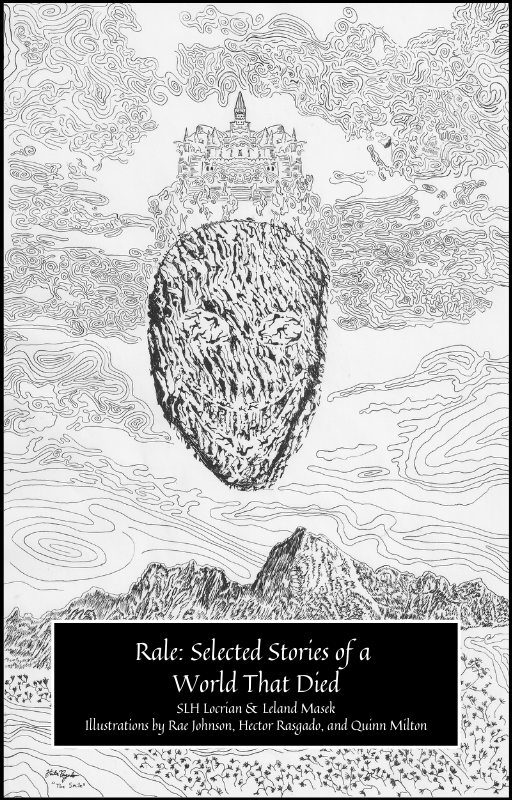
I have compiled (and lightly edited) ~170 pages of stories from the War Torn/Rale project into a reasonably coherent anthology. Many of the stories have appeared in some form previously on this blog. Several have not. It is by no means a finished product, but I am looking for feedback from beta readers. If you are at all interested, drop me an email.
Image: Hacked-together cover by me. Background image is Lies, by Hector Rasgado.
Edit 5/3/2020: I gave this heads-up, and then the length of the story increased by like 50%. It’s done now. Transcription/minor editing is in progress, and I should have it posted here within the week.
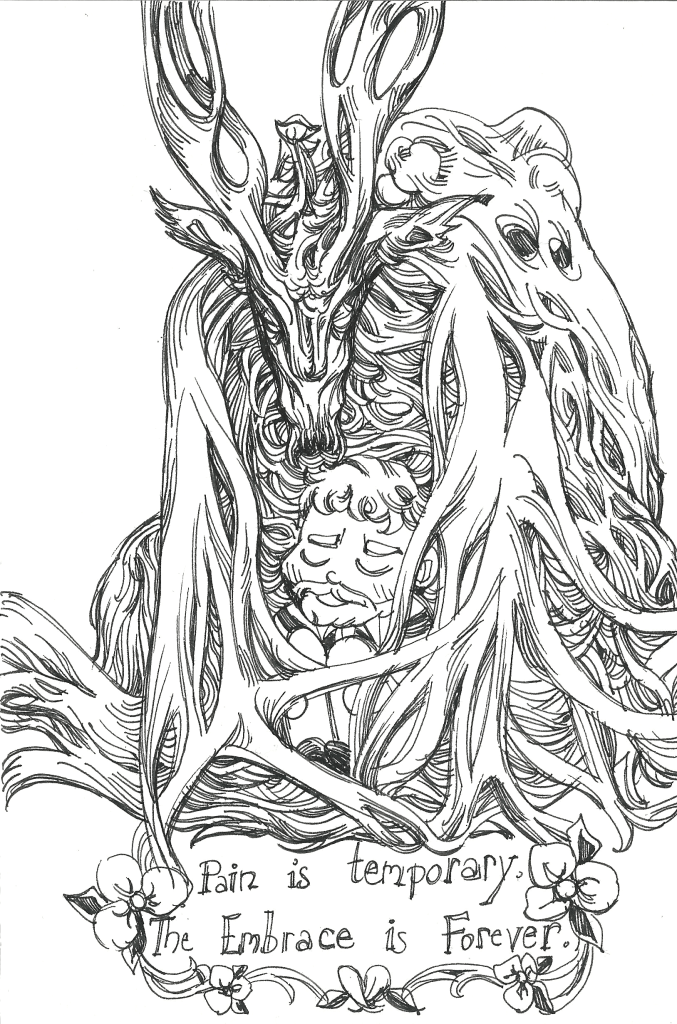
Apologies for the brief lapse in activity–there is a very long story incoming. Stay tuned. Have an inspirational Chimera doodle, courtesy of Rae.
Two decrees, issued under the authority of Her Majesty, [————], Right-Hand Queen of Spar, presented below as they were circulated, in their original Diarchian. A translation is included as well:
Dacreem Goetcia
Al kinderseiztentreyundtcan enten brainenger Goetcia
Sonaftdoon al Citizia trin hidcitfia Kinder entin deta
Goetria exa entin fin Sonaftop
Translation: Decree of the Goetia
All children over the apparent age of 10 are to be brought to the Goetia.
After sundown all citizens attempting to hide children from the state will be arrested
The magical propensity testing will be completed after sun up
Dacreem Goeci
Goeki destrin citiociticzia, al Goeionsaf ent detenenger
Excle Goetia entin kain Goei protreyrciticzia
Al Goeccioltrakai entin pena dairith
Decree of Magic
Because magic is killing the state of all citizens, all non-safe magic is to be stopped
Only the Goetia may use magic for protection of the public
This keeps coming up in my writing for some reason. The first piece is an excerpt from a novel I wrote some time ago. The second is a story I wrote more recently, featuring the Smile.
Espereza’s Riddle
“Let’s get to know each other, Samuel.”
“What the fuck is that supposed to mean?” Samuel yelled. Espereza grabbed him by the shoulder and slammed him into the rock.
“Tell me, Samuel,” he whispered, the syllables rolling out wet and reptilian. “Have you thought about my riddle?” Samuel scowled.
“Your riddle?”
“Yes. A labyrinth. Two doors. Two guards. Do you recall?” Samuel sighed with disgust.
“Sure,” Samuel said. “You ask each guard which door the other would recommend to get you out alive. Their answers will be the same. You take the other door.”
“Really?” Espereza asked, his grip on Samuel’s shoulder still firm. “I think a fair amount of the time, their answers will be different.”
“No,” Samuel said, annoyance seeping in over his fear for his life. “You said one always tells the truth, the other always lies–”
“I didn’t say that.”
“What?” Samuel asked.
“I didn’t say that the other always lies.” Samuel stared into the man’s black eyes for about ten seconds.
“You can’t solve the riddle if one of them only sometimes lies!” he said, finally.
“I know,” Espereza replied. “Isn’t life just awful that way?”
The Smile’s Riddle
Care to join me in a game of riddles, my dear?
Suppose you find yourself in a passage you must escape. Before you are two sentinels. One tells only truth, the other only lies.
“I am Truth,” says the first.
“I am Truth,” says the second.
Behind them are two doors.
“This first door leads to terrible agony,” says the first sentinel.
“This second door leads to terrible agony,” says the second.
Your companion, thinking he has seen past the riddle, enters the first door. You, under the same impression, enter the second. Some time later, your companion exits the passage with memories of torture, violation, and such atrocities visited upon him that he would sooner drown in an ocean of drink than recall. In the same time, you exit with those same memories.
So who lies? Is it the first sentinel? Is it the second? Or is it me?
What, for that matter, is a lie? In my homeland, it was a mismatch, words or images set against a reality that rejects them. Our dead queen, immortal in the dark of her ziggurat, bade us–myself, your precious Rom, all of her shadowmen–bade us go and tell lies of fear and unrest to her people, our enemies, anyone who would listen, really. It was all such a waste. Right there, all the potential in the world, squandered for a bad lie told by a bad liar.
The thing about a trick of the light is that it makes the trickster apparent. Back to the riddle: There is no trick, no obvious mismatch of words to reality, but that’s because you have no knowledge of reality. No, all you have is memories, and they lie more fluently than any sentinel. If you believe them, in fact, there is no lie. Thus spoke the Man of the Clouds, the greatest leader I ever knew.
He proved it, too. You see, all we ever needed to do to throw off the queen’s claim–that she was immortal, that she was Death, whom we all must serve–was to stop believing the lie. He led us from that pit, into the sky, and the eternality of Khet just fell from reality, as dew from shuddering grass. It is not even that his City in the Clouds was any different–just images and sensations and words and dreams, sculpted of vapor and bequeathed to any who would believe his lie instead. And of course we believed it. It was idyllic paradise over dronehood before unending Death. No, the turning point was what came next.
One day, the travails of my past life well and truly recovered from, I stood at the edge of that City in the Clouds and looked down at the great sea we appeared to pass over, and a single, ruinous thought thrust into my brain: I didn’t believe it. Do you know why? Do you know what I saw, down there in those depths? It was nothing. Nothing below, in those waves; nothing in sight, save for our city; nothing real beside peace, goodwill, and the serene ephemerality of clouds. It was a pretty, elegant lie, but elegance is only of use against a particular problem, and my problem was not particular. It was everything. All of reality–the grim, beautiful, violent reality the Man of the Clouds had omitted from his paradise–I knew to be down there in that roiling Deep.
So I descended–and those who knew as I did followed–to go and imbibe the horrors and agonies of life, to create a new lie, a grand story of this whole, glorious, accursed world. With what we learned, we would build a new stairway to the sky, a stairway of earth and blood, and we would prove the primacy of our lie, just as the Man of the Clouds proved his.
Which brings us, as ever, back to the riddle. Did your memories lie? Did the sentinels speak falsehood? Or within those passages was there merely life, just as without, with its rocks and thorns and fears and pains? And if everything was true, am I the liar for posing the question?
“Do you see what you’ve made, my dear? Parity. As above, so below. The Deep has always been a mirror, but even I can admit it is a dark one. But you! You have darkened the heavens, made one great blackness of the whole affair! As below, so above, and tell me now: Are black sea and black sky one and the same?
“It depends, you say. They are alike as voids to shout into, but throw yourself along with your voice, and you shall know the difference. One will accept you, begrudgingly, perhaps, in its cold, airy breath. The other will pour into you, unrelenting to your separateness, ceasing only when you, too, are darkness.
“But I’ll let you in on a little secret: That will, that relentless, violent churn, that everything that will suffer no scissor, no duality, no self amidst others–it is nothing but a lie! Darkness is darkness, nothing is nothing, a mirror is but a trick of the devoured light.
“Ah, but another secret: Lies are to be cherished.”
Top Image: The Smile, concept by Rae Johnson, commissioned for War Torn/Rale