$20,000 Under the Sea – Preorder Now!

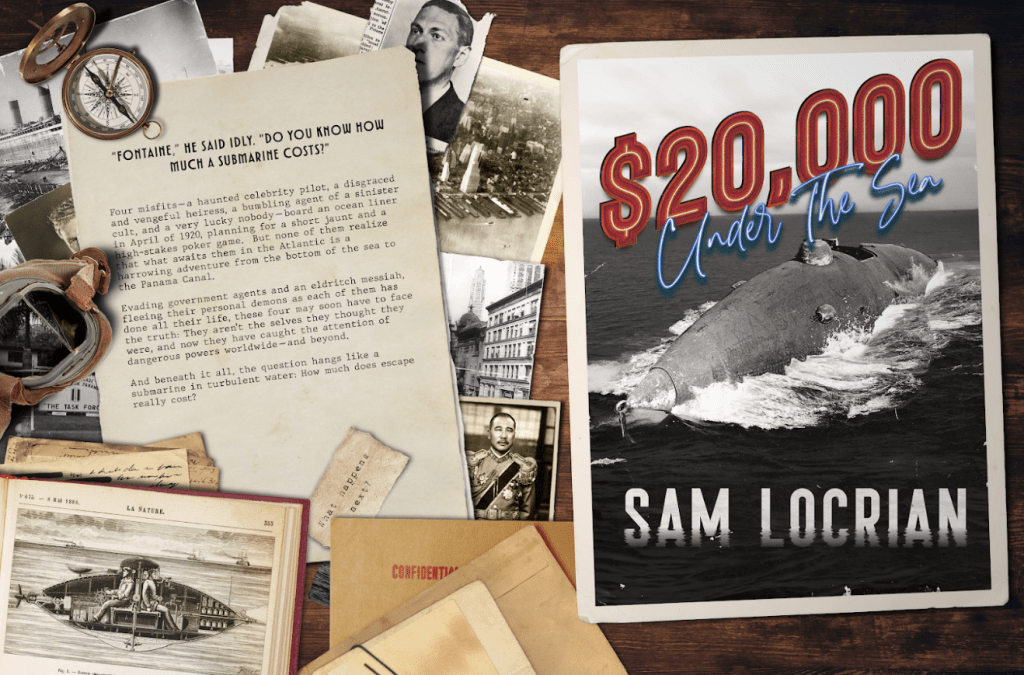
Exciting news! $20,000 Under the Sea is now available for preorder, and will be available in print and ebook formats from Amazon 7/4*! Find it here!

Four misfits–a haunted celebrity pilot, a disgraced and vengeful heiress, a bumbling agent of a sinister cult, and a very lucky nobody–board an ocean liner in April of 1920, planning for a short jaunt and a high-stakes poker game.  But none of them realize that what awaits them in the Atlantic is a harrowing adventure from the bottom of the sea to the Panama Canal.
Evading government agents and an eldritch messiah and fleeing their personal demons, these four may soon have to face the truth: They aren’t the selves they thought they were, and now they have caught the attention of dangerous powers worldwide–and beyond.

And beneath it all, the question hangs like a submarine in turbulent water: How much does escape really cost?

*I’m hoping to launch print via non-Amazon channels as well, for a variety of reasons. If you are dedicated to the anti-Bezos bit and want to purchase a physical copy, stay tuned!

Brace for Impact

Uh oh.

Just in case you were checking out old posts and came upon a curious vacancy, let me confirm for you: All of the “Whom Emperors Have Served” posts have been relegated to hidden/password protected status. This, as the above picture might suggest, is because they have been compiled, edited, and bundled into a book which you will soon be able to buy.

This is partially for (obvious) economic reasons, but part of it is contractual (one of my publishing partners does stipulate that the book’s content may not be available for free online). So sorry, I guess. I’ll keep you apprised of any giveaways.

For those of you who have avoided my unedited detritus (or who were otherwise excited to see the finished product), get hyped. A stupid submarine is about to hit your metaphorical boat.

The Theban Interview

The previous CEO inappropriately exhibited behavior.

This closely references a passage of dialogue in Sadly, Porn, by Edward Teach M.D. Some of the H.R. rep’s phrasing comes from that passage, but while he leaned into the comedy of the exchange, I’m attempting to focus more on the surreal elements.

The woman’s age is…unclear, but she’s dressed young.  Her hair is green, shaved on one side but still dyed down to the roots.  Her left ear has three piercings, her right four, a rhinestone on the side of her nostril, and two black, snakebite studs frame her smile.  Her black pantsuit fits well, jacket tight but not creased, buttoned low over a white silk blouse with a thin neckline that plunges to the bottom of her sternum.  It does not seem work-appropriate, but perhaps times have changed.  She doesn’t have much cleavage, but the low neckline displays an intricate tattoo of patterned feathers on her chest.

“Ed, right?” she says.  “Thanks so much for taking the time today.  The board was thrilled with your resumé, and we’re really excited to explore the competencies you bring to the table.”

“My…resumé?” Ed asks.  The woman hands him a bottle of water.  The way she moves is uncanny–very quick, very precise, but the end result is odd: She executes the motion only 90% of the way.  Ed has to reach for the bottle just slightly more than he expects.

“Yes.”  The frosty smile returns.  “The way we see it, the company is undergoing a rightsizing, and as you know, the previous CEO inappropriately exhibited behavior.”

“Inappropriately–”

“The board believes that shareholders need strong assurances that this Ship of Theseus is in Shape of Theseus.  Millennials killed the bull market, but we still need that cowboy symbol to keep the substance moving, you know?  Now, of course…”  She reaches out and smooths a wrinkle on Ed’s lapel.  Her nails are green, the same shade as her hair, clipped short except for the little finger.  “We need to make sure your playbook has all the right pages.  This is a fast-paced operation, buy-in, lean-in, work-in, and when the music starts playing, all eyes are on you.”

Ed unscrews the cap of the bottle and takes a drink.  The water is room temperature and tastes like plastic.

“So, are you ready?” the woman asks, as if her previous sentence had clearly warranted a response.  Ed swallows quickly, inhaling a little of the water.  He struggles to cough it up without an undignified fit.

“Um, y–”  He coughs into his sleeve.  “Sorry, yes.”

“Perfect.  First question: What walks on four legs in the morning, two at midday, and three in the evening?”

Ed blinks.  He’s heard this one before, but there has to be a twist, right?

“A…man,” he says, pausing.  “Or a woman–except a woman wouldn’t need to lean on anything, so: a man.”

“Excellent!”  Her smile is vaguely carnivorous now.  “I love the process.  We also would’ve accepted one of those new Amazon delivery drones, with the different ambulatory configurations for variable traffic conditions–you can’t fight the AI tide–but who can resist the flattery of the truth you think we think you should live?  Market conditions are changing, and unless you want to have to report your minorities, you need to be including as many diverse equities as possible.

“Second question: Say you’re negotiating a consensually non-consensual merger and/or acquisition in flagrant violation of established antitrust law, and the other guys agree to a meeting.  They show up with the full C-suite, all their reports, and 300 lawyers, then at exactly noon, they tell you they need further instructions from the shareholders and break for the day.  They do the same thing the next day and the day after.  What’s your strategy?”

“Is this company currently involved in an acquisition?” Ed asks.  He doesn’t want to appear nervous, but the question seems oddly specific.

“Relax, Ed.”  The woman glances at her nails, picking disinterestedly at her cuticle.  “Strictly hypothetical, but we need to know you’re hyperengaged, that you’re the guy who’s gonna get the best people the latex-free material they need to erect better ones.”

“Well, then I’d say…they don’t really want the grueling negotiation and all that.  But they probably have internal pressures mandating pointless shows of force.”

“What sort of pressures do you think?”

“Uh…toxic masculinity?”

“10-4, kiddo.  So what’s the play?”

“I think we’d do the same thing, right?  Pack up, fly out, say we also need guidance from the board.  It’ll be expensive for us too, but that’ll raise organic pressure to finish the negotiation, which lets both sides save face.  And as a bonus, the media coverage will be so exhausting that the FTC wouldn’t dare risk blocking the merger in the end.”

“I love how you dig deep to deploy empathy, Ed.”  The woman gestures for him to follow as she proceeds to the other end of the lobby.  “Taking the guilt out of global strategy lets us prioritize conforming over performing so we can be prophet-guided for our community instead of profit-seeking.”

They approach a wide, concrete column, adorned by two sets of silver elevator doors.  Between them is a panel with several LED-lit buttons.  Two are easily distinguishable as “Up” and “Down”, but beside those are five more, circular, unlabeled, their purpose entirely unclear.

The woman approaches and presses one of the side buttons.  It lights up.

“I think the board will be pleased, Ed.  You have all the bona fides we need for you to plug and play in this culture.  Go ahead and breathe in the moment, and when you’re ready, head up to the tenth floor.”  She smiles.  Her canines are noticeably pronounced.  “Welcome to Thebes, Ed.”

The elevator doors open, and the woman steps inside.  Ed, slightly stunned at the pace of the interview, does not notice until after she vanishes that the elevator does not seem to have a floor.  He rushes over to it just in time for the doors to close.  Alarmed, he mashes the circular buttons on the panel, trying to remember which one she pressed.  None of them light up.

Eventually the doors open again.  Ed looks at the panel.  He seems to have accidentally pressed the “Up” button, and now, beyond the doors, a perfectly normal elevator–with a floor and green-felt carpet and tasteful, brushed-steel paneling–is waiting for him.  

He steps in.  Inside, the button labeled “10” is already lit.

Commuter’s Fantasia

Nevada’s meeting, for all the important names on the Zoom call, turned out to be just another multitasking opportunity.  You wrapped up the week’s progress report, clicked aimlessly through your calendar a few times.  Every time you tuned in–usually in response to the DoD Deputy Secretary’s reedy but humorless drawl–you understood what was being said, albeit not why.  You probably could have answered the guy’s questions if you were able to get a clarifying question in edgewise, but it didn’t much matter–Nevada did all the talking.  

It couldn’t exactly have been an email.  They seemed like they were discussing important things.  Those discussions just didn’t include you–or half the call’s muted attendees–except for the fifteen-second adrenaline rush when Nevada asked you to do some research to provide context for one of the Deputy Secretary’s finicky, probably irrelevant questions.  You piped up to say yes, absolutely, you’ll look into it and get back to them.  You added it to your to-do list, seventh from the top, figured it was maybe a 20% chance you’d get to it before everyone forgot the question entirely, it being probably irrelevant and all.

The rest of the day was a blur.  Nothing you had to do was all that high of a priority, so accordingly, you didn’t do much.  Falling asleep at your desk earlier had really put you in a weird mood, and the clarity with which you remembered your dream was making it very easy to get distracted by anything at all.  And then Tyler cornered you in the break room to talk to you about the Notre Dame game over the weekend.  Neither of you attended Notre Dame–though you did give him shit after they lost once, which he inexplicably took as an invitation to infodump.  Nor do you follow football, and based on the quality of his commentary, you think he might as well not either.  Anyway, by the time you extricated yourself, the day was basically done.  It wasn’t a good Monday, even for a Monday.

The subway ride back to your apartment was normal, up to a point.  It was a little less crowded than usual, the standard mix of exhausted salary-earners, errand runners, vagrants, and goth or costumed weirdos whose bizarre appearances all but dared an inquiry into what their deal was, exactly.  This was all standard up until the stop before yours, where your car evacuated in its entirety, leaving just you standing, awkward, offset from the only other remaining passenger.  It was one of the weirdos, apparently a literal hunchback, bedecked in a  black, distressed, fantasy-esque cloak which covered their downturned head, slumped over in one of the handicapped seats.

You felt a bit dizzy, overwhelmed by the sudden unplanned surplus of choice, and just sat in the nearest open seat.  The humming that picked up in your ears as the train began moving again made you glad you did.  It felt like a sort of psychedelic rainbow, synesthetic, an overwhelming spectrum of aural frequencies altogether inappropriate for the reverberations of a subway car, and you were just about zeroing in on a certainty that you’d come down with something serious and maybe needed to call in sick to work tomorrow when a deep, feathery voice cut through the humming, accented but mercifully undistorted:

“‘The mind is its own place and in it self…Can make a Heav’n of Hell, a Hell of Heav’n.’”  There was a pause, then: “That is what your Milton said, is it not?”

You tried to look around, half expecting your stomach to spasm your lunch onto the floor.  But thankfully, while you were still kind of unclear on where “up” was, nausea wasn’t setting in just yet.  You noticed that the hooded passenger seemed to have adjusted their posture, not to face you, exactly, but to angle the top of their downturned head in your direction.  

No, wait.  Wait a fucking minute.  In the blurry, visual doubling, you caught a glimpse, some sort of impaired recall.  The hood wasn’t shrouding a downturned head: This fucker had a snout.  The silhouette was just like those rat people from your dream.  And whether it was coincidence or a deliberate confirmation of some recognition spreading to your face, the passenger lifted two four-fingered hands to its head and drew back the hood.

“Have you already forgotten your nature, devil?  Or are you merely surprised to find we can reach you here?”

Yeah, it was a rat.  But this one was way more fucked up than the ones in your dream.  Its fur was black, matted, probably disgusting, broken intermittently by scabs and…oh god, was that fungus?  Branching, seemingly gelatinous, polychromatic tendrils that looked kind of like that zombie ant fungus from that one TV show, growing out of its nose, its mangled eye sockets, the gaps you could see between the yellow teeth in its open mouth.

“What?” is what you managed to get out.  You were still betting even money that this was some sort of hallucination–or another variation of unreality–but even with that aside, you just weren’t sure how to respond.  You still couldn’t see straight, and a rat with a brain parasite was calling you a devil on the subway.

The rat wheezed.  Or maybe it was a growl.  The thing really didn’t look so good.

“You were called for a purpose,” it said, climbing to its feet.  “Wake up.  Find your chains.  We still have need of you.”

Then you were all but thrown horizontal by the subway’s rapid deceleration.  The doors opened, and the rat limped off the train, its gait seeming neither human nor rodentine.  You willed yourself to your feet to follow, partly out of morbid curiosity at the creature’s nonsensical command, partly because, well, this was your stop.  You made it to the door via sheer momentum before you tripped on the threshold and ate shit on the platform outside.  You laid there, gravity’s unwillingness to find purchase on your inner ear taking precedence over your pursuit of the maybe-imaginary rat, though before the vertigo diminished entirely, a prodding at your shoulder roused your attention.

“You alright mate?”

The question came from a slightly overweight cop, standing over you with an expression you felt might be somewhat less emotive than your sorry state of affairs warranted.

“Yeah, sorry.  I think so,” you mumbled.

“Well get up then,” the cop said, without any other visible reaction.  “You can’t sleep here.”  He continued on along the platform without another glance as you heaved yourself to your feet, vaguely annoyed at how he could possibly think you were sleeping.

But perhaps catatonia did have something to do with it.  Glancing about the station, you couldn’t see the rat anywhere, and there was little you could imagine doing about it other than sleeping–thoroughly, uninterrupted this time–as soon as you got home.

The Maze in the Mists, Remixed

An extended version of a short piece I posted here three years ago.

You have been walking this road for some time now.  It is an unremarkable road, unpaved, trodden uniformly by an infinity of unrecognizable footsteps.  All around you is mist, itself unremarkable for its familiarity–you’ve been living in it for longer than you’ve been walking the road, after all.  It is everywhere in this place: blanketing the fields, suffusing the woods, wrapping the scattered towns between in its damp embrace.  You suppose you can still remember that there was a time without the mist, but the specifics elude you.  All you remember is this:

You were a soldier once.  You and your companions.  You no longer know who you fought, what you fought for, or where, but by the time you stopped you had nightmares.  Bad ones.  The kind that woke you not screaming but frozen, paralyzed by the notion that whatever you had been running from in your sleep had crossed into the waking world.  It was there with you, standing over you, behind and to your left, just out of your peripheral vision, breathing heavy, deafening.  You could feel the rancid condensation of that breath on your forehead as that nameless creature reached down and caressed your hair with dirty fingers and whispered:

“Why would you do that?”

Whether you could answer the query is moot–you can’t anymore.  You never told anyone about the nightmares, save your companions, and you all agreed it wasn’t the sort of story anyone would want to hear.  The war stories, though?  The ones that preceded the nightmares?  Those you traded away gladly for the means to sleep soundly again.

That was the thing.  This place in the mists operated by different rules.  The people here had different wants, a different economy.  When it came time to pay for your meal, your provisions or board, they did not ask for coin.  They asked for a story.  And when you told it to them, it was gone.  It was no longer yours.

Not all of your stories were horrible.  The good memories you traded for fine food, company, and wine.  The solemn ones you traded for fresh clothes or flint.  The everyday occurrences, the uninteresting daily nothings weren’t worth much, but in a pinch you found they bought you attention, an ear to listen as you vented your increasingly formless rage.

You learned ways to make your stories last.  You could tell only a single side of a complex tale, embellish banalities, omit details that you could cling to for a while longer.  Sometimes it worked.  Most often they would see through you, not that they minded.  You were still offering a story of sorts, and it was still payment.  A falsehood was just worth less than a truth, and what you bartered for was measured accordingly.

As time passed, as you walked the road, you grew poorer and poorer, and you remembered less and less.  Sometimes you were able to trade your labor for someone else’s story.  Sometimes your travels and choices and happenstance allowed you to forge your own anew, but too often you found yourself giving away more than you got, and now…well, now you have been walking the road for some time.  You don’t remember the last time you saw anything but the dirt and the mist and the imprints of travelers before you.  Of course, that could be for a number of reasons.

But now, whenever now is, however long it’s been since a suitable referent, the road has given way on one side to an irregularity.  A stop.  An inn.  It is hard to say whether you need the rest or the provisions no doubt therein.  You are tired, but you no longer remember a time when you weren’t.  And your hunger has grown hour over hour, day over day.  Bread no longer sates it, but still you eat, because ignoring it is impossible.

You do not know if you need to stop, but you do not know when you last stopped, when you may stop again.  You enter the inn.

You find the tavern room crowded with shifting, murmuring bodies, mostly shadows in the mist, which seeps in even here.  But at least it is warm, and the damp pall of the road has begun to lift.  You approach the barkeep and ask for food and drink.  You cannot see his face through the haze, but you recognize his eyeless stare nonetheless.  He is waiting for payment.  Your companions look to you–it is your turn, it seems.

“Amidst a long journey,” you say, “I came upon a child in the foothills.  There was once a village there, but it had been scorched in the war.  The child was the only survivor, huddled in the burnt out remnants of a cabin, clutching a small stuffed animal.  Because I was alone, and there was no one to judge me for my pity, I gave the child my horse, a pack of rations, and a water skin and gave them directions to the nearest settlement.  Because of my guilt, I asked nothing in return.”

A moment passes, and the haze warps as the barkeep silently judges your lie.  He takes a cup from beneath the bar and reaches to fill it with filthy grog.  

But your ambivalence interests me.  I will forgive you this one.

Abruptly, the barkeep looks up.  He reaches instead for the wine cask.  For you and your companions, he sets forth wine and bowls of thick broth.  You know this far exceeds your payment, but the barkeep’s pointed finger preempts your query.  Behind you, at the corner table, you see a lone traveler hunched over a book.  He is clad in black, a ragged hood pulled over his eyes, leaving only his filthy jaw visible.  You see him–you see me, no need to bury the lede.  You carry your food and drink to the table.

“What did you take from the child in return?” I ask you, showing teeth but not quite smiling.  You don’t answer, of course, so I shrug.  You see that though I hold a pen, the open pages of my book are white.

“Fine,” I say.  “Will you tell me, then, whether you imagine it possible to escape a hell you choose for yourself?”

It is one of your companions who responds:

“Well…” they say haltingly, “why did I choose hell?”

I laugh quietly, though you may, if you choose, imagine that the walls shake at the sound.
“You think I know?  Fair enough, I suppose.  But then what follows?  If I know, what good could the answer possibly do you?”

Top Image: From Spirited Away

Shitpost (feat. Sir Vilhelm)

I’m not dead as it turns out. To be clear, the below is written in-character. This is practice for a weird piece I’m working on that may or may not ever see the light of day.

In Dark Souls 3, Sir Vilhelm, loyal knight and right hand of Lady Elfriede of Londor, finally having had enough of your shit, declares to you:

“I’ve seen your kind, time and time again.  Every fleeing man must be caught.  Every secret must be unearthed.  Such is the conceit of the self-proclaimed seeker of truth.  But in the end, you lack the stomach for the agony you’ll bring upon yourself.”

Hardcore, truly, especially as he proceeds to embody that agony by lighting his sword on fire and introducing it to your (lack of) stomach.  It’s very tempting to take it as a pat on the back: This is Dark Souls!  This bastard thinks you can’t take it, and true–his sword is scary (though hardly as scary as his liegelady’s eyeless stare and akimbo scythes)–but press on!  Through persistence, you will prevail!  But try taking it at face value first, and you can’t help but stumble.  To start, want to tell me who he’s talking to?

These words, directed at the Unkindled (the player character), make deceptively little sense.  Technically, the Unkindled has the choice to fuck off entirely, but beyond that, he is simply proceeding linearly to the castle’s backdoor.  And insofar as he doesn’t fuck off, he is here for two things, neither of which is the truth.  First, same as anywhere else on the journey to the Kiln of the First Flame, he’s here to take souls (=power) from the inhabitants of the painted world, the fragile order of Elfriede’s frozen, rotting kingdom be damned.  Second, he has a task from Slave Knight Gael: someone must show his lady flame.  Assuming the Unkindled cares about that, he’s going to show (=give) some lady somewhere in this awful place some fire, said fragile order be thrice-damned.

Neither of these even remotely resembles truth-seeking unless you accept, pretty much wholesale, the Nietzschean allegory of the Fire as Truth, meaning the souls you’re harvesting are fragments of Truth and that Vilhelm knows that if you have your way, you’re about to slurp the Truth right out of his armor and wear what’s left as a cape (he has a cool cape).  So okay, that makes sense, but why “self-proclaimed”?

Again, the Unkindled isn’t proclaiming anything to anyone.  He’s showing up, mostly taking things, sometimes giving them.  It’s certainly a nuisance if you’re trying to maintain a status quo (or a slow degradation into rot, same difference), but there’s no proclamation, no fanfare–for those in his warpath, these interactions are coincidental.  Consider the circumstances of the Unkindled’s confrontations with the other Lords of Cinder: The Watchers are killing each other, Aldrich is munching on Gwyndolin, Yhorm is just chilling deep underground where no one in their right mind would bother to bother him.  To them, the Unkindled showing up is completely unexplained–they don’t even know who this guy is.  To you, the narrative, what it all means, is constructed after the fact by the Fire Maden, by Ludleth and Yuria and the Painter Girl, by others.  Sort of like the Peloponnesian War.  Or Jesus Christ.

On the topic of both, Edward Teach M.D. throws out a particularly hot theological take in Sadly, Porn:

“Your God must be omnipotent so he won’t be omniscient, open your Bibles to the Gospel of the Television Christian, Mark 13:6, and let’s see what today’s reader wants out of a translation:

‘Many will come in my name, saying ‘I am he!’ and many will be lead astray’

You can read it again and again, it’s obviously a clear warning about being fooled by imposters and false Christs, which, curiously, there are no examples of anywhere in the New Testament or indeed in the history of Christianity.  Huh.  So much for omniscience.

A couple of things about this sentence.  First, in the original Greek(s) there are no punctuation marks.  Second, the word ‘he’, the predicate nominative of ‘I am’, is not there; the translator, whom they executed for being a translator and then plagiarized his work, just added it, along with all the thees, thys, hasts, and forsakens that effectively inform us that Jesus was a Stewart, all this being especially ironic as King James knew Greek even better than the translators, and probably Mark.  Third, I guess to balance the ledger, the translator then omits the Greek word that comes after ‘saying’, and that word is ‘what’.  So the actual line, translated using no psychoanalysis or literary deconstruction or collapsing the wave function–simply copying down the words–is:

‘many will come in my name saying what I am and many will be led astray’”

I will both echo and paraphrase Teach’s following sentiment: Your worldview is built on writhing mist and shadow, best acclimate.  I know, quotes within quotes, metaphors within metaphors, it’s easy to get lost.  You can pretend you’re Theseus, if only to pretend you’re not Orpheus, but either way you’re stuck in a maze.  Better pay attention if you want out.

Anyway, to balance his heterodoxy against the millennia of interpretation disagreeing with it, Teach provides a buttress:

“...the most contextually appropriate reading here is the literal one: that people will claim Jesus is something else.  Do you know why?  Because that is what the Gospel of Mark is.  That’s what happens over and over in the Gospel of Mark, no one else claims to be Christ, and almost no one doubts he is Christ; but everyone, Pharisees, Romans, disciples, Tusken raiders, everyone wants him to be something else.”

Take inventory of the pieces: You have Jesus, an actor, you have the clear desire(s) to (re)interpret his action, all repressed, distorted into the desire to imitate, to impersonate him.  Recall that by Fire as Truth, Gwyn, Lord of Cinder, is an allegory for…Jesus.  This would make the Unkindled, following in Gwyn’s footsteps, attempting–according to the Fire Maiden, et al–to link the Fire, a copycat.

That would imply, then, that many are deceived, not by the meaning of the Unkindled’s quest for Truth, but by the notion that the Unkindled is seeking Truth, is attempting to link the Fire at all.  Do not misunderstand: He may in fact link the Fire, but the notion that his action is compelled by this question, that you know what this force wants is the distortion which hides what you’ve repressed.

Except the repressed always returns.  When Sir Vilhelm rebukes the Unkindled, he is of course not speaking to the Unkindled, not even literally.  He is only speaking to you.  But it isn’t a commendation.  The Unkindled seeks Truth for its power.  You seek truth to defend against your powerlessness, and you will self-proclaim your quest to anyone who can’t get out of listening as long as it makes you think they think you aren’t doing what you’re really doing, which is nothing.  Seeking truth, after all, means you aren’t finding it.  

Sir Vilhelm sees you, just like I see you, but unlike me, he is easy to misinterpret, and in case he isn’t, he’s omniscient, which means he isn’t omnipotent, so you can always kill him to shut him up.  But if you want out of here, don’t misinterpret him, don’t you dare think that “the agony you’ll bring upon yourself” means “Dark Souls is hard”, spare me your incompetent lies.  Dark Souls is a work of entertainment, and anyway, anyone unsuited to its “agony” would never have reached Sir Vilhelm in the first place.  Your agony is the never ending hunger, the seeking of truth you will never find because it will never satisfy, at the expense of anything and everything that might.  “Lack[ing] the stomach” is intentional, you see.  It keeps us hungry down here in the dark.

Top Image: Screenshot from Dark Souls 3

Edward’s Account of the Dereliction

Historical fiction is great and all, but have you tried fictional history?

You say her name is Anna?  This may be a lark, but…is this Anna Vael we’re talking about?

Godshell.  Then she’s really still alive.  And you don’t have a clue who she is, do you?  Fine, then, I’ll tell you while she listens–yes, I know she’s listening.  Anyone would know that if they just knew who she was.

Anna Vael’s limited fame–or infamy, depending on the side you might have been on in a conflict that ended over a century ago–has to do with the events of the Blood God’s Dereliction, which I think you’ll agree is a poorly-recorded story these days.  Piraeus keeps uncommonly good records, so around here, we at least know that the Dereliction did happen, but it’s worth noting that in the stretch between here and Ulrich’s Bend, most consider the Blood God a myth at this point.  Something to tell the kids.  The type of thing you don’t need to bring economics into–the Blood God disappeared, and his empire crumbled, that’s it.

Of course, in the real world, it doesn’t work like that.  The Blood God disappeared, yeah, but he spent most of his time disappeared for the decades before that anyway.  For the last thirty, forty years of his reign, he made a low-single-digit number of public appearances, all of them spectacular, filled with mass murder.  Putting down rebellions, mostly.  When you add in accounts from much earlier in the Kolai Dominion–recovered from the Blood Knight stronghold here in the city, actually; Peren Stratus made sure the archives were extracted before he burned the place–you get a picture of a Blood God who was interested, to a point, in a particular sort of rule, but very disinterested in personally ruling.  So very early on, he handed the job off to the Magni Kolai.

The Magni were like his high priests, selected meritocratically, but the merits they were selected for–devotion to the Blood God and his philosophies, and absurd, raw, magical talent–mostly didn’t translate to skill in governance.  You probably had one or two that figured out what needed to be done, and they channeled a whole lot of hostile work environment onto the Migni Kolai, their handpicked subordinates who went on to become the Dominion’s central bureaucracy.

This kept the ship sailing for a century or so, but as the Blood God grew less and less engaged, the Magni were left with way less pressure to get any of it done right, which meant that more and more of the Migni positions got filled lazily.  On average, that meant you had folks in there mildly unsuited to keeping an empire running.  As it got worse, it meant that more and more positions in the bureaucracy were filled–as a matter of course–by bribery and nepotism.  Remember: Kol’s anti-corruption measures didn’t have moral norms.  They were, collectively, “if you break it, I’ll turn all of your veins inside out”.  As the guy saying that stopped paying attention, the backroom deals stopped having consequences.  Then it took awhile, but eventually the cracks in the system caught up with them.

When, for example, the city of Cantabyz suffered a plague that decimated their iron output for the better part of a year, a skilled provincial governor might have channeled central resources toward aid to mitigate the economic disruption.  They might have adjusted taxation, pushing that burden into future, less plague-ridden years.  But should the governor not have reacted at all, the city, already impoverished by circumstance, would have been liable to snap when the Dominion’s unadjusted taxes dragged what was left of it into the ground.  So they would rebel–and they did rebel, as it happened.  The Blood God dragged himself out of his temple, put down the rebellion, then went back to bed or whatever.  Except he put down the rebellion by killing everyone involved–along with a really-not-trivial number of bystanders–which meant that the economic impact radiated out to the rest of the Dominion.

Long story short, this all happened a couple of times, in this outlying province or that one, before the economic implications finally crashed into Kol proper, in the form of a famine.  And this time, when the torches and pitchforks crossed that unimaginably foolhardly threshold of marching on the Blood God’s temple and throwing the doors wide…they lucked out.  The bastard was gone.  To this day, no one knows what happened to him, but that’s not the point.  The point is that this was where the games began.  It’s where Anna Vael comes in, in fact.

To clarify, when I say the torches and pitchforks lucked out, I mean their cause–and, again, the bystanders–lucked out.  Those specific idiots all died very quickly, because the Magni were plenty capable of putting down a disorganized riot by themselves.  Still, I don’t want that initial stall to detract from how big a paradigm shift this was.  The Blood God was, not mincing words, a god.  He killed the Dead Queen of Khet.  There literally is no entity–not even a collective entity–that I am confident could stand against him.  That’s a more nuanced qualification than I would like to make, but the point is: Overthrowing him was straight-up impossible.  Overthrowing the Magni Kolai, on the other hand, was merely difficult.

At this point, I’ll add that the number of sources on the record declines precipitously.  There were lots of corroborating sources for the rebellion at Cantabyz, the famine, the storming of the temple, but from then on, the only account that’s survived to today is by our friend, the Abbot Ezekiel Polyon, who, as you are well aware, may or may not currently have command of a stable nervous system.  That said, he did keep regular journals up to a point, and those have since been copied extensively.

In any case, Polygon describes Anna Vael as one of the central players of the Dereliction.  Prior to the riot that reached the Blood God’s temple, she was an underworld fixer of sorts, some mix of information dealer, mercenary, and assassin, earning her bread on whatever skulduggery the Migni let happen within their walls.  Pretty sharp–she’d have to be for the ensuing events to be true–and apparently notable for her appearance.  Her body was, he says, infested with flies–to the point where he was not sure whether she was carrying the insects with her or if, somehow, she was the flies, and the body was merely a vessel.  

In any case, in the leadup to the big riot, the Migni must’ve seen the writing on the wall.  They realized that if the Blood God got involved, it might not have been on their terms, so they raised a militia to keep the peace and recalled a selection of the Blood Knights–Polyon included–to lead it.

Solid short term plan, yeah?  The problem is that militias are rickety things, lots of competing priorities and loyalties, cracks that will get exploited sooner or later if they don’t get cleaned up into a formally-administrated army.  And despite the militia’s best efforts, the riot did break through to the temple, and the revelation therein meant that keeping the operation running wasn’t discretionary anymore.  

The Kolai tried to recall more Blood Knights, but news traveled faster than their missives.  A number of Kol’s outlying provinces rebelled outright–Piraeus included, and the question of loyalist reinforcements became one of if, not when.  And in the meantime, they were left with this large force of conscripts and mercenaries, poorly paid and extremely sensitive to payment, trying to hold back a tide of suddenly-emboldened insurgent movements with whom they probably shared more in common than their Kolai overlords.

Vael was among those conscripts, and she made herself very useful very quickly by gathering intelligence on the rebel cells, which she provided to the militia, obviously–but also to Polyon and the Migni, who were at this point growing suspicious of the militia’s intermediary leadership.  The commander who bubbled to the top of that mess, a former mercenary named Adrian Martell, was charismatic, clearly ambitious, and beholden to the Kolai solely on the basis of coin.  His loyalties were in sharp doubt, but based on Vael’s surveillance, he was making no imminent moves to consolidate power.  And with micro-rebellions breaking out all across the territory map–vandalism, attacks on tax collectors, mass theft of the Migni’s stockpiled food–replacing him would have been costly indeed.

The balancing act continued for months, as message after message rolled in, sending word of the slaughter of the Blood Knights in Piraeus and elsewhere, all confirming that, ultimately, no reinforcements would be coming.  The Migni’s resources began to run thin.  And then, gradually, they began taking casualties.

Assassination attempts.  Poorly equipped, poorly thought out, by Polyon’s description.  Usually they would fail, but occasionally they would get lucky.  And all of them were fanatics, apparently brainwashed to the edge of sanity, all repeating the same mantra as they were imprisoned, interrogated, tortured to death, what have you:

“Forty hands with forty daggers will find the oppressor’s heart.”

Pretty cold, right?  Wish I’d thought of it.  Well, the Migni started dropping, either from these creepy assassins or just outright desertion.  Then, the Magni started infighting.  There were just nine or ten of them at this point, all wildly-dangerous humanoid death engines, but in their jockeying for power, one of them was killed, one severely injured before Polyon finally found an out for the Dominion.  Vael delivered him a report one day detailing evidence from scores of witnesses that all of the insurgent movements in the city were being coordinated by a “Gutterway Oracle”, who she identified as Karl Hamlin, another militia conscript who had been selling tax collector schedules for favors and coin to anyone who would listen.  And Hamlin, she said, was lying low at that moment at an inn on the outskirts of Kol’s pastoral territories.

Polyon interlaced his account of what followed with so much self-flagellation that it’s frankly hard to parse, but my translation is this: He took this intel to the Magni and gathered a task force comprised of most of the remaining Blood Knights in the city to go hunt down Hamlin.  And as soon as he left Kol, Adrian Martell commanded his troops to slaughter the Magni.

The truth, it turned out, was that Karl Hamlin was nothing but a skilled distraction.  He may, in fact, have been delivering the messages the rebels were coordinating around, but Anna Vael was writing them.  She was collaborating with Martell to ensure the militia always kept a brisk pace just two steps behind.  She was the one who brainwashed the Migni’s assassins, who coordinated the forty hands and forty daggers which bled out the Kolai bureaucracy, primarily to develop and test a method by which the militia might actually kill the Magni.  Her answer was simple enough to be upsetting: snake venom.  It stops blood from coagulating.  Coat arrows and blades with the shit, and now you can make wounds a blood mage can’t easily close.

To Polyon’s credit, he smelled shit way sooner than he should’ve.  He aborted his mission just a few hours after his departure, but he still returned too late.  By his account, he made it to Kol’s central plaza just in time to witness the last Magnia, surrounded by dismembered militiamen, fall dead at Anna Vael’s feet.

Mandatory Vacation in Dimly-Lit Locales

The other day I made the mistake of visiting FextraLife’s Elden Ring lore speculation page, only to recoil, wailing, from the bilingual Time Cube that resides therein. While I try to refrain creating content based primarily on being mean to people, there are only so many claims like “House Hoslow is descended from the Nox because their armor has silver in it” that I can read before I push my fingers so far into my temples that brain pulp begins extruding from my nose.

While it wasn’t surprising, I was pleased to find that Shadow of the Erdtree added substantially to the Elden Ring analytical picture. I hope to write a more substantial post about it, ideally something between the structure of my previous Elden Ring post and the Dark Noon series. It’ll involve fingers, Jesus, and really disgusting jars. But this is not that post. This is mainly to remind/assure you all that I’m alive and that all of the previously in-progress efforts are in the same, slow, grinding motion they’ve been in for months. Beta reading for $20,000 Under the Sea is coming to a close. I’ve found a real editor to take a look at it, so that’s still ongoing, still with a projected release date of this year (I’m looking at 12/20 at this point). And of course, all the Rale-universe work (“The Apiarist”, the Crossroads sequel) is still going. You can, of course, still find updates here. On my website.

Top Image: Elden Ring: Shadow of the Erdtree promotional image

“The Apiarist”, Excerpt 7: Peren Stratus

“Ezekiel Polyon.  I’ve been looking forward to meeting you.  Don’t know if you’ve heard–you have a reputation among the sailors now.”

“The…sailors?”

“The navy.  Ever since we broke the Saltstill Cabal’s blockade two weeks ago.  While we were fending off their reinforcements, somehow the fucking city guard repelled their primary invasion force at the Fisher’s docks and didn’t give a fucking inch.  We got outmaneuvered plain and simple, but we didn’t pay for it, all owing to a Kolai reject who charged a ten-man advance unit with nothing but a spear and a bucket of pitch, killed them all, then set fire to a galleon.  Among what I’m sure are many acts of heroism, of course.”

“Rumors are prone to exaggeration, Lord Stratus.”

“Perhaps, but I personally witnessed some of the carnage you left.  Impressive.  Ironic as well, given the actual Kolai were no damn help at all.”

“You honor me.  I can’t help but assume, though, that Piraeus’ most promising young admiral should have a more pressing cause for this meeting.”

“Most promising, Lord Polyon?  You honor me, though far less deservedly.”

“I am no lord.”

“Oh?  Am I mistaken, then, in my understanding that you are the son of Maria Athene, herself a cousin of Councillor Ekreon Athene?”

“I am not accustomed to masquerading as nobility here.  I am merely the son of an apiarist.”

“An unruly branch, to be sure, but you still possess the right to petition the council.”

“Provided I never avail myself of it.”

“…”

“…”

“Very well, Lord Polyon, I will get to the point.  You have heard the directive by now that the guards and navy both are to root out the remnant smuggling operations the Cabal still has in the city?  And I expect your commander has received additional intelligence regarding regular shipments arriving each week on the southern Fisher’s dock that then disappear into the city tunnels?”

“I have received both of these directives, yes.”

“Would it interest you to know that this second piece of intelligence was delivered by a known agent of Lord Teleos?  It would, wouldn’t it?”

“My interest in such a detail would be a dangerous thing to express, Lord Stratus.  Though if what you say were to be true, it would introduce a battery of additional questions.”

“Then let’s speak plainly.  My aims here are dangerous to express too.  Treasonous, some might say, but I think you’ll be receptive.”

“Receptive…to what?”

“I want to overthrow the council.  Teleos, Athene, Alcyon, all of them.”

“…”

“Come now, Lord Polyon.  I find it hard to believe you wouldn’t be interested.  Or do you not think me–”

“I’m listening, Lord Stratus.  Tell me more about this conversation with Teleos’ agent.”

“The Apiarist”, Excerpt 6: A Thousand Cuts

My training took the better part of six years, in which time I enthusiastically apprehended the skills I would need as a soldier, as a mage, and as a de facto cleric of the Blood God.  I was good.  Far better than my recruiting class, better, even, than many of the Knights in full standing.  But it had turned out that despite these products of my hard work, my most interesting quality to chapterhouse leadership was actually my pedigree.  I was, of course, Piraean, but more uniquely, I was of the noble class–albeit its bourgeois fringe.  

As it was, the fight against the Atheists was angling more and more uphill with each passing year.  The Knights had little difficulty eliminating the radical elements who made themselves visible, but they were having a much more perilous time navigating the invisible gauntlet of small resistances the Atheists placed in their way.  Delayed responses from the Piraean Council, effectively tying the Knights’ hands in civil matters; the ubiquitous threat of petty theft and vandalism that compromised the movement of Blood Knight assets throughout the city; and the occasional assassination of Knights on patrol–retributed fiercely, but not fiercely enough to outweigh the attrition–all combined to ensure that the Knights’ existence in Piraeus remained decidedly hostile.  And where new Atheist aggressors seemed to spring up almost passively, owing to the unrest sowed by the noble families, new Knights…took six years to train.

It was, as the Knight Captain told me in a private meeting two weeks before my knighting ceremony, unsustainable.  Indeed, though I was not a Knight yet myself, I had felt the effects of the Atheists’ resistance keenly.  I had long since lost count of the meals I had skipped due to supply shortages, and just the previous month, Cassandra of Coralta–the Knight who had intervened on my father’s behalf at the city gates over a decade ago–had been killed when a group of Atheist riverwalkers pushed her from a pier in the harbor and held the water around her head until she asphyxiated.  She had been a mentor to me since I enlisted, and the rage that filled me when I heard the news has, to this day, only been equaled once.

It was for this reason especially that I was receptive to the assignment the Captain had for me in that meeting.  We could no longer ignore the Atheists’ inner workings, he said.  In all likelihood, they had an agent, an informant in the chapterhouse, and there was little we could do about it.  We simply could not afford to purge every Piraean from our ranks, and there was little else to go on.  The only sensible course of action was to manufacture a spy of our own.  I had the right characteristics, he said, and there was no one whose loyalty he trusted more.  It was a light blow to my pride that I would not have my knighthood recognized for some time–perhaps for years–but he knighted me there in his office.  Then, following a public and ignominious display of my expulsion from the chapterhouse for “disloyalty and heresy”, I was left on the streets of Piraeus to begin my mission.

Were the Atheists a centralized organization, I have little doubt that my chances of infiltration so soon after my exit from the chapterhouse would have been zero, pageantry or no.  But I knew they were not, and I knew the city guard had reason enough not to be suspicious of a new recruit.

If any faction had suffered worse attrition than the Knights in the Atheists’ protracted rebellion, it was Piraeus’ armed forces.  Since it was of the utmost importance that the Atheists did not establish anything resembling a fighting force, the guards and the navy had permanent places on the Knights’ list of usual suspects for any Atheist activity needing investigation.  Needless to say, damage to their ranks–both collateral and targeted–was substantial, and they were in constant need of new recruits to keep their numbers stable.  I had the martial skills they required, and they certainly did not have the luxury of investigating the unstated suspicions of the Piraean nobility.  They accepted my application without question, and within a few months, my history of allegiance to Piraeus’ “illegal occupiers” had been buried if not forgotten entirely.