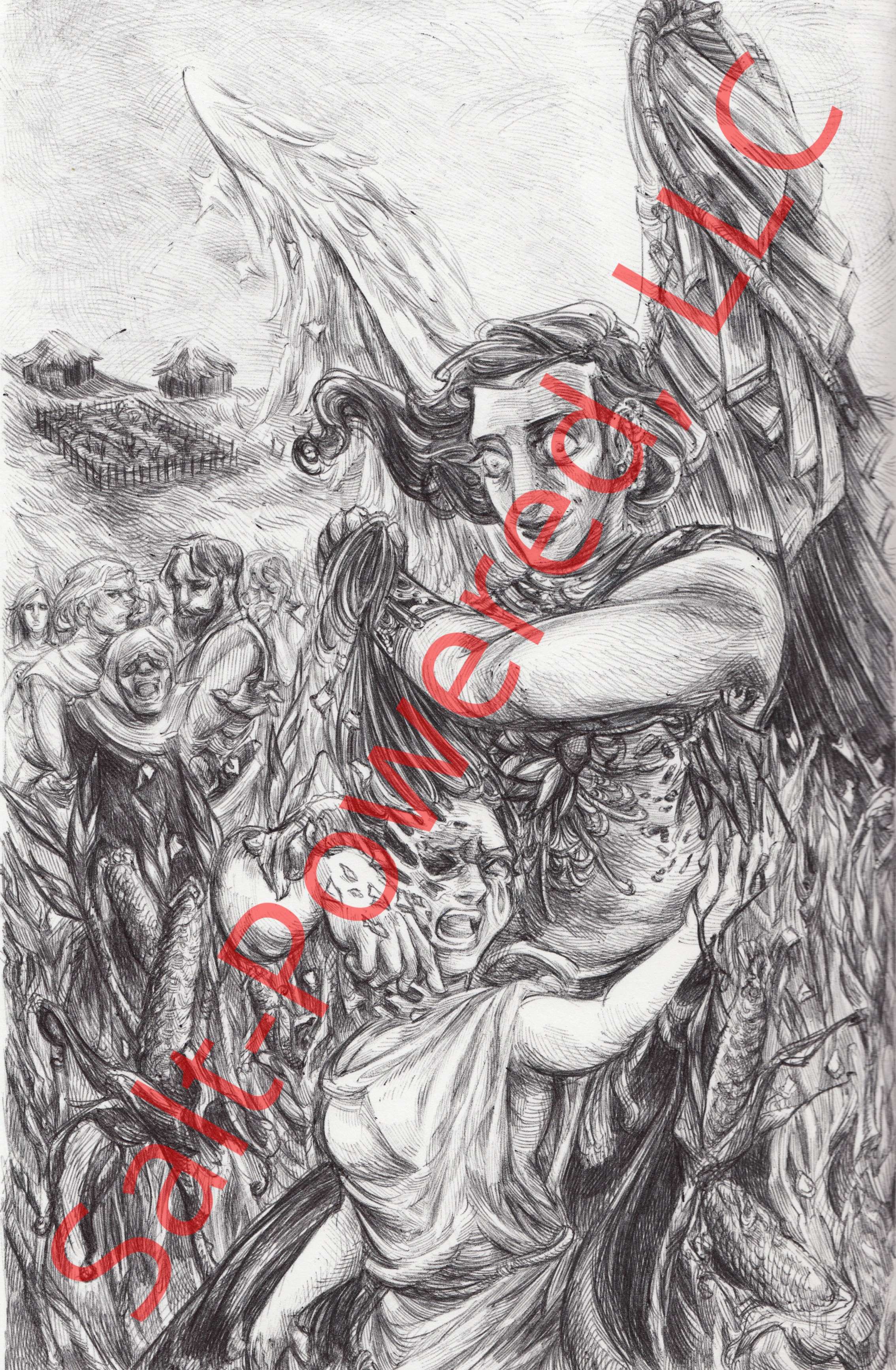
There is a story I’m planning to pair with this piece, but for reasons I will not discuss just yet, I likely won’t post it here. Instead, I wanted just to show it to you all:
Rae did a fantastic job with this one, and while the scene is in some ways powerful enough to stand on its own, it also drips context.
I’ve mentioned Spar previously, if briefly, here. The head-brandishing individual is one of its Diarchs–the Right-Hand Queen, specifically. This one, known to history as the Iron Queen (or to her contemporaries as…less savory names), ascended to the throne at a very young age alongside an older, more experienced Left-Hand King who sought to make her politically irrelevant. He arranged that she be sent to the front lines of war for over a decade while he consolidated power at home, but instead of quietly allowing her generals to direct the campaigns (or dying), she became a brutal warrior and an accomplished battlefield tactician, leading her to countless victories and a homecoming in Spar as a hero of the people. Nonetheless, the political elite, the Left-Hand King included, found her vulgar and imperious and feared she would upset the balance of power in the city.
A turning point came when she and the King attended a private demonstration at the academy. A traveling scholar had found a child, prodigious in a strange reality-bending magic practiced in the north, very different from the elemental magics espoused by the Diarchian scholars. Of the twenty or so that went into the room, only the Queen left alive, holding the head of the child in her bloodied gauntlet. She took it to the speaker for the Diarchian senate and presented it to him, with reference to the prophecy all had heard and few had taken to heart: This is what magic has done to our kingdom, I will defend us against it, and you will stand in my way no longer. But even as she holds the child’s head in her right hand, we can see something in her left: the crown of the Left-Hand King. No one knows what happened in that room, no one knows whether the child’s magic truly caused this tragedy, but it hardly matters now that there is no one left to oppose the Queen’s rule.
Top Image: Blame, by Rae Johnson, commissioned for War Torn/Rale
At this point, I am pretty much done with my backlog of material to post here. That means that my lead time per long post is probably going to be a little longer than the 2-3 day intervals I’ve been following to this point. Sevenfold Gyre part three is about a third done, but fuck, it’s update day, so while I continue grinding that out, today you get a shitpost of a game review.
Those who have been following my Dark Souls series are probably aware that today, From Software released Sekiro: Shadows Die Twice, Hidetaka Miyazaki’s first game since Dark Souls 3 in a vaguely similar space (technically he also directed Déraciné, but that’s radically different enough that I’m going to ignore it for the purposes of this timeline). As the name might imply: This is not Dark Souls. You’re playing a named character, it’s a stealth game, you don’t do damage–you just need to break the enemy’s poise–the game has a non-historical story (which I’m disappointed about, but only because Dark Souls invented the genre, and I’ve never seen anyone do it as well), the reviews go on and on. Oh yeah, most of that isn’t true, I’m just parroting the takeaways I’ve read online, and it’s actually a double fake, because the big idea is wrong, too: This game is totally Dark Souls.
I can quantify that. Here are the actual differences between Sekiro and Dark Souls (taken broadly, in the “Soulsborne” sense):
The main character has backstory.
There is a jump button.
Enemies block attacks in a way that makes fighting crowds is noticeably more dangerous.
The advancement systems (equipment, stats) have been replaced with the type of thing you see in Devil May Cry (or equivalent action game).
Fits on one hand. I, for one, am thrilled. That said, it’s very polished, combat is intricate in spite of its very fast pace, and moving around is a joy. By far the most significant of those, though, is the first, and it’s a deceptively small change. At a very surface level, the setting is historical. The Ashina clan was a real clan during the Sengoku period, the named characters don’t appear to have been, but whatever. Below that surface, we’re back to–you guessed it–more Dark Souls, with all of the desolation, bleakness, and lovely, fuzzy vagueness that From Software does so well, which is why it’s so cool that simply adding a pre-existing drive to the player character alters the experience so radically. In a lot of ways, the Souls games were framed, defined by that void, and filling it changes the basis for analysis.
Mind, I have no idea at this point what that analysis is going to look like (I’m only 15 hours in), but man, am I stoked to find out.
Top Image: Gameplay/cutscene footage from Sekiro: Shadows Die Twice. I do not own it.
Some of you may have noticed the minimalist titles for the art I’ve been posting for War Torn/Rale. It’s not accidental, and it’s not a deliberate attempt at edge, rather, it’s a philosophical premise that we’ve built into our pipeline, better appreciated with some backstory:
I’ve mentioned before that War Torn is a “dying” world, and I hope my fiction has made its bleakness clear, but I’ve also been pretty vague about what exactly that means. It “starts” (there is time before, but consider this the history’s inciting event) with a prophecy. The exact content of the prophecy varies with each retelling, and no one’s really sure who said it first, but the thrust is this: “The use of magic will destroy the world.” Understandably, this prompts some questions. How will it do this? When? And, most popular: Is it tru, tho? And, of course, the answers don’t come clear, concise, etched into stone–they come in cacophanies, as followers and dissidents argue with words and steel over what words mean and what is true.
That’s not quite true. At first, the prophecy garners little attention from anyone until it gets picked up by the tyrant of a city-state called Spar to cement the legitimacy of her rule during a political crisis, and from there, it becomes the basis for a system of extermination for all those gifted with impure magic. Long story short: A blood mage slips through the cracks of this system, murders the entire establishment, and declares himself the Blood God, beginning an era of free magic. Things proceed slowly but steadily downward from there.
The timeline goes on for several thousand years past that point, until the world is a desert, and the last vestiges of humanity are fighting to the bitter, pyrrhic end over the last known source of drinkable water. Even then, it’s not clear: Was the prophecy true? Was it causal? At a literal level, it’s not something we intend to answer, but Leland and I were set on a metaphor that should hang heavy–much like the prophecy itself on the world’s history–in both the mechanics of our system and the characterization of magic in the canon. Perhaps you’ve noticed in the allusions from stories like The Chimera: Magic is death.
I.
Digression: I don’t think most realize the variability of what “magic” means in different fantasy worlds. Obviously, it is underpinned by different sources of power–the gods, nature, crystals (wtf, Square Enix), the strength of one’s body, etc.–but there are practical differences as well, and if you dig into the philosophy (or at least apparent philosophy–many times this isn’t textual), those differences are pretty profound.
Consider two of the largest archetypes: magic as a scholarship (as practiced by DnD’s wizards) and magic as religion, a means of channeling the power of some elevated entity (as practiced by DnD’s clerics and warlocks). There are others, but it’s defensible to say that almost all magical systems are a linear combination of these two ideas, and praxis, in all cases, is an argument. The difference is just whom you’re arguing with. For religion, that’s a duh, but for the hermetic, scholarly variety, the argument with Truth is a little harder to visualize. Still, I’m not coming up with this from nothing–this line of thought is extremely old, dating back to Pythagoras, and it formed the underpinnings of alchemy as it was understood in the Middle Ages as well as the epistemological tradition that enabled modern science (1).
As it concerns War Torn, magic in our world is decidedly of the “hermetic” tradition. There are no proper deities in our world, rather the “True Gods” were presumably human (or animal) at some point, as I describe here, and they don’t have much in the way of codified rites allowing one to channel their power. Rather, magic is fueled by mana, ambient environmental energy that a properly trained individual can sense and draw into himself.
I put quotes around “hermetic” because this is actually fairly paradigm-neutral. It’s just energy that you can harness (essentially) with yoga-style breathing exercises, but it only appears that way because no one really knows what it is. Throughout history, various schools of thought uncover ways that mana may be gathered more effectively. The fire mages of the Diarchian Goetia learn that mana can be harvested from burning flames, the beast mages of the Bloodwood gather it by devouring living prey, and the Walking Winters of the Dereliction leach it directly from their hypothermic victims. Behaviorally, there is a sort of argument with Truth happening here, and the method of argumentation seems to be: being a dick. Think about it. You’re burning down a forest, you’re eating someone, you’re sucking the life from their body. Magic can be used for good, but you can use so much more of it if you’re open to murder.
II.
As I said before, I don’t intend to make the scholarship any clearer than that. Ostensibly, magic is not really death, but there’s a hell of a tragedy going on in the commons. Magic is power, the acquisition of power kills, but how else are we to fight death? This is roughly where the backstory collides with the prompt. Think back to the art titles: Hope, Embrace, Control, Names, a collection of vague ideals, certainly, but there’s a pattern: These are ways that humans fight death.
I mentioned in my intro for Flailingthat the history of War Torn/Rale is not one of humanity at its worst, and I really do mean that. Humanity is obviously capable of a tremendous amount of good (and even more obviously, the opposite), but what’s profound isn’t the capability–it’s the need. Fighting death isn’t just a human behavior, it’s perhaps the most fundamental human behavior of them all, and if you don’t believe me, consider the way we relate to animals: It’s pretty easy to grok a spider’s (or any animal’s) fights and flights, struggles for survival that we experience in our own lives (however indirectly in the modern world), but how well do you relate to allowing your mate to devour you? You’ll note that adulations of the male spider’s noble sacrifice are vanishingly rare (2). Embracing death is unsettling, as a society it revolts us, though the fact that the individual has no such immunity is an important basis for the Dark Souls series.
My point muddles, I’ll clarify: In so many places, in so much literature, you’ll find indictments and benedictions of human nature. We are inherently good, bad, tabula rasa, but that’s wrong. We are all of the above, and we are only one or the other insofar as it serves a need, and that need is to be, if not in true life, then in memory, its simulacrum. Look back to The Dragon’s Thesis. The Dragon’s goal matches the setup perfectly, but look closer: so does Mefit’s. That is the nature of redemption by memory. Even if you die, you’re not dead to everyone else.
III.
This (the essay you’re reading, but also the theme as it appears throughout the world of War Torn/Rale) is meant artistically, as an exploration and affirmation. It does not criticize, and it desires no particular change. Still, some may be tempted to view the singular drive of a fight against death as something selfish. It isn’t. To that end, I’ll leave you on the same note we began. See the opening image. What, do you think, is its title?
Footnotes:
(1): For a good example of how this translates to fantasy, see Full Metal Alchemist, particularly the original. Its brand of magic tracks very well with the mathematical tradition of alchemy as it actually existed. By its title, you can probably tell that it wanted to be associated with alchemy, but recognize that the scholarly wizard angle in DnD et al is the same logical foundation.
(2): It can be justified with some mental gymnastics–we do, in fact, make sacrifices for those we love, but there’s a brief moment of revulsion when you think of it, right?
Top Image: Children, by Quinn Milton, commissioned for War Torn/Rale
Working on a couple of larger pieces right now, but posting is going to be dead for the next few days due to travel. The following was originally written as an introduction to the War Torn/Rale rulebook. That is unlikely to be its final use, but I want to share it here as good perspective on that world, looking to the beginning from the end. Overall the history on which Mefit is commenting is not really a story of humanity at its worst, but it is nonetheless deeply pessimistic. Death here is inexorable, and if humanity at its highly variable average cannot stop it, then hope certainly is difficult to hold.
To whomever reads this: I pray dearly that your hope is not lost. My own fled me long ago, but perhaps you may yet find a use for these pages. You see, I paid for them, with the years of my life, my blood, my sweat, even the integrity of my mind; everything I’ve ever built, indeed everything I’ve ever been, I’ve scrawled onto this parchment and bound in this leather in hope that it might serve as a lens through which one might see the way to save us.
I see no such way. I have found no such map to salvation in what you hold in your hands. I have found only a grim chronicle of the way the world has died. And how is that? Even now I cannot be sure whether it was our arrogance or our cowardice; our strength or our weakness, but I know one thing without a doubt: We are to blame. It was man and woman, just like you or I–indeed you and I–who tore the essence of life from our kin and used it to grind to dust every last thing that was good. Some of us were as dark gods; others simple murderers, rapists, and thieves; still others called themselves heroes. Some called themselves nothing at all. Not one of them–not one of us–was innocent.
Now the ground we stand on is torn asunder, and there is no lot left us but to fall. Grow wings if you can. Else, read on and abandon hope.
-Mefit Il-Hazeen
Note: Mefit Il-Hazeen–though perhaps he did not use that name then–is also the narrator of The Dragon’s Thesis. You’re welcome to sort out the chronology yourselves.
Top Image: Mefit Il-Hazeen, concept sketches by Rae Johnson
Not a substantive post, but I’ve made a few organizational changes to the blog. Notably the Archives are much more up-to-date, and I’ve added a few links to our War Torn artists’ websites on the About page. I’ve also added an Ongoing Series page to help folks read through the Dark Souls and Sevenfold Gyre posts in order (since I’m not really posting them at a readable cadence).
Also, I’m once again approaching a week of travel, so there will be a gap in my posts next week that I’ll try to mitigate as best I can.
Art by Rae Johnson, original story by Leland Masek, editing by me. In between some of the larger posts, I wanted to give a look into the creative process we use for War Torn/Rale. The story was the concept we used to flesh out the idea of this character’s–Judiah’s–death scene, a pivotal moment in the history of our world. Your context is certainly limited, but that’s the intent–what do you glean from these images and words?
Forty hands with forty daggers will find the hole in Judiah’s unbreakable flesh.
And that is what happened.
Judiah, False God of Wind and Time. Was stabbed in the armpit by a random, thrashing, dying girl. With a blade from her grandmother, meant for crops, a tiny, cutting blade. As he held her down and lowered the Arm of Justice to her skin, turning first her hair, then her scalp, to ash, as if caressing her with love. Her random flailings hit flesh like stone over and over, the sound of steel chipping at rock ringing out, nauseating, infamous in Judiah’s wake of destruction. Until a strike landed wet and hot in her hand.
And Judiah’s eyes opened wide. And he blinked. And the Arm of Justice drifted inward, obliterating the poor child’s face as he fell, dying.
The blade had found a gap in his uncanny invincibility, a gap that had not existed the year before, a gap that grows from magic wearing thin. But Judiah had never known his tools well enough to become careful. And like that, his powers of Wind and Time, which had made him God-like for twenty years, simply and utterly failed him.
Top Image: Flailing, by Rae Johnson, commissioned for War Torn/Rale
Part three of the Dark Souls series, on the Undead and Lordran. Part 1 here. Part 2 here.
Lots of words have been written at this point; here’s where we’re at: There’s a clear parallel between Nietzsche’s progression of nihilism and Dark Souls’ setup. We’ll flesh that out soon–the last essay only introduced it–but it’s better that we have most of our details down before we get into implications. After all, “the world of Dark Souls is nihilistic” is so vague as to be undisputable, and it’s not like it makes Dark Souls make sense by itself. If we want that, we’ll need to discuss the game’s minute-to-minute experience.
I.
I chopped this out of the transcription from last essay, but let’s discuss it now:
Yes, indeed. The Darksign brands the Undead. And in this land, the Undead are corralled and led to the north, where they are locked away, to await the end of the world… This is your fate. Only, in the ancient legends it is stated, that one day an Undead shall be chosen to leave the Undead asylum, in pilgrimage, to the land of ancient lords, Lordran.
You probably have some internal definitions of what it means to be “undead”, and Dark Souls probably doesn’t meet very many of those. The denizens of Lordran are often articulate, intelligent, usually even “normal”-looking. They aren’t skeletons (though they’re around), they aren’t zombies (they’re around too, see Hollows), they’re just exactly the same as humans except for some little black scab that you wouldn’t even notice unless things were getting hot and steamy. One might point out their (inconsistent) tendency to revive around swords shoved into campfires or the fact that hollowing makes them more and more zombie-like, but that combination of traits seems so far away from a conventional understanding of the term that you wonder: Why call them that at all? Why not play up the “curse” aspects instead of reengineering a term with so much cultural cachet (1)?
This probably sounds like criticism, but I’m really just trying to discourage face-value readings of the situation. At face value, labelling people in Lordran as Undead seems confusing and stupid, so you can either ignore the apparent Japanese arcana of it and blow right past, or you can be a kind reader and work from the assumption that the stupid-looking decisions are deliberate. This is my essay, so I’m going to do that. Start from the basics: What does being Undead mean for the Undead?
Solaire of Astora: “Now that I am Undead, I have come to this great land, the birthplace of Lord Gwyn, to seek my very own sun!”
Laurentius of the Great Swamp: “In this land, pyromancers earn a certain respect. The Witch of Izalith, one of the legendary Lords, is the godmother of pyromancy. So, the day I became Undead, I was ecstatic. I felt as if I’d been chosen to attune myself to the ancient arts.”
Of course, it’s not all great–these people were still hunted by Allfather Lloyd, et al and corralled in asylums, but now zoom out to the world, Lordran. Solaire and Laurentius both are excited that their Undeath should grant them entry to this place, and you have to wonder why: A) It’s in ruins, steadily falling apart, hardly seems aspirational, and B) in what way, exactly, does Undeath get them in? Does the bird only carry people with the Darksign? Is the bird the only way to get there?
Let’s examine the ruins question first. Lordran certainly looks like a slowly degrading collection of fallen kingdoms, but only if you aren’t looking very closely. If you are, the juxtaposition is jarring: A semi-functioning city is stapled to a church guarded by knights of a random ancient kingdom. Go down a staircase, and you find a giant hydra in a lake, surrounded by crystalline golems, and just a jaunt away is lethal funhouse staffed by murderous snake-people. And Anor Londo, lost city of the gods themselves? Just over the hill past the fortress. If you look at it this way, you can see it: This isn’t a kingdom at all–it’s a museum. It may be trying to kill you, but don’t let that give you the wrong impression. We’re in the metaphysical layer, walking through a monument to what once was (or perhaps what once was mythologized), which brings us to question two: If becoming Undead qualifies you for entry into a place inhabited by gods, wherein reality itself is enshrined semi-eternally, where are you (bonus: Your alternative, pending one bird flight is a hellish prison guarded by literal demons)? I’m no theologian, but it seems like you might be in some kind of fucked up Heaven.
II.
While Lordran as the afterlife may be a good entry point into a particular way of looking at it, it’s best not to take that interpretation too far. An afterlife presupposes that Lordran’s denizens had a before-life, outside this place, and while there is evidence for that, it’s really not clear to what degree it’s relevant to the world dynamic (at least in Dark Souls 1). For example, it’s pretty easy to tell that Solaire of Astora isn’t from around here because it says right in his name: He’s from Astora. Astora, ostensibly at least, isn’t in Lordran (also dialogue, etc.), so Solaire almost certainly existed before he showed up there, but there isn’t much mention of anything he did in his past life or its bearing on the here and now (2).
To rephrase, the question is one of emphasis. Starting with the afterlife interpretation, consider the aforementioned inconsistency of characters’ resurrection. If you squint, you can see a conceptual pattern between the types of characters that respawn (random enemies, ie museum exhibits; phantom Undead) and those that don’t (bosses, other non-phantom Undead, legendary enemies like Black Knights or Havel). Excluding the player (this is also a thin reading, but hear me out), you can describe these same groups as [those enshrined/entangled in Lordran’s museum-reality] and [those vying to dominate it]. Since the player character is as inexterminable as a cockroach in spite of belonging clearly to the latter group, the resurrection angle may not be accurately descriptive, but the distinction between conquering agents and metaphysical background is still useful. It also brings us to two important questions: First, what is the significance of that struggle to conquer for the physical and metaphorical layers; and second, what exactly does domination of the metaphysical look like? The former is broad and has a broad answer–we’ll be exploring it through the entirety of this series. The latter is more specific, tied to a question so obvious it’s a wonder we’ve avoided it up to now: The game is called “Dark Souls”, right? Pray tell, what exactly are these “souls” (3)?
III.
For those following along who have not played the game, Dark Souls’ souls are a catch-all currency and experience system. When you kill an enemy, you are given a number of souls (usually hundreds or thousands–the guy was carrying them or something). You can use these souls to improve your attributes, but the interesting thing is that everyone around you seems to be doing the same. This isn’t entirely literal–individual characters don’t generally get any stronger throughout the game; that’s just you–but they certainly do try to get all the souls they can, and if they aren’t inclined to do it through murder, they’ll do it through trade. Characters throughout Lordran will sell you items or teach you skills for souls, and the game lampshades their status as currency with juxtaposition to actual currency. See the Gold Coin. Description:
“Coin made of gold, with Allfather Lloyd and his white halo shown on its face. Even coins of great value in the world of men have little value in Lordran, where the accepted currency is souls.”
Our metaphysical realm, then, has an economy of souls. The prose is appropriate to the genre, but in real terms, what does this mean? What is a soul? Conventionally, of course, it’s paired with a possessive, the soul is someone’s. It’s someone’s identity, agency, lifeforce, whatever. The three-digit numbers you reap from each fallen foe might discourage that interpretation, but a certain class of item muddies the water. Throughout Lordran, you will find items called something of the form: “Large Souls of a Lost Undead”. These, along with “Soul of [Boss Name]” (guess how you get those), can be consumed for a reward of some number of souls, suggesting that characters in Lordran are not just fueled by souls, but comprised of them. Reasonable, but the plurality is perplexing.
One resolution might be the American Gods route: The metaphysical is the realm of the gods, and gods have metaphysical strength proportional to the strength of their believers in the physical world. Might a single soul then represent a believer? There may be something to this line of thought (4), but A) it doesn’t really have any explicative power as the nihilism metaphor is concerned, and B) petty, perhaps, but the metaphorical mechanism can be improved: Ideological battles aren’t exactly amoebic as followers are concerned–sometimes people convert when they clash, but more often they just die. In Dark Souls, by contrast, the nature of conflict is straightforward: You kill a guy, you get his stuff.
Consider a close alternative. Among believers, a clash of ideologies is inherently political, and politics is, well, difficult to model, especially in a way that makes sense at this level of abstraction. So, for now, take out the believers. Without them, the ideological clash is just an argument without an audience, reason applied to determine truth rather than realize a political goal. Not all such arguments have a victor, but when they do, there is no death of the evidence–it all merely supports a new conclusion, a victor in the battle.
What, then, are souls? They are concepts, memes, evidence, tiny fragments of truth. Which is appropriate: If the Lords found their souls within the Flame, and the Flame is Truth, then why should their progeny be built of anything but its component parts? Why should the above be unlike the below?
Footnotes:
(1): Worth noting that Dark Souls 2 does this, but that Dark Souls does not feels deliberate. Consider also that Miyazaki did not direct Dark Souls 2.
(2): There are exceptions, the most nuanced of which is probably Siegmeyer of Catarina, whose sins ultimately pursue him to his end at Ash Lake. But even then, it’s not like you ever find out what they are, which is a good indicator that his case is one of brand rather than particulars. Specifically, his daughter’s mention of his relationship with her mother seems to more to serve as development of his persona in Lordran as a paragon of wanderlust.
(3): This question rightfully begins with Demon’s Souls, from which the experience system was more or less transplanted wholesale. For what it’s worth, I’ve never attempted a literary reading of Demon’s Souls, but it may be on the docket for the future, alongside Bloodborne.
(4): If you like conspiracy theories, here’s one: The maximum amount of souls you can spend leveling up in Dark Souls is 1,692,438,971, suggesting by the believers metaphor that this is the maximum number of a followers a metaphysical ideal can have. The largest religion in the world is Sunni Islam, with a very close 1.5 billion followers. Probably a coincidence, but that’s a weirdly precise match of orders of magnitude.



 Salt-Powered Investments, LLC