Curtains Rising and Intelligent Wailing

Holiday pressures and life changes do often make it difficult to maintain post schedules for longform work, so I want to fill the gap today with a hybrid of housekeeping and history.

In the former theater, I’ve been blessed by/suffered with a number of developments. I’ve completed the handwritten manuscript for $20,000 Under the Sea, and you can expect the final two chapters to be posted here in the coming weeks. My writing process is to do first-round editing as I’m transcribing my handwritten work into a digital format, and those final two chapters are chonky, so bear with me as I’m getting everything in. Once it’s up here, I intend to initiate beta-reading and second/third-round editing, and you, as readers, have until that process is done (or near done) to read it here before I hide it like I did with Three and Two and Two and the material that went into Promises for a Worse Tomorrow. That said, if you are interested in beta reading, please reach out to me at slhlocrian@saltpoweredllc.com. I am not being choosy with who is allowed to offer me feedback (though I may be choosy about what feedback I listen to). The only qualification I ask for is interest in reading through the manuscript and providing me with your opinion (ideally with a minimal amount of follow-up required from me).

The beta-reading/editing phase for $20,000 Under the Sea will likely be longer than for my previous two books. This is because I’ve recently started a job, and my dedicated writing/editing time has been quartered. On the flipside, lack of uncertainty regarding my ability to survive in the hellscape of capitalism really has been a breath of fresh air, so motivation is in higher supply now at the very least.

Now for history. As my access to illustration for my work is currently limited, I’m looking at a more graphic-design-centric approach for covers/graphics/materials for $20,000 Under the Sea. In particular, I’m hoping to leverage the theme of historical photographs with which I’ve been adorning my recent Whom Emperors Have Served posts. Chief among the questions for cover design for the book is how one might use historical photographs to depict (or at least reference) the Nicholas. Fortunately, in the early days of submarine navigation, vehicle designs–likely the same ones the inspired Jules Verne–were wild.

In particular, see the Intelligent Whale, depicted at the top of this post. It was an experimental craft built during the American Civil War, sold to the U.S. Navy in 1869, tested (disastrously) once, and then condemned in 1872. Various sources indicate that the total number of people drowned in testing the sub may be as high as 42. Between the aggressively silly design and its outright unreliability, it feels…appropriate that it might be a stand-in for Captain Kneecap’s inimitable trash sub.

For a less exceptional inventor or navigator, the design may in fact be an inexpensive conveyance beneath the waves. Whether that’s desirable, of course, depends on how badly you ever want to make it back to the surface.

Top photo courtesy of chinfo.navy.mil

Updates and Recent Happenings

Hi there. I feel like it’s been a little while since we chatted. At least two weeks–while I hope you enjoy the fiction posts, they feel less like a connection with the world. Moreover, I feel a little bad that my post frequency has decreased below the once-per-week mark recently. Never fear, though, much is on the way!

Transcription is behind schedule, but I have three more chapters written and incoming for Whom Emperors Have Served. More exciting than that, I am probably within three chapters of completing the manuscript for the first book in that series (which will likely be published as $20,000 Under the Sea, as I’ve mentioned elsewhere).

Beyond that, I want to give some thanks to…

…those of you who have read either Promises for a Worse Tomorrow or Three and Two and Two. I hope you liked them. There will be more to come, but in case you haven’t checked them out, you can do so here and here, respectively…

…those of you who contributed to TimmyP7’s fundraising stream on Tuesday (featuring me). It was very short notice as far as my involvement was concerned, but we exceeded our goal by far and were able to raise some good money for Gamers Outreach, a charity which provides games to hospitalized children. I advertised this with some limited notice on my Instagram, so if you’re interested in more content like this in the future (admittedly pretty different from what I post here), stay tuned there.

Otherwise, I hope you all are doing well. For those of you in the U.S., enjoy spooky season, and I’ll be back with more soon!

Top Image unrelated to everything but Halloween season.

Can’t You Read the Sign?

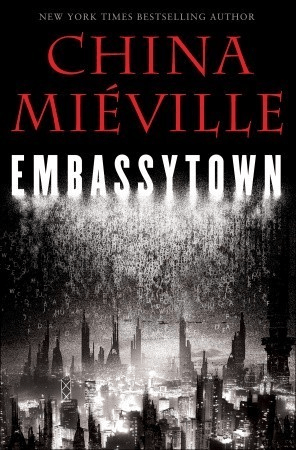
A review of Embassytown, by China Mieville.

Circumstances being what they are (ie, needing to focus on finishing one more manuscript while I have the freedom to do so), it is likely that the following will not do China Mieville’s Embassytown justice.  Perhaps that’s because the book is a lot, perhaps it’s because it’s just a lot that I’m personally interested in.  It’s become depressingly clear to me over my adult life that the average person just cannot be persuaded to care about epistemology.  That’s fine; it’s a headache, but just as others may enjoy headaches in the form of booze or boxing, the nuances of knowing things is a headache that speaks to me.  And boy oh boy does Embassytown speak that Language.

Cheap pun notwithstanding, this book is silty.  It’s classic Mieville, which is to say it’s not especially forthcoming with what it’s about, despite seeming to follow a cogent narrative arc.  I’m not sure why this is so common in his work, since it seems to be a different sin (or at least a different purpose) depending on the story you’re reading.  In Perdido Street Station, it’s an issue the setting gobbling up pages in exploration of details and implications extraneous to–and thus obfuscating–the plot.  Meanwhile, in Kraken, it’s just an excessive amount of intentional misdirection (seriously: That book builds to a climax around the theft of an idol worshipped by a squid cult, only to reveal that the god-squid was merely incidental to the antagonist’s quest to become a god of ink, which is then thwarted by the protagonist’s realization that he has become a god of glass containers, only then to reveal that the apocalypse he was seeking to avert has nothing to do with that antagonist’s scheme and everything to do with the ideological impact of Darwin’s theory of evolution, completely unrelated to squid, ink, or bottles).

Embassytown is somewhere in between.  The setting is, of course, very whacky, and a lot of space is given to implications and interactions of its aspects, but after the third (or so) major paradigm shift that changes how everything operates, one can’t help but feel a little jerked around.  To that end, I think it’s fair to say that as a story, the pacing is kinda flawed.  It’s still gripping, in ways, for reasons, but what makes the book great is what it is beyond a plot.

For starters, like most of the sci-fi genre, Embassytown is about its premise just as much as the series of events that occurs within it.  That premise is that there is a planet on the edge of known, navigable space that is home to a sentient species (the Ariekei; the planet is Arieke) that can communicate only via the weirdest language.  They have two speaking mouths, and each word or term is constructed of two words, spoken simultaneously by those two mouths.  No, that isn’t the weird part.  The weird part is that they are incapable of registering anything not spoken in this language, according to particular constraints (cumulatively, Language) as communication at all.  A person speaking to them in a foreign tongue; body language; writing–they are aware that there is a thing moving or making sounds in their vicinity, but they will not, cannot understand it or even grasp the notion that there might be thought or intent behind it.  Even weirder, when two people repeat the phonemes of their Language back to them, down to the precise pronunciation and simultaneity, the result is the same: They don’t react.  It isn’t communication to them.  Only through a slow, historical stumble (which the book briefly summarizes) do the linguists making contact figure out that the two halves of Language must essentially be spoken simultaneously by a single mind in order to be comprehensible.

This discovery prompts a series of attempts at workarounds.  Mechanical aids (to provide the second speaking mouth) don’t work, ditto synthesized sounds in general.  The closest of the first drafts is identical twins, which mostly doesn’t work either, but per Miracle Max, mostly failure is slightly success.  Humans devise psychological tests to evaluate empathic synchronicity, gather the sets of twins who score the highest, and then further augment that synchronicity with cybernetic implants.  This works okay, and they are able to establish basic lines of communication with the Ariekei.  By the time of the book’s events, though, this is all rickety, ancient history, and the embassy (of the interplanetary empire that originally made contact) has moved onto using precisely-engineered clones.  These are the Ambassadors.

A brief digression: Some portion of the book gets into the significance of Arieke to interplanetary politics, which is amusing anticlimax.  The planet is, in fact, very valuable, but for reasons that have nothing to do with natural resources, the oddities of Language, or the super weird, biorigged technology in which the Ariekei specialize.  So going in, the score is that the interests of the empire and its embassy only slightly intersect.  Contact with the empire is of a fraught sort of salience, but it’s infrequent.  Embassytown (the place, not the book) is out in the boonies, and the way in which its citizens have gone (or proceed to go) native is part of the point.

Anyway, the Ambassadors communicate reliably, but the way the Ariekei work is still a bit opaque.  For the Ambassadors, speaking Language requires a lot of engineering, but in the end, Language for them is just language, a semiotic construct.  For the Ariekei, it’s not.  For them, Language is Truth.  They can’t lie, for instance, but it is more than a preventative for deception.  They cannot describe anything they know to be contrary to reality, they cannot speculate as to anything that has not happened (they have a future tense, but it can only be used in situations of extremely high certainty), they can’t use conditional hypotheticals or metaphors, cannot even conceive of them.  In order to access new concepts, they have a practice called “performing simile”, in which an individual, frequently a foreigner from Embassytown, performs some task of abstract significance under ritualistic observation.  These individuals, including Avice, Embassytown’s protagonist-narrator (her simile, roughly translated: “the girl who was hurt in the dark and ate what was given to her”) effectively comprise the Ariekei’s limited window into that which is not.

Needless to say, this is all very bizarre, but the embassy is not especially interested in understanding the boundaries of these limitations.  They don’t want to rock the boat–the status quo is awesome for them.  They effectively rule their provincial kingdom, coexisting peacefully with the Ariekei via their genetically-engineered, diplomatic metis.  For one, elucidating the fundamentals of their diplomacy undermines their interests: The empire understanding what they do makes them replaceable.  But also, they would honestly rather the Ariekei not discover anything wild and crazy in their linguistic differences, lest the embassy become a victim of a cultural revolution that turns political.  Of course, this is exactly what happens.

Actually, that isn’t precise.  It’s what almost happens.  And then it’s what happens so hard that nothing will ever be the same again.

The book’s first conflict is fairly organic.  Per the above, despite their best efforts, the embassy has introduced a new, invasive oddity into Ariekei culture: The Ambassadors can lie.  It turns out the Ariekei have noticed and find it very interesting.  For many, it’s entertainment, something between a magic show and a freak show, but a group–of what Avice speculates are sort of Ariekei intellectuals–pick up the idea with more curiosity and attempt to learn how to lie themselves.  They can do it, sort of.  With great difficulty, by omitting words from sentences, by tricking themselves into failing to finish thoughts, they are capable of vocalizing things which they know to be false.

But they don’t stop there.  The intellectual clique, led by an Ariekes named Surl/Tesh-echer (each side of the slash said simultaneously) appears to be fixating on a group of human similes as a means to speak falsehood without having to trick oneself.  Ultimately, Surl/Tesh-echer is able to say, in front of a crowd:

“Before the humans came we did not speak so much of certain things.  Before the humans came we did not speak so much.  Before the humans came we did not speak.”

And then, in very short order, Surl/Tesh-echer is assassinated in a conspiracy between the embassy and the Ariekei “rulers”.  Everyone agreed, apparently, that it (Ariekei use impersonal pronouns, or the Ambassadors do for them anyway) was onto something, and none of them wanted to find out what, for reasons ranging from brutal realpolitik to religious fanaticism.  The book presents this arc, effectively the first, post-prologue, interspersed with the events leading up to the true crisis years later, and from a storytelling perspective, it is Embassytown at its (and Mieville at his) best.  It’s an elegant introduction to a highly complicated world and a heartbreaking belated coming-of-age for Avice, who had somewhat intimate personal connections to both sides of the assassination conspiracy.  This isn’t to say that the two thirds of the book that follow are a letdown–the beginning merely stands very well on its own.  What happens after, though, is where the already philosophically heavy situation gets spicy.

So: Several “years” later (time spans that large are measured in the book in kilohours, because space), the empire sends an Ambassador to Embassytown.  This is, on its face, already strange.  Ambassadors don’t come from the empire–they are grown in a vat in Embassytown (an ethically spiky topic on which the book touches but does not dwell).  Moreover, the particulars of the empire’s Ambassador are highly atypical.  Again, modern Ambassadors are sets of doppels, perfect clones, cybernetically linked and physically re-synchronized (so that minute differences in their physical experiences do not accumulate) on a daily basis.  The empire’s new Ambassador, EzRa (this is the ambassadorial naming convention, e.g. BrenDan, JoaQuin, MagDa, JasMin) on the other hand, is just two completely different guys with a supposedly off-the-charts score on the paired empathy test that predicts ability to speak Language.

But can they speak Language?  Ha.  Haha.  Yes, but really badly.  This is not “badly” as in “their grammar is terrible” or “they are hard to understand”.  Rather, when they speak, it enraptures the Ariekei into a trance.  It takes a minute for anyone to figure out what’s going on because, surprise, this isn’t what the empire intended at all.  They knew their new Ambassador was scientifically fucky (there is, of course, more going on technologically than two guys who just really get each other), but they were genuinely just hoping to create a pipeline for Language speakers they could control.  Within a few days, the embassy is able to put enough pieces together to relate EzRa’s oratory to a little known phenomenon they had encountered in their own failed Ambassadors (of which they apparently have an asylum-full in the basement).  Turns out that when a pair of humans speaks Language in a way that is just slightly off, the effect on the Ariekei is not distortionary but narcotic.  In a small way, the Ariekei can become addicted to the infinitesimal incongruities in a miscalibrated Ambassador’s voice.  Except what’s going on with EzRa is not small.  The high of their voice is potent enough to spread demand like wildfire: Upon their first public pronouncement, the Ariekei subsequently flood the embassy, overcome by fervid desire to hear EzRa’s voice based on nothing but word of mouth.  And once they hear it, the addiction does not seem to have a cure.  If an Ariekes goes too long without hearing EzRa say something else (and it has to be something new–repeated pronouncements induce tolerance rapidly), they just shut down.

Oh, but it gets worse.

Virtually all Ariekei infrastructure is biorigged, organic, chemically and physiologically interconnected, which means it isn’t just the Ariekei individuals who are addicted.  It’s every Ariekei machine, vehicle, and building on the planet as well.  Embassytown is still mostly human architecture, so it isn’t entirely a biological construct, but it isn’t unaffected.  The most visible clock to emerge from this development is that the addiction afflicts the aeoli used to convert Arieke’s toxic atmosphere into human-breathable air, which means that unless the situation is stabilized, everyone is gonna die.

It gets even worse than that.  And then, it gets even worse than that.  In summary, everyone loses their shit; Ez murders Ra; the embassy, in whose leadership Avice is taking on an increasingly active role, figures out how to “replace” Ra in order to keep the Ariekei going and creates EzCal, who is way too into his role as the “god-drug” and begins solidifying power structures around himself; the Ariekei begin to deafen themselves in order to cure their addiction (which, for a species for whom spoken language is thought and unspoken language isn’t language at all, is way worse than it sounds); the deafened Ariekei begin massing an unstoppable horde, hell-bent on the extermination of the humans and addicted alike; and Avice goes renegade and discovers a way to teach the Ariekei to use referential language, which cures the addiction and stops the forthcoming genocide.  I want to be clear that my description does not do this last step justice.  It is extremely awesome, and I would almost recommend reading the book just for that portion of it.

Needless to say, this is all extremely analyzable.  The low-hanging fruit, the piece that I imagine a socially-involved but not especially careful reader might notice with immediate umbridge, is the commentary on colonialism.  Embassytown as a colonial story runs counter to the anti-imperialist narrative in vogue right now, and without getting too political, I do want to clarify that that narrative has a lot of good sense behind it: Historical colonialism was rife with utter atrocity, and it is hard to defend the intent behind it as any more noble.  This is why my above weakman would not be wrong to be immediately suspicious of Embassytown’s characterization of its colony as native-friendly.  Anyone even passingly familiar with the concept of bias should immediately recognize that first-person good intentions are very easy to presuppose and wildly difficult to ethically execute on.  But counterpoint: This is fiction, not a geopolitical instruction manual.  Mieville is at liberty to define whatever setup he wants, without any obligation to make that setup replicable in real life, and the setup he defines is one where the colonists have little power over the natives, and their empire has little interest in establishing any direct political control.  Part of this should be understood as a change in economic theory between now (and especially Mieville’s stellar far-future) and the 15th century, largely independent of the parallel shift in geopolitical ethics (it is worth noting that despite Mieville’s impressive authorial catalog, he also has a fair amount of training in law and economics).  A little-appreciated observation is that mercantilism as a driving motivation for early colonialism was catastrophically destructive for the places getting colonized, and Embassytown is operating on very different sensibilities.  Specifically, the empire in the book is operating with the specific interest of being friends with whatever human settlement ends up on Arieke in the long run.  They don’t really care about conventional exploitation (though they do want reliable and semi-exclusive diplomatic influence), they certainly don’t want to be financially responsible for the settlement’s survival.  And the resources?  Meh.  Biorigging is neat but probably not a game changer.  No, the value for the empire is deep space exploration, and Arieke is the farthest outpost available.  They just want to be on better terms with that outpost than anyone else.  Mieville himself is a Marxist, but if that isn’t a picture of capitalism, I don’t know what is.  The empire thinks the liability of owning the capital is too much, but they would love to lease, and the natives are free to share in the value.

Now of course not all of the downsides of colonialism arise from the colonizers being evil fuckers.  Addictive substances introduced with varying levels of intention have resulted in events that might fairly be described as “genocide” on multiple continents, and I don’t think Embassytown glosses this.  But what I think may ruffle feathers is that in this story, a colonist “saves” the natives by “elevating” their conception of the world.

Yeah, I don’t love that either.  Still, I think there’s a perforated line where you can tear the book’s themes to save it.  Set aside the particulars of Language for a moment–they’ll be relevant on the other side of the tear, but on this side let’s simply examine the colonial commentary alone.  A generalization from this narrative that is obviously true is that cultural exchange has a significant potential for harm.  In history, this is most visible in the transmission of European vices and poor hygiene, but it is a much stronger claim to say it stops there than that it doesn’t.  I think the sci-fi style question that Embassytown very reasonably asks is whether it is possible to acknowledge certain directional harms of that cultural exchange and provide mutually agreed-upon aid to mitigate those harms.  A key feature of this story is that even though factions align in opposition to each other, they are still all in agreement that this addiction thing is apocalyptically bad, and the only solution that will resolve it is one the Ariekei themselves choose.  I think that this, as a prescriptive cap to the interpretation, is not in itself an offensive assertion.

Now on the other side of things, consider the Language.  For a number of reasons, despite the unfortunate conjunction of the Ariekei’s shift in linguistic culture with the aforementioned colonial story, I think the particulars of Language and its evolution place it in a separate allegory.  Calling it a philosophical allegory would be eliding the point: It is an allegory of philosophy itself.  Think about it.  Capital L Language is a very strange concept, even by sci-fi standards, and if this were a run-of-the-mill white savior story, that strangeness would be wholly unnecessary.  If you want to make the natives wrong, there are easier ways to do it, but Mieville didn’t make the natives wrong–it’s the exact opposite!  Language is both thought and Truth.  It obviates epistemology.  Human language is referential because our experience is unreliable.  We need reference points to reassure ourselves and others that we know anything at all, but the Ariekei don’t have that misunderstanding.  Their map is literally their territory.  They still have a Westword-style “those words don’t sound like anything to me” when an Ambassador says something that fails to compute, but for the most part, this is a species entirely unconstrained by one of the most fundamental handicaps of the human experience.  It’s no wonder, then, that Avice’s xenolinguist husband, Scile, reacts with almost militant horror when he discovers the emergent cultural phenomenon of Ariekei attempting to lie.  Here is an experiential wonder of the universe, unlike anything ever discovered before, and human influence is already destroying it.

So think like an economist in this case.  Do the cost-benefit analysis.  List out the pros and cons, quantify them if possible; it’s easy to not question why we do what we do when there isn’t any alternative, but here one is.  And while an anthropologist may very reasonably retreat from this exercise for fear of the bias-wolves lurking in the hills, we shouldn’t be deterred.  In real life, that bias might literally kill people, which is why we sometimes write books to explore these sorts of problems instead of field-testing our solutions.

Since Scile’s stance is the first to disrupt the flow, we’ll look at that first.  Why might the disruption of Language be bad?  Obviously, change is not always good.  Ariekei culture–which, it’s worth reiterating, is not especially well-understood–is deeply rooted in Language, so any linguistic revolution will almost necessarily mean cultural upheaval.  Even if the Ariekei are “better” on the other side (hard to evaluate and extremely far from certain), some of them are going to get hurt along the way.  Assuming you care about them, your prior should be toward caution.  Moreover, even though the total benefits of the Ariekei’s linguistic status quo may not be legible, we can see some aspects that are clearly prosocial.  Social trust and coordination are crazy valuable and hard to establish, and being unable to lie automatically overcomes the hardest hurdles for both, to say nothing of the reduced social friction from the much higher fidelity by which the Ariekei are able to articulate concepts.  Tertiarily (from the philosophy of this argument–though Scile, et al may value it more highly), there is the aesthetic value of this truly unique linguistic (and, to a certain extent, metaphysical) phenomenon existing in a place where you can reach out and touch it.  The alternative has potential to destroy it, and that is not a negligible cost.  Even if you accept that the giant panda is dubiously fit for survival, you’d still kind of rather it wasn’t extinct.

On the other side, pinning your language to your thoughts, to what is literally, verifiably there, is limiting in ways you might not expect.  Consider that the Ariekei are a technologically advanced civilization (they have made technological advancements that an interstellar empire has not), but they’ve never been to space.  They have no interest in space–how could they?  It being unknown to them means it is not, and it being not, means it can neither be spoken nor thought of.  Needless to say, this has downsides in much more mundane ways too, hence the Ariekei’s reliance on living similes.

But this is all fairly surface.  It’s what the book lays out for you, alongside the embassy’s political motivations, leading up to the assassination of Surl/Tesh-echer.  The question one ought to be asking oneself: The megacrisis, the EzRa-induced addiction–is that explainable by the philosophical nature of Language (without a need for some additional MacGuffin)?

I think it is, mostly, sort of.  It requires us to fill in a number of gaps as to what it means to speak Language badly.  Mieville provides a hint, though: In the creation of EzCal following the death of Ra, the protagonists operate on the assumption that a key ingredient in the “god-drug” is that the second voice in the second voice in the speaking pair hates the first.  For normal language, this would be irrelevant, entirely outside the model, but for Language, where both voices are meant to come from a single mind, it makes each word a negation of itself, infusing it with a whole bunch of meaning not implied by the actual phonemes.  The scale of the crisis is MacGuffin, of course.  The reason EzRa’s voice is so much more narcotic than previous observations of the phenomenon is that Ez is, himself, an engineered hyper-empath for whom being hated by his cybernetically-linked second voice is a uniquely-affecting experience, which comes through in his Language.  But consider what this implies about the Ariekei experience.

It is obvious that scientific discovery depends in some measure on epistemology, but those roots spread wide underground.  To paraphrase Lou Keep, Kant claimed that his work was meant to save the sciences, but what was really at stake was everything else.  Interpretation of experience relies on validity of experience, which means that epistemology has fairly serious implications for aesthetics as well.  The Ariekei don’t really have epistemology, but they have plenty of science.  Provided your biology allows it, you can just go places to expand your mind.  Skipping over a lot of details of this argument (this isn’t really the venue for philosophical groundwork), the Ariekei’s empiricism is awesome, but their predictive math is not.  And if all of your experience is high-fidelity empiricism, all of your aesthetic values are going to center around anomalies.

The retreat, then, from Language’s perfect alignment with reality, to semiotics, to reference, is really about values.  It’s about freedom to define what is good, independent from the balance of Science (the good is minimizing anomalies) and Suffering (the good is minimizing pain) which the Ariekei were strung between before.  It’s the ability to access philosophy, tools to make the incommensurate commensurate.

Of course, Mieville doesn’t overextend thai to a stance on such thinking being better.  Some Ariekei are unable to unlearn Language, some choose not to, and the society of cured is able to engineer workarounds to keep the addicted alive.  Nor is it a perfect exploration of the topic (to say nothing of my own no doubt stunted understanding of it), but even so, there’s a lot there.  A lot of things to think about, biases to unlearn, new looks to be had at this series of images we call life, and, of course, new words to describe it all.


A New Print Approaches

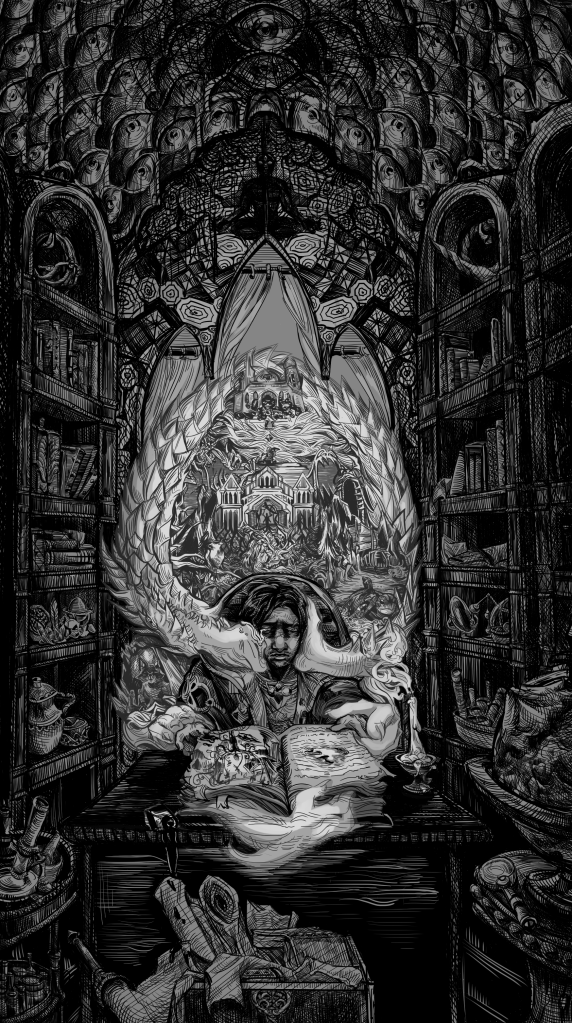
As I mentioned a week and a half ago, I’ve been tinkering in my spare moments to get another product up on the Etsy shop. In case you’re a fan of R. Johnson’s fabulous cover art for Promises for a Worse Tomorrow, you’re in luck, because it is now available in print form!

If you’re interested, check it out here!

Separately, a very, very long time ago, I posted about the original intent behind a lot of the work Leland and I commissioned for this project. A version of that is finally becoming real–stay tuned for an update!

Book Signing Recap

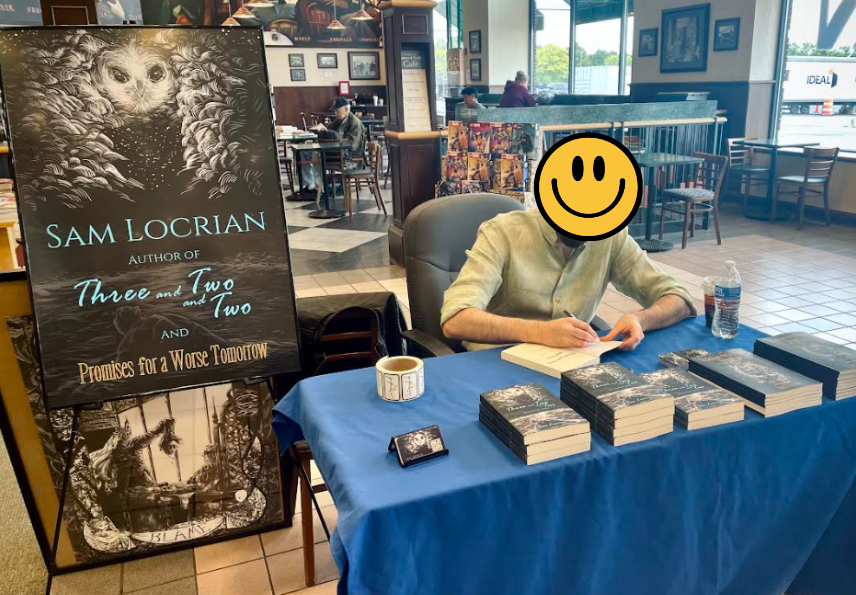
Before we return to our regularly scheduled programming, I want to thank all the folks who stopped by my table at Barnes & Noble this last Saturday. It was awesome getting to know you all, and I hope you have as much fun with Three and Two and Two and Promises for a Worse Tomorrow as I did writing them.

Thanks as well to Tim, Michele, and the other amazing staff at the store. You guys are awesome! And thank you to the fans who traveled some not insignificant distance to be there–you make it worth it to keep on trying.

For anyone in the U.S. Midwest who missed out, feel free to follow me on Facebook, where there will hopefully be more events incoming. I’ll also try to keep my various social media feeds more synched up on this as well.

Hey Kid, Wanna Patronize Some Arts?

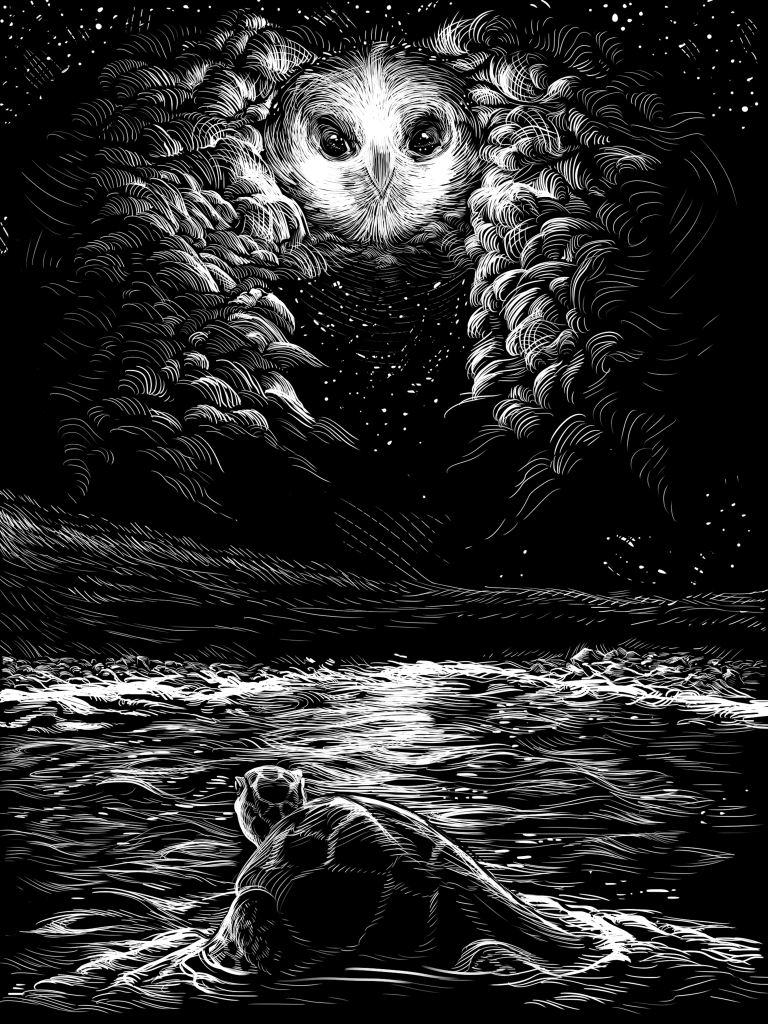
It’s been…forever, but the Etsy shop is finally back up! For those of you who were there in the before times, I’ve stripped down the inventory a little, since I’m not totally confident in the product viability of the “tarot card” prints. Currently, I’m offering prints of R. Johnson’s “The Third Gift”, which you will certainly recognize (since it’s probably now my single most-posted image on this blog):

…as well as Quinn Milton’s “God”:

I’m currently testing resolution for a third product, R. Johnson’s “Redemption” (alternatively “The Dragon’s Thesis”), the cover for Promises for a Worse Tomorrow. If it turns out, I’ll have that up shortly. Check it all out here!

Tick Tock

Like the viral marketing/content trough where people watch videos they hope will make them feel alive, even as each virtual second wrenches them further and further from the feeling that anything will ever be okay, ever again? No! It’s just the sound of the clock ticking down to the end of the Three and Two and Two ebook sale ending on Sunday! Buy it today, and perhaps escaping into a pocket of literary fantasy will forestall the gloom for another day!

No, I don’t guarantee it. It’s a pretty awesome book, though, if I’m allowed to toot my own horn.

One way or the other, though, thank you to all my readers. I hope you are doing well and that you have a lovely weekend!

What’s on Sale and What’s Next

Well, the first topic is easy: Three and Two and Two is available in ebook format everywhere for $2.99 until August 27th! Check it out here! Unfortunately, the print version is not currently discounted, as my print publisher is not especially agile with price changes. I’m looking into alternatives, but those won’t be for awhile.

Looking forward, I’m working on a few projects. The first is Whom Emperors Have Served. For those of you who have been skipping past those posts (because you don’t dig the unedited manuscript content, or for whatever reason), let me offer some context:

Whom Emperors Have Served (the working title of the overall story for which the first book will likely be titled $20,000 Under the Sea) is a mashup of the otherwise neighborly genres of noir, Lovecraft, and good-old-fashioned 19th century adventure-sci-fi. It’s a story of a group of misfits in the orbit of New York City’s rich-and-famous who are, for various reasons, roped into a celebratory voyage on a Titanic-like ocean liner, only to be plunged into a conspiracy of government secrets, monsters, and their own uncertain identities. The first book will hopefully be released within the next year!

Meanwhile, I am also writing the second book in the Crossroads series–working title: The One Winged Lark and the One Eyed Crow–in parallel, albeit somewhat behind. I’m looking forward to beginning to share draft chapters for it in the coming days. Thank you to everyone who has read Three and Two and Two. I’m looking forward to continuing the adventure with you!

Strange, Lucid Faespeak

A review of Alice, by Gary Gautier. Obligatorily, the “low-class art” in the intro refers to my own genre work and not the book being reviewed.

It’s a strange paradox of the modern world’s educational edifices that aspiring artists only receive meaningful training in the production of low-class art in the context of great prestige, at the greatest expense.  I mean, sure, you can take a few free credit hours of “modern film” your senior year of high school to help pay off the district’s gambit to persuade you not to spend your lunch break on the bike path across the street, getting blasted on some guy’s blend of low-quality cannabis, but that generally doesn’t train you on much.  Meanwhile, if you would like to attend USC’s high-cachet rockstar school for approximately $1 bazillion per year, you are suddenly in a very competitive environment.

The economics are deceptively obvious: Cynically, teaching enduring classics shields criticism, absolves educators of the responsibility for excessive insight, etc.  But the other side pushes hardest: Marvel is big business, and if you want to speak to the masses, the system will only spend the money teaching you how if it thinks you can succeed.  Dollars are expected of you, so either put skin in the game or get to work.

All this to say, I did not attend rockstar school or its literary equivalent, so virtually all of my training in the written word has been on more highbrow material.  I suspect this is common for genre authors like myself, where the glitz of speculative fiction was left as an exercise for the writer.  Less common, perhaps (or not, I don’t know you), I really enjoyed that training, I have literary aspirations, of course I try to return to it often.

Today’s return is Alice, by Gary Gautier.  Gary is a neighbor in the blogosphere (you can check him out here), and he was kind enough to consent to me posting this review.  Unsurprisingly, I recommend the book–it’s a quick read, an enticing dream, a novel take on post-apocalypse.  I make no claim to a “final” reading of it.  I’m sure I missed a few things, but that’s part of the fun of analyzable literature: The point of the puzzle is that the solution is not trivial.

Before I get to the meat of it, I want to note that the below contains some spoilers.  My isolated take is that preserving the surprise of Alice’s plot is somewhat beside the point, but if reading those sorts of revelations early bothers you, I encourage you to read the book and then come back.

Now: The premise of Alice is that Alice (the character) lives in an idyllic, egalitarian commune in the woods and is having some strange experiences.  Like dreams but waking, less hallucination than astral dissociation, paired with the inexplicable experience of change.  For example, in the very first paragraph, she perceives that the constellations in the sky have changed.  Much is made of this, of course, and it remains ambiguous whether the change was material or perceptual.  She mentions it to other characters, and they acknowledge something, but they seem mostly to be acknowledging Alice’s perception rather than a physical change in the world that is salient to them.  These changes, alongside visions and conversations with individuals who are dubiously “there”, are bewildering and concerning to Alice, but it’s notable all the same how long she does nothing about it.

Okay, so the real draw here isn’t the plot.  It’s the prose (which later validates the plot).  It’s faespeak, highly simple, almost the literary equivalent of “plain English” legalese, but informal, hazy, and full of reference to commonly-understood memes.  At the risk of comparing it to something it’s not really like, it reminds me a lot of Madeleine Is Sleeping, a very different book about dreamlike hazes.  But it’s a book about dreamlike hazes.  Whimsy is definitionally protean, and it takes the form of Kingdom Death: Monster just as well as that of A Midsummer Night’s Dream.  Her somnolence is technical, surface level, and her flights of fancy are more worldly than fantastical, but practically speaking, Alice is asleep.  Part of this is literal–it is revealed that the ladybugs flying throughout the commune are robotic, designed to acoustically pacify the people around them–but much of it is still literary.  Alice is chock full of circumlocution of the fact that, while she is very reasonably confused at the unfolding of her ethereal meta-world, she is neither incompetent nor dumb.  She is clearly capable of synthesizing from the information she has, and she has more information than she should due to her metaphysical connections.  But she still lacks agency for much of the book.  Materially, this is the same reason most people lack agency: She doesn’t know what she wants.  But this manifests as an aimless seeking of answers only to be shunted from her path, gently but repeatedly, by random happenstance, by people who also do not really know what they want but seek control because it’s there to seek.  Psychoanalytically, this looks a whole lot like resistance, a projection of Alice’s inability to act, onto the external structures that theoretically should bind her but really don’t.

This perspective, that of the individual within the world, nominally surrounded by power structures meant to corral populations, but in reality gated only by their ability to control/change themself, to want things, to act, feels to me to be where Alice is at its strongest.  This may be projection–I may still be high on Sadly, Porn, but the core thought is not especially uncommon.  From Alice:

“The pointlessness of all the rebellions in El Dorado–the deliberate pointlessness–that was the point.  Changing the world is vanity.  The revolution must be subjective, or at least physical in the body, not physical in the world.  That’s why Alice felt her body changing.  Subjective transformation first, and the change in the world will follow.  You can only change the world from the inside out.  Those who would start by changing the outside world are starting all wrong.”

Alternatively, at a somewhat lower reading level, from Netflix’s Nimona:

“Ballister: No matter what we do, we can’t change the way people see us.

[Pause]

Nimona: You changed the way you see me.”

To be clear, that isn’t a criticism.  Life’s most important lessons are often deceptively ubiquitous, and literature’s role is to affirm insights–it virtually never makes an insight that’s actually new.  And Alice affirms this notion–that human power over the world originates within the self–beautifully, piecing it into a framework of interconnectedness not unlike the oneness and being you might encounter in the midst of an acid trip.  This is intentional, of course: Alice’s dream-insights arise from the…unique qualities of her genetics, but she finds herself connected to individuals who became connected in this way, literally, from drug use.  Why this is such a common experience with psychedelics in the real world is an interesting topic.  I won’t address it here, but the assertion that said interconnectedness is a real thing that the drugs simply give access to is, at the very least, reasonable within the bounds of literature.  Still, it’s on the threshold of where I think Alice stumbles.

As an affirmation of those theses in psychology and social connection, Alice does a fantastic job for as long as Alice’s experience is foggy enough to ward off the insufferable mosquitoes of material reality, the annoying inquiries of “yeah, but does it actually work like that?”  Having written a whole novel manuscript with a plot predicated on a quantum-mechanical basis for sentience (and extinction), believe me, I relate to the challenge of making up believable science, but Alice’s invocation of the economic history of the Hoarder Wars, the lab and the social control schemes of El Dorado, the Mitochondrial Eve–one has to wonder if the coherence of the argument might have been improved with less scientismic dei ex machina.

I’m not entirely hostile to it, and I will readily admit that there are a lot of cool meta-dynamics within those details, but writing realistic but fantastical hard sciences is, well, hard.  The inner workings of chaotic systems are stupendously difficult to discern; paraphrasing Lou Keep, it’s unclear whether there is anyone alive who really understands how “the economy” works.  So when Alice postulates a delta within a single lifetime, from 1970 upstate New York to a post-apocalyptic-war clean slate in which there are two towns and a total population of ~300 people (and almost no one has any memory of the war, and also no meaningful technology has been lost, and actually significant technological strides have been made, etc.), I 100% understand it’s not the point, but the material details are distracting.  I don’t think it’s entirely the text’s responsibility to provide those details, but it provides just enough that the HOW?! in the back of my head is deafening.

My feelings are even more mixed (though, to be clear, for the better) on Alice’s use of genetics.  The book employs the Mitochondrial Eve, the matrilineal common ancestor of all living humans, as a symbol for the ebbing of possibilities and the cyclical repetition of human history.  Putting aside the perhaps unnecessary paradox of those two concepts being symbolized by the same entity, I found myself a little distracted by the fact that that’s neither how genetics work nor how they are used.  Said differently, I found the actual subject of genetics to be a poor substrate for what it felt like the book was trying to get at.

But there’s still something cool here: A prevailing theme in Alice is ancestral connection, which is experientially, psychologically, a very key part of what it means to be human.  And I get it, literature can be what we want it to be, and there seems to be a want for that ancestral connection to be more than experience and psychology–the want is for it to be real, for it to be true.  So Gautier asks: Why can’t it be chemical, embedded in our actual, physical DNA?

The answer: cryptography.  Since, to the extent that environmental factors get encoded into our DNA, they are encoded many-to-one, you can’t decode them backwards without a key.  The book clearly gets this at some level–much space is devoted to keys that would unlock this: the aforementioned psychedelics, an “elixir” brewed up by a young witch from medieval Germany whom Alice speaks to in dream space, a literal skeleton key that Alice finds early on.  The symbol of a key allowing one to access the encoded past is absolutely there.  

But it’s messy.  The encoding is literal; the key is metaphorical.  The Mitochondrial Eve, a temporally moving target (the common ancestor of all living humans changes depending on which humans are currently living) is framed as fundamental root potentiality and an inevitable return to “true alpha”.  The environmental information encoded in DNA–in reality, stuff like “drank a bunch of lead before adolescence” or “was, by sheer happenstance, good at throwing things and lived in an environment where that was relevant to survival”–is so far from what ancestral memory actually means to us that these sections just fall a little flat.  Though, reiterating, these are impressions and not a final reading–I would absolutely welcome discussion on this take.

Belatedly, I think another side of it is that the prose, which fits the buzzed out tranquility of the commune’s life excellently, is not a great match for technical description.  Consider Alice’s conversation with Faunus, the director of the lab at the rival town of El Dorado:

“‘Or maybe,’ continued Faunus, ‘the cyborg approach, using artificial intelligence and robotics.  Artificial intelligence will give you control alright, but it always tends toward total control, total surveillance.  All freedom is lost.  But now we’re getting back to the idea of the fascists, aren’t we?  But the fascists, as I said, were rooted out.  And robotics?  Sure, you can make someone faster, stronger.  But human nature?  No, the cyborg approach–artificial intelligence and robotics won’t do.”

I’ll admit that Pan the Venture Capitalist is a symbol I have not entirely unpacked.  But beyond his Greco-Roman cred, Faunus very much resembles a caricature that applies equally well to podcasting VCs and drunk hipsters at house parties: This is a guy, surrounded by people who think he’s a genius, who has absolutely no idea what he’s talking about.  All of his thoughts and perceptions are organized into neat, macro-philosophical boxes, labeled things like “Fascism” or “Artificial Intelligence” while he leaves the messy details/comprehension to his employees and/or no one.  I got the impression that this was at least partially unintended, largely because the tone (again, informal, full of imprecise commonplaces and memes) is kind of how Alice describes everything.  In context, I got the impression Faunus was supposed to sound ambiguously villainous, walking through the twists and turns of his plan for social control, but the language isn’t quite right.  Social control can be described from a wonk perspective (see Pigouvian taxes) or, more horrifyingly, from ideology (see Goebbels), but getting it in milquetoast party-chat over tea rather conveys the impression that none of the underlying machine actually works.  I mean, perhaps this was intended: In the end, the lab fails to achieve its (or, discernibly, any) goal and gets a couple people killed.  It’s a very digestible moral with regards to the desert of top-down social engineering.  My skepticism is merely with respect to the highly dubious intentions behind it–intentions which would have carried more weight had they been better thought out (or rather, expressed in the language of those doing the thinking).

Despite the criticisms, I don’t mean all the harping to be much more than a warning sticker in aggregate.  On the whole, I found Alice very much worth reading.  Despite the simplicity of the prose, it was literarily very crunchy, and though I wrapped it up some weeks ago, I’m still thinking through it.  Moreover, I’ll certainly be checking out more of Gautier’s work in the future.  There’s something inspiring in this horribly modern era about his belief in human potential.  The faespeak, for all its limitations, makes for good dreams.

Some notes:

  1. Those who read my work frequently probably already know this, but I want to be clear that my use of the term “meme” is academic here.  I am referring to commonly-understood ideas and idea fragments, not to Advice Animals.
  2. Because the book is titled Alice and involves journeys into dreams and/or the subconscious, I would be remiss to not at least mention the potential for references to Carroll.  I have not read Through the Looking Glass, so I don’t feel confident asserting anything in particular, but an allegory between the social control schemes of New Arcadia versus El Dorado and the opposition of the Red and White Queens does seem at least possible.

At the End of My Fork

A review of Naked Lunch, by William S. Burroughs.

Planned writing is kind of weird.  In terms of workflow, any writer out there will tell you that the way to do things, the way to beat writer’s block, get kickstarted, etc. is to just write.  I don’t disagree, of course, it’s just that the robot which runs our existence, Mr. The Economy, and its various amalgamated, algorithmic henchmen tend to prefer a few more control measures around the content.  They want you to write the specific things that fulfill demand.  In my fiction writing (pre-editing, anyway), I usually have most of the freedom I need to take the conventional approach.  On the other hand, my reading list, the review content I synthesize thereof, and the sOcIaL mEdIa PrEsEnCe it feeds, well, those all need planning.  Cadence matters to y’all (or so say my webpage stats), so it must matter to me.

Anyway, the next book I had put on my list was Naked Lunch.  I am not “ready” to write this review; the book is still worming its way through my brain; the extent to which I “get it” is not much farther than a certainty that there is something to get (skeptical readers: I promise you there is).  It honestly feels something like the congealing protoplasm of one of Burroughs’ junk highs–gobbets of meaning sloughed off of reality, free-floating despite their truant obligation to be connected.  Burroughs himself helpfully reaches up and jigsaws some of the slime via postscripts and afterwords: this book is about the twisted economy of opiate addiction.  This book is about countercultural homosexuality.  This book is about capital punishment and the violence of invasive government.  Beyond that, based on secondhand accounts and editors notes, it seems like even the author was somewhat confused about what Naked Lunch really was.  It makes one feel better at least.

The book comes out swinging hard:

“I can feel the heat closing in, feel them out there, making their moves, setting up their devil doll stool pigeons, crooning over my spoon and dropper I throw away at Washington Square Station, vault a turnstile and two flights down the iron stairs, catch an uptown A train…Young, good looking, crew cut, Ivy League, advertising exec type fruit holds the door back for me.  I am evidently his idea of a character.  You know the type: comes on with the bartenders and cab drivers, talking about right hooks and the Dodgers, calls the counterman at Nedick’s by his first name.  A real asshole.  And right on time this narcotics dick in a white trench coat (imagine tailing someone in a white trench coat.  Trying to pass as a fag I guess) hit the platform.  I can hear the way he would say it holding my outfit in his left hand, right hand on his piece: ‘I think you dropped something, fella.’”

Yeah, so maybe you’re quick, but for most I expect the language hits like cold water.  The Beat slang, the pace, the not-really-stream-of-consciousness–more stream of words–simultaneously inscrutable and frantically modern (despite being written when my grandparents were kids).  I had to read it like three times.  You get used to it.  You have to, there’s a whole lot of book, and it’s all written at least as incoherently as that.

The book is nominally written in vignettes that can be read in any order.  I’m not totally sure if that’s true, but the chronology is by no means definite.  At the beginning, you can sort of settle into the makings of a narrative frame: You’re following Bill Lee, junky, dealer, all-around ne’er-do-well, as he flees west across the U.S., through Chicago, down into Mexico.  Context is hazy, descriptions of places and people are weirdly transient, allusions to titled-but-nameless figures such as “The Vigilante” or “The Rube” abound, and you start getting the picture of a heavy–but amusingly unhinged–noir.

But the descriptions get more and more detached from reality.  You encounter an anecdote of Bradley the Buyer, a cop who never actually does drugs but picks up a contact habit from the act of buying them in stings.  One thing apparently leads to another, and he turns into an ectoplasmic monster and assimilates his commanding officer.  Among other dubious accolades, Naked Lunch makes better use of the onomatopoeia “schlup” than any other in literature.  Anyway, shortly thereafter, the continuity breaks with the introduction of the highly disturbing Dr. Benway, and the ensuing 50% of the book’s material can best be described as phantasmagoria.

What does that mean?  Well.  It means it’s a great melting pot of senseless violence and animal sexuality; monstrously disinterested cruelty; every racial, misogynist, and homophobic slur imaginable–and others besides, along with a collection of derogatives that would certainly be more offensive if anyone used them these days–and for whatever reason, more semen than would be appropriate in erotica of a similar length.  “Um, was it worth it?”  Fuck if I know, though I can’t really say I enjoyed reading it.  I took two things from it, though: First, in its picture of “the Interzone”, it reflected some essence of the carnival nightmare of existence between cultural identities, something which Burroughs, a cultural public enemy in America who spent his life flitting between his home country, Mexico, Europe, and Morocco, must have understood deeply and darkly.

Second, well, a digression first: Burroughs states explicitly in an afterword that the more violent and allegedly pornographic sections of the book were intended as an indictment of capital punishment, a description that strikes me as…strategically incomplete.  The role of the state in dehumanizing, immiserating, and, yes, killing its populace is certainly spotlit in these and other sections of Naked Lunch, but the vitriol of the phantasmagoria seems to me to be about much more than government.  It feels almost like emesis, vomiting out a hideous concentration of cynicism, frustration, and fear which Burroughs might very reasonably have swallowed involuntarily in his fifteen-year journey as a junky and gay man in ‘40s/’50s America.  But he doesn’t seem to be much for naked self-pity.  Hence the form.

The book resolves to coherence again at about the 70% mark, where the madness of the Interzone gets grounded around a more meaningful description of its power players (A.J., Hassan, Fats “Terminal”, and the other Agents) and its political parties (Factualists, Liquefactionists, Divisionists, and Senders).  The former comprise the closest thing the book has to traditional characters–real personalities with (admittedly hard to decipher) wants, collaborating and competing toward their various and nefarious ends.  The parties, meanwhile, are some of the book’s more interesting allegories, representing, apparently, something closer to worldly philosophy than strict politics.

Literally, three of the four rely on the Interzone’s surreal physics in order for their outlooks to make any sense.  The Liquefactionists believe that ultimately, all of the protoplasm that forms each person’s essence will fuse into one.  For them, it’s true, zero-sum schlup or be schlupped.  The Divisionists are kind of like the opposite.  They are obsessed with replicating themselves, though their endgame–where one mass of replicants has outcompeted the others, and everyone is just a copy of the same person–is much the same.  Ditto for the Senders, a telepathic hive-mind in thrall to “the Sender” who collapses cyclically from the strain of sending all of themself to the receivers, leaving a void for a new Sender to fill.  The Factualists seem primarily concerned with antagonizing all of the other factions, leaving some ambiguity as to whether their “factuality” is actually pragmatism or simply contrarianism.

Crudely, one can map the Liquefactionists to a “conqueror/capitalist” mindset, one that perceives the world as a rat race to be dominated at an individual level.  The Senders are the religious, spiritually, and philosophically-inclined, who believe in the power of ideas, heedless to the inconvenient truth that in any given exchange, there is only one person talking at a time.  The Divisionists, meanwhile, are the culture warriors who perceive the good of civilization to be a numbers game (a decent parallel to the Birchers from Burroughs’ time, the precursor to the modern U.S. right-wing propaganda machine).  And the Factualists, with whom one must assume Burroughs identified himself, are the existentialists who, despite having none of the answers, are quite certain they disagree with all of the above.

Naked Lunch eventually ends in a dreamlike swirl of its dark images, leaving virtually all of its conflicts unsatisfactorily resolved.  But it was never a book about resolution.  It’s a book about going under, about the heavy, excruciating climb out of the water thereafter and the uncertainty of falling in again–or your ability to make it out again when you do.  I won’t say it’s a must-read.  A family member recently described a similarly unhinged book I recommended to her as “things you shouldn’t know”.  This is a lot like that and much more disturbing besides.  But it does feel true to a certain inebriated stream of experience.  I believe Burroughs, and I think I’m better for having heard his thoughts.  With some curiosity and an appetite for painful language, perhaps you might be as well.