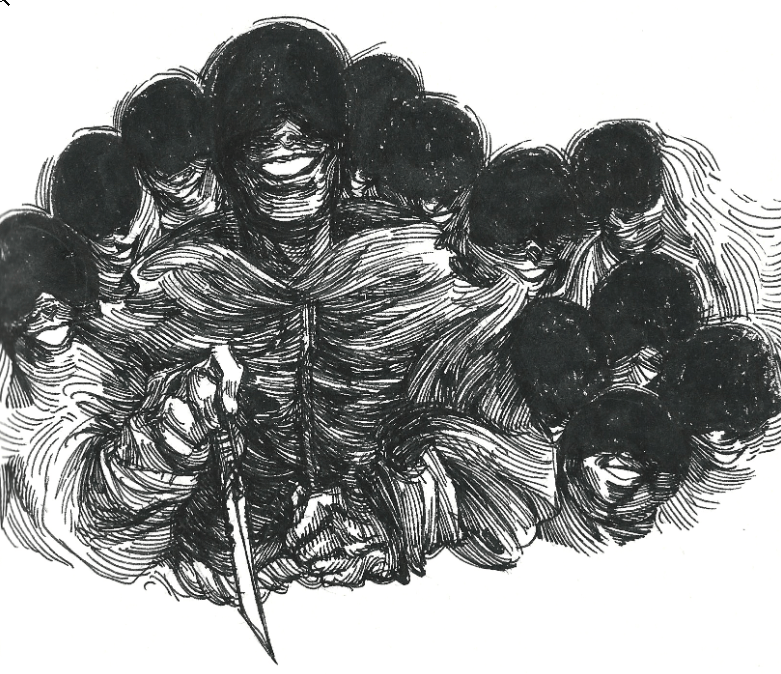
Green

Through the whirring, root-lined passages of the workshop, a diminutive figure shuffles along.  Where there is open space, she observes the goings on, the maintenance of her domain, with muted interest.  At the periphery, tiny, metal spiders clink and clatter on about their thousand little tasks, sweeping away dust, digging, polishing, sometimes even melting themselves down, embedding themselves in the tunnels as struts and beams, retaining enough function, though, to click and whir and watch.  Her workshop was alive, the figure mused with a smile, so unlike the houses of men.

Where the ceilings were high enough to permit them, her other servants labored in studious silence.  Men–and women, she supposed, though it hardly mattered anymore–made of ticking metal transcribed and translated her library, organized the tables at the center of her workspace, banished her abandoned projects to the corners of the room, and, when so requested, retrieved them.  Their tasks were not difficult, but they were not easily programmable or required more heft than the spiders offered readily.  Either way, the metal men did them gladly–they were grateful for the life she had given them.

Pensively, she scaled a stool, producing a host of spindly appendages from within her black robes which carried her into the seat with the undulating grace of a centipede.  She had been traveling–not physically, of course, but through a proxy–and the effort of the conscious projection invariably wore on her.  Still, she was disinclined to display any affect outwardly, though it was doubtful her servants would have noticed or cared.  She had notes yet to make, and fatigue–even the magical variety–was an enemy to which she refused to succumb.

From a stack on the table, she drew a leaf of thin, papery material and licked her finger, secreting a drop of oily, black ink from the reservoirs in her salivary glands.  Splitting her finger into eight much finer-tipped instruments, she lowered them to the page, where their twitching, seemingly random and erratic in the air, began, precisely and rapidly, to inscribe her thoughts:

On this 1237th year of the Exsanguine Era, it has come to pass that open practice of the Way of the Green has been all but eradicated here in the Riverlands.  The popularity of anti-magical “Harmony” movements in the wake of the Incident has evidently left it little room to grow, and what texts remain of its rites all seem to have disappeared into the Papacy’s vaults, likely to be burned or twisted beyond reasonable recognition.  Thus, it has fallen to me to generate a more trustworthy record of the institution.  This is necessary, I would submit, both for the value of the knowledge in itself as well as for a speculative angle of analysis.  After all, the diaspora of the Greencircle, in more than a single sense, can be held responsible for the Riverlands’ worrying modernity.

To begin, the Way of the Green, distinct from the Greencircle as day to the sun, was a movement, and like any popular movement, it was fragmented in its purpose.  Its intentions and praxis varied wildly among its constituencies, and any anthropocentric account of its history is sure to be flawed for this reason.  This is fitting, of course, as its origin had little to do with humanity.  The Greencircle did not congregate there in the Bloodwood to found a movement, and they were certainly uninterested in teaching a way of life.  Rather, the Greencircle was a reaction, itself, to an external threat.

Some 500 years ago, by my best estimate, the folk hero known popularly as the Hunter of Beasts raised a call to arms among the aspiring heroes and scholars of the Riverlands.  He sought an alliance meant to destroy a monster deep within the Bloodwood, a ravenous, devouring mass he called the Hunger, though it was a subsequent name–the Chimera–that found its way into the local lore of the time.  A great number answered his call, for the Hunter was well-known at the time, and he soon led a host of glory-seekers on an ill-fated quest to slay the beast.  Nearly all of them perished.  Most among the company were inexperienced, blessed by talent or ambition but no art, and vanishingly few had cunning or strength to match the Hunter’s.  So bereft, they made of themselves easy food for the Chimera.  Far more notable than the casualties, though, were those that survived.  The organization they formed thereafter, though it had no formal title, became known as the Greencircle.

Chief among its members were the Wolf–also called the Masked Alpha–a powerful hermit mage and self-styled “protector” of the forest; a pair of scholars, a Botanist and an Arborist whose names were not recorded but who are noteworthy nonetheless for their success in translating the Chimera’s ability to manipulate flora into a teachable magical art; and, of course, the Strange Bird, ostensibly just a talented, one-eyed hedge witch, though her enduring influence–and the macabre nature thereof–raises serious questions as to the innocuousness of her identity.

Now, for a period of some twenty years–an average of the retellings I’ve gathered–this organization–which is to say the Hunter, those four, and their closest followers and aspirants–were an open and public institution, well-known among the villages in and around the outer Bloodwood.  Following their disastrous confluence, they tempered their aim of destroying the Chimera, instead focusing on containment: repelling the beast from woodland villages and–to a reasonable extent–keeping it confined to the wood’s heart, where it posed little threat to the “civilization” outside.  In so doing–for all the Greencircle were learned mages–they uncovered and codified magical knowledge to rival that of the ancient universities, including the bases for what I would now classify as three distinct schools of magic.  The organization was loved and respected as protectors of the people, and soon, the discoveries and philosophies of its members began to spread beyond the Bloodwood and throughout the Riverlands.

The words I have chosen, however, are very particular: The Greencircle had little in the way of a unified worldview, save, perhaps, for the agreement that the Chimera was dangerous.  Regardless, what proceeded to spread among the people, known collectively and indiscriminately as the “Way of the Green” were the ideas of the Greencircle’s individuals.

What this meant, of course, differed by both origin and adherent.  The Wolf, for instance, inspired a tradition of copycats, practitioners of his shapeshifting and cannibalism, albeit with only a fraction of his zeal for the defense of the wood.  Meanwhile, devotees to the Arborist and Botanist practiced their plant magic and maintained a calendar of rituals to honor the flora of the world, within their spheres of experience and without.  Alone among them, the Strange Bird’s followers formed a longer-lived organization, but I will return to that discussion separately.

Despite the spread of the Way of the Green, the Greencircle itself remained focused throughout this process on the danger of the Chimera, and to judiciously interpret various accounts of the Hunter’s temperament at the time, that focus was not bearing fruit.  While the creature voraciously consumed–or, perhaps more accurately, assimilated–all flesh in its path, it seemed to matter little whether that flesh was human or even faunal.  The Greencircle’s work in deterring the Chimera from human settlements had thus been admirable but futile: While the humans remained, the once-small region where the beast dwelled had increased tenfold in size, and with countless new mouths, its rate of expansion had multiplied accordingly.

Nearing a point at which he surmised they would be hopelessly outmassed, the Hunter brought the Greencircle’s considerable magical expertise to bear in an effort that was, while clearly significant, ill-documented and historically unclear.  From the accounts and scraps I have amassed, I am to ascertain that it incorporated a ritual employing numerous mages; that it was successful, insofar as the Chimera is not mentioned in any record thereafter; and that it was quite costly.  Notably, it is clear that neither the Botanist nor the Arborist survived the ordeal.  How many others might have died alongside them is, of course, unclear, but it is well-recorded that the Hunter of Beasts at that point ceased his engagement with the Greencircle, effectively dissolving the organization.

While the Way of the Green flourished for centuries thereafter amidst the Riverlands’ long-harbored thirst for a magical and cultural identity distinct from that of the eastern domains, the more interesting epilogue to this story is with regards to the Strange Bird.  Her followers, known as the Feathermen in the years after the Greencircle dispersed, remained in their secluded corner of the Bloodwood until just a decade before the Incident.  It is difficult to say what purpose they labored toward, but a few points are clear: First, for a time, the feathermen were known among the villages closer to their domain for their “exports”: trinkets, imbued with Mana, able to perform magic with little input or expertise required from their bearer.  It seems doubtful that any of these creations had much use, even at the time, but taken against the veritable–and not altogether benign–economy that thrives for such goods today, one can almost see the Strange Bird’s influence in the here and now, hundreds of years since she was last seen.  My suspicion on this point is only deepened by the list of individuals to whom I can draw affiliation with her club.

Le Marquains of the Southern Reaches, for example, made no secret of his training with the Feathermen, and his arrival in the South to quell the Saraa Sa’een well outside the monster’s known territory certainly merits comment.  Likewise, witness accounts of the individual known as the Hawk, who assumed control of the Feathermen in the last decade of their existence, bear more than passing resemblance to those of the one-eyed man who led Ka’s armies during the Incident.  And, of course, I need rely on no hearsay to recall the tufts of feathers that still clung to the Dragon’s hide the day he arrived in my village.  That all of these men became generals of the Bloodfish seems both deliberate and in poor accordance with their ideals–the Dragon, in particular, had little apparent interest in Ka’s ravings.  I do not doubt, at this point, that this was strategy on the Strange Bird’s part, though now with her pieces–her manipulable Greencircle and Bloodfish–dead and buried, it is not clear for what she aimed or whether some plan of hers might still be unfolding.
Closed Beta

So this is happening currently:

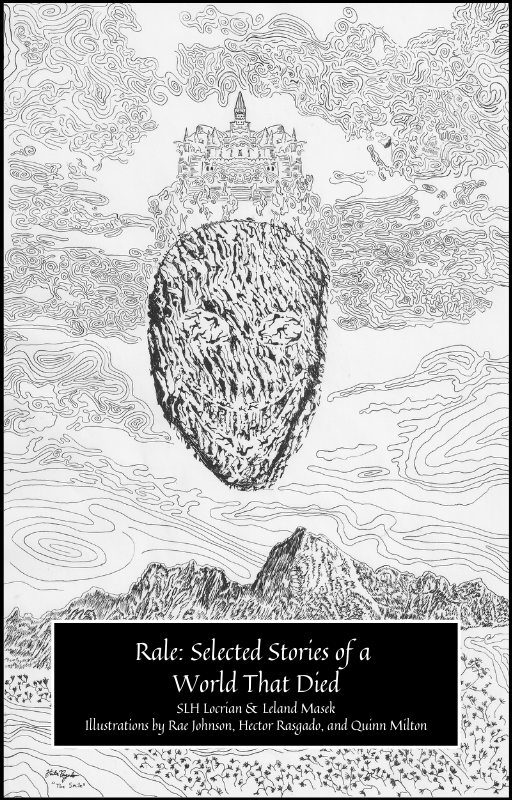
I have compiled (and lightly edited) ~170 pages of stories from the War Torn/Rale project into a reasonably coherent anthology. Many of the stories have appeared in some form previously on this blog. Several have not. It is by no means a finished product, but I am looking for feedback from beta readers. If you are at all interested, drop me an email.

Image: Hacked-together cover by me. Background image is Lies, by Hector Rasgado.

The Twin Decrees

Two decrees, issued under the authority of Her Majesty, [————], Right-Hand Queen of Spar, presented below as they were circulated, in their original Diarchian.  A translation is included as well:

Dacreem Goetcia

Al kinderseiztentreyundtcan enten brainenger Goetcia

Sonaftdoon al Citizia trin hidcitfia Kinder entin deta

Goetria exa entin fin Sonaftop

Translation: Decree of the Goetia 

All children over the apparent age of 10 are to be brought to the Goetia.

After sundown all citizens attempting to hide children from the state will be arrested

The magical propensity testing will be completed after sun up

Dacreem Goeci

Goeki destrin citiociticzia, al Goeionsaf ent detenenger

Excle Goetia entin kain Goei protreyrciticzia

Al Goeccioltrakai entin pena dairith

Decree of Magic

Because magic is killing the state of all citizens, all non-safe magic is to be stopped

Only the Goetia may use magic for protection of the public

Any other use of magic will be punished by death

The Two Guards Riddle

This keeps coming up in my writing for some reason. The first piece is an excerpt from a novel I wrote some time ago. The second is a story I wrote more recently, featuring the Smile.

Espereza’s Riddle

“Let’s get to know each other, Samuel.”

“What the fuck is that supposed to mean?” Samuel yelled.  Espereza grabbed him by the shoulder and slammed him into the rock.

“Tell me, Samuel,” he whispered, the syllables rolling out wet and reptilian.  “Have you thought about my riddle?” Samuel scowled.

“Your riddle?”

“Yes.  A labyrinth.  Two doors. Two guards.  Do you recall?” Samuel sighed with disgust.

“Sure,” Samuel said.  “You ask each guard which door the other would recommend to get you out alive.  Their answers will be the same. You take the other door.”

“Really?” Espereza asked, his grip on Samuel’s shoulder still firm.  “I think a fair amount of the time, their answers will be different.”

“No,” Samuel said, annoyance seeping in over his fear for his life.  “You said one always tells the truth, the other always lies–”

“I didn’t say that.”

“What?” Samuel asked.

“I didn’t say that the other always lies.”  Samuel stared into the man’s black eyes for about ten seconds.

“You can’t solve the riddle if one of them only sometimes lies!” he said, finally.

“I know,” Espereza replied.  “Isn’t life just awful that way?”

The Smile’s Riddle

Care to join me in a game of riddles, my dear?

Suppose you find yourself in a passage you must escape. Before you are two sentinels. One tells only truth, the other only lies.

“I am Truth,” says the first.

“I am Truth,” says the second.

Behind them are two doors.

“This first door leads to terrible agony,” says the first sentinel.

“This second door leads to terrible agony,” says the second.

Your companion, thinking he has seen past the riddle, enters the first door.  You, under the same impression, enter the second. Some time later, your companion exits the passage with memories of torture, violation, and such atrocities visited upon him that he would sooner drown in an ocean of drink than recall.  In the same time, you exit with those same memories.

So who lies?  Is it the first sentinel?  Is it the second? Or is it me?

What, for that matter, is a lie?  In my homeland, it was a mismatch, words or images set against a reality that rejects them.  Our dead queen, immortal in the dark of her ziggurat, bade us–myself, your precious Rom, all of her shadowmen–bade us go and tell lies of fear and unrest to her people, our enemies, anyone who would listen, really.  It was all such a waste. Right there, all the potential in the world, squandered for a bad lie told by a bad liar.

The thing about a trick of the light is that it makes the trickster apparent.  Back to the riddle: There is no trick, no obvious mismatch of words to reality, but that’s because you have no knowledge of reality.  No, all you have is memories, and they lie more fluently than any sentinel.  If you believe them, in fact, there is no lie. Thus spoke the Man of the Clouds, the greatest leader I ever knew.

He proved it, too.  You see, all we ever needed to do to throw off the queen’s claim–that she was immortal, that she was Death, whom we all must serve–was to stop believing the lie.  He led us from that pit, into the sky, and the eternality of Khet just fell from reality, as dew from shuddering grass. It is not even that his City in the Clouds was any different–just images and sensations and words and dreams, sculpted of vapor and bequeathed to any who would believe his lie instead.  And of course we believed it.  It was idyllic paradise over dronehood before unending Death.  No, the turning point was what came next.

One day, the travails of my past life well and truly recovered from, I stood at the edge of that City in the Clouds and looked down at the great sea we appeared to pass over, and a single, ruinous thought thrust into my brain: I didn’t believe it.  Do you know why? Do you know what I saw, down there in those depths? It was nothing. Nothing below, in those waves; nothing in sight, save for our city; nothing real beside peace, goodwill, and the serene ephemerality of clouds. It was a pretty, elegant lie, but elegance is only of use against a particular problem, and my problem was not particular.  It was everything.  All of reality–the grim, beautiful, violent reality the Man of the Clouds had omitted from his paradise–I knew to be down there in that roiling Deep.

So I descended–and those who knew as I did followed–to go and imbibe the horrors and agonies of life, to create a new lie, a grand story of this whole, glorious, accursed world.  With what we learned, we would build a new stairway to the sky, a stairway of earth and blood, and we would prove the primacy of our lie, just as the Man of the Clouds proved his.  

Which brings us, as ever, back to the riddle.  Did your memories lie? Did the sentinels speak falsehood?  Or within those passages was there merely life, just as without, with its rocks and thorns and fears and pains?  And if everything was true, am I the liar for posing the question?

“I am Truth,” says the first sentinel.

“I am Truth,” says the second.

And, of course, I am Truth as well.

A Smiling Man

“Do you see what you’ve made, my dear? Parity. As above, so below. The Deep has always been a mirror, but even I can admit it is a dark one. But you! You have darkened the heavens, made one great blackness of the whole affair! As below, so above, and tell me now: Are black sea and black sky one and the same?

“It depends, you say. They are alike as voids to shout into, but throw yourself along with your voice, and you shall know the difference. One will accept you, begrudgingly, perhaps, in its cold, airy breath. The other will pour into you, unrelenting to your separateness, ceasing only when you, too, are darkness.

“But I’ll let you in on a little secret: That will, that relentless, violent churn, that everything that will suffer no scissor, no duality, no self amidst others–it is nothing but a lie! Darkness is darkness, nothing is nothing, a mirror is but a trick of the devoured light.

“Ah, but another secret: Lies are to be cherished.”

Top Image: The Smile, concept by Rae Johnson, commissioned for War Torn/Rale

Lords of Cinder

More prose poetry, this time on Dark Souls.  The below is a lot of things, but among them, I intend it to be an extremely succinct (and therefore not very careful) explication of my argument from the Dark Noon series. You can fill in the gaps with the actual essays, excepting those gaps in the essays which you can fill in with this. Git gud, I suppose.

***

“When the Ashes are two, a flame alighteth.  Thou’rt Ash, and fire befits thee, of course.”

-Father Ariandel, Dark Souls 3

In the beginning, there was mist, and in that mist were shapes of trees, of branches, of great, stone dragons that remained forever still, of vermin that writhed and crawled in the fog’s deepest whorls.  Nothing seemed to move. Nothing seemed to cease moving. No creature in that mist looked out and recognized any other, but even if one had, it would have troubled at a quandary: “This Everything I see–is it one, or is it many?”

***

Two.  The first prime.  A great, uncertain step forward, every bit as profound as the gulf between the mist and the void, even more important in its way.  It answers a question, a question that truly must be asked: One or many? No one, after all, disputes that there is something. Even the most charred cynic claims not that there is nothing, merely that nothing matters.  Nothing is different.  It is all the same.  A Son of God once claimed that where two gather in His name, He shall be among them.  It makes sense. He claimed to be the Truth, and Truth is what separates the first from the second.

***

A moment came within the fog–timeless until this strange happenstance–when a fire, dim within the great stasis, flickered to life, deep within the earth that clung to the trees.  Its heat drove back the mist, and the vermin, eyes at last open, could ignore it no longer.

For the Fire brought disparity: Heat and cold.  Life and death. And, of course, light and dark.  The vermin at last saw themselves amongst the trees.  They saw the dragons looming above them. They saw difference, and, within the Fire, they found a means to address the inequity.  From its burning depths, they drew forth the souls of Lords: Light, order, nobility; Chaos, change, flux; Death, decay, eternal rest.  Together, the Lords rose up and overthrew the dragons, Lords in their own right of stone and Stasis. Upon what remained, they built a great kingdom for the Humanity they championed.

But were they truly champions?  The Flame of Truth had made two of one, had separated humanity from the tree and the stone, but is Truth itself singular?  

When the Lords departed for their war against the dragons, the pygmies of the vermin, the lowest of those that writhed, considered what remained within the Fire and found in its dregs one final soul, a Dark soul of ash and lies, a stain to be feared, buried, forgotten.  Truth, after all prescribes what is true but also what is not. Is Humanity, then, above or below? Is it the second or the first?

***

A fire is not an object.  It is a process. It devours the singular, separates its fuel into two: Goats and sheep, good and ill, heat and ash.  To be fuel is to be exalted, momentarily brought forth from the mist, placed upon a hilltop to be, however briefly, a guiding light for those attempting to see.  But the fate of cinder is grim. Heat dissipates. What once appeared lordly soon crumbles, charcoal to ember to ash. The Fire gave us God, but it is the fate of gods to die.  To burn. To be separated into truth and lies, buried, leaving us to wonder whether there was ever truth in what we believed. But still deeper, quietly slithering beneath the denouement, a question remains.  It is not the question–Fire presupposed to answer it.  It is our question.  Not: One or zero?  But: One or two?

Ignition brought us new life, but the dying Fire offers a choice.  Do we wish the Fire to survive? It needs fuel, that which we elevate, which guides us, which dies and is forgotten; but not just any fable from the mist might be a Lord of Cinder.  The abyss within us is clever. It sees the dying light and asks: 

“Don’t you see?  Your Lord is dead.  Why should the next be any different?  Truth has shown its colors, revealed that Truth itself is a lie.  Hew no more Lords, set no more lies ablaze. All are hollow, and I am their final Lord.  Let us break the cycle, now and forever.”

The words of the abyss are like cold iron.  They cut and slice the specters Humanity has brought forth, those unkindled that would be cinder.  Some are defeated, others corrupted, persuaded. Some retreat to the cold land of stories, far from the Flame’s light, in search of a sweetly rotting bed where they might breathe their last.  But some remain, steadfast, flickering like embers in the dark, stronger, more meaningful to us than the abyss’ creeping truth. More meaningful, for just a brief, shining moment, than Truth itself.

These few are fit for the pyre, fit to be fuel, to become two and be forgotten, but immolation cannot be their choice.  They are mist, and mist cannot choose.  No, the choice lies with us. Do we allow the flame to gutter and die, plunging us into a new era of dark and mist?  Do we throw our Lords upon the Fire? Are we of lies or Truth? Dark or light? One or two?

And if we have abandoned our choice, retreated to our stories and our cold and our rot, do we yet pray to the shadows that remain of gods long dead?  And what of the Fire that casts them? Perhaps it only flickers, but we are ash, and Fire befits us, of course.

The Night Sky

A prose poem for an Old God.

The sun has set, twilight’s pastel aether faded to cool, thin air, and a vista like a vast sphere of ink hangs over the camp.  In daylight, the landscape had been unremarkable, hill after hill, trough after marshy trough, but the night has taken even those bland features, engulfed them in a void the campfire can only lap at.

At first you see nothing in the dark.  The fire is hot and blinding, and next to it, you surmise you must be safe, though you wonder if the light has simply made you terrified of the beyond to which you’ve been blinded.  In a moment of courage, you stand, you forsake the heat and security of your fire, and you take a small, timid step into the night. With surreal immediacy, pinprick glimmers blink into the sky overhead.  The hills, the trees, the cattails and rocks at the pond’s edge all fold into relief as the night stirs in its sleep, and, slowly, in a sense you can feel only in the space between your lungs, the Night Sky opens its eyes.  On the horizon, from shadow your fire could never reach, the moon rises.

Blight.  Aberration.  What do you dare bring here?

The words are not spoken, but nonetheless they are borne to your ears on whistling wind, the buzz of dragonflies, pond water slapping at its shore.  They are not spoken, but, somehow, you perceive a speaker anyway.

From the horizon, the moon approaches, wreathed by dead branches, clad in bark and tenebrous mist.  Atop an eyeless steed the color of coal, it regards you. You feel its presence, its vastness, its derision–for you–its hatred–for…something else–and as the pale sphere’s gaze moves beyond you, to your camp, your fire, your intrusion upon this dream so clearly not your own, you feel–deeply and certainly–unwelcome.

Children.  Gone astray.  Weak. Blasphemy.  Destroy. Devour.

The words are no longer coherent.  They still suffuse the air, spoken in that half-sense by which the Night Sky speaks, but they are not for you.  None of this is for you any longer, but the Night Sky does not lash out in violence like the creatures of day. It would have you understand your transgression, swallow it, have it writhe like worms in your blood, that you should go willingly to nothingness, for you deserve only nothing.

The moon’s steed turns to you, and its head splits into halves, equine silhouettes spreading like lepidopteran wings, baring yet more swirling constellations within their cranial span.  Then the nightmares begin. All around, you perceive the subtle, fearful shifts. At the shore of the pond, the tiny pebbles glinting in firelight reveal themselves to be teeth, erupting, bloody and irregular, from throbbing gums where ground should have rested.  Leeches wriggle at your ankles, crawling over one another for a taste of the blood you yet owe this place, and in the pitch beyond the moon’s sinister figure, the reeds and grasses flagellate the sky in ways that plants should not move.

The steed continues to approach, vaporous tongues lolling from its mangled wing-face, caressing your cheek, your eyes, the inside of your face, tasting what it is like to be you.  Its touch is icy, alien, shocking in its utter strangeness, and yet its intent cannot be misunderstood: It means to imbibe you, with the night, of the night; to extinguish your heat, your clarity, your definition; to purge from you any pretense of being.

You feel the hopelessness, the isolation of the dark, but instinctively, you rebel.  You tear your gaze from the steed’s hypnotic visage. You run headlong back to your blaze, your bulwark against the night’s advance.  Behind, you hear the steed’s hooves bearing down upon you. You shudder at its rider’s curses, carried on the whistle and rasp of the breeze.  You thrust your hands into the fire and withdraw a flaming bough, and you fling it, whirling, frantic, back at the approaching moon. The flames lick your hands, leaving charred, smoldering marks on your palms, but your aim is true enough.  The branch strikes the rider across the arm, igniting its wooden armor, but even as the blaze engulfs the rider and its steed and the grass and the sky and the nightmare that has swallowed you, the moon’s gaze remains impassive.

You open your eyes to an undisturbed camp.  Your fire has died down, the sky is clear and starlit, and even your erstwhile terror, still ringing in your skull, cannot quite disturb the serenity of this nocturnal silence.  But the moon still hangs between the clouds above, and it occurs, quietly, buried between the ripples of your relief, that the eyes of the Night Sky have still not closed.