Sorry for the relative radio silence. Work has been ongoing, albeit slowly. I have a relatively exciting update coming this week, but I wanted to drop a small preview today (while I’m thoroughly engaged):

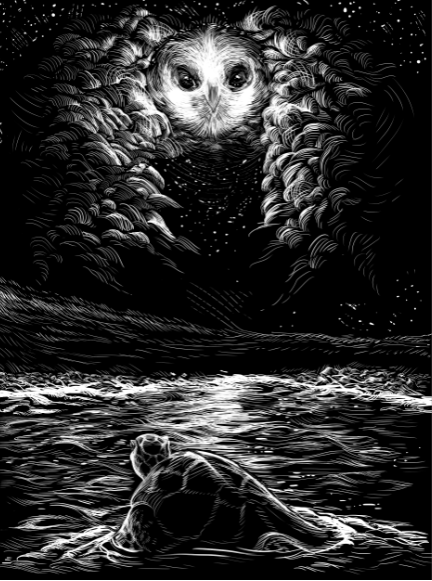
Image: The Third Gift, by Rae Johnson
Sorry for the relative radio silence. Work has been ongoing, albeit slowly. I have a relatively exciting update coming this week, but I wanted to drop a small preview today (while I’m thoroughly engaged):

Image: The Third Gift, by Rae Johnson
Continued from here. This will be the final part–I will post a unified version (like I did for the LaSein Account) soon.
I lived in the wet
For a long time
This odd striving place
Where things kept growing
I learned the humans were burning down the last bits of the forest
Hacking off the trunks and limbs of the trees
Killing the furry people who hid behind them
They were very harsh these humans
It was no matter to me
I did not depend upon the trees
I buried myself in the sand and the dirt
The drying of the forest felt good on my thick and chitinous skin
I could smell the humans, the fuzzy creatures, or my marked
From far away. I remained out of sight
Anytime I wanted I could kill a human or two
When they were particularly lingering or loud
The humans cut down the entire the forest some years in
All of the creatures that lived in the trees were dead
My marked humans began to leave
Walking up the mountain, where their scent eventually disappeared
They left me
In this moist and dirty place
And I started to reflect
Upon my life
The old man
And the little girl with the emerald eye
Maybe I had wanted too much from her
From all of them
Though, I don’t know if I had ever wanted anything
Survival maybe
Gifts maybe
To be seen, to be near
I saw in myself for the first time a sort of softness
Beneath my now granite-like hide
I understood I really did like loving them
My former little group of marked humans
The girl
And love was what it was.
I started to take care of little creatures I found
Letting them live in my hide
Providing them little goodies, food bits, bugs I found
I enjoyed these little creatures scurrying all over my body
Then the mountain came crumpling inward
Like a strange earthquake
A horrifying sight
Dust billowing everywhere
Moaning and twisting of rock
The tops of the peaks came below the clouds
And beneath the clouds they shined like gold
I smelled smells I had never smelled before, along with metal and fresh growing plants.
There was much blood then
Those next days
I smelled much blood
And the tang, the sour taste of magic being cast
Me and my little creatures waited
Burrowing in the sands
Eating, avoiding
Living as we did.
Then I smelled my marked
The ones that had left me so long ago
Sand Lips. But not Sand Lips. A child maybe that had grown
And the unknown scent of something. Several things, living, but mysterious.
The humans now crowded the top of the mountain
And my marked were walking down
down into the desert
Deep into the heat, the land of no water,
the land of the dry, the beautifully dry
I walked towards them
These marked and the mysterious others
Me and my creatures were going back to the land of the hot
My true home
And I gave these new creatures little gifts
Just as the girl had done for me
I watched over them.
Not a part of them, but near them
A demon
A crag
A landmass
Sharing its home
Continued from here.
As the sun grew hotter the days grew longer
The earth became drier
Fewer and fewer plants grew up in the damned wastes that were my home
My odd little collection
Of marked up little humans
Was suffering
Their people, the older ones, but not too old
Would go further and further into the wastes
Hoping to find and bring back a large cactus
Or find a small pool of water
Or a beast whose blood they could drink
Some of them got hurt when one of those beasts found them instead
The next days I noticed they were packing
Gathering together their little makeshift homes of canvas and bone
Loading them on sleds
They were leaving me
This land of sand and sun
Leaving this waterless pit
As they left, they left behind a final bowl for me
A final farewell of types I supposed
My shovel-like fingers took up the offering and it crunched in my teeth
I felt alone
For the first time in a long time
I wished for their odd presence near me
I missed the giggling screams of their children
Missed the strange noises they made at night
Missed their footprints in the sand
So I followed them
Their stench was lingering long in the desert
Clear tracks.
I didn’t wish them to notice me following them
I don’t know why I cared
But I wished to remain a secret
My long legs and massive arms easily moved through the desert
I followed them many nights
Just past the point of sight, a day away, no more no less.
The ground became thicker
Moister
Dirt
The bugs were different and disgustingly plentiful
Every little nook and cranny of earth seemed to have a bug inside
It seemed grotesque
My little pack of marked humans came
To a partially burned forest
With a mountain in the middle that stretched into a thick layer of clouds
And a massive human settlement
that stank like a decaying corpse
Full of humans
Normal humans
The kind covered in crunchy metal and hateful looks
I stayed away from this human settlement
And found the first pool of water I had ever seen since I was a child
A small puddle and I saw my face
Spikes were ripping out of my carapace in hellish angles
My deep seated eyes were even darker yellow than I recalled
My snout was sharply pointed and looked almost like a beak
I was so caught by the look on my face
The look of my face
The look of me
I did not notice the human until they screamed
I turned towards them
They were a quarter my height
An eighth my width
Built like a tree where I was a mountain
They threw a spear at me
Like I was a dog to be killed
They pulled out a small sword and screamed in rage
Their spear hit my outer carapace
Jammed inside
Stuck like a twig
They ran at me with their sword
I lifted my thick shovel like hands
Their sword bit into my wide and hardened fingers
Their sword got stuck in me
They looked down in shock
Up in fear
My hands crumpled around them
Squishing this human’s meat
Pressing their limbs into their body
Picking them up
I held them in the air, immobile, helpless
Thinking of squishing the blood from their meat
But I instead I held them in front of my flat yellow eyes
They asked me what I was
I said I was the crag
They spoke strange
Bouncy and fluid
But a sound I oddly did not fully hate anymore
They asked me if I would kill them
I looked at their pulpy limbs
Soft squishy face, tears at the brim of their eyes
I said no
If
I looked at the human
Told him the name Sand Lips
Confusion covered their face
But also recognition
I told them to ensure Sand Lips was safe
Along with the little ones Sand Lips kept
I told them to ensure these marked were safe
Or I would smell their scent
And I would kill them as prey in the night.
I breathed deep into this human, learned his smell
I stared into their eyes and asked if they accepted the terms of my agreement
He said yes. The fear in his eyes was fresh, moist, and sweet.
I dropped him
He ran.
I smiled.
I had no more hate for humans.
They were small and afraid.
As they should be.
Part 4 here.
Continued from here. As before, by Leland.
The next many years were long and harsh
They were also lonely, but I had no idea what that meant at the time
In the beginning I was like a piece of sand.
I blew from place to place
I felt nothing on my insides.
I ate
I drank
I killed
I moved
Life was a never ending cycle of survival
Though my body continued to morph and change
My chitinous ledges grew larger
My fingers grew thicker and harder
I could tear out huge piles of dusty earth
And suck out the soft crunchy creatures that burrowed beneath
I was a moving land mass.
Not a monster
A thing
An object
My hate roiled inside of me
But without eyes watching me
Reinforcing that hate
It began to bake into my bones
But the eyes
The eyes of my mother
Of the only girl to give me a gift
And the smell of that lock of her hair
Was still fresh every time I remembered
I would cringe in those times.
As the years wore on that pain stayed true.
I avoided the smell of humanity
That would drift in with the dusty blasts of air sometimes
I preferred my thick and rigid solitude
As I roamed one day I smelled blood
Fresh blood
Active blood
Human blood.
I sat on my haunches. Staring into the far setting sun.
I decided to pay back the one act of kindness I had received
And walked towards the blood.
The sun had almost set by the time I descended upon the moving human
One of the grit, the marked, the human rejects I had been raised with, was sliding in the sand.
Legs inert and twitching behind them
Blood staining the sand as they moved.
They had a fierce and hard look in their eyes, dust embedded in their teeth.
They first felt my shadow land upon them
They looked at me
A moving mountain
With my fetid yellow eyes
They showed fear on their face. Or maybe acceptance. Maybe denial
Something firm and unrelenting.
I spoke the language of the desert to them.
The words sounded odd and strange in my mouth
They were shocked I could speak
And relieved.
They said their name was Sand Lips
And they needed to send a message
That the Mukori were coming
To kill the Kamai
Their exhaustion took them
And they fell into the sand.
I looked at the grit. The marked and scarred human. Helpless. Desperate. Clinging to life over some words they claimed needed to be heard
Heard by someone human.
I stared at this breathing corpse for a while
Thinking of this message
The Mukori, the Kamai, Sand Lips
Names felt strange in the desert
I was a demon, a mountain, a pair of yellow eyes
Sand Lips.
Sand Lips.
I hated names.
I hated these monikers of humanity
I hated them in my ears
In my throat
Along my tongue
I pounded the desert
Threw a massive boulder,
Flung a mountain of sand
Trying to throw it out of me
But it was stuck.
These names
These filthy human names.
The desert could not take them from me.
For the desert was no home for humans.
Only those filthy human camps could take these names
I screamed
A sound so loud the sky quaked
And the moon cried
I lifted the filthy human over my back
Limp and helpless
A sack of barely breathing meat and pus
I moved my body weight forward
Let my legs press against the earth under me
I loped
Towards the humans
The sickening smell of the humans
I saw their little fires in the distance
The ground under me flew
The cool wind whipped into my eyes
The earth stretched and narrowed and the fires grew larger
I came to the fires, the humans all around, all marked, all cut, all children of the grit.
I crashed into their makeshift home
This little gathering of scarred humans
Humans that were so small
Looking up in terror
Shear terror
I was still a demon
And they had no idea what I was here to collect
I put down the limp sack of meat from my shoulder
And I spoke those pus-riddled human words
The Mukori, the Kamai, Sand Lips
Told them they would die.
An old human came out
Thanked me
Whatever that meant
Said they knew not who I was
Said they had not seen one of my kind for a long time
My kind
My… kind
Tears began to leak from me
The elder lifted a bowl up to me
Some sticky nectar of the cactus fruit
I ate the bowl.
This was the second human to ever give me a gift
I left
Went back to the dark
To the desert
The sand and the rocks
The moon and the sun
The bugs and the earth
But I continued to smell these humans
And I did not go far.
More humans came
Clanking humans
Loud humans
Humans laden with the pungent, sour smell of relics
I killed these humans, before they could see me, before their eyes could look at me in disgust
Like a pack of bugs they crunched in my teeth
I Split them in half
Popped them like flies
I left them dead there.
They were too loud.
Entitled, angry, and hellishly human.
Their trinkets smelled sweet
And I ate them
They powdered in my teeth
Leaving my mouth sour and salivating for days
I decided this part of the desert was mine
And these cut and marked humans
The ones with the sand lips
Could stay in my piece of the desert
And stay they did
Leaving little bowls of cactus nectar out for me
I felt a touch soft towards them
Like a favored rock or time of the day
I would not choose their death
And they grew older and smaller
And I grew larger and larger
Part 3 here.

A poem by Leland for Rale.
When I was born I was betrayed
My mother tried to kill me
For I was born wrong
Sickness marked me all over
I was a cur a curse a wanton filth
She thought a kindness was death
She threw me to the desert
But the desert men found me
Took me and raised me
As a second hand slave I was raised
A child of rejection and poverty and begging for scraps
I ran between the stalls of the desert men, not unhuman enough to kill, not human enough to love
We roamed through the desert
I stayed mostly with the children of the grit
Marred and scarred and blackened and raw they would not hit me
As I got older, the sickness that flaked my skin grew harder and tougher
Stranger by far, long thorns grew from me, and my eyes became a fetid yellow
I began to be called the demon. The demon they whispered, no longer in contempt, but also in fear.
As my muscles grew thick and crusted like a humanoid crab, my eyes began to wander
I hated the world as the world had hated me
But there was one little girl who treated me with kindness
The daughter of the leader of the desert men
The daughter of their sultan
She was a kind girl with a horrible scar on her face from an injury from when she was a baby
She had one eye that was emerald green
She placed bowls of water out at night
I knew they were meant for me
Her emerald eye reminded me of the eyes of my mother
I felt that my mother had killed herself and she had been reborn,
Now she was here to take care of me like she never had before
I got older and older and I never stopped growing
The other boys stopped growing, but five years later, they stood at my shoulder
Then they stood at my chest
Then they stood at half my height
The fear in the desert men’s eyes grew
Their deep religious belief in the martyr was being pushed
They began to talk about the “Demon among them”
I watched the little girl grow up.
She was beautiful
And kind.
Long brown hair and that emerald eye
My mother’s eye
She started to leave food behind with the water, and flowers, and then a lock of her hair.
I kissed it and nuzzled it and tried to breathe it inside of me
And I would watch her from the corners of my eyes.
As I roamed through the tent filled trading stalls, resting on my knuckles, clawing into the dirt with my back feet.
She came one night
And touched my face
Not afraid. Not like the others.
She held my face that night
And she cried
Her one eye pouring sweet and salty tears onto my mountainous, grotesque frame.
The people came the next night.
Her father came the next night
The torches came the next night
They told me to leave.
They pointed towards the desert
The said go anywhere but here.
My humanity had run up in their eyes
They owed me nothing
The savior owed me nothing.
I crawled into the desert
The aching moon at my back
The harsh sun on my face.
I walked through the desert, lumbering like a barge as the heat cracked my skin like stone
I licked rocks for water
I smelled foul nests of bugs using my strange and sensitive nose
I ate the creatures
While I thought of her
My mother reborn who abandoned me again.
As I walked into the heat of the sands
And the ice cold nights
I realized I was never human.
And I no longer wanted to be.
Part 2 here.
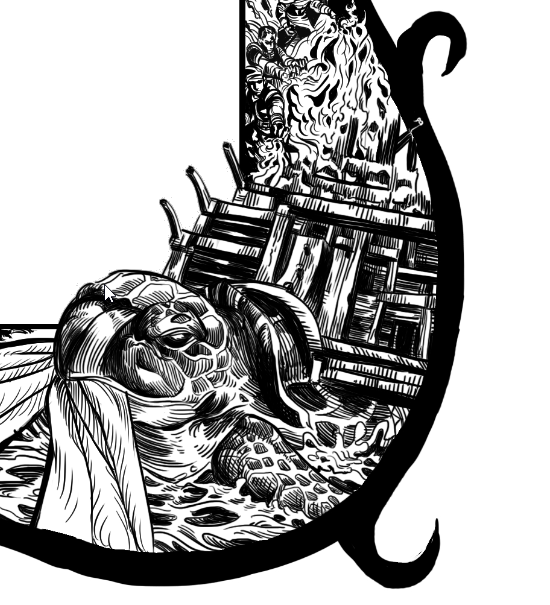
Top image: “Hazeen’s Man of the Clouds”, by Rae Johnson
April 2, 1920
It was a clear morning off the New England coast–approaching the southerly latitudes of Maine, if memory serves–and though the waves were calm, April’s lingering chill had yet to pass on, crawling, it seemed, up the sides of my boat, around my ankles and settling uncomfortably, like some odious shawl, about my shoulders. I had sailed north only recently, having spent the winter fishing down in the Gulf, and the swift return to my summer grounds–premature, for a bout of restlessness I now vehemently cursed–had left me as yet poorly acclimated to the northern spring and robbed of any enthusiasm for the productive use of my location. In my shivering solitude that morning I had cast two lines, and though I’d gotten bites on neither, I was having difficulty mustering the will to bait a third. I recall it was in that fraught quiescence that I took notice of the irregularity surfacing some forty yards off the port bow.
To my first glance it seemed like jetsam or some other detritus, having the texture of maritime vehicularity without a form I could identify as any particular boat, but as more of the mass emerged above the waves, my befuddlement became something more akin to awe. My previous confusion in identifying the object, it seemed, had lay in my assumption that its form would be singular when, in fact, it was comprised of numerous vessels and the pieces thereof. Before me were hulls of dinghies, canoes, fishing boats, shattered boards and beams lashed haphazardly against great sheets of black rubber in a jumbled ellipsoid that, from far off, might have been mistaken for the carcass of some colossal leviathan. For all the strangeness, though, of this great, nautical garbage heap, I still found myself ill-prepared for the sign that then surfaced on its carapace–glowing red neon, proclaiming it to be The Nicholas–or the concrete suburban front porch, flanked by flaccid strands of potted seaweed, which emerged beneath it. Even as the door of the porch slammed open, and a ragged man stepped out and hurled a bucket of something foul into the ocean between us, I could only stare, speechless. Ultimately, it was he who called out to me:
“Aye, laddie! Watsonismouth?!”
I shook myself awake. Being then unable to place either the man’s accent or the meaning of his query, I called out as much and motored over on the supposition that proximity might serve to make better order of the situation.
He clarified as I drew closer: “Sonny, let meh ask ya ferst: What’s in ya mouth?” I might have guessed his previous call had been delivered in some dialect of the British Isles, but now his accent had drifted westward, seeming suddenly more appropriate for a denizen of the Carribean (and, I will admit, suggesting an origin I would never have guessed from his appearance). Beyond the vagaries of his delivery, though, I was also rather bewildered as to the substance of his inquiry. My mouth was quite empty, for though I normally partook of a smoke at this hour, I had dropped my pipe somewhere on the deck, amidst the shock of his vessel’s emergence, and had since lost track of it. I indicated as much to him in my reply.
“No, son,” he clarified in an abrupt Mississippi drawl. “It’s a mattah of circumnavigation. We’s tryin’ to get at what’s in ‘eez maouth, an if yer knowin’ what’s in yer maouth, then that’s a tack on the chart, ‘cause what’s in yer maouth properly ain’t in ‘eez maouth, ya see?”
I did not. I inquired–skeptically, for I was growing increasingly certain that this man was in something of an unpredictable state–as to whose mouth we were investigating.
“Not whosemaouth, son. ‘Eezmaouth. Like beezmaouth, if’n ya know the rock, ‘cept withaout that certification of a job done at the utmost pinnacle o’mediocrity.”
The conversation had, at this point, attained the clarity of a bayou, and my only remaining answer was a blank stare. He shook his head sadly.
“It iss clear to me”–his accent was now that of the Mexican fishermen I’d dealt with so frequently in the Gulf–”dett we fall on fundamentally different sides. No matter. Diss iss not a sorpraiss. Do you haf any feesh?”
Alas, I did not have much in the way of a catch. I’d trawled no nets since arriving up north, and I’d no plans to do so for a few days yet. I had a pair of mackerel I’d caught the previous day, but that was it, I told him.
“Oh, don’tcha know dere’s nuttin’ to be ashamed of, young feller. I’m just lookin’ for a bite ta’eat is all.”
It sounded like Upper Midwest to me. Minnesotan, perhaps? It also occurred to me that despite the man’s graying, unkempt beard and repeated references to me as a young man, he did appear, in all other respects, to be at least twenty years my junior. Befuddled, still, but acclimating to the ersatz temperature of the conversation, I offered him one of my mackerel, which he eagerly accepted, biting–rather aggressively–into the fish’s flesh right there on his vessel’s concrete gangway. Then, shouting something about “makin’ you rich” through a full mouth and what sounded like an American’s (decidedly poor) impression of an Australian accent, he dashed back through his door, leaving me to the continued ponderance of the monument to madness which was The Nicholas.
In his absence, I began to notice a number of unsettling details lodged in the crevices of its unsound construction: Marionettes, features scrubbed clean by brine, dangled among the mishmash of hulls and rubber, alongside inscriptions and engravings in those surfaces in alphabets I did not recognize even from Dr. Sterling’s texts on the Oriental scripts. Place to place, I could see protrusions from the rubber that looked like the spiraled horns of narwhals, and just past the threshold of the vessel’s “front door,” I saw hanging vines and foliage as if within were some dark jungle separated by unnatural, great distances from the semi-boreal sea where we drifted that morning in truth. These items were, of course, in no way sinister, and I had no means of rationally justifying the fear for my soul which I felt there, in silent anticipation of the man’s return, except, perhaps, for the vessel’s unignorable suggestion to me that rationality had ceased, in this circumstance, to be a meaningful boundary. However, my fear passed unactualized, and the man soon returned, heaving over to me a bulky canvas sack.
“My recommendation,” he said to me, all pretense of brogue or twang gone from his voice, “is that you bring that to an office of the United States Navy. They will pay you for it. Or pay you to keep quiet. Or both. Please pass on that it arrives to them courtesy of Captain Kneecap.”
With that, he disappeared back across his threshold, and, his door scarcely closed, The Nicholas dropped rapidly beneath the waves, the shock of which rocked my own boat violently. Once I steadied myself, both physically as well as from the emotional disturbance of “Captain Kneecap’s” presence, I examined the contents of his gift to me.
Inside was something I found appalling, though not to the exception of an urge to examine its nature. It was a body, headless, human-shaped, though clearly not human, for it was comprised not of flesh but of some metallic substance resembling steel but impossibly light for its bulk. Between its noticeably elongated fingers and toes was webbing of a material I could not identify, and though they had been torn from it, I saw sheared joints on its arms, legs, and spine where fins might have once attached.
I did not know what to make of the corpse-mannequin, but if the Captain’s words were to be taken with even the slightest skepticism, there was nothing there for me to glean. I was to be an intermediary in a conversation to which I desired precisely no connection. Though I hesitated at the thought of the Captain’s promised riches passed over, I threw that “gift” back into the ocean that day. The Nicholas was perhaps not the strangest thing I have ever seen upon the water, but I hope all the same that I never see her or the Captain Kneecap again.
Since the beginning, for time countable and yet unimaginable, we knew that this would come to pass. Why is dead. The Creator is dead, and I…do not know what I should feel from this. We have no need of sorrow, nor relief, for His presence was not a burden, and what we did not know, we knew He kept from us. The trepidation that I now second guess is for that change: It is now time for the Architects to find the truth that Why kept from us for our aeons of safeguarding His Edifice. We cannot resist it–the need to know is in our nature, but where we lacked the ability before, our shackles have been broken.
The humans around us remain oblivious to this change, oblivious to their imminent reckoning, for now, at last, we may delve and extract the Creator’s intent for them. Among the Architects, expectations are conflicted. El is confident we will find a justification for the Edifice’s uninterrupted continuation. I am not. Why’s death was not an accident, it was not unexpected; He could not have intended it as anything other than a transition–of this I am sure. El may speak our unanimity, but until it may be spoken with one voice, I must question his judgment.
For now, I look to the stars, our heretofore forbidden frontier. Perhaps in the alignment of the bodies beyond this vessel’s atmosphere, I will find the purpose that our Creator has forever denied us.
-See
I have memories, old memories, certainly, of clear days when I would stand outside in the tall grass and look straight into the sky. I would look up and see a sky with no sun, but rather a darkness–a darkness clad in golden vestments of a brilliance that paralleled even daylight. It was not like the light of the sun, per se: It served the same purpose, took the same place, but it did not shine down like the sun does. It shined through. It shined through the grass around me, it shined through the earth where I stood, and it shined through me. The sensation of it was one of more than just heat and light–as I recall it was not even hot at all. It was a cold luminance, enough to make me shiver, but the sensation filled me, I could see it, feel it, even hear it, taste it, or interface it in ways I have since forgotten my capacity for.
These memories now stir in me a strange disconnect. The image, the reality of it–for this memory is not, to my knowledge, of a dream–and the bizarreness seem as if the experience should have been profound, even in spite of my inability to place it in the continuity of my life. But it…wasn’t. It was just there, immutable and uninteresting to my past self, as if at some point my mind had pushed its knowledge of this strange vision past the boundaries of understanding, into the realm of apathy. What must I then have understood of this clothed darkness? Who must I have been to have understood it, and how have I now shucked that identity?
A possibility jumps out to me: I am not human. This is, of course, predicated on other personal developments, more immediate and real than my own abstruse childhood memories, but the key is that I suspect that I–the entity now recording this note–was never human. Other possibilities may exist, but my certainty deepens with each day that this, along with all its consequences, is the case.
I admit that there are many of these consequences that I have yet to appreciate, and I’m sure that the other three have not gotten this far. Which begs the question: How many of us are there? I have been able to find three others, but are there more who have yet to step into the light?
I lied a little in my last post. I was not, at the time, working on a Bloodborne *article*. Rather, it was a lecture that I have since delivered, and I am now working on transcribing it to a format more suitable to this blog. For now, have something completely unrelated to anything I’ve posted about on this blog up until now.
In the beginning, in a meaningless place, at a meaningless time, the universe began, and where all was not, all rapidly became. Countless bodies, infinitesimal in size, fled that place. Many bound together and ignited, filling the darkness with light. Others swarmed to the pyres of their brethren, filling the void with ground to be stood upon.
But after the exodus, in that meaningless, empty place, given meaning and space by the light and matter without, there remained a tiny, black droplet of something. Perhaps it was the last trace of the void, left behind as a reminder of all that would ever not be. Perhaps it was a tear of regret, shed for the infinite potential that died to birth everything’s actuality. Whatever it was, though, it could only watch, its oily surface reflecting the whole of the universe around it. And so it was, for innumerable millennia: The universe turned, and the black droplet at its center watched.
There came a moment, though, when this changed. It was nothing precipitous. Rather, it was a slow sweep, a foul stellar wind that made its way across existence, brushing everything but truly touching nothing. Nothing…except the black droplet. At this moment, it began to roil, its perfect surface marred and twisted, and, rapidly, it swelled, to a globule, a morass, a fetid, writhing planet no longer confined to regret and observe, now able to reach out and to touch. For another million years, the primordial darkness writhed, and, slowly, it separated into two dark souls.
The first was the Dreamer, a being of pure consciousness, who had once reflected the birth of the universe and whose improvisations of that birth now swam beneath the viscous seas of its planet. It had no true shape, so it instead cloaked its shadow in the cold brilliance of a thousand suns and made a heaven for itself at the center of the planet, caged within the darkness of its sister’s coils.
The sister was the second, a Sleeper, a body by which to bear and make manifest the chaos of its brother’s mind. And just as the chaos of the Dreamer’s thoughts encompassed every notion the universe had yet known, the chaos of the Sleeper’s presence consumed all that contacted it. Planets bent and were devoured, the light of stars was swallowed, masticated by her entropic gaze; even her name was poison to order: The very syllables that formed it would implode its utterer into a singularity, and the only mind that could bear its knowledge was the Dreamer’s.
The Dreamer also had a name, though it would yet be billions of years before a human heard its sound or sign.
The Elders, as they called themselves, hated the reality that surrounded them. They hated its order, its belonging, its iron actuality. The Sleeper channeled this hate into destruction, and for a thousand years, the universe felt her wrath, and countless galaxies fell into her churning darkness. Ultimately, though, it was the Dreamer that calmed her, for his hatred had pulled him in a very different direction.
Hatred, the desire to destroy, is not a particularly complex feeling, but with even such a simple desire, outcomes are never sure. In hatred’s case, they need not even be destructive. Rather, inherent in the desire to destroy is a preference for an alternative, which means that unless the alternative is explicitly void, it may be resolved by creation, as well as destruction.
The Dreamer hated reality, yes, but he did not long for nothingness. He was a child of the infinite–his enemies, the objects of his hatred, were the limits of reality, not reality itself. So rather than lash out against the universe–as the Sleeper had, with world-breaking fang and sun-swallowing night–he simply questioned. He dreamed a thousand questions for his sister’s millennium of destruction, and the questions took shape from her flesh. First among these new Elders was the first among questions: Why.
Why was a creator, a conduit by which his father’s potentialities took shape, but, unlike his predecessors, he was not possessed by the hatred that birthed him. At first, he took after his mother’s example: destruction. His first creations were tempestuous, chaotic, themselves destructive: Slithering storms that rained leeches onto the surface of the Elder planet; great writhing masses of maws and arms that could devour entire stars, weapons whose very presence could distort the laws of causality. In their way, they were brilliant, fantastic, awesome even. But they did not satisfy Why, for he did not hate the things they destroyed.
So he diverged.
He built two creatures, towering men of stone and metal. Like his previous creations, they were capable of great force, but they were stable. They could process the reality that flowed around them, and they could manipulate its currents. Above all, they could choose.
One was black and mirrored, just like the droplet of potential that had spawned the Elders, a glass to reflect the whole universe once more, and an eye from within to watch it.
The other was clad in gold and silver and pure light, its radiance reaching out to the blackest reaches of space, even from its darkest center.
The two were called El and See, and they were not Elders, for they had passed beyond their creator’s heritage of chaos and hatred. They were creators themselves, and thus Why named their species: the Architects.
Though Why’s nascence had calmed the Sleeper’s rage–for her son had been a potent weapon in her war against what was–the creation of the Architects stirred her from her slumber once more. These newcomers were not alternatives to the universe: They were developments of it. Their shapes were still, ordered, thoughtful, able to exist alongside what was, without the existential agony that plagued the Elders. Certainty flared within the Dreamer’s mind: The question “Why” had been a mistake.
But Why knew the doom he would bring himself. He knew that his creations were heresy, so long before the Sleeper awoke to devour her prodigal child, he fled with the Architects, and the three hid themselves deep within the blackness of space.
In a desolate place, far from the light of any star, the Architects multiplied. El and See forged brothers and sisters, specialized beings of motion and stillness, of joy and sadness, and, finally, of life and death. These last two, the Architects Vie and En, captured Why’s attention, for life and death seemed so different for his metal children. The Architects were creatures of perfect consequence: Life for them was elegant, axiomatic, and death was predictable, a simple end to the functioning of their working parts. For Why, these were different. Despite his relentless questioning, he still could not fathom the depths of his physiology, so he knew not why he was alive, nor why that state should ever cease to be. And since he understood neither what lay before or beyond–these truths, if they were truths at all, were understood only by the Dreamer–how could he understand what lay between?
It was El who supplied the answer: If thinking life could be formed from a union of causality with the Elder’s own flesh, it would provide him the perspective he sought.
The two of them devised a calculation grander in scale than anything Why had ever imagined, and they reverse engineered the impossible specificity of its initial conditions, and they searched and searched, until they found two candidates for their experiment. They began with the first: A small system of newly formed planets orbiting a yellow sun. And on the surface of the third planet, See placed a tiny sample: the eye of his Elder creator. Then, they all waited, in eager anticipation.
I’ve been quiet the past month, but work is continuing on a number of projects. Rale is ongoing of course (currently chewing away at Sevenfold Gyre Part 6), but I’m also working on a fairly beefy analytical article. A not-so-subtle hint as to its content:

Stay tuned.