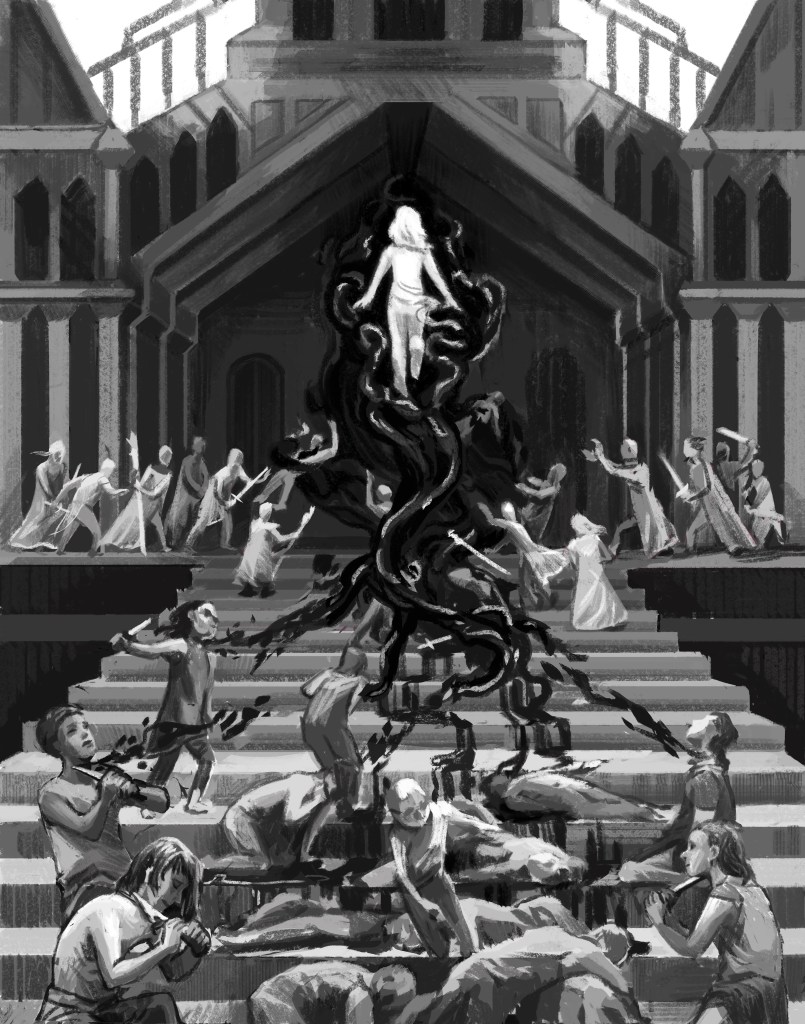
The Chimera, Chapter 2: The Fortress

A continuation from the Maze in the Mists.

It is yet ambiguous whether your course is chosen or not, but you proceed.  I leave you and your companions to finish your broth and wine, and you waste little time.  The lure of opportunity feels akin to the hanging sword.  It drives you out into the mists again and, for the first time in a long time, off the road.  It is not clear to you whether the frenzy smothers your fear or if they are one feeling, the stag’s panicked flight and its hunger overlaid upon a single annulus, an undivided will to survive.

The first step into the mist immerses you in chill breath.  The second is like being swallowed, and from there, your path is painstaking, carefully chosen from my map between the rocks, shrubs, untrodden muck, and, eventually, trees, themselves a concept which you had all but forgotten.  The continuity of the road before had offered you a predictable notion of your location, not with respect to the places the road connects but simply that you were on the road.  My map offers you no such assurances, for it does not truly identify the path–merely the unimportant landmarks that suggest it.  The mist offers scarcely more than ten feet of visibility in any direction, and the way it wavers is unsettlingly regular.  Like lungs.  Corridors of shapeless, breathing bodies, opening esophageal as you venture forward.  I do not mislead you, though, and you execute admirably.

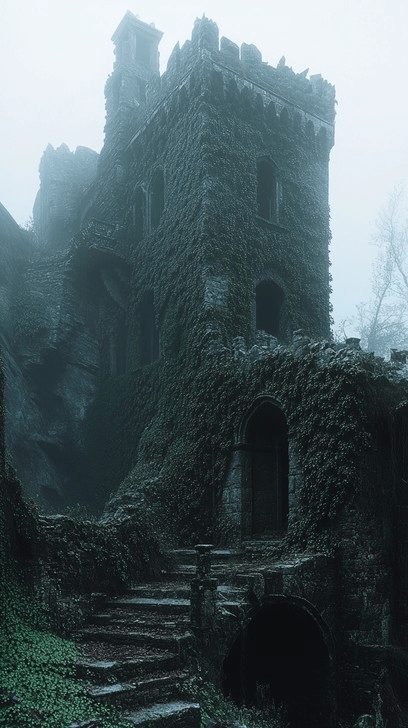
After hours or days, you and your companions arrive at a set of ruined gates, dilapidated and sunk into the forest floor, giving the impression of a cave, comprised uncannily of uneven masonry and shielded by great doors of rotting wood.  You stand before it in a sort of prescient horror, though you cannot say what about the fortress so moves you.  One of your companions, though, undaunted, jaunts to the doors and heaves one up and open.  The irreverence shocks you, even more so as you spot the shape of his smirk through the gloam, but you have to relent: He is right.  You have found your quarry.  Now you must find your prize.

You approach the doors, pushing against the deep foreboding you feel in spite of your companion’s nonchalance, resisting the urge to pause again as you notice something truly strange: At the darkened boundary of the fortress gates, the mist ends.  There is no reason that should be impossible, of course, but you do not recall a time or place that the mist ever did end.  It shrouded the road, every rest stop, every inn, stable, tavern, or village, indoors or out.  The mist was the whole world, and here, somehow, the world ends.  There is no reason that should matter, you tell yourself, no reason it should stop you.  Encouraging.  And so, as the door slams shut behind you–you are unsure whether your companion closed it or if the presence of this place is reacting to you–you find yourself out of the mists and in a pitch black tunnel of hard stone.

The scrape of flint against steel behind you makes you shiver, even as you draw comfort from the distant familiarity of the sound.  You turn, witnessing the orange bloom as another companion presses a torch into your hand.  It occurs to you that you have grown used to being unable to clearly discern your companions’ faces, and this one’s–obscured by a cloth mask and heavy goggles in spite of the darkness–nearly takes you by surprise.  You know them, of course.  This one has been loathe to abandon their supplies and effects despite their limited use in the mists, but you must admit that now seems fortunate.  That reluctance now means you can see.

All of you can see, in fact, waiting there in the umbra, taking stock of the stone hallway, hesitating, momentarily dazed–all except for your insolent companion who previously opened the door, though he has always been…unique.  With a grating chuckle, he takes the lead, refusing the torch your companion offers him.

An old place–but it should have plenty of secrets, I’d told you.  It is as if the questions seep from between the stones:  How old?  What was this place?  How did it come to ruin?  Why is the mist gone?  Need I continue to iterate the obvious?  The lethargy of your mental cogs allows you to vacillate, and eventually you will have to realize that is on purpose.

Walk.

The hallway continues onward for an improbable distance without any doors, branches, or turns–save for a rightward bend where it is clear the stonework has become warped, as if some landslide managed to torque the entire structure.

After five minutes and change, your companion in the lead saunters past a damp, wooden doorframe that smells like a forest after rain, and you cautiously follow onto a landing with a half-broken balcony overlooking a flat, open room with a bar tucked into one corner.  Both the landing and the room below are scattered with planks of wood and shattered furniture, all similarly fragrant, some even with visible fungal growth.  And while you are struck with bewilderment as to why this darkened fortress would have a tavern in any state of repair, your concerns are preempted by the bodies strewn about the place.

They look withered.  Perhaps mummified.  But despite the disorder of the scene, the bodies’ postures do not reflect any obviously violent end.  One lies alone on the floor.  Others are slumped over the bar or against the walls.  One sits, head down at the only unbroken table and chair combination remaining.  In all, there are five.  The same as your number.  

You freeze, but your companions hurry down the stairs from the landing for–you have little doubt–a variety of reasons, ranging from moral concern (though these corpses ought be long dead) to alarm at this sign of danger (though any violent threat ought be long gone) to bald-face greed, a drive which rises within you as well, even as recognition of it stings with guilt.

You are not sure what gives you pause, though it is not as if you feel any need to preempt your companions’ instinctual investigations.  Perhaps it is the sense that the scene before you is uncanny (it is) or that you feel you are being observed (you are, though that is hardly hidden–this is all in the second person, after all).  Whatever the reason, your inaction does allow you a strange observation: The construction of this room is different from the hallway which led you to it.

Everything you had seen of the fortress up to now had been stone.  This “tavern” appeared to be a kind of mud brick, and the subtleties of the architecture–in which you of course have no particular expertise–nonetheless evoke a removal of great physical and cultural distance.

Whatever the reason for this sudden change in decor, you find yourself with little time to contemplate it, as your masked companion below lets out a muffled yelp of surprise.  You rush down the stairs to find that the desiccated figure slouched at the lone table–which you had thought a corpse–had lurched from his seat and grabbed your companion by the shoulders.

“Why did we do it?” the figure’s guttural rasp fills the space, distorted by coughed dust from mummified lungs but somehow both perfectly audible and completely comprehensible.  “WHY?!”

Your companion, dependably present as the rest of you stand paralyzed, wondering at how you all are allowed to respond, places their hands on the figure’s arms and calmly responds:

“What did you do?  Who are you?”

The figure breathes, his grip loosening on your companion.

“What…I…” he begins.  “I was…we were called Taamir Ra…”

And that, of course, is when you begin to remember.

Sin (from The Chimera)

Another strange piece, part of the same weird project as Maze in the Mists. House of Leaves had a lasting influence on me, and there is something just fascinating about the idea of a fictional character delivering a non-fictional analysis of a book that doesn’t exist. The difference here is that the latter will (hopefully) eventually exist. But that’s a far future sort of thing.

And if you enjoy my writing and would like to support it, please considering buying one of my books. It is timely, after all. $20,000 Under the Sea released just this month, and you can buy it in ebook or paperback format here!

Why did Taamir Ra allow himself to be taken by the Dead Queen?  His companions’ reasons shouldn’t be any great mystery: For his brother, it was a desperate, knowingly doomed attempt to repel the darkness which would surely swallow the kingdom.  For Tiresias and–but for an ancient pact–Jabez, it was brazen, stupid curiosity.  For the masked man, it was compelled.  Taamir’s reason should be no great mystery either, but it’s hard to trust you people: It was guilt.

Consider that for a moment.

It’s easy to dismiss many modern representations of guilt as melodrama since so few of you feel guilt anymore.  “The weight of your sins?  Grow up,” says the man with a soul of formaldehyde and jism.  “Quit sulking.”  Think of the last time you allowed yourself to be tormented by your past–for deeds no one would ever discover, that it would be immaterial for them to discover–and, perhaps, despair.  The modern human is tormented by the consequences of their actions, they are tormented by shame, the pain of their true self being seen–the fear that it might be seen–but guilt is wallowing.  An indulgence.

It wasn’t always that way.  Edward Teach calls guilt the synonym of freedom: “You bond yourself to yourself to free yourself from everyone else.”  If you are without guilt, then, what follows?

The lack of guilt is downstream of the hatred and envy which armors you against the terrible responsibility of that world that you–not you, specifically; it is crucial that it was not only you–have built.  You became powerful, only to discover that power does corrupt.  It burns like fire, and charred skin simply makes one pliable.

But unlike you, Taamir Ra still had his soul.  He understood his sin and acted to absolve it.  “But Persephone’s capture was engineered by Bas’ahra and the masked man.  They manipulated him!”

So little wisdom remains among Christians that it’s easy to forget there is a great deal of wisdom to be gleaned from their discarded flesh.  As it were, the Christian god is quite clear on this particular sin: Eve manipulated Adam–Adam still gets the boot.  He had exactly two jobs to do: Follow the rules, and make sure she follows the rules.  He failed at both.  He did not impress upon her the importance of the task at hand, perhaps because he was too stupid to understand it, and when it came time to make sure she was actually listening, he fell asleep.  The mistakes are boring, prosaic, and kind of pathetic, not the kind of thing you would think ought to cost an eternity of Paradise, but I assure you: The boring, the prosaic, and the pathetic are in fact an extremely dependable foundation for evil.

Taamir Ra should have seen through Bas’ahra’s incredible incentive to defect, he should have spirited Persephone away without telling her; failing that, he should have outwitted the masked man; failing that, he should have refused the Sun Priests’ job and left Khet, because if he were not there, Bas’ahra could not have succeeded in the way she did.  By his very presence, he caused others to do evil successfully.  That is sin, and sin ought to elicit guilt.

Where Adam had little choice but to accept the consequences of his failure, Taamir faced a decision.  His failure caused a child to be buried alive, and his submission to the revenant which disgorged from her tomb ten years later might have atoned–but to what end?  He could have simply run.  Bas’ahra did.

But sin weighs on more than the sinner.  The injustice of Persephone Elea’s death did not go unnoticed.  Divine recompense brought about her return, and Taamir saw that, even if he could not know the particulars of the divinity.  Perhaps he thought his sacrifice–even if it did not sate the Dead Queen–might adjust the karmic scales of Khet just so, might undermine the Queen’s right to the suffering she would inflict upon the city and the world.  It might bring about a responsibility for those who could one day resist.  A responsibility to do so, under pain of guilt.

The Maze in the Mists, Remixed

An extended version of a short piece I posted here three years ago.

You have been walking this road for some time now.  It is an unremarkable road, unpaved, trodden uniformly by an infinity of unrecognizable footsteps.  All around you is mist, itself unremarkable for its familiarity–you’ve been living in it for longer than you’ve been walking the road, after all.  It is everywhere in this place: blanketing the fields, suffusing the woods, wrapping the scattered towns between in its damp embrace.  You suppose you can still remember that there was a time without the mist, but the specifics elude you.  All you remember is this:

You were a soldier once.  You and your companions.  You no longer know who you fought, what you fought for, or where, but by the time you stopped you had nightmares.  Bad ones.  The kind that woke you not screaming but frozen, paralyzed by the notion that whatever you had been running from in your sleep had crossed into the waking world.  It was there with you, standing over you, behind and to your left, just out of your peripheral vision, breathing heavy, deafening.  You could feel the rancid condensation of that breath on your forehead as that nameless creature reached down and caressed your hair with dirty fingers and whispered:

“Why would you do that?”

Whether you could answer the query is moot–you can’t anymore.  You never told anyone about the nightmares, save your companions, and you all agreed it wasn’t the sort of story anyone would want to hear.  The war stories, though?  The ones that preceded the nightmares?  Those you traded away gladly for the means to sleep soundly again.

That was the thing.  This place in the mists operated by different rules.  The people here had different wants, a different economy.  When it came time to pay for your meal, your provisions or board, they did not ask for coin.  They asked for a story.  And when you told it to them, it was gone.  It was no longer yours.

Not all of your stories were horrible.  The good memories you traded for fine food, company, and wine.  The solemn ones you traded for fresh clothes or flint.  The everyday occurrences, the uninteresting daily nothings weren’t worth much, but in a pinch you found they bought you attention, an ear to listen as you vented your increasingly formless rage.

You learned ways to make your stories last.  You could tell only a single side of a complex tale, embellish banalities, omit details that you could cling to for a while longer.  Sometimes it worked.  Most often they would see through you, not that they minded.  You were still offering a story of sorts, and it was still payment.  A falsehood was just worth less than a truth, and what you bartered for was measured accordingly.

As time passed, as you walked the road, you grew poorer and poorer, and you remembered less and less.  Sometimes you were able to trade your labor for someone else’s story.  Sometimes your travels and choices and happenstance allowed you to forge your own anew, but too often you found yourself giving away more than you got, and now…well, now you have been walking the road for some time.  You don’t remember the last time you saw anything but the dirt and the mist and the imprints of travelers before you.  Of course, that could be for a number of reasons.

But now, whenever now is, however long it’s been since a suitable referent, the road has given way on one side to an irregularity.  A stop.  An inn.  It is hard to say whether you need the rest or the provisions no doubt therein.  You are tired, but you no longer remember a time when you weren’t.  And your hunger has grown hour over hour, day over day.  Bread no longer sates it, but still you eat, because ignoring it is impossible.

You do not know if you need to stop, but you do not know when you last stopped, when you may stop again.  You enter the inn.

You find the tavern room crowded with shifting, murmuring bodies, mostly shadows in the mist, which seeps in even here.  But at least it is warm, and the damp pall of the road has begun to lift.  You approach the barkeep and ask for food and drink.  You cannot see his face through the haze, but you recognize his eyeless stare nonetheless.  He is waiting for payment.  Your companions look to you–it is your turn, it seems.

“Amidst a long journey,” you say, “I came upon a child in the foothills.  There was once a village there, but it had been scorched in the war.  The child was the only survivor, huddled in the burnt out remnants of a cabin, clutching a small stuffed animal.  Because I was alone, and there was no one to judge me for my pity, I gave the child my horse, a pack of rations, and a water skin and gave them directions to the nearest settlement.  Because of my guilt, I asked nothing in return.”

A moment passes, and the haze warps as the barkeep silently judges your lie.  He takes a cup from beneath the bar and reaches to fill it with filthy grog.  

But your ambivalence interests me.  I will forgive you this one.

Abruptly, the barkeep looks up.  He reaches instead for the wine cask.  For you and your companions, he sets forth wine and bowls of thick broth.  You know this far exceeds your payment, but the barkeep’s pointed finger preempts your query.  Behind you, at the corner table, you see a lone traveler hunched over a book.  He is clad in black, a ragged hood pulled over his eyes, leaving only his filthy jaw visible.  You see him–you see me, no need to bury the lede.  You carry your food and drink to the table.

“What did you take from the child in return?” I ask you, showing teeth but not quite smiling.  You don’t answer, of course, so I shrug.  You see that though I hold a pen, the open pages of my book are white.

“Fine,” I say.  “Will you tell me, then, whether you imagine it possible to escape a hell you choose for yourself?”

It is one of your companions who responds:

“Well…” they say haltingly, “why did I choose hell?”

I laugh quietly, though you may, if you choose, imagine that the walls shake at the sound.

“You think I know?  Fair enough, I suppose.  But then what follows?  If I know, what good could the answer possibly do you?”

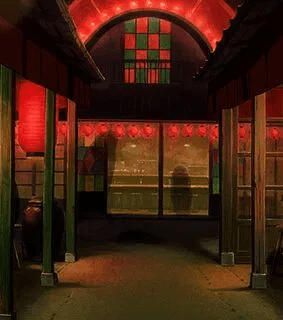
Top Image: From Spirited Away

The Dreamer’s Rhyme

A rhyme that will likely appear in some form in $20,000 Under the Sea, revealed to me, perhaps ironically, in a dream nearly a decade ago. This is the version that has bubbled up after some 10 revisions. There is a particular, if obscure, lyrical inspiration, though I’m not sure how apparent it is at this point.

On darkest side of darkest Dream
The Dreamer softly sings
He wraps himself in gilded thought
And robes and eyes and wings

One man has seen the Yellow Sign
The other never will
In synthesis they reckon with
The world He means to kill

So watcher if you like the glass
That shatters in the sky
Show me what you’ll trade for it
This hour before you die

Give me the fire in your heart
And the shards of Dream shall be
Smoothed for you, made glassy eyes
Through which, at last, you’ll see

A New Print Approaches

As I mentioned a week and a half ago, I’ve been tinkering in my spare moments to get another product up on the Etsy shop. In case you’re a fan of R. Johnson’s fabulous cover art for Promises for a Worse Tomorrow, you’re in luck, because it is now available in print form!

If you’re interested, check it out here!

Separately, a very, very long time ago, I posted about the original intent behind a lot of the work Leland and I commissioned for this project. A version of that is finally becoming real–stay tuned for an update!

Hey Kid, Wanna Patronize Some Arts?

It’s been…forever, but the Etsy shop is finally back up! For those of you who were there in the before times, I’ve stripped down the inventory a little, since I’m not totally confident in the product viability of the “tarot card” prints. Currently, I’m offering prints of R. Johnson’s “The Third Gift”, which you will certainly recognize (since it’s probably now my single most-posted image on this blog):

…as well as Quinn Milton’s “God”:

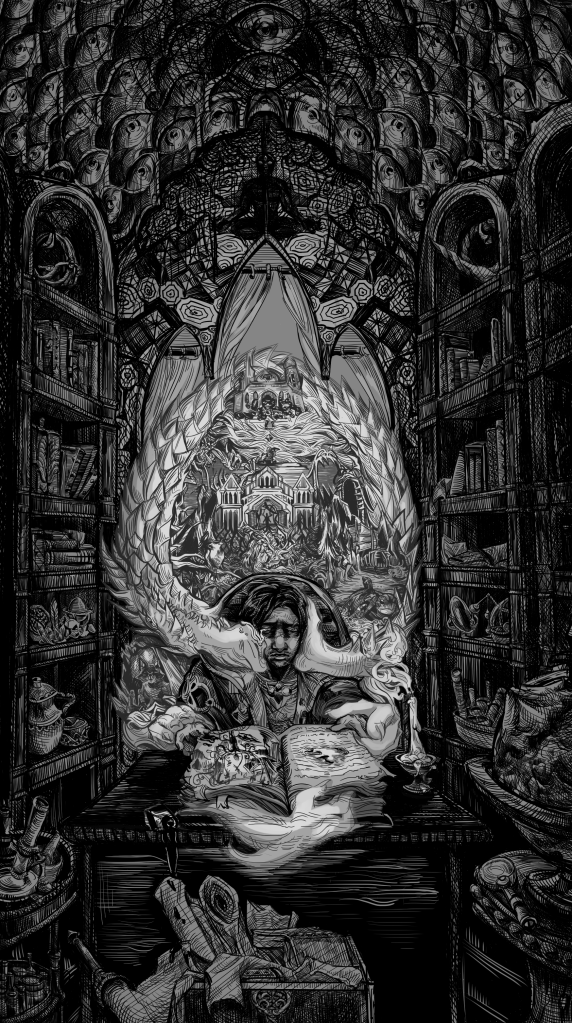
I’m currently testing resolution for a third product, R. Johnson’s “Redemption” (alternatively “The Dragon’s Thesis”), the cover for Promises for a Worse Tomorrow. If it turns out, I’ll have that up shortly. Check it all out here!

Strange, Lucid Faespeak

A review of Alice, by Gary Gautier. Obligatorily, the “low-class art” in the intro refers to my own genre work and not the book being reviewed.

It’s a strange paradox of the modern world’s educational edifices that aspiring artists only receive meaningful training in the production of low-class art in the context of great prestige, at the greatest expense.  I mean, sure, you can take a few free credit hours of “modern film” your senior year of high school to help pay off the district’s gambit to persuade you not to spend your lunch break on the bike path across the street, getting blasted on some guy’s blend of low-quality cannabis, but that generally doesn’t train you on much.  Meanwhile, if you would like to attend USC’s high-cachet rockstar school for approximately $1 bazillion per year, you are suddenly in a very competitive environment.

The economics are deceptively obvious: Cynically, teaching enduring classics shields criticism, absolves educators of the responsibility for excessive insight, etc.  But the other side pushes hardest: Marvel is big business, and if you want to speak to the masses, the system will only spend the money teaching you how if it thinks you can succeed.  Dollars are expected of you, so either put skin in the game or get to work.

All this to say, I did not attend rockstar school or its literary equivalent, so virtually all of my training in the written word has been on more highbrow material.  I suspect this is common for genre authors like myself, where the glitz of speculative fiction was left as an exercise for the writer.  Less common, perhaps (or not, I don’t know you), I really enjoyed that training, I have literary aspirations, of course I try to return to it often.

Today’s return is Alice, by Gary Gautier.  Gary is a neighbor in the blogosphere (you can check him out here), and he was kind enough to consent to me posting this review.  Unsurprisingly, I recommend the book–it’s a quick read, an enticing dream, a novel take on post-apocalypse.  I make no claim to a “final” reading of it.  I’m sure I missed a few things, but that’s part of the fun of analyzable literature: The point of the puzzle is that the solution is not trivial.

Before I get to the meat of it, I want to note that the below contains some spoilers.  My isolated take is that preserving the surprise of Alice’s plot is somewhat beside the point, but if reading those sorts of revelations early bothers you, I encourage you to read the book and then come back.

Now: The premise of Alice is that Alice (the character) lives in an idyllic, egalitarian commune in the woods and is having some strange experiences.  Like dreams but waking, less hallucination than astral dissociation, paired with the inexplicable experience of change.  For example, in the very first paragraph, she perceives that the constellations in the sky have changed.  Much is made of this, of course, and it remains ambiguous whether the change was material or perceptual.  She mentions it to other characters, and they acknowledge something, but they seem mostly to be acknowledging Alice’s perception rather than a physical change in the world that is salient to them.  These changes, alongside visions and conversations with individuals who are dubiously “there”, are bewildering and concerning to Alice, but it’s notable all the same how long she does nothing about it.

Okay, so the real draw here isn’t the plot.  It’s the prose (which later validates the plot).  It’s faespeak, highly simple, almost the literary equivalent of “plain English” legalese, but informal, hazy, and full of reference to commonly-understood memes.  At the risk of comparing it to something it’s not really like, it reminds me a lot of Madeleine Is Sleeping, a very different book about dreamlike hazes.  But it’s a book about dreamlike hazes.  Whimsy is definitionally protean, and it takes the form of Kingdom Death: Monster just as well as that of A Midsummer Night’s Dream.  Her somnolence is technical, surface level, and her flights of fancy are more worldly than fantastical, but practically speaking, Alice is asleep.  Part of this is literal–it is revealed that the ladybugs flying throughout the commune are robotic, designed to acoustically pacify the people around them–but much of it is still literary.  Alice is chock full of circumlocution of the fact that, while she is very reasonably confused at the unfolding of her ethereal meta-world, she is neither incompetent nor dumb.  She is clearly capable of synthesizing from the information she has, and she has more information than she should due to her metaphysical connections.  But she still lacks agency for much of the book.  Materially, this is the same reason most people lack agency: She doesn’t know what she wants.  But this manifests as an aimless seeking of answers only to be shunted from her path, gently but repeatedly, by random happenstance, by people who also do not really know what they want but seek control because it’s there to seek.  Psychoanalytically, this looks a whole lot like resistance, a projection of Alice’s inability to act, onto the external structures that theoretically should bind her but really don’t.

This perspective, that of the individual within the world, nominally surrounded by power structures meant to corral populations, but in reality gated only by their ability to control/change themself, to want things, to act, feels to me to be where Alice is at its strongest.  This may be projection–I may still be high on Sadly, Porn, but the core thought is not especially uncommon.  From Alice:

“The pointlessness of all the rebellions in El Dorado–the deliberate pointlessness–that was the point.  Changing the world is vanity.  The revolution must be subjective, or at least physical in the body, not physical in the world.  That’s why Alice felt her body changing.  Subjective transformation first, and the change in the world will follow.  You can only change the world from the inside out.  Those who would start by changing the outside world are starting all wrong.”

Alternatively, at a somewhat lower reading level, from Netflix’s Nimona:

“Ballister: No matter what we do, we can’t change the way people see us.

[Pause]

Nimona: You changed the way you see me.”

To be clear, that isn’t a criticism.  Life’s most important lessons are often deceptively ubiquitous, and literature’s role is to affirm insights–it virtually never makes an insight that’s actually new.  And Alice affirms this notion–that human power over the world originates within the self–beautifully, piecing it into a framework of interconnectedness not unlike the oneness and being you might encounter in the midst of an acid trip.  This is intentional, of course: Alice’s dream-insights arise from the…unique qualities of her genetics, but she finds herself connected to individuals who became connected in this way, literally, from drug use.  Why this is such a common experience with psychedelics in the real world is an interesting topic.  I won’t address it here, but the assertion that said interconnectedness is a real thing that the drugs simply give access to is, at the very least, reasonable within the bounds of literature.  Still, it’s on the threshold of where I think Alice stumbles.

As an affirmation of those theses in psychology and social connection, Alice does a fantastic job for as long as Alice’s experience is foggy enough to ward off the insufferable mosquitoes of material reality, the annoying inquiries of “yeah, but does it actually work like that?”  Having written a whole novel manuscript with a plot predicated on a quantum-mechanical basis for sentience (and extinction), believe me, I relate to the challenge of making up believable science, but Alice’s invocation of the economic history of the Hoarder Wars, the lab and the social control schemes of El Dorado, the Mitochondrial Eve–one has to wonder if the coherence of the argument might have been improved with less scientismic dei ex machina.

I’m not entirely hostile to it, and I will readily admit that there are a lot of cool meta-dynamics within those details, but writing realistic but fantastical hard sciences is, well, hard.  The inner workings of chaotic systems are stupendously difficult to discern; paraphrasing Lou Keep, it’s unclear whether there is anyone alive who really understands how “the economy” works.  So when Alice postulates a delta within a single lifetime, from 1970 upstate New York to a post-apocalyptic-war clean slate in which there are two towns and a total population of ~300 people (and almost no one has any memory of the war, and also no meaningful technology has been lost, and actually significant technological strides have been made, etc.), I 100% understand it’s not the point, but the material details are distracting.  I don’t think it’s entirely the text’s responsibility to provide those details, but it provides just enough that the HOW?! in the back of my head is deafening.

My feelings are even more mixed (though, to be clear, for the better) on Alice’s use of genetics.  The book employs the Mitochondrial Eve, the matrilineal common ancestor of all living humans, as a symbol for the ebbing of possibilities and the cyclical repetition of human history.  Putting aside the perhaps unnecessary paradox of those two concepts being symbolized by the same entity, I found myself a little distracted by the fact that that’s neither how genetics work nor how they are used.  Said differently, I found the actual subject of genetics to be a poor substrate for what it felt like the book was trying to get at.

But there’s still something cool here: A prevailing theme in Alice is ancestral connection, which is experientially, psychologically, a very key part of what it means to be human.  And I get it, literature can be what we want it to be, and there seems to be a want for that ancestral connection to be more than experience and psychology–the want is for it to be real, for it to be true.  So Gautier asks: Why can’t it be chemical, embedded in our actual, physical DNA?

The answer: cryptography.  Since, to the extent that environmental factors get encoded into our DNA, they are encoded many-to-one, you can’t decode them backwards without a key.  The book clearly gets this at some level–much space is devoted to keys that would unlock this: the aforementioned psychedelics, an “elixir” brewed up by a young witch from medieval Germany whom Alice speaks to in dream space, a literal skeleton key that Alice finds early on.  The symbol of a key allowing one to access the encoded past is absolutely there.  

But it’s messy.  The encoding is literal; the key is metaphorical.  The Mitochondrial Eve, a temporally moving target (the common ancestor of all living humans changes depending on which humans are currently living) is framed as fundamental root potentiality and an inevitable return to “true alpha”.  The environmental information encoded in DNA–in reality, stuff like “drank a bunch of lead before adolescence” or “was, by sheer happenstance, good at throwing things and lived in an environment where that was relevant to survival”–is so far from what ancestral memory actually means to us that these sections just fall a little flat.  Though, reiterating, these are impressions and not a final reading–I would absolutely welcome discussion on this take.

Belatedly, I think another side of it is that the prose, which fits the buzzed out tranquility of the commune’s life excellently, is not a great match for technical description.  Consider Alice’s conversation with Faunus, the director of the lab at the rival town of El Dorado:

“‘Or maybe,’ continued Faunus, ‘the cyborg approach, using artificial intelligence and robotics.  Artificial intelligence will give you control alright, but it always tends toward total control, total surveillance.  All freedom is lost.  But now we’re getting back to the idea of the fascists, aren’t we?  But the fascists, as I said, were rooted out.  And robotics?  Sure, you can make someone faster, stronger.  But human nature?  No, the cyborg approach–artificial intelligence and robotics won’t do.”

I’ll admit that Pan the Venture Capitalist is a symbol I have not entirely unpacked.  But beyond his Greco-Roman cred, Faunus very much resembles a caricature that applies equally well to podcasting VCs and drunk hipsters at house parties: This is a guy, surrounded by people who think he’s a genius, who has absolutely no idea what he’s talking about.  All of his thoughts and perceptions are organized into neat, macro-philosophical boxes, labeled things like “Fascism” or “Artificial Intelligence” while he leaves the messy details/comprehension to his employees and/or no one.  I got the impression that this was at least partially unintended, largely because the tone (again, informal, full of imprecise commonplaces and memes) is kind of how Alice describes everything.  In context, I got the impression Faunus was supposed to sound ambiguously villainous, walking through the twists and turns of his plan for social control, but the language isn’t quite right.  Social control can be described from a wonk perspective (see Pigouvian taxes) or, more horrifyingly, from ideology (see Goebbels), but getting it in milquetoast party-chat over tea rather conveys the impression that none of the underlying machine actually works.  I mean, perhaps this was intended: In the end, the lab fails to achieve its (or, discernibly, any) goal and gets a couple people killed.  It’s a very digestible moral with regards to the desert of top-down social engineering.  My skepticism is merely with respect to the highly dubious intentions behind it–intentions which would have carried more weight had they been better thought out (or rather, expressed in the language of those doing the thinking).

Despite the criticisms, I don’t mean all the harping to be much more than a warning sticker in aggregate.  On the whole, I found Alice very much worth reading.  Despite the simplicity of the prose, it was literarily very crunchy, and though I wrapped it up some weeks ago, I’m still thinking through it.  Moreover, I’ll certainly be checking out more of Gautier’s work in the future.  There’s something inspiring in this horribly modern era about his belief in human potential.  The faespeak, for all its limitations, makes for good dreams.

Some notes:

  1. Those who read my work frequently probably already know this, but I want to be clear that my use of the term “meme” is academic here.  I am referring to commonly-understood ideas and idea fragments, not to Advice Animals.
  2. Because the book is titled Alice and involves journeys into dreams and/or the subconscious, I would be remiss to not at least mention the potential for references to Carroll.  I have not read Through the Looking Glass, so I don’t feel confident asserting anything in particular, but an allegory between the social control schemes of New Arcadia versus El Dorado and the opposition of the Red and White Queens does seem at least possible.