Charting a Course Ahead

First off: Reminder that all of my books are currently on sale! Ebook versions are $0.99, and paperback versions are significantly discounted until the end of the month. You can find Promises for a Worse Tomorrow on Amazon here and Three and Two and Two from your preferred retailer (including Amazon if you so desire) here!

Beyond that, editing for $20,000 Under the Sea is underway, and since it is going to take significantly longer than past books, I may post some of the intermediary materials here as well. To that end, it’s all still in the early stages. If you have any interest in participating in beta reading, you would be most welcome–feel free to reach out to me at slhlocrian@saltpoweredllc.com!

Otherwise, upcoming content will theoretically be a little more short-form (book reviews, short nonfiction posts, a review of my recent reading list), though I will continue adding chapters for One Wing, One Eye as I finish them. I hope the New Year is treating you well!

One Wing, One Eye, Chapter 3: A Restless Homecoming

But this has not yet become a story about the knife.
Three and Two and Two

“Godshell, I–I don’t even know what to say, Dog Boy.  This is beyond the pale.”

“I don’t either, Gene,” Bleeding Wolf muttered, ducking in through the door to the jail.  “It’s why I came here.  To figure the details.  Sort my thoughts.”

“That ain’t what I mean!” Gene retorted, loudly enough to catch Michel’s attention from behind the warden’s desk.

“Evening gentlemen,” he called.  “What brings you, uh, here tonight?”

“Town business,” Bleeding Wolf replied.

“The shell it is, Dog Boy!” Gene interjected.  “There shouldn’t be nothin’ to figure!”

“What sort of business?” Michel asked, frowning.  “Incidentally, Anita and I did want to thank both of you for helping out as much as you have these last few days.  It’s taken a load off both of our backs.”

“Don’t mention it.”  Bleeding Wolf didn’t much care for effusive thanks, but he was happy to help.  “This place is home for me, even if I’m given to spend time away.  Anyway, Gene, if there’s nothing to figure, then who would you fork over to the whitefrocks?”

“No one!  That ain’t our right!”

“That’s neither an option nor your call,” Bleeding Wolf growled.

“Uh, what’s all this then?” Michel asked, taking a nervous step back as the argument reerupted.  Bleeding Wolf raked his claws through the stubble on his face.

“I’m sure word was gonna reach you soon enough,” he said.  “Meetin’ with Holme went…meh.  Sculptor wants a sacrifice in exchange for the Holmite lives lost.”

“But…didn’t they attack you?”

“Yep.  John wants to keep ‘em happy, though.”

“They don’t get to demand our blood if it was their fault!” Gene objected.

“I mean, right,” Michel agreed.  “They shouldn’t…well…”

“Well, what, son?” Gene spat.  Bleeding Wolf put a hand on the old man’s shoulder as Michel frowned, nervous.

“There is the Masson boy,” he said.  “He’s still here.”  Bleeding Wolf raised an eyebrow as Gene’s face fell.

“Masson?” Bleeding Wolf asked.  “What’d he do?”

“Vince Masson,” Michel clarified.  “Young man set fire to his house a few years ago.  His family was inside, and the fire spread too.  Took out a whole district.  Ten or so died, dozens more were hurt.  Kid was sentenced to hang.”

“But he’s still here?” Bleeding Wolf asked.  Michel shrugged.

“Mayor Bergen commuted all death sentences when he was elected.  There was a vocal portion of the town that thought we were going too far, killing a sixteen-year-old.  So Mayor Bergen changed the sentence to jail and mandatory labor.”

“For how long?”

“Rest of his life, which…”  Michel glanced back toward the hallway which housed the jail cells.  “Which isn’t great logistically.  This place wasn’t made to have permanent tenants.  We’ve had to hire temporary jail guards, put him fully in the care of the caravants he’s working for–not totally humane, those contracts.  They treat him like an animal, and he’s come back a few times with serious injuries that Brill has had to treat.  I’ve wondered a few times if it would’ve been kinder to just follow through in the first place.”

“An’ now it’s convenient to flip-flop, John’s doin’ it,” Gene muttered.  It was a fair point.  Though that didn’t mean it was the wrong answer in this instance.

“Politics, indeed,” Bleeding Wolf growled.  He agreed with Michel, for what it was worth.  It sounded like the kid did a bad thing, probably for bad reasons.  If the town wanted to kill him, they were well within their rights, but this “leniency”, the process, the spectacle of it–bigger pieces of shit marched through the Crossroads every day, and the seriousness with which the mayor pretended at justice here felt like a mockery.  It almost did feel kinder to hand the condemned man over to Holme.  Except Bleeding Wolf knew what the Holmites did with their sacrifices, and he suspected Mayor Bergen did not.

“A town meetin’ in the gaol?” came the twisting syllables of Atra’s accent from the doorway.  “I must’ve missed quite the development today.  Michel, here to relieve ye.”

Bleeding Wolf turned to regard the woman sweeping into the room.  He knew that at this point, Commander Atra enjoyed quite a bit of the Crossroads’ respect, and he could see why.  By all outward appearances, she was a reassuring protector.  Even-tempered, muscled, battle scarred, yet still clearly in her prime.  Bleeding Wolf trusted her about as little as it was possible to trust an ally–and less than many enemies.  When they met, he had caught a glimpse of the magical power she was somehow keeping hidden.  He was certain that she had not accumulated that much death from even-tempered protecting, but what she had told him of her goals–forthrightly, honestly, that she wished to meet the Blaze in battle–made no fucking sense.  And he had a feeling that she was dragging the Crossroads into the fire more than she was shielding it.

“Thank you, Commander,” Michel said with a respectful salute.  “Have a good evening, gentlemen–I’m sure that you and the mayor will come to a reasonable solution.”  Bleeding Wolf waved him a halfhearted goodbye and faced Atra.

“What ‘reasonable solution’ are ye debatin’ then?” she asked.

“You want me to believe you don’t already know?” he growled back.  Her calm smile somehow made him feel both remorse for the sudden aggression and even more anger for the accusation’s little visible effect.

“I’m runnin’ a militia here, Bleeding Wolf, not a spy network.”

“And yet.”

Atra shrugged, walking past them to the warden’s desk.  She lifted a piece of parchment with a convincing veneer of assiduousness.

“Mr. Jens spent his 24 hours here,” she muttered.  “Best be lettin’ him out tonight.”  She looked up.  “Yer deliberation’ on whom to send to Holme, then?”

“You have been spyin’!” Gene snapped, almost shouting.  “And we ain’t sendin’ nobody!”

“Well, Bleeding Wolf’s right, and there’s no point hidin’ it: I do keep informed.  But ye’ll forgive me for takin’ a turn at disbelief, seein’ as the decision of whom to send isn’t yers to make.”

Gene’s face slowly reddened as he grasped the meaning of Atra’s roundabout phrase.

“It isn’t mine, either,” she added, lifting a keyring from a hook behind the desk.  “So there’s little warrant for the blame yer bringin’ to me, Gene.”

And yet.  Bleeding Wolf didn’t need to say it again–the thought hung in the air obviously enough without additional vocalization.  He couldn’t tell if his intuition was being clouded by what he had discovered of Atra’s prowess–by how incredibly intimidated he realized he was–but he couldn’t shake the notion that the particulars of the arrangement with Holme were material to her interests.  It was obvious that she would want an arrangement with the Sculptor’s military, of course, but what made no sense–and yet seemed inexplicably evident–was that an offering of one of the Crossroads’ own to those horrifying statues was exactly how she wanted it to go down.

If she was concerned by Bleeding Wolf’s anxious calculus, though, Atra did not show it.  She simply returned his pensive glare with a pleasant smile and left the room, proceeding down the jail hallway, keyring jingling as she walked.

“I’m startin’ to get damned tired of everyone tellin’ me my opinion don’t matter,” Gene muttered quietly.  Bleeding Wolf listened as the metallic jingle receded to the far end of the hallway.

“It’s a distraction to think of it as an insult, Gene,” he replied in a similarly low voice, though he doubted there was anything they could do to prevent Atra from eavesdropping at this range–even Bleeding Wolf’s magic was capable of augmenting his hearing enough to catch isolated whispers fifty feet away.  “If you look at the big picture right now, you’ll notice that no one’s opinion matters that much.  I don’t know if you realize how much political fuckery it takes to engineer a situation that everyone disagrees with but no one can gainsay.”

Gene raised an eyebrow, evidently rattled, though he didn’t have time to respond.

“Gentlemen!” a voice boomed as the jail door slammed violently open.  “I have need to interject upon your arrangement with Holme!”  Bleeding Wolf whirled, annoyed at what was becoming a stream of interruptions, as Lan al’Ver glided through the doorway, brandishing his umbrella like a showman.

“Where the hell have you been?” Bleeding Wolf spat.

“The Chateau de Marquains, Mr. Wolf, retrieving our dear Orphelia and more–”

What?!

“Pay attention!  You are to travel to Holme, and we shall join your caravan.”  Bleeding Wolf blinked.

“To…Holme?” he asked, winded.

“Indeed,” al’Ver continued dismissively.  “To secure the iron you promised the Doctor’s ward.  Have you forgotten your own priorities in this crisis?”

“Crisis?  How do you…?” Bleeding Wolf sputtered.  He shook himself, rapidly reacclimating to al’Ver’s infuriating gift for putting him off balance.  “We aren’t going to Holme!”  Al’Ver rolled his eyes.

“Of course you are,” he said.  “There is no one here you trust to take charge of that exchange.  You will be going there, and as momentous events await beyond that bend, I will be accompanying you.”  There was a moment of silence.

“Did you say Orphelia was at the Chateau de Marquains?” Gene finally asked.

“Now yer to go straight home.  No stops at the tavern–ye worried yer family bad with this last stunt, so don’t ye go worryin’ them more.”  Atra’s voice preceded her entrance from the hallway, escorting a gaunt, disheveled man whom Bleeding Wolf did not recognize but assumed was the “Mr. Jens” mentioned earlier.  “Ah,” she said, looking to the three of them.  “Captain al’Ver, welcome back.”

Al’Ver was silent for about a second longer than the greeting warranted.  Bleeding Wolf glanced back at him and noted that–for perhaps the first time in his memory–Lan al’Ver seemed surprised.

“Atra, my lady,” al’Ver said belatedly, though with recovered composure.  “It is a pleasure to see you again.”

“You’ve met?” Gene grunted.

“Had the good fortune of meetin’ the Captain on the way here,” she replied with a smirk.  “As I understand many do.”

“Indeed,” al’Ver corroborated disinterestedly.  “But once again, you have me at a peculiar disadvantage: I did not expect to find you here, and so I am unsure what to make of it. –”

“The mayor here issued a call for fightin’ folk to train a militia while ye were on yer latest voyage, Captain…”

Bleeding Wolf stared at Atra as she explained the situation, Bergen’s nominal concerns, progress in the Blaze’s advance in the weeks al’Ver had been gone, all of it logical and intuitive.  Al’Ver nodded politely, adding his stupid, self-important quips and affirmations as he would, but Bleeding Wolf had heard it: the jolt at the end of his expression of confusion, as Atra offered her explanation just slightly too quickly.  It was impeccably smooth, but she had interrupted him.  Why?

“If you don’t mind,” Bleeding Wolf said, reentering the conversation amidst a somewhat off-topic discussion of Holmite idiosyncrasies, “I would like to hear the end of al’Ver’s question.”  He looked at Atra.  “The one you cut off.”

“Oh, I’m sorry, Captain!  Did I interrupt ye?”

“It is Captain al’Ver, Mr. Wolf,” al’Ver rebuked.  “And there is no need to be rude.  The commander’s explanation was perfectly sufficient.

Bleeding Wolf scowled but did not reply.  He was going to have to pry less directly if al’Ver was going to be a pill about it.

“In any case,” al’Ver continued, “this has been a serendipitous reunion, surely, but my work lies elsewhere.  We have our objective, Mr. Wolf!  Now I must determine where Orphelia has gotten to.”

“Oh no,” Gene mumbled.

“Orphelia?” Atra asked.  “I recall mention of the name from Brill when I arrived.  Is the girl prone to trouble, perhaps?”

***

Orphelia had not intended any trouble to come from her visit to the tavern.  She really only wanted some mulled wine by the fire–and to spend the two pieces of silver she had pickpocketed from Mr. Naples before he realized it was gone.  But now that she was there, it was getting difficult to resist.

Part of it was boredom, yes.  She knew it was.  The last several days on the water had not been mentally stimulating, in spite of the cool cave Captain al’Ver had found with Ty and the weird metal man who had joined them.  And she was starting to appreciate that her reactions to boredom were perhaps more of a burden than she really wanted to inflict on herself or others.  Listening to Mr. Ruffles that day she had left the Crossroads had put her and Devlin in danger–far more danger than she had even realized until Ty and Naples’ explained what the Chateau de Marquains was–and she wasn’t eager to do that again.  But she was still bored.

The other part was that the happenings at the tavern tonight were making her really curious.

It wasn’t an especially busy night.  Multiple large caravans had apparently just departed, and the room was spotted with empty tables.  But one patron, a tall, bulky, middle-aged man in ill-fitting clothes, had gotten sloppy drunk and was proclaiming loudly to anyone who would listen that during the War, he had become known as the “Taker of Skulls” for his combat prowess–or his roach body part collection, or just a habit of decapitating any corpse he came upon as an offering to the Blood God.  It wasn’t really clear to Orphelia, but as far as she could tell, it also wasn’t clear to him.  The man seemed confused, and his fit of bravado likely would have guttered quickly had Orphelia not sat down beside him and–to the barkeep’s chagrin–began requesting elaborations on his various boasts.

“I killed a hundred men at Bloodhull!” he roared at one point.

“Oh, so you were fighting for the bad guys?” Orphelia asked.

“What?!  Of course not!  I fought for Harmony!  Matze Matsua was right next to me, he was!”

“Then why’d you kill all those people?  Weren’t the bad guys mostly roaches and those tongue things?”

“Well…”

Orphelia didn’t know whether she was asking after real historical details or simply playing along with this weirdo’s delusions of grandeur–the stories her father had told her about the War of the Roaches always did seem rather fanciful.  But either way, it didn’t seem like this guy would know.  He didn’t look old enough to have actually seen the war, and he seemed too stupid to be a mage like Dog Boy.

Or like her, she supposed.

She was still processing what had happened at the Chateau de Marquains, Mr. Ruffles’ task, what he had said about her abilities.  Could she still call him Mr. Ruffles?  She wanted to, but there was a part of him now that she couldn’t force back into the stuffed animal her father had given her.  The spectral man who had guided her to the Saraa Sa’een.  Romesse of Khet.  Rom, he had called himself.

Captain al’Ver didn’t seem to trust him, but it didn’t seem like Rom had lied: She was able to do magic.  Mr. Ruffles didn’t talk to her the entire trip back, didn’t give her any instructions, but she had tried to do the things he had helped her do before, pushing away Naples’, Ty’s, and the metal Homunculus’ notice while she skulked around the raft, stealing things which she usually gave back.  It worked.  Sort of.  For a while.

It didn’t work on Captain al’Ver at all–he seemed to have an eye on her whenever she was near, whether she was attempting to “channel mana” or not.  And then, after a time or two, Naples caught her trying to lift his notebook.

“When you do that,” he said, gently taking the book from her hands, “people around you can sense the mana that you’re pushing at them.  The reason it works most of the time is because they aren’t paying that much attention–not unless they know someone’s close.  Or trying to steal their stuff.

“But once they’re actively looking for you, it takes a lot more effort to keep them from finding you.  Heck, that’s why Master Faisal taught us to look for shadow-walkers before teaching us to shadow-walk ourselves.”

It turned out that both Naples and Ty knew how to do some of the things Rom had guided her through.  It was a rare school of magic which, Naples explained, originated with a “separatist sect”–or something like that–from the city of Khet.

“Where is Khet, Mr. Naples?” she asked.

“Oh, nowhere anymore.  It used to be way north, in the desert past the Gravestone mountains, but it was destroyed centuries ago by the Blood God.”

“The who?”  Naples laughed at this.

“Do you actually want to learn some history, Orphelia?”

She did not, though she did think that the “Blood God” sounded like a cool name.  Now, though, as the “Taker of Skulls” kept going on about how the powers of the Blood God strengthened him or whatever, she slightly regretted not asking about it when the opportunity was there.

“I even got some proof I was there,” the strange man grunted eventually.  “Ya see, I was in the vanguard at the assault on Roachheart after Bloodhull fell too.  Was the first one in the room where Ka done killed ‘imself.  Stodgy bastards wouldn’t let me take his head, but I did get this!”

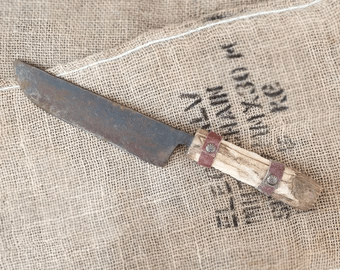
The “Taker of Skulls” drew a small knife from a sheath at his belt and embedded it into the bar with a loud THUNK.

“The very knife he cut ‘is throat with!” he proclaimed.

Orphelia wasn’t sure what she was supposed to be impressed with.  The knife was visibly rusting, and the blade appeared to be loosely joined to the handle with twine.  The barkeep was even more unimpressed.

“Alright, I think you’ve had plenty,” she said, glaring at the new notch in her bar.  “Time to go!”

The “Taker of Skulls” slammed his fist against the bar and roared something back, but Orphelia was only dimly aware of it.  She realized with equal parts fascination and concern that despite the knife’s innocuous appearance, she couldn’t take her eyes from it.  And the sounds around her had faded.  It was as if the substantial din of the tavern–of the argument ongoing right beside her–had become background, replaced not by different noise, but by intrusive thought:

Take it, her instinct told her.

Take it.  Take it.

Take it.

TAKE IT.

The part of her that was concerned was now, of course, alarmed, but she had no other reason not to take the knife.  So she did.

The silence and stillness fell so immediately that she felt she had been struck.  But nothing had touched her.  She pried the knife from the bar, considered it, noting that it was indeed a shoddy, unremarkable piece of work.  But then she noticed that the tavern around her had not merely stilled.  It had changed.

The barkeep was staring at her.  No.  No, everyone, the whole tavern was starting at her, but for some reason, as she glanced, panicked, back and forth, she couldn’t seem to focus on their eyes.  All of their faces were…the same.  And every single one of them was smiling, teeth bared.  At the back tables, some of them began to laugh, quiet peals of high-pitched cackling echoing across the room’s high ceiling.  And then a whisper, chime-like, consonants clicking, inches from her ear:

“Awake from your dream, child?”

She sat bolt-upright, suppressing a shiver, and whirled.  No one was there.  Rather, the tavern was there, its warmth and noise suddenly returned, and not a single person was looking at her.  No one was smiling.  At least no one was smiling like that.

Next to her, the barstool where the “Take of Skulls” had been sitting was empty.  The barkeep looked up from the cask of ale she had just finished tapping.

“You alright, sweetheart?” she asked.  “Need more wine?”

Orphelia shook her head, dazed.  Then she looked down at her hands.  She was still holding the knife, and, despite its dubious construction, it felt light and comfortable in her palm.  She glanced at the notch in the bar where the man had plunged the knife moments before.

“Excuse me, ma’am,” she said to the barkeep, gesturing to the empty stool.  “Do you know where the man who was sitting here went?”  The barkeep frowned.

“You sure you’re okay, hun?  That seat’s been empty all night.”

Orphelia stared at her, feeling a pit in her stomach.  She nodded slowly, tucked the knife into a pocket inside her dress, and slid down from her stool.  Saying nothing to the barkeep, she placed Naples’ two pieces of silver on the bar and made her way to the door as quickly as she could without sprinting.

The air was cool and wet outside.  Calming.  Traffic was light, but the street was far from empty, which was good: What happened in the tavern had left her unsettled, somehow, by both crowds and solitude.  She took a deep, nervous breath.

What was that?  Did it have to do with that weird Skull guy?  With the knife?  And where did he go?  And why did she keep the knife?  Ooh.  She had no answer she could frame in words, but even the thought of discarding the knife struck her with overpowering dread.  The voice…the knife, for some reason it was all settling, familiar, in her mind.  She didn’t like that.  She knew it wasn’t familiar.  She knew she had never seen it before.

“Orphelia, my dear!”

The voice calling from the busy end of the street was familiar too.  But it was the right kind of familiar.

“Captain al’Ver…?” she muttered, turning, dazed, toward its source.

“Orphelia, what’s the matter?” Captain al’Ver asked, drawing closer.  Behind him, she saw old Gene and Dog Boy approaching as well, along with a tall woman she had never seen before.

Orphelia didn’t reply.  She just shook her head, the air in her lungs feeling fuzzy amidst the comedown from the panic.  Gene exchanged a glance with Bleeding Wolf, who ducked quickly through the tavern door, only to reemerge a few seconds later with a shrug.

“Seems normal in there,” he said.  “What’s gotcha spooked, girl?”  Once again, Orphelia had no words.  What could she say?  How would she even begin to describe it?  Captain al’Ver frowned, looking down at her empty hands.

“Where is your stuffed bear, Orphelia?” he asked quietly.

“Left him at Brill’s,” she replied.  The world’s resolution was coming back.  She could breathe normally again.

Still, she thought, better not tell Captain al’Ver about the knife.  Better to save it for a surprise.

Oh no.

That thought had not been hers, but try as she could to contradict it, she could not.

Unresolutions

Happy New Year, everyone!

I know I’ve been pretty quiet for the past few weeks. It was actually quite loud for me, and I got to live out a lifelong dream of floating down the Amazon River, passionately vomiting every single damn thing in my gastrointestinal tract from sundown to sunup. It was perhaps the best vacation I’ve ever taken.

Meanwhile, my recent good fortune in day-job world has left the timelines for my upcoming projects with unfortunately little resolution. Not an auspicious New Year situation, but still, the original plan for $20,000 Under the Sea is more or less on track. The beta-reading/editing process has started, and I’m continuing to target release by the end of 2024. For The One-Winged Lark and the One-Eyed Crow, well, stay tuned. A new chapter should be up shortly.

And of course, one more bit of good news. If you’re new here or were waiting on a chance to read my work, I’ve adjusted ebook prices down to $0.99 for both Three and Two and Two and Promises for a Worse Tomorrow and discounted the Three and Two and Two paperback by 40% until the end of the month (exact amounts subject to platform and country; some platforms may take a minute to update the price, keep an eye on it).

May your upcoming year be resolute. Or at least, you know, nice or something.

Curtains Rising and Intelligent Wailing

Holiday pressures and life changes do often make it difficult to maintain post schedules for longform work, so I want to fill the gap today with a hybrid of housekeeping and history.

In the former theater, I’ve been blessed by/suffered with a number of developments. I’ve completed the handwritten manuscript for $20,000 Under the Sea, and you can expect the final two chapters to be posted here in the coming weeks. My writing process is to do first-round editing as I’m transcribing my handwritten work into a digital format, and those final two chapters are chonky, so bear with me as I’m getting everything in. Once it’s up here, I intend to initiate beta-reading and second/third-round editing, and you, as readers, have until that process is done (or near done) to read it here before I hide it like I did with Three and Two and Two and the material that went into Promises for a Worse Tomorrow. That said, if you are interested in beta reading, please reach out to me at slhlocrian@saltpoweredllc.com. I am not being choosy with who is allowed to offer me feedback (though I may be choosy about what feedback I listen to). The only qualification I ask for is interest in reading through the manuscript and providing me with your opinion (ideally with a minimal amount of follow-up required from me).

The beta-reading/editing phase for $20,000 Under the Sea will likely be longer than for my previous two books. This is because I’ve recently started a job, and my dedicated writing/editing time has been quartered. On the flipside, lack of uncertainty regarding my ability to survive in the hellscape of capitalism really has been a breath of fresh air, so motivation is in higher supply now at the very least.

Now for history. As my access to illustration for my work is currently limited, I’m looking at a more graphic-design-centric approach for covers/graphics/materials for $20,000 Under the Sea. In particular, I’m hoping to leverage the theme of historical photographs with which I’ve been adorning my recent Whom Emperors Have Served posts. Chief among the questions for cover design for the book is how one might use historical photographs to depict (or at least reference) the Nicholas. Fortunately, in the early days of submarine navigation, vehicle designs–likely the same ones the inspired Jules Verne–were wild.

In particular, see the Intelligent Whale, depicted at the top of this post. It was an experimental craft built during the American Civil War, sold to the U.S. Navy in 1869, tested (disastrously) once, and then condemned in 1872. Various sources indicate that the total number of people drowned in testing the sub may be as high as 42. Between the aggressively silly design and its outright unreliability, it feels…appropriate that it might be a stand-in for Captain Kneecap’s inimitable trash sub.

For a less exceptional inventor or navigator, the design may in fact be an inexpensive conveyance beneath the waves. Whether that’s desirable, of course, depends on how badly you ever want to make it back to the surface.

Top photo courtesy of chinfo.navy.mil

Updates and Recent Happenings

Hi there. I feel like it’s been a little while since we chatted. At least two weeks–while I hope you enjoy the fiction posts, they feel less like a connection with the world. Moreover, I feel a little bad that my post frequency has decreased below the once-per-week mark recently. Never fear, though, much is on the way!

Transcription is behind schedule, but I have three more chapters written and incoming for Whom Emperors Have Served. More exciting than that, I am probably within three chapters of completing the manuscript for the first book in that series (which will likely be published as $20,000 Under the Sea, as I’ve mentioned elsewhere).

Beyond that, I want to give some thanks to…

…those of you who have read either Promises for a Worse Tomorrow or Three and Two and Two. I hope you liked them. There will be more to come, but in case you haven’t checked them out, you can do so here and here, respectively…

…those of you who contributed to TimmyP7’s fundraising stream on Tuesday (featuring me). It was very short notice as far as my involvement was concerned, but we exceeded our goal by far and were able to raise some good money for Gamers Outreach, a charity which provides games to hospitalized children. I advertised this with some limited notice on my Instagram, so if you’re interested in more content like this in the future (admittedly pretty different from what I post here), stay tuned there.

Otherwise, I hope you all are doing well. For those of you in the U.S., enjoy spooky season, and I’ll be back with more soon!

Top Image unrelated to everything but Halloween season.

Can’t You Read the Sign?

A review of Embassytown, by China Mieville.

Circumstances being what they are (ie, needing to focus on finishing one more manuscript while I have the freedom to do so), it is likely that the following will not do China Mieville’s Embassytown justice.  Perhaps that’s because the book is a lot, perhaps it’s because it’s just a lot that I’m personally interested in.  It’s become depressingly clear to me over my adult life that the average person just cannot be persuaded to care about epistemology.  That’s fine; it’s a headache, but just as others may enjoy headaches in the form of booze or boxing, the nuances of knowing things is a headache that speaks to me.  And boy oh boy does Embassytown speak that Language.

Cheap pun notwithstanding, this book is silty.  It’s classic Mieville, which is to say it’s not especially forthcoming with what it’s about, despite seeming to follow a cogent narrative arc.  I’m not sure why this is so common in his work, since it seems to be a different sin (or at least a different purpose) depending on the story you’re reading.  In Perdido Street Station, it’s an issue the setting gobbling up pages in exploration of details and implications extraneous to–and thus obfuscating–the plot.  Meanwhile, in Kraken, it’s just an excessive amount of intentional misdirection (seriously: That book builds to a climax around the theft of an idol worshipped by a squid cult, only to reveal that the god-squid was merely incidental to the antagonist’s quest to become a god of ink, which is then thwarted by the protagonist’s realization that he has become a god of glass containers, only then to reveal that the apocalypse he was seeking to avert has nothing to do with that antagonist’s scheme and everything to do with the ideological impact of Darwin’s theory of evolution, completely unrelated to squid, ink, or bottles).

Embassytown is somewhere in between.  The setting is, of course, very whacky, and a lot of space is given to implications and interactions of its aspects, but after the third (or so) major paradigm shift that changes how everything operates, one can’t help but feel a little jerked around.  To that end, I think it’s fair to say that as a story, the pacing is kinda flawed.  It’s still gripping, in ways, for reasons, but what makes the book great is what it is beyond a plot.

For starters, like most of the sci-fi genre, Embassytown is about its premise just as much as the series of events that occurs within it.  That premise is that there is a planet on the edge of known, navigable space that is home to a sentient species (the Ariekei; the planet is Arieke) that can communicate only via the weirdest language.  They have two speaking mouths, and each word or term is constructed of two words, spoken simultaneously by those two mouths.  No, that isn’t the weird part.  The weird part is that they are incapable of registering anything not spoken in this language, according to particular constraints (cumulatively, Language) as communication at all.  A person speaking to them in a foreign tongue; body language; writing–they are aware that there is a thing moving or making sounds in their vicinity, but they will not, cannot understand it or even grasp the notion that there might be thought or intent behind it.  Even weirder, when two people repeat the phonemes of their Language back to them, down to the precise pronunciation and simultaneity, the result is the same: They don’t react.  It isn’t communication to them.  Only through a slow, historical stumble (which the book briefly summarizes) do the linguists making contact figure out that the two halves of Language must essentially be spoken simultaneously by a single mind in order to be comprehensible.

This discovery prompts a series of attempts at workarounds.  Mechanical aids (to provide the second speaking mouth) don’t work, ditto synthesized sounds in general.  The closest of the first drafts is identical twins, which mostly doesn’t work either, but per Miracle Max, mostly failure is slightly success.  Humans devise psychological tests to evaluate empathic synchronicity, gather the sets of twins who score the highest, and then further augment that synchronicity with cybernetic implants.  This works okay, and they are able to establish basic lines of communication with the Ariekei.  By the time of the book’s events, though, this is all rickety, ancient history, and the embassy (of the interplanetary empire that originally made contact) has moved onto using precisely-engineered clones.  These are the Ambassadors.

A brief digression: Some portion of the book gets into the significance of Arieke to interplanetary politics, which is amusing anticlimax.  The planet is, in fact, very valuable, but for reasons that have nothing to do with natural resources, the oddities of Language, or the super weird, biorigged technology in which the Ariekei specialize.  So going in, the score is that the interests of the empire and its embassy only slightly intersect.  Contact with the empire is of a fraught sort of salience, but it’s infrequent.  Embassytown (the place, not the book) is out in the boonies, and the way in which its citizens have gone (or proceed to go) native is part of the point.

Anyway, the Ambassadors communicate reliably, but the way the Ariekei work is still a bit opaque.  For the Ambassadors, speaking Language requires a lot of engineering, but in the end, Language for them is just language, a semiotic construct.  For the Ariekei, it’s not.  For them, Language is Truth.  They can’t lie, for instance, but it is more than a preventative for deception.  They cannot describe anything they know to be contrary to reality, they cannot speculate as to anything that has not happened (they have a future tense, but it can only be used in situations of extremely high certainty), they can’t use conditional hypotheticals or metaphors, cannot even conceive of them.  In order to access new concepts, they have a practice called “performing simile”, in which an individual, frequently a foreigner from Embassytown, performs some task of abstract significance under ritualistic observation.  These individuals, including Avice, Embassytown’s protagonist-narrator (her simile, roughly translated: “the girl who was hurt in the dark and ate what was given to her”) effectively comprise the Ariekei’s limited window into that which is not.

Needless to say, this is all very bizarre, but the embassy is not especially interested in understanding the boundaries of these limitations.  They don’t want to rock the boat–the status quo is awesome for them.  They effectively rule their provincial kingdom, coexisting peacefully with the Ariekei via their genetically-engineered, diplomatic metis.  For one, elucidating the fundamentals of their diplomacy undermines their interests: The empire understanding what they do makes them replaceable.  But also, they would honestly rather the Ariekei not discover anything wild and crazy in their linguistic differences, lest the embassy become a victim of a cultural revolution that turns political.  Of course, this is exactly what happens.

Actually, that isn’t precise.  It’s what almost happens.  And then it’s what happens so hard that nothing will ever be the same again.

The book’s first conflict is fairly organic.  Per the above, despite their best efforts, the embassy has introduced a new, invasive oddity into Ariekei culture: The Ambassadors can lie.  It turns out the Ariekei have noticed and find it very interesting.  For many, it’s entertainment, something between a magic show and a freak show, but a group–of what Avice speculates are sort of Ariekei intellectuals–pick up the idea with more curiosity and attempt to learn how to lie themselves.  They can do it, sort of.  With great difficulty, by omitting words from sentences, by tricking themselves into failing to finish thoughts, they are capable of vocalizing things which they know to be false.

But they don’t stop there.  The intellectual clique, led by an Ariekes named Surl/Tesh-echer (each side of the slash said simultaneously) appears to be fixating on a group of human similes as a means to speak falsehood without having to trick oneself.  Ultimately, Surl/Tesh-echer is able to say, in front of a crowd:

“Before the humans came we did not speak so much of certain things.  Before the humans came we did not speak so much.  Before the humans came we did not speak.”

And then, in very short order, Surl/Tesh-echer is assassinated in a conspiracy between the embassy and the Ariekei “rulers”.  Everyone agreed, apparently, that it (Ariekei use impersonal pronouns, or the Ambassadors do for them anyway) was onto something, and none of them wanted to find out what, for reasons ranging from brutal realpolitik to religious fanaticism.  The book presents this arc, effectively the first, post-prologue, interspersed with the events leading up to the true crisis years later, and from a storytelling perspective, it is Embassytown at its (and Mieville at his) best.  It’s an elegant introduction to a highly complicated world and a heartbreaking belated coming-of-age for Avice, who had somewhat intimate personal connections to both sides of the assassination conspiracy.  This isn’t to say that the two thirds of the book that follow are a letdown–the beginning merely stands very well on its own.  What happens after, though, is where the already philosophically heavy situation gets spicy.

So: Several “years” later (time spans that large are measured in the book in kilohours, because space), the empire sends an Ambassador to Embassytown.  This is, on its face, already strange.  Ambassadors don’t come from the empire–they are grown in a vat in Embassytown (an ethically spiky topic on which the book touches but does not dwell).  Moreover, the particulars of the empire’s Ambassador are highly atypical.  Again, modern Ambassadors are sets of doppels, perfect clones, cybernetically linked and physically re-synchronized (so that minute differences in their physical experiences do not accumulate) on a daily basis.  The empire’s new Ambassador, EzRa (this is the ambassadorial naming convention, e.g. BrenDan, JoaQuin, MagDa, JasMin) on the other hand, is just two completely different guys with a supposedly off-the-charts score on the paired empathy test that predicts ability to speak Language.

But can they speak Language?  Ha.  Haha.  Yes, but really badly.  This is not “badly” as in “their grammar is terrible” or “they are hard to understand”.  Rather, when they speak, it enraptures the Ariekei into a trance.  It takes a minute for anyone to figure out what’s going on because, surprise, this isn’t what the empire intended at all.  They knew their new Ambassador was scientifically fucky (there is, of course, more going on technologically than two guys who just really get each other), but they were genuinely just hoping to create a pipeline for Language speakers they could control.  Within a few days, the embassy is able to put enough pieces together to relate EzRa’s oratory to a little known phenomenon they had encountered in their own failed Ambassadors (of which they apparently have an asylum-full in the basement).  Turns out that when a pair of humans speaks Language in a way that is just slightly off, the effect on the Ariekei is not distortionary but narcotic.  In a small way, the Ariekei can become addicted to the infinitesimal incongruities in a miscalibrated Ambassador’s voice.  Except what’s going on with EzRa is not small.  The high of their voice is potent enough to spread demand like wildfire: Upon their first public pronouncement, the Ariekei subsequently flood the embassy, overcome by fervid desire to hear EzRa’s voice based on nothing but word of mouth.  And once they hear it, the addiction does not seem to have a cure.  If an Ariekes goes too long without hearing EzRa say something else (and it has to be something new–repeated pronouncements induce tolerance rapidly), they just shut down.

Oh, but it gets worse.

Virtually all Ariekei infrastructure is biorigged, organic, chemically and physiologically interconnected, which means it isn’t just the Ariekei individuals who are addicted.  It’s every Ariekei machine, vehicle, and building on the planet as well.  Embassytown is still mostly human architecture, so it isn’t entirely a biological construct, but it isn’t unaffected.  The most visible clock to emerge from this development is that the addiction afflicts the aeoli used to convert Arieke’s toxic atmosphere into human-breathable air, which means that unless the situation is stabilized, everyone is gonna die.

It gets even worse than that.  And then, it gets even worse than that.  In summary, everyone loses their shit; Ez murders Ra; the embassy, in whose leadership Avice is taking on an increasingly active role, figures out how to “replace” Ra in order to keep the Ariekei going and creates EzCal, who is way too into his role as the “god-drug” and begins solidifying power structures around himself; the Ariekei begin to deafen themselves in order to cure their addiction (which, for a species for whom spoken language is thought and unspoken language isn’t language at all, is way worse than it sounds); the deafened Ariekei begin massing an unstoppable horde, hell-bent on the extermination of the humans and addicted alike; and Avice goes renegade and discovers a way to teach the Ariekei to use referential language, which cures the addiction and stops the forthcoming genocide.  I want to be clear that my description does not do this last step justice.  It is extremely awesome, and I would almost recommend reading the book just for that portion of it.

Needless to say, this is all extremely analyzable.  The low-hanging fruit, the piece that I imagine a socially-involved but not especially careful reader might notice with immediate umbridge, is the commentary on colonialism.  Embassytown as a colonial story runs counter to the anti-imperialist narrative in vogue right now, and without getting too political, I do want to clarify that that narrative has a lot of good sense behind it: Historical colonialism was rife with utter atrocity, and it is hard to defend the intent behind it as any more noble.  This is why my above weakman would not be wrong to be immediately suspicious of Embassytown’s characterization of its colony as native-friendly.  Anyone even passingly familiar with the concept of bias should immediately recognize that first-person good intentions are very easy to presuppose and wildly difficult to ethically execute on.  But counterpoint: This is fiction, not a geopolitical instruction manual.  Mieville is at liberty to define whatever setup he wants, without any obligation to make that setup replicable in real life, and the setup he defines is one where the colonists have little power over the natives, and their empire has little interest in establishing any direct political control.  Part of this should be understood as a change in economic theory between now (and especially Mieville’s stellar far-future) and the 15th century, largely independent of the parallel shift in geopolitical ethics (it is worth noting that despite Mieville’s impressive authorial catalog, he also has a fair amount of training in law and economics).  A little-appreciated observation is that mercantilism as a driving motivation for early colonialism was catastrophically destructive for the places getting colonized, and Embassytown is operating on very different sensibilities.  Specifically, the empire in the book is operating with the specific interest of being friends with whatever human settlement ends up on Arieke in the long run.  They don’t really care about conventional exploitation (though they do want reliable and semi-exclusive diplomatic influence), they certainly don’t want to be financially responsible for the settlement’s survival.  And the resources?  Meh.  Biorigging is neat but probably not a game changer.  No, the value for the empire is deep space exploration, and Arieke is the farthest outpost available.  They just want to be on better terms with that outpost than anyone else.  Mieville himself is a Marxist, but if that isn’t a picture of capitalism, I don’t know what is.  The empire thinks the liability of owning the capital is too much, but they would love to lease, and the natives are free to share in the value.

Now of course not all of the downsides of colonialism arise from the colonizers being evil fuckers.  Addictive substances introduced with varying levels of intention have resulted in events that might fairly be described as “genocide” on multiple continents, and I don’t think Embassytown glosses this.  But what I think may ruffle feathers is that in this story, a colonist “saves” the natives by “elevating” their conception of the world.

Yeah, I don’t love that either.  Still, I think there’s a perforated line where you can tear the book’s themes to save it.  Set aside the particulars of Language for a moment–they’ll be relevant on the other side of the tear, but on this side let’s simply examine the colonial commentary alone.  A generalization from this narrative that is obviously true is that cultural exchange has a significant potential for harm.  In history, this is most visible in the transmission of European vices and poor hygiene, but it is a much stronger claim to say it stops there than that it doesn’t.  I think the sci-fi style question that Embassytown very reasonably asks is whether it is possible to acknowledge certain directional harms of that cultural exchange and provide mutually agreed-upon aid to mitigate those harms.  A key feature of this story is that even though factions align in opposition to each other, they are still all in agreement that this addiction thing is apocalyptically bad, and the only solution that will resolve it is one the Ariekei themselves choose.  I think that this, as a prescriptive cap to the interpretation, is not in itself an offensive assertion.

Now on the other side of things, consider the Language.  For a number of reasons, despite the unfortunate conjunction of the Ariekei’s shift in linguistic culture with the aforementioned colonial story, I think the particulars of Language and its evolution place it in a separate allegory.  Calling it a philosophical allegory would be eliding the point: It is an allegory of philosophy itself.  Think about it.  Capital L Language is a very strange concept, even by sci-fi standards, and if this were a run-of-the-mill white savior story, that strangeness would be wholly unnecessary.  If you want to make the natives wrong, there are easier ways to do it, but Mieville didn’t make the natives wrong–it’s the exact opposite!  Language is both thought and Truth.  It obviates epistemology.  Human language is referential because our experience is unreliable.  We need reference points to reassure ourselves and others that we know anything at all, but the Ariekei don’t have that misunderstanding.  Their map is literally their territory.  They still have a Westword-style “those words don’t sound like anything to me” when an Ambassador says something that fails to compute, but for the most part, this is a species entirely unconstrained by one of the most fundamental handicaps of the human experience.  It’s no wonder, then, that Avice’s xenolinguist husband, Scile, reacts with almost militant horror when he discovers the emergent cultural phenomenon of Ariekei attempting to lie.  Here is an experiential wonder of the universe, unlike anything ever discovered before, and human influence is already destroying it.

So think like an economist in this case.  Do the cost-benefit analysis.  List out the pros and cons, quantify them if possible; it’s easy to not question why we do what we do when there isn’t any alternative, but here one is.  And while an anthropologist may very reasonably retreat from this exercise for fear of the bias-wolves lurking in the hills, we shouldn’t be deterred.  In real life, that bias might literally kill people, which is why we sometimes write books to explore these sorts of problems instead of field-testing our solutions.

Since Scile’s stance is the first to disrupt the flow, we’ll look at that first.  Why might the disruption of Language be bad?  Obviously, change is not always good.  Ariekei culture–which, it’s worth reiterating, is not especially well-understood–is deeply rooted in Language, so any linguistic revolution will almost necessarily mean cultural upheaval.  Even if the Ariekei are “better” on the other side (hard to evaluate and extremely far from certain), some of them are going to get hurt along the way.  Assuming you care about them, your prior should be toward caution.  Moreover, even though the total benefits of the Ariekei’s linguistic status quo may not be legible, we can see some aspects that are clearly prosocial.  Social trust and coordination are crazy valuable and hard to establish, and being unable to lie automatically overcomes the hardest hurdles for both, to say nothing of the reduced social friction from the much higher fidelity by which the Ariekei are able to articulate concepts.  Tertiarily (from the philosophy of this argument–though Scile, et al may value it more highly), there is the aesthetic value of this truly unique linguistic (and, to a certain extent, metaphysical) phenomenon existing in a place where you can reach out and touch it.  The alternative has potential to destroy it, and that is not a negligible cost.  Even if you accept that the giant panda is dubiously fit for survival, you’d still kind of rather it wasn’t extinct.

On the other side, pinning your language to your thoughts, to what is literally, verifiably there, is limiting in ways you might not expect.  Consider that the Ariekei are a technologically advanced civilization (they have made technological advancements that an interstellar empire has not), but they’ve never been to space.  They have no interest in space–how could they?  It being unknown to them means it is not, and it being not, means it can neither be spoken nor thought of.  Needless to say, this has downsides in much more mundane ways too, hence the Ariekei’s reliance on living similes.

But this is all fairly surface.  It’s what the book lays out for you, alongside the embassy’s political motivations, leading up to the assassination of Surl/Tesh-echer.  The question one ought to be asking oneself: The megacrisis, the EzRa-induced addiction–is that explainable by the philosophical nature of Language (without a need for some additional MacGuffin)?

I think it is, mostly, sort of.  It requires us to fill in a number of gaps as to what it means to speak Language badly.  Mieville provides a hint, though: In the creation of EzCal following the death of Ra, the protagonists operate on the assumption that a key ingredient in the “god-drug” is that the second voice in the second voice in the speaking pair hates the first.  For normal language, this would be irrelevant, entirely outside the model, but for Language, where both voices are meant to come from a single mind, it makes each word a negation of itself, infusing it with a whole bunch of meaning not implied by the actual phonemes.  The scale of the crisis is MacGuffin, of course.  The reason EzRa’s voice is so much more narcotic than previous observations of the phenomenon is that Ez is, himself, an engineered hyper-empath for whom being hated by his cybernetically-linked second voice is a uniquely-affecting experience, which comes through in his Language.  But consider what this implies about the Ariekei experience.

It is obvious that scientific discovery depends in some measure on epistemology, but those roots spread wide underground.  To paraphrase Lou Keep, Kant claimed that his work was meant to save the sciences, but what was really at stake was everything else.  Interpretation of experience relies on validity of experience, which means that epistemology has fairly serious implications for aesthetics as well.  The Ariekei don’t really have epistemology, but they have plenty of science.  Provided your biology allows it, you can just go places to expand your mind.  Skipping over a lot of details of this argument (this isn’t really the venue for philosophical groundwork), the Ariekei’s empiricism is awesome, but their predictive math is not.  And if all of your experience is high-fidelity empiricism, all of your aesthetic values are going to center around anomalies.

The retreat, then, from Language’s perfect alignment with reality, to semiotics, to reference, is really about values.  It’s about freedom to define what is good, independent from the balance of Science (the good is minimizing anomalies) and Suffering (the good is minimizing pain) which the Ariekei were strung between before.  It’s the ability to access philosophy, tools to make the incommensurate commensurate.

Of course, Mieville doesn’t overextend thai to a stance on such thinking being better.  Some Ariekei are unable to unlearn Language, some choose not to, and the society of cured is able to engineer workarounds to keep the addicted alive.  Nor is it a perfect exploration of the topic (to say nothing of my own no doubt stunted understanding of it), but even so, there’s a lot there.  A lot of things to think about, biases to unlearn, new looks to be had at this series of images we call life, and, of course, new words to describe it all.

A New Print Approaches

As I mentioned a week and a half ago, I’ve been tinkering in my spare moments to get another product up on the Etsy shop. In case you’re a fan of R. Johnson’s fabulous cover art for Promises for a Worse Tomorrow, you’re in luck, because it is now available in print form!

If you’re interested, check it out here!

Separately, a very, very long time ago, I posted about the original intent behind a lot of the work Leland and I commissioned for this project. A version of that is finally becoming real–stay tuned for an update!

Book Signing Recap

Before we return to our regularly scheduled programming, I want to thank all the folks who stopped by my table at Barnes & Noble this last Saturday. It was awesome getting to know you all, and I hope you have as much fun with Three and Two and Two and Promises for a Worse Tomorrow as I did writing them.

Thanks as well to Tim, Michele, and the other amazing staff at the store. You guys are awesome! And thank you to the fans who traveled some not insignificant distance to be there–you make it worth it to keep on trying.

For anyone in the U.S. Midwest who missed out, feel free to follow me on Facebook, where there will hopefully be more events incoming. I’ll also try to keep my various social media feeds more synched up on this as well.

Hey Kid, Wanna Patronize Some Arts?

It’s been…forever, but the Etsy shop is finally back up! For those of you who were there in the before times, I’ve stripped down the inventory a little, since I’m not totally confident in the product viability of the “tarot card” prints. Currently, I’m offering prints of R. Johnson’s “The Third Gift”, which you will certainly recognize (since it’s probably now my single most-posted image on this blog):

…as well as Quinn Milton’s “God”:

I’m currently testing resolution for a third product, R. Johnson’s “Redemption” (alternatively “The Dragon’s Thesis”), the cover for Promises for a Worse Tomorrow. If it turns out, I’ll have that up shortly. Check it all out here!