Journey to the Center of Society, Chapter 1: The McFlinn Boy

For those who want to know what comes next–or those new to the adventure of $20,000 Under the Sea, this is a draft of the first chapter of the sequel.

$20,000 Under the Sea will be available for purchase in digital and physical formats on 7/4. Preorder the ebook on Amazon here!

Vincent McFlinn was feeling pretty unimpressed with New York.  Some of the boys back in the Chicago Outfit had talked it up in their way.  They were from Jersey, if he recalled, so they weren’t fans or anything, but those fuckers still gassed the place up: the big time, greatest worst city on earth, largest wormy apple you ever did see.  Made it sound like a crazy, fourth-circle hellscape where everything was different.  Like it was kinda different: buildings were a little taller.  Mostly, the people were just fuckin’ twits.

Vincent–Drip, to his acquaintances–was certainly not accustomed to decorum, but this was somethin’ else.  Bums struttin’ around the sidewalk like some kinda aristocracy, an idiot on every goddamn street corner fuckin’ yellin’ their lungs out in that stupid, incomprehensible New York accent, and the Lethal Chamber…just…seriously?  You need the fuckin’ government to subsidize your suicide attempt?  And they were mean to the pigeons, which was never a good sign–though, as Vasco reminded him, the pigeons were generally dicks.

Maybe there were extenuating circumstances.  The city did seem to be on a kind of high alert, though pulling the reasoning thereof outta these citizens was a task.  After maybe four conversations of the form of “hey, what’s with all the coppers, ya need five on every street, seems like a lot?” “Hey buddy wassa matta wit you, missin’ ya ears or somethin’?” Drip finally managed to squeeze a red-eyed businessman for the big picture summary that the local constabulary was embroiled in a hot fight with some sorta cult.  This, combined with a far less social–but far more physically detailed–account Vasco had obtained from the local crows, yielded a more complete story: A few days ago, New York’s mayor had been assassinated by members of a cult.  A manhunt ensued, and at some point, the cops had surrounded a group of the cultists in an office building in Midtown.  And then a couple random citizens dove onto the cops’ perimeter, double-fisting live grenades.

Also, apparently, the better part of the harbor had been obliterated by a spring storm, which Drip didn’t think was related, but he did find it odd that neither the people nor the birds of the city seemed even to acknowledge the damage except under duress.

Anyway, fuck the cops and all that, but Drip really did have to hand it to this cult for making the most of their time together.  He’d been downtown for all of three hours now, and these lunatics were already chafing his dick.  Not that they even knew who he was, but with all the nest kicking, they’d gotten their enemies out in force with no evidence to go on but a mandate to be fuckin’ everywhere looking for “suspicious characters”.  Unfortunately, by any reasonable definition, Drip was a suspicious character.

Because he wasn’t a dirty plebeian, he put effort into his appearance.  Hair slicked, clean shaven, fashionable dark red suit tailored and pressed, matching Stetson worn at this season’s calculated tilt.  He stood out in a fuckin’ crowd even without Vasco there–with the crow perched on his shoulder he was just about a beacon of salience, and he clocked more than a few significant looks and gestures from the patrols, prompting him to maneuver off down sidestreets and stations to avoid whatever questions they were brewin’ up for him.

Not so different from Chicago, really.

At this point, Drip felt like he’d spent half his life on the outs in one way or another.  He grew up in a tenement in Fuller Park before the fire, along with the rest of the Irish portion of the city’s scum.  His father was a pickpocket, which, in lieu of the real job the bastard was never gonna hold down, made enough money for beer and shitty soup.  No mother was present–though Drip’s social understanding was so fucked that he didn’t even notice he was supposed to have a mother until he was eleven.  When he asked Dad what was up with that, he just scowled, walked out the door, and didn’t come back until one in the morning.  Drip didn’t ask again.

Otherwise, he and his old man got on alright, until the sap got caught red handed and beaten to death by a copper two blocks away from their house.  Most of his memory of it was less painful than just fuckin’ numb.  Hazy.  The part that stuck out was the other cop–a different one, he was sure–that showed up at his door to let him know his dad was concussed and bleeding out over thataway.  Fucker was wearing sunglasses at eight o’clock and smiling.  It hurt to look at him.  The cop that killed his father took a trip to the bottom of the river for Drip’s twenty second birthday–one of the rare cases he saw of Boss Nepoca’s sweet side before things went sideways–but the guy with the shades?  Drip never saw him again.

Drip had a rough few years after that.  He couldn’t keep up rent, but he scraped enough together between his neighbors’ charity and his own pickpocketing and petty theft to keep himself mostly fed and mostly off the streets.  His streak ran out, though, when a couple of stiffs in the North Side Gang caught him nickin’ a box from their car.  Things kinda went red after that, and he woke up in an alley with four stab wounds, his own knife white-knuckled in his hand, and the two stiffs dead on the ground next to him.  Since it was December at the time, and “dead” was only slightly less alive than he was then, he probably wouldn’t have made it if not for the men who pulled up, dragged him into their car, and took him to the hospital.

Turned out that even though he’d stolen from the wrong people, those North Siders were causin’ trouble in Outfit territory, and Al Nepoca appreciated Drip’s sacrifice in keepin’ his streets clean.  About a year later, Drip was made muscle for the Chicago Outfit, and that might’ve been history if he could’ve just kept it in his pants.

Puberty had been pretty disastrous for Drip, less for his adaptation to his body or appearance than for the Irish Catholic neighborhood’s reaction to the appearances and bodies he found himself attracted to.  Refreshingly, the Outfit’s attitudes were practically progressive in comparison.  They didn’t like that he was a fag, but they didn’t mind so long as his romantic proclivities didn’t intersect with gang business.  Problem was, six years on, he found himself a crush.  A reciprocated crush: Sal Biggs.  Roman statue jawline, eyes like emeralds, those shoulders.  And he was Nepoca’s nephew.  They managed to keep their relationship secret for a year and a half before the big man found out, but then Drip got a no-nonsense, knuckle-accented nastygram indicating he better get the fuck outta Chicago, we don’t wanna see you around here no more, got it?

That one hurt.  Probably more than his dad dying, to be honest.  It probably didn’t help that before leaving, he jumped Nepoca’s messenger, sawed off his right hand to teach him to use some professional courtesy in his communications, but he wouldn’t’ve pulled that stun if he hadn’t been handed an out: a letter under his apartment door from someone named “J.B.”, offering timely employment far away from Chicago.  Accordingly, he packed light, and after disarming Nepoca’s impolite associate, he got into a black car at the corner of Canal and Jackson driven by an annoyingly chatty man named Bluesummer.  About forty-eight hours later, he was deposited on the steps of the Claridge Hotel in Atlantic City, New Jersey, with a prepaid reservation and another note from J.B.–this one with a wad of cash–telling him to sit tight and await further instructions.  Normally, he’d bristle, but he had to admit he might’ve gone overboard.  Nepoca had told him to get gone, yeah, but hitting back at his guys might’ve given him reason to call up some friends in New York if he caught wind of where Drip was headed.  Better to lie low for now.  Stick to this swanky hotel in this little mob bubble, just him and Vasco.

It did, however, put into sharp relief that Drip’s life up to now had been extremely unapologetic.  It was fortunate that for a time, anyway, the Chicago Outfit had accepted him as he was, because he’d done fuck all to fit in.  During those months he spent in Atlantic City, he wondered how reasonable that was, every day looking at his reflection in the mirror of the hotel bathroom: him, his red suit, his pet crow.  That was kind of a weird thing, wasn’t it?  Gangsters didn’t really walk around with birds on their shoulders, they weren’t pirates or some shit.  This was real life.  More to the point, people didn’t talk to birds, or rather, as Vasco confirmed, people did, but it was in the same way they talked to walls.  But somewhere in those years of stealing and stabbing in Chicago, Drip started talking to birds–on the street, feeding ‘em in the park, wherever–and at some point, he began to understand what they were saying back.

Most of them were pretty stupid, in an endearing sort of way, but the crows were alright for conversation.  And then Vasco stuck around after the rest of the flock flew off.  After a few times tailing him to the bar after dark, he just started sleeping at Drip’s apartment.  The way he put it, Drip’s life was just more interesting, whatever that meant.  Vasco had good enough sense to make himself scarce around the other gangsters–didn’t trust ’em; probably wise–but Sal was nice enough to him.  Yet another reason leaving Chicago had been painful.  Still, Drip found it pathetically comforting that Vasco had been so willing to leave with him.

At this point, though, the possibility that he would never see Sal again was significant, and he had burned the shit out of just about every other uneasy companionship he’d gathered up to this point in his life.  Drip had always been kind of a loner, but this was a distressing severity of alone.  He found himself relieved that Bluesummer had been willing to take Vasco’s attendance on their journey in stride.  Saved him from from wondering what sort of violence or self-sabotage he might’ve lashed out with otherwise.

In any case, Atlantic City went, Drip assumed, pretty much according to plan.  Two and a half months lying low, sleeping, eating, lightly gambling, and drinking himself into a stupor as the weather warmed up, as he steeled himself for a humid summer of his discontent.  Then in April, some arms dealer’s pleasure cruise out of New York turned into a national fucking incident, and scarcely two weeks later, another letter appeared on his hotel bed.  It was terse, just an address on the north side of Long Island, a date, and a time: tomorrow, 4 PM.

He took the train up north, but things got screwy pretty much just as he reached the city.  Whatever hand-of-god storm had wrecked the harbor had also taken out the bridge to Brooklyn, so he was forced to sidetrack through Manhattan.  Between getting lost and the business with the stupid cult, he was only now zeroing in on the subway station a distracted drug store clerk had told him would get him to Queens where he could catch an aboveground line out to Long Island.  It was nearly 1 PM, and Drip was beginning to realize that his chances of traversing 70 more miles east within the next three hours were closing in on zero.  Before he could conclude that punctuality was impossible, though, the strident blast of a car horn beside him scrambled his calculations beyond recovery.  His gaze snapped murderously to the vehicle, pulled up to the curbside.  The young man at the wheel called out:

“Mr. McFlinn!”

Drip’s response was a crooked grimace and a raised eyebrow.  He was careful not to offer any more positive acknowledgement than that: If this guy was Nepoca’s, there was about to be a tommy gun aimed through that window.  Better to leave him with some doubt that he might be shooting an innocent.  Hitmen didn’t like collateral damage.  That was the sort of shit that made ‘em a liability to the boss.

The driver leaned toward the passenger door and pushed it open.

“Get in,” he said.  “You’re going to be late!”

Drip let his annoyance and relief annihilate each other as he obliged.

Some fifteen minutes of adroit but chaotic swerving later, the driver broke the uneasy silence.

“You certainly took a circuitous route,” he said.  “What on earth prompted you to go through Manhattan?”

“Couldn’t get over to Brooklyn,” Drip muttered.  “You know somethin’ I don’t?”

“Couldn’t get over to…”  The driver whipped suddenly around a milk wagon stopped in front of them.  “Ah, of course, the bridge, right?”  Drip blinked.

“Yeah, wise guy.  The bridge.”

“You can see it, then?”

“What?”  Drip’s turn to look at the driver head-on jostled Vasco enough that the bird jumped to the dashboard with a rustling, surprised caw.  “The fuck kind of a–”

“I can’t see it,” the driver added, cheerfully.  “Very few in the city can.”

“What?!” Drip blurted, though neither his nor Vasco’s outsize reactions seemed to faze the driver–which was surprising.  He was young, maybe even younger than Drip.  Clean cut, spectacles, smart blazer and tie.  He looked like an assistant to an advertising executive–notably not like the type to maintain his nerve in traffic while gaslighting an alarmed gangster.

“It’s called memetic disavowal, I’m told,” the driver explained.  “When the Architects take direct action on society, society just refuses to perceive it–depending on the individual’s proximity to the Architect itself, that is.  But otherwise they’ll react as normal–like I wouldn’t try to take the bridge today and just fall into the bay.  Hell, construction’ll get funded, and crews’ll get out there to fix it, but none of us–me, the bureaucrats, the workers–register that anything happened or anything’s missing.”

“Is this the setup for some kinda joke?” Drip asked dryly.

“Not at all.  Just a personal observation of a phenomenon I find interesting–one which you evidently do not find at all.  Hence the discussion of the bridge which you no doubt found lacking among the citizenry this morning.  Heck, I only know about it because I was told about it by someone who, like you, is unaffected by said memetic disavowal.”

“Oh, so I’m special because I can see your Illuminati or whatever?”

“You’re special because of what allows you to see things I can’t,” the driver said.  “Which is the same as what allows you to speak to animals–I trust you accept this isn’t a joke now, yes?”

“You think I can talk to animals?” Drip probed, attempting a façade of incredulity.

“I know why you can talk to animals, though the way you are clutching your seat suggests you may not be ready to hear that explanation just yet.  Suffice it to say that my employer has had you under surveillance since before your specialness even manifested in that particular way.  So can we please table the skepticism at the notion that I know who you are?”

“Sure,” Drip muttered, rolling his eyes.  “Fine, whatever.  Who the fuck are you, then?”

“Jonathan Banks,” the driver replied smugly.  “I’ve been arranging your transportation, supervision, and lodging since slightly before your falling out in Chicago, and I daresay it is a pleasure to finally meet you in person.

Drip sighed, forcing himself to soften his posture and turn back to the road.

“J.B.?” he asked.

“The very same.”

“And your employer?”

“That’s a nosy question for a career criminal,” Jonathan said, “though I suppose it need not be a secret or anything.  Jonathan Banks is my real name after all.”

“Banks?”  Drip frowned, glancing back at him, trying to piece together where he might’ve heard that name before.  “Wait–like Milo Banks?  The M&M Corporation?”

“Alas, my father,” Jonathan replied resignedly.

Though Drip couldn’t quite tell what the M&M Corporation did, its owner, American-exceptionalist entrepreneur Milo Banks, was something like a celebrity.  He had played a recurrent supporting role in the news-drama of the Great War, aiding–and then seizing and turbo-charging–the Allies’ supply chains, the movement of materiel behind and to the battle lines, and, of course, the valiant postwar relief efforts in Germany.  By all accounts, every enterprise he touched became fabulously successful, and it had all made him fabulously rich.  More recently, Banks had relocated his corporate headquarters to Chicago, quietly purchasing the rebuilt skyline’s tallest building and loudly renaming it the stupidest thing ever.  Drip didn’t know whether the gesture was mistaken or facetious–he was not aware of any connection between the M&M Corporation and anyone named “Willis”–but he found the outrage around the city funny nonetheless.

“I’d heard he and Al Nepoca met last year,” Drip said.  “Was that about me, then?”  Jonathan shrugged.

“I can’t say for sure,” he replied.  “But I doubt it.  Rather, I don’t think it was about you yet.  I suppose you spent the morning downtown–have you become familiar with the King in Yellow?”

“Those cultists that killed the mayor?”

“Right.  My father has had issues with what they’ve been doing to cotton prices in Chicago for some time.  I think he asked Nepoca to help him do something about it.”

“Can’t imagine that went well,” Drip muttered.  “But wait, cotton?”  Jonathan shook his head.

“Don’t worry about it,” he said.  “What you’re here for is not about cotton, but it is about the King in Yellow.”

“You want me to do something with this cult?”

“To be clear about our terms, the King in Yellow is a person, and he is competing with my employer–our employer, assuming your cooperation–for control over some key resources.

“Key resources?” Drip snorted.  “The businessy-fuck does that mean?”

“To be frank with you, I don’t have the whole picture,” Jonathan said, grimacing as another automobile cut them off.  “My understanding is that we are meant to put some pressure on the King.  In order to do that, we need to find him.  In order to do that, we’re best off collaborating with some other interested parties, hence the agenda today.”

“Long Island?”

“Long Island.”

The drive to Long Island, it turned out, was longer than Drip had anticipated, even knowing the distance, and Jonathan seemed reluctant to share any more material details about the job.  The conversation devolved to weather, traffic, observations about New York City–Jonathan’s outlook on the place was much more positive–and Vasco’s anomalous inability to form an opinion on their erstwhile “handler”.  Jonathan was personable, Drip conceded.  Rather, he was disarming, which he decided that he wouldn’t trust, even if it was pleasant for conversation.  Jonathan, for his part, noted the crow’s communication with a raised brow, but did not otherwise comment.

Eventually, they arrived in the driveway of a picturesque estate backed up against Smithtown Bay.  Jonathan stopped the car and got out, beckoning Drip to join him.

“I do want to warn you,” he said, rummaging through his blazer pocket before producing a key.  “I think it’s likely there will be a gun pointed at us as soon as we open that door.  Please remain calm.  I’ll introduce us.”

Without further elaboration, he approached the entrance stairs.  Vasco, expressing his distaste for firearms, told Drip to find him when all that was done, which was discouraging but entirely the crow’s prerogative.  Drip took a deep breath, concerned–admittedly more for the lack of details than the threat of violence–and followed.  Calmly, Jonathan unlocked the door, opened it, and stepped inside.

Crossing the threshold behind him, Drip was dismayed to find that Jonathan’s prediction had been quite prescient: Awaiting them in the foyer were three men, one clean shaven in a crisp, gray suit, the other two disheveled and sunken-eyed, in filthy military uniforms.  The gray-suit man and one of the others, a familiar-looking face with a bloodthirsty snarl, were both brandishing pistols.

“You,” the bloodthirsty man growled.  Seemingly oblivious to the danger, Jonathan smiled.

“Mr. Sterling!” he said.  “Hello again!”
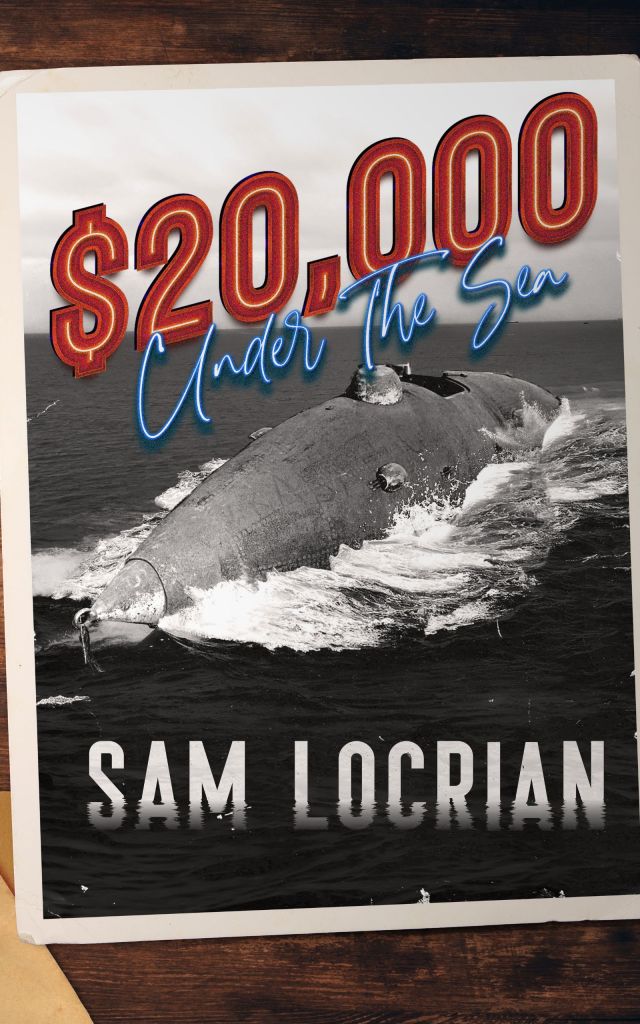
$20,000 Under the Sea – Preorder Now!

Exciting news! $20,000 Under the Sea is now available for preorder, and will be available in print and ebook formats from Amazon 7/4*! Find it here!

Four misfits–a haunted celebrity pilot, a disgraced and vengeful heiress, a bumbling agent of a sinister cult, and a very lucky nobody–board an ocean liner in April of 1920, planning for a short jaunt and a high-stakes poker game.  But none of them realize that what awaits them in the Atlantic is a harrowing adventure from the bottom of the sea to the Panama Canal.
Evading government agents and an eldritch messiah and fleeing their personal demons, these four may soon have to face the truth: They aren’t the selves they thought they were, and now they have caught the attention of dangerous powers worldwide–and beyond.

And beneath it all, the question hangs like a submarine in turbulent water: How much does escape really cost?

*I’m hoping to launch print via non-Amazon channels as well, for a variety of reasons. If you are dedicated to the anti-Bezos bit and want to purchase a physical copy, stay tuned!

Mandatory Vacation in Dimly-Lit Locales

The other day I made the mistake of visiting FextraLife’s Elden Ring lore speculation page, only to recoil, wailing, from the bilingual Time Cube that resides therein. While I try to refrain creating content based primarily on being mean to people, there are only so many claims like “House Hoslow is descended from the Nox because their armor has silver in it” that I can read before I push my fingers so far into my temples that brain pulp begins extruding from my nose.

While it wasn’t surprising, I was pleased to find that Shadow of the Erdtree added substantially to the Elden Ring analytical picture. I hope to write a more substantial post about it, ideally something between the structure of my previous Elden Ring post and the Dark Noon series. It’ll involve fingers, Jesus, and really disgusting jars. But this is not that post. This is mainly to remind/assure you all that I’m alive and that all of the previously in-progress efforts are in the same, slow, grinding motion they’ve been in for months. Beta reading for $20,000 Under the Sea is coming to a close. I’ve found a real editor to take a look at it, so that’s still ongoing, still with a projected release date of this year (I’m looking at 12/20 at this point). And of course, all the Rale-universe work (“The Apiarist”, the Crossroads sequel) is still going. You can, of course, still find updates here. On my website.

Top Image: Elden Ring: Shadow of the Erdtree promotional image

Partial Eclipse of My Writing Schedule

Posting since it’s been a minute since my previous spree of relatively high-frequency updates. Everything is still underway–a new Apiarist excerpt is forthcoming (hopefully within the week), and editing for $20,000 Under the Sea is hopefully nearing its conclusion. However, travel to see the recent eclipse, while absolutely worthwhile, has put a kink in my content pipeline that I’m only now beginning to sort out. I hope you all are well and that you spent an appropriate minimum of time staring directly into the sun in the past week and a half.

Kindness, Revisited

Not all opinions are equal. But some are, and whereof one cannot speak…

My bandwidth for ancillary writing has tanked recently, but amid the ongoing trek of editing $20,000 Under the Sea, a trend has emerged in my media intake that is explicable in the way a full-length review is not.  It’s particularly convenient to blog about because I’ve blogged about it before–five years ago.  Back then, I was reminiscing about the increased weight Nabokov’s (admittedly abrasive) instructions had taken on in my evaluation of media.  More recently, I’ve seen a good clip of amateur reviews run across my newsfeed, and boy, would you know it, all that shit is still relevant.

If you’re in the habit of writing reviews, especially if you are an amateur reviewer (which we mostly are here on WordPress), you would do well to read it.  Too long?  You’re a dirty liar, but fine, whatever, I’ll give you a highlight:

In your capacity as a critic, check your damn ego.  Be kind.  Lean on mainstream takes before you pan something.  Don’t trust them, of course–the mainstream is often very stupid–but at least take it mathematically: Is it more likely that you saw through the marketing and vacuous acclaim of the idiot masses, or…did you maybe miss something?  Was the draw simply something that wasn’t for you?  Did you let the fact that you didn’t care for a book’s main character shade your interpretation of all the rest?

Don’t get me wrong, it’s fine to dislike anything for just about whatever reason.  The problems only come when it’s time to square perspectives with everyone else. And though I don’t care for a lot of people, I very pointedly do not throw rocks at (most of) their houses.

One Wing, One Eye, Chapter 4: Unwelcome Participants

“What the fuck is this?” Marko snapped, lifting his hood as he scuttled into Brill’s backroom infirmary.  He started as the Homunculus turned to face him.

“It may be more efficient,” the Homunculus said to Brill in its unnaturally even, unnervingly human tone, “if you were to gather all of the appropriate audience prior to further discussion.  It will save time on repeated explanations.”

Brill shook their head, beckoning Marko closer and stepping past him to draw the curtain that divided the infirmary from the rest of their shop.

“Now was that sarcasm?” they asked.  The Homunculus looked back to them, moving only its head and neck.  While seated, the construct remained almost perfectly still, save for the limited gestures it used to facilitate its stilted communication.

“Monk’s great at sarcasm,” Naples added.  “Gave us some real zingers on the way here.”

“Fucking wh–”

“Your name is ‘Monk’, then?” Brill asked, cutting off Marko’s outburst.

“I was designated the title ‘Homunculus’,” the construct replied.  “You may call me whatever you find serviceable.  This one has elected the moniker ‘Monk’.”

“Quick-witted as ever, Mr. Naples.”

“Isn’t this the guy you threw out of here two weeks ago?” Marko interjected.

“I did, yes,” Brill sighed.  “But when he arrived with my erstwhile charges, themselves safe from what al’Ver concurs as a harrowing journey to the Reach, I thought it perhaps worth our time to entertain some discussion as to how this discovery relates to the Crossroads.  As to why I sent for you, Marko, I trust you can see what is in plain sight?”

“Quit with the fuckin’ riddles and get to the fuckin’…” Marko trailed off as he scanned the room, his eyes focusing on the parting of Monk’s cloak.  “Motherfucker.  That’s the Keystone, ain’t it?”

“Indeed,” Monk confirmed.

“Ah…” Marko exhaled, somehow giving the impression of smiling and scowling at the same time.  “I don’t suppose you also brought Ehsam back with you, Naple man?”

“It’s, um, it’s Naples, thank you.  And no.  Ty Ehsam is–”

“Skulking about somewhere but not dumb enough to show his face, got it.”

Naples frowned momentarily before he realized the expression only served to confirm Marko’s cold read.

“Calm, Mr. Naples,” Brill said, noting the shape curled on the bed in the back of the infirmary, stirring.  “We are not in a position to turn Mr. Ehsam over to the Blaze at present, as much as we all would like to be rid of that threat.  And I imagine Commander Atra might try to sabotage such an exchange, from what Bleeding Wolf has told us of her goals.”

“So…?” Naples prodded.

“So it’s still best he’s in hiding,” Marko said.  “Us knowin’ about him’s the least of your concerns.  That still don’t answer my first question–” he gestured at Monk, “–the fuck are you?”

“Please explain again…Monk,” Brill added.  “The only person left who ought to hear is Bleeding Wolf, and I cannot say when he will be joining us.”

As Monk recounted its purpose–its scenario, the Alchemist’s plan to avert some prophesied end of the world–Brill idly wondered how credulous they ought to be at it all.  Though popular legend made Excelsis out to be a sort of magical genius–and Monk’s presence in their shop was perhaps even proof of that–they one thing they had never heard of magic having any success with was prophecy.  The histories they had read were dotted with accounts of charlatans who attempted to parlay spurious–though difficult to disprove–half-predictions into political influence.  But these histories all culminated in situations where those regimes with supposed access to magical foresight found ruin by pointedly unforeseen circumstances.

The Bloodfish’s rise completely obliterated the Highlord’s unsuspecting hegemony.  All the Sun Priests of Khet could not, apparently, predict the ascendancy of the Dead Queen.  And even the vaunted prophecy said to have fueled the reign of the Iron Queen of Spar–the sourceless and vaguely-worded “magic will destroy the world”–seemed, in the scope of history, to be little more than post-hoc justification for the Right-Hand Diarch’s consolidation of power.

And putting the conceptual issues with prophecy aside , the particulars of this one invited skepticism.  The Night Sky?  The Old Gods?  They weren’t real.  Sure, there was historical evidence of their worship, but people might worship any old thing.  The forces of Harmony believed Matze Matsua was an incarnation of some godlike spirit, but he died like any other man when he was gored by a roach.  Before the War, the followers of Le Marquains reportedly worshipped bulimia.  Hell, Bleeding Wolf still counted himself part of a cult that worshipped the color green!

The shape on the bed had sat upright, and Brill caught Devlin’s face, shaded by the boy’s tattered hood, staring, lidded with exhaustion but nonetheless fascinated by the construct’s locutions.

“And thus it is of paramount importance that the site of the Night Sky’s awakening be located expediently,” Monk concluded.  “It was Captain al’Ver’s belief that we might investigate that question here.  And Brill recommended we consult you, as you have expertise in creations such as myself.”

Brill nodded in agreement.

“What do you make of it, Marko?” they asked.  Marko shrugged, grimacing.

“What do I make of it?  I don’t sell abominations anymore,” he spat.  “Though…I’ve a few clients who–”

“Abomination?!” Naples exclaimed.

“Technical term,” Marko replied, distractedly calculating what Brill could only assume was a sales offer on their guest.  “Any artifact that seems to be alive.  Messy fuckin’ business, but–”

“Regardless, Monk is not for sale!”

“Indeed, Marko,” Brill interjected.  “My query for you was not regarding commerce.”

“Well then what the fuck was it regarding?  I don’t know shit about the Keystone–and I woulda bet you no one’s interest in it was more’n speculative in the first place.  And if you want my opinion on the end of the world story, it’s horseshit.  If the tinker toy here ain’t a commercial opportunity, I can’t fuckin’ fathom why you want my opinion.”

Brill glanced at Monk, but if the construct was alarmed or offended at Marko’s outburst, it did not show it.

“I was hoping, my friend, that you might consider this development from a different angle.”

“Talk straight or I’m leavin’,” Marko growled.  Brill sighed.

“Self-preservation, Marko,” they said.

“Eh?”

“The Blaze’s momentum toward us is being used to justify meddling in your business that you don’t much appreciate, yes?”

Marko held their gaze for a moment before nodding slowly.

“An’ you think that whatever prophetic interaction this thing has prepped can be used as leverage.”

“I have no idea whether such a thing is feasible, of course,” Brill added.  “But if it is, I would consider you best equipped to determine it.  Ideally before Atra does.”

Brill glanced again at Devlin, still staring from afar, half his face concealed by his hood.  The boy seemed different since his return, they realized.  He was still quite ill, of course, but beneath his labored breathing and evident weakness, a sort of grim determination had overcome his catatonia.  Brill could not imagine Devlin held any stake in the intrigue to which he was listening so intently.  They could only wonder where all that determination was aimed.

“So…who is this ‘Atra’, anyway?” Naples asked.  Before anyone could answer, the creak of Brill’s shop door wheezed from beyond the infirmary curtain, along with the sound of voices.  Brill motioned to Naples, who readily intuited the alarm in the gesture.  He quietly escorted Monk to the corner of the infirmary and draped the construct in a bulky canvas sheet.

“Now you must promise to rest, my dear,” came Lan al’Ver’s voice from the next room, followed by the trudge of approaching footsteps.  “Your journey has been arduous, and it is no weakness to admit it!”

“It seems there was no cause for concern after all, Captain…” Atra’s voice was fainter, trailing off as the door creaked shut again.  Then Orphelia drew the infirmary curtain aside, only to freeze as she beheld the veritable crowd within.

“Mr. Marko…” she said.  It was an almost-gasp, as if she lacked the energy to be properly surprised.  Brill noted with some concern that the aura of mischief she’d had in her brief visit to the shop a few hours ago had given way to a demeanor that seemed practically haunted.

Marko looked from her to Brill.

“Gonna go,” he muttered uncomfortably.  

He slipped past Orphelia and made his way out as Brill approached the girl, wary that she seemed somewhat far from alright.  Like Devlin, she seemed different as well.  Older, they decided.  By several years.  They could have sworn that she was a child when they took her in a few weeks ago, but now she seemed nearly old enough to be married.  That could not have been a lapse in attention, they thought.  There had to be something more…complex affecting the girl.

“What’s wrong, Orphelia?” they asked, setting aside their suspicions for now.  She shook her head, looking up at them vacuously.

“Nothing…” she said.  “You aren’t smiling.  And that’s…good.  Probably.”

***

This wasn’t good, Atra thought, reentering the jail.  She stood over the desk, shuffling parchment absentmindedly.  The girl.  Something was not right about the girl.  She could not tell what, and that by itself was perhaps cause for alarm.

Orphelia was indeed a mage, that was certain.  Bleeding Wolf had said as much–though he had deliberately omitted detail–but it was more than that.  Not a concrete observation, not a characteristic Atra could see, but a feeling: like a paranoid delusion that something was just over her shoulder, just out of sight, but only when she was near Orphelia.  That feeling was magic she had never seen before, and she had seen quite a bit.  

Never mind the shock of it, though.  She had researched the deep lore of the Riverlands extensively, and though the complication Orphelia presented was outside her expertise, it was unlikely to be outside her knowledge entirely.

A different angle, then: The girl had been traveling with al’Ver, “retrieved” from the Chateau de Marquains, as he had relayed to Bleeding Wolf.  This meant the girl had made a journey south…a week’s journey to the Reach, a week’s journey back with al’Ver.  The captain had been gone about two weeks, yes.  But so had the girl, according to a conversation Cirque had overheard from Brill.  Had he…chased her down to the Reach?  That was impossible.  No one could elude al’Ver on a river for a whole week.  His “experience” as a boatman aside, the magical forces involved in that proposition made the certainty of him catching her almost categorical.

Which meant he wasn’t chasing her.  He knew she would be at the Reach.  And if he meant to retrieve a teenage girl from the Chateau de Marquains of all places , she had to imagine his hurry would supersede his preference for conventional travel.

Which meant she wasn’t there in the intervening week.  She was merely going to be there at the end of it.

She had left the stream.

And the Chateau de Marquains…the Saraa Sa’een.  Fucking shit.

It was all Atra could do to keep from punching through a corner of the jailer’s desk.  It wasn’t a certainty, no, but if the girl was a locus of the Gyre, it would dwarf every other cause for concern she and Cirque had yet found.  Marko’s scrying attempts, Brill’s political feints, even al’Ver–an incarnate primal storm, albeit one she was pretty sure she could sidestep–all of these were minor distractions compared to the prospect of being warped into the circular story, the Smiling Lie and the Promised Vengeance.  Al’Ver could be convinced to stay out of things.  The Gyre, though, existed almost exclusively to meddle.

Her ears perked up at the telltale sound of skittering in the jail hallway.  Odd.  Cirque was early tonight.  She looked over her shoulder to see him stalk into the room, frustration more apparent than usual on his face.

“Weird stuff going on at the apothecary,” he said.  His tone was quiet but still cuttingly clear.  “Al’Ver came back with a talking construct that’s trying to find the ‘place where the Night Sky will awaken’.  Marko’s trying to use it to keep the mayor away from his toys, and it gets worse.”

“We might be in the Gyre right now,” Atra replied grimly.  Cirque stared at her, his frustration visibly giving way to worry as he slouched back against the wall.

“No shit.”  He paused.  “You sure?  You see the old man or something?”

“No.  Not yet.  But I’m fairly certain there’s a locus in this town.”

“So we might not be in it yet?”

“Right,” she said.  “But I’m not sure we have the luxury of keeping to the background right now.  An’ I hate to run.”  Cirque snarled at nothing in particular.

“Worthless town,” he muttered.  “Rotten scheme.  Can the Gyre be counteracted magically?”

“Hard to say.  Only information we’ve got is that’s ensnared many a powerful mage.  Catherine of Greypass was said to be one of the greatest Blood Knights of Kol.  Jin Gaenyan was supposedly formidable enough to have the Barabadoon on ‘is tail even before he became a monster.  An’ Feathermen records suggest even the bloody Masked Alpha got pulled in before the War.  But there’s ambiguity.”

“Ambiguity?”

“Did they get pulled in?  Or did they enter of their own accord?”

Cirque scowled.

“That’s a greedy fucking question.”

“‘Tis.  But we may never get a chance like this again.  The whole damn horizon’s dyin’, an’ a barren waste just won’t burn.  No fire for me, no feast for ye.”

“I hate this argument.”

“Come now.  Isn’t it exciting there’s a player in this game that might best us?”

“Two,” Cirque spat.  Atra raised an eyebrow.

“Pardon?”

“Two players.  The boy al’Ver brought to town–”

“Not the girl?”

No, not the girl.  The fucking boy.  He reeks of feathers.”

“…feathers?”

“Feathers, you arrogant musclehead.  Like the Feathermen and the Sadist.  Like Ka’s palace.  Like her.”

Winter is Ending

I’m having to bunt here since writing on the latest preview chapter for One Wing, One Eye is going slowly. But it will be done soon (hopefully by my next post), and in the meantime, I am very much still alive.

Content here over the next year is going to be a little tricky. Editing on $20,000 Under the Sea will mean that a fair portion of my output isn’t going to show up here (until the release of the book), and my new job is cutting into my writing time substantially. That said, I intend to find a way to make it work. In the meantime, thank you to all of you for reading and following. I hope you are doing well and that your winter ends soon.

Charting a Course Ahead

First off: Reminder that all of my books are currently on sale! Ebook versions are $0.99, and paperback versions are significantly discounted until the end of the month. You can find Promises for a Worse Tomorrow on Amazon here and Three and Two and Two from your preferred retailer (including Amazon if you so desire) here!

Beyond that, editing for $20,000 Under the Sea is underway, and since it is going to take significantly longer than past books, I may post some of the intermediary materials here as well. To that end, it’s all still in the early stages. If you have any interest in participating in beta reading, you would be most welcome–feel free to reach out to me at slhlocrian@saltpoweredllc.com!

Otherwise, upcoming content will theoretically be a little more short-form (book reviews, short nonfiction posts, a review of my recent reading list), though I will continue adding chapters for One Wing, One Eye as I finish them. I hope the New Year is treating you well!

One Wing, One Eye, Chapter 3: A Restless Homecoming

But this has not yet become a story about the knife.
Three and Two and Two

“Godshell, I–I don’t even know what to say, Dog Boy.  This is beyond the pale.”

“I don’t either, Gene,” Bleeding Wolf muttered, ducking in through the door to the jail.  “It’s why I came here.  To figure the details.  Sort my thoughts.”

“That ain’t what I mean!” Gene retorted, loudly enough to catch Michel’s attention from behind the warden’s desk.

“Evening gentlemen,” he called.  “What brings you, uh, here tonight?”

“Town business,” Bleeding Wolf replied.

“The shell it is, Dog Boy!” Gene interjected.  “There shouldn’t be nothin’ to figure!”

“What sort of business?” Michel asked, frowning.  “Incidentally, Anita and I did want to thank both of you for helping out as much as you have these last few days.  It’s taken a load off both of our backs.”

“Don’t mention it.”  Bleeding Wolf didn’t much care for effusive thanks, but he was happy to help.  “This place is home for me, even if I’m given to spend time away.  Anyway, Gene, if there’s nothing to figure, then who would you fork over to the whitefrocks?”

“No one!  That ain’t our right!”

“That’s neither an option nor your call,” Bleeding Wolf growled.

“Uh, what’s all this then?” Michel asked, taking a nervous step back as the argument reerupted.  Bleeding Wolf raked his claws through the stubble on his face.

“I’m sure word was gonna reach you soon enough,” he said.  “Meetin’ with Holme went…meh.  Sculptor wants a sacrifice in exchange for the Holmite lives lost.”

“But…didn’t they attack you?”

“Yep.  John wants to keep ‘em happy, though.”

“They don’t get to demand our blood if it was their fault!” Gene objected.

“I mean, right,” Michel agreed.  “They shouldn’t…well…”

“Well, what, son?” Gene spat.  Bleeding Wolf put a hand on the old man’s shoulder as Michel frowned, nervous.

“There is the Masson boy,” he said.  “He’s still here.”  Bleeding Wolf raised an eyebrow as Gene’s face fell.

“Masson?” Bleeding Wolf asked.  “What’d he do?”

“Vince Masson,” Michel clarified.  “Young man set fire to his house a few years ago.  His family was inside, and the fire spread too.  Took out a whole district.  Ten or so died, dozens more were hurt.  Kid was sentenced to hang.”

“But he’s still here?” Bleeding Wolf asked.  Michel shrugged.

“Mayor Bergen commuted all death sentences when he was elected.  There was a vocal portion of the town that thought we were going too far, killing a sixteen-year-old.  So Mayor Bergen changed the sentence to jail and mandatory labor.”

“For how long?”

“Rest of his life, which…”  Michel glanced back toward the hallway which housed the jail cells.  “Which isn’t great logistically.  This place wasn’t made to have permanent tenants.  We’ve had to hire temporary jail guards, put him fully in the care of the caravants he’s working for–not totally humane, those contracts.  They treat him like an animal, and he’s come back a few times with serious injuries that Brill has had to treat.  I’ve wondered a few times if it would’ve been kinder to just follow through in the first place.”

“An’ now it’s convenient to flip-flop, John’s doin’ it,” Gene muttered.  It was a fair point.  Though that didn’t mean it was the wrong answer in this instance.

“Politics, indeed,” Bleeding Wolf growled.  He agreed with Michel, for what it was worth.  It sounded like the kid did a bad thing, probably for bad reasons.  If the town wanted to kill him, they were well within their rights, but this “leniency”, the process, the spectacle of it–bigger pieces of shit marched through the Crossroads every day, and the seriousness with which the mayor pretended at justice here felt like a mockery.  It almost did feel kinder to hand the condemned man over to Holme.  Except Bleeding Wolf knew what the Holmites did with their sacrifices, and he suspected Mayor Bergen did not.

“A town meetin’ in the gaol?” came the twisting syllables of Atra’s accent from the doorway.  “I must’ve missed quite the development today.  Michel, here to relieve ye.”

Bleeding Wolf turned to regard the woman sweeping into the room.  He knew that at this point, Commander Atra enjoyed quite a bit of the Crossroads’ respect, and he could see why.  By all outward appearances, she was a reassuring protector.  Even-tempered, muscled, battle scarred, yet still clearly in her prime.  Bleeding Wolf trusted her about as little as it was possible to trust an ally–and less than many enemies.  When they met, he had caught a glimpse of the magical power she was somehow keeping hidden.  He was certain that she had not accumulated that much death from even-tempered protecting, but what she had told him of her goals–forthrightly, honestly, that she wished to meet the Blaze in battle–made no fucking sense.  And he had a feeling that she was dragging the Crossroads into the fire more than she was shielding it.

“Thank you, Commander,” Michel said with a respectful salute.  “Have a good evening, gentlemen–I’m sure that you and the mayor will come to a reasonable solution.”  Bleeding Wolf waved him a halfhearted goodbye and faced Atra.

“What ‘reasonable solution’ are ye debatin’ then?” she asked.

“You want me to believe you don’t already know?” he growled back.  Her calm smile somehow made him feel both remorse for the sudden aggression and even more anger for the accusation’s little visible effect.

“I’m runnin’ a militia here, Bleeding Wolf, not a spy network.”

“And yet.”

Atra shrugged, walking past them to the warden’s desk.  She lifted a piece of parchment with a convincing veneer of assiduousness.

“Mr. Jens spent his 24 hours here,” she muttered.  “Best be lettin’ him out tonight.”  She looked up.  “Yer deliberation’ on whom to send to Holme, then?”

“You have been spyin’!” Gene snapped, almost shouting.  “And we ain’t sendin’ nobody!”

“Well, Bleeding Wolf’s right, and there’s no point hidin’ it: I do keep informed.  But ye’ll forgive me for takin’ a turn at disbelief, seein’ as the decision of whom to send isn’t yers to make.”

Gene’s face slowly reddened as he grasped the meaning of Atra’s roundabout phrase.

“It isn’t mine, either,” she added, lifting a keyring from a hook behind the desk.  “So there’s little warrant for the blame yer bringin’ to me, Gene.”

And yet.  Bleeding Wolf didn’t need to say it again–the thought hung in the air obviously enough without additional vocalization.  He couldn’t tell if his intuition was being clouded by what he had discovered of Atra’s prowess–by how incredibly intimidated he realized he was–but he couldn’t shake the notion that the particulars of the arrangement with Holme were material to her interests.  It was obvious that she would want an arrangement with the Sculptor’s military, of course, but what made no sense–and yet seemed inexplicably evident–was that an offering of one of the Crossroads’ own to those horrifying statues was exactly how she wanted it to go down.

If she was concerned by Bleeding Wolf’s anxious calculus, though, Atra did not show it.  She simply returned his pensive glare with a pleasant smile and left the room, proceeding down the jail hallway, keyring jingling as she walked.

“I’m startin’ to get damned tired of everyone tellin’ me my opinion don’t matter,” Gene muttered quietly.  Bleeding Wolf listened as the metallic jingle receded to the far end of the hallway.

“It’s a distraction to think of it as an insult, Gene,” he replied in a similarly low voice, though he doubted there was anything they could do to prevent Atra from eavesdropping at this range–even Bleeding Wolf’s magic was capable of augmenting his hearing enough to catch isolated whispers fifty feet away.  “If you look at the big picture right now, you’ll notice that no one’s opinion matters that much.  I don’t know if you realize how much political fuckery it takes to engineer a situation that everyone disagrees with but no one can gainsay.”

Gene raised an eyebrow, evidently rattled, though he didn’t have time to respond.

“Gentlemen!” a voice boomed as the jail door slammed violently open.  “I have need to interject upon your arrangement with Holme!”  Bleeding Wolf whirled, annoyed at what was becoming a stream of interruptions, as Lan al’Ver glided through the doorway, brandishing his umbrella like a showman.

“Where the hell have you been?” Bleeding Wolf spat.

“The Chateau de Marquains, Mr. Wolf, retrieving our dear Orphelia and more–”

What?!

“Pay attention!  You are to travel to Holme, and we shall join your caravan.”  Bleeding Wolf blinked.

“To…Holme?” he asked, winded.

“Indeed,” al’Ver continued dismissively.  “To secure the iron you promised the Doctor’s ward.  Have you forgotten your own priorities in this crisis?”

“Crisis?  How do you…?” Bleeding Wolf sputtered.  He shook himself, rapidly reacclimating to al’Ver’s infuriating gift for putting him off balance.  “We aren’t going to Holme!”  Al’Ver rolled his eyes.

“Of course you are,” he said.  “There is no one here you trust to take charge of that exchange.  You will be going there, and as momentous events await beyond that bend, I will be accompanying you.”  There was a moment of silence.

“Did you say Orphelia was at the Chateau de Marquains?” Gene finally asked.

“Now yer to go straight home.  No stops at the tavern–ye worried yer family bad with this last stunt, so don’t ye go worryin’ them more.”  Atra’s voice preceded her entrance from the hallway, escorting a gaunt, disheveled man whom Bleeding Wolf did not recognize but assumed was the “Mr. Jens” mentioned earlier.  “Ah,” she said, looking to the three of them.  “Captain al’Ver, welcome back.”

Al’Ver was silent for about a second longer than the greeting warranted.  Bleeding Wolf glanced back at him and noted that–for perhaps the first time in his memory–Lan al’Ver seemed surprised.

“Atra, my lady,” al’Ver said belatedly, though with recovered composure.  “It is a pleasure to see you again.”

“You’ve met?” Gene grunted.

“Had the good fortune of meetin’ the Captain on the way here,” she replied with a smirk.  “As I understand many do.”

“Indeed,” al’Ver corroborated disinterestedly.  “But once again, you have me at a peculiar disadvantage: I did not expect to find you here, and so I am unsure what to make of it. –”

“The mayor here issued a call for fightin’ folk to train a militia while ye were on yer latest voyage, Captain…”

Bleeding Wolf stared at Atra as she explained the situation, Bergen’s nominal concerns, progress in the Blaze’s advance in the weeks al’Ver had been gone, all of it logical and intuitive.  Al’Ver nodded politely, adding his stupid, self-important quips and affirmations as he would, but Bleeding Wolf had heard it: the jolt at the end of his expression of confusion, as Atra offered her explanation just slightly too quickly.  It was impeccably smooth, but she had interrupted him.  Why?

“If you don’t mind,” Bleeding Wolf said, reentering the conversation amidst a somewhat off-topic discussion of Holmite idiosyncrasies, “I would like to hear the end of al’Ver’s question.”  He looked at Atra.  “The one you cut off.”

“Oh, I’m sorry, Captain!  Did I interrupt ye?”

“It is Captain al’Ver, Mr. Wolf,” al’Ver rebuked.  “And there is no need to be rude.  The commander’s explanation was perfectly sufficient.

Bleeding Wolf scowled but did not reply.  He was going to have to pry less directly if al’Ver was going to be a pill about it.

“In any case,” al’Ver continued, “this has been a serendipitous reunion, surely, but my work lies elsewhere.  We have our objective, Mr. Wolf!  Now I must determine where Orphelia has gotten to.”

“Oh no,” Gene mumbled.

“Orphelia?” Atra asked.  “I recall mention of the name from Brill when I arrived.  Is the girl prone to trouble, perhaps?”

***

Orphelia had not intended any trouble to come from her visit to the tavern.  She really only wanted some mulled wine by the fire–and to spend the two pieces of silver she had pickpocketed from Mr. Naples before he realized it was gone.  But now that she was there, it was getting difficult to resist.

Part of it was boredom, yes.  She knew it was.  The last several days on the water had not been mentally stimulating, in spite of the cool cave Captain al’Ver had found with Ty and the weird metal man who had joined them.  And she was starting to appreciate that her reactions to boredom were perhaps more of a burden than she really wanted to inflict on herself or others.  Listening to Mr. Ruffles that day she had left the Crossroads had put her and Devlin in danger–far more danger than she had even realized until Ty and Naples’ explained what the Chateau de Marquains was–and she wasn’t eager to do that again.  But she was still bored.

The other part was that the happenings at the tavern tonight were making her really curious.

It wasn’t an especially busy night.  Multiple large caravans had apparently just departed, and the room was spotted with empty tables.  But one patron, a tall, bulky, middle-aged man in ill-fitting clothes, had gotten sloppy drunk and was proclaiming loudly to anyone who would listen that during the War, he had become known as the “Taker of Skulls” for his combat prowess–or his roach body part collection, or just a habit of decapitating any corpse he came upon as an offering to the Blood God.  It wasn’t really clear to Orphelia, but as far as she could tell, it also wasn’t clear to him.  The man seemed confused, and his fit of bravado likely would have guttered quickly had Orphelia not sat down beside him and–to the barkeep’s chagrin–began requesting elaborations on his various boasts.

“I killed a hundred men at Bloodhull!” he roared at one point.

“Oh, so you were fighting for the bad guys?” Orphelia asked.

“What?!  Of course not!  I fought for Harmony!  Matze Matsua was right next to me, he was!”

“Then why’d you kill all those people?  Weren’t the bad guys mostly roaches and those tongue things?”

“Well…”

Orphelia didn’t know whether she was asking after real historical details or simply playing along with this weirdo’s delusions of grandeur–the stories her father had told her about the War of the Roaches always did seem rather fanciful.  But either way, it didn’t seem like this guy would know.  He didn’t look old enough to have actually seen the war, and he seemed too stupid to be a mage like Dog Boy.

Or like her, she supposed.

She was still processing what had happened at the Chateau de Marquains, Mr. Ruffles’ task, what he had said about her abilities.  Could she still call him Mr. Ruffles?  She wanted to, but there was a part of him now that she couldn’t force back into the stuffed animal her father had given her.  The spectral man who had guided her to the Saraa Sa’een.  Romesse of Khet.  Rom, he had called himself.

Captain al’Ver didn’t seem to trust him, but it didn’t seem like Rom had lied: She was able to do magic.  Mr. Ruffles didn’t talk to her the entire trip back, didn’t give her any instructions, but she had tried to do the things he had helped her do before, pushing away Naples’, Ty’s, and the metal Homunculus’ notice while she skulked around the raft, stealing things which she usually gave back.  It worked.  Sort of.  For a while.

It didn’t work on Captain al’Ver at all–he seemed to have an eye on her whenever she was near, whether she was attempting to “channel mana” or not.  And then, after a time or two, Naples caught her trying to lift his notebook.

“When you do that,” he said, gently taking the book from her hands, “people around you can sense the mana that you’re pushing at them.  The reason it works most of the time is because they aren’t paying that much attention–not unless they know someone’s close.  Or trying to steal their stuff.

“But once they’re actively looking for you, it takes a lot more effort to keep them from finding you.  Heck, that’s why Master Faisal taught us to look for shadow-walkers before teaching us to shadow-walk ourselves.”

It turned out that both Naples and Ty knew how to do some of the things Rom had guided her through.  It was a rare school of magic which, Naples explained, originated with a “separatist sect”–or something like that–from the city of Khet.

“Where is Khet, Mr. Naples?” she asked.

“Oh, nowhere anymore.  It used to be way north, in the desert past the Gravestone mountains, but it was destroyed centuries ago by the Blood God.”

“The who?”  Naples laughed at this.

“Do you actually want to learn some history, Orphelia?”

She did not, though she did think that the “Blood God” sounded like a cool name.  Now, though, as the “Taker of Skulls” kept going on about how the powers of the Blood God strengthened him or whatever, she slightly regretted not asking about it when the opportunity was there.

“I even got some proof I was there,” the strange man grunted eventually.  “Ya see, I was in the vanguard at the assault on Roachheart after Bloodhull fell too.  Was the first one in the room where Ka done killed ‘imself.  Stodgy bastards wouldn’t let me take his head, but I did get this!”

The “Taker of Skulls” drew a small knife from a sheath at his belt and embedded it into the bar with a loud THUNK.

“The very knife he cut ‘is throat with!” he proclaimed.

Orphelia wasn’t sure what she was supposed to be impressed with.  The knife was visibly rusting, and the blade appeared to be loosely joined to the handle with twine.  The barkeep was even more unimpressed.

“Alright, I think you’ve had plenty,” she said, glaring at the new notch in her bar.  “Time to go!”

The “Taker of Skulls” slammed his fist against the bar and roared something back, but Orphelia was only dimly aware of it.  She realized with equal parts fascination and concern that despite the knife’s innocuous appearance, she couldn’t take her eyes from it.  And the sounds around her had faded.  It was as if the substantial din of the tavern–of the argument ongoing right beside her–had become background, replaced not by different noise, but by intrusive thought:

Take it, her instinct told her.

Take it.  Take it.

Take it.

TAKE IT.

The part of her that was concerned was now, of course, alarmed, but she had no other reason not to take the knife.  So she did.

The silence and stillness fell so immediately that she felt she had been struck.  But nothing had touched her.  She pried the knife from the bar, considered it, noting that it was indeed a shoddy, unremarkable piece of work.  But then she noticed that the tavern around her had not merely stilled.  It had changed.

The barkeep was staring at her.  No.  No, everyone, the whole tavern was starting at her, but for some reason, as she glanced, panicked, back and forth, she couldn’t seem to focus on their eyes.  All of their faces were…the same.  And every single one of them was smiling, teeth bared.  At the back tables, some of them began to laugh, quiet peals of high-pitched cackling echoing across the room’s high ceiling.  And then a whisper, chime-like, consonants clicking, inches from her ear:

“Awake from your dream, child?”

She sat bolt-upright, suppressing a shiver, and whirled.  No one was there.  Rather, the tavern was there, its warmth and noise suddenly returned, and not a single person was looking at her.  No one was smiling.  At least no one was smiling like that.

Next to her, the barstool where the “Take of Skulls” had been sitting was empty.  The barkeep looked up from the cask of ale she had just finished tapping.

“You alright, sweetheart?” she asked.  “Need more wine?”

Orphelia shook her head, dazed.  Then she looked down at her hands.  She was still holding the knife, and, despite its dubious construction, it felt light and comfortable in her palm.  She glanced at the notch in the bar where the man had plunged the knife moments before.

“Excuse me, ma’am,” she said to the barkeep, gesturing to the empty stool.  “Do you know where the man who was sitting here went?”  The barkeep frowned.

“You sure you’re okay, hun?  That seat’s been empty all night.”

Orphelia stared at her, feeling a pit in her stomach.  She nodded slowly, tucked the knife into a pocket inside her dress, and slid down from her stool.  Saying nothing to the barkeep, she placed Naples’ two pieces of silver on the bar and made her way to the door as quickly as she could without sprinting.

The air was cool and wet outside.  Calming.  Traffic was light, but the street was far from empty, which was good: What happened in the tavern had left her unsettled, somehow, by both crowds and solitude.  She took a deep, nervous breath.

What was that?  Did it have to do with that weird Skull guy?  With the knife?  And where did he go?  And why did she keep the knife?  Ooh.  She had no answer she could frame in words, but even the thought of discarding the knife struck her with overpowering dread.  The voice…the knife, for some reason it was all settling, familiar, in her mind.  She didn’t like that.  She knew it wasn’t familiar.  She knew she had never seen it before.

“Orphelia, my dear!”

The voice calling from the busy end of the street was familiar too.  But it was the right kind of familiar.

“Captain al’Ver…?” she muttered, turning, dazed, toward its source.

“Orphelia, what’s the matter?” Captain al’Ver asked, drawing closer.  Behind him, she saw old Gene and Dog Boy approaching as well, along with a tall woman she had never seen before.

Orphelia didn’t reply.  She just shook her head, the air in her lungs feeling fuzzy amidst the comedown from the panic.  Gene exchanged a glance with Bleeding Wolf, who ducked quickly through the tavern door, only to reemerge a few seconds later with a shrug.

“Seems normal in there,” he said.  “What’s gotcha spooked, girl?”  Once again, Orphelia had no words.  What could she say?  How would she even begin to describe it?  Captain al’Ver frowned, looking down at her empty hands.

“Where is your stuffed bear, Orphelia?” he asked quietly.

“Left him at Brill’s,” she replied.  The world’s resolution was coming back.  She could breathe normally again.

Still, she thought, better not tell Captain al’Ver about the knife.  Better to save it for a surprise.

Oh no.

That thought had not been hers, but try as she could to contradict it, she could not.