The other day I made the mistake of visiting FextraLife’s Elden Ring lore speculation page, only to recoil, wailing, from the bilingual Time Cube that resides therein. While I try to refrain creating content based primarily on being mean to people, there are only so many claims like “House Hoslow is descended from the Nox because their armor has silver in it” that I can read before I push my fingers so far into my temples that brain pulp begins extruding from my nose.
While it wasn’t surprising, I was pleased to find that Shadow of the Erdtree added substantially to the Elden Ring analytical picture. I hope to write a more substantial post about it, ideally something between the structure of my previous Elden Ring post and the Dark Noon series. It’ll involve fingers, Jesus, and really disgusting jars. But this is not that post. This is mainly to remind/assure you all that I’m alive and that all of the previously in-progress efforts are in the same, slow, grinding motion they’ve been in for months. Beta reading for $20,000 Under the Sea is coming to a close. I’ve found a real editor to take a look at it, so that’s still ongoing, still with a projected release date of this year (I’m looking at 12/20 at this point). And of course, all the Rale-universe work (“The Apiarist”, the Crossroads sequel) is still going. You can, of course, still find updates here. On my website.
Top Image: Elden Ring: Shadow of the Erdtree promotional image
A review of Labyrinths, by Jorge Luis Borges. Separately, this is one of two pieces of content that I have prepared going into the next month where most of my writing activity will be focused on edits and rewrites for Three and Two and Two (Crossroads, Book 1). I’ll try to keep content coming, but either way, I’ll see you on the other side.
Labyrinths was (aside from a scattered few assignments in college) my first experience with Jorge Luis Borges. It was fabulous. Everyone should read it. “I didn’t enjoy it very much,” says the inexplicably boosted review near the top of its Goodreads page, as if your enjoyment has anything to do with evaluating impeccable specimen of magical realism, science fiction, perhaps the only compelling exegesis of Eleatic philosophy that I will ever read. Despite my derision, I understand the sentiment–not everyone fuels themselves on the same homeopathic masochism I do–but even that, I suspect, is an anomaly. I found the prose very approachable. Perhaps the constant barrage of Neoplatonic mathy-ness can grate, so reader beware in that sense, I guess.
I.
Regardless, while I hope you may give Tlön its chance to worm its way into your brain, the meat of this will be about a more particular image. Among the stories of Labyrinths, a number stood out to me, but one, “The Immortal”, stood out for particular, personal reasons.
For synopsis: A handwritten note found in 1929 in the cover of a (set of) book(s) published in 1715 details an expedition undertaken by a Roman soldier in Eritrea to seek out the City of the Immortals across the desert. On the way, his men mutiny, and he escapes into the sands, where his recollection of the next several days goes hazy, distorted by heat and dehydration. He awakes in a graven, stone niche on the slope of a mountain, below which runs the river of immortality (from which he has apparently unconsciously drunk), and across is the city itself. His niche is one of many, and around him, gray-skinned troglodytes who devour serpents and do not speak emerge. He lives among them for a minute, goes to explore the City, finds it a vast labyrinth, built for something other than inhabiting–and accordingly uninhabited–and eventually wanders out. On the way back, he and the troglodyte who followed him there witness a sudden rainstorm, at which point the troglodyte is inspired to speak and reveals himself to be the poet Homer.
It turns out the troglodytes are the Immortals who built the city and not just some hapless animals who drank the water–it’s just that being endless changes your outlook on things and leaves you with very little to talk about. Anyway, the narrator joins them for a time before resolving to go find the river of immortality’s double, the river which gets rid of immortality. He rejoins civilization, finds the river quite by accident, sells the books with the note, and dies shortly thereafter. Also, because of the vagaries of the Immortals’ collective memory in their society, the narrator at the end was actually Homer rather than the Roman soldier.
There’s plenty to dig into, from the novelty of the hyper-ascetic picture of immortality to the incomprehensibility of the Immortals’ works, but what stuck out to me more than all of that were Borges’ physical descriptions of the City of Immortals, beginning with the far shore where the narrator awakens:
“…I found myself lying with my hands tied, in an oblong stone niche no larger than a common grave…shallowly excavated into the sharp slope of the mountain…A hundred or so irregular niches, analogous to mine, furrowed the mountain and the valley.”
And the City itself:
“I emerged into a kind of little square or, rather, a kind of courtyard. It was surrounded by a single building of irregular form an variable height; to the heterogeneous building belonged the different cupolas and columns. Rather than by any other trait of this incredible monument, I was held by the extreme age of its fabrication…
…In the palace I imperfectly explored, the architecture lacked any such finality. It abounded in dead-end corridors, portentous doors which led to a cell or a pit, incredible inverted stairways whose steps and balustrades hung downwards. Other stairways, clinging airily to the side of a monumental wall, would die without leading anywhere, after making two or three turns in the lofty darkness of the cupolas.”
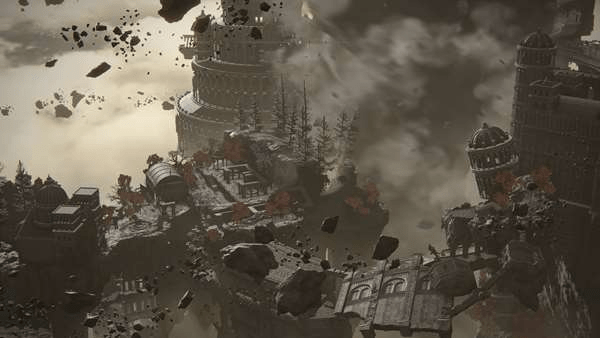
You see, with some allowance for Borges’ use of “irregular”, the vista I see here looks something like this:
Top Image: Crumbling Farum Azula from Elden Ring
Bottom Image: Crumbling Farum Azula, entrance to Placidusax’s Arena
II.
Inspiration, perhaps; hammers and nails, I know; but there is a lot tying the two together. Perhaps its best to start with the physical structure of the city. Though Borges qualifies the “labyrinthine” nature of the City, and though Farum Azula is an imperfect facsimile of the sheer idiocy of the Immortals’ monument, the difference perhaps ties them together more than it pushes them apart. Per Edward Teach (on the similarly labyrinthine Inception)
“When Ariadne draws her mazes for Cobb, he rejects the square mazes and is satisfied/stumped only by the circular classical labyrinth.
And anyway, mythological Ariadne didn’t construct the Minotaur’s labyrinth–Daedalus constructed it for her–she merely showed Theseus how to get out of it. But she didn’t need to: a classical labyrinth doesn’t have multiple dead ends; it is a single winding path that lead either in or out.
But Theseus, like the audience, upon being shoved inside wouldn’t have known the form of the labyrinth–dead ends or a single path? Sot to be able to find the Minotaur, he needed to know which way to go, and Daedalus told him: downwards is the only way forwards.”
It’s worth disclaiming/clarifying: Teach’s distinction (maze versus labyrinth) may be correct, but it is not commonly written about in popular culture, and I think most works are agnostic to the difference. The reason I bring it up is not to nitpick either Borges or Miyazaki but rather to point out that the distinction exists: branching, built to frustrate versus linear and built to obfuscate. To which end, it’s worth looking at the forms of the narratives that use these labyrinths. “The Immortal” is, contrary to the implications of its twists and turns, a linear piece of prose. Though your own eyes and thoughts may be deceived, you can read forward, and your questions will be answered–you’ll exit the labyrinth on the last page of the story. Elden Ring–a point of which a number of my readers would surely love to remind me–is a game, a medium much more on the maze side of the spectrum. There is no one way forward, a player might be stuck in any corner of the Lands Between forever, despite any amount of movement. Except in Farum Azula (among other locales), the form of the maze is subordinated to the immediate obstacle of the dungeon (From Software’s terminology–Farum Azula is a dungeon mechanically though not thematically). There are dead ends in the dungeon, yes, but rewards wait at each of them. Unlike Borges’ narrator, the Tarnished is incentivized to perfectly explore their City, and so their idealized task is no longer to simply make it out of the maze but to construct a path which touches every piece of it. One path–making it a labyrinth. This leaves us with a pleasingly Borgesian symmetry: “The Immortal”, a labyrinth which presents a maze in the form of its City of Immortals, is reflected sixty years later by Elden Ring, a maze whose own City is a labyrinth. Borges did love his mirrors, and with apologies to Mr. Smith, it appears they are real.
III.
This is to say nothing, of course, of the other aesthetic similarities which tie these images together. The crumbling, ancient spirals of Farum Azula, a city in a temporal maelstrom, unreachable to all but the most desperate, built to be listlessly guarded but not really inhabited. And despite its grim aesthetic, there is no death awaiting those that linger there. For Placidusax, the temporal prison sees to that. For everyone else, Maliketh is keeping a tight hold on the Rune of Death.
And of course, Maliketh, Marika’s lupine vassal, is merely the greatest of the beastmen of Farum Azula, the raggedly-clad, gray-skinned troglodytes who (aside from Maliketh) do not speak and whose animate corpses fill the shallow, grave-sized niches that adorn the terraces of the City. I’ll admit there is no evidence they devour serpents–they seem, rather, to worship the dragons who remain there–and there are some other specificities missing, like the impure stream which grants immortality.
To which end, in Elden Ring, Farum Azula is only implicitly a “City of the Immortals”. To find an explicit City, we’ll need to look to a different From Software property:
IV.
I’ve written before about Sekiro’s Fountainhead Palace in reference to both Sekiro and Elden Ring’s use of the centipede as a symbol. Much of Sekiro’s symbolism and plot revolves around the idea of worldly immortality as given by the Divine Dragon. Among humans, there exists an “heir” to the Dragon’s blessing who is able to confer that blessing to others, which serves to explain the pseudo-eponymous protagonist’s continued resurrection in the face of the player’s ineptitude the impossible odds of his mission.
But in-world, this isn’t a secret, and it is well-known that the waters that flow from the Fountainhead Palace, where the Divine Dragon is known to reside, grant a sort of fucked-up immortality of their own. This is because those waters contain the eggs of a species of…spiritually volatile centipede–a morphological reflection of the serpentine dragon–that parasitizes anyone drinking the water. Thus, by devouring a pseudo-serpent, the ashen-skinned monks of the Senpou Temple, the peasants of Mibu Village, and the deformed aristocrats of the Fountainhead Palace all persist in perpetual witness of a City of Immortals upon a mountain, from which flows an impure stream that grants eternal, if cursed, life.
V.
Borges believed (or at least once claimed) that there were only four devices which comprised all fantastic literature: The work within the work, the contamination of reality by dream, the voyage in time, and the double. Amusingly or predictably, all four are relevant to this analysis, but the last is particularly important. I’ve already referenced it in this essay (see: mirrors), but it of course comes in many forms. Sekiro, like Elden Ring, like most works of fantasy, really, is the story of a warrior, and a necessary element of any plot pitting a warrior against undying foes is the method the warrior uses to subvert their immortality. For “The Immortal” (where the foe was the narrator’s own interminable experience) this means was a reflection, a mirror, the stream which was the antithesis of the polluted river. For Sekiro, this means is a sword, a cutting instrument. It should not be surprising that the two should have something in common.
It was, of course, Borges who wrote, in this same book:
“…copulation and mirrors are abominable, because they increase the number of men.”
Perhaps a blade does not increase the number of men, but just like a mirror, a scissor, or Truth, it increases the number of things. From one, it makes two. That a blade should reflect darkly the infested immortality of the Fountainhead, in reflection of Borges’ reflection; that the pieces of Borges’ immortal City should be separated and made two cities in two worlds, each with the specificities necessary to lead back to the dream which bled into them–well, it’s only appropriate, isn’t it?
A story told by fallen leaves in the style of a young Nietzsche
***
Note: To be clearer to those less familiar with the context, this is a discussion of various literary themes (or just personal points of interest) in Elden Ring. It’s meaty for a series of essay-fragments, but disconnected and certainly not a complete treatment of any of these topics, much less the game as a whole. The style might be something I return to–temporally, though, I had just been reading a collection of Nietzsche’s earlier aphoristic work (alongside, as I mention, Borges), and it seemed a decent way to expound upon the contents of my brain at the time.
Cross the fog to the Lands Between. In the tradition of Bloodborne (and in contrast to Dark Souls) Elden Ring is rather forthcoming with the metaphysical nature of its action. The Lands Between are ruled by a goddess who has banished the very concept of death, power is conferred by “runes” (including the Elden Ring itself) and “grace”, individuals physically accomplish insane, abstract tasks like “holding the constellations in place” or “literally being two people” (including the fecundity implied by a less abstract multiplicity)–no need for the subtlety of a bird ride that transcends substrates of reality, but that’s okay. I mean it genuinely. It is often okay to say what one means, especially with the cat so far out of the bag.
Familiar Miyazaki-isms return: The fog from without the Lands Between again symbolizes the shifting becoming of materiality giving way to the divine being of grace (the Christian through-line) and runes (the Norse through-line, perhaps to be taken as Viking geometry, linking the metaphysical language to the old Platonic stand-in).
Perhaps it’s the Borges I have on my brain at the moment, but it’s all rather evocative of a labyrinth. Lands of resolved solidity delineating (forming pathways amidst) the fog (or vice-versa–the negative of a labyrinth is also a labyrinth)–I sure don’t have any idea what it was meant to house (or I lack the energy to enunciate it–you guess which), but labyrinths are awesome and, definitionally, provide both a goal and at least one path to tread in one’s delving.
***
Long lost grace. Grace, the guidance of gold, a network of glittering signposts and rest stops left by the Greater Will (the Outer God from which the Golden Order and the Two Fingers arise; and against whom both Marika and Ranni rebel), a golden glow in the eyes of the blessed–beyond its utility as supportive game mechanics, it sounds kind of like “purpose” and even more like “commandment”.
For the player character it’s a rough constant, but it’s worth considering the others for whom it comes and goes. Back before the Shattering, Godfrey, First Elden Lord, was divested of grace and “hounded from the Lands Between”, as far as I can tell not for any indiscretion, but because he fulfilled his commandment. He was done conquering the Lands Between in the name of Marika and the Erdtree, so as is only just, she banished her champion and the father of (some of) her children and remarried…herself. Divinity certainly is a strange thing. No one would appreciate me extrapolating this logic to IRL religion, but it’s worth ruminating on this characterization of “divine love” and the rules it plays by.
Anyway, when Godfrey is banished, loses the guidance of gold, he becomes Tarnished. Because From Software spends approximately a bazillion dollars (or at least hours) on English translation, we should be careful with their words–and we should be very suspicious when it looks like they aren’t. To which end, pure gold doesn’t tarnish–silver/other stuff does. The implication, then, of calling the Erdtree’s discarded guardians “Tarnished” is subtle but important: The golden grace which they formerly held was not a transmutation of the soul but an alloying. They, at base, are not gold but silver.
Sound familiar?
“I said; ‘but all the same hear the rest of the story. While all of you in the city are brothers, we will say in our tale, yet the gods, in fashioning those of you who are fitted to hold rule, mingled gold in their generation, for which reason they are the most precious–but in the [guardians, Samzdat’s words] silver, and iron and brass in the farmers and other craftsmen.’”
-Plato, Republic
TL;DR/#AllGreek2U, the rulers are gold, the soldiers are silver, everyone else is economically replaceable, and in the Lands Between, we sometimes stuff warriors into cabinets (or jars) until (or, more realistically: so that) they get corroded and gross. It’s worth considering as well that (Plato’s) Socrates presented the city based on the noble lie not as an ideal city (as he might have claimed for plausible deniability) but as a hellscape, a festering city, an absurd monument to the tendency of human complexities toward strife.
You can blame the genre or the philosophy, but either way the result is what you’d expect: Strife arrives, the gold-souled rulers are proven untrustworthy (or at least unworthy), so the conduits of grace on the ground begin unearthing their guardians. In other words, they not only followed Adeimantus’ bad example–they followed his bad example badly.
This is to say nothing of Miquella, child of Marika alone, who championed “unalloyed gold” as a countermeasure to the influence of the Outer Gods. Because philosopher kings are clearly the solution.
***
Game of rings. “Sonic or Gandalf?” Depends on how fast you are.
An obviously relevant point of discussion is that the development of Elden Ring’s pre-Shattering mythos was a collaboration between Miyazaki and the much vaunted (though perhaps tarnished in his own right) George R.R. Martin. Less obvious is exactly why this is relevant. We do know that the collaboration was not longitudinal: Martin’s involvement was at the beginning, in creating a “D&D sourcebook” for a setting that Miyazaki would then twist. What’s not clear is where the line is drawn–the degradation of the Lands Between was not by a single event, be it the Shattering (the war), the shattering (of the Elden Ring by Radagon), the Night of the Black Knives (which likely catalyzed both), or the banishment of Godfrey (which exposed–or even created–the cracks in the order that led to all the rest). Miyazaki has commented that some of the characters ended up unrecognizable from Martin’s original submission, but that raises more questions than it answers (like the degree to which that difference is editing versus the in-story corruption of the Shattering). All I can say now is that I would give not-zero appendages to see Martin’s original document.
In the same vein, I’ve long wondered about the particulars of Miyazaki’s collaborative strategy. The structure of this arrangement is particularly clear (in spite of the aforementioned ambiguities), in the sense that such arrangements must exist in most, if not all, collaborative works of long-form literature, and we, as onlookers, rarely get this degree of insight. Meanwhile, during the development of Elden Ring, Miyazaki was also directing Sekiro, on which he has stated he took a backseat on most of the object-level writing. Yet: Sekiro remains a beautifully-written work with the same hallmarks of style and attention to detail. I realize this observation is nothing especially profound, but I’m still curious about the nuts and bolts: Is Miyazaki himself especially good at directing his own style? Are From Software’s processes particularly conducive to that style? Do they simply maintain a staff of talented and faithful imitators? I have no idea, but I would love to understand how I could scale my own work in the same way.
***
Yass, King, I seen’t it! There’s something cowardly to me about getting too low-level in one’s critique/analysis, but there’s one piece of Elden Ring for which I’ll flirt with the lower bound of my standards.
Miyazaki has said before that his favorite boss in Demon’s Souls is the Old Monk, the proprietor of a tower in a swamp who was driven mad by a relic he acquired: a long, flowing, vibrant yellow robe. His reasons for liking this boss are likely multiple. There’s a lot to like, from the super creepy aesthetic (it’s instilled in me a lasting affinity for piles of discarded chairs), to the fact that the fight is not against the monk himself but an invading enemy player “possessed” by the robe (a mechanic which reprised its role in Dark Souls 3), to, of course, the literary reference. Hidetaka Miyazaki, too, has seen the Yellow Sign.
That The King in Yellow is so close to Miyazaki’s heart (or at least his portfolio) makes his use of the color yellow in Elden Ring nearly unignorable. To be fair, even not taking that into consideration, the precision (and deliberate obfuscation) of it is diabolical–or did we think that the representation of no fewer than four distinct (and bitterly-opposed) factions by nearly-identical yellow particle effects was merely sloppy art direction?
For accounting: The Golden Order, the “good guys” in the quest for a restored balance via the Elden Ring are, insofar as they are in any way a united front, represented by projections of pale yellow light and a predictably golden aura. Those Who Live in Death, worshippers of Godwyn the Golden (the first demigod to die) who would see the rune of death reintegrated with the Elden Ring, are characterized by a golden aura intermingled with black smoke, as if to connote some corruption of Godwyn’s original purpose. Similarly, the Omen, the curse of horns and filth that cuts its victims off from the Greater Will (see Margit/Morgott, Mohg, and the Dung Eater) is the same gold, interspersed with brown. And of course, the Frenzied Flame, ender of life and bringer of madness, is also yellow, this time more saffron–though it is scarcely distinguishable from the Golden Order’s particle effect when it is in an NPC’s eyes.
Far be it from me to offhandedly summarize the “point” of The King in Yellow without citation, but I think a respectable try looks like:
“A sort of madness, transient or not, of devotion to something larger than ourselves, even–especially–at the expense of the reality we would otherwise affirm, is endemic to the human condition.”
Shabriri and the Frenzied Flame thus stand at one end of the spectrum, wearing the same color but demonstrating, perhaps, just how deep the yellow/gold rabbit hole goes, while the remaining Erdtree derivatives reticently acknowledge that all that glitters, well, maybe it has something in common.
Less artistically but 100% also the point: The narcissism of small differences is often much more bitter than any rivalry with an alien Other.
***
We’ve made some improvements to the chapel since 2015. Furthering the “thematic connection to Bloodborne angle”, the two games’ use of runic alphabets is worth interrogating, and Elden Ring in particular gives a useful starting point for the aspiring Lorax linguist: the tree. The Lands Between admittedly incorporate several linguistic traditions (Latinate, e.g. Raya Lucaria, Dectus; descriptive English, e.g. Volcano Manor, Redmane Castle; and of course Germanic, e.g. Leyndell, Fortissax, Placidusax), but since most of them are allocated to the names of specific people and places (which is about how you would expect culture to work), the question of the Erdtree (a more fundamental concept) stands out. It’s definitely a tree, that part makes sense, but per the name, it’s also an “Erd”, so what’s that?
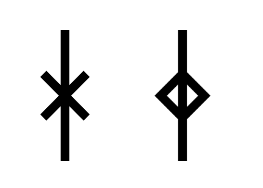
My own leap of logic lands me on “œd”, short for œdal, the Elder Futhark rune for “heritage” or “estate”, a fitting symbol for the Golden Lineage (used also by the Nazis, a connection which I will not explore here). It also seems to be the nominative basis for Bloodborne’s Great One, Oedon (not to mention the Norse god Odin). Except, one problem–the œdal rune looks like this:
And the Oedon rune looks like this:
Actually, no, not a problem, just a connection. You see, the seal of Queen Marika is this:
…which bears reference to Odin’s infamous vigil, hanging from a tree, and closely resembles the Anglo-Saxon rune “ear”, meaning “earth”:
…implying a “heritage of the earth” (Biblically, “inheriting the earth”) or the less grand “earthly heritage”, or both. There are fruitful implications to either.
Note: While I did mention before that these explorations are largely incomplete, it’s worth mentioning the trail of breadcrumbs leading to the “elgaz” rune as well:
The literal meaning of this rune is “elk”, which is a less useful similarity to Marika and the Erdtree, but given its visual similarity to “ear”, it might indicate some connection to the moose/elk-themed Ancestors present in various locations throughout Elden Ring, whose culture is believed to predate the Erdtree.
If we’re going to grill the Erdtree, we ought to do the same with its disfavored progeny. Thankfully, the Haligtree is easy–”Halig” fairly clearly derives from the Anglo-Saxon “hægl” rune
(or “haglaz” in Elder Futhark–aside, I am continuing to reference Elder Futhark mainly because Wikipedia’s entry for it is way better, but evidence points to the Anglo-Saxon runic alphabet being the most appropriate reference for Elden Ring’s runes), meaning “hail” or “precipitation”. Aesthetically, hail is appropriate–the Haligtree is located in the snow-covered northern mountains–but at a deeper level, the significance of the Haligtree is much better understood as precipitation, that which falls from the storm or, less meteorologically, from the heritage of the Erdtree. Miquella is an Empyrean, one of the three potential successors to Marika (Miquella, Malenia, and Ranni, for reference), and he intended the Haligtree to be a new symbol of a new order in the Lands Between. That it should be named for precipitation–or consequence–is entirely reasonable.
Lastly, just as we are shown the modified “ear” as the symbol of Marika, we are shown another rune as the seal of Radagon:
This is a superimposition of the epigraphical and manuscript variants of the Anglo-Saxon rune “gēr”:
“Gēr” signifies “year” or “harvest”, connoted as “year/season of plenty”, which in Radagon’s case might be taken ironically. In his role as champion of the Golden Order, he was “harvested” from his place at Raya Lucaria, ultimately leaving Liurnia in disarray (if not outright ruin), and the metaphor only gets darker in the sense of “harvest” as it applies to fertility.
Radagon and Marika had two children, Miquella and Malenia, both of whom wound up cursed, presumably by the particular degradation of the divine gene pool that occurs when one’s parents are not merely related but are, in fact, the same person. And if the problem of the harvest is a problem of one’s descendants, of succession, then it’s worth noting that the Shattering was literally a war of succession, preceded, of course, by the literal shattering of the Elden Ring–by Radagon.
***
A golden parasite for the golden lineage. Also returning in the Lands Between is one of Sekiro’s most potent symbols: the centipede. The one-armed wolf had a pretty good time with this one–literally, it is a creature that infests the corpses of the divine carp that swim in the Dragon-blessed waters of the Fountainhead Palace. It lines the corpses with its eggs, and as the flesh breaks down, the eggs bleed into the overall water supply, into the runoff that flows to Ashina. Then, when the mortals below drink the water, they find themselves “blessed” with an unpleasant and hollow brand of immortality.
The immortality, of course, is the result of the giant centipedes whose eggs they swallowed, now growing through and infesting their still-living body, though the “why” is definitely where the literality starts to blur. Is it because they are parasites to the divine? Is it coincident, in that the centipedes are themselves divine (which would allow them to devour the carp in the first place)? Sekiro isn’t especially clear on the biomechanics, but it all but bludgeons you with the notion that the immortality granted by the waters of the Fountainhead is only a crude imitation of that granted by the Dragon’s Heritage. A note, obvious within the Ashina province but worth clarifying for the Europhilic audience of Souls/Elden Ring: This is an Asian dragon we’re talking about here, no wings, serpentine, aquatic, celestial (a combination of adjectives worth dragging back to Bloodborne, by-the-by).
It should not be surprising that all of the supernatural creatures present in Sekiro (the carp, the centipedes, the giant snakes of the valley) all bear some morphological resemblance to the Dragon, to the divinity they emulate, but the implied ladder there also calls to mind a fable of a Buddhist monk and a centipede, where the centipede is expounded upon as a lesser creature which may yet regain its honor through rebirth.
Do you see it? Where the paradigm switches around? In traditional Buddhist teaching, the centipede is on the same continuum as man–in Sekiro, the ladder to divinity is snakeybois top-to-bottom, and that divinity (be it the literal gestation of centipedes in your gut or the more metaphorical “feeding” of the Heritage via Dragonrot) is a parasite to mankind. Yeah, religion. Someone call Bong Joon-ho and see if he can work that into the sequel or something.
Right, this is about Elden Ring, but all that is necessary context. So when Elden Ring’s Rune of Death is the Mark of the Centipede and golden centipedes begin to appear in places frequented by Those Who Live in Death, that is the lens we need to use to understand what it all ought to imply.
From the basics, the centipede, originally, is death, a threshold upon which the things that are become the things that were and then fade into the everything from which they were born. It is fitting that the true Cursemark of Death, broken into half-wheels during the Night of the Black Knives, is not one, but two centipedes in a circle. An ouroboros. Fitting for a conception of death meant to coexist with the rest of the Golden Order, but Marika dIdN’t LiKe ThAt PaRt. She cut it out of the Elden Ring, gave it to Maliketh, and what she got was a different death–not integrated cohesively with her Order but jammed askew into its cogs, birthing Those Who Live in Death. For all points and purposes, they’re undead, much the same as the Senpou monks who drank of the Fountainhead in Sekiro, but that is a slim overlap with Sekiro’s otherwise extremely well-developed mythology for the symbol.
With the exception of Rykard, Elden Ring’s pantheon is nowhere near so serpentine as Sekiro’s, but consider the position of the centipede in particular. Our myriapodal friend may be at the bottom of the spiritual totem pole (a turn of phrase made literal in Elden Ring: Godwyn, an unwilling recipient of the Half-Wheel Mark of the Centipede rests amidst the roots of the Erdtree), but the bottom of that hierarchy has more in common with the top than wherever mortal man hangs out (ie, not in the hierarchy at all). The theme of parasitism is not as eminent as in Sekiro, but the game is clear that adherents to the Golden Order are not stoked about the centipede stuff at all, reiterating that even the most reverent dogmatists tend to find some expression of the divine they would rather revile. And, of course, the parasite’s absence leaves an echo: Follow the Erdtree’s totem pole up to the very top to find the Greater Will, overwhelmingly interested in keeping the course of history in the Lands Between confined to its Golden parameters. For a being so immense, so abstract and multifarious, it is difficult to even formulate the question, but in the end, what can mankind be to such a creature? The answer: a pet, a pest–or a host.