Tag: fantasy
Protected: The Crossroads, Chapter 1: Orphelia
The Age of Heroes and Horrors
Another expositional story by Leland. Edited by me.
All us left the city after the bureaucrats fell. There was nothing there no more.
However much the food was a problem an’ those bureaucrats shit at solving it. When nobody was there. It got a lot worse. Can’t feed no thousands people with no planning. Chaos in the street what it was.
Only law was they ol’ blood knights. But they turn real nasty. Blood knight want your house, want your food, they don’t give a rat whisper ‘bout you. They kill you like they kill your mama. They ain’t got no more blood god, like a preacher an’ no church. They just nothin’. Big ole freaky piles o’ nothin’ with unbreakable skin an’ a sense o’ entitlement.
We had to find food. Find land for growing food. Become farmers. A whole world become farmers. Everyone hungry then, thousands people. All roaming the countryside stealing everything. All dangerous people, smart people, social people. But that didn’t matter nothin’. Don’t matter if you talk good, lie good. That don’t make no food grow from the ground.
Everyone learned how to become farmers real quick though. You figure out how to tear up the earth, plant seeds, never let no fruit get thrown away like the old time. No way. No garbage dumps. You use everything. Your poop, mama poop, the donkey poop. It was a dirty, simple kinda life.
Tiny little villages start poppin’ up. With stupid names. Things like “River Crossing” because there a river with a dirt path that cross it. Mostly trade posts where people sit for half day chattin’. Not a lot o’ chit chat on the old farm you see. Mostly the traderfolk knew what was what a little bit around an’ people wanna hear news. Most the news was gossip.
Some the farmers though, they didn’t like this new life. Used to be someone. Used to be someone important. Had a nice life in the world city. Didn’t need t’ work hard on the farm. Some these people had some real nasty magic too. Power didn’t go nowhere an’ at the beginning ain’t nobody have nothing to steal. But after first five years or so, they ol’ blood knights start popping like wasps durin’ the summer time. Nasty little gangs o’ em, three, four, five. Come to a farm, demand food, maybe murder someone, maybe rape ‘em. Horrible little creatures they was.
Villages start posting bounties on some these nasty types. They didn’t like no gangs o’ bullies an’ robber man coming in, messing up the place. Some those used-to-be-someone people start doing the bounty trade. Hunt down these washed up, second rate demons roam round.
Trade grow an’ grow ‘tween villages like River Crossing an’ Forest Lake. More bounties an’ bullies walk round. A certain kind of peace come durin’ these times. Not so safe on dirt roads in the middle. But in a trade post you were safe enough. Then the Monsters start really poppin’ up. Things just had enough magic no one could deal with ‘em at all. Creatures like them mages o’ the back before. Nothing powerful as the blood god, but powerful enough. They know not t’ always fight everyone. Some of them was even likable for awhile. Some of them talked real nice. But they always want weird things, strange things, twisted things.
They live on a mountain top and want virgin boys every month like some sort of moon ritual. If you don’t pay up they burn a field with hellfire. It weren’t good to live near a Monster. But it weren’t’ all bad neither. The crops grow better near, they give you these little gifts, cure the sick children sometimes. Some people worshipped ‘em.
Was all a matter of chance. Whether that old mage lived just out of town would help you or
turn on you. Never know who that stranger walked in was. They gonna cure the pox? Or they takin’ a child at midnight?
It weren’t a safe way to live. But better than starvin’.
Words From a Severed Head
Shall Harmony reign, yet in his wake
Lie severed heads whose fortunes bore
Craven lies and notes of strife
But also those whose scales returned to balance with their vengeful roar
For each great circle ‘scribed thereof in single voice the headless spake:
***
There was once a man who wished to hide from the truth. He gathered his flock and said unto them: “See how we cower in servitude before death and shadow. Do you not wish to escape this tyranny?” They did, the flock replied, but they could see no path, no way by which they might escape. So the man gathered the clouds from the sky and wrapped them about his people, that when the agents of death came to find them, they encountered only mist and lies. The man then swept his flock and his clouds both to a peak rising high above the land, and from there, they ascended to the heavens.
***
There was once a man who realized the world was a lie. He saw what the Man of the Clouds had wrought. He saw that what was real had been split in twain. Others beheld the city in the clouds and declared it fantasy, an escape from reality. But this man questioned: Was the world they had escaped any more real? Was it so in any way that mattered? He thought to the lies the world had told him, that when men and women ceased to be they ascended to Heaven or rested beneath the earth, in the domain of the Dead Queen they had left behind, but he had ascended and, in so doing, made true that great lie. But though he could have rested in his Heaven, he could not avert his gaze from the tiny fracture now etched in halcyon Truth. Through it he beheld a churning darkness, a Deep of ill portent which he knew would one day come crashing through. Yet he did not recoil. He did not wail in terror or seek to forget what he had seen, for in that Deep he saw salvation, a beautiful and terrible reunion of reality’s glassy shards. So he smiled upon it and mad his preparations, for to perform his miracle of one only thing, to link once again the Heavens to the Deep, he knew he must descend and evoke his argument below the anesthetic comfort of the clouds.
***
There was once a man who sought to complete the circle. He knew well from the river beneath his feet. For it to flow, the reservoirs in the lands above must be emptied, struck, their discordant greed resolved. He knew that memory, like water, lacked persistence. With time its form would denature. It would evaporate, would become mists and clouds and false shapes therein, once again to fall upon the stagnant reservoir. He knew that were he to maintain the circle, ensure that the lake of discord always emptied in Harmony, his memory could not falter. The circle could not fall victim to time. He could not fall victim to time, so he separated himself from it, became a terrible grudge which remembered in cinder instead of dewdrops, that discord the world over might be met by righteous Vengeance and inevitable Harmony.
***
From these three came two and two
And circles stretched from sea to sky
To the Gyre did Seven headlong run
Then all the world
That’s why, that’s why
Old Times and Old Gods
A story by Leland. Not unlike this, but less saccharine and more anthrocentric.
When the ancient gods roamed the world we humans were harvested.
Every bear with teeth and fur and claws could rip us apart and eat our soft meaty insides. The creatures of the wild were so big back then. Monstrous. All with terrible magics far greater than our soft skin.
But the thing that truly hunted us was the Wendigo. It roamed in the forests at night, riding the winds, riding the cold. It cultivated us as a crop. The weakest were culled every season by that creature that sang in the dark. We humans fought within ourselves to avoid weakness, undermining our neighbors to save our children from the horrible screams. We humans developed emotions and manipulations to survive this thousand year torture.
Then came the Bird, the Turtle, the Fox and humans received protection. A sweet gift of safety beneath the mountains of fur and feather they offered. Sitting atop the shell of the island Turtle we humans were not hunted for flesh, but these gods still had hunger.
The gargantuan animals with their beautiful magics hungered for something else that the humans had: sweetness and sadness. Our strange emotions that ruled our universe and had been developed by seeing our neighbors and children die while wishing for their survival. These emotions became the sweet desserts that the old gods ate.
Rituals upon rituals upon rituals were made for the old gods. Their massive eyes would watch them with an odd, thirsty calm as they drank our emotions in. Humans in groups learned different god’s preferences and built their society around satisfying a terrifying yet loving benefactor.
The beautiful red Fox loved weddings and desire. It would curl around a group of young humans that were bonding themselves to each other. The fox required that this group never touch fully before they made their promise in its ear. Then that night they would lie in the mountains of soft, deep, velvety fur and make love for the first time on the old gods back. The fox would rumble and purr underneath the human moans.
The Turtle was obsessed with mourning and the death of those long dead. It required it’s humans who lived on its island-like shell to record the names and loving acts of each person in each lineage from the very beginning of time. Parents would recite stories to their children about their grandparents and great grandparents and their great grandparents before them. Deep, powerful, emotional stories of pain, and they would all cry at the end, banging on the ground, the Turtle’s shell, as hard as they could. Every week the humans would light a fire for each loved one who had ever died and try to keep the fire going, heating the tortoise, while they sobbed.
The Lark was fascinated by change in the bodies and in the minds of the humans. Parenting and adulthood were curious for the bird, for old gods never raised their children. The bird demanded clothes on its humans, feathers that covered the humans up and made them see shame in each other. Different colors for different ages, different colors for different genders, different colors for those who made mistakes. The change between colors was a massive affair, humans would get naked under the eyes of the bird and wait for a day and a night in the cold and the rain while the bird hunted down the fluff and trinkets that would cover them again. The bird required children to leave their parents upon the age of thirteen. Too young to feel safe, but old enough to survive their silent pain. The bird would stare into their eyes and then pick them up flying them to another nest of humans hours and hours away.
The Wendigo never left. It’s horrible whistling and ice cold breath still rang through the woods at night. It never crossed the ancient gods, never stole from their herd. But it knew the sadness of being one of the enslaved. It offered freedom for humanity a chance to not need do anything but live in its forest. Some humans chose freedom and had their guts turned into ice. Some humans chose freedom and ate their children with the distended mouth of the Wendigo. Some humans chose freedom and moaned in the night, crying and sobbing and chewing the ice cold of their own hands and feet.
In that way, humanity never lost its emotions and the gods never grew tired of us.
Prologue: The Merchant
The true prologue to the Crossroads story I begin writing a long time ago and then took offline. The plot and characters of that novella are much more fleshed out now, though it remains to be seen how much of it will end up on here.
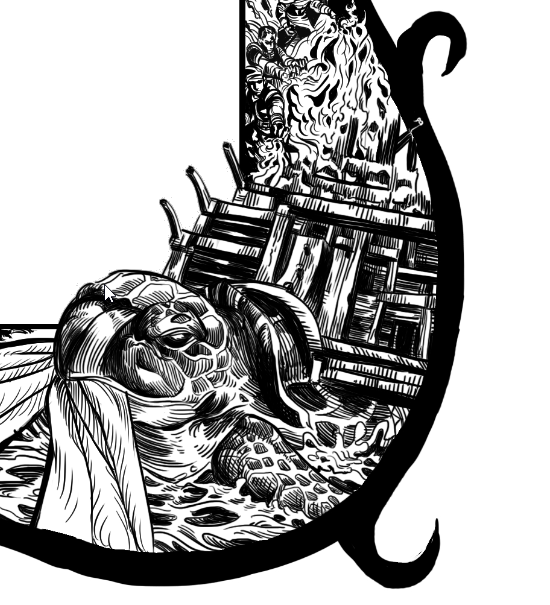
Thago is burning. The river is burning. The Floating God is burning. It began with unrest, an uprising among the slaves of the lower barges, made perilous by an attack by the servants of the Two-Eared Crown. Coincidence, surely. So the magisters and princes must have thought. Coincidence, perhaps, they would take to their grave. But the Merchant knows this was not coincidence. It was fire, built and kindled and sparked by singed, practiced hands, spread by design and the carelessness of those who saw coincidence in such things. And now Thago is burning.
With this certainty, the Merchant finds himself in the plaza before the palace which was once a temple. The northern and eastern launches have been blockaded; the bridge to the trade barges is ablaze, and the flames now lick the palace’s western walls. The southern dock below swarms with the enemy, and above, the Riversworn guard their trapped princes, awaiting reinforcement that will not arrive in time, hopefully and foolishly unaware that their only path out is through the force massing beneath them. The Merchant draws his sword and locks his shield to his arm. His task is impossible but clear: He must somehow give them enough time.
Five race up the steps now. They are scouts meant to reconnoiter, but they charge anyway, seeing only the Merchant in their path. Their spears stall upon his shield, and he dispatches them quickly. One tumbles down the steps, two die to his blade, two are pushed from the plaza to the churned water fifty feet below. One will drown, the Merchant knows. The other will be rescued by his countrymen. But there is little time to dwell on either fate, for a much larger host of soldiers has begun its determined ascent.
Many fall before him–seven more are hurled into the water, fifteen bleed out there on the plaza, nine thrown down the steps collide with eleven climbing, and two more collapse, skulls fractured by the spur of the Merchant’s shield–but the number on the plaza with him continues to grow. He is driven back to the palace entryway, certainty resolving that his vain gift is reaching its limits. Then the soldiers fall back. They open a wide circle as a silhouette crests the stairway behind them.
The Merchant recognizes this one, recognizes the tattered regalia, the scar over his broken nose, the long knife set ablaze by magical gifts twirling in his hand. This is Brother’s general, the one called Ignigoet, Pyrotechnic of the Left Hand. It is betrayal then. The Merchant suppresses a roar and hurls himself at the smirking man.
Their engagement is swift and brutal. Ignigoet parries the first thrust, catching the Merchant’s shield with his offhand. They separate. Ignigoet throws a barrage of knives into the Merchant’s shield. Then the flames upon them detonate, and the Merchant is scorched and sprawling, and time has run out.
He dimly notices the knife cut his throat as he stares up at the plumes of smoke in the night sky. The general kneels over him, but the smirk is gone. His face is impassive, and the burning eyes therein do not belong to Selenus Ignigoet. The Merchant realizes too late that this is no betrayal at all.
And then he is gone.
Top Image: From Stories, by Rae Johnson
Purchase a Little Piece of Suffering Today!
Coming from here…
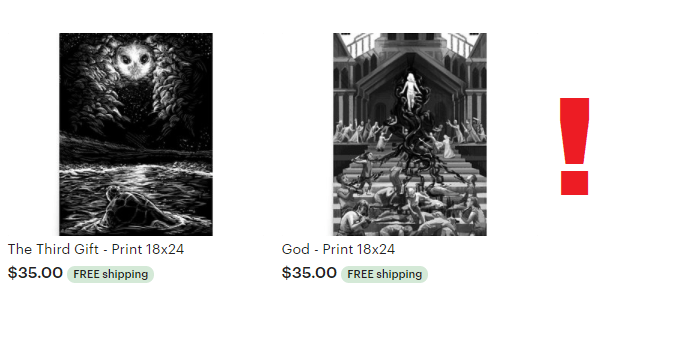
This is so much later than “this week”, but testing shipping took a hot minute. While work is ongoing on literally everything, we’ve set up a shop! Offerings are limited right now, though we’re working to set up more soon. But still, if you’d like to buy a print and support our work, we’d be very grateful.
Infrastructure
Sorry for the relative radio silence. Work has been ongoing, albeit slowly. I have a relatively exciting update coming this week, but I wanted to drop a small preview today (while I’m thoroughly engaged):
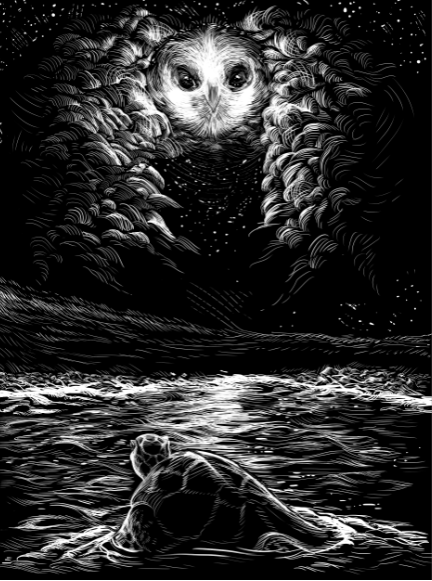
Image: The Third Gift, by Rae Johnson
Humanity’s Eyes, Part 4
Continued from here. This will be the final part–I will post a unified version (like I did for the LaSein Account) soon.
I lived in the wet
For a long time
This odd striving place
Where things kept growing
I learned the humans were burning down the last bits of the forest
Hacking off the trunks and limbs of the trees
Killing the furry people who hid behind them
They were very harsh these humans
It was no matter to me
I did not depend upon the trees
I buried myself in the sand and the dirt
The drying of the forest felt good on my thick and chitinous skin
I could smell the humans, the fuzzy creatures, or my marked
From far away. I remained out of sight
Anytime I wanted I could kill a human or two
When they were particularly lingering or loud
The humans cut down the entire the forest some years in
All of the creatures that lived in the trees were dead
My marked humans began to leave
Walking up the mountain, where their scent eventually disappeared
They left me
In this moist and dirty place
And I started to reflect
Upon my life
The old man
And the little girl with the emerald eye
Maybe I had wanted too much from her
From all of them
Though, I don’t know if I had ever wanted anything
Survival maybe
Gifts maybe
To be seen, to be near
I saw in myself for the first time a sort of softness
Beneath my now granite-like hide
I understood I really did like loving them
My former little group of marked humans
The girl
And love was what it was.
I started to take care of little creatures I found
Letting them live in my hide
Providing them little goodies, food bits, bugs I found
I enjoyed these little creatures scurrying all over my body
Then the mountain came crumpling inward
Like a strange earthquake
A horrifying sight
Dust billowing everywhere
Moaning and twisting of rock
The tops of the peaks came below the clouds
And beneath the clouds they shined like gold
I smelled smells I had never smelled before, along with metal and fresh growing plants.
There was much blood then
Those next days
I smelled much blood
And the tang, the sour taste of magic being cast
Me and my little creatures waited
Burrowing in the sands
Eating, avoiding
Living as we did.
Then I smelled my marked
The ones that had left me so long ago
Sand Lips. But not Sand Lips. A child maybe that had grown
And the unknown scent of something. Several things, living, but mysterious.
The humans now crowded the top of the mountain
And my marked were walking down
down into the desert
Deep into the heat, the land of no water,
the land of the dry, the beautifully dry
I walked towards them
These marked and the mysterious others
Me and my creatures were going back to the land of the hot
My true home
And I gave these new creatures little gifts
Just as the girl had done for me
I watched over them.
Not a part of them, but near them
A demon
A crag
A landmass
Sharing its home
Humanity’s Eyes, Part 3
Continued from here.
As the sun grew hotter the days grew longer
The earth became drier
Fewer and fewer plants grew up in the damned wastes that were my home
My odd little collection
Of marked up little humans
Was suffering
Their people, the older ones, but not too old
Would go further and further into the wastes
Hoping to find and bring back a large cactus
Or find a small pool of water
Or a beast whose blood they could drink
Some of them got hurt when one of those beasts found them instead
The next days I noticed they were packing
Gathering together their little makeshift homes of canvas and bone
Loading them on sleds
They were leaving me
This land of sand and sun
Leaving this waterless pit
As they left, they left behind a final bowl for me
A final farewell of types I supposed
My shovel-like fingers took up the offering and it crunched in my teeth
I felt alone
For the first time in a long time
I wished for their odd presence near me
I missed the giggling screams of their children
Missed the strange noises they made at night
Missed their footprints in the sand
So I followed them
Their stench was lingering long in the desert
Clear tracks.
I didn’t wish them to notice me following them
I don’t know why I cared
But I wished to remain a secret
My long legs and massive arms easily moved through the desert
I followed them many nights
Just past the point of sight, a day away, no more no less.
The ground became thicker
Moister
Dirt
The bugs were different and disgustingly plentiful
Every little nook and cranny of earth seemed to have a bug inside
It seemed grotesque
My little pack of marked humans came
To a partially burned forest
With a mountain in the middle that stretched into a thick layer of clouds
And a massive human settlement
that stank like a decaying corpse
Full of humans
Normal humans
The kind covered in crunchy metal and hateful looks
I stayed away from this human settlement
And found the first pool of water I had ever seen since I was a child
A small puddle and I saw my face
Spikes were ripping out of my carapace in hellish angles
My deep seated eyes were even darker yellow than I recalled
My snout was sharply pointed and looked almost like a beak
I was so caught by the look on my face
The look of my face
The look of me
I did not notice the human until they screamed
I turned towards them
They were a quarter my height
An eighth my width
Built like a tree where I was a mountain
They threw a spear at me
Like I was a dog to be killed
They pulled out a small sword and screamed in rage
Their spear hit my outer carapace
Jammed inside
Stuck like a twig
They ran at me with their sword
I lifted my thick shovel like hands
Their sword bit into my wide and hardened fingers
Their sword got stuck in me
They looked down in shock
Up in fear
My hands crumpled around them
Squishing this human’s meat
Pressing their limbs into their body
Picking them up
I held them in the air, immobile, helpless
Thinking of squishing the blood from their meat
But I instead I held them in front of my flat yellow eyes
They asked me what I was
I said I was the crag
They spoke strange
Bouncy and fluid
But a sound I oddly did not fully hate anymore
They asked me if I would kill them
I looked at their pulpy limbs
Soft squishy face, tears at the brim of their eyes
I said no
If
I looked at the human
Told him the name Sand Lips
Confusion covered their face
But also recognition
I told them to ensure Sand Lips was safe
Along with the little ones Sand Lips kept
I told them to ensure these marked were safe
Or I would smell their scent
And I would kill them as prey in the night.
I breathed deep into this human, learned his smell
I stared into their eyes and asked if they accepted the terms of my agreement
He said yes. The fear in his eyes was fresh, moist, and sweet.
I dropped him
He ran.
I smiled.
I had no more hate for humans.
They were small and afraid.
As they should be.
Part 4 here.
 Salt-Powered Investments, LLC