Apologies for the wait. This is by far the longest in the series so far, though it’s a bit of a departure in terms of style. That may hold out in editing, we’ll see. For now, I think it frames this particular character better than the streams of consciousness in previous entries.
Interlude 3
A damp haze looms in the sky. It is not so dark as smoke, not so ominous. It does not billow. It only seeps. For the men and women working the fields outside the fortress, this is little comfort. They have heard the stories, they know what approaches under that cloud, oozing like mud, skittering like vermin. Some know that they are about to die. Others have not grasped it yet, but all are afraid–should death come, it will be horrific.
An army has arrived at the fortress today. They are the personal force of Lord Martin, whose keep fell three days ago. Their numbers are thinned, some are wounded, and they have come here to the domain of Lord Thom to determine their fate. Will they run? Will they make their last stand here? The last of the Riverlands’ great powers stand together now, but though they still stand, they clearly tremble.
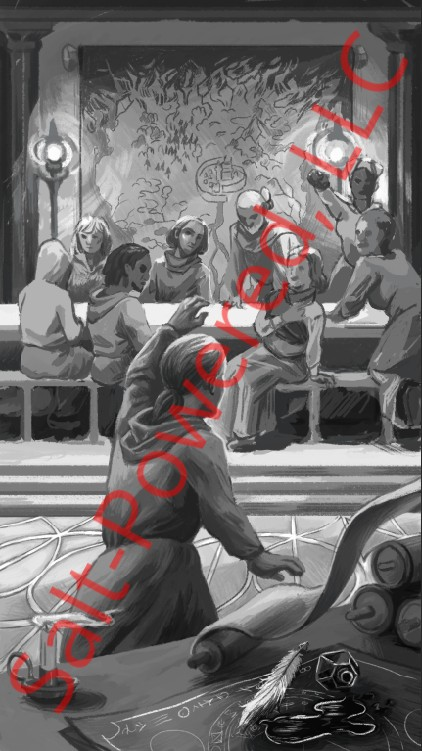
The two lords hold council with their officers in the courtyard. A crowd gathers. Perhaps before the peasants would have allowed the soldiers and their commanders to settle these matters, but this war is unlike anything they have seen. This is no longer a matter of to whom they pay their tribute. They face extinction, that the whole of the Riverlands be swallowed by the Bloodfish and the roaches. Perhaps it will be more than the Riverlands. Perhaps the whole world will face a tithe of bones and tongues and teeth.
“Welcome,” Thom says, somber. Martin nods.
“We appreciate your hospitality,” he replies, “but I don’t know that we have time for it.”
“You’ve seen them, then? What can you share?” Martin exhales, weary.
“All the stories are true,” he says. “They’re bones and mud, monsters, they’re faster than us, they’re inhumanly vicious, they’re immune to pain–in that they sense anything at all–and they outnumber us here five to one, with thousands more pouring out of Bloodhull every fucking day!” Thom’s eyes widen, but he holds his expression otherwise.
“Can you think of any–”
“Godhusk, Thom!” Martin interrupts. “We can’t fight them! I saw these things swallow half my men, and we couldn’t take a single one of them in return!”
“They are a distillation of mankind’s malice,” a voice from the crowd says, quiet but unmistakably clear. “They are pure in their purpose. Of course you cannot defeat them head-on.” The two lords turn, unsettled enough to temper their annoyance at the disruption. The speaker steps forward, a young man, dark skin, a white cloak, eyes dulled to fear but seething with determination. Strapped to his back is a wooden box, long enough, perhaps, to be a child’s coffin, but considerably flatter.
“But you are wrong, Lord Martin,” he continues. “They can certainly be defeated.”
“Who on earth…” Thom begins, shaking his head. “You speak as if you know these creatures, vagrant. Explain yourself.” The young man unshoulders his box, setting it gently on the ground beside him.
“I will answer obliquely, if you’ll permit,” he replies after a moment. “I have seen the roaches and the Sadist who leads them. I do not doubt that you have seen them too, but I suspect your vision is clouded, both of you.”
“For fucks sake,” Martin mutters. “I’m about done.”
“Do you respect Ka, Lord Martin?” the vagabond asks. Lord Martin snorts.
“The Mudfish? Of course I don’t. He’s scum and needs to be put down.”
“That is the problem, then,” the vagabond replies. “You must accept that you are losing, that by virtue of whatever hideous power he found, Ka has become superior to you.” Lord Martin pales.
“You speak out of turn.”
“The victorious general adjusts his strategy when he is losing,” the vagabond continues, pushing past Martin’s rage. “And it is my intent that you should be victorious. That we should be victorious.” The deference is only token, but it is enough. Lord Martin is scared–the entire fortress is scared, and this stranger is a glimmer of stupid hope.
“What do you propose, then?” Thom asks.
“We leave this place. Take everyone and everything we can. Head for the Bloodwood. It is likely out of range for the roaches the Sadist has with him now.”
“You want us to run away?”
“Oh, no,” the vagabond says. “Once we have evaded them, we will return their malice sevenfold. We will devour Ka’s outposts, spirit his people away, and when the fish is starved and desperate, we’ll bait him, trap him, gut him. He has spread a dissonance in this land. We will return harmony.”
The two lords stare, silent, unnerved by the stranger’s sudden fervor. Whispers begin to spread through the crowd around them. At last, it is Martin who relents.
“We will support this harmony,” he says. “Do you have a name?” The vagabond speaks, gaze burning through Martin, through the crowd, through the vicious reality closing in around them:
“My name is Matze Matsua.”
Part IV – Catherine
She stood at the gates of Greypass for a moment, troubled, too lost in thought to signal her arrival. This was a familiar ritual. She had repeated it annually for the two decades since she had been knighted, but every year the foreboding grew. Her predecessor hadn’t had this problem. He came to this place an emissary of something real, something to be feared. The Knights of Kol were impressive in themselves, of course, but back then, to defy one of them was to defy the Blood God, a gesture separated only by words from a beautiful and violent death. But Catherine came here in a time when that threat, while perhaps still real, was far less credible.
That was the first decade anyway. The ten years since the Blood God disappeared outright brought even more unease. Kol had fallen, and though Catherine was formidable enough to command authority at her outpost, that authority was her own, the tenuous, human variety. If they defied her–a costly choice, but eminently executable–there would be no god to descend upon the wretches of Greypass in vengeance.
And now, her thoughts returned to that reality, set ever more firmly by her futile pilgrimage to Kol’s ruins. Every year she traveled back to Free Magic’s former seat of power, to the city where she was raised, hoping desperately that someone would be there waiting. The Blood God; the Magni, returned from their exile; even citizens rebuilding, steadfast; but she was always disappointed. The ruins of Kol were just ruins, and the starving masses she’d heard fled its walls en masse seemed to consider their exodus permanent. And every year, she returned to Greypass and pondered her mortality at its gates, considering whether this year might finally be the year she abandoned her post, made a life for herself in the countryside, disavowed her knighthood forever.
At long last she sighed, defeated again. This would not be that year. She called the guard to open the gate.
***
“Lady Catherine,” Zacharus said, sipping from a goblet. “I was pleased to hear of your safe return.” The room–Zacharus’ audience hall–had acquired a number of expensive furnishings in the month Catherine had been away. She contemplated breaking one. Zacharus was far too comfortable in her presence. She settled instead for a cold stare.
“What has happened in my absence, Captain?”
Zacharus was not a captain anymore, not really, but the title was still the basis of their relationship. Soon after she had come to Greypass, he had climbed to the top of the ranks among the town guard, making him her primary contact for enforcing order upon the place. He was an abject coward, but it worked well for them: He did what she told him, kept the town fed and riot-free, and made a tidy profit skimming from their taxes, and as long as he kept to his role, Catherine had no objections. It seemed, though, that he had begun to deal in more than stolen cash. The opulence of the room where they now conversed hinted at influence beginning to be parlayed at a higher level. No doubt he had his own interpretation of the fall of Kol; perhaps he was beginning to fancy himself the true ruler of Greypass. He would have to die soon, Catherine mused. She wondered how many of his thugs would stay loyal, watching him bleed out through his eyes. The image brought a thin smile to her face, though she was not at all happy with the news he was at that moment relaying.
“The harvest was poor this year, as you predicted, my Lady. We’ve had to tighten our belts, alas…” Catherine suppressed a sneer. She doubted his belt had been tightened in years. “Alas,” he continued, “some have not taken so well to the ascetic spirit. Our men have had to work hard in making sure our just taxes have been paid. Four delinquents have been imprisoned so far.”
“Hmm,” Catherine merely grunted. She had little doubt Zacharus was well aware of her stance on the matter. She was actually fairly certain of every word yet to be spoken in this conversation. It would be a difficult one for the verminous little shit.
“My Lady?”
“I do not approve,” she remarked. “What of Amelia? Has she prepared my chambers?” Zacharus nodded and took another sip. Alarm had yet to set in.
“Ah yes,” he said. “Unfortunately, with the guard being so busy, we’ve needed extra hands at the barracks. I had her reassigned to aid in that capacity.” Catherine unstrapped her wristguard from her right arm as he spoke, revealing a crosshatched pattern of shallow scars running up to her elbow.
“I recall leaving explicit instructions regarding Amelia,” she said, approaching Zacharus’ makeshift throne. “You were to keep her far away from those degenerates you employ. That is what I remember.” She wanted him to hurt, she wanted him to bleed. She felt the hate dancing through her veins, vibrating beneath the scars in her arm, hardening, sharpening, slicing through her skin and dripping down, dying her knuckles a glistening crimson.
Her showmanship had not gone unnoticed. Zacharus had set down his goblet, clenched the arms of chair. He stared at the blood dripping from her fingers, blood that dripped but did not fall, that instead flowed into a mass of glass-like tendrils that slithered back up her arm, hungrily waiting for a victim. He had seen her work before, he knew what he was being threatened with.
It was unfortunate, Catherine thought. She had hoped he would have some of his lackeys in the room to witness his embarrassment, to remember–since he apparently did not–that she was not to be fucked with.
“My…Lady…” he said, leaning back as she grabbed his throat, her animate streams of blood wrapping around his face, sharpening as they very slowly dug in at his temples, his mouth, his eyes.
“You subverted me, Zacharus.” He whimpered, the beginning of a shallow scream, and she couldn’t help but grin, perversely satisfied with his insubordination and its lovely consequences. She wouldn’t kill him, no. In spite of his traitorous leanings, she knew him too well. He was predictable, and in that he was safe. But she would hurt him, scar him perhaps, let him cry out just a little more. She would have liked to, anyway.
“I am sorry to interrupt,” a dry voice echoed across the room. “But you must be Lady Catherine.” She turned to see a man in a dark green habit, middle aged, hair far greyer than the lines on his face might suggest.
“My name is Rom,” he said. He gestured to Zacharus. “The lord indicated you would arrive today.”
***
“I’m very glad you are back with us, my Lady,” Amelia said, handing Catherine a bowl of thin soup. Catherine leaned back, sipping the scalding broth as Amelia moved about the room, arranging and tidying. The girl was pretty, she observed, her twenties had been kind to her, to the point that Zacharus’ guards might have been giving her more trouble than they ought. She took another gulp. It was worrying, something she would have to monitor.
“I’m afraid I must apologize,” she said. “I anticipated that Zacharus would ignore my instructions for you.” Amelia looked up from her work and laughed, shaking her head.
“Oh, please don’t worry! I can handle myself around them.” Her voice was bright, sonorous. Catherine smiled in spite of herself. She was fond of the girl. Fonder, she admitted, than a simple preference in company, though she couldn’t say why. Perhaps it was simply that in all the years she had been here, Amelia was the only one who had shown any fondness for her. Because of Amelia, however minor, however limited to these evenings of casual conversation, Catherine had a place in Greypass. It was a scarce comfort, and she was grateful for it.
“That is good to hear,” she said. “Still, I am not pleased with him. I ordered him to free the ones he arrested over taxes.”
“The town is surely thankful, my Lady.” Catherine set her bowl down, troubled.
“It won’t be enough,” she added. Amelia’s pleasant smile faded. She crossed the room, placing a reassuring hand on her friend’s arm as she picked up the bowl. “Zacharus’ actions can be dealt with. I am concerned that he will not stop attempting them.” She glanced up at Amelia. “I don’t think I can leave again.”
“Please, my Lady,” Amelia said, giving Catherine’s arm a gentle squeeze before stepping away. “We will manage. Your work is important.” Catherine snorted. She had shared a number of her feelings and opinions with Amelia, but she had yet to confide her reasons for the annual return to Kol, her unwillingness to let the gone stay gone. She quelled the dismissive gesture. It was not fair to Amelia, and besides, her freedom was not the only thing on her mind.
“What do you make of the Khetite?” she asked. Amelia had begun pouring water for tea, but she paused.
“Is that what he is?” she asked, twisting to look back at Catherine. “I thought Khet fell years ago.”
“It did. But you saw his skin? Looks like a ghost, doesn’t he?” She reached out, accepting a teacup from Amelia. The girl nodded. “That’s magic,” Catherine continued. “The Magni Kolai believed it was passive imagery projected by excess shadow mana. The scrolls say it made the shadowmen resemble dreams or ghosts, even when they weren’t actively channeling.”
“So he is one of them?” Amelia asked. “A shadowman?” Catherine shrugged, sipping her tea. It burned her palate, but the pain seemed to help. It focused her. She shook her head.
“I don’t know,” she said. “Could be, but he’s definitely a mage. Smelled like…” She sniffed the air. “Murder. I think he will need to leave soon too.” Amelia stared, obviously upset.
“What does he want?” she asked.
“He wasn’t very forthcoming,” Catherine mused, eyes wandering to the ceiling. “Kept deflecting. I suppose that will be tomorrow’s business.”
***
That night, Amelia’s scream woke her. Catherine sat up as her friend slammed open her chamber door.
“My Lady!” she yelled. “Please, they think you–” There was a thump, and in the shadows Catherine heard the spatter of blood against stone, caught the pinpricks of violent joy dancing up from it, felt, with heart shattered and sunken, the crumple of Amelia’s body hitting the floor. She didn’t think. She couldn’t think. She could only howl, as every capillary in her body burst, sending spikes of blood through her skin. Barely willed, her body tore out of bed, through the door, into the hall, where a crossbow bolt caught her in the stomach, tearing through skin but little else as her blood, roiling, seething with mana, spat it back out.
It was dark, but she didn’t need her eyes. She could feel the heartbeats around her, three of them, more approaching. She could feel their adrenaline, their excitement, their murderous intent, and in that moment, images of their death, their bloody, vivid dismemberment, were everything she saw. She sprinted toward the one who shot her, batting a spear from the darkness out of her way. The man tried to block her swing with his crossbow, but she shattered the thing with a backhand swipe and grabbed him by the face, forcing channels of mana through his eye sockets and dragging blood and brain matter messily back out.
The spearmen pursued her. Before he could raise his weapon, she caught him with a haymaker that collapsed his chest cavity, impaling him on bloody spikes as the remaining guard fired on her with his own crossbow. Again, her magic stopped the bolt from going past her skin, and she sprinted back toward him, as he frantically tried to reload his weapon. He wouldn’t get to. His reinforcements were too far away, his hands too slow, and by the time anyone intervened, Catherine would have collected his spine.
But somehow, someone did intervene. Mere paces away from the men fumbling their bolts, Catherine felt a shooting pain through her calf, and, through the pain, a sudden immobilization. It took precious instants for it to sink in: She had been stabbed. No, that wasn’t possible, she thought, whirling, snapping the spear pinning her leg to the floor. She had listened. There were only three heartbeats.
Before her, suddenly clear to all of her senses, was another guard, reeling backward from his splintered weapon. Why didn’t she hear him? What was going on? She lunged for him, but was stopped by another spear, this time through her side, as another heartbeat suddenly became apparent. Her insides wretched. She opened her mouth to howl again, and blood poured from it. She was getting dizzy, but she drew even more mana, wrapping it around her newest assailant. The guard staggered backward, hands clapped to his throat, his whole body beginning to swell. She felt the blood welling in his face, at his extremities, but she kept it forced inside him. He would bleed soon.
At that moment, the man with the crossbow, finished finally with his task, fired again, hitting her face, shattering her jaw and her concentration. Their swollen comrade exploded, covering the corridor and its occupants in blood and bits of flesh. Catherine, fell to her knees as the two remaining guards scrambled away, whimpering.
Her world was getting hazy. Magic alone, now, was keeping enough blood circulating within her to keep her alive, but it was only doing so much. She heard more footsteps approach. She winced as the guards drove a spear through her heart, bound her hands and feet.
“She’s a blood knight–she’ll take forever to bleed out. Drag her to the dungeon.”
There was dragging, pain, oceans of nausea, bone scraping against damp, moldering rock, then darkness, as the guards trudged off. And then a voice cut through the haze.
“I think it unlikely you would have acquiesced to my designs,” Rom said. He was in her cell, leaning against the wall. She could not respond to him, she could not look at him. She could barely even hear him over the pain. “But I’ll offer you an explanation. Not as an olive branch, but perhaps to soothe a final disappointment: That you were murdered and never understood why.”
“They attacked you tonight,” he continued, “because they believed you had killed me, and Zacharus felt this would finally serve as justification to have you removed. They required no additional push in this respect, but acceptance of the Deep begins with acceptance of a single drop of alternative reality, and I mean to make these people understand it all.”
“Perhaps, though…” His laughter was soft. “Perhaps you will be the first of them. Certainly you understand now that reality can change fundamentally in mere moments. Things, people, they disappear, others, heartbeats, fade into existence like gathering mist.” Catherine’s eyes widened. “The water is cold, at first, you cannot breathe, but you are amidst so much more than you have ever known.”
As he spoke, his voice seemed to drift to the cell door–though Catherine heard no footsteps–becoming fainter with each syllable until it was muffled by the rotting wood between them, and all trace of Rom had vanished. She wanted to scream after him, in defiance of her injuries, of the blood, coagulated in metallic crust holding together what remained of her teeth, but she knew that even that effort would kill her.
She needed to hang on, to survive, because if she didn’t, she would never get the chance to make that bastard understand her reality, understand agony, the brutal death of self that she was now enduring. And it did test her. She felt the spear still embedded in her chest, splintering, rotting inside her, screaming like fire as she twitched. She felt her world ache as her strength drained, her organs failed, the blood she held fast in her veins, churning through her impaled, no longer beating heart, began to drip away from her.
It tested her, but she persisted.
It was a long time, impossibly long, perhaps days or weeks, before she heard footsteps against the dungeon stone, the musty creak of the cell door swinging open, a sigh of disgust from a voice she didn’t recognize. Then its owner grasped the shaft of the spear in her chest and pulled, and after all her endurance, then she screamed and writhed as one who was truly dying.
“Get up,” the voice snapped. She realized the spear had come free, that the pain was fading faster than it should, that she was not bleeding. With sudden command over her magic, she severed the bonds that held her hands and feet and reached to her face. Her teeth were there, her jaw uninjured. She looked to the figure in the doorway, head cocked to the side, face in shadow, holding the spear he’d taken from her body.
“What did you do?” she asked, grim suspicion replacing her trauma. The man sighed again. He slapped the flat of the spear against the wall. He didn’t seem angry, and the gesture, Catherine realized, didn’t seem to be directed at her–the man simply seemed bored.
“You want to kill them, right?” he said, not waiting for a reaction. “Let’s go.” He turned and headed into the hallway as Catherine’s memory slowly reignited.
Oh, yes. Zacharus. The guards. They attacked her, left her to die, impaled and disfigured in the dungeon. She resented it, would repay them in kind, but she was a knight. It was part of her trade. No, what burned now, what would make their deaths hellish was what they had done to Amelia. They killed the girl, her only friend, the one glimmer of good in this bleak, useless, pile of stone and flesh and avarice. She had not fought. She only screamed, and for her warning, they killed her. Scrabbling to her feet, she tore from the room, scars opening once again, blood writhing with wicked intent. The stranger, the man who’d freed her, was gone, no trace, no heartbeat, but Catherine remembered Rom’s lesson, and though she bristled, she understood reality better for it.
Quickly, she ascended to the main floor, clawing through five guards on her way, sprinting to the audience hall, bare, blood-drenched feet slapping on stone as she entered to find Zacharus with seven of his guards.
“Lady…Catherine,” he uttered, face pale, but she ignored him. He didn’t deserve any more words. She just grinned, wild-eyed, staring down the first of his guards, a young one, hefting his spear in a pitiful attempt at intimidation. She looked to the next as the young guard collapsed, crimson spikes jutting from his mouth and ears and eyes. The rest ran, Zacharus among them, but Catherine lashed out with her magic again, and his right leg twisted with enough force to break bone. He tripped and fell, scrambling to face her, pushing himself back as fast as he could, calling for his guards to help.
She slowed, looming over him, reaching down, gently cradling his jaw as, once again, streams of blood wound around him, slithering into his ears, his nostrils, his mouth, his eyes, gouging into him until his own blood began to run.
“You killed her, Zacharus,” she whispered, dragging him upright, pulling his face close to her own. “You killed Amelia.” He hacked out a crying, burbling scream, but beneath his pathetic din, she heard another voice. Shivering. Behind her.
“Did he, though?”
Tensing her grip, she crushed Zacharus skull, dropped him, spun to face the source. It was Amelia, drenched in blood, bolt still embedded in her temple, surrounded by the tendrils of blood magic.
“If you never returned,” she said, her voice tinny tormented. “If you just ran, like you wanted, like we all wanted, I would never have been hurt.”
“Amelia…” Catherine gasped, but the girl just shrieked and flung herself forward, raking the air where Catherine’s face had been. She tripped backward, knowing the girl would follow, would kill her. Amelia was justified, and Catherine didn’t have the heart to stop her. But in that moment, Amelia vanished with the sound of spurt of blood, and Catherine turned to see Rom, not ten feet from her, with a spear through his shoulder.
“What the…?” the Khetite muttered, glancing at Cathering as another spear from the entryway caught him in the stomach. He doubled over, groaning in pain.
“I’ve been looking for you.” The speaker stepped into the room, another spear slung over his shoulder against a hook-like tool. By his posture, Catherine immediately recognized her rescuer from the dungeon. Rom looked up as well, clearly in agony, but instead of shock, it was ecstasy that seemed to take over his face.
“Daniel,” he breathed. “You’re back…it’s begun. He did it.” Whipping the hook forward, Daniel flung his last spear across the room, impaling Rom’s unwounded shoulder, stretching him back against the ground on a gruesome tripod.
“It’s about to end,” Daniel muttered. Striding to the edge of the room, he took a crossbow from a rack and loaded it.
“No, no,” Rom wheezed. “You are there, we are there. The Deep. Your world…” Daniel took the crossbow over to Rom and placed it on his chest, the bolt just below his chin.
“Your world has changed…and it will keep getting smaller…” Daniel glanced at Catherine.
“You wanna do the honors?” he asked. She nodded, climbing to her feet.
“The heavens smile down on you, Catherine,” Rom said, grinning, a single trail of blood seeping from the corner of his mouth. She looked the Khetite in the eyes, pulled the trigger, and soaked in the cascade of joy as his head splattered the wall behind him.
“Lovely,” Daniel said, after a moment. “Now come on, we have somewhere to be.” Catherine turned to him, defiant.
“Who are you?” she asked. “What do you mean?” He spat, pulling a spear from Rom’s corpse.
“I mean there’s a cycle to complete. You got your revenge, now someone else has got to get theirs, and the old man’s gotta get everyone’s.” Catherine stared at him through narrow eyes. He stared back. “You don’t have a choice,” he said, and–she realized–he was right. She knew she was going to leave with him, that it had been preordained, that she had no will that could fight that truth on its terms.
And so as he turned to leave, and she followed, she felt an unsettling pang, a realization that Rom had never been deluded, had not been a madman. His ravings, that something had begun, that her world had changed, were precisely and completely true.
Top Image: God, by Quinn Milton, commissioned for War Torn/Rale