Rough but fun. I am intending for the Chimera to be a weird piece, combining fiction and nonfiction. I’m discovering how to write it as I write it, so bear with me, and don’t worry about what this is a footnote to.
Wow, what a coincidence, wonder what it means. A plausible answer is forthcoming; perhaps there is no meaning at all, but I would direct the amateur critics on X/Twitter/Insta/methamphetamine/TikTok toward the age-old discourse on the connections between Lord of the Rings and Tolkien’s experiences as a soldier, full of wrinkled noses and invectives usually employing the term “blunt allegory”.
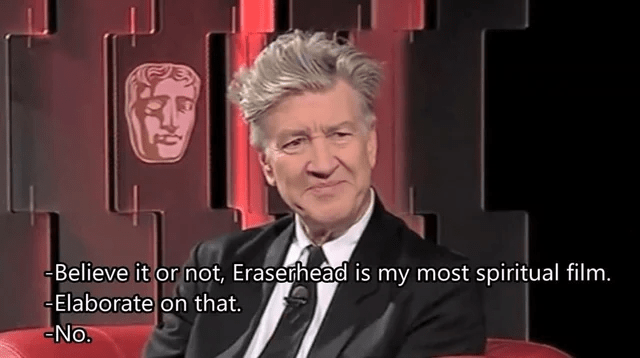
Alternatively, David Lynch has a zinger: “It’s better not to know so much about what things mean or how they might be interpreted, or you’ll be too afraid to let things keep happening.”
Alt-alternatively: Eat shit. You want to know what Mulholland Drive means? Tell me what your breakfast means. I’d chance it means little to you, but that doesn’t seem to stop you swallowing it.
But fine, here you go: Betty is a delusion confabulated by Rita after she survives the hit Diane paid for, and otherwise (aided by the wild unreliability of the film’s primary camera angle) you can probably just consider the chronology of events to be scrambled. I wouldn’t bother trying to put them in the right order–you have a concussion, and some of the puzzle pieces are now from the next box over.
“No, obviously Rita is being imagined by Betty!” Kind of a weird take, considering Betty doesn’t exist. “But Rita doesn’t exist either!” ‘Rita’, again, has a concussion. She may have access to her–Camilla’s–distorted memories, she may be a hypothetical imagined by Diane–but in that case Betty is neither an image of Diane nor her memory but a fantasy, brought forward in time, that Diane imagines working with Camilla to solve her attempted murder and Diane’s suicide. And the vision of that Ourobouros is so revolting that upon beholding it, all Diane can do is flail for the exit, which takes the convenient form of the pistol in her bedside table. You know what? Nevermind, that slaps.
“Wait, so you don’t know what it means?”
Why would I know what it means to you? There you go, querying Legion again, as you breeze past at least three examples of what Mulholland Drive is really about.
It’s actually almost magical how effectively Sadly, Porn’s opening question repels readers despite being excellently written and frankly fascinating. “Who decides what porn is?” Note that this is a separate question from what it is. You use it to not act, yes, but why not throw in another interrogative: Why does it work?
If the fantasies you’re masturbating to were your own, that would prompt action or change, hence all the Freudian repression hoodoo. They aren’t. They are someone else’s dream, and dreams as wish fulfillment doesn’t really work if neither is yours. Changing your dream is a matter of changing your wish–of changing your self. Not easy by any means, for some that’s a line of life and death, perhaps that is the case for Diane. But changing someone else’s dream is impossible. It is there in the world, and however you came upon it, you have no power over it. Consider how many times the film depicts this lesson being taught: Adam learns it, Diane learns it twice over, and in the end/beginning, Camilla learns it too.
In some ways it’s obvious–it’s a movie about movies and moviestars, both of which are dreams wholly unowned by their participants–but since you don’t have dreams of your own, you disavow the inevitable conclusion. Inevitable for Camilla, inevitable for Adam (count the cowboys), and of course, inevitable for Diane.
It’s precisely for this disavowal that everyone’s pick for most inscrutable scene in the film is the one at the beginning at Winkie’s diner, where a man recounts his dream of sitting in the diner (NB: where Diane later sits to pay for her lover’s assassination), only to step outside and find a fucking orc, which he then finds in real life too.
“So is he in Diane’s dream, or is she in his?” What’s your encounter rate on phantasmal orcs behind dumpsters? Mine’s pretty low, and the diner guy does seem rather surprised as well. “So he’s in hers?” ‘He’ being ‘Dan’? The guy who doesn’t appear in the film after that scene? If I were trying to help you, I’d ask you what that would imply–the void has a way of focusing the flailing–but you don’t have the time, and I don’t believe in it. The answer is neither. They’re both in someone else’s dream, and while I’m sure you’re curious as to whose, I want you to know it really, really doesn’t matter. Hollywood is a slurry of nameless aspirations, and the rest of your society isn’t much different. The only way out is to wake up.
Alternatively, Deleuze has a zinger: “If you’re trapped in the dream of the Other, you’re fucked.”
 Salt-Powered Investments, LLC