An Additional Problem With the Ubisoft Model

Discussion of worldbuilding principles, referencing Nioh, Elden Ring, and Ender Lilies. A lazy review of Nioh 3 included.

I recently dipped my toe into Nioh 3, and I’m sad to report that perhaps the nicest thing I have to say about it is that it is better than the previous two games in the series.  The writing and narrative might fairly be described as the My Immortal of Shogunate-era historical fanfic (“Fanfic of what?  You can’t write fanfic of history!”  The faux-fantasy Sengoku/Shogunate genre is so saturated it may as well be fanfic of all of them), the goddamned loot piñatas ensure you spend at least half your playtime managing your inventory instead of playing the game (having done my time in the ARPG casinos, I think I can say that randomized equipment stats don’t belong in any game, though Nioh is still one of the worst implementations out there), and the dialogue is cringe: poorly written, poorly localized, and overacted with an incomprehensible array of British Isles accents (NB: these characters are definitely Japanese).

The point of contention is obviously the combat, which one reviewer describes as “the best combat of any soulslike, past or present, end of story”.  To be clear, this is false, and the take is dumb and hypey.  Still, I’ll admit the combat is good.  At the end of the end of the day, this is an action RPG, and action RPGs do benefit from toolkits of flashy toys.  But after a point it starts to feel like a roadside family restaurant: 

This place has everything!  Burgers, breakfast, pasta, steak, sushi (huh?), parries, i-frames, magic on an ammo system, two sets of magic on a mana system, summon spells, fighting game combos, stance breaking, enemy stamina management (with bonus BAD zones!), and invincible devil trigger transformations!  After a couple of visits you get wise.  You realize that most of this shit is best left unordered, must have been dropped onto the menu by a chef with low standards after a weekend fixation–or by a tone-deaf manager hoping to project the appearance of repertoire.  Most of it isn’t all that good.  It probably shouldn’t be there.  But just like there’s a market of hooligans who think that the latest Call of Duty is the bleeding edge of FPS, there is apparently a conclave of plebeians who want their Dark Souls to be more like God of War or Diablo (or both, I guess).  Oh well.  There’s no accounting for taste.

What I really want to discuss, though, is the map.  I think Nioh 3 took the wrong lesson from Elden Ring.  But unlike the rest of my feedback (I think Nioh’s aesthetics are bad, but you don’t have to listen to me yucking your yum), I think there is actually a lesson to be learned here.

After Elden Ring’s release, there was much discourse on the contrast between its UI and the “Ubisoft model”.  The latter might reasonably be called the previous paradigm of open world game design, and though it goes way beyond Ubisoft, it was a Ubisoft dev that jumped on Twitter and called Elden Ring’s UI “bad”.  The memeing was accordingly relentless:
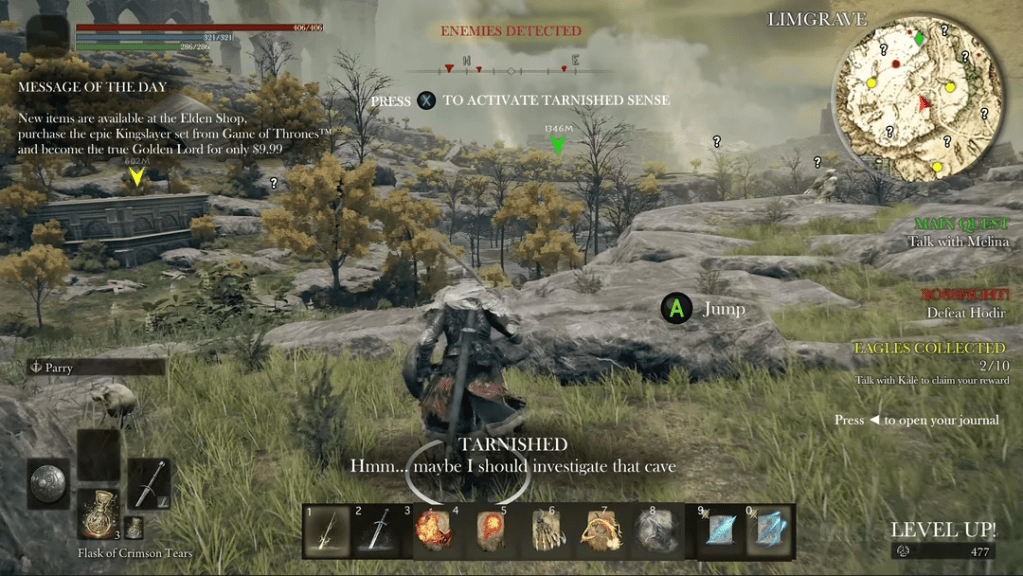
The larger story unfolded from there.  Since the mid-00’s, the argument goes, “readability” in games has come to be interpreted as “making sure the reviewer who gets assigned your game finishes it with no distractions and never, ever gets lost”.  This began as clear notations of an open world game’s “main path”, but over time, more and more studios began to take the MMO strategy (marking quests on the map) to its logical extreme, leading to a sort of implied guarantee in the UI in general–and the map in particular: If there is something to do in a location, it will be marked on your map.  This will help you not waste time.

Elden Ring’s insight, thus, was that people don’t actually like being force fed information on how they should be playing the game, and also they like exploring!  If everything they could find on the map is already marked, then they aren’t exploring–they’re navigating, which is much less fun.

Well, seems like Nioh 3 has proved this only half-right.  Putting aside that its map segmentation system is kind of a miss (exploring and doing stuff in region X, Y, or Z gives you stats and stuff; this is good in that it partially supplants worrying about the horrible loot system, but it’s bad in that it’s essentially still a sign that says GO HERE FOR REWARDS), it did make an attempt to move closer to not bombarding the player with information.

Ah, but it turns out there was another, worse thing the Ubisoft model was doing the whole time!  Calling it copypasting would be inaccurate–what it actually is is drawing a boundary around a particularly minute play pattern (say, killing a group of enemies in a location), calling that pattern a “system”, then littering the map with low-effort quests that trivially use that system.  Shoot the ferret balloons!  Chase the spherical cats!  Kill the 10 enemies in the “base”!  Kill the 10 enemies in staggered waves in the “crucible”!  I’m not saying Elden Ring didn’t have these play patterns, but it didn’t act like you were supposed to care.  In that game, if you kill a group of enemies, you get one of your refillable potions back.  Nice job not dying to that, kid.  Keep looking, maybe you’ll find something interesting around here.  What it definitely doesn’t do is track each of these stupid encounters you have and present you a checklist so that you can make sure to find and complete every single one.

But for Nioh 3, that’s the name of the game.  You go to the place, you kill the guys, you get a fucking loot piñata.  Unlike the Ubisoft model, I guess you don’t then open your map and find the next one, since the map is hidden until you complete enough checklist items.  I guess that’s better?  But it’s not much better, because while you get some of the fun of exploring, you’re still just trying to find all of the items on your scavenger hunt in each region, and none of the items are actually interesting.

The only “quests” Nioh gives you that don’t feel lazy are the field bosses (which start to feel lazy again when you encounter them as regular enemies, not in the late game, but literally the next zone over) and the “ghosts with unfinished business”, which aren’t lazy in the templating (it’s nice to have some unique experiences in the soup of what is otherwise the same shit over and over) but are lazy in the execution.  “Find out what happened here!”  Was…everyone killed by yokai?  Again?  Damn, that’s crazy.

So consider some advice in the affirmative.  If you are a game designer looking to fill out a map players may actually want to explore, consider having a map full of stories.  I don’t mean cutscenes or quests, I definitely don’t mean “lore tidbits” (to writers/designers: reading chunks of your unrelated prose is almost never the reward you want it to be–in order for that stuff to be interesting, it has to actually answer a question), and I’m not even particularly referring to the Dark Souls-esque fragmentary lore-in-item-descriptions.  I get that those have grown divisive, I know that some don’t want to deal with the sleuthing and reading in order to have an idea of what’s going on.  To be clear, what I’m saying has nothing to do with that argument–the merits and flaws of conventional exposition are orthogonal to the worldbuilding I’m getting at–but also: If you’re having trouble with context clues, Nioh 3 isn’t gonna make sense to you anyway, not because it relies on them overly so much as it doesn’t really make a lot of sense in the first place, and that isn’t gonna be kind to someone playing with less than a full deck.

Rather, what I’m referring to is stuff like Elden Ring’s first accessible cave dungeon, so early you’re liable to wander in before even meeting Melina.  It’s a little cave off the path, full of wolves, and in the boss room is a beastman of Farum Azula.  Farum Azula is notably an endgame area, but from a less gameist point of view, it is a shattered, floating tomb city suspended at the edge of a vortex in the middle of the sea.  What is the beastman doing here, far from home, with no clear method of transit between there and here?  You’ll never know.  The game doesn’t tell you, doesn’t even really hint at it.  But the situation is highly salient, there is a notably out of place enemy here, definite lore implications (even if what is implied is unclear), and I’d bet even money there exists at least a draft of this beastman’s story somewhere on a From Software hard drive.

That is the “system” you should be establishing across your map.  Every place of interest should have a story that explains how it got to be how it is.  If that story boring, change details until it isn’t, then change the place in-game to match.

And then throw the story away.  Don’t show the player any more than a dangling fragment, feel free to not even show that.  There are, of course, players who will gravitate to the fuzzy edges, interested in the mystery, but this isn’t only for them.  Even the most lore-disinterested player is going to notice when your world turns into a checklist, because while checklists are helpful, it’s no fun to play them.  The purpose of writing a story for all the unique pieces of your world is to create a world with actually unique pieces.  Players can engage with the underlying implications if they want, but whether or not it all feels same-y comes upstream of that engagement, and, unfortunately, Nioh 3, is a great example of how to do it wrong.

Of course, the problem for Nioh 3 specifically is more foundational than just that they didn’t do the writing homework.  Where Elden Ring and other games have robust vocabulary of enemy types as symbols for lore and factions, all interrelated and furtively gesturing, Nioh’s set pieces are way too neatly quadrifurcated into material (people, soldiers, historical Japan) and spiritual (kodama, yokai, guardian spirits, Buddhist…stuff) elements, each in turn divided clearly into the good guys and bad guys.  Since the setup is that the bad humans have summoned the bad demons everywhere to kill everyone, constructing a factional anomaly is close to impossible.  And since the yokai appear to have the agenda sophistication of the Hulk, their presence anywhere in particular says nothing.  It’s almost amazing how a game with this level of enemy variety manages to make them all feel narratively identical.  If this point is confusing, consider a comparison point other than Elden Ring.  Look at Ender Lilies, admittedly a game that is almost as Dark Souls as Dark Souls in its narrative setup–but if you want to see how you can do more with less, it’s your girl.

Ender Lilies is a game where every single enemy is a deranged zombie thrashing at everything around.  All of them were made this way by the same eldritch force, so with no agendas or intents, you’d think it would be just as homogenized as Nioh.  And yet, every single area prompts different questions that the game conveys (outside of lore tidbits) through enemy visuals, the architecture, the surrounding state of disrepair.  “Something happened here” is obvious, but it slowly becomes clear that “something” was much more delightfully twisted than “the bad stuff showed up and killed everyone”.  The problem with Nioh 3, thus, isn’t just that they opted for the dumbest possible backstory but also that they obliterated any of the language they might have used to convey that it was anything more.

I point all of this out not simply to rag on Team Ninja.  For their missteps here, I do feel they’ve exposed a lesson they and others can learn.  And to be clear, you don’t need to be on an open world game design team to make use of it.  Consider it if you’re a fiction writer, a tabletop GM, any other narrative architect.  Similar to Mark Rosewater’s venerable themed party planning advice (Rule 1: Have a theme), building an interesting world matters.  Whether you built it from interesting bones will be noticeable, regardless of whether your audience ever has access to the backstory, history, and planning that went into those bones.

Top image: Nioh 3 splash, from Team Ninja

Mandatory Vacation in Dimly-Lit Locales

The other day I made the mistake of visiting FextraLife’s Elden Ring lore speculation page, only to recoil, wailing, from the bilingual Time Cube that resides therein. While I try to refrain creating content based primarily on being mean to people, there are only so many claims like “House Hoslow is descended from the Nox because their armor has silver in it” that I can read before I push my fingers so far into my temples that brain pulp begins extruding from my nose.

While it wasn’t surprising, I was pleased to find that Shadow of the Erdtree added substantially to the Elden Ring analytical picture. I hope to write a more substantial post about it, ideally something between the structure of my previous Elden Ring post and the Dark Noon series. It’ll involve fingers, Jesus, and really disgusting jars. But this is not that post. This is mainly to remind/assure you all that I’m alive and that all of the previously in-progress efforts are in the same, slow, grinding motion they’ve been in for months. Beta reading for $20,000 Under the Sea is coming to a close. I’ve found a real editor to take a look at it, so that’s still ongoing, still with a projected release date of this year (I’m looking at 12/20 at this point). And of course, all the Rale-universe work (“The Apiarist”, the Crossroads sequel) is still going. You can, of course, still find updates here. On my website.

Top Image: Elden Ring: Shadow of the Erdtree promotional image

The Three Cities of the Immortals

A review of Labyrinths, by Jorge Luis Borges.  Separately, this is one of two pieces of content that I have prepared going into the next month where most of my writing activity will be focused on edits and rewrites for Three and Two and Two (Crossroads, Book 1).  I’ll try to keep content coming, but either way, I’ll see you on the other side.

Labyrinths was (aside from a scattered few assignments in college) my first experience with Jorge Luis Borges.  It was fabulous.  Everyone should read it.  “I didn’t enjoy it very much,” says the inexplicably boosted review near the top of its Goodreads page, as if your enjoyment has anything to do with evaluating impeccable specimen of magical realism, science fiction, perhaps the only compelling exegesis of Eleatic philosophy that I will ever read.  Despite my derision, I understand the sentiment–not everyone fuels themselves on the same homeopathic masochism I do–but even that, I suspect, is an anomaly.  I found the prose very approachable.  Perhaps the constant barrage of Neoplatonic mathy-ness can grate, so reader beware in that sense, I guess.

I.

Regardless, while I hope you may give Tlön its chance to worm its way into your brain, the meat of this will be about a more particular image.  Among the stories of Labyrinths, a number stood out to me, but one, “The Immortal”, stood out for particular, personal reasons.  

For synopsis: A handwritten note found in 1929 in the cover of a (set of) book(s) published in 1715 details an expedition undertaken by a Roman soldier in Eritrea to seek out the City of the Immortals across the desert.  On the way, his men mutiny, and he escapes into the sands, where his recollection of the next several days goes hazy, distorted by heat and dehydration.  He awakes in a graven, stone niche on the slope of a mountain, below which runs the river of immortality (from which he has apparently unconsciously drunk), and across is the city itself.  His niche is one of many, and around him, gray-skinned troglodytes who devour serpents and do not speak emerge.  He lives among them for a minute, goes to explore the City, finds it a vast labyrinth, built for something other than inhabiting–and accordingly uninhabited–and eventually wanders out.  On the way back, he and the troglodyte who followed him there witness a sudden rainstorm, at which point the troglodyte is inspired to speak and reveals himself to be the poet Homer.

It turns out the troglodytes are the Immortals who built the city and not just some hapless animals who drank the water–it’s just that being endless changes your outlook on things and leaves you with very little to talk about.  Anyway, the narrator joins them for a time before resolving to go find the river of immortality’s double, the river which gets rid of immortality.  He rejoins civilization, finds the river quite by accident, sells the books with the note, and dies shortly thereafter.  Also, because of the vagaries of the Immortals’ collective memory in their society, the narrator at the end was actually Homer rather than the Roman soldier.

There’s plenty to dig into, from the novelty of the hyper-ascetic picture of immortality to the incomprehensibility of the Immortals’ works, but what stuck out to me more than all of that were Borges’ physical descriptions of the City of Immortals, beginning with the far shore where the narrator awakens:

“…I found myself lying with my hands tied, in an oblong stone niche no larger than a common grave…shallowly excavated into the sharp slope of the mountain…A hundred or so irregular niches, analogous to mine, furrowed the mountain and the valley.”

And the City itself:

“I emerged into a kind of little square or, rather, a kind of courtyard.  It was surrounded by a single building of irregular form an variable height; to the heterogeneous building belonged the different cupolas and columns.  Rather than by any other trait of this incredible monument, I was held by the extreme age of its fabrication…

…In the palace I imperfectly explored, the architecture lacked any such finality.  It abounded in dead-end corridors, portentous doors which led to a cell or a pit, incredible inverted stairways whose steps and balustrades hung downwards.  Other stairways, clinging airily to the side of a monumental wall, would die without leading anywhere, after making two or three turns in the lofty darkness of the cupolas.”

You see, with some allowance for Borges’ use of “irregular”, the vista I see here looks something like this:

Top Image: Crumbling Farum Azula from Elden Ring

Bottom Image: Crumbling Farum Azula, entrance to Placidusax’s Arena

II.

Inspiration, perhaps; hammers and nails, I know; but there is a lot tying the two together.  Perhaps its best to start with the physical structure of the city.  Though Borges qualifies the “labyrinthine” nature of the City, and though Farum Azula is an imperfect facsimile of the sheer idiocy of the Immortals’ monument, the difference perhaps ties them together more than it pushes them apart.  Per Edward Teach (on the similarly labyrinthine Inception)

“When Ariadne draws her mazes for Cobb, he rejects the square mazes and is satisfied/stumped only by the circular classical labyrinth.

And anyway, mythological Ariadne didn’t construct the Minotaur’s labyrinth–Daedalus constructed it for her–she merely showed Theseus how to get out of it.  But she didn’t need to: a classical labyrinth doesn’t have multiple dead ends; it is a single winding path that lead either in or out.

But Theseus, like the audience, upon being shoved inside wouldn’t have known the form of the labyrinth–dead ends or a single path?  Sot to be able to find the Minotaur, he needed to know which way to go, and Daedalus told him: downwards is the only way forwards.

It’s worth disclaiming/clarifying: Teach’s distinction (maze versus labyrinth) may be correct, but it is not commonly written about in popular culture, and I think most works are agnostic to the difference.  The reason I bring it up is not to nitpick either Borges or Miyazaki but rather to point out that the distinction exists: branching, built to frustrate versus linear and built to obfuscate.  To which end, it’s worth looking at the forms of the narratives that use these labyrinths.  “The Immortal” is, contrary to the implications of its twists and turns, a linear piece of prose.  Though your own eyes and thoughts may be deceived, you can read forward, and your questions will be answered–you’ll exit the labyrinth on the last page of the story.  Elden Ring–a point of which a number of my readers would surely love to remind me–is a game, a medium much more on the maze side of the spectrum.  There is no one way forward, a player might be stuck in any corner of the Lands Between forever, despite any amount of movement.  Except in Farum Azula (among other locales), the form of the maze is subordinated to the immediate obstacle of the dungeon (From Software’s terminology–Farum Azula is a dungeon mechanically though not thematically).  There are dead ends in the dungeon, yes, but rewards wait at each of them.  Unlike Borges’ narrator, the Tarnished is incentivized to perfectly explore their City, and so their idealized task is no longer to simply make it out of the maze but to construct a path which touches every piece of it.  One path–making it a labyrinth.  This leaves us with a pleasingly Borgesian symmetry: “The Immortal”, a labyrinth which presents a maze in the form of its City of Immortals, is reflected sixty years later by Elden Ring, a maze whose own City is a labyrinth.  Borges did love his mirrors, and with apologies to Mr. Smith, it appears they are real.

III.

This is to say nothing, of course, of the other aesthetic similarities which tie these images together.  The crumbling, ancient spirals of Farum Azula, a city in a temporal maelstrom, unreachable to all but the most desperate, built to be listlessly guarded but not really inhabited.  And despite its grim aesthetic, there is no death awaiting those that linger there.  For Placidusax, the temporal prison sees to that.  For everyone else, Maliketh is keeping a tight hold on the Rune of Death.

And of course, Maliketh, Marika’s lupine vassal, is merely the greatest of the beastmen of Farum Azula, the raggedly-clad, gray-skinned troglodytes who (aside from Maliketh) do not speak and whose animate corpses fill the shallow, grave-sized niches that adorn the terraces of the City.  I’ll admit there is no evidence they devour serpents–they seem, rather, to worship the dragons who remain there–and there are some other specificities missing, like the impure stream which grants immortality.

To which end, in Elden Ring, Farum Azula is only implicitly a “City of the Immortals”.  To find an explicit City, we’ll need to look to a different From Software property:

IV.

I’ve written before about Sekiro’s Fountainhead Palace in reference to both Sekiro and Elden Ring’s use of the centipede as a symbol.  Much of Sekiro’s symbolism and plot revolves around the idea of worldly immortality as given by the Divine Dragon.  Among humans, there exists an “heir” to the Dragon’s blessing who is able to confer that blessing to others, which serves to explain the pseudo-eponymous protagonist’s continued resurrection in the face of the player’s ineptitude the impossible odds of his mission.

But in-world, this isn’t a secret, and it is well-known that the waters that flow from the Fountainhead Palace, where the Divine Dragon is known to reside, grant a sort of fucked-up immortality of their own.  This is because those waters contain the eggs of a species of…spiritually volatile centipede–a morphological reflection of the serpentine dragon–that parasitizes anyone drinking the water.  Thus, by devouring a pseudo-serpent, the ashen-skinned monks of the Senpou Temple, the peasants of Mibu Village, and the deformed aristocrats of the Fountainhead Palace all persist in perpetual witness of a City of Immortals upon a mountain, from which flows an impure stream that grants eternal, if cursed, life.

V.

Borges believed (or at least once claimed) that there were only four devices which comprised all fantastic literature: The work within the work, the contamination of reality by dream, the voyage in time, and the double.  Amusingly or predictably, all four are relevant to this analysis, but the last is particularly important.  I’ve already referenced it in this essay (see: mirrors), but it of course comes in many forms.  Sekiro, like Elden Ring, like most works of fantasy, really, is the story of a warrior, and a necessary element of any plot pitting a warrior against undying foes is the method the warrior uses to subvert their immortality.  For “The Immortal” (where the foe was the narrator’s own interminable experience) this means was a reflection, a mirror, the stream which was the antithesis of the polluted river.  For Sekiro, this means is a sword, a cutting instrument.  It should not be surprising that the two should have something in common.

It was, of course, Borges who wrote, in this same book:

“…copulation and mirrors are abominable, because they increase the number of men.”

Perhaps a blade does not increase the number of men, but just like a mirror, a scissor, or Truth, it increases the number of things.  From one, it makes two.  That a blade should reflect darkly the infested immortality of the Fountainhead, in reflection of Borges’ reflection; that the pieces of Borges’ immortal City should be separated and made two cities in two worlds, each with the specificities necessary to lead back to the dream which bled into them–well, it’s only appropriate, isn’t it?