Through the whirring, root-lined passages of the workshop, a diminutive figure shuffles along. Where there is open space, she observes the goings on, the maintenance of her domain, with muted interest. At the periphery, tiny, metal spiders clink and clatter on about their thousand little tasks, sweeping away dust, digging, polishing, sometimes even melting themselves down, embedding themselves in the tunnels as struts and beams, retaining enough function, though, to click and whir and watch. Her workshop was alive, the figure mused with a smile, so unlike the houses of men.
Where the ceilings were high enough to permit them, her other servants labored in studious silence. Men–and women, she supposed, though it hardly mattered anymore–made of ticking metal transcribed and translated her library, organized the tables at the center of her workspace, banished her abandoned projects to the corners of the room, and, when so requested, retrieved them. Their tasks were not difficult, but they were not easily programmable or required more heft than the spiders offered readily. Either way, the metal men did them gladly–they were grateful for the life she had given them.
Pensively, she scaled a stool, producing a host of spindly appendages from within her black robes which carried her into the seat with the undulating grace of a centipede. She had been traveling–not physically, of course, but through a proxy–and the effort of the conscious projection invariably wore on her. Still, she was disinclined to display any affect outwardly, though it was doubtful her servants would have noticed or cared. She had notes yet to make, and fatigue–even the magical variety–was an enemy to which she refused to succumb.
From a stack on the table, she drew a leaf of thin, papery material and licked her finger, secreting a drop of oily, black ink from the reservoirs in her salivary glands. Splitting her finger into eight much finer-tipped instruments, she lowered them to the page, where their twitching, seemingly random and erratic in the air, began, precisely and rapidly, to inscribe her thoughts:
On this 1237th year of the Exsanguine Era, it has come to pass that open practice of the Way of the Green has been all but eradicated here in the Riverlands. The popularity of anti-magical “Harmony” movements in the wake of the Incident has evidently left it little room to grow, and what texts remain of its rites all seem to have disappeared into the Papacy’s vaults, likely to be burned or twisted beyond reasonable recognition. Thus, it has fallen to me to generate a more trustworthy record of the institution. This is necessary, I would submit, both for the value of the knowledge in itself as well as for a speculative angle of analysis. After all, the diaspora of the Greencircle, in more than a single sense, can be held responsible for the Riverlands’ worrying modernity.
To begin, the Way of the Green, distinct from the Greencircle as day to the sun, was a movement, and like any popular movement, it was fragmented in its purpose. Its intentions and praxis varied wildly among its constituencies, and any anthropocentric account of its history is sure to be flawed for this reason. This is fitting, of course, as its origin had little to do with humanity. The Greencircle did not congregate there in the Bloodwood to found a movement, and they were certainly uninterested in teaching a way of life. Rather, the Greencircle was a reaction, itself, to an external threat.
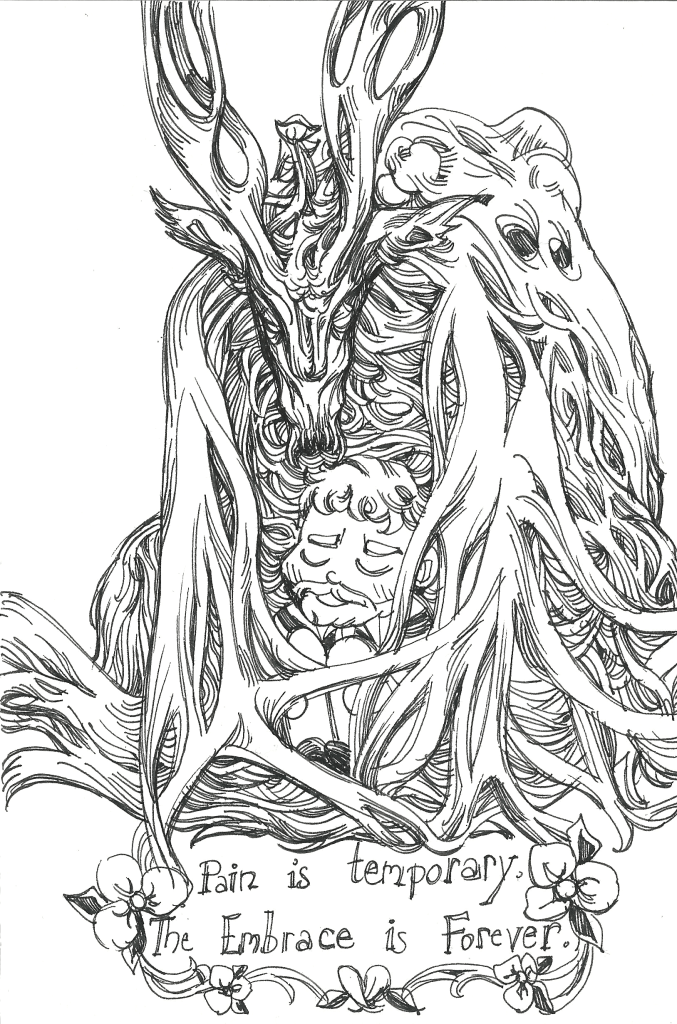
Some 500 years ago, by my best estimate, the folk hero known popularly as the Hunter of Beasts raised a call to arms among the aspiring heroes and scholars of the Riverlands. He sought an alliance meant to destroy a monster deep within the Bloodwood, a ravenous, devouring mass he called the Hunger, though it was a subsequent name–the Chimera–that found its way into the local lore of the time. A great number answered his call, for the Hunter was well-known at the time, and he soon led a host of glory-seekers on an ill-fated quest to slay the beast. Nearly all of them perished. Most among the company were inexperienced, blessed by talent or ambition but no art, and vanishingly few had cunning or strength to match the Hunter’s. So bereft, they made of themselves easy food for the Chimera. Far more notable than the casualties, though, were those that survived. The organization they formed thereafter, though it had no formal title, became known as the Greencircle.
Chief among its members were the Wolf–also called the Masked Alpha–a powerful hermit mage and self-styled “protector” of the forest; a pair of scholars, a Botanist and an Arborist whose names were not recorded but who are noteworthy nonetheless for their success in translating the Chimera’s ability to manipulate flora into a teachable magical art; and, of course, the Strange Bird, ostensibly just a talented, one-eyed hedge witch, though her enduring influence–and the macabre nature thereof–raises serious questions as to the innocuousness of her identity.
Now, for a period of some twenty years–an average of the retellings I’ve gathered–this organization–which is to say the Hunter, those four, and their closest followers and aspirants–were an open and public institution, well-known among the villages in and around the outer Bloodwood. Following their disastrous confluence, they tempered their aim of destroying the Chimera, instead focusing on containment: repelling the beast from woodland villages and–to a reasonable extent–keeping it confined to the wood’s heart, where it posed little threat to the “civilization” outside. In so doing–for all the Greencircle were learned mages–they uncovered and codified magical knowledge to rival that of the ancient universities, including the bases for what I would now classify as three distinct schools of magic. The organization was loved and respected as protectors of the people, and soon, the discoveries and philosophies of its members began to spread beyond the Bloodwood and throughout the Riverlands.
The words I have chosen, however, are very particular: The Greencircle had little in the way of a unified worldview, save, perhaps, for the agreement that the Chimera was dangerous. Regardless, what proceeded to spread among the people, known collectively and indiscriminately as the “Way of the Green” were the ideas of the Greencircle’s individuals.
What this meant, of course, differed by both origin and adherent. The Wolf, for instance, inspired a tradition of copycats, practitioners of his shapeshifting and cannibalism, albeit with only a fraction of his zeal for the defense of the wood. Meanwhile, devotees to the Arborist and Botanist practiced their plant magic and maintained a calendar of rituals to honor the flora of the world, within their spheres of experience and without. Alone among them, the Strange Bird’s followers formed a longer-lived organization, but I will return to that discussion separately.
Despite the spread of the Way of the Green, the Greencircle itself remained focused throughout this process on the danger of the Chimera, and to judiciously interpret various accounts of the Hunter’s temperament at the time, that focus was not bearing fruit. While the creature voraciously consumed–or, perhaps more accurately, assimilated–all flesh in its path, it seemed to matter little whether that flesh was human or even faunal. The Greencircle’s work in deterring the Chimera from human settlements had thus been admirable but futile: While the humans remained, the once-small region where the beast dwelled had increased tenfold in size, and with countless new mouths, its rate of expansion had multiplied accordingly.
Nearing a point at which he surmised they would be hopelessly outmassed, the Hunter brought the Greencircle’s considerable magical expertise to bear in an effort that was, while clearly significant, ill-documented and historically unclear. From the accounts and scraps I have amassed, I am to ascertain that it incorporated a ritual employing numerous mages; that it was successful, insofar as the Chimera is not mentioned in any record thereafter; and that it was quite costly. Notably, it is clear that neither the Botanist nor the Arborist survived the ordeal. How many others might have died alongside them is, of course, unclear, but it is well-recorded that the Hunter of Beasts at that point ceased his engagement with the Greencircle, effectively dissolving the organization.
While the Way of the Green flourished for centuries thereafter amidst the Riverlands’ long-harbored thirst for a magical and cultural identity distinct from that of the eastern domains, the more interesting epilogue to this story is with regards to the Strange Bird. Her followers, known as the Feathermen in the years after the Greencircle dispersed, remained in their secluded corner of the Bloodwood until just a decade before the Incident. It is difficult to say what purpose they labored toward, but a few points are clear: First, for a time, the feathermen were known among the villages closer to their domain for their “exports”: trinkets, imbued with Mana, able to perform magic with little input or expertise required from their bearer. It seems doubtful that any of these creations had much use, even at the time, but taken against the veritable–and not altogether benign–economy that thrives for such goods today, one can almost see the Strange Bird’s influence in the here and now, hundreds of years since she was last seen. My suspicion on this point is only deepened by the list of individuals to whom I can draw affiliation with her club.
Le Marquains of the Southern Reaches, for example, made no secret of his training with the Feathermen, and his arrival in the South to quell the Saraa Sa’een well outside the monster’s known territory certainly merits comment. Likewise, witness accounts of the individual known as the Hawk, who assumed control of the Feathermen in the last decade of their existence, bear more than passing resemblance to those of the one-eyed man who led Ka’s armies during the Incident. And, of course, I need rely on no hearsay to recall the tufts of feathers that still clung to the Dragon’s hide the day he arrived in my village. That all of these men became generals of the Bloodfish seems both deliberate and in poor accordance with their ideals–the Dragon, in particular, had little apparent interest in Ka’s ravings. I do not doubt, at this point, that this was strategy on the Strange Bird’s part, though now with her pieces–her manipulable Greencircle and Bloodfish–dead and buried, it is not clear for what she aimed or whether some plan of hers might still be unfolding.
 Salt-Powered Investments, LLC