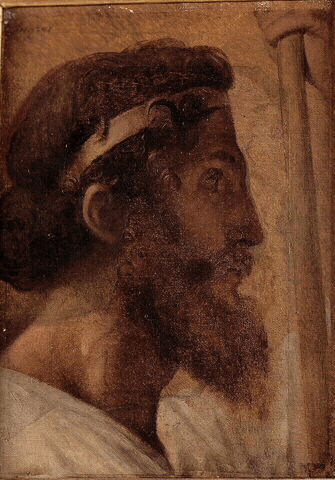
Broken

Apologies for the slow cadence of posts lately. I’ve had a number of things cooking, but they are all in such a way that none is quite ready to post here. And then I went to the hospital this last weekend, which threw a wrench in most of my plans. I will have something new up in a few days. It’ll be a little weird–but hopefully pleasantly so.

“The Apiarist”, Excerpt 5: The Right Side of History

I enlisted with the Blood Knights in the eighty-second year of the Blood God’s reign, when I was twenty years old.  This was somewhat older than most recruits, but my path in life had been dominated by other factors, and I had yet to seize any particular control over it.

The previous year, my father was stricken with a consumptive infection of the lungs and–mercifully, perhaps–passed quickly.  It wasn’t precisely the attack in Piraeus that had brought about his end: His injuries healed mostly, leaving him with a limp and limited function in his right eye.  But it had, in hindsight, been the beginning of a downward slide.

He, of course, did not return to the city from then on, for the very reasonable desire not to become a martyr or scapegoat to either side in the thinly-veiled conflict now ongoing between the Knights and Piraeus’ self-determinative Atheist faction.  But I suspected it was also deeper than that, a phobic unwillingness to face even the place, much less the people, which had subjected him to that trauma.  The result was that he was confined to our home and grounds, occupied by not busy, increasingly present and irritable to Mother, the servants, and myself.  That he was moving so much less than he had been, that even his limited mobility in that limited space was painful for him–it all meant that even before the infection set in, he had become little more than a cruel, vaporous reminder of his former self.  I found it striking that when he died, not even Mother truly mourned.

The legacy he left, though, was complicated for everyone.  Despite his many enemies, Father was still regarded as one of the most talented artisans in the region.  Our family’s honey fetched an outright exotic price as far away as Kol, and even despite our lifestyle of rural borderline-nobility, the business had been shockingly frugal.  It turned out Father had left behind a fortune in silver, valuable goods, and stock certificates in a number of successful merchant companies, each of which had been paying dividends for years.  The future of the apiary was, of course, uncertain, but it quickly became clear that Mother and I were in no danger of starvation.  What was less clear was whether either of us had any desire to carry on Father’s work.

Eventually we settled on a course.  Our head servant, Giuseppe, the very same servant who had sought help for Father the night of the attack, would take charge of the apiary, and when Mother passed, he would be the one to inherit it.  I, meanwhile, had taken my father’s rejection to heart and fully accepted I would have no future in beekeeping, truly assumed I had no aptitude for it.  And my mind had belatedly wandered to the political unrest in Piraeus, and tectonics of power I now saw shifting around us.  So it was with not insignificant enthusiasm that I renounced my inheritance and made my way to the city, determined to stand on the right side of history.

Despite my ardent opposition, I have little doubt that if the political skirmish I arrived in had taken place even twenty years later, the Atheists would have won handily.  Though the Knights were formidable warriors, anti-Kolai sentiment ran deeply through Piraeus, and they were outnumbered–possibly a hundred to one.  Their advantage was that the Uprising of the 79th was fresh in the collective memory of the Kolai dominion: Only three years earlier, the city of Cantabyz, the source of the majority of the Dominion’s iron, had declared open rebellion against the Magni Kolai.  The Blood God’s arrival at their gates–his first public appearance in a decade–claimed over 10,000 lives.

In the wake of this event, Piraeus’ cooler heads overwhelmingly opted to lie low, leavin the Knights to contend only with the Atheist’s firebrands.  My allegiances were unconflicted.  I had no grievance against the Kolai’s taxes, and the only meddling I had seen from the Knights had been clearly on the side of justice.  It did not matter that when I arrived at the chapterhouse, the squire on duty in the hall urged me to consider that I would very likely not become a Knight without any magical talent I knew about.  And it did not matter that my enthusiasm was met by a bemused chuckle from the only Knight in the hall at the time.  I had existed too long in a state of terror at the unbelonging I had felt from my father, from the apiary, from the indolent, insular people of Piraeus.  I knew that the Blood Knights–even simple service to the Blood Knights–was something greater that I would be glad to be part of.  The Knight Captain’s speculative nod, when it came time to provide him my reason for enlisting, was tepid vindication.  But it was enough.

“The Apiarist”, Excerpt 4: The Blood Knights of Piraeus

My first contact with the Blood Knights was when I was eleven years old.  Against my father’s wishes, I was made to accompany him into the city on a delivery to the Hospitality Quarter, as the servant who normally helped him with those trips had fallen ill.  It was a fraught journey, but I was familiar enough with the work that I no longer roused his anger, so long as I stayed quiet.

Some years later, I would become acquainted with a common template of a man: the type who charmes, who is a socialite to all except those with whom he lives–to them he is a terror.  As that template is well understood by many, I wish to emphasize that my father was very certainly not this type of man.  He was not merely irritable and angry to his family–he was irritable and angry to everyone, and, as I discovered on this trip, these qualities had earned him enemies in Piraeus.

At the gates of the city, we were stopped by a guard who requested, smirking lasciviously, that my father produce his licensure.  Rather than showing documents, my father handed over a large parcel of his goods before continuing through the gates.  He did not offer me any explanation, and I did not ask, but I found the interaction decidedly tense.  And I was not the only one–I distinctly recall the skeptical glance of the woman in armor on the other side of the checkpoint.

As we were finishing our third delivery, that same woman approached us, carrying the parcel Father had given the guard.

“Piraeus has no licensure requirements for apiarists,” she said.  “I guess you knew that, but extortion is also prohibited.  If it happens again, you can let us know at the chapterhouse.”

Father accepted the parcel, eyes down and jaw set with an emotion that seemed perturbed but otherwise lacked definition.  When we passed back through the gates on our way home, the guard we had spoken with was no longer there, and the one who had taken his place fixed us with a look of such hatred that I could not bear to hold his gaze.

I was at the time too young, too sheltered to understand the political implications of what occurred that day, but as my role facilitating Father’s deliveries expanded, the situation grew clearer:

In those days, Piraeus was ruled by a council of elders who nominally commanded the loyalty of the city’s entrenched aristocracy.  It had been this way for as long as most citizens could remember, but where, a century ago, Piraeus had taken pride in being the last stronghold of Riverlander rule unswayed by the machinations of Spar, the city had finally surrendered rather than face ruin at the hands of the Blood God.  Even now, there were many Piraeans who resented this obeisance, who refused to recognize the Blood Knights’ authority to oversee and overrule the city’s various administrative functions.  That the Knights were largely hands-off and demonstrably less corrupt than their local counterparts–a notion for which the incident at the gate was, to me, irrefutable evidence–was beside the point.  Nor did it matter that the Blood Knights in Piraeus were a majority ethnically-Piraean: The Kolai were outsiders, and those that bent the knee were, behind certain doors, traitors.

Of course, when those criticisms emerged publicly, the repercussions were severe.  A month after that first incident, a group of guards, displeased with the Blood Knights intervening on his behalf, ambushed my father in the midst of his deliveries.  They destroyed his goods and beat him so severely that his servant had to fetch me and a separate wagon in order to bring him back home.  And though, to my knowledge, Father never reported the incident, the Knights seemingly discovered the incident on their own.  They massacred the city’s peacekeeping force, assuming their duties for the better part of a year, and the guards’ flayed and exsanguinated corpses were hung from the city walls for months after the altercation.

Father never set foot in Piraeus again.  I never learned whether he had a stance of his own on the Blood Knights’ rule.  He certainly did not seek their aid–I discovered from his ledgers that he had been paying bribes to the guards for over a decade.  But that was a stable arrangement: He was paying for his ill repute among the citizens.  It had nothing to do with the Blood Knights, and it was not by his will that his business became a battleground in their fight over who would control their hive.

Partial Eclipse of My Writing Schedule

Posting since it’s been a minute since my previous spree of relatively high-frequency updates. Everything is still underway–a new Apiarist excerpt is forthcoming (hopefully within the week), and editing for $20,000 Under the Sea is hopefully nearing its conclusion. However, travel to see the recent eclipse, while absolutely worthwhile, has put a kink in my content pipeline that I’m only now beginning to sort out. I hope you all are well and that you spent an appropriate minimum of time staring directly into the sun in the past week and a half.

“The Apiarist” Excerpt 3: A Lesson on Free Magic

“I do so hate these commencement speeches, but our mission can get so muddled in all the regimens and pageantry and Sacristi; especially out here, so far from Kol…”

It was customary, the Knight Captain had explained, that each new class of recruits receive its first training in Kol’s sacred art from the visiting Magnia that year.  It was a great honor, and exposure to the Magni was otherwise highly limited.  Command of the Blood Knights mixed only tepidly with the ranks of the Migni Kolai, the World City’s administrators and functionaries, and promotion to civilian office from the Blood Knight rank and file was vanishingly rare.  And it was almost unheard of that any of these should join the company of the Magni, the Blood God’s high priests.  Kol’s leaders, for the most part, were born rather than made.  So to be close to a Magnia, to have her attention, was not to be squandered.

Even at the time, though, I was under little illusion as to how practical the instruction would be.  The chapterhouse’s senior squires had already put us through remedial arms training, and I was well familiar with how foundational any introduction to a martial art would have to be.  And of course, we had little time: Magnia Livia was important, and we, plainly, were not.

This impression proved only partially correct.  I did not learn to call the Blood that day–that would be a process of slow growth over decades, as it was for nearly every recruit–but the pith she did dispense was more impactful than all the tutelage I would soon receive from lesser teachers.  She began with a demonstration:

“As I’m sure you all know,” she said, unsheathing a razor, “the armament our God wields is blood, and the strength by which he wields it is violence.”  She cut a deep line from her elbow to her wrist and turned her palm upward.  Solid, sharp tendrils of blood erupted from the wound.  She continued:

“Both violence and blood exist within all of us which is both blah blah blah and blegh blegh blegh…”

Rolling her eyes, she shook her arm, and the writhing tendrils collapsed in a wet cascade, which seeped back up into her arm as she turned to us.

“You will learn how to do that with a lot of practice, and you’ll learn the apologetics and justifications–probably with a bit less practice.  But all of that–the weapons and discipline–is what we use to maintain our strength.  None of it is, by itself, going to tell you what it’s for, and the lot of you are going to be damned miserable excuses for knights if you can’t grasp why the Blood God sent us out here in the first place!

“To that point,” she said, “consider a bit of heresy.”

Once again, she drew her razor from her elbow to her wrist, but this time, instead of a roiling scourge of blood, a blast of flame surged from the wound, engulfing her arm and prompting more than one of us to stagger backward at the sudden wave of heat.  And then, just as suddenly, the flame extinguished, and her flesh knit itself back together.

“The Blood God decreed Free Magic, so we mustn’t forget that the arts of the pyromancer, the Greyskin, the beastman–all are like to ours.  Free Magic means that never again shall a tyrant claim control over the potential that lies within us.  That is the legacy the Blood Knights are meant to protect.  We do not cultivate strength for its own sake, we don’t imitate our God out of vanity, and we certainly don’t become strong so we can bully the weak.  You are protectors, and it will serve you to learn a thing or two about what you aim to protect!”

“The Apiarist” Excerpt 2: Fear of Bees

My father kept bees, and it terrified me.  Perhaps it was some shameful regard I had for him manifesting in how I saw the creatures.  He did not care for me, and he showed me little more than disdain throughout my childhood.  He barely spoke to me, though the harsh glares and the terse dismissals hurt far more keenly than the sting of the switch when he had the servants discipline me for indolence or insolence or whichever transgression he decided must have brought me into the room with him in that moment.  It was my being there, I now understand, which was my true sin.  The wound still aches occasionally.  I still think it cruel that a father should so resent his son’s presence, though I’ve come to understand his reasons better.

In any event, my terror at his diminutive livestock was certainly not empirical.  I never earned their ire, and they never stung me, but I maintain it was quite rational.

“Stay away from the hives,” Mother would warn me when I ventured into the yard while Father was away.  “If you bother them, they will sting you.”
She frequently mentioned the servant who, when I was very young, toppled a hive by accident and perished thereafter in agony.  I worried that if the creatures were as irritable as Father, even catching sight of those ominous, thrumming boxes would put me in danger.  But I know there was something more.  I would encounter lone bees and wasps hovering about the flowers in front of our house, and though I took the same care with these solitary specimens, I felt none of the visceral fear in approaching them that I did in the apiary.  A bee was just a creature to me.  Like me, in a way, with needs and fears and priorities.  But the buzz–the swarm–was something else.  All of those needs, all of those fears, all of those bodies.  It was chaos.  It was too much.

“The Apiarist” Excerpt 1: Magnia Livia

I’ve begun writing a long story/short novella in the Piraeus-headspace (like the Halia and Dreamfish pieces, except way longer and way more tangential), and I’ll be posting the mostly-unedited segments here. Highly unfinished and likely not at all in the order they’ll be for the finished product, but hopefully good reading.

The one who visited the chapterhouse that season was named Livia–Magnia Livia, the Knight Captain enforced, for failure to address the Magni by their proper title was punishable by Sacristi.  She arrived in Piraeus, as was traditional for Kolai dignitaries, in a palanquin suspended on barbed handles carried by chanting acolytes–the Order of the Blades of Kol, temporarily bereft of their deific wielder–steps perfectly synchronized, immaculate, precise control belied by mania stitched in bloodshot eyes.  I remember finding it at once appropriate and deeply unnatural.  I saw in it a reflection of the rules and ritual of the chapterhouse–though perhaps I was merely part of the mirror image–in turn a careful mold to the deliberate equities and geometries of Piraeus itself, though this was an irony I would not realize until much later.  

But in their hymns and mutilations I could sense a current connecting them, focusing them in burning passion toward horrifyingly singular end.  I did not know why the feeling was familiar to me, nor why I found it so perverse, but I was possessed of many misconceptions back then.  So was the Knight Captain, it turned out.

Prior to the Magnia’s arrival, the Knights had sorted us according to their impressions of our magical aptitude, toward vocations of knight, servant, or squire as our capabilities allowed, but even then, in the “Era of Free Magic”, certain forms of mana were repellant enough that cultural awareness of them all but vanished with distance from the World City.  The Blood Knight chapterhouse in Piraeus thus had minimal record of the mana currents that existed in the microsensory networks of swarms, they did not look for those currents in their recruits, and they had little ability to find them even if they were so inclined.  But this was part of the reason the Magni supervised the recruiting process.

I was surprised to find that Magnia Livia showed little regard to the stiff sort of ritual espoused by the Blood God’s other faithful.  Far from the Knight Captain’s stone-faced severity–an attitude I had come to understand as the invariable face of the Kolai–Livia was warm, mirthful, middle-aged and slightly overweight, but effusively energetic.  Upon her first tour of the chapterhouse, she loudly bemoaned the asceticism of the squires’ quarters, the kitchens’ stores of spices, the frequency with which Sacristi was exacted from the servants:

“‘It is not suffering for which we care,’” she said, quoting Kolai scripture.  “Stop this at once, Captain.”

I found it odd at the time that the Knight Captain was willing to suffer such admonishment from a bureaucrat, but I was naive.  I later learned that Livia could have eviscerated him with a gesture were she truly displeased–a prowess I saw for myself in the Dereliction when she slaughtered a militia of over 300 before the Lady of the Flies overwhelmed her.  And it proved I would owe far more of my fate to Livia than the Knight Captain.  It seemed I had potential of which I was unaware, and she recognized it immediately.
“You’ve misjudged these ones,” she remarked to him, patting me and two other would-be squires on the head.  And with that single gesture she altered my destiny.  No longer was I to be a foot soldier to an institution that bound the world by code, by a paradigm of sense to match its chaos.  I was to be a leader of that institution, and I was to discover all the degrees of deeply unsustainable freedom it allowed itself.

Winter is Ending

I’m having to bunt here since writing on the latest preview chapter for One Wing, One Eye is going slowly. But it will be done soon (hopefully by my next post), and in the meantime, I am very much still alive.

Content here over the next year is going to be a little tricky. Editing on $20,000 Under the Sea will mean that a fair portion of my output isn’t going to show up here (until the release of the book), and my new job is cutting into my writing time substantially. That said, I intend to find a way to make it work. In the meantime, thank you to all of you for reading and following. I hope you are doing well and that your winter ends soon.

Curtains Rising and Intelligent Wailing

Holiday pressures and life changes do often make it difficult to maintain post schedules for longform work, so I want to fill the gap today with a hybrid of housekeeping and history.

In the former theater, I’ve been blessed by/suffered with a number of developments. I’ve completed the handwritten manuscript for $20,000 Under the Sea, and you can expect the final two chapters to be posted here in the coming weeks. My writing process is to do first-round editing as I’m transcribing my handwritten work into a digital format, and those final two chapters are chonky, so bear with me as I’m getting everything in. Once it’s up here, I intend to initiate beta-reading and second/third-round editing, and you, as readers, have until that process is done (or near done) to read it here before I hide it like I did with Three and Two and Two and the material that went into Promises for a Worse Tomorrow. That said, if you are interested in beta reading, please reach out to me at slhlocrian@saltpoweredllc.com. I am not being choosy with who is allowed to offer me feedback (though I may be choosy about what feedback I listen to). The only qualification I ask for is interest in reading through the manuscript and providing me with your opinion (ideally with a minimal amount of follow-up required from me).

The beta-reading/editing phase for $20,000 Under the Sea will likely be longer than for my previous two books. This is because I’ve recently started a job, and my dedicated writing/editing time has been quartered. On the flipside, lack of uncertainty regarding my ability to survive in the hellscape of capitalism really has been a breath of fresh air, so motivation is in higher supply now at the very least.

Now for history. As my access to illustration for my work is currently limited, I’m looking at a more graphic-design-centric approach for covers/graphics/materials for $20,000 Under the Sea. In particular, I’m hoping to leverage the theme of historical photographs with which I’ve been adorning my recent Whom Emperors Have Served posts. Chief among the questions for cover design for the book is how one might use historical photographs to depict (or at least reference) the Nicholas. Fortunately, in the early days of submarine navigation, vehicle designs–likely the same ones the inspired Jules Verne–were wild.

In particular, see the Intelligent Whale, depicted at the top of this post. It was an experimental craft built during the American Civil War, sold to the U.S. Navy in 1869, tested (disastrously) once, and then condemned in 1872. Various sources indicate that the total number of people drowned in testing the sub may be as high as 42. Between the aggressively silly design and its outright unreliability, it feels…appropriate that it might be a stand-in for Captain Kneecap’s inimitable trash sub.

For a less exceptional inventor or navigator, the design may in fact be an inexpensive conveyance beneath the waves. Whether that’s desirable, of course, depends on how badly you ever want to make it back to the surface.

Top photo courtesy of chinfo.navy.mil

Autopsies and Roadmaps

The roads are made out of flesh or something.

Summer has been busy, which, in its way, has been a good thing.  Still, it’s been havoc on my writing schedule, and the relative absence of volume on this blog the past few months is some testament to that.  Rae and Leland have been similarly occupied, so our art pipeline has been more or less paused until later this month. For my own working cadence, I’m not sure when I’ll be fully back online, but I’m thinking that the beginning of September isn’t a bad guess.  For now, this post will be a little bit about everything, but we can start by going backwards.

Notes on the LaSein Account is now done, and, taken together, it makes a decent epistolic story.  For future readers’ convenience, I’ll probably post it in its entirety, along with a number of other organizational updates to the blog/Patreon, but for the writing process, it was definitely important at the time that it be in a serial format.  As I’ve mentioned numerous times, Part 5 of the Sevenfold Gyre has been extremely difficult to write, and not all of that has been due to my schedule. When I started that series, I was working to make it at least somewhat literary, but subsequent entries have diverged.  That they’ve each been written in different styles is kind of intentional (and definitely acceptable),but they have been trending toward less artistry, and I was hoping with the upcoming chapter to change that.  Between that and the introduction of characters that I’ve been avoiding talking about here up until now, the result was a lot of stress and not a lot of movement, and while I can say Part 5 is almost done now, I’ve needed to walk away and come back a number of times throughout the process.  LaSein was, in essence, an excuse to walk away.

I feel like the experiment was pretty successful.  The quality of writing wasn’t great; keeping myself sharp almost certainly means writing more than an intermittent page, but on first pass, I think it’s good enough to be editable.  It fleshes out a portion of the War Torn/Rale story that I’ve been wanting to get in writing for some time, and, topically, it sets up a good transition into Part 5. I’ll probably use it in the book.

At some point in the farther future, though, I’ll need to start thinking about transitions.  I had originally intended this blog to be a venue for all of my writing, and I had not intended for its fiction portion to be exclusively about the War Torn/Rale project.  Once I do have the necessary pieces for the manuscript of said book, I’ll likely be posting less on here throughout the editing phase. We’ll see what happens then, but I would expect just about everything else you’ve seen on here to continue in some fashion.  I’ll continue with the game reviews, though generally only when I find something in games worth commenting on, and there is at least one more Dark Souls essay on the map. Feel free to comment if you have opinions on what you’d like to see more of, otherwise, thank you to those continuing to follow me on this journey.  I hope you continue to enjoy.