In 1948, Vladimir Nabokov accepted a position at Cornell University, teaching Russian and European literature. That same year, he wrote this piece, ostensibly material for his students (though I can find no confirmation of that inference). Go ahead and read it if you haven’t–this will essentially be a review.
My own experience with this essay goes back to high school. I read it then for class, found it completely insufferable, moved on with my life, etc., but now I’m returning to the ideas and finding them mostly correct and very relevant to the “reading” I am doing now with Dark Souls and Sekiro. This is, of course, not psychically painless. Nabokov’s tone is still aneurysmally condescending, and his organizational structures are bizarre, but he’s also One of the Most Important Writers of the 20th Century, so his thoughts are worth a looksee. Take from the piece what you will, it may not be the same list as mine, but in case it’s at all helpful to you, my thoughts are these:
The authors of the classics are smarter than you.
Okay, this isn’t actually one of Nabokov’s points, but it’s a healthy attitude to have and all but prerequisite for digesting the rest of his exegesis. A more plain way of putting it would be to say that in reading a work, you should assume that there is something there of depth. Ironically, Nabokov himself distinguishes between writers of genius and minor authors, but to assume you can tell the difference is astonishingly arrogant. Perhaps Nabokov earned his arrogance. You didn’t–be kind to those you read.
Read, then evaluate.
This is especially important for works that you’ve heard about. Everyone knows Beloved is a scathing indictment of the evils of slavery (and it totally is), but to condense it to that, to go in with those expectations sells short the loving detail (sic) with which its characters are rendered and everything else it might say about what it is to be human.
By the same token, don’t judge a book’s contents by the one who recommended it to you regardless of whether your opinion of (e.g.) Karen is positive or negative. Sure, take a recommendation as an excuse to eat some tasty, tasty typesetting, but don’t let your knowledge of the recommender’s mind preempt your own capacity to interpret art for yourself.
Fiction is generally not historically accurate.
Uh, yes. I’m a little confused as to why Nabokov finds this observation uniquely important, but it is correct, and it has some useful implications regarding the role of art. I’ve alluded to it before, but politics and art have an annoying way of getting tangled up in each other. This isn’t all bad–politics shapes life, life shapes art, why shouldn’t art sometimes be political? Things start turning sideways, though, when one uses political art from the past to synthesize political arguments today; worse: when one uses historical fiction depicting politics that might never have existed to draw conclusions about the present. If the distinction is confusing, let me put it this way: Harry Potter has nothing actionable to say about politics in the 1930s, the 1990s, or the 2010s (I have seen arguments for all three on this lovely internet). I will not accept disagreement on this point.
Attune your reading to the work and not yourself.
Nabokov is much more vehement on this “lowly kind” of imagination, which is a little funny to me. I wouldn’t begrudge someone emotional involvement in their reading material, and I suspect he wouldn’t either, not truly. Rather, I’d guess his war, as with many of these points, is against preconception. If you identify with a character in a story, if you empathize with them, that creates expectations that the author didn’t put there, and expectations cause misinterpretations and distractions.
An example from my own work: If you identify with Les Marquains in this story (and you are not a dangerous sadist), you run the risk of taking the narrative at face value and assuming that his character arc has a distinct turning point. No doubt being raped traumatized him, but he was also abused physically and psychologically his entire life. A very salient question is whether, if his grandfather never learned about his homosexuality, he wouldn’t have gone full despot-de-Sade anyway. Was he on the cusp of acceptance by the common people, a hopeful vector away from his grandfather’s authoritarian rule, or was he just playacting at peasantry? Answer that how you like, but kindness means recognizing that there is a question.
***
The rest of the essay has some ballin’ quotes (“To call a story a true story is an insult to both art and truth,” fuck yeah), and deals largely with the craftsman on the other side of the printing press. It’s a beautiful, if not incredibly useful, description of an author’s own responsibility to his work, but that’s appropriate. Art is a remarkably difficult thing to describe, its manufacture more difficult still, and in writing his essay, I hope you realize he was making art himself. And I hope we can agree that art has minimal mandate toward utility.
Apologies for the wait. This is by far the longest in the series so far, though it’s a bit of a departure in terms of style. That may hold out in editing, we’ll see. For now, I think it frames this particular character better than the streams of consciousness in previous entries.
Interlude 3
A damp haze looms in the sky. It is not so dark as smoke, not so ominous. It does not billow. It only seeps. For the men and women working the fields outside the fortress, this is little comfort. They have heard the stories, they know what approaches under that cloud, oozing like mud, skittering like vermin. Some know that they are about to die. Others have not grasped it yet, but all are afraid–should death come, it will be horrific.
An army has arrived at the fortress today. They are the personal force of Lord Martin, whose keep fell three days ago. Their numbers are thinned, some are wounded, and they have come here to the domain of Lord Thom to determine their fate. Will they run? Will they make their last stand here? The last of the Riverlands’ great powers stand together now, but though they still stand, they clearly tremble.
The two lords hold council with their officers in the courtyard. A crowd gathers. Perhaps before the peasants would have allowed the soldiers and their commanders to settle these matters, but this war is unlike anything they have seen. This is no longer a matter of to whom they pay their tribute. They face extinction, that the whole of the Riverlands be swallowed by the Bloodfish and the roaches. Perhaps it will be more than the Riverlands. Perhaps the whole world will face a tithe of bones and tongues and teeth.
“Welcome,” Thom says, somber. Martin nods.
“We appreciate your hospitality,” he replies, “but I don’t know that we have time for it.”
“You’ve seen them, then? What can you share?” Martin exhales, weary.
“All the stories are true,” he says. “They’re bones and mud, monsters, they’re faster than us, they’re inhumanly vicious, they’re immune to pain–in that they sense anything at all–and they outnumber us here five to one, with thousands more pouring out of Bloodhull every fucking day!” Thom’s eyes widen, but he holds his expression otherwise.
“Can you think of any–”
“Godhusk, Thom!” Martin interrupts. “We can’t fight them! I saw these things swallow half my men, and we couldn’t take a single one of them in return!”
“They are a distillation of mankind’s malice,” a voice from the crowd says, quiet but unmistakably clear. “They are pure in their purpose. Of course you cannot defeat them head-on.” The two lords turn, unsettled enough to temper their annoyance at the disruption. The speaker steps forward, a young man, dark skin, a white cloak, eyes dulled to fear but seething with determination. Strapped to his back is a wooden box, long enough, perhaps, to be a child’s coffin, but considerably flatter.
“But you are wrong, Lord Martin,” he continues. “They can certainly be defeated.”
“Who on earth…” Thom begins, shaking his head. “You speak as if you know these creatures, vagrant. Explain yourself.” The young man unshoulders his box, setting it gently on the ground beside him.
“I will answer obliquely, if you’ll permit,” he replies after a moment. “I have seen the roaches and the Sadist who leads them. I do not doubt that you have seen them too, but I suspect your vision is clouded, both of you.”
“For fucks sake,” Martin mutters. “I’m about done.”
“Do you respect Ka, Lord Martin?” the vagabond asks. Lord Martin snorts.
“The Mudfish? Of course I don’t. He’s scum and needs to be put down.”
“That is the problem, then,” the vagabond replies. “You must accept that you are losing, that by virtue of whatever hideous power he found, Ka has become superior to you.” Lord Martin pales.
“You speak out of turn.”
“The victorious general adjusts his strategy when he is losing,” the vagabond continues, pushing past Martin’s rage. “And it is my intent that you should be victorious. That we should be victorious.” The deference is only token, but it is enough. Lord Martin is scared–the entire fortress is scared, and this stranger is a glimmer of stupid hope.
“What do you propose, then?” Thom asks.
“We leave this place. Take everyone and everything we can. Head for the Bloodwood. It is likely out of range for the roaches the Sadist has with him now.”
“You want us to run away?”
“Oh, no,” the vagabond says. “Once we have evaded them, we will return their malice sevenfold. We will devour Ka’s outposts, spirit his people away, and when the fish is starved and desperate, we’ll bait him, trap him, gut him. He has spread a dissonance in this land. We will return harmony.”
The two lords stare, silent, unnerved by the stranger’s sudden fervor. Whispers begin to spread through the crowd around them. At last, it is Martin who relents.
“We will support this harmony,” he says. “Do you have a name?” The vagabond speaks, gaze burning through Martin, through the crowd, through the vicious reality closing in around them:
“My name is Matze Matsua.”
Part IV – Catherine
She stood at the gates of Greypass for a moment, troubled, too lost in thought to signal her arrival. This was a familiar ritual. She had repeated it annually for the two decades since she had been knighted, but every year the foreboding grew. Her predecessor hadn’t had this problem. He came to this place an emissary of something real, something to be feared. The Knights of Kol were impressive in themselves, of course, but back then, to defy one of them was to defy the Blood God, a gesture separated only by words from a beautiful and violent death. But Catherine came here in a time when that threat, while perhaps still real, was far less credible.
That was the first decade anyway. The ten years since the Blood God disappeared outright brought even more unease. Kol had fallen, and though Catherine was formidable enough to command authority at her outpost, that authority was her own, the tenuous, human variety. If they defied her–a costly choice, but eminently executable–there would be no god to descend upon the wretches of Greypass in vengeance.
And now, her thoughts returned to that reality, set ever more firmly by her futile pilgrimage to Kol’s ruins. Every year she traveled back to Free Magic’s former seat of power, to the city where she was raised, hoping desperately that someone would be there waiting. The Blood God; the Magni, returned from their exile; even citizens rebuilding, steadfast; but she was always disappointed. The ruins of Kol were just ruins, and the starving masses she’d heard fled its walls en masse seemed to consider their exodus permanent. And every year, she returned to Greypass and pondered her mortality at its gates, considering whether this year might finally be the year she abandoned her post, made a life for herself in the countryside, disavowed her knighthood forever.
At long last she sighed, defeated again. This would not be that year. She called the guard to open the gate.
***
“Lady Catherine,” Zacharus said, sipping from a goblet. “I was pleased to hear of your safe return.” The room–Zacharus’ audience hall–had acquired a number of expensive furnishings in the month Catherine had been away. She contemplated breaking one. Zacharus was far too comfortable in her presence. She settled instead for a cold stare.
“What has happened in my absence, Captain?”
Zacharus was not a captain anymore, not really, but the title was still the basis of their relationship. Soon after she had come to Greypass, he had climbed to the top of the ranks among the town guard, making him her primary contact for enforcing order upon the place. He was an abject coward, but it worked well for them: He did what she told him, kept the town fed and riot-free, and made a tidy profit skimming from their taxes, and as long as he kept to his role, Catherine had no objections. It seemed, though, that he had begun to deal in more than stolen cash. The opulence of the room where they now conversed hinted at influence beginning to be parlayed at a higher level. No doubt he had his own interpretation of the fall of Kol; perhaps he was beginning to fancy himself the true ruler of Greypass. He would have to die soon, Catherine mused. She wondered how many of his thugs would stay loyal, watching him bleed out through his eyes. The image brought a thin smile to her face, though she was not at all happy with the news he was at that moment relaying.
“The harvest was poor this year, as you predicted, my Lady. We’ve had to tighten our belts, alas…” Catherine suppressed a sneer. She doubted his belt had been tightened in years. “Alas,” he continued, “some have not taken so well to the ascetic spirit. Our men have had to work hard in making sure our just taxes have been paid. Four delinquents have been imprisoned so far.”
“Hmm,” Catherine merely grunted. She had little doubt Zacharus was well aware of her stance on the matter. She was actually fairly certain of every word yet to be spoken in this conversation. It would be a difficult one for the verminous little shit.
“My Lady?”
“I do not approve,” she remarked. “What of Amelia? Has she prepared my chambers?” Zacharus nodded and took another sip. Alarm had yet to set in.
“Ah yes,” he said. “Unfortunately, with the guard being so busy, we’ve needed extra hands at the barracks. I had her reassigned to aid in that capacity.” Catherine unstrapped her wristguard from her right arm as he spoke, revealing a crosshatched pattern of shallow scars running up to her elbow.
“I recall leaving explicit instructions regarding Amelia,” she said, approaching Zacharus’ makeshift throne. “You were to keep her far away from those degenerates you employ. That is what I remember.” She wanted him to hurt, she wanted him to bleed. She felt the hate dancing through her veins, vibrating beneath the scars in her arm, hardening, sharpening, slicing through her skin and dripping down, dying her knuckles a glistening crimson.
Her showmanship had not gone unnoticed. Zacharus had set down his goblet, clenched the arms of chair. He stared at the blood dripping from her fingers, blood that dripped but did not fall, that instead flowed into a mass of glass-like tendrils that slithered back up her arm, hungrily waiting for a victim. He had seen her work before, he knew what he was being threatened with.
It was unfortunate, Catherine thought. She had hoped he would have some of his lackeys in the room to witness his embarrassment, to remember–since he apparently did not–that she was not to be fucked with.
“My…Lady…” he said, leaning back as she grabbed his throat, her animate streams of blood wrapping around his face, sharpening as they very slowly dug in at his temples, his mouth, his eyes.
“You subverted me, Zacharus.” He whimpered, the beginning of a shallow scream, and she couldn’t help but grin, perversely satisfied with his insubordination and its lovely consequences. She wouldn’t kill him, no. In spite of his traitorous leanings, she knew him too well. He was predictable, and in that he was safe. But she would hurt him, scar him perhaps, let him cry out just a little more. She would have liked to, anyway.
“I am sorry to interrupt,” a dry voice echoed across the room. “But you must be Lady Catherine.” She turned to see a man in a dark green habit, middle aged, hair far greyer than the lines on his face might suggest.
“My name is Rom,” he said. He gestured to Zacharus. “The lord indicated you would arrive today.”
***
“I’m very glad you are back with us, my Lady,” Amelia said, handing Catherine a bowl of thin soup. Catherine leaned back, sipping the scalding broth as Amelia moved about the room, arranging and tidying. The girl was pretty, she observed, her twenties had been kind to her, to the point that Zacharus’ guards might have been giving her more trouble than they ought. She took another gulp. It was worrying, something she would have to monitor.
“I’m afraid I must apologize,” she said. “I anticipated that Zacharus would ignore my instructions for you.” Amelia looked up from her work and laughed, shaking her head.
“Oh, please don’t worry! I can handle myself around them.” Her voice was bright, sonorous. Catherine smiled in spite of herself. She was fond of the girl. Fonder, she admitted, than a simple preference in company, though she couldn’t say why. Perhaps it was simply that in all the years she had been here, Amelia was the only one who had shown any fondness for her. Because of Amelia, however minor, however limited to these evenings of casual conversation, Catherine had a place in Greypass. It was a scarce comfort, and she was grateful for it.
“That is good to hear,” she said. “Still, I am not pleased with him. I ordered him to free the ones he arrested over taxes.”
“The town is surely thankful, my Lady.” Catherine set her bowl down, troubled.
“It won’t be enough,” she added. Amelia’s pleasant smile faded. She crossed the room, placing a reassuring hand on her friend’s arm as she picked up the bowl. “Zacharus’ actions can be dealt with. I am concerned that he will not stop attempting them.” She glanced up at Amelia. “I don’t think I can leave again.”
“Please, my Lady,” Amelia said, giving Catherine’s arm a gentle squeeze before stepping away. “We will manage. Your work is important.” Catherine snorted. She had shared a number of her feelings and opinions with Amelia, but she had yet to confide her reasons for the annual return to Kol, her unwillingness to let the gone stay gone. She quelled the dismissive gesture. It was not fair to Amelia, and besides, her freedom was not the only thing on her mind.
“What do you make of the Khetite?” she asked. Amelia had begun pouring water for tea, but she paused.
“Is that what he is?” she asked, twisting to look back at Catherine. “I thought Khet fell years ago.”
“It did. But you saw his skin? Looks like a ghost, doesn’t he?” She reached out, accepting a teacup from Amelia. The girl nodded. “That’s magic,” Catherine continued. “The Magni Kolai believed it was passive imagery projected by excess shadow mana. The scrolls say it made the shadowmen resemble dreams or ghosts, even when they weren’t actively channeling.”
“So he is one of them?” Amelia asked. “A shadowman?” Catherine shrugged, sipping her tea. It burned her palate, but the pain seemed to help. It focused her. She shook her head.
“I don’t know,” she said. “Could be, but he’s definitely a mage. Smelled like…” She sniffed the air. “Murder. I think he will need to leave soon too.” Amelia stared, obviously upset.
“What does he want?” she asked.
“He wasn’t very forthcoming,” Catherine mused, eyes wandering to the ceiling. “Kept deflecting. I suppose that will be tomorrow’s business.”
***
That night, Amelia’s scream woke her. Catherine sat up as her friend slammed open her chamber door.
“My Lady!” she yelled. “Please, they think you–” There was a thump, and in the shadows Catherine heard the spatter of blood against stone, caught the pinpricks of violent joy dancing up from it, felt, with heart shattered and sunken, the crumple of Amelia’s body hitting the floor. She didn’t think. She couldn’t think. She could only howl, as every capillary in her body burst, sending spikes of blood through her skin. Barely willed, her body tore out of bed, through the door, into the hall, where a crossbow bolt caught her in the stomach, tearing through skin but little else as her blood, roiling, seething with mana, spat it back out.
It was dark, but she didn’t need her eyes. She could feel the heartbeats around her, three of them, more approaching. She could feel their adrenaline, their excitement, their murderous intent, and in that moment, images of their death, their bloody, vivid dismemberment, were everything she saw. She sprinted toward the one who shot her, batting a spear from the darkness out of her way. The man tried to block her swing with his crossbow, but she shattered the thing with a backhand swipe and grabbed him by the face, forcing channels of mana through his eye sockets and dragging blood and brain matter messily back out.
The spearmen pursued her. Before he could raise his weapon, she caught him with a haymaker that collapsed his chest cavity, impaling him on bloody spikes as the remaining guard fired on her with his own crossbow. Again, her magic stopped the bolt from going past her skin, and she sprinted back toward him, as he frantically tried to reload his weapon. He wouldn’t get to. His reinforcements were too far away, his hands too slow, and by the time anyone intervened, Catherine would have collected his spine.
But somehow, someone did intervene. Mere paces away from the men fumbling their bolts, Catherine felt a shooting pain through her calf, and, through the pain, a sudden immobilization. It took precious instants for it to sink in: She had been stabbed. No, that wasn’t possible, she thought, whirling, snapping the spear pinning her leg to the floor. She had listened. There were only three heartbeats.
Before her, suddenly clear to all of her senses, was another guard, reeling backward from his splintered weapon. Why didn’t she hear him? What was going on? She lunged for him, but was stopped by another spear, this time through her side, as another heartbeat suddenly became apparent. Her insides wretched. She opened her mouth to howl again, and blood poured from it. She was getting dizzy, but she drew even more mana, wrapping it around her newest assailant. The guard staggered backward, hands clapped to his throat, his whole body beginning to swell. She felt the blood welling in his face, at his extremities, but she kept it forced inside him. He would bleed soon.
At that moment, the man with the crossbow, finished finally with his task, fired again, hitting her face, shattering her jaw and her concentration. Their swollen comrade exploded, covering the corridor and its occupants in blood and bits of flesh. Catherine, fell to her knees as the two remaining guards scrambled away, whimpering.
Her world was getting hazy. Magic alone, now, was keeping enough blood circulating within her to keep her alive, but it was only doing so much. She heard more footsteps approach. She winced as the guards drove a spear through her heart, bound her hands and feet.
“She’s a blood knight–she’ll take forever to bleed out. Drag her to the dungeon.”
There was dragging, pain, oceans of nausea, bone scraping against damp, moldering rock, then darkness, as the guards trudged off. And then a voice cut through the haze.
“I think it unlikely you would have acquiesced to my designs,” Rom said. He was in her cell, leaning against the wall. She could not respond to him, she could not look at him. She could barely even hear him over the pain. “But I’ll offer you an explanation. Not as an olive branch, but perhaps to soothe a final disappointment: That you were murdered and never understood why.”
“They attacked you tonight,” he continued, “because they believed you had killed me, and Zacharus felt this would finally serve as justification to have you removed. They required no additional push in this respect, but acceptance of the Deep begins with acceptance of a single drop of alternative reality, and I mean to make these people understand it all.”
“Perhaps, though…” His laughter was soft. “Perhaps you will be the first of them. Certainly you understand now that reality can change fundamentally in mere moments. Things, people, they disappear, others, heartbeats, fade into existence like gathering mist.” Catherine’s eyes widened. “The water is cold, at first, you cannot breathe, but you are amidst so much more than you have ever known.”
As he spoke, his voice seemed to drift to the cell door–though Catherine heard no footsteps–becoming fainter with each syllable until it was muffled by the rotting wood between them, and all trace of Rom had vanished. She wanted to scream after him, in defiance of her injuries, of the blood, coagulated in metallic crust holding together what remained of her teeth, but she knew that even that effort would kill her.
She needed to hang on, to survive, because if she didn’t, she would never get the chance to make that bastard understand her reality, understand agony, the brutal death of self that she was now enduring. And it did test her. She felt the spear still embedded in her chest, splintering, rotting inside her, screaming like fire as she twitched. She felt her world ache as her strength drained, her organs failed, the blood she held fast in her veins, churning through her impaled, no longer beating heart, began to drip away from her.
It tested her, but she persisted.
It was a long time, impossibly long, perhaps days or weeks, before she heard footsteps against the dungeon stone, the musty creak of the cell door swinging open, a sigh of disgust from a voice she didn’t recognize. Then its owner grasped the shaft of the spear in her chest and pulled, and after all her endurance, then she screamed and writhed as one who was truly dying.
“Get up,” the voice snapped. She realized the spear had come free, that the pain was fading faster than it should, that she was not bleeding. With sudden command over her magic, she severed the bonds that held her hands and feet and reached to her face. Her teeth were there, her jaw uninjured. She looked to the figure in the doorway, head cocked to the side, face in shadow, holding the spear he’d taken from her body.
“What did you do?” she asked, grim suspicion replacing her trauma. The man sighed again. He slapped the flat of the spear against the wall. He didn’t seem angry, and the gesture, Catherine realized, didn’t seem to be directed at her–the man simply seemed bored.
“You want to kill them, right?” he said, not waiting for a reaction. “Let’s go.” He turned and headed into the hallway as Catherine’s memory slowly reignited.
Oh, yes. Zacharus. The guards. They attacked her, left her to die, impaled and disfigured in the dungeon. She resented it, would repay them in kind, but she was a knight. It was part of her trade. No, what burned now, what would make their deaths hellish was what they had done to Amelia. They killed the girl, her only friend, the one glimmer of good in this bleak, useless, pile of stone and flesh and avarice. She had not fought. She only screamed, and for her warning, they killed her. Scrabbling to her feet, she tore from the room, scars opening once again, blood writhing with wicked intent. The stranger, the man who’d freed her, was gone, no trace, no heartbeat, but Catherine remembered Rom’s lesson, and though she bristled, she understood reality better for it.
Quickly, she ascended to the main floor, clawing through five guards on her way, sprinting to the audience hall, bare, blood-drenched feet slapping on stone as she entered to find Zacharus with seven of his guards.
“Lady…Catherine,” he uttered, face pale, but she ignored him. He didn’t deserve any more words. She just grinned, wild-eyed, staring down the first of his guards, a young one, hefting his spear in a pitiful attempt at intimidation. She looked to the next as the young guard collapsed, crimson spikes jutting from his mouth and ears and eyes. The rest ran, Zacharus among them, but Catherine lashed out with her magic again, and his right leg twisted with enough force to break bone. He tripped and fell, scrambling to face her, pushing himself back as fast as he could, calling for his guards to help.
She slowed, looming over him, reaching down, gently cradling his jaw as, once again, streams of blood wound around him, slithering into his ears, his nostrils, his mouth, his eyes, gouging into him until his own blood began to run.
“You killed her, Zacharus,” she whispered, dragging him upright, pulling his face close to her own. “You killed Amelia.” He hacked out a crying, burbling scream, but beneath his pathetic din, she heard another voice. Shivering. Behind her.
“Did he, though?”
Tensing her grip, she crushed Zacharus skull, dropped him, spun to face the source. It was Amelia, drenched in blood, bolt still embedded in her temple, surrounded by the tendrils of blood magic.
“If you never returned,” she said, her voice tinny tormented. “If you just ran, like you wanted, like we all wanted, I would never have been hurt.”
“Amelia…” Catherine gasped, but the girl just shrieked and flung herself forward, raking the air where Catherine’s face had been. She tripped backward, knowing the girl would follow, would kill her. Amelia was justified, and Catherine didn’t have the heart to stop her. But in that moment, Amelia vanished with the sound of spurt of blood, and Catherine turned to see Rom, not ten feet from her, with a spear through his shoulder.
“What the…?” the Khetite muttered, glancing at Cathering as another spear from the entryway caught him in the stomach. He doubled over, groaning in pain.
“I’ve been looking for you.” The speaker stepped into the room, another spear slung over his shoulder against a hook-like tool. By his posture, Catherine immediately recognized her rescuer from the dungeon. Rom looked up as well, clearly in agony, but instead of shock, it was ecstasy that seemed to take over his face.
“Daniel,” he breathed. “You’re back…it’s begun. He did it.” Whipping the hook forward, Daniel flung his last spear across the room, impaling Rom’s unwounded shoulder, stretching him back against the ground on a gruesome tripod.
“It’s about to end,” Daniel muttered. Striding to the edge of the room, he took a crossbow from a rack and loaded it.
“No, no,” Rom wheezed. “You are there, we are there. The Deep. Your world…” Daniel took the crossbow over to Rom and placed it on his chest, the bolt just below his chin.
“Your world has changed…and it will keep getting smaller…” Daniel glanced at Catherine.
“You wanna do the honors?” he asked. She nodded, climbing to her feet.
“The heavens smile down on you, Catherine,” Rom said, grinning, a single trail of blood seeping from the corner of his mouth. She looked the Khetite in the eyes, pulled the trigger, and soaked in the cascade of joy as his head splattered the wall behind him.
“Lovely,” Daniel said, after a moment. “Now come on, we have somewhere to be.” Catherine turned to him, defiant.
“Who are you?” she asked. “What do you mean?” He spat, pulling a spear from Rom’s corpse.
“I mean there’s a cycle to complete. You got your revenge, now someone else has got to get theirs, and the old man’s gotta get everyone’s.” Catherine stared at him through narrow eyes. He stared back. “You don’t have a choice,” he said, and–she realized–he was right. She knew she was going to leave with him, that it had been preordained, that she had no will that could fight that truth on its terms.
And so as he turned to leave, and she followed, she felt an unsettling pang, a realization that Rom had never been deluded, had not been a madman. His ravings, that something had begun, that her world had changed, were precisely and completely true.
Top Image: God, by Quinn Milton, commissioned for War Torn/Rale
So is this damn writing process. Today I have good news, bad news, and a conciliatory gift.
The good news is that I have at this point pushed through two episodes of writer’s block on Part 4 of the Sevenfold Gyre. The bad news is that it is still far from done. Right now, it’s about 40% the length of Part 3, but since these have been getting longer with each installment, that’s no guarantee that it’s 40% done. Part of the issue is that the first two pieces were pretty tightly conceived before I wrote them (and if you are familiar with the material I’m referencing in the series, you know that Part 3 was preordained as well). We’re now reaching parts of the story where I only have shells to fill in. Quality-wise, that seems to be fine so far, but it’s taking awhile.
Also, an astounding amount of life has intervened in the past few weeks, so that’s inconvenient too. That said, we’re always working on things here, so while you wait and I write, enjoy these concept sketches Rae made for the roaches:
Bottom image: “Roach Party”, concept by Rae Johnson
Since I’m riding the strugglebus with the latest chapter of Sevenfold Gyre, you get a shitpost today. This toes the line regarding how political I’d like my writing to be, but the subject matter is highly relevant to this blog.
“Git Gud”, for me, is as much life advice as it is meme. It’s a simple message, profound in its applications if not in its essence, but not everyone is a Dark Souls diehard. For the game, it’s a response to an often punishing difficulty (for the non-gamers in my audience, Dark Souls is a hard game). For life, it’s an assurance: Your situation is under your control. Life is difficult. Work sucks. Writing is a bitch. The solution is panacea: You gotta git gud.
For me this is extremely empowering. Is it true? Probably not. 50% at best, and sometimes it’s more comforting to hear the opposite, that it isn’t all your fault–keep that in mind before you sling this at someone struggling with their mental health. I open with this because it’s personal to me, and perhaps you might be able to make use of this dubious proverb. But it’s not why I’m writing this piece. I’m writing it because every asshole on the internet seems to have piped up on this exact subject, and, near as I can tell, they’re all wrong.
I.
Sekiro: Shadows Die Twice has been a massive success in every way possible. That’s an absolute, I know the phrasing is uncomfortable, I’ll clarify: That isn’t hyperbole. It meets/exceeds expectations as a successor to the Dark Souls series, its critical reception has been stellar, and it’s on track to be From Software’s best selling game of all time. But, as I’ve said before, it’s essentially a Dark Souls game, with all of the fuzzy narrative depth I alluded to in that post and all of the aforementioned punishing difficulty, and now that it’s not just in the mainstream but dominating the mainstream, you have a chunk of folks paying attention that might never have played this game by choice five years ago.
Enter Asshole Number 1, a games journalist who patches his game in order to beat the final boss then crows about it in his review. Asshole Number 2, and a legion of fans blast him for it–probably deserved, if only for the profound misreading of his audience–and then every other asshole takes to their preferred outlet to yell about whether the game should have an Easy mode, and then a vocal faction starts saying that it’s not about an Easy mode, it’s about handicapped accessibility, so it’s a social justice issue.
There isn’t enough alcohol in the world for this.
II.
“Who’s in the right?” No one, they’re assholes, and all of the noise is the rough equivalent of going out at night and screaming at the moon. Yeah, I’m doing it too, but I told you right off the bat that this was a shitpost. But actually, the basis for my venom is that there are multiple dynamics at play here, and everyone seems to be getting tripped up thinking that they are all one thing. Since it’s the most charged, let’s start with the accessibility side and work backwards.
Sekiro is a hard game, probably harder than Dark Souls, definitely faster, more reflex-oriented. There exist people that, due to a variety of maladies, are physically not capable of playing this game. “Should From Software make the game accessible to those people?” is a giant, angry vortex, so let’s start with something easier: Is it imperative that every game is accessible to everyone? I hope we can agree that the obvious answer is “No”, if only because it is literally impossible with today’s technology (e.g. you can’t make Sekiro playable for blind people). That’s a straw man, but its blazing corpse at least confirms that we are swimming in the middle of a blurry, grey line.
Next rung up, is it imperative that every game is accessible to everyone where possible? That depends on how you look at it. If you want to check legal precedent, a certain standard of handicapped accessibility is mandated for buildings open to the public (in the US, at least), but you wouldn’t be wrong to suggest that games and public spaces are not precise equivalents. This is also where you run into questions of responsibility. I’ll tell you right now: If Sekiro’s difficulty is preventing you from playing it, you are totally able to install the same damn mod that Asshole Number 1 used for free. And if the issue is that you have no arms, people have rigged up Darks Souls on DDR pads. You’re welcome to as well.
If you are actually handicapped, you probably think I’m being a complete jerk right now. You are correct. I am being a jerk, but as a side note, that’s the type of reaction any system is going to give when you vocalize a complaint that doesn’t line up with what exactly is wrong. The issue isn’t that Sekiro is truly gated, the issue is that as a society, we have decided that not being dicks to handicapped people is a good thing to do, and games like this are made, more or less, in ignorance of that cultural consensus.
III.
“So From Software should add accessibility options to their games?” Honestly, I don’t think so, but I’ll admit to some conflict of conscience. Isn’t it great that mod developers protect us from having to make difficult moral decisions like this? “But wait, what’s the argument against adding them?” Uh, orthogonal. “What?”
Whereas the Dark Noon series is devoted to Dark Souls’ literary elements, it should still be mentioned that From Software’s games are masterclasses of mechanical design. In particular, they have perfected the “hard game”, and I know that up until now, I have been building up how hard these games are. That was not totally honest of me. Dark Souls and Sekiro are not easy, to be sure. I find them difficult, but I’m also not that good at games. I’ve had to make double-digit attempts to kill many of the bosses throughout the series. Meanwhile, a close friend of mine beat Dark Souls 2 without stopping at a bonfire. If you’ve played the game, you know how absurd that is, but for those who haven’t, that means (with some nuance) that he never once refilled his health bar. And I don’t mean to belittle his accomplishment, but it’s not like he was the only person to ever do that either.
So yeah, Dark Souls/Sekiro is hard, but there are tons of harder games. What really sets the series apart is how rude it is to the player. The game world is inherently dangerous, the easiest enemies can still kill you if you’re sleepwalking, and should you screw up, you get sent back far, with heavy potential penalties to your accumulated experience. It’s frustrating, and that is crafted 100% intentionally. At some point, usually very early, you will make a mistake, you will fail, and you will encounter a wall of adversity–rather than difficulty–that you will need to overcome. And when the intended audience encounters that wall, they lean in.
I want to be abundantly clear: Almost everyone is physically capable of beating these games. Most will not, and there isn’t any particular shame in that. My wife is totally good enough at games to beat Dark Souls, but she likely never will. She doesn’t want to, crashing into a wall of pain over and over again isn’t her idea of a good time. So is there anything wrong with accessibility options? No not inherently. Using them to remove physical barriers is completely reasonable. It’s just that using them to remove the wall of adversity means you’re playing a different game, and From Software didn’t want to develop that different game. I won’t make strong claims about the value of one or the other, but I don’t think that’s a moral failing on their part.
From A History of the Wars Fought-Under-Shadow, by Romesse of Khet:
Even before the Iron Queen championed the Prophecy to the intelligentsia of Spar, the Diarchian view of magic’s scholarship was already curiously close-minded. The University had come of institutional age soon after the destruction of Thago, when the attentions of the Diarchs and their generals were fixed upon the applications of organized fire and water magics for future war efforts. This, intentionally or not, seemed to form the basis of the scholars’ narrative, pairing political expediency with an already-prevalent explanation that mana was an expression of the earth’s natural, elemental energies.
The practice of magic, even then, was hardly limited to the four elements the University recognized, but it was geographically convenient to anchor its study there. Spar itself had a social comfort with fire magic, and its neighbors in the Riverlands to the west, as well as the Endless Dunes to the south, had strong traditions of water and earth magic, respectively. Alternatives were scarce or much farther afield: The Lie-magic of Khet was separated from the Diarchy by nigh-impassable mountains, and the arts of manipulating blood and plants were squirreled away in the countryside, the trade of hedge mages and medicine women. Of course, the University was aware of these. It did not dismiss their existence. It merely rebranded it.
The theory was this: The earth’s mana could be drawn to a number of ends, but the elements were channels it flowed to most naturally. With limited access to anomalous data, the scholars at first concluded that mana directed toward “impure” magics–for they classified the non-elements as combinations thereof–simply would not flow as readily, weakening the magic’s effect. However, as tensions between Spar and Khet escalated, and knowledge of Khet’s shadowmen became more common throughout the Diarchy, the consensus shifted: Non-elemental magic was not weaker, per se. Rather, it was more prone to “distortion”, a vague sort of misfiring or unintended disaster. Still, though the University concurred on a value judgment for this debatably imaginary phenomenon, scholars could hardly agree on a quantification for the risk it posed.
In effect, the Iron Queen provided a resolution to this dispute. After the Decree of Magic, the fear, the nature of the distortion, had been linked to the Prophecy, to an existential threat. It was concrete, and needed no further debate…
Top Image: Prophecy, by Quinn Milton, commissioned for War Torn/Rale
Another housekeeping post, as long term plans are becoming increasingly material.
I brought up in the very beginning that this blog is meant for investment of a sort. I’ve been writing and working on creative projects for some time, and having an outlet has been a motivator for me to do so faster and more regularly than I otherwise might. That said, working on these projects is not an end in itself. The War Torn/Rale project in particular is heading for publication at some point. In the long run, the ruleset for the game (not posted here) will be refined, prettied up, and marketed to the sorts of people who enjoy those sorts of products. This might be you, or it might not.
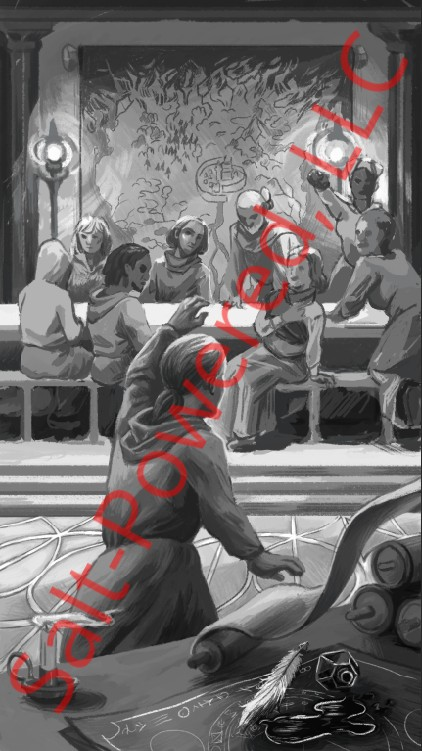
In the shorter run, the fiction and art is going toward a book, and as such, I will be providing less of it for free. This isn’t a big issue for the fiction. I post unedited work here–by the time it’s published, it may be similar, but it won’t be the same. The art is a different story. Some of you may have noticed that I’ve been watermarking the (full) pieces that I’ve already posted. This is why.
What does this mean for you? Well, if you don’t really care about any of that, then very little. The art will be slightly uglier, but I intend to keep updating at roughly the same frequency, with roughly the same quality of material.
On the other hand if you do care about that, because you want to read the future book, the watermark is insufferable, or you just really like this blog, then take a look at our Patreon. Backers get the un-watermarked art and “free” copies of any material we publish. I’ll also probably be posting some extra writing on the feed there to keep it interesting for the people kind enough to contribute.
I’ve mentioned this before, but I continue to get questions on it. So far, all of the fiction I have posted to this blog has been in the world of War Torn/Rale. This, for some, has been pretty confusing. The events of those stories span thousands of years of fictional time, and I’ve been telling them in an order that does not remotely resemble a chronology.
Enamored as I am with the Dark Souls style of relating fantasy via primary sources, I will only do so much to help you all with this, but while it will be an exercise for the reader to fit the pieces of the puzzle together, I will give you frame to work with.
In the beginning were the Old Times. In the end were the End Times. The intervening periods had more descriptive names. The chronology is this:
The Rise of the Great Cities
The Era of Spar
The Reign of the Blood God and Free Magic
The Dereliction of the Blood God
The Era of Heroes and Horrors
The War of the Roaches
The Era of Scavengers and False Gods
The Desiccation and Era of Grit
The Mud Wars, culminating in…
The War of Fallen Trees
The War of the Freaks
The Destruction of Haven
This is not really the way the world died–that is something more nuanced–but the terminology will hopefully give you some anchor for the events of the various stories.
The boy was raised to be clean. His father was heir to the largest domain in the Riverlands, bastion of the Pure, and in his grandfather’s house, all chose: They would be made clean, or they would be expelled. Grandfather taught him to vomit all but the barest taste of his food from his guts, taught him to scrub the grease from his skin until it bled. He was taught that his body was sacred, that it must not be contaminated with the grime and gluttony of lesser folk. When he failed–and he failed often–Grandfather broke his bones and seared his back with hot iron.
The boy was raised to be resilient. When he was ten, his mother and father departed to lead the Bloodfish’s armies in the war. Grandfather would not hear a word otherwise. Lord Ka had brought the ways of the Pure out of a great, lost darkness, mustering the strength to force upon the wretched the cleanliness they were too weak to maintain in themselves, and Lo Markhan, the hero of the Riverlands–Grandfather–would help him realize that revolution at any cost. The boy was alone, bereft of any shield from the marquis’ ferric discipline. He learned to hide his pain, bind his wounds invisibly, make himself seem a model of Purity, for to be expelled was to join the roaches and Lo Markhan’s other creations of mud and bile.
The boy was raised to be strong. Grandfather had studied the fey-magics of the Feathermen in the Bloodwood, and his house was filled with death-infused creations. Some of these were for the boy, like the dish he was made to vomit in, the gown he was given for dress, the bandages wrapped around his seared skin. They lapped at his suffering, hungry, as if one day, finally sated, they would wake, but of course they never did. Instead that suffering flowed into the house, accumulating in foreboding presences that loomed when Grandfather was away.
Other objects, the boy was never to touch. There were shackles in the cellar that slowly gnawed the flesh of whomever they held, spools of thread, gifts from the Dragon of the West, that wormed into any skin unfortunate enough to be nearby. These were meant for Grandfather’s guests-of-low-regard–prisoners, perhaps, or idle, sadistic diversions–but there were still other oddities whose cruelty was not quite so direct. The boy’s favorite was a painting in the sitting room near where he slept. It was an arid, hilly landscape, unremarkable as a work of art, but fascinating in the way its pigments and smudges danced and drifted across the surface. Birds flew in the painted sky, dust blew, and branches swayed. It confused him, even as it filled him with wonder: How could this expression of beauty be at home amidst Grandfather’s other trinkets? The boy understood these creations to be fueled by suffering, maiming, the pursuit of Purity, but that darkness did not seem to be there in the painting.
It was a visiting emissary of the Dune Men, a tall, intense man with yellow eyes, intrigued by the child’s interest, who finally revealed the answer: The painting was a prison. Years ago, Lo Markhan had assisted in the subdual of the Saraa Sa’een, a terrible, wandering monster responsible for centuries of destruction. This painting was possibly his greatest creation, a cage of color and fiction that would keep the demon bound forever. That was it, the boy realized. This beauty was still of death, but death was not confined to the ugly austerity Grandfather so revered. His bewilderment was gone, but wonder remained.
As he grew into his teenage years, the boy was allowed to travel beyond the house’s boundaries, down to the villages of Grandfather’s domain. There, the customs of the Pure were merely one of many superstitions, and the darkness that watched him always seemed to abate. He walked among the villagers, queer but unobtrusive in his gown, absent the regalia and symbols of Ka or his manor. Among them, he found companionship, a sense of commonality in survival–even flourishing–in a world the boy felt so acutely to be immersed in death. On his days of escape from Grandfather’s house, he joined them in their goings-on, he learned their sayings, he ate their food, he even fell in love.
One day, he and a peasant boy caught a rabbit in the woods. The cooked it over a fire and shared it. Overcome by an affection the boy had never known under his grandfather’s roof, he kissed his companion, and the peasant boy kissed back. The two made love into the evening until the responsibilities of reality set back in, and, flush and delighted, they parted ways. But that delight soon soured–the boy had not been attentive to the time. He would arrive home after dark, and Grandfather would certainly notice. Suddenly welling with dread and acutely aware of the rabbit fat still flecking his lips, he made his way back to the manor. He needed to find his dish. He needed to vomit.
But when he arrived, Grandfather was waiting. He tore the boy’s gown from his body, struck him with knuckles like horn, raped him until he bled, and again, and again.
“Is this how you like it?” he asked, his breath hot against the boy’s ear.
The boy did not eat for days. He did not walk for weeks, and even then, he needed a cane. He did not return to the villages for some time, and he never saw the peasant boy again.
But he wasn’t broken. He simply understood: He was raised to be strong. He began to grasp at the death he felt writhing in his broken body, in the house, in Grandfather’s demented trinkets. He found he could speak to it, and it would make things change. Perhaps it was his startling memory of first love in the forest, perhaps it was simple coincidence, but he found it easiest with plants. He could make them grow, flower, entangle constrict. He practiced first with the vines growing on the manor walls, snatching insects from the air, crushing them, savoring the odor of their pain. Then he embedded those vines in the lungs of a manor worker malingering in the shade on a hot day. He watched the man claw at his throat, eyes wide, gasping as the leaves emerged from his mouth. In that moment, he understood his grandfather’s cruelty, and he understood his strength.
He was raised to be resilient. As the war grew more fierce, Grandfather’s attentions became ever more drawn to it. The boy began to look for a particular opportunity, a pretext for removing the marquis from his sorcerous bastion and separating him from his lieutenants. For a single day, he slipped away, finding the commander of the Bloodfish’s enemies in a remote village. He made the man a proposal: Attack the domain of the Dragon. Lo Markhan would marshal his forces to defend his ally, and the boy would ensure the marquis would never arrive to the battlefield.
The commander did as the boy proposed, and when Lo Markhan departed to join his troops, the boy met him in the forest at the edge of his domain and entangled him in thorny branches. He planted a briar in his grandfather’s throat, and it grew rapidly, bursting through the skin of his face and chest. In his final moments, Grandfather could not speak, but he did not need to. The boy knew he was meeting the old man’s expectations.
He was raised to be clean. When the soldiers returned to the manor months later, they found a new marquis there, decadent, flamboyant, everything his grandfather had not been, save for cruel. The new marquis had found a diversion in the torture of his subjects, and he had begun to tax the villages of his domain for meat and wine and able-bodied men to satisfy him. Some of the soldiers rebelled against Le Markhan, the sickening She-Lord of Ka, but they were defeated, tortured and executed in the village squares by the marquis’ thorns. Those that survived left without a backward glance, but to Le Markhan, it did not matter. He did not much care for Ka or his war.
He ruled there for many more years, leeching the despicable world and its despicable people for all they were worth. He, himself, was despicable–he knew that. But he had been taught that cruelty somewhere.
I’m now composing the ongoing Dark Souls series while playing through Sekiro (slowly), and being able to note the similarities and differences, immersed as I am, is a pretty interesting experience. It’s also pretty plain at this point that getting at the juicy, literary meat of the game is going to be way harder for me this time around. Dark Souls and Bloodborne were riffing on philosophical frameworks (Christianity, Lovecraft, Nietzsche) that I am coincidentally familiar with. Sekiro has structurally similar roots in Buddhism and sort-of obscure 1960’s ninja-historical-fantasy, about which I know approximately fuck all. Accordingly, the following are working notes, a surface reading of a game I still haven’t finished, an attempt to get the ideas on paper where perhaps a pith might become more visible.
Literary References
Miyazaki himself cites the manga Basilisk and the works of Futaro Yamada as an inspiration for elements of Sekiro’s world. For those unfamiliar (myself included), these began with a novel published in 1958 called Kōga Ninpōchō, a historical fantasy about rival clans of superhuman mutant ninjas who get caught up in a Romeo-and-Juliet-style love triangle. I was totally unaware that this style of storytelling had roots that old (contemporary with Tolkien, even though the first English translation seems to have been published in 2006). More research is needed–discoveries like this keep me humble as to how little I really know.
Historical References
The setup of the game is that near the end of the Sengoku period, Isshin Ashina stages a coup and takes over one of Japan’s warring regions. Twenty years later, the story begins. Neither Isshin, nor his grandson Genichiro appear to have been real people, but the Ashina clan was. Translating some historical details: The region, known also as Ashina in-game, was likely the Aizu region historically, and the aforementioned “end” of the Sengoku period is probably the first of such points recognized by historians–the conquest of Kyoto by Nobunaga Oda. Twenty years after this point, the Ashina clan was defeated decisively by Masamune Date who then seized control of the Aizu region. Timing checks out.
It’s also likely that the family personas are based on real people. Based on the timing and details of their life stories, it seems likely that Isshin and Genichiro are meant to parallel Moriuji and Moritaka Ashina respectively. Moriuji’s reign was considered to be a golden age for the clan, whereas Moritaka (not Moriuji’s grandson, but not his son either) succeeded him and, proving unpopular among his retainers, was assassinated. Spoiler: This is more than vaguely similar to Genichiro’s fate in the game.
Buddhism/Literary Motifs
I know embarrassingly little about Buddhism, and I hope to do more reading before formalizing any of this, but the narrative is clearly moist with its secretions. The repeated theme of death and rebirth seems to be a clear expression, but it almost certainly goes deeper. The Sculptor’s obsessive drive to carve the Buddha (and its relationship to his previous life as a shinobi), the relationship between Kuro and other sources of immortality, even the significance of Sekiro using a prosthetic for a left arm–they scream meaning, and I bet much of it is tied up in philosophical traditions very different from the earlier games.
Aside, Miyazaki apparently took a backseat on writing for this game, so it probably will not have the same tone anyway.
Sources for my information include the linked interview, Wikipedia, and Samurai Wiki.
It’s been a little while since we’ve been here. If you need, check out the previous posts in this series first. Also, because you can never sit down and read just one thing, I linked an article in my first essay on this topic. If you haven’t read it yet, you should now. It was always relevant, but it connects the philosophical parts of this to our reality better than I ever could.
A little under two months ago, I started this blog, and the first substantive thing I posted was about choices in video games. This will be about choices as well, in video games, in life, and, more deeply, in what we value. It will be a turning point–the previous essays have been getting at the metaphors underlying Dark Souls’ setup. Now, we get to ask the question: “Why?”
I.
I’ve talked a lot about “Truth” in the last two essays without really getting into what it means. This is meant to be respectful. The only sense in which I am the first to say any of the things I’m saying is the sense in which they relate to Dark Souls (which is still a little surprising, but I’ve beaten that horse enough already). Still, since this runs the risk of sounding completely insane without clarity on that concept, I want to be explicit: Truth is something that humans value–we all intrinsically want the things we believe to be true. This starts, obviously, with perceptions of reality, but then it goes and starts a bar fight with religion and science. For those interested in the hard sciences without a background in philosophy, it may be difficult to believe, but the advances in scientific thought that propelled us from the Middle Ages to modernity were based heavily on metaphysics. This starts with the question “If I can’t trust what I see, how can I know anything?” but the high-level ends up being this: We created/reinforced gods in service of Truth. We then ask whether we need gods and, unable to see their purpose, begin devaluing them. Then comes the best part: Some asshole asks whether we need Truth.
“Is this still about Dark Souls?” Sure, just replace “Truth” and “gods” with “Flame” and “Lords”, and we’re hunky dory. More pointedly, in Dark Souls, that asshole has a name: Kaathe.
Darkstalker Kaathe is a primordial serpent. He goes way back to when the world was mist and trees and dragons, and this means A) he has a complicated relationship with the Truth and gods metaphor that I don’t really want to get into here and B) his age grants him a view on the situation that doesn’t have a good real-world analog. Anyway, he starts a cult, they kill a lot of people, and the powers that be flood a city on top of them. This is the advent of nihilism in Dark Souls. The details actually are pretty interesting, but the Abyss is going to get its own essay. Kaathe is coming up here because he’s the one that offers you an alternative in your quest to save the world. Oh yes, you were on a quest–didn’t I mention that?
II.
That isn’t a gotcha at all if you actually played Dark Souls, but I know for a fact that some of you have not. Recall from the intro:
Thus began the Age of Fire. But soon the flames will fade and only Dark will remain. Even now there are only embers, and man sees not light, but only endless nights. And amongst the living are seen, carriers of the accursed Darksign.
The plot of the game–which we’ve avoided discussing up to now–is you exploring Lordran in fulfillment of some vague prophecy that no one seems to have respect for, but then you complete the first piece, ring some bells, and a giant snake blasts out of the ground where you first showed up. His name is Frampt, and he tells you that your purpose is to succeed Lord Gwyn and link the Fire, prolonging this golden age. He’s not terribly specific about what “linking the Fire” means, but man, becoming the successor to God? That seems pretty neat, and so this becomes your quest: You must gather the souls of the gods and use them to open the way to the Kiln of the First Flame, that you may link the Fire.
That goes about as swimmingly as things can go in Lordran until you find Kaathe at the bottom of the Abyss. He has a counterproposal for you: Why don’t you just…not do that? Gwyn went and linked the Fire, sure, but he was a pussy, scared of the dark or something. It’s not like an Age of Dark would actually end the world or anything. This is when he lets you in on the piece of the creation myth that doesn’t get repeated:
If you remember the other gods from the second essay, you remember that they each represented something. Gwyn was light, the Witch was chaos, Nito was death, but there was another, “so easily forgotten”. The pygmy found a special soul within the Fire, the only one named without a possessive: the Dark Soul. Gwyn is not happy about this for reasons that aren’t really clear without the metaphor, and he goes to great lengths to ensure that the descendants of the pygmy don’t flourish and the dark does not overpower the light. On the first count, he clearly failed–you’re here after all, but you can’t say he wasn’t motivated. To stop the guttering of the Fire and the coming Age of Dark, he used his own body as fuel..
There are a number of metaphors here, let’s unpack them:
First, note the obvious parallel to Christianity, but also note the dramatically developed context. In this version, God still sacrifices himself, but there’s an added element: fear. That he fears the dark here means he fears its impact on the metaphysical–it is not simply love for another substrate of reality. So what danger does the Dark Soul pose?
The Fire is Truth, light emanates from fire, and that makes Gwyn a manifestation of true things. The Dark Soul, then, is what’s left. Not-true things. Lies. “Seems bad.” Oh, really? I’m sure it does, but can you make a case for it without appealing to Truth as a value? Lies are easy to detach from the types of harm we hold to be bad based on other values, but still, they feel wrong, it stings your character to lie to others, and for some reason, you can’t lie to yourself. Truth is king, we’ve put everything else in service to it, and, of course, why would the Fire embrace its own death?
And so, Kaathe offers us a choice: Immolate yourself, the successor to the gods, in service of Truth, or walk away, embrace the lies, and usher in an Age of Dark.
III.
About the most famous thing Nietzsche ever said was “God is dead”. Sounds about right. Death and Chaos are toast, you murdered them on your way here. Light is in the process of burning, soon to be spent. All of that may seem good or bad to you, but to Nietzsche, it was an inevitable result of that initial enshrinement of Truth as our highest value. It brought us through the Stone Ages, to antiquity, to modernity, to the point where we are capable of contending with the forces of Gaia on a nearly even playing field. Truth has brought us power even if we’ve had to sacrifice human meaning to get there, but that was a long-term decision. Now, finally, we have the opportunity to course-correct. Truth is going out, and the sun has reached its median in the course of human history. Nietzsche called it the Great Noon, but as you might guess, the Dark Souls take is a little different.
Interpreting Nietzsche’s options from Lou Keep’s essay, you can translate them to the Dark Souls metaphor like so: The last man is letting every value burn to nothing, ceasing our advance to power, and living on in the twilight until at last we die. Affirmation is embracing the Dark, learning how to lie, and adopting a new hierarchy of values in Truth’s place. Of course, affirmation could mean that we are affirming an ideal that does not exist (which isn’t ideal), or it could mean affirmation of the here and now. The problem is that it’s very hard to do either if we can’t lie to ourselves.
However, Dark Souls allows for two other options, one of which isn’t well explored by Nietzsche’s framework (which we’ll save for last), and one that…well, that he was reacting to in the first place. That one, we’ll discuss next.
Top Image: Screenshot from the launch trailer for Dark Souls 3, I do not own it




 Salt-Powered Investments, LLC