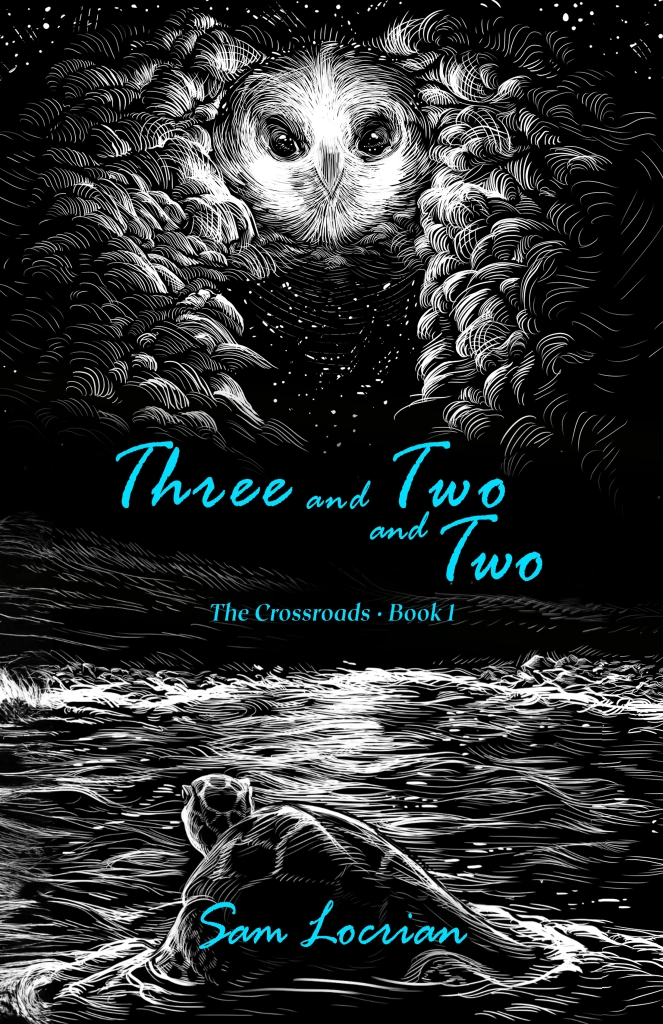
Happy 4th to my U.S. readers! And of course, for the remaining, (M.) Bison among you, happy Tuesday. I wanted to pass along a quick update that Three and Two and Two is on sale during the month of July on Smashwords. Head over there if you are so inclined, and you can pick up the ebook for only $2.49!
Also…
Or rather, I will be putting out a steady stream of shorter form content on Instagram. This will, of course, not replace the blog, but if life in photos and short video is your preferred format, by all means, check it out!
Three and Two and Two is now available at most vendors here! Most of that variation is going to be ebook platforms for now. If you would like to get it in print, Barnes and Noble is going to be the most reliable source. Amazon will also distribute it eventually, but they are currently working through an issue with their handling of certain ISBNs.
All the technicalities aside, the journey to publication is finally over, and I’m so happy you all could join me on it. There are more journeys ahead, of course: new adventures, new stories to tell. The exciting world of ads and marketing that I’m going to be embroiled in for the coming months. The much longer meditation of what this all means in the long run. But that is soon, and this is now. The book is here, and should you have time, I hope you’ll give it a look.
We’re almost there! Three and Two and Two is coming out in only four days!
Preorders (for the ebook format) are available from certain (non-Amazon) stores–you can find them here! Stay tuned for print copies and Amazon. I’m not assuming that print will be available for pre-order prior to 7/1, but I will update if anything changes!
For those of you who follow me for more general content, I apologize again for the drought while all of this has been in the works. I have three posts written and awaiting transcription, and I hope to have them to you in the coming weeks. Thank you all for staying with me on this journey, and I’ll hopefully have some exciting things to share with you soon!
Hey everyone! I wanted to jump back on to provide some quick details about the upcoming release of Three and Two and Two!
When is it coming out?
I’m currently targeting a release date of 7/1, and so far, everything is on track. I’ve reviewed the digital proof of the paperback, and now I’m just waiting on the physical proof copy (leaving some padding in the schedule in case anything needs to change). Given that the digital print proof looks good, I’m not currently anticipating any issues with validating the ebook layout either.
What formats will it be available in?
Ebook and paperback, available from most digital storefronts where books are sold. Time permitting, I will be attempting to make some inroads at physical bookstores as well, but that will not be immediate. I may release a hardcover edition at some point, but there are no plans for that at this time.
What happened to the Crossroads posts?
They are now behind a password (with the exception of the Prologue, which, not to spoil anything, got cut. It will likely appear in a subsequent book in the series). Despite the volume of editing that went into the book, there is still enough similarity with what is there that I would prefer my readers engage with the finished product. At some point, I may offer access to the unedited content of my released books as a paid subscriber perk (e.g. on Patreon), but that framework is not in place yet.
How many books will be in the Crossroads series?
Three! When the subsequent two will come out remains a mystery. The soonest the second could arrive is probably around a year from now (though I may publish a book outside the series before that), but depending on my professional circumstances (as well as the sales of the first book), that could very well be longer.
For now, though, stay tuned. The future be damned, the beginning of the story is finally here, and I’m so excited to share it with all of you.
Hey folks, I know things have been radio-silent here for a few weeks, but it’s all been building in the background. Building to this:
My first full-length book, Three and Two and Two, the first entry in the planned Crossroads trilogy, will be releasing later this summer! The exact date will be announced in a later post, but stay tuned for more details! In the meantime, this does mean that the Crossroads entries on this website will be moving to password-protected very soon. If you are curious as to the unedited material that went into this book, feel free to give those a read.
A review of Kameron Hurley’s Meet Me in the Future.
As may be obvious from the shifts in my content, I’ve been reading a lot lately. I’m writing on a daily basis, reading has proved a workable ritual for lubricating the process, and besides, I felt it was finally time to do something about the endless parade of interactions with friends and family wherein we agree, amidst enthusiastic exhortation, to consume media we never really intend to touch. The last two–Labyrinths and Shantaram–were for that purpose. Kameron Hurley’s Meet Me in the Future was too, but it was a more modern sort of enjoyment. It’s neither the middlebrow literary or high-concept philosophy of the prior two, but it’s not not a thinky book. Nominally, it’s sci-fi. Truly, it’s well within the realm of speculative fiction, but how well any of the stories conform to the expectations of their genre varies with, apparently, Hurley’s mood.
I’ll say before the grit of it that I very much admire Kameron Hurley. Her work is generally well-executed, extremely unique, uncomfortable in cool ways. Also there’s just something vicariously cathartic about an author whose (professional) social media presence is mostly cooking and gardening. If only I could so grossly and incandescently not give a fuck. Prior to this point I had read about half of the Worldbreaker Saga, and Meet Me in the Future mostly delivered on my expectations for both enjoyment and heightened difference.
One of Hurley’s specialties, on full display here, is a particular brand of lexical worldbuilding. She presents you with a situation in a strange setting, hints that none of the words she’s using to describe it mean what they should mean in everyday English, then lets it run. This works awesomely in character-focused narratives, and the book comes out swinging with it in the first story, “Elephants and Corpses”, about a mercenary who uses lost tech to transplant his consciousness into corpses, hopping from body to body in an odd impression of ersatz immortality. That story is one of the book’s best, which isn’t meant to be a dig at the rest, but I do recommend it as a starting point. Beyond it, the book’s undercurrents start becoming less undercurrent and more the point.
Hurley, for those unfamiliar, is an opinionated writer, and this is an opinionated book. That is by no means a bad thing–her opinions are well worth the illumination–but most would appreciate knowing their coffee is black before the first lidded sip. I find it productive to think of it as a contrarian impulse, a starting point of a world where our social and biological preconceptions don’t apply, whether that means the four-gendered social structure of the bayou-punk “The Plague Givers”, the flip-flopped male-female predispositions in “The Women of Our Occupation”, or the simple-but-obvious question of how gender works for a person who regularly swaps out their body.
Again, nominally sci-fi, but practically, I found that the stories fall into a few categories. The first is, well, actually sci-fi, where Hurley minds her responsibilities as a sci-fi author and explores not only a premise but also its implications (e.g. “The Sinners and the Sea”, “Warped Passages”). Another is a sort of weird fantasy, where the story is more character-focused and the speculative elements serve more to disrupt your prejudices than explore anything intrinsic to themselves (e.g. “Elephants and Corpses”, “The Plague Givers”).
The last category I tracked–not valueless but weaker for me personally–is a class of story that presents a speculative premise alongside a bucket of exposition and…leaves it at that. For some, I was able to take it for what it was, as in “When We Fall”, but for the weightier examples of this category (e.g. “The Women of Our Occupation”), I tended to find myself more distracted by the questions the story did not answer than taken by the ground it covered.
All this said, even the least palatable of these stories is well worth reading, but on a more personal note, I did take note of a particular phrase on the back cover before I opened the book:
“It’s weirder–and far more hopeful–than you could ever imagine.”
As someone who worries often that my work is too somber for a wide audience, I have to laugh. I don’t anticipate–and I mean this kindly–that that description will ring true for you. These stories are in fact quite depressing. But I’ve long held that staring into the abyss helps us remember the value of the Fire. Drink your coffee black, I suppose, and wake up.
A review of Labyrinths, by Jorge Luis Borges. Separately, this is one of two pieces of content that I have prepared going into the next month where most of my writing activity will be focused on edits and rewrites for Three and Two and Two (Crossroads, Book 1). I’ll try to keep content coming, but either way, I’ll see you on the other side.
Labyrinths was (aside from a scattered few assignments in college) my first experience with Jorge Luis Borges. It was fabulous. Everyone should read it. “I didn’t enjoy it very much,” says the inexplicably boosted review near the top of its Goodreads page, as if your enjoyment has anything to do with evaluating impeccable specimen of magical realism, science fiction, perhaps the only compelling exegesis of Eleatic philosophy that I will ever read. Despite my derision, I understand the sentiment–not everyone fuels themselves on the same homeopathic masochism I do–but even that, I suspect, is an anomaly. I found the prose very approachable. Perhaps the constant barrage of Neoplatonic mathy-ness can grate, so reader beware in that sense, I guess.
I.
Regardless, while I hope you may give Tlön its chance to worm its way into your brain, the meat of this will be about a more particular image. Among the stories of Labyrinths, a number stood out to me, but one, “The Immortal”, stood out for particular, personal reasons.
For synopsis: A handwritten note found in 1929 in the cover of a (set of) book(s) published in 1715 details an expedition undertaken by a Roman soldier in Eritrea to seek out the City of the Immortals across the desert. On the way, his men mutiny, and he escapes into the sands, where his recollection of the next several days goes hazy, distorted by heat and dehydration. He awakes in a graven, stone niche on the slope of a mountain, below which runs the river of immortality (from which he has apparently unconsciously drunk), and across is the city itself. His niche is one of many, and around him, gray-skinned troglodytes who devour serpents and do not speak emerge. He lives among them for a minute, goes to explore the City, finds it a vast labyrinth, built for something other than inhabiting–and accordingly uninhabited–and eventually wanders out. On the way back, he and the troglodyte who followed him there witness a sudden rainstorm, at which point the troglodyte is inspired to speak and reveals himself to be the poet Homer.
It turns out the troglodytes are the Immortals who built the city and not just some hapless animals who drank the water–it’s just that being endless changes your outlook on things and leaves you with very little to talk about. Anyway, the narrator joins them for a time before resolving to go find the river of immortality’s double, the river which gets rid of immortality. He rejoins civilization, finds the river quite by accident, sells the books with the note, and dies shortly thereafter. Also, because of the vagaries of the Immortals’ collective memory in their society, the narrator at the end was actually Homer rather than the Roman soldier.
There’s plenty to dig into, from the novelty of the hyper-ascetic picture of immortality to the incomprehensibility of the Immortals’ works, but what stuck out to me more than all of that were Borges’ physical descriptions of the City of Immortals, beginning with the far shore where the narrator awakens:
“…I found myself lying with my hands tied, in an oblong stone niche no larger than a common grave…shallowly excavated into the sharp slope of the mountain…A hundred or so irregular niches, analogous to mine, furrowed the mountain and the valley.”
And the City itself:
“I emerged into a kind of little square or, rather, a kind of courtyard. It was surrounded by a single building of irregular form an variable height; to the heterogeneous building belonged the different cupolas and columns. Rather than by any other trait of this incredible monument, I was held by the extreme age of its fabrication…
…In the palace I imperfectly explored, the architecture lacked any such finality. It abounded in dead-end corridors, portentous doors which led to a cell or a pit, incredible inverted stairways whose steps and balustrades hung downwards. Other stairways, clinging airily to the side of a monumental wall, would die without leading anywhere, after making two or three turns in the lofty darkness of the cupolas.”
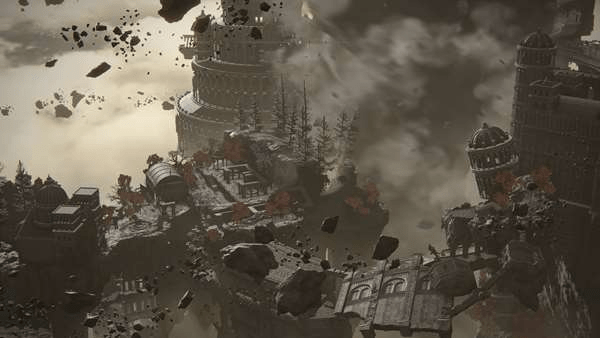
You see, with some allowance for Borges’ use of “irregular”, the vista I see here looks something like this:
Top Image: Crumbling Farum Azula from Elden Ring
Bottom Image: Crumbling Farum Azula, entrance to Placidusax’s Arena
II.
Inspiration, perhaps; hammers and nails, I know; but there is a lot tying the two together. Perhaps its best to start with the physical structure of the city. Though Borges qualifies the “labyrinthine” nature of the City, and though Farum Azula is an imperfect facsimile of the sheer idiocy of the Immortals’ monument, the difference perhaps ties them together more than it pushes them apart. Per Edward Teach (on the similarly labyrinthine Inception)
“When Ariadne draws her mazes for Cobb, he rejects the square mazes and is satisfied/stumped only by the circular classical labyrinth.
And anyway, mythological Ariadne didn’t construct the Minotaur’s labyrinth–Daedalus constructed it for her–she merely showed Theseus how to get out of it. But she didn’t need to: a classical labyrinth doesn’t have multiple dead ends; it is a single winding path that lead either in or out.
But Theseus, like the audience, upon being shoved inside wouldn’t have known the form of the labyrinth–dead ends or a single path? Sot to be able to find the Minotaur, he needed to know which way to go, and Daedalus told him: downwards is the only way forwards.”
It’s worth disclaiming/clarifying: Teach’s distinction (maze versus labyrinth) may be correct, but it is not commonly written about in popular culture, and I think most works are agnostic to the difference. The reason I bring it up is not to nitpick either Borges or Miyazaki but rather to point out that the distinction exists: branching, built to frustrate versus linear and built to obfuscate. To which end, it’s worth looking at the forms of the narratives that use these labyrinths. “The Immortal” is, contrary to the implications of its twists and turns, a linear piece of prose. Though your own eyes and thoughts may be deceived, you can read forward, and your questions will be answered–you’ll exit the labyrinth on the last page of the story. Elden Ring–a point of which a number of my readers would surely love to remind me–is a game, a medium much more on the maze side of the spectrum. There is no one way forward, a player might be stuck in any corner of the Lands Between forever, despite any amount of movement. Except in Farum Azula (among other locales), the form of the maze is subordinated to the immediate obstacle of the dungeon (From Software’s terminology–Farum Azula is a dungeon mechanically though not thematically). There are dead ends in the dungeon, yes, but rewards wait at each of them. Unlike Borges’ narrator, the Tarnished is incentivized to perfectly explore their City, and so their idealized task is no longer to simply make it out of the maze but to construct a path which touches every piece of it. One path–making it a labyrinth. This leaves us with a pleasingly Borgesian symmetry: “The Immortal”, a labyrinth which presents a maze in the form of its City of Immortals, is reflected sixty years later by Elden Ring, a maze whose own City is a labyrinth. Borges did love his mirrors, and with apologies to Mr. Smith, it appears they are real.
III.
This is to say nothing, of course, of the other aesthetic similarities which tie these images together. The crumbling, ancient spirals of Farum Azula, a city in a temporal maelstrom, unreachable to all but the most desperate, built to be listlessly guarded but not really inhabited. And despite its grim aesthetic, there is no death awaiting those that linger there. For Placidusax, the temporal prison sees to that. For everyone else, Maliketh is keeping a tight hold on the Rune of Death.
And of course, Maliketh, Marika’s lupine vassal, is merely the greatest of the beastmen of Farum Azula, the raggedly-clad, gray-skinned troglodytes who (aside from Maliketh) do not speak and whose animate corpses fill the shallow, grave-sized niches that adorn the terraces of the City. I’ll admit there is no evidence they devour serpents–they seem, rather, to worship the dragons who remain there–and there are some other specificities missing, like the impure stream which grants immortality.
To which end, in Elden Ring, Farum Azula is only implicitly a “City of the Immortals”. To find an explicit City, we’ll need to look to a different From Software property:
IV.
I’ve written before about Sekiro’s Fountainhead Palace in reference to both Sekiro and Elden Ring’s use of the centipede as a symbol. Much of Sekiro’s symbolism and plot revolves around the idea of worldly immortality as given by the Divine Dragon. Among humans, there exists an “heir” to the Dragon’s blessing who is able to confer that blessing to others, which serves to explain the pseudo-eponymous protagonist’s continued resurrection in the face of the player’s ineptitude the impossible odds of his mission.
But in-world, this isn’t a secret, and it is well-known that the waters that flow from the Fountainhead Palace, where the Divine Dragon is known to reside, grant a sort of fucked-up immortality of their own. This is because those waters contain the eggs of a species of…spiritually volatile centipede–a morphological reflection of the serpentine dragon–that parasitizes anyone drinking the water. Thus, by devouring a pseudo-serpent, the ashen-skinned monks of the Senpou Temple, the peasants of Mibu Village, and the deformed aristocrats of the Fountainhead Palace all persist in perpetual witness of a City of Immortals upon a mountain, from which flows an impure stream that grants eternal, if cursed, life.
V.
Borges believed (or at least once claimed) that there were only four devices which comprised all fantastic literature: The work within the work, the contamination of reality by dream, the voyage in time, and the double. Amusingly or predictably, all four are relevant to this analysis, but the last is particularly important. I’ve already referenced it in this essay (see: mirrors), but it of course comes in many forms. Sekiro, like Elden Ring, like most works of fantasy, really, is the story of a warrior, and a necessary element of any plot pitting a warrior against undying foes is the method the warrior uses to subvert their immortality. For “The Immortal” (where the foe was the narrator’s own interminable experience) this means was a reflection, a mirror, the stream which was the antithesis of the polluted river. For Sekiro, this means is a sword, a cutting instrument. It should not be surprising that the two should have something in common.
It was, of course, Borges who wrote, in this same book:
“…copulation and mirrors are abominable, because they increase the number of men.”
Perhaps a blade does not increase the number of men, but just like a mirror, a scissor, or Truth, it increases the number of things. From one, it makes two. That a blade should reflect darkly the infested immortality of the Fountainhead, in reflection of Borges’ reflection; that the pieces of Borges’ immortal City should be separated and made two cities in two worlds, each with the specificities necessary to lead back to the dream which bled into them–well, it’s only appropriate, isn’t it?
Sorry to those who have been checking day over day for the next thing. There are several next things forthcoming, including more Whom Emperors Have Served and some more review material (I’ve jumped back into the Borges pool recently and am glad I did). But transcription and editing are taking a long while (alongside editing for the Crossroads book), so the wait will be a small bit longer.
Thank you to all of you who have purchased or otherwise acquired my book! I appreciate you very much, and I hope your fortunes are or continue to be favorable.
And once again, a reminder that some of my work is now available in ebook and paperback form on Amazon. If you like what you read and are interested in supporting my efforts, I would greatly appreciate a purchase and/or review!
A friend convinced me to read Shantaram via quid pro quo. In exchange he would read Edward Teach’s Watch What You Hear. Cursory familiarity with these two ought to tip you off pretty quickly that this quid was not, in fact, quo, and of course, he didn’t even read his ~100-page tribute, but so it goes. I bring it up mainly because the same friend said something interesting when I came round to discuss the book with him. He said that whenever he evaluates any piece of art, he always asks the question: “Do I believe them?”
Heh. Those of you who have read Shantaram (or even the book jacket) should maybe slow down here. There are traps in that question. For one, my friend is a musician who mostly evaluates music, a medium not known for its use of the phrase, “Based on a True Story”. I knew what he meant immediately, both for my awareness of that context and for my continued inebriation on the Nietzschean outlook of truth and lies, but to be clear, what he meant was this: Does the core message of the work, underlying and/or overall, feel true?
The problem with applying this question to Shantaram, a book which pitches itself hard on the notion that it’s based on author Gregory David Roberts’ life, is that you have to ask it twice. The first: To what degree is Roberts telling the truth? The second: Is he…right?
Taking a step back into the actual content of the book, here’s the deal: Gregory David Roberts got a divorce (or more general marriage breakup) sometime in the early ‘70s and lost custody of his daughter. As people often do, he dealt with this poorly. Specifically, he dealt with this poorly with heroin. To fund the heroin addiction, he started robbing businesses. Irrelevant but amusing: He did so in a three-piece suit, with a particular code of etiquette, and only targeted businesses with insurance to cover the losses from the robberies. Anyway, he got caught, went to prison, escaped from prison, fled Australia, ended up in Bombay (now Mumbai), and got up to, reportedly, some wild shit.
The setup of Shantaram is, well, literally that. The book begins with the protagonist, Lin, getting off the plan in Bombay, falling in with a motley crew of expats and locals, losing all his money, moving into a slum, and slowly–but not that slowly–getting wrapped into the fold of the Bombay mafia. It’s a crazy story, and the tension between the often harsh, sometimes outright brutal picture of life on Bombay’s streets and the oneness and love for it all (or at least most of it) that Lin melodramatically continues to express throughout does serve to keep the pages turning. But it also prompts questions I wouldn’t normally care to ask.
Chief among them, for grounding purposes: How crazy of a story is this, actually? Stranger than fiction? Well, that’s the problem. It is, in fact, very easy to imagine Lin–criminal background, talent for absorbing cultures and languages, a heart of gold, minus Roberts’ often syrupy prose–in a David Baldacci-esque thriller, and I gotta say, Bizarrodacci-Lin is not especially compelling. With apologies to the book-clubbers and DnD players, it turns out that complex and fraught backstories are neither difficult to put together nor especially interesting on their own. And of course, the wild ride of Shantaram’s plot isn’t the only thing going on, but what remains has its own caveats.
It’s easy to read Shantaram, in a sense, as a book of personal philosophy. It’s also easy, if you know anything about philosophy, to get very, very bored with what Roberts clearly considers important takes. Most of them aren’t wrong, not really, but I would still expect even the most insightful of them to have come up–not merely in essence, but literally expressed in words–at some point in the average college student’s late-night explorations of their red Solo cup. To put it bluntly and perhaps uncharitably, Lin is a hippie, part of a demographic renowned for its fervor but not its intellectual care, which is why, in perhaps the most philosophically cursed point in the book, Lin, Khader (the mafia don who dons the familiar hat of “father figure”), and, apparently, the author himself all get bamboozled by a vocabulary mixup that I can only assume originated with a gap in translation. For those of you following solely in English, please note that “complexity” and “entropy” are very much not the same thing.
As answer to the question of whether Roberts is “right”, it probably suffices to say that the philosophy of Shantaram is not, on its own, a worthwhile message, nor can Lin, taken as a thriller protagonist, save it. But I think that Lin as an autobiographical representation maybe can. It’s much the same as the story itself. Cataloged in no particular order: heroin addiction, Australian prison, Indian prison, slum resident, slum doctor, organized crime, disorganized crime, Afghan freedom fighter, dirt-poor pastoral village resident. These are experiences that many will collect vicariously in our global, internet age, to the extent that bulleting them off on an invented character’s life story is at best uninteresting and on average rank, stinking of the excess of bad lies. But an actual person collecting these experiences firsthand is legitimately impressive, both for their qualities (many are highly disturbing) and their quantity. Moreover, the scars of these experiences upon the philosopher provide ammunition that the florid prose, while sometimes beautiful, cannot possibly advance without an argument from true character.
So, do I believe him?
Predictably, Roberts’ own statement on the veracity of Shantaram is that it is fiction, not autobiography, grounded in real events from his life but not really following his story or relationships. Specifically, he seems to actually have been a slum doctor and mafia operative (to some extent), but the rest is a mystery. I can’t really blame him. There are a lot of crimes in there that I wouldn’t want to confess to, having spent 19 years in prison already, but at the same time, the ambiguity is less hazy than it is forked.
I’ve always considered “Based on a True Story” to be a transparent marketing ploy, and when it comes to ambiguities that will never be resolved for me, I’ve favored Baudrillard as a guiding ethos. But that won’t really work here. There isn’t really any message hidden in the unknowing, and the force preventing the resolution isn’t a commonality of human experience–it’s just logistics. I get to know either the position or the velocity, and since the position is uncomfortably close to Roberts’ business, well, at least we know how fast he was going. And unfortunately, we can’t just eliminate the false side of the story Socratically either, because Shantaram as pure fiction isn’t meaningless. It’s just…commonplace.
In the end, the value of this book for me was very positive, but that’s because I think I do believe him. There’s still some doubt there, superimposed over my thoughts like a subatomic dead cat, but since I will likely never know the full truth, the opinion stands as-is.





 Salt-Powered Investments, LLC